
I'm Isaac Saul, and this is Tangle: an independent, nonpartisan, subscriber-supported politics newsletter that summarizes the best arguments from across the political spectrum on the news of the day — then “my take.”
Are you new here? Get free emails to your inbox daily. Would you rather listen? You can find our podcast here.
Today’s read: 15 minutes.
Enjoy online shopping? Protect your transactions with this easy tool.
Using a VPN (Virtual Private Network) is a powerful tool for keeping your online banking secure.
What’s a VPN?
It sounds techy but don’t despair — it’s a super simple tool that will mask your IP address and shield your online activity.
Think of your IP address like the address of your house — just as your home address tells people where to send letters or packages, an IP address tells websites, apps, and other devices where to send information you’ve requested.
And it also makes it easy for hackers to access your sensitive information like credit card numbers and passwords.
A VPN like Surfshark can protect your sensitive information by encrypting your internet traffic, making it extremely difficult for hackers or third parties to intercept or steal your data.
And it’s never been easier to start using one.
Get Surfshark's Black Friday deal only for 1.99/month (plus 3 months extra)!
*Our sponsors help keep Tangle free — thank you for supporting them when you feel they could be useful to your life.
Our reader mailbag.
On Friday, we published a members-only reader mailbag. We answered questions about how Tangle would have covered the rising Nazi Party in Germany in the 1920s, whether unauthorized migrants are really stealing jobs from Americans, the debates around rising autism rates, what being “anti-woke” means and whether AOC is an anti-Zionist, among many other questions. You can read the full edition here.
Quick hits.
- President Donald Trump suggested that the U.S. may hold discussions with Venezuelan President Nicolás Maduro amid a military buildup in the Caribbean Sea and ongoing strikes against boats allegedly trafficking drugs from Venezuela to the U.S. (The comments) Separately, Secretary of State Marco Rubio said the U.S. will designate Venezuela’s Cartel de los Soles as a foreign terrorist organization, alleging that it is “responsible for terrorist violence throughout our hemisphere.” (The designation)
- The Federal Aviation Administration lifted its emergency order requiring cuts to flight volume at major airports across the U.S. The cuts were implemented to address fatigue and staffing issues among air-traffic controllers during the government shutdown, which ended on Wednesday. (The order)
- President Trump issued an executive order removing tariffs on some goods that are not produced in the United States, including coffee, bananas, and cocoa. The administration says the rollback is a result of new trade deals with several countries that export these products. (The rollback)
- Protests led by the group “Generation Z Mexico” took place across the country on Saturday, calling for reductions in crime and corruption. The demonstrations followed the killing of Uruapan Mayor Carlos Manzo during a public event on November 1. 120 people, including 100 police officers, were reportedly injured in Mexico City, and 20 people were arrested. (The protests)
- The first round of voting in Chile’s presidential election did not result in an outright winner, sending the election to a run-off vote in December between Communist Party candidate Jeannette Jara and far-right candidate José Antonio Kast. (The election)
Today’s topic.
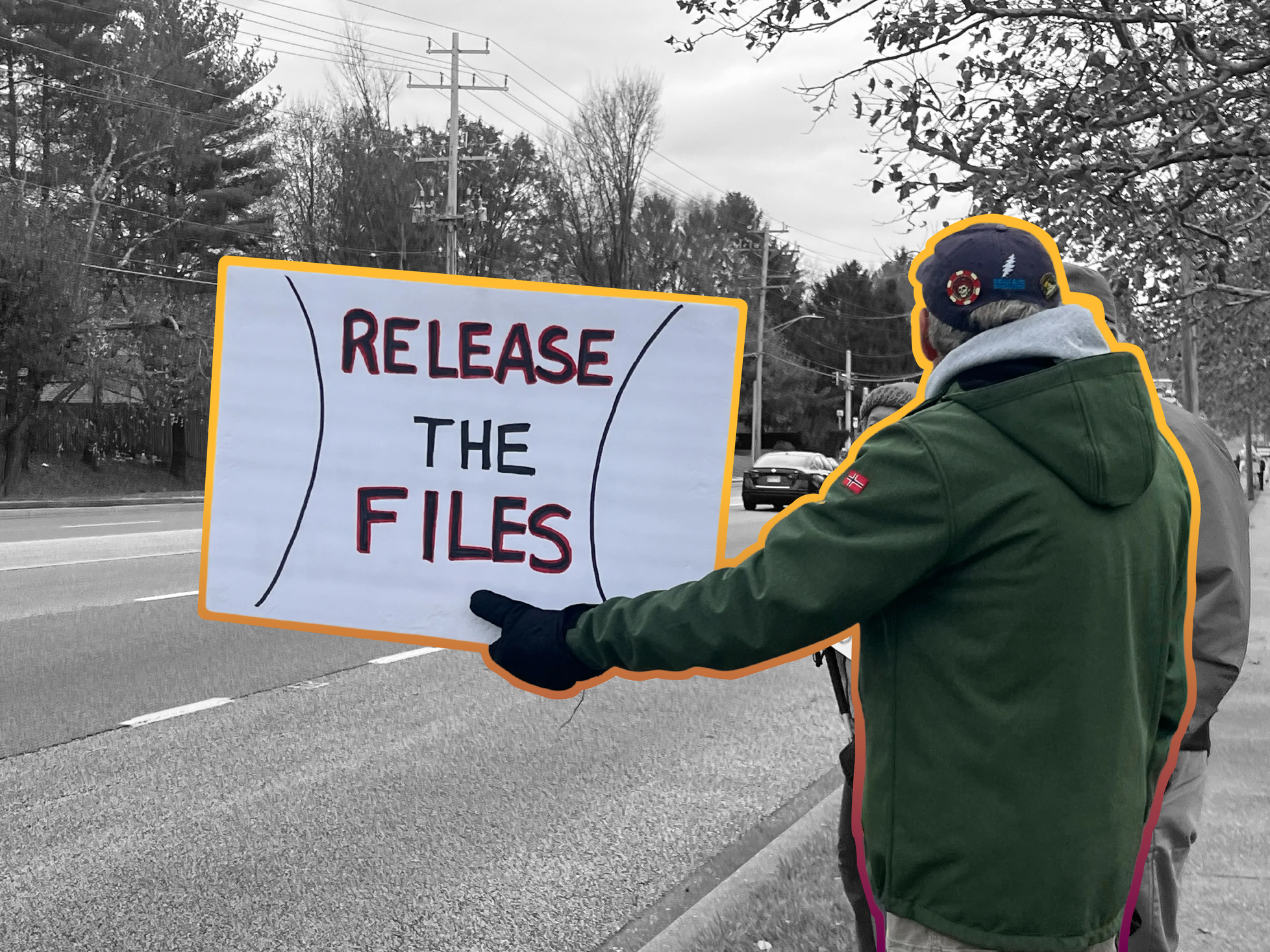
The latest on the Epstein files. On Tuesday, the House of Representatives is expected to vote on legislation to force the Justice Department to release all of its files on convicted sex offender Jeffrey Epstein. After suggesting last week that House Republicans should vote against the measure, President Donald Trump said on Sunday that they should pass it “because we have nothing to hide,” calling the story a “Democrat Hoax.” The vote follows the House Committee on Oversight’s release of approximately 20,000 documents from the Epstein estate; the documents contain repeated mentions of Trump and other public figures.
Back up: Since the start of President Trump’s second term, a range of new information about Epstein has been released, some of it pertaining to his relationship with Trump when he was a private citizen. In July, The Wall Street Journal published a report claiming that Trump signed a letter containing a lewd drawing and sexually suggestive text as part of a birthday album for Epstein in 2003 (Trump has maintained that he did not write the letter and sued The Journal for defamation). Separately, the Justice Department has released batches of files related to Epstein, including over 100 pages of documents and audio recordings and transcripts of Deputy Attorney General Todd Blanche’s interview with Epstein associate Ghislaine Maxwell in July. Also in July, the Justice Department and Federal Bureau of Investigation wrote in a joint memo that they had found no evidence that Epstein blackmailed powerful figures, kept a client list, or was murdered.
On Wednesday, Rep. Robert Garcia (D-CA), the ranking member of the House Oversight Committee, released three emails (from 2011, 2015, and 2019) in which Epstein discusses Donald Trump. In one email, Epstein refers to Trump as the “dog that hasn’t barked” and claims that one of his victims (whose name was redacted) spent “hours at my house with [Trump].” The White House said that the victim was Virginia Giuffre, who previously testified in detail about her relationship with Epstein and said she never saw Trump engage in any wrongdoing.
In another email, Epstein says, “Of course [Trump] knew about the girls as he asked ghislaine to stop.” Later that day, the Republican-controlled Oversight Committee released the additional 20,000 documents from Epstein’s estate containing further mentions of Trump and correspondence with prominent political figures such as former Treasury Secretary Larry Summers, former White House Counsel Kathryn Ruemmler, and journalist Michael Wolff.
Last week, Trump administration officials met with Rep. Lauren Boebert (R-CO) in the Situation Room to discuss a petition to force a vote on the full Epstein files release, which Boebert supported. President Trump also reportedly sought to discuss the petition with Rep. Nancy Mace (R-SC), another one of the four House Republicans who backed it. Discharge petitions require support from 218 members to force a vote on legislation. All Democrats joined the four Republicans in signing the petition, which reached the 218 threshold after Rep. Adelita Grijalva (D-AZ) was sworn in on Wednesday.
The petition clears the way for a vote on the Epstein Files Transparency Act, a bill introduced by Rep. Ro Khanna (D-CA) in July that would compel the Justice Department to release “all unclassified records, documents, communications, and investigative materials in DOJ’s possession that relate to the investigation and prosecution of Jeffrey Epstein,” including materials related to Ghislaine Maxwell, flight logs and travel records, and individuals named or referenced (including government officials) in connection with the investigation and prosecution of Epstein. Before President Trump said House Republicans should vote for the bill, Rep. Thomas Massie (R-KY) suggested that over 100 Republicans were preparing to support the measure, which — with the addition of full Democratic support — would give it a veto-proof majority. If passed, the bill would head to the Senate, where the timeline for its consideration is unclear.
Today, we’ll share views from the left and right on the latest in the Epstein saga. Then, Executive Editor Isaac Saul gives his take.
What the left is saying.
- The left views the Epstein issue as a deepening political problem for the president.
- Some say Trump is seeing conspiracies he promoted come back to bite him.
- Others say the story has always been about more than just Trump.
In The Atlantic, Jonathan Lemire said “Epstein returns at the worst time for Trump.”
“Jeffrey Epstein is dead. But the disgraced financier and sex offender continues to shadow Trump. The storyline’s reemergence yesterday—with the release of thousands of Epstein’s emails, some of which highlight his relationship with Trump—delivered another blow to a president already at the weakest moment of his second term,” Lemire wrote. “Trump’s party got wiped out in last week’s elections as voters assigned it the greater portion of blame for the shutdown. The Supreme Court seems set to unravel his signature tariffs. His poll numbers have dipped as Americans conclude that he cares too much about gilded ballrooms and is not focused nearly enough on bringing down high prices.”
“What exactly is Trump trying to prevent from being released? For months, White House aides have snapped at reporters who even mentioned the word Epstein. But in private moments, members of the president’s inner circle acknowledge that they don’t know the true extent of Trump’s relationship with Epstein,” Lemire said. “Few people in the White House believe that the Epstein matter will swing many votes next year. But it has the makings of an unrelenting distraction, a scandal that could bog down Trump’s presidency.”
In Bloomberg, Timothy L. O’Brien suggested “Trump stoked the Epstein scandal. It’s come back to bite him.”
“The White House dismissed the trove as nothing more than ‘selectively leaked emails to the liberal media to create a fake narrative to smear President Trump.’ The reality is that it was conspiracy-minded Republicans who set the Epstein firestorm in motion last summer, outraged that Trump’s Justice Department ended an investigation into Epstein’s suicide and clientele,” O’Brien said. “Trump, who hasn’t been accused of any crimes in connection with Epstein, once made political hay stoking conspiracy theories about Epstein’s relationships with elites. He knitted that tale into a broader narrative about institutional malfeasance smothering average Americans.”
“It should have crossed Trump’s mind, of course. After all, he and Epstein were pals. Trump once bragged to me that their friendship was stronger than mere business after showing me a prized Palm Beach property that he had outbid Epstein to secure. For his part, Epstein considered himself deeply familiar with Trump,” O’Brien wrote. “The Epstein episode transcends questions about Trump’s character alone. What remains to be discovered and delineated is whether he secured sexual liaisons through Epstein, or whether the same president who has been busily enriching himself from the Oval Office also once made use of some of Epstein’s murkier financial services.”
In The Nation, Jeet Heer wrote “Jeffrey Epstein was a warlord. We have to talk about it.”
“Trump richly deserves whatever reputational harm and possible legal retribution may come to him as a result of his ties to Epstein. But, at its heart, this has always been a scandal about the ruling class as a whole, not one individual or political party,” Heer said. “The Epstein e-mails document his ties to a wide swath of the US and global elite in ways that transcend partisan lines. Among those Epstein was on easy terms with were former treasury secretary Larry Summers (who held high office under both Bill Clinton and Barack Obama) as well as Trump adviser Steve Bannon and right-wing billionaire Peter Thiel.”
“The Jeffrey Epstein story makes no sense unless you realize that he was deeply entrenched in the foreign policy elite, a fact that gave him much of the impunity he enjoyed for most of his life,” Heer wrote. “He had the same neoliberal worldview that has dominated the US elite since the end of the Cold War. He was a believer in the Washington Consensus, US military hegemony bolstered in the Middle East by the alliance with Israel, globalization, the privatization of government functions, STEM-dominated education, and male-centered sexual hedonism — an ethos he took to sickening extremes.”
What the right is saying.
- Many on the right say none of the available evidence implicates Trump in wrongdoing — and future releases are also unlikely to.
- Some argue Democrats are overplaying their hand.
- Others suggest the ongoing Epstein story could destroy Trump’s presidency.
National Review’s editors wrote about “the Democrats’ Epstein dud.”
“Democrats on the House Oversight Committee released new emails the other day from Jeffrey Epstein that caused an instant frenzy in Washington, although they are more of what one would expect given what we know so far: They are embarrassing regarding President Trump’s relationship with Epstein, but contain no smoking gun regarding any misconduct,” the editors said. “In one email… Epstein claims that Trump spent hours at Epstein’s home with a victim, whose name Democrats conveniently redacted. The only reason to strike her name, Virginia Giuffre, was that people might go back and see what she said about Trump. In a deposition, she said she never saw Trump and Epstein together and never saw him at Epstein’s home, and denied that he ever flirted with her.”
“It seems that the push to release all the Epstein documents is an unstoppable train in the House. But this isn’t the way to handle sensitive investigative documents or to treat innocent people who may be mentioned in them,” the editors wrote. “We favor maximal transparency, overseen by the relevant judges in the various, ongoing Epstein-related cases, rather than a willy-nilly, politicized push to violate every standard practice in the hopes of nailing Trump or exposing some vast, elite criminal conspiracy.”
In The Wall Street Journal, Holman W. Jenkins, Jr. argued “Democrats get the Epstein wars wrong.”
“[Activists] insisted Democrats show ‘fight’ with the thankless government shutdown that finally ended this week. Now they want more ‘fight’ over Epstein. Never mind that this represents the sorriest possible way of building on recent electoral successes and Mr. Trump’s shrinking approval ratings,” Jenkins said. “Read carefully in a press somewhat chastened by its previous misreporting and you learn a couple of things. Mr. Trump and Epstein socialized in Palm Beach, but Epstein and his chief accuser, the late Virginia Giuffre, both left clear testimony Mr. Trump never behaved improperly.”
“I erred in 2016 in believing [Trump’s] personal baggage would make him a risky nominee. In office, I thought he would be trammeled like no president in history by attacks on his businesses and his history of financial and personal scandals. Wrong. All this disappeared from the public discourse in favor of a made-up story about Russia. In essence, Democrats immunized him from his own past by accusing him of the one thing of which he could be found innocent,” Jenkins wrote. “What keeps these Democrats from power are the antics of their national party: the Russia folly, the border folly, the trans folly, the Biden incapacity folly. The Epstein distraction bids to be another piece of foolishness that does more to inhibit Democrats’ return to real influence than advance it.”
In The Free Press, Eli Lake explored “why Trump’s Epstein problem won’t go away.”
“The White House has tried over the last half year to dismiss the Epstein files as a hoax spun up by the president’s opponents. But the scandal hasn’t gone away — instead, it is becoming a crucial test of Trump’s power,” Lake said. “Until now Trump has been able to keep his party in line in Congress. The Epstein matter, though, is different. There is a very good chance many Republicans will break ranks next month. That would be a humiliation for a president who has punished members of his party who oppose him, targeting them in primaries and insulting them on his social media feeds.”
“Trump, of course, has survived many scandals before. But the timing of this one is tricky. The president’s poll numbers are going in the wrong direction. The Economist’s presidential approval ratings tracker puts him at 39 percent. Earlier this month, Democrats thumped the GOP in the off-year elections, winning governors’ races in Virginia and New Jersey. And while the rate of inflation dipped slightly in September, prices on many consumer goods continued to soar. Meanwhile, the president’s coalition grows more fractious by the day,” Lake wrote. “For some factions on the right, the distrust of the Trump administration on Epstein is part of a broader fight over the direction of MAGA — and the Republican Party — after Trump leaves the scene.”
My take.
Reminder: “My take” is a section where I give myself space to share my own personal opinion. If you have feedback, criticism or compliments, don't unsubscribe. Write in by replying to this email, or leave a comment.
- Everyone has a pet story they can pick from the Epstein files.
- The latest email dump confirms some of what we knew and provides only a little new information.
- We still don’t know everything about Trump’s involvement, and we need to know more about just how far Epstein’s influence extended.
Executive Editor Isaac Saul: For the media and the public, the Epstein saga has always been akin to a choose-your-own-adventure story.
Some people want the story to be “Donald Trump is a rapist.” Some people want it to be “Democrats are running a child sex ring.” Some people want it to be “Epstein is an Israeli spy.” Some people want it to be about various governments across the globe that Epstein somehow infiltrated. Some people want it to be about how elites all protect each other and prey on the innocent, while others want it to be about sleazy men who were held accountable during the “Me Too” movement.
No matter how you see this story, an email dump like last week’s offers some fodder. The magnitude of influence Epstein maintained is genuinely remarkable. He writes about his personal relationship with President Trump. He writes to Steve Bannon, and then to the White House counsel under President Barack Obama. He exchanges emails with Peter Thiel and Larry Summers. He had conversations with Emirati and New York businessmen, with Russian and Israeli and British politicians, with theoretical physicists from major universities, and with famed academics like Noam Chomsky. Whatever conclusions you want to reach, you can probably find something to support them — because Epstein really was injecting himself into just about every social circle and institution imaginable.
To that end, to differentiate between what we can project and what we can reasonably surmise, I want to go through what these emails confirmed, what requires more context, and what information is new. Let’s start with the facts these emails confirmed — even if a lot of people wanted to deny or ignore them:
- Trump and Epstein were close before their falling-out; they had a personal relationship and many friends and acquaintances in common.
- Epstein was well connected throughout the Democratic Party, including with Bill Clinton and the Obama administration.
- Epstein was well connected among New York power players, with foreign governments like the United Kingdom, Israel, and Russia — and with business leaders all over the world.
- Epstein was abusing and trafficking young women, and he believed some of the people around him (including Trump) “knew about the girls” (though this could be a reference to Epstein recruiting girls away from Mar-a-Lago).
Personally, I’m also reminded that Michael Wolff is the kind of journalist you should not really trust. Wolff, who has now written four books about Trump, can be seen offering public-relations and media advice to Epstein, even after allegations about his behavior had become public.
Other parts of the email dump require additional context. For instance, one of the most eye-popping lines is Epstein writing to Ghislaine Maxwell: “I want you to realize that the dog that hasn’t barked is Trump,” he says. “[Redacted victim name] spent hours at my house with him, he has never once been mentioned.”
The name of the redacted victim here is important: It’s Virginia Giuffre, who died by suicide earlier this year. Giuffre has given contradictory testimony over the years. In 2011, she said that she had encountered Trump during her time with Epstein, but she withdrew that claim in sworn testimony in 2015, and later said she had been quoted inaccurately. Giuffre worked at Mar-a-Lago before she alleged Epstein recruited her, and while she said Trump was a “good friend” of Epstein’s, she also said Trump never partook in any sex with the underage girls, never flirted with her, and never appeared with Epstein at his home.
Now, you can make what you will of that testimony — but with Giuffre’s name added, you can also make what you will of Epstein’s email.
A lot of the recent release isn’t new, partly because a hacker collective has been releasing troves of Epstein emails over the past few years. Major media organizations like Bloomberg have been digging into those emails, and the latest email dump provides frustratingly little new insight — especially into how Epstein amassed his fortune, which is a major piece of this puzzle that still seems to be missing.
Still, a few pieces of information are new: One, Epstein believed Trump “knew about the girls,” and that he was worried about how Trump would respond to his investigation. Two, many of Epstein’s ties persisted long after his first sex-crime conviction. Three, economist and former United States Treasury Secretary Larry Summers leaned on Epstein for advice. Four, Epstein offered his services to Sergei Lavrov, Russia’s longtime foreign minister, in 2018 as someone who could offer insights on how to deal with Trump. Five, Epstein texted a Democratic member of Congress during Michael Cohen’s testimony, coaching her on what questions to ask.
Of all the stories the emails offer up, the president’s role has been cast as the most salacious. This makes sense — he is the sitting president. And I certainly think these emails reflect poorly on him. Let’s remember the full picture here:
Trump was accused of raping an underage girl in 2016. That woman said she was 13 when Trump sexually abused her at Epstein’s residence, though she canceled a press conference and withdrew her lawsuit, citing threats against her. The Trump–Epstein relationship is well documented. During his campaign and the early days of his presidency, Trump’s team made a big deal about how they would release the Epstein files, and his supporters thought he would unmask the Democratic Party as the sexual miscreants they believed them to be. But when Trump became president, they seemed to get gun-shy. Amid his feud with Trump over the summer, Elon Musk said that the Epstein files won’t be released because Trump was in them. Now some files about Epstein are out, and — to some degree — Trump is in them.
Does that more complete picture confirm the president is a child rapist? Of course not. But is it fair to want more answers? Is it fair to be alarmed? Is it fair to say that the combination of these allegations against Trump and the months he spent trying to stop these files from getting released is suspicious? Yes, I think it is.
The Epstein story has become a legitimate political problem for Trump, as it seems to be one of the few things that transcends the Republican party’s loyalty to him. He’s now asking House Republicans to release the files — whether the Senate will follow through, and what Trump’s Justice Department would earmark for release, remains unclear. Meanwhile, Trump is openly instructing the DOJ to investigate the Democrats or Democratic donors implicated in the emails, while totally ignoring the Republicans (as a quick aside, such blatantly partisan direction was unthinkable even just a decade ago — but now seems commonplace).
I don’t know where this goes next, but the whole story is obviously more complex than most of us understood even a few years ago. And it goes much further than just Donald Trump. I hope the documents keep coming, and I hope they help expose the circle of people involved in abusing these girls and how these elite circles actually operate — whether or not the president is criminally implicated.
Take the survey: Do you believe the Justice Department is holding information about Epstein that incriminates other powerful people? Let us know.
Disagree? That's okay. My opinion is just one of many. Write in and let us know why, and we'll consider publishing your feedback.
Your questions, answered.
Q: I recently engaged on social media with someone who supports Trump and claimed that his legal expert friends (a prosecutor and a lawyer) said that this so-called “hidden” provision [in Trump’s One Big Beautiful Bill] is not a power grab and was inserted for “cost savings.” What is your take on this change to legislative language?
— Noel from Tempe, AZ
Executive Editor Isaac Saul: The provision in question reads, “No court of the United States may use appropriated funds to enforce a contempt citation for failure to comply with an injunction or temporary restraining order if no security was given when the injunction or order was issued pursuant to Federal Rule of Civil Procedure 65(c), whether issued prior to, on, or subsequent to the date of enactment of this section.” In effect, this would mean that courts could not enforce consequences for violating an injunction or temporary restraining order (which federal judges have frequently used to limit Trump’s executive actions) unless the plaintiffs in the case have paid a bond, which is typically a rarity.
Legal experts like Erwin Chemerinsky (who was quoted in the Newsweek piece you linked) raised reasonable objections to this provision. But now, it’s irrelevant: The provision never became law. The House stripped language about how appropriated funds could be used, and then the Senate’s version of this bill, which became law, struck the entire provision. So it became neither a provision to grab power nor to save costs.
Want to have a question answered in the newsletter? You can reply to this email (it goes straight to our inbox) or fill out this form.
Under the radar.
On Friday, the Department of Transportation published a notice in the Federal Register that it is withdrawing a proposed rule put forth by the Biden administration that would have required airlines to pay travelers for extended flight delays. Under the rule, airlines would have to pay passengers $200–$300 for domestic delays lasting at least three hours and up to $775 for flight delays lasting at least nine hours. Proponents of the measure said it would have helped offset the financial costs of delays, particularly when they are exacerbated by mistakes made by airlines. However, the Trump administration said it decided to drop the proposal to “allow airlines to compete on the services and compensation that they provide to passengers rather than imposing new minimum requirements for these services and compensation through regulation.” CBS News has the story.
CleanWeb from Surfshark blocks ads, trackers, and malware before they load so you can browse faster, safer, and without interruptions.
No more pop-ups ruining your recipe hunt or creepy targeted ads following you around.
Numbers.
- 30. The minimum number of legislative days after a bill has been introduced and referred to a committee that a House member can file a motion for a discharge petition to force a vote on the bill.
- 4 and 214. The number of Republicans and Democrats, respectively, who signed onto the discharge petition to force a vote on releasing the Epstein files.
- 1,628. The number of files mentioning Donald Trump in the approximately 20,000 files from Jeffrey Epstein’s estate released by House Republicans on Wednesday.
- 421. The number of files mentioning Barack Obama.
- 392. The number of files mentioning Bill Clinton.
- 9 in 10. The proportion of Republicans who say they approve of President Trump’s overall performance, according to an October 2025 Reuters/Ipsos poll.
- 4 in 10. The proportion of Republicans who say they approve of Trump’s handling of the Epstein files.
- 77%. The percentage of U.S. adults who say they want all of the Epstein files released but with the victims’ names removed, according to an October 2025 NPR/PBS News/Marist poll.
- 9%. The percentage of U.S. adults who say they do not want any of the files released.
The extras.
- One year ago today we had just published a Friday edition on why Harris lost the election.
- The most clicked link in Thursday’s newsletter was the report on Jeffrey Epstein’s emails referencing Trump.
- Nothing to do with politics: Nine vintage Thanksgiving dishes to consider this year — or relegate to history’s trash heap.
- Thursday’s survey: 2,824 readers responded to our survey on the Supreme Court’s ruling on gender identification on passports with 68% saying they oppose the court’s ruling and the administration’s policy. “Why make it hard when it can be easy? Sex assigned at birth is the easiest way to determine which box to check,” one respondent said. “People have been allowed to choose a sex opposite the one assigned at birth since 1992. Why is this even a case?” asked another.

Have a nice day.
When he was in high school, Jamal Hinton received a text from an unknown number inviting him to Thanksgiving dinner. The sender, Wanda Dench, told Hinton she had meant to text her grandson, but she assured him he was still welcome to come — and Hinton took her up on the offer. Their exchange went viral, and for the past nine years, the pair has switched off hosting duties. This Thanksgiving will mark their 10th spent together. “It’s just amazing to sit back and think that one mistaken text led to so many people’s happiness and joy,” Hinton said. Dench said she hopes her friendship with Hinton “reminds people how awesome Thanksgiving can be.” TODAY has the story.

Member comments