
I'm Isaac Saul, and this is Tangle: an independent, nonpartisan, subscriber-supported politics newsletter that summarizes the best arguments from across the political spectrum on the news of the day — then “my take.”
Are you new here? Get free emails to your inbox daily. Would you rather listen? You can find our podcast here.
Today’s read: 15 minutes.
ICYMI.
Last Friday, we ran a little experiment: How would ChatGPT do if we had it write a Tangle take? Isaac gave his opinion on the future of AI, asked ChatGPT to try to mimic him, then evaluated how well it delivered its take. That piece generated a lot of interest, questions, and criticism — and in case you missed it, you can read it here and join the discussion in the comments.
Quick hits.
- The U.S. Secret Service said a man was shot and killed after allegedly making an “unauthorized entry” at President Donald Trump’s Mar-a-Lago estate in Palm Beach, Florida. Authorities said the suspect was carrying what appeared to be a shotgun and a fuel can when he was confronted by authorities. President Trump was not on the property when the shooting occurred. (The incident)
- Mexican officials said the Mexican Army killed Nemesio Rubén Oseguera Cervantes, the leader of the Jalisco New Generation Cartel, one of the country’s most powerful cartels. U.S. officials said the U.S. military assisted in the operation through the Joint Interagency Task Force-Counter Cartel. Violence broke out across the state of Jalisco in response to Cervantes’s death, and Jalisco Gov. Pablo Lemus Navarro declared a state of emergency. (The operation)
- Large portions of the Northeast are under blizzard warnings, with New York City and New Jersey declaring bans on nonessential travel. Several other cities and states in the region also declared states of emergency. (The storm)
- The Department of Homeland Security said it is implementing emergency measures to conserve resources during the ongoing agency shutdown, potentially impacting the Transportation Security Administration’s PreCheck program and Global Entry service. (The update)
- District Judge Aileen Cannon permanently blocked the Justice Department from releasing special counsel Jack Smith’s final report on his investigation into President Trump’s handling of classified documents, finding that releasing the report would “contravene basic notions of fairness and justice.” (The ruling)
Becoming truly anonymous online is hard — but it’s not impossible.
Experts say there are several steps you can take:
> Use a VPN all the time
> Buy a burner phone instead of a smartphone
> Use a secure email service instead of Gmail or Yahoo
> Delete your social media accounts and associated data
Or use a data removal service like Incogni and stress less.
Incogni helps you disappear online by erasing your personal data from brokers, search engines, and any site where it leaks.
Build a private digital presence, layer by layer.Hide what should stay hidden.
Tangle readers get 55% off your subscription with code Tangle.
Today’s topic.
The Supreme Court’s tariffs ruling. On Friday, the Supreme Court voted 6–3 to strike down most of President Donald Trump’s tariffs, finding that the president exceeded his authority when he imposed duties under the International Emergency Economic Powers Act (IEEPA). The Court’s ruling invalidates the president’s “Liberation Day” tariffs, which imposed a 10% baseline duty on U.S. trading partners as well as steeper tariffs on individual countries.
Back up: IEEPA allows the president to regulate international commerce during declared national emergencies. President Trump claimed that unfair trade practices by other countries constituted such a threat, allowing him the power to impose nation-specific duties. In November, the Court heard oral arguments in the consolidated cases of Learning Resources, Inc. v. Trump and Trump v. V.O.S. Selections, Inc. that challenged the president’s interpretation. During arguments, many Court watchers said that the justices appeared skeptical of the Trump administration’s case and likely to rule in favor of the plaintiffs.
Chief Justice John Roberts delivered the opinion of the Court, writing, “The President asserts the extraordinary power to unilaterally impose tariffs of unlimited amount, duration, and scope. In light of the breadth, history, and constitutional context of that asserted authority, he must identify clear congressional authorization to exercise it. IEEPA’s grant of authority to ‘regulate… importation’ falls short.” Roberts also said that Trump’s use of IEEPA violated the “major questions” doctrine, a legal principle that any significant economic or political power must be explicitly granted by Congress to the executive branch.
Justice Brett Kavanaugh’s dissent — joined by Justices Clarence Thomas and Samuel Alito — argued that it was not the Court’s role to resolve disputes over President Trump’s tariffs. Kavanaugh also argued that IEEPA fell under the president’s power to manage foreign affairs; therefore, the major questions doctrine did not apply.
While the Court’s ruling strikes down President Trump’s “Liberation Day” tariffs, the decision does not address whether the U.S. government must pay back tariff revenue it has collected, setting the stage for subsequent legal challenges. Separately, on Sunday, U.S. Trade Representative Jamieson Greer said the Trump administration expects countries that struck trade deals to lower or eliminate the president’s tariffs to honor their agreements.
President Trump criticized the Court’s ruling as “ridiculous, poorly written, and extraordinarily anti-American” and said he would keep the tariffs in place through alternative means. On Friday, he invoked Section 122 of the 1974 Trade Act to impose 10% duties on all imports and announced investigations into other countries’ trade practices under a separate provision; on Saturday, he announced he was using the law to increase the duties to 15%. The Trade Act allows the tariffs to remain in place for up to 150 days before they require congressional authorization. Trump’s new tariffs include exceptions for certain agricultural products and goods covered by an existing trade agreement with Canada and Mexico.
Today, we’ll break down the Court’s ruling and its impact, with views from the right and left. Then, Executive Editor Isaac Saul gives his take.
What the right is saying.
- The right is mixed on the ruling, with many supporting the majority’s reasoning.
- Some argue the decision misapplies the major questions doctrine.
- Others say Trump should base his tariffs on other laws.
National Review’s editors wrote “the Supreme Court keeps the taxing power with Congress.”
“As Justice Brett Kavanaugh’s dissent observed, Congress has already given presidents a great many tools to impose tariffs, and the Court neither suggested that those tools were unconstitutional nor limited what Trump could do with them,” the editors said. “The Court, like the majority of the judges on the Federal Circuit, concluded that IEEPA’s vague, general references to a power to ‘regulate’ trade through ‘licenses’ does not create an emergency presidential tariff power — let alone one that extends to every product imported from every country on earth.”
“While the Court’s conservatives were equally divided in this case, we believe that the majority… had much the better of the argument that the extraordinary, limitless delegation of the most central power possessed by Congress needs to hang on language more specific than what IEEPA says,” the editors wrote. “In so holding, the Court was faithful to the same principles it repeatedly cited to constrain Biden on student loans, the eviction moratorium, the workplace vaccine mandate, and carbon emission rules.”
In The American Thinker, S. David Sultzer criticized the Court’s “political attack masquerading as a judicial decision.”
“In Learning Resources, Inc. v. Trump, the Supreme Court used a legal test meant to rein in the regulatory state and, instead, misapplied it to the President’s powers to manage foreign policy. This leads to an absurd outcome that leaves the President with draconian powers over foreign trade, but a limited ability to take effective, lesser measures,” Sultzer said. “The case is about the powers that Congress granted the President to manage foreign trade in times of crisis. And in that context, for the Court to apply the major questions doctrine to the law and require ‘magic words’ for specific presidential acts becomes very problematic.”
“True, Art. I, Section 8 gives Congress the sole power to tax, and tariffs are a form of taxes. But the ‘major questions’ doctrine has never been applied in the foreign policy arena. As Justice Thomas documents, Presidents have been unilaterally imposing tariffs on foreign trade since the Founding,” Sultzer wrote. “The absurd result is that, under this new reading of the statute, a president can unilaterally shut down all foreign trade with a particular nation to address a crisis, but cannot exercise the much less draconian power of enacting a tariff while allowing trade to continue.”
The New York Post editorial board said “Supremes’ tariff ruling will not, MUST not stop Trump’s push for trade justice.”
“Friday’s Supreme Court decision limiting some of President Donald Trump’s tariff powers won’t derail his larger, vital project of rebalancing US trade relations, boosting US industry and safeguarding US supply chains — nor should it,” the board wrote. “Yes, he’ll need to find other ways (more permanent and legally airtight) to pursue those goals, but the high court’s ruling against his across-the-board tariffs illegal also made it clear he has many such tools at his disposal — including other tariff powers.”
“Crucially, he should have bipartisan backing for his top priority: disentangling the US economy from China — and the silver lining here may be the need to explicitly repair the so-called ‘rules based’ post-1990 global order that was an open invitation to the world to come and feast on a supine America,” the board said. “Meanwhile, the tariff setback is no blow to Trump’s larger economic program: His cheap-energy policies, tax cuts and deregulation moves already have wages growing faster than inflation, with solid private-sector growth.”
What the left is saying.
- The left welcomes the ruling, and many commend the conservative justices in the majority.
- Some say the outcome could be an inadvertent political win for Trump.
- Others argue the damage done by the tariffs will be difficult to reverse.
In Slate, Mark Joseph Stern called Chief Justice Roberts’s opinion “withering, confident, and genuinely encouraging.”
“Roberts’ opinion for the court sends the blunt message that Trump should not expect SCOTUS to rubber-stamp all of his expansions of executive power, no matter how much political pressure he puts on the justices. This rejoinder may be surprising given the Republican-appointed supermajority’s previous tolerance for the president’s assertions of king-like authority,” Stern wrote. “All six justices agreed on the bottom-line conclusion that ‘[IEEPA’s] words cannot bear such weight.’ As the chief explained, the Constitution assigns primary authority over tariffs to Congress, not the president.”
“Kavanaugh’s principal dissent — joined by Thomas and Alito — is an embarrassment that cannot be squared with much of his jurisprudence under Biden,” Stern said. “After consistently reading statutes narrowly to hem in Biden’s authority, the justice interpreted IEEPA as expansively as possible, declaring that ‘tariffs are a traditional and common tool to regulate importation.’ And after touting the major questions doctrine for his entire judicial career, he announced that it does not apply ‘in the foreign affairs context’ (at least when Trump is in office).”
In New York Magazine, Ed Kilgore suggested “SCOTUS may have saved Trump from his disastrous tariff addiction.”
“Unsurprisingly, President Trump did not react well to the U.S. Supreme Court decision invalidating much of his tariff agenda as an unconstitutional power grab,” Kilgore wrote. “The president also announced some new tariffs based on different statutes than the one addressed by SCOTUS, and we’ll have to wait to see how that works out from a legal point of view. But for the moment, it’s clear a huge sigh of relief is emanating from GOP circles in and far beyond the White House.”
“Even those Trump allies who don’t really care whether tariffs make good economic sense are aware they are very unpopular. The latest Silver Bulletin polling averages show that the president’s specific job approval numbers for his management of trade policy are far underwater, with 39.3 percent of Americans approving and 55.7 percent disapproving,” Kilgore said. “The bottom line is that SCOTUS may have done the angry president a solid by relieving the economy and his political ledger of the problems created by his 19th-century convictions about trade policy.”
In Bloomberg, Jonathan Levin wrote “Trump’s tariff mistake isn’t easily cured.”
“The Supreme Court’s decision… is a victory for the rule of law. As such, it’s also a win for the country’s reputation as a destination for global capital. Financial markets should celebrate — but not too much,” Levin said. “The 6-3 ruling is sure to spark volatility as businesses and investors adjust to yet another curveball from an already chaotic presidency. That’s because it’s possible the White House may attempt to reinstate the tariffs under different statutes. Meanwhile, the US will have to reckon with a fresh hit to federal revenue when the budget deficit shows few signs of shrinking to a manageable level.”
“The decision won’t completely offset a year of foolhardy policymaking. As far as companies are concerned, they will face continued questions about their supply chains, especially the small businesses that have been among the worst hit from the policy,” Levin wrote. “Many will be stuck waiting to see whether the administration manages to replace IEEPA duties with similar ones under different statutes. At the very least, that will continue to delay investment decisions and restrain economic dynamism. As for consumers, it seems unlikely that companies will reverse price increases that have already taken place.”
My take.
Reminder: “My take” is a section where we give ourselves space to share a personal opinion. If you have feedback, criticism or compliments, don't unsubscribe. Write in by replying to this email, or leave a comment.
- I support the Court’s decision, but feel much more conflicted than I expected to be.
- Kavanaugh raises good points about IEEPA’s authority and the major questions doctrine.
- The implications will be messy, since the root problem — the president’s broad emergency powers — remains.
Executive Editor Isaac Saul: An odd thing happened here: The Court ruled exactly how I expected it to, yet my opinion on the legality of Trump’s tariffs became more complicated.
For months, I’ve been arguing that Trump’s tariffs were illegal. The basis for this belief has been as straightforward as the majority’s ruling on Friday: The Constitution gives Congress the power to tax, tariffs are taxes, and no national trade emergency could allow Trump to wrest that power from Congress through the International Emergency Economic Powers Act (IEEPA).
However, after reading through all the opinions in the ruling, I don’t feel up for a victory lap. Instead, I feel like my previously held black-and-white views here were not nearly as straightforward as I initially thought. For starters, seven different Justices filed opinions, signaling meaningful disagreements across the bench. It’s probably better to think of this decision as 3–3–3 than 6–3. Justices Sotomayor, Kagan, and Jackson all struck down the tariffs based simply on the “ordinary tools of statutory interpretation”; Justices Roberts, Gorsuch, and Barrett found the tariffs failed the major questions doctrine; and Justices Thomas, Alito, and Kavanaugh dissented, arguing that IEEPA’s phrase “regulate… importation” included the power to impose tariffs.
Justice Kavanaugh led the dissenting voices, and I found his argument much more compelling than I expected. Kavanaugh made two thorough arguments: First, the language of IEEPA gives Trump the express power to tax during peacetime national emergencies, which he had already declared. Second, the major questions doctrine does not apply to IEEPA because the law gives the president express authority, and it deals with foreign affairs.
As Kavanaugh argued, tariffs are an import-regulation tool, like quotas or embargos, that have been used since the country’s founding. He catalogued the history of IEEPA’s creation, including evidence that members of Congress were aware that IEEPA granted the president some tariff authority. The legislation was born out of the Trading with the Enemy Act (TWEA), which Nixon used to impose 10 percent tariffs on most foreign imports in 1971. As Kavanaugh asked, “If Congress wanted to exclude tariffs from IEEPA’s scope, why would it enact the exact statutory language from TWEA that had just been invoked by the President and interpreted by the courts to cover tariffs?”
Further, Kavanaugh raised an interesting question: Taking the majority’s argument, IEEPA gives the president the authority to completely block some imports, but not to tariff them. This means, for example, the president could invoke IEEPA to “block all imports from China but cannot order even a $1 tariff on goods imported from China.” This is, very obviously, an odd contradiction.
In the Yale Journal on Regulation, law professor Chad Squitieri put it like this: “Assume a legislative body was vested with the powers to (1) ‘raise revenue at baseball stadiums’ and (2) ‘regulate how many people enter baseball stadiums.’ Charging money for baseball tickets might be a means of exercising either power. So to say that a statute explicitly delegating the second power does not delegate the authority to charge money for tickets simply because the statute does not also grant the first power is, again, to miss the point.”
This view makes a lot of sense to me. Of course, reading a single Justice’s opinion in a Supreme Court case is a good way to skew your view. These are, after all, nine of the most compelling and intelligent people on earth.
Justice Gorsuch, a Trump appointee, wrote an equally thorough opinion responding to Kavanaugh and defending the invocation of the major questions doctrine (which the Court used repeatedly to limit Biden’s executive excesses). Gorsuch addressed Kavanaugh’s argument by pointing out that in the 85 years this statutory language has existed, only one president (Nixon) on one occasion (in 1971) has used that language to impose tariffs. Ultimately, I found Gorsuch’s opinion the most appealing to my head and my heart. He strongly reaffirmed that the executive can’t simply bypass Congress when pressing problems arise, however tempting that may be, and that our system is designed to run ideas through the messy legislative process to allow the “wisdom of the people’s elected representatives” to ensure we the people have “a stake in the laws that govern us.”
His argument felt aspirational, even a little obvious — the entire thing had a “my house, my rules” undertone of a parent explaining basic responsibility to their teenage child.
Chief Justice Roberts, writing the opinion of the Court, was also appealing in his straightforwardness. IEEPA authorizes a president to “investigate, block… regulate, direct and compel, nullify, void, prevent or prohibit” all manner of economic transactions, but it does not mention tariffs or duties. Congress knows how to delegate authority, yet the Trump administration could not identify any statute in which the power to regulate includes the power to tax. And despite Kavanaugh’s inference, this power was not expressly given by IEEPA, meaning the major questions doctrine reasonably applies and Trump cannot invoke an emergency to levy tariffs. This makes total sense, too. In the words of law professor Ilya Shapiro, “We don’t assume that when Congress creates a federal program, it’s secretly giving the agencies in charge of the implementing regulations carte blanche taxation authority.”
Like Kavanaugh, Roberts also highlighted an interesting logical contradiction: If we were to interpret the word “regulate” in IEEPA to include the power to tax, that would “render IEEPA partly unconstitutional.” The law cannot grant the president the power to “regulate” (i.e. tax) importation and exportation, because the Constitution specifically bars taxes on exports. So if that is the understood meaning, as Kavanaugh argues, then the law is unconstitutional.
This left me in an odd position. The Supreme Court’s final decision affirmed my priors, and I believe they came down on the right side of the tariff question. The simplicity of Roberts’s argument and the obvious inconsistency of not invoking the major questions doctrine here are boulders too big to push aside for me. Yet, at the same time, I was much less firm in my convictions after reading Kavanaugh’s dissenting opinion. The justice didn’t wholly convince me of his view, but he did convince me that reasonable people can disagree on the statutory meaning, historical context, and application of the major questions doctrine.
So… now what? The Court has not ordered Trump to repay the tariff revenue to those he taxed, but the lawsuits are almost certainly coming. Trump will blame the Court for the absolute mess that creates, but the truth is he can only blame himself. This is the risk of stretching the boundaries of executive power, since the judicial branch can always find your argument unconvincing. This is what happens when you usurp the power of Congress.
Already, the president has begun trying to replace the tariffs that were struck down with tariffs under new authority, but he’s off to an inauspicious start. Section 122 tariffs also look illegal, as the law authorizes payments to reconcile balance-of-payments deficits, not trade deficits. I wouldn’t be surprised to see the courts shut these down as well. When that challenge will come, or what law Trump will try to leverage next, I don’t know; and I don’t know how much longer this ricocheting economic policy can go on.
After taking all this in, I’m left with two core feelings: One, IEEPA seems to be a sloppily written law, given how differently it can be interpreted and used. And two, the executive branch’s emergency powers are genuinely out of hand. We (rightly) spend a lot of time talking about Congress’s dereliction of duty, but maybe they’d do more if a president weren’t able to say the words “national emergency” and then upend trillions of dollars of economic activity, knowing the courts would take nearly a year to catch up (and maybe they should do more to stop a president before he tries such maneuvers).
Until we fix that problem, both the judicial and legislative branches will be chasing the executive around, yelling and screaming, but always a step too slow or too inept to stop the chaos. That’s a problem that this ruling fails to address and that far too few people are thinking critically about how to resolve.
Take the survey: What do you think of the Supreme Court’s ruling? Let us know.
Disagree? That's okay. Our opinion is just one of many. Write in and let us know why, and we'll consider publishing your feedback.
Your questions, answered.
Q: I have been seeing news articles claiming that we need to stop using AI imminently due to its effect on water supplies. Originally I thought the AI energy concern was electricity, which makes sense, but all of a sudden we have an existential crisis related to water that no one previewed before? What’s going on here? Is this true?
— Lyndsey from Philadelphia, PA
Tangle: Yes, a lot of the current concern about AI’s resource consumption centers on water. In a nutshell, AI queries (e.g., asking ChatGPT a question) require a lot of computer processing to run. These computations, along with cloud storage of the data that gets transferred every day on the internet, are powered by data centers. In normal operation, data centers need cooling, which requires water (direct consumption), and they need energy, which also requires water (indirect consumption).
Roughly 75% of a data center’s water consumption is indirect — meaning that most of a data center’s water demand comes from the power plant. The remaining water comes from cooling the heat produced by the servers during normal operation. According to a report from the Lawrence Berkeley National Laboratory, data centers in the United States consumed 17 billion gallons of water for cooling in 2023 — and they required 211 billion gallons through indirect energy use. According to the Department of Energy, data centers accounted for 4.4% of the total U.S. electricity demand in 2023.
A lot of these calculations depend on the area where the data center is. Many of these facilities are in the Southwest, where they can use less water-intensive renewable energy sources but where water is more scarce, making the water question all the more pressing.
The demand for data centers is only projected to grow as AI becomes more sophisticated, exacerbating these concerns. However, those concerns should be caveated in a few, important ways. First, as Google highlighted, much of that water is not clean freshwater but untreated municipal greywater. And AI itself does not require as much water as you may think: According to some estimates, a single pair of jeans requires as much water to produce as 5.4 million AI prompts. Second, next-generation cooling systems will be more efficient, cooling processor chips directly rather than conditioning the ambient air surrounding server racks. Third, future data centers will implement closed-loop water systems, requiring all the water a data center uses to be consumed at one time then recycled throughout its operation. Fourth, and finally, many future data centers are planning to turn to on-site energy sources, several of which are not highly carbon- or water-intensive — like nuclear or geothermal.
A lot of variables in the water-consumption equation are in flux: AI adoption, energy demand, energy efficiency, cooling efficiency, and how quickly new centers can be built and come online. Small changes to each of these inputs will have a massive effect on how much water data centers consume in the coming years.
Want to have a question answered in the newsletter? You can reply to this email (it goes straight to our inbox) or fill out this form.
Under the radar.
On Friday, JPMorgan, the United States’s largest bank, said in a filing that it closed over 50 accounts belonging to President Trump and the Trump organization in February 2021. The bank filed the disclosure in response to a lawsuit by Trump alleging that JPMorgan deliberately closed his accounts, or “debanked” him, after the Capitol riot on January 6, 2021. JPMorgan did not specify why the accounts were closed and continues to deny wrongdoing, saying in a statement last month that it has, as a rule, closed accounts determined to “create legal or regulatory risk for the company.” The New York Times has the story.
True Online Anonymity Is Possible, Just Not Easy
VPNs, burner phones, secure email, deleting social media — experts recommend all of it.
Or skip the hassle: Incogni erases your personal data from brokers, search engines, and leak sites automatically.
Build privacy layer by layer without the stress. Hide what should stay hidden.
Numbers.
- $163.8 billion. The amount of tariff revenue collected by the United States in 2025, according to U.S. Customs and Border Protection.
- $93.1 billion. The amount of that 2025 revenue that came from duties imposed under the International Emergency Economic Powers Act (IEEPA).
- $40.4 billion. The amount of tariff revenue collected in 2026 by duties imposed under IEEPA.
- $175 billion. The potential amount of refunds owed as a result of the Supreme Court striking down the IEEPA tariffs, according to a Penn Wharton Budget Model analysis.
- 60% and 23%. The percentage of U.S. adults who approve and disapprove, respectively, of the Supreme Court’s decision striking down most of President Trump’s tariffs, according to a YouGov poll conducted on February 20, 2026.
- 37% and 63%. The percentage of registered U.S. voters who approve and disapprove, respectively, of President Trump’s handling of tariffs, according to a January 2026 Fox News survey.
The extras.
- One year ago today we had just published a Friday edition reviewing President Trump’s first month.
- The most clicked link in Thursday’s newsletter was the avalanche in California.
- Nothing to do with politics: Jack Hughes, the scorer of Team USA’s golden goal in the men’s Olympic hockey final, answers a question by defending Captain Auston Matthews while his brother orders a beer.
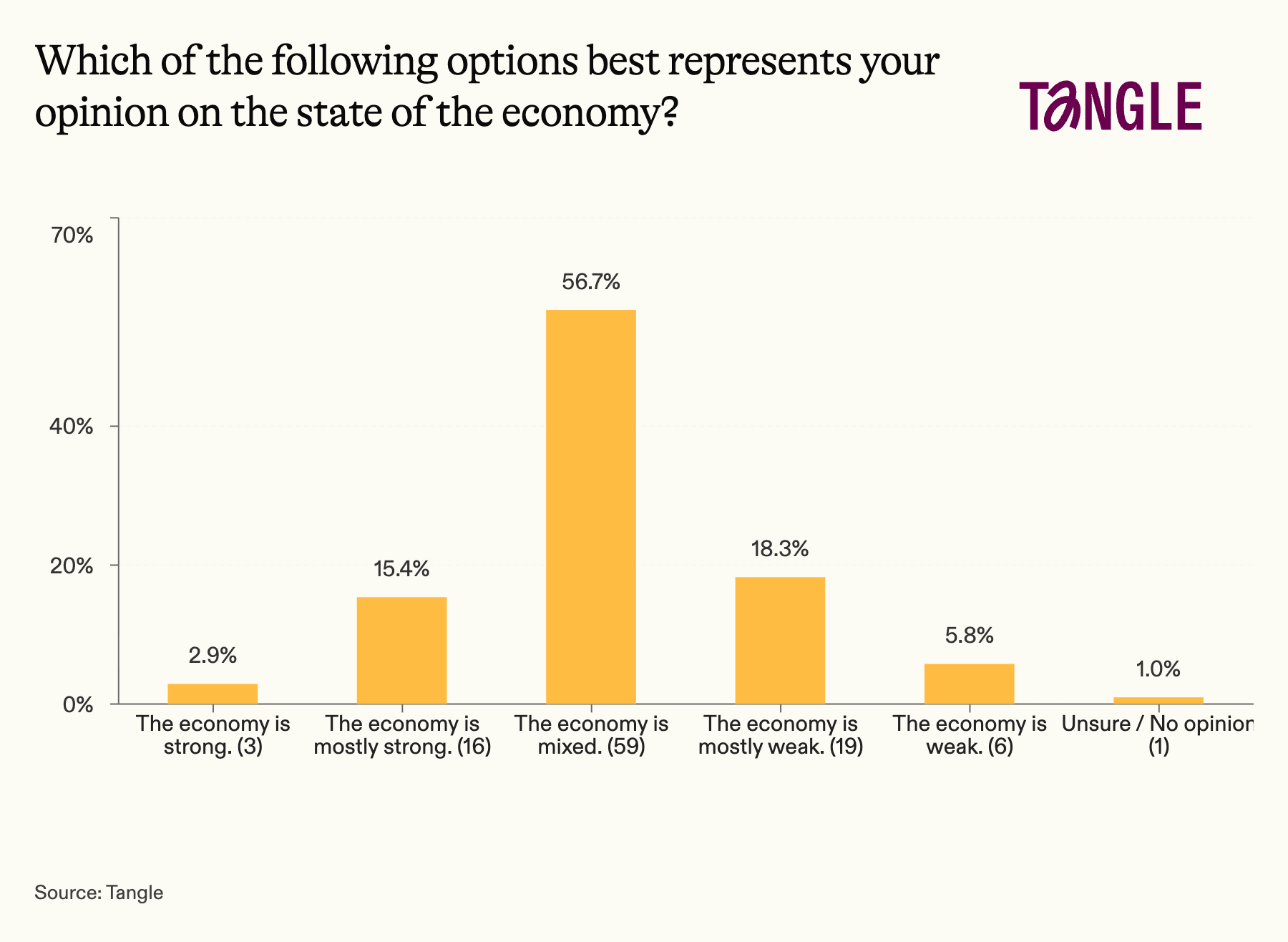
- Thursday’s survey: We did not link out to our survey when we sent Thursday’s newsletter due to an editing error. Accordingly, only 104 readers responded to our survey on the strength of the economy with 57% saying it is mixed. “Low firing/low hiring economies are not a fun experience for workers, even if they might be pretty good for companies and therefore for GDP growth as a whole,” one respondent said. “It’s gotten to where if the mainstream news hasn’t mentioned the economy in a long time, I assume it must be doing great,” said another.
Have a nice day.
In February, more than 200 World War II-era love letters between a U.S. Army soldier and his future wife went on digital display through the Nashville Public Library. William Raymond Whittaker and Jane Dean met in college at Meharry Medical College, where they first dated. They eventually lost touch, but Whittaker reconnected with Dean after he was drafted in 1942. The two rekindled their relationship during the war through letters, which were discovered in a Nashville home and donated to the Metro Nashville Archives in 2016. Whittaker and Dean eventually married, and their letters are now publicly accessible online. The Associated Press has the story.

Member comments