
I'm Isaac Saul, and this is Tangle: an independent, nonpartisan, subscriber-supported politics newsletter that summarizes the best arguments from across the political spectrum on the news of the day — then “my take.”
Are you new here? Get free emails to your inbox daily. Would you rather listen? You can find our podcast here.
Today’s read: 15 minutes.
NOTE: We will be off next Monday, April 6, in observance of Easter.
Get texts from us.
After oral arguments in the birthright citizenship case concluded yesterday, subscribers to Tangle’s free SMS messaging service, Subtext, got a first peek at Isaac’s analysis of the case.
For more instant commentary on the biggest stories, as well as chances to help Tangle choose daily topics and occasional looks behind-the-scenes, join our Subtext channel by clicking here or texting TANGLE to (850) 338-9163.
Quick hits.
- President Donald Trump delivered a national address Wednesday evening, calling the U.S. military’s operation in Iran a success and saying it was “very close” to fulfilling its objectives. He suggested the war will continue for up to three weeks. (The speech) Separately, President Trump said in an interview that he is “strongly considering” pulling the United States out of the North Atlantic Treaty Organization, expressing displeasure with member states’ refusal to support the U.S. military in Iran. (The comments)
- Republican House and Senate leaders announced a plan to end the Department of Homeland Security shutdown by passing funding that excludes Immigration and Customs Enforcement and Customs and Border Protection, later funding the agencies through the budget reconciliation process. They did not specify a timeline for a vote on the appropriations bill. (The plan)
- The National Aeronautics and Space Administration launched Artemis II, a roughly 10-day lunar flyby mission, from the Kennedy Space Center in Florida. The four astronauts on board will travel the farthest any human has been from Earth if the mission goes according to plan. (The mission)
- The United States lifted sanctions on Venezuela’s acting president, Delcy Rodríguez, enabling her to work more freely with American companies and investors. (The decision)
- The Federal Bureau of Investigation reportedly declared a recent China-linked cyber intrusion into an agency surveillance system a “major incident,” suggesting that hackers compromised sensitive data in the hack. The “major incident” determination denotes a significant risk to U.S. national security. (The incident)

1,000+ Proven ChatGPT Prompts That Help You Work 10X Faster
ChatGPT is insanely powerful.
But most people waste 90% of its potential by using it like Google.
These 1,000+ proven ChatGPT prompts fix that and help you work 10X faster.
Sign up for Superhuman AI and get:
- 1,000+ ready-to-use prompts to solve problems in minutes instead of hours — tested & used by 1M+ professionals
- Superhuman AI newsletter (3 min daily) so you keep learning new AI tools & tutorials to stay ahead in your career—the prompts are just the beginning
Today’s topic.
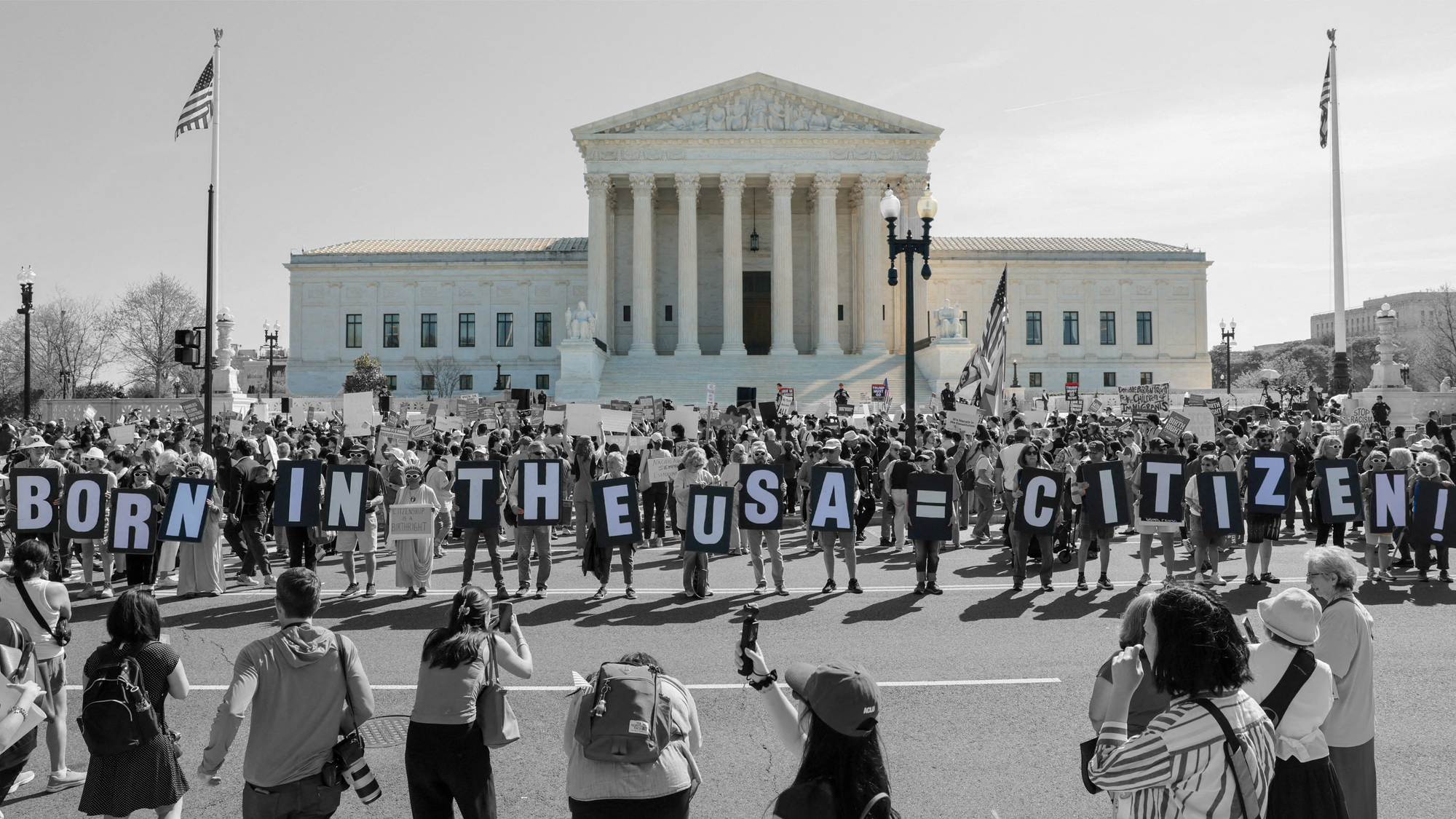
Oral arguments on birthright citizenship. On Wednesday, the Supreme Court heard arguments in Trump v. Barbara, a case challenging President Donald Trump’s executive order restricting birthright citizenship. While a majority of justices seemed skeptical of the Trump administration’s argument that the order should be upheld, several conservative justices appeared similarly unconvinced by the plaintiffs’ case. President Trump attended the arguments, a first for a sitting president, though he left before they concluded.
Back up: On the first day of his second term, Trump signed an order saying that a child born in the U.S. will not get citizenship if their father is not a citizen or permanent resident, and their mother is either in the country illegally or only there temporarily. The order was immediately challenged on grounds that it violated the 14th Amendment; district judges in several states blocked the order, and appeals courts declined the government’s requests to lift or narrow the injunctions. The Trump administration appealed the injunctions to the Supreme Court, which ruled 6–3 in June 2025 that the lower courts exceeded their authority. In December 2025, the Court agreed to consider a challenge to the merits of the order.
The 14th Amendment’s Citizenship Clause reads, “All persons born or naturalized in the United States, and subject to the jurisdiction thereof, are citizens of the United States and of the State wherein they reside.” The Trump administration contends, among other points, that the executive order “restores the original meaning” of the amendment, which they claim was enacted to give citizenship to formerly enslaved people and their children but should not apply to children whose parents are in the country illegally. The plaintiffs argue that the Citizenship Clause clearly confers citizenship to anyone born in the United States, noting that the drafters of the 14th Amendment did not specify any exceptions to the clause’s language.
A large portion of oral arguments centered on United States v. Wong Kim Ark (1898), which affirmed the principle of birthright citizenship for almost everyone born on American soil, regardless of their parents’ status. Arguing for the Trump administration, U.S. Solicitor General D. John Sauer suggested that a child’s parents had to be legal residents to confer citizenship. Justice Neil Gorsuch, among others, questioned this argument, noting that the U.S. did not have strict immigration laws when the 14th Amendment was ratified.
Cecillia Wang, who represented the challengers, argued the residence question in Wong Kim Ark was not relevant to the current case. Chief Justice John Roberts asked why the question of “domicile,” a person’s intended permanent home country, should be ignored when it appeared “20 different times” in the ruling, but Wang noted that the majority said six times that domicile is irrelevant under common law.
Today, we’ll break down oral arguments in the case, with views from the left and right. Then, Executive Editor Isaac Saul gives his take.
Agreed.
- Commentators on the left and right think the Supreme Court will strike down the order, though perspectives vary on how they’ll do so.
What the left is saying.
- The left expects the order to be struck down, noting conservative justices’ pushback to the administration’s arguments.
- Some say the ruling could be another major Supreme Court loss for Trump.
- Others stress the relevance of Court precedent.
In Vox, Ian Millhiser wrote “even this Supreme Court seems unwilling to end birthright citizenship.”
“The Fourteenth Amendment’s ‘subject to the jurisdiction’ rule primarily excludes the children of foreign ambassadors and similar foreign officials from US citizenship, because the families of diplomats often enjoy diplomatic immunity from US law,” Millhiser said. “Trump’s attempt to expand this ‘subject to the jurisdiction’ exception to include children of undocumented immigrants and people here on a temporary basis received a cold reception from nearly all of the justices… Similarly, after Sauer claimed that we live in a new world where pregnant foreign nationals allegedly enter the United States to ensure that their child will be a US citizen, Chief Justice John Roberts responded that ‘It’s a new world; it’s the same Constitution.’”
“Justice Amy Coney Barrett offered a clever hypothetical exposing a contradiction in Sauer’s legal argument,” Millhiser wrote. “Barrett asked about an enslaved person who was brought to the United States against their will, who always viewed themselves as a captive, and who never intended to remain in the US. Under Sauer’s ‘domicile’ rule, she pointed out, this person could not be a citizen even though Sauer concedes that the Fourteenth Amendment does give citizenship to freed slaves.”
In The American Prospect, Robert Kuttner explored “Trump’s losing streak in court.”
“Chief Justice John Roberts observed to Solicitor General D. John Sauer that all of his attempts to extrapolate from rare situations where birthright citizenship did not apply were far-fetched,” Kuttner said. “Justice Brett Kavanaugh… reminded Sauer that Congress in 1940 and 1952 passed federal statutes codifying the language of the 14th Amendment’s birthright citizenship clause. Congress passed those laws, Kavanaugh said, well aware of the interpretation, dating to the 1898 Supreme Court ruling, that birthright citizenship applied to virtually everyone born on U.S. soil.”
“Trump was in the front row of the gallery, the first sitting president to attend a Supreme Court argument. The justices did not acknowledge his presence,” Kuttner wrote. “If the idea was that his personal attendance would somehow intimidate the justices, it didn’t work. With each succeeding decision, most recently in its 6-3 ruling overturning Trump’s use of ‘emergency’ tariffs, a supposed emergency that Roberts ridiculed in his opinion, this Court grows bolder and more explicit in its restraint of Trump.”
In The New York Times, Stephen I. Vladeck said “Trump will lose the birthright citizenship case. But in a way, he’s already won.”
“This has always been an open-and-shut case under almost any approach to constitutional and statutory interpretation. What may get lost in the discussion of such an outcome is the uniquely twisted procedural path that this case took to the Supreme Court — one that, along the way, made it much harder for lower federal courts to block lawless executive action,” Vladeck wrote. “Initially, the issue the justices took up… [was] whether the three Federal District Courts that had blocked its implementation had exceeded their authority by having their rulings apply on a nationwide basis. In a 6-to-3 decision handed down in June, the Supreme Court’s Republican appointees all said ‘yes.’”
“In the nine months since the Supreme Court’s ruling constraining nationwide injunctions, we’ve seen how difficult it has been to challenge everything from immigration detention to the conduct of federal agents in and around Minneapolis, to the administration’s summary cancellations of federal programs and grants authorized by Congress,” Vladeck said. “We must not lose sight… of the opportunities the court won’t have to rein in the administration when it overreaches — and the court’s own responsibility for creating such an increasingly dangerous reality.”
What the right is saying.
- Many on the right support the administration’s arguments but expect the Court to strike the order down.
- Some say the conservative justices poked meaningful holes in the government’s interpretation of the 14th Amendment.
- Others argue the Court risks its legitimacy if it rules against Trump.
In Fox News, Gregg Jarrett described the Court’s posture as “wary.”
“Sauer was an impressive advocate with a masterful command of the law and history. However, he faced a level of skepticism from a majority on the court which suggests that, in the end, Trump’s executive order may be struck down,” Jarrett wrote. “Granted, divining an outcome based solely on oral arguments can be equivalent to reading tea leaves. The dynamic could change behind closed doors and upon further deliberations. But it cannot be overlooked that even conservative justices at the hearing posed penetrating questions that seemed to manifest their doubt.”
“Sauer quoted Sen. Lyman Trumbull, a moving force behind the 14th Amendment, who specifically stated that the citizenship clause does not encompass individuals still subject to any foreign power or ‘owing allegiance to anybody else,’” Jarrett said. “However, the justices seemed unmoved by the notion that citizenship should not apply to the children of people who broke the law coming here and have no permission to be in the U.S.”
In National Review, Dan McLaughlin wrote “no big surprises at the birthright citizenship argument.”
“Oral argument has a way of narrowing disputes. On the one hand, Sauer conceded that he is not asking the Court to overturn Wong Kim Ark, which significantly limits the swing-for-the-fences appeal of his argument for those who think that case was wrongly reasoned from the start,” McLaughlin said. “On the other hand, while Kavanaugh and a few other justices asked questions about the statutory argument, there seemed to be little appetite for using that as an excuse to avoid the constitutional questions.”
“The move that Sauer makes to turn ‘lawful domicile’ into the test for who is subject to U.S. jurisdiction by saying that illegal aliens ‘lack the legal capacity to form’ legal residence here is a modern engraftment onto the 1866–68 debates, which discuss nothing of the sort,” McLaughlin wrote. “In fact — as Justice Barrett noted — if we move from domicile to a theory focused on legal competence to form an allegiance, we get into some of the logic followed by those of the antebellum defenders of Dred Scott, who argued that slaves had no legal capacity to be citizens… The odds of there being five votes for the administration’s entire position without even overturning Wong Kim Ark appear pretty distant.”
In The Federalist, Breccan F. Thies said the Court upholds birthright citizenship “at its own peril.”
“If the Supreme Court rules in favor of this view, allowing any foreigner circumstantially (or intentionally) born on U.S. soil to be automatically adopted into the Union as a citizen, it will mean the end of actual American citizens taking the high court seriously,” Thies wrote. “As Justice Clarence Thomas pointed out, the purpose of the 14th Amendment was to grant citizenship to black people and freed slaves after the Civil War. Making the point further, Thomas asked, ‘How much of the debates around the 14th Amendment had anything to do with immigration?’”
“Sauer’s introduction of the issue of birth tourism led to a potentially telling exchange with Chief Justice John Roberts, where Roberts asked about birth tourism’s prominence,” Thies said. “Roberts has consistently postured himself as the chief justice most intent on preserving the institution of the Supreme Court… That is what makes his line of questioning both confusing and concerning, because it suggests he believes the proper constitutional interpretation of the 14th Amendment would continue to allow these birthright farms to send foreigners to the United States so their babies can receive rubber-stamp citizenship.”
My take.
Reminder: “My take” is a section where we give ourselves space to share a personal opinion. If you have feedback, criticism or compliments, don't unsubscribe. Write in by replying to this email, or leave a comment.
- The Supreme Court seems on track to make the obvious and correct ruling here.
- Congress didn’t consider illegal immigration when it ratified the 14th Amendment, but that’s immaterial to the text of the law.
- This won’t end the debate about birthright citizenship, but it will settle the legal question.
Executive Editor Isaac Saul: “It’s a new world, but it’s the same Constitution.”
When Chief Justice John Roberts delivered that line, the Court’s decision became obvious. The Trump administration will likely lose the case at least 7–2, with both Justices Samuel Alito and Clarence Thomas in the minority (I’m not sure where Alito will land, so it could be 8–1, though most courtwatchers believe he is certainly going to vote to end birthright citizenship).
Fundamentally, I never thought the Trump administration had a shot here. The 14th Amendment’s language is direct: “All persons born or naturalized in the United States, and subject to the jurisdiction thereof, are citizens of the United States and of the State wherein they reside.”
“All persons” is pretty clear-cut, and the one qualifier — “subject to U.S. jurisdiction” — had a very direct purpose that was well understood at the time and has been well understood since. It was designed to provide citizenship to slaves, but to exclude children of foreign diplomats or children of enemy soldiers from becoming U.S. citizens simply by being born here. It was also meant as a carveout for Native American tribes that did not pay taxes and did not want to live under U.S. law. To this day, ambassadors and their families can live on U.S. soil but have diplomatic immunity and owe allegiance to their home country, and their children do not become citizens if they are born here. The Indian Citizenship Act of 1924 later resolved the question about Native Americans, granting them full status as American citizens (and full protection of the law). Lastly, we’re not at war with an invading country, so the question of enemy soldiers having children here is moot.
Credit to Solicitor General D. John Sauer, who had the nearly impossible task of arguing Trump’s case but came prepared with arguments that clearly engaged the Court. His arguments are stronger than many critics allow, and history is replete with anomalies regarding the 14th Amendment that demand further inquiry. Sauer pulled quotes from late 19th century politicians who defined “subject to U.S. jurisdiction” as having some kind of allegiance to the United States. He also attempted to argue that 130 years of legal understanding of United States v. Wong Kim Ark, the 1898 Supreme Court case where the Court affirmed the citizenship of a child born to Chinese immigrants, was wrong (all while he refrained from asking the Court to overturn the ruling).
Rather than offering citizenship for anyone born here to non-citizens (with exceptions for enemy soldiers and foreign diplomats), Sauer argued that the case’s description of “domiciled” meant that someone in the country illegally had to be permanent residents, with full allegiance to the U.S., for their children to be granted citizenship. Justice Sonia Sotomayor argued that even Wong’s parents did not have “full allegiance” to the U.S., but Sauer never directly defined — and wasn’t asked to define — how he would measure or gauge allegiance under such a test. Still, he seemed to argue that the circumstances of Wong’s life were the only circumstances the court greenlit, and precedent didn’t apply to every person born on U.S. soil.
Putting aside the fact that no court or legislative body had ever interpreted the 14th Amendment or the ruling this way, Justice Amy Coney Barrett engaged Sauer on his terms. She asked him about a person brought to America as a slave who viewed themself as a captive and never intended to stay here. Under Sauer’s framework, this person’s child could not be a citizen, even though the 14th Amendment was specifically designed to give such a person citizenship. Sauer struggled to navigate the hypothetical.
Traditionally speaking, “subject to the jurisdiction thereof” has been understood to mean bound by U.S. laws. Sauer’s interpretation suggests that children of immigrants are not subject to U.S. jurisdiction, and therefore not bound by our laws. As Vox’s Ian Millhiser pointed out (under “What the left is saying”), that would mean the federal government could not deport them even if they were in this country illegally, nor could they arrest them if they committed a crime. The idea makes no sense.
When Trump issued this executive order, a Reagan-appointed judge with more than 40 years on the bench immediately struck it down, saying he couldn’t “remember another case where the question presented is as clear as this one is.” The justices, at times, seemed similarly gobsmacked, though far more measured. Justice Brett Kavanaugh spent his time questioning Cecillia Wang, the ACLU lawyer representing the challengers, by effectively asking her how she might want the Court to strike the order down. Justice Elena Kagan criticized Sauer’s argument as drawing on obscure, out-of-context quotes, while Chief Justice Roberts said his reading was “quirky” and Justice Neil Gorsuch gently suggested Sauer may not want to rely on Wong Kim Ark — the very case that has, for 130 years, affirmed U.S. citizenship for anyone born on U.S. soil.
Of course, I think the Trump administration is right that Congress and the states were not exclusively, specifically, or even partially considering the question of illegal immigration or birth tourism when they ratified the 14th Amendment. Illegal immigration didn’t exist then, as we had (actual) open borders. The law didn’t account for someone crossing the border, claiming asylum, giving birth to a child, and having that child become an American citizen — nor did statutes anticipate navigating multi-million dollar birth tourism companies. It wouldn’t be the worst thing for the Court to consider how to carve out some of those specific, more nefarious means of gaining citizenship, yet that sounds much more like a job for Congress than anyone else.
These unintended consequences are true of all manner of rights and amendments. When Congress ratified the Second Amendment, they anticipated local governments maintaining regulated militias, not individuals building up entire armories in their basements. To anyone who wants to argue against it, the refrain is “you have to pass an amendment” — the same counterpoint applies here. The 1866 Congress wasn’t attempting to greenlight birth tourism or mass migration, but they didn’t pass the 14th Amendment to limit it, either. Both ideas are equally absurd, so we’re left with the actual text of the amendment, which is that anyone born here is a U.S. citizen, with very limited and narrow exceptions. That’s the rule of law, and if we don’t like it, we can elect people to change it.
It’s a new world, but it’s the same Constitution.
While Sauer and Trump do clearly seem destined for a loss here, the Court did briefly consider what might happen if they won. The open questions this produced made the practicality of radically altering the understood meaning of the 14th Amendment so fraught as to be nearly impossible. When a woman gives birth, would she have to immediately give proof of citizenship — and who would be responsible for confirming it? If someone didn’t have that documentation, would we start trying to measure their intent to domicile or allegiance to the United States? How would allegiance even be defined? Also, what if a presidential administration said it wanted to apply this standard retroactively? Would we then start revoking citizenship? On the Advisory Opinions podcast, Sarah Isgur had a funny exchange with her cohost David French where she wondered aloud if her own citizenship would hold up — she wasn’t sure her Irish immigrant ancestors ever got actual citizenship before having children.
Much about this — from the early executive order, to Sauer’s re-interpretation of long-held laws, to the practical implications — seems so far-fetched as to produce a foregone conclusion. It won’t end the immigration debate, but it should put to bed any questions about what the 14th Amendment actually means.
Take the survey: How do you think the Supreme Court will rule in this case? Let us know.
Disagree? That's okay. Our opinion is just one of many. Write in and let us know why, and we'll consider publishing your feedback.
Your questions, answered.
Q: I was wondering if there is some concrete data out there that helps us compare the effect of deployment of National Guard troops in our cities on crime reduction? Now that the troops are being withdrawn, it’ll help to check if things became safer before vs during and possibly vs after.
— Debnath from Oakland, CA
Tangle: Yes, we have some preliminary data for several of these cities. As a reminder, President Trump deployed the National Guard to address crime in five different cities in 2025: Washington, D.C.; Portland, Oregon; Memphis, Tennessee; Chicago, Illinois; and New Orleans, Louisiana. The administration also deployed troops to Los Angeles in June, but their deployment was in direct response to violent protests in the city — not to address crime — and half the Guard was ordered withdrawn in July. The withdrawal in Los Angeles was completed in January, and guardsmen in Portland and Chicago were limited to protecting DHS facilities and quickly withdrawn, so we’ll only consider D.C., Memphis, and New Orleans in this analysis.
Before we provide any before and after statistics on these cities, we have three points of caution. First, we don’t have enough information to say that any changes in crime rates here are caused by deployments; any number of factors could be driving these numbers one way or another.
Second, these figures only represent a small span of time — troops have not been in these cities for very long, so the effect of their presence may be muted (and the National Guard is prohibited from arresting citizens, so they can only assist other agents, further dulling their potential effect).
Third, crime rates were already trending down in these cities before deployments, so we should try not to analyze these numbers in isolation. For context, from 2023 to 2025, homicides declined by 54% in D.C., 47% in Memphis, and 54% in New Orleans.
With that said, here’s the most up-to-date data.
Washington, D.C. (since August): Year-to-date data through April 2 shows 12 murders, compared to 34 during the same period last year, a 65% decrease. The city also had a 21-day homicide-free streak in January — the longest in nearly 30 years. Separately, assault with a dangerous weapon crimes are up 32%.
Memphis (since October): In January 2026, Part 1 crimes (serious offenses) were down 48% compared to January 2025 (3,709 incidents down to 1,908).
New Orleans (since December): As of March 27, 2026, murders were down 29% compared to the same point in 2025.
Want to have a question answered in the newsletter? You can reply to this email (it goes straight to our inbox) or fill out this form.
A deeper look.
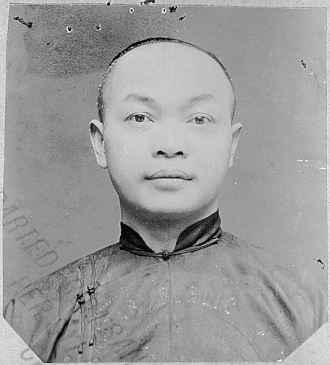
The Supreme Court first affirmed that the 14th Amendment grants birthright citizenship in the 1898 decision U.S. v. Wong Kim Ark. The man at the center of the case, Wong Kim Ark, was born in 1873 in San Francisco, California, as the son of Chinese legal residents who were staying in the U.S. on business. His parents returned to China in 1890, but Wong intended to continue living in the U.S. as a citizen. After an 1895 visit to China, Wong was blocked from re-entry to the U.S. under the Chinese Exclusion Act of 1882, which denied citizenship to Chinese nationals — which the government argued Wong was. When his case reached the Supreme Court, the justices ruled 6–2 that the 14th Amendment granted Wong citizenship by birth. Wong Kim Ark’s great-grandson, Norman Wong, lives in the San Francisco area today.
The Gold Standard for AI News
AI will eliminate 300 million jobs in the next 5 years.
Yours doesn't have to be one of them.
Here's how to future-proof your career:
• Join the Superhuman AI newsletter — read by 1M+ professionals
• Learn AI skills in 3 mins a day
• Become the AI expert on your team
The road not taken.
This week, the Tangle team considered covering the Supreme Court’s decision on conversion talk therapy. In Chiles v. Salazar, the Court sided 8–1 with a Colorado counselor’s challenge to a law barring therapy for minors intended to change their sexual orientation or gender expression, finding that the law regulates speech based on viewpoint and that lower courts did not apply sufficient scrutiny during review.
We ultimately decided the importance of the recent oral arguments on mail-in ballots and birthright citizenship superseded covering the Chiles decision, since we had covered oral arguments in the case in October. As our staff expected then, the Supreme Court ultimately didn’t reject the Colorado law on the merits — it sent the case back to the lower courts.
You can review our original coverage of Chiles here.
The extras.
- One year ago today we covered the election results in Florida and Wisconsin.
- The most clicked link in our most recent newsletter was the University of Minnesota’s scientific survey of the Tangle audience. Please take it if you haven’t already (and be entered into a lottery for a $200 Amazon gift card)!
- Nothing to do with politics: A closer look at NASA’s Artemis mission.
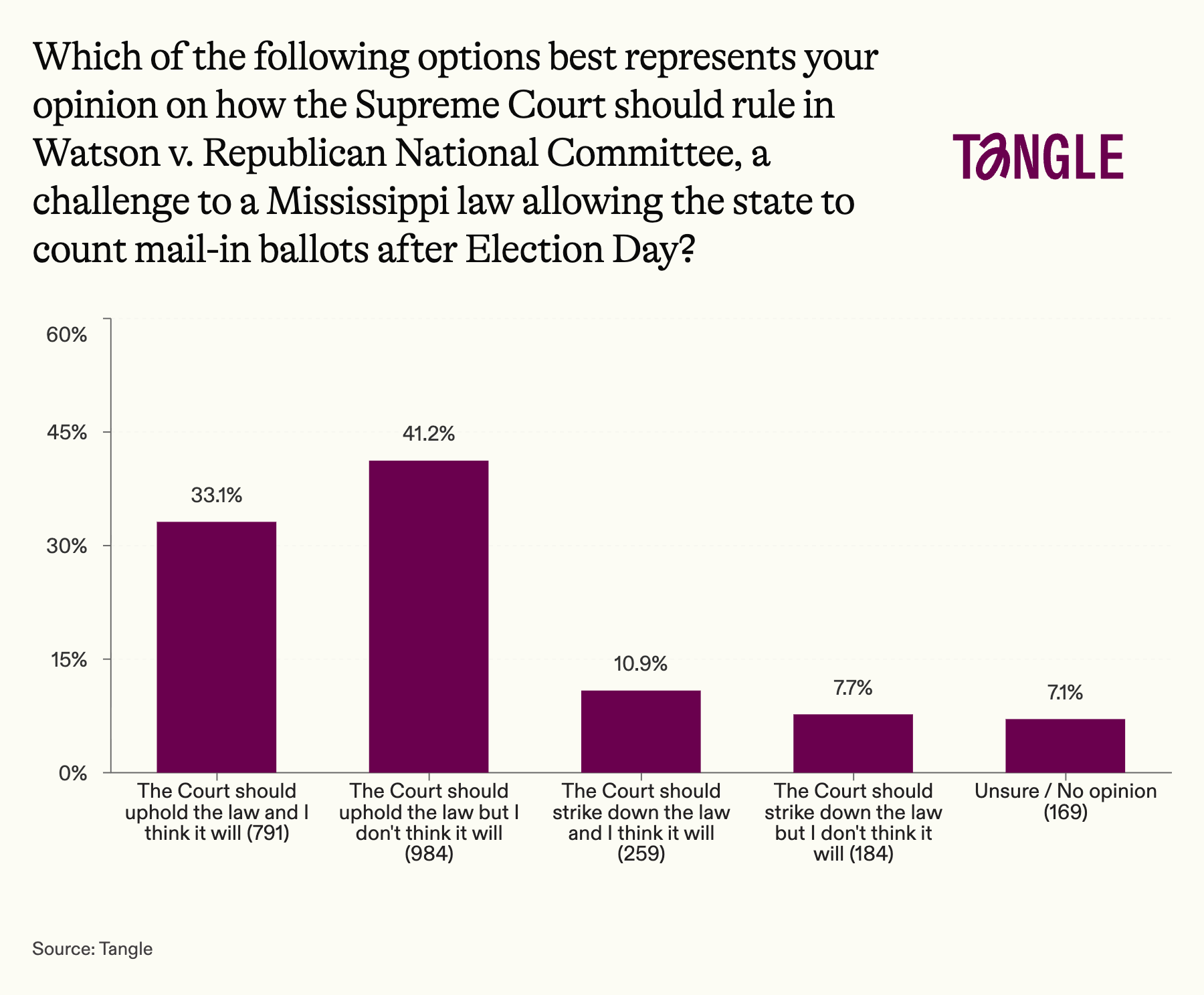
- Our last survey: 2,387 readers responded to our survey on the Supreme Court case considering mail-in ballots with 41% saying the Court should uphold the challenged law but predicting that it won’t. “I believe if the vote is ‘cast’ by Election Day, it should count. Also, have you experienced USPS services lately?” one respondent said. “Why is a grace period necessary? The options available — early, absentee or in person — are enough,” said another.
Have a nice day.
On March 21, Coloradans Emma Stasko and Logan Bonn found themselves stranded on a remote beach in the Hawaiian island of Oahu during a severe flood. The pair had planned to leave the beach earlier in the day but lost the keys to their rental car and weren’t able to find help before the storm began. They turned to one of the oldest tricks in the book: writing “SOS” in the sand. A helicopter crew assessing the damage from the storm saw the message and mobilized rescue crews, which quickly reached Stasko and Bonn and brought them to safety. SFGate has the story.

Member comments