







Good Monday morning. I’m Isaac Saul, and here’s a remarkable story to start your week: Last Monday, I wrote about traveling to North Carolina to celebrate a “miraculous” run of nine family birthdays in a four-week span. I used the word “family” loosely to include a non-blood-related family I grew up across the street from, whom I consider family, and I still think the birthday coincidences are pretty crazy. Well, a friend told me over the phone on Saturday that a family in Pakistan boasts nine people all born on August 1st — a husband and wife and all seven of their children, none of whom were purposely delivered early. They hold the Guinness World Record for most family members born on the same day. And August 1st is the couple’s wedding anniversary. I’m not kidding.
As you ponder that genuinely miraculous birthday math, today we’re covering the 60 Minutes controversy at CBS — plus, an under-the-radar story about a new Trump pardon.
Oh, and before you go: Don’t forget that we’re coming to Berkeley Springs, West Virginia, this weekend. I’ll be on stage with Kmele Foster, Andy Mills, and The Free Press’s Kat Rosenfield to talk about the future of artificial intelligence. Plus, we’ll discuss the day’s news and take live audience questions. VIP tickets are sold out, but a few general admission tickets are still available! More details here.
Quick hits.
- Iran and Israel exchanged air strikes for the first time since a ceasefire went into effect in April. After Israel struck a target in Beirut, Iran launched multiple missile attacks, then Israel struck multiple targets in Iran. President Donald Trump had reportedly asked Israel not to retaliate against Iran amid peace negotiations. (The attacks)
- On Monday morning, disrupted commodities markets and stock exchanges rebounded after Iran announced the “end of military operations” against Israel. Brent crude prices are now up 1.75% to $94.58 per barrel, after reaching a high of $98, and the S&P 500 and Nasdaq indices opened the morning up after a Friday slump. (The markets)
- Former California Attorney General and U.S. Health Secretary Xavier Becerra (D) is projected to advance to the general election in California’s gubernatorial race. He is expected to face either fellow Democrat Tom Steyer or Republican candidate Steve Hilton. (The race) Separately, Los Angeles City Councilmember Nithya Raman (D) is projected to advance past reality TV star Spencer Pratt (I) in the city’s mayoral primary; she will face Mayor Karen Bass (D) in the general election. (The race)
- The Bureau of Labor Statistics reported that nonfarm payrolls increased by 172,000 jobs in May, exceeding economists’ estimates of 80,000 jobs added. The unemployment rate remained unchanged at 4.3%. (The numbers)
- Gunmen opened fire at a street festival in Toledo, Ohio, wounding 12 people. Police believe there were at least two shooters and are still searching for suspects. (The shooting)
That scam call wasn’t random.
Scammers don’t just guess your number. They buy personal information from data brokers — companies selling your phone number, home address, relatives’ info, and more online.
That’s how a random scam call can turn into phishing, impersonation, identity theft — or someone knowing more about you than they should.
That’s why we recommend Incogni. It removes your personal information from these databases and keeps removing it automatically.
Today’s topic.
Scott Pelley’s firing. On Tuesday, 60 Minutes executive producer, Nick Bilton, fired the show’s longtime correspondent Scott Pelley following a confrontation during a staff meeting in which Pelley criticized Bilton and CBS News Editor-in-Chief Bari Weiss. Pelley’s firing is the latest shakeup at the show and network since Weiss took the head role in October 2025; Pelley and other former correspondents have accused Weiss of interfering in editorial decisions in an attempt to cover the Trump administration in a more positive light.
Back up: In December, in one of her first major decisions at CBS News, Weiss pulled a 60 Minutes segment on Venezuelan men deported to the Terrorism Confinement Center (CECOT) in El Salvador hours before the episode was scheduled to air. The editor-in-chief said the segment lacked original reporting and the Trump administration’s perspective, but correspondent Sharyn Alfonsi claimed that the story had been pulled for political reasons. The piece eventually ran in January 2026, and CBS News declined to renew Alfonsi’s contract when it ended in May. Four of 60 Minutes’s seven correspondents, as well as an executive editor and producer, have now left the show or been fired during Weiss’s tenure.
On Monday, June 1, Bilton held a 60 Minutes staff meeting to introduce himself after Weiss hired him to run the program in May. Early in the meeting, Pelley reportedly began questioning Bilton’s qualifications and making pointed remarks about Weiss’s management of the show, suggesting she was “murdering” it. The next day, Bilton, Pelley, Weiss, and CBS News President Tom Cibrowski discussed the altercation in a closed-door meeting. Weiss later said to staff, “Despite our attempts to engage with Scott Pelley and to find a way back, unfortunately we weren’t able to do so, and so we had to part ways.” Pelley rejected Weiss’s characterization of the meeting, saying he was “stonewalled” by the executives.
Following the closed-door meeting, Bilton sent a letter to Pelley informing him of his firing, writing, “Yesterday, you hijacked my first meeting with staff to disparage me, my qualifications, and my intentions with remarkable incivility and contempt… [the] performative display of hostility enacted in front of the staff instead of in a civil, private conversation demonstrated that you have no interest in contributing to the future success of the show.”
Pelley responded later that day, reiterating his claim that CBS’s new ownership under David Ellison’s Paramount Skydance was seeking to “curry favor” with the Trump administration. “The collapse of values at the top has become untenable. The leadership of 60 Minutes is no longer recognizable,” he wrote. Pelley also told The New York Times that Weiss was attempting to put her “thumb on the scale for the president’s version of events.” He noted a segment on the two Minneapolis residents killed by federal immigration agents in January, claiming that Weiss asked the producers to portray protesters as more violent and to characterize Renee Good as driving towards the officer who shot her.
Today, we’ll share views from the right and left on Pelley’s firing and the changes at CBS News. Then, Executive Editor Isaac Saul gives his take.
What the right is saying.
- The right says Pelley’s firing was justified, arguing he violated professional boundaries.
- Some say Pelley is positioning himself as a martyr for the anti-Trump cause.
- Others suggest the correspondent and his defenders don’t understand why 60 Minutes needs to change.
In The Washington Examiner, Joe Concha wrote “sanctimonious Scott Pelley finds out no one is indispensable.”
“Pelley made the miscalculation that so many in this business have in recent years: He thought he was indispensable. His contract made him rich. Likes and reposts from his social media posts made him feel powerful. He felt he could challenge his bosses during staff meetings or even publicly,” Concha said. “Good for Bilton. Because if he had allowed Pelley to stay after such a condescending, disrespectful tirade, the entire network would see him as a pushover.”
“But the real tell was Pelley’s commencement speech at Wake Forest University in 2025 after Trump won the presidency for a second time. ‘This moment, this morning, our sacred rule of law is under attack. Journalism is under attack, universities are under attack, freedom of speech is under attack,’ Pelley declared dramatically,” Concha wrote. “It’s this kind of cheesy, theatrical performance by a 60 Minutes correspondent and former anchor of the CBS Evening News… that helped turn the longtime news magazine into just another program with an agenda.”
The New York Post editorial board suggested “Pelley got himself fired to set up his next career move.”
“CBS’s owners brought in Bari Weiss (a left-leaning centrist!) as news chief to restore balance; she brought in award-winning journalist Nick Bilton (also no righty) to helm ‘60 Minutes’ for the same reason,” the board said. “But Pelley spent his career scoring cheap lefty points; he had no interest in changing his ways, so he defied management with a pose of standing on neutral principle against a supposed right-wing agenda, then followed his firing with a letter claiming Weiss wanted him to ‘inject falsehoods and bias’ into his work at ‘60 Minutes.’
“Not that he cited any specifics, because he couldn’t: Being told you need to get quotes from the other side before a new story is finalized, after all, is the reverse of bias,” the board wrote. “His ‘principles’ involved lazy, biased reporting that he wasn’t going to be able to keep doing; he staged his exit to maximize his chances of getting a new gig doing the same old hack work, and will probably succeed.”
In National Review, Becket Adams called Pelley’s response to his firing “revealing.”
“Notable about the tantrum thrown by journalists and a considerable number of elected Democrats was that it was part of a larger conniption that has run uninterrupted since Bari Weiss took over as the network’s editor in chief in October 2025,” Adams said. “What this long-running ‘outrage’ reveals, what with its boilerplate rhetoric about oligarchies and its vague, specifics-free allegations of wrongdoing by Weiss and 60 Minutes executive producer Nick Bilton, is that a lot of people in the news business think of their profession as something akin to a public university.”
“Weiss is obviously trying to run CBS as a business, one with broad appeal and plump profit margins… Running a successful newsroom today also means accounting for the credibility crisis, which makes sense given that it is the most pressing issue,” Adams wrote. “The resistance is rarely any deeper than professional self-preservation, fighting for perks and good salaries, and for the freedom to indulge their partisan preferences… We see this in the Pelleys and the NPRs of the world and their supporters in media — those who’d like to enjoy all the benefits and prestige of major league journalism with none of the market pressures or business concerns.”
What the left is saying.
- The left says Pelley stood up for journalistic values and was punished for it.
- Some suggest the firing confirms CBS’s shift toward appeasing the Trump administration.
- Others say 60 Minutes is slowly being hollowed out.
In The Guardian, Margaret Sullivan said “[Pelley] stood up for his principles and lost his job.”
“Rather than hearing the truth that Pelley spoke in a staff meeting on Monday, rather than taking it seriously and vowing reform, the bosses treated his remarks as grounds for dismissal… Pelley plainly believes that the destruction of a storied institution is the result, and perhaps the point, of what his bosses are doing. It started when the chief executive of CBS’s parent company, tech scion David Ellison, named Bari Weiss the top editor of CBS News last fall,” Sullivan wrote. “Weiss has been a one-woman wrecking ball at CBS News, and particularly at 60 Minutes. She meddled with cherished editorial independence, prompting the departures of deeply respected reporters and producers.”
“Something Weiss apparently doesn’t understand is that a newsroom… is a living organism with a culture all its own. That culture doesn’t function based only on commands from above. Strict hierarchical control hurts (yes, it can even kill) the journalism,” Sullivan said. “Creative people want to do their work — which many of them consider a mission, not just a job — in an atmosphere of respect, cooperation, and a certain amount of autonomy. They understand that they take direction from above and that their preferences may be overruled, but their most closely felt ideals cannot be trampled on.”
In The New Republic, Perry Bacon argued “Pelley knew exactly what he was doing in trashing Bari Weiss.”
“I am not sure if Pelley meant to be fired. But I’m quite sure he meant to create a firestorm and focus the nation on what’s happening: Bari Weiss, a center-right activist more concerned by Donald Trump’s critics than the authoritarian president himself, has now consolidated power at one of America’s three broadcast networks and taken control of perhaps the nation’s most reputable and prestigious news program,” Bacon wrote. “60 Minutes isn’t one of the nightly news programs that’s declining in ratings and relevance, or a morning show that alternates between hard news and cooking segments. Its ratings are strong. Its reporting is compelling.”
“What Pelley and [former correspondent Cecilia] Vega are experiencing isn’t unique. A common tactic of authoritarians is to use government power to steer the ownership of news organizations to companies or leaders who are favorable to that leader,” Bacon said. “That’s what Trump has done. He’s not telling 60 Minutes what to air, but he has ensured the network is run by someone who will do his bidding. And it’s likely that CNN will also soon be owned by David Ellison’s Skydance Media and run by Weiss or someone like her.”
In Slate, Nitish Pahwa wrote “the clock is ticking for 60 Minutes.”
“The past year… has been one of the rockiest in 60 Minutes’ decadeslong history. The fact that any of its correspondents can even raise the prospect of the newsmagazine ‘dying’ is itself a dire indicator for the future of American journalism,” Pahwa said. “No doubt, the show had made mistakes and errors of judgment over time, while some of its leaders had faced credible accusations of heinous misdeeds and staff mistreatment. And the careful, steadily reported, once-a-week format may seem like a dinosaur in this hyper-paced timeline where deluges of information accost us every ticking second.
“But even from a business-minded standpoint, by any hard-minded accounting of costs and time and reach and relevance and adaptability and return on investment, 60 Minutes was working,” Pahwa wrote. “60 Minutes staffers have fretted that there are simply not enough people left — forget about people with experience — to properly get the fall season produced… It all sounds less like a good-faith effort to invigorate a vital newsmagazine for modern times — and more like an effort to have it fall apart, piece by piece. No one remaining on 60 Minutes wants the show to die. But that may not matter if the people in power do."
My take.
Reminder: “My take” is a section where we give ourselves space to share a personal opinion. If you have feedback, criticism or compliments, don't unsubscribe. Write in by replying to this email, or leave a comment.
- I came into Pelley’s interview with some biases against him.
- After listening to the interview and reflecting, I’m starting to think that maybe Pelley is just right.
- 60 Minutes has been succeeding, Bilton doesn’t seem qualified, and the whole saga is another knock on Weiss’s managerial record.
Executive Editor Isaac Saul: Yesterday, I spent an hour listening to Scott Pelley’s interview with The New York Times.
I came in with a few biases: First, I find Pelley’s affect to be a bit pompous and sometimes overwrought. When I’ve heard him talk about journalism or CBS in the past, I sometimes feel embarrassed — like he mythologizes the importance of journalism in a way that makes all media people seem self-important. Second, as I’ve discussed before, I’ve interacted with Bari Weiss in a professional capacity and do not believe she is afraid to criticize the Trump administration. Indeed, much of her (and her wife’s) work at The Free Press does just that. And finally, like Weiss, I am of course part of the independent media ecosystem trying to challenge the traditional, mainstream giants like CBS, so I figured my view of the situation might more closely align with hers than Pelley’s.
In the Times interview, he was, as I expected, a bit pompous and overwrought. He repeatedly likened the changes at CBS to “your spouse being murdered,” which caused me to groan aloud as I listened. He defended himself against accusations that he did not love this country with an uncomfortable valorization of his time as a war correspondent, suggesting he’d been “in combat” much like those in uniform had. And the way he talks about CBS, as if it has been insulated from ideological bias up until now, strikes me as farcical. CBS, like many major news outlets, has a center-left bias throughout its newsroom that is apparent to most honest brokers.
Yet, I have to say, I found much of Pelley’s version of events credible. That Pelley confronted new 60 Minutes Executive Producer Nick Bilton with the allegation Weiss was “murdering” CBS during a team meeting seems undisputed, but the closed-door meeting he had with Weiss and Bilton is a he-said, she-said tale with both sides claiming they were the ones really trying to reconcile. Some people might think Pelley’s open criticism of Weiss is so professionally inappropriate it was cause for firing, but after hearing him out I actually think he had reasons to stand up and make his case — and Weiss and Bilton should have been better prepared to navigate his objections.
He accused Weiss of trying to inject falsehoods into the show, and he came with a specific, credible example. He claimed Weiss attempted to fundamentally change the 60 Minutes piece on Renee Good at the last minute by including an allegation that Good was “driving toward the officer.” Like Pelley, I believe this framing is false. As I wrote at the time, the video clearly shows Good turned her wheels to try to drive around the officer before he shot her in the head.
Pelley is now the third prominent journalist at 60 Minutes, along with correspondents Sharyn Alfonsi and Cecilia Vega, to allege Weiss attempted to inject political bias into their stories. When it was just Alfonsi, I said “I didn’t think one reporter’s account of her story getting spiked was undeniable proof of CBS currying favor with the Trump administration,” but three reporters alleging the same thing is a more damning portrait of CBS’s new leadership.
Claims of bias aside, one of Pelley’s arguments that moved me most was one of his simplest: What’s the meritocratic case for what is happening now? As Pelley put it, Executive Producer Tanya Simon oversaw an unheard-of 9% ratings increase for the program last year, as well as good social media numbers: 2.5 billion video views, up 185%. Simon was a CBS lifer whose dad also worked for the show, and despite clearly succeeding just a year into the position, she got canned. On the merits, letting her go is pretty much indefensible; and, indeed, Weiss and company have not really mounted a credible defense for it. For Pelley, Simon’s dismissal was even harder to swallow when she was replaced by a tech journalist with zero broadcast experience.
Put differently: Weiss was brought in to be the editor-in-chief of CBS News, and her first order of business seems to be shaking up the organization’s most successful and recognizable program. It’s hard to justify that as a strictly profit-motivated decision.
Pelley further defended the network from allegations it has somehow been “frozen in amber” since the 1960s and is not adapting to the new age of journalism, noting that 60 Minutes has had a significant online presence since 2010 and he’s shooting TikTok videos on every assignment. Their YouTube presence is massive, with 4.1 million subscribers, and the program is already going after a younger audience. “It’s almost as if Bari Weiss and Nick Bilton were sealed in a time capsule in 1990, and it just cracked open,” Pelley said. “They’ve just discovered the internet, and they’re running around telling everybody how important it is.”
As I ruminated on Pelley’s interview, something occurred to me: The cool, independent, heterodox thing would be to trash 60 Minutes as stuck in the stone age and drag Pelley as a pompous, self-important “stiff” (as President Trump called him). But what if it’s simpler than that. What if he’s just… right?
Pelley is not some Joe Schmoe faker who failed his way to the top. He is a real journalist. He really has gone to war zones and risked his life for a story. He really has been a face of one of the most successful television news programs of all-time. Doesn’t he deserve some benefit of the doubt, given that after 37 years, many leadership changes and much disruption, nothing like this has ever happened at CBS 60 Minutes before? And is it really so bad that he cares so much about his job that it feels over the top to other people? I thought about how I’d feel if 30 years from now something like this happened to Tangle, and I imagine I’d be pretty upset, too.
Even the defense from Weiss and Bilton that Pelley somehow “crossed a boundary” in confronting the new leadership of CBS is hard to swallow. Isn’t this the anti-cancel culture crew? Weiss is supposed to be a champion of dissent and confrontation — her editorial ethos revolves around our country being too sensitive and too divorced from meritocracy. How does that coexist with an outcome where successful producers and correspondents are fired for semi-public dissent?
In the end, Pelley said something that is worth the rest of us considering, too: He said the bigger problem than any political influence is incompetence. Pelley actually supported the Ellisons’ buying CBS, and said he was “walking on air” after meeting David Ellison and hearing him address the newsroom. That might come as a surprise to many liberals who are now in his corner. Yet Weiss running the network, Pelley said, was akin to someone handing him the keys to a Boeing 747 with 400 people on board and asking him to fly to Paris: “I’m going to decline because I don’t have a clue.” While describing Weiss as a “lovely person,” he also said she had no business running an organization this size in a space she didn’t understand.
Again: Maybe Pelley is just right. Frankly, the view that Weiss is a great person but not a great manager is not far off from what I’ve heard about her in the industry — and that’s in the context of a much smaller company at The Free Press and in her native space (digital news).
Of course, 60 Minutes’s ratings haven’t suffered under Weiss’s management to this point, and as someone who actually watches the show I haven’t detected any meaningful shifts in the programming. Even Weiss’s much maligned decision to delay a CECOT story in December ended up being a nothingburger of sorts; the new, revised program ended up running almost exactly as the original, just with additional statements from the Trump administration.
But if I’m looking at this story objectively and trying to decide whose story makes more sense — that Pelley is an impossible-to-wrangle, disobedient employee who cares more about refusing to work for Weiss and Bilton than helping CBS, or that Pelley is a legitimately concerned TV veteran trying to raise the flag that his new managers are in over their heads — I have to say I find the latter explanation a lot more credible.
Take the survey: What do you think of Scott Pelley’s dismissal? Let us know.
Disagree? That's okay. Our opinion is just one of many. Write in and let us know why, and we'll consider publishing your feedback.
Under the radar.
On Thursday, President Trump announced he had pardoned former Rep. Steve Buyer (R-IN) of his 2023 conviction for insider trading. A jury found that Buyer used nonpublic information gained from his job as a corporate consultant to make investment decisions, and he was sentenced to 22 months in prison. However, several current and former Republican lawmakers have appealed to the president on Buyer’s behalf, arguing that he was the target of a politically motivated prosecution by the Biden administration. Trump cited these appeals in his statement, though he did not offer further detail on his rationale for the pardon. The Washington Post has the story.
Ever get a scam call and think, “How do they even have my number?”
Simple: Someone sold it.
Data brokers collect and sell your personal information to anyone willing to pay. Incogni helps scrub your data from the internet and keeps monitoring for new exposures.
Numbers.
- 37. The number of years Scott Pelley worked at CBS News.
- 22. The number of seasons Pelley served as a 60 Minutes correspondent.
- 3. The remaining number of 60 Minutes correspondents after Pelley’s firing.
- 9.1 million. 60 Minutes’s average viewership for its 2025–26 season, according to Nielsen.
- 52. The number of consecutive seasons that 60 Minutes has been rated as the number one news program in the United States.
The extras.
- One year ago today we had just published reader responses to Isaac’s piece about Zionism.
- The most clicked link in our last regular newsletter was the Sacramento Bee’s list of former Rep. Katie Porter’s (D-CA) controversies.
- Nothing to do with politics: Why human eyes are weirdly white.
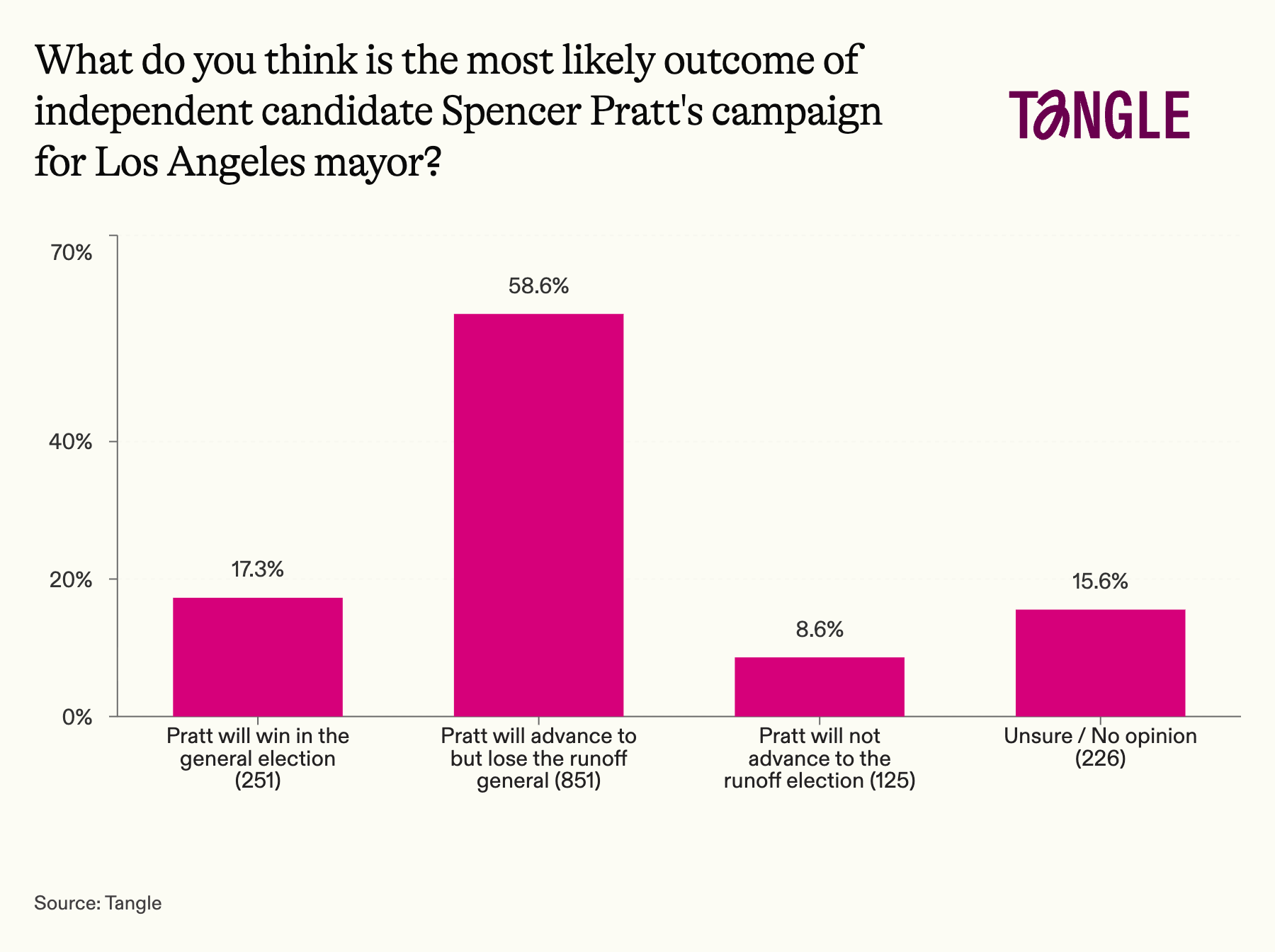
- Our last survey: 1,453 readers responded to our survey on the Los Angeles mayoral primary with 59% saying Spencer Pratt will advance to the general election and lose. “Bass and Raman have a combined nearly 59% so far. It’s hard to imagine many progressives switching to Pratt in the general,” one respondent said. “They can’t even get their votes counted. California is a joke,” said another.
Have a nice day.
Wendy House had a passion for baking — but as a full-time pharmacist with a husband and four kids, she didn’t have the time. That changed as her kids started leaving the house. One day, as she and her husband were walking through Costco and processing their transitional stage of life, Wendy saw a small, premade greenhouse and thought, “What if I actually sell [bread] out of that?” House bought the greenhouse and started making and selling baked goods — like caramelized-onion Gruyère sourdough and freshly baked cinnamon rolls — out of it. There’s no checkout line or cash register. People walk in, pick out their treats, and pay on an honor system. “I started that way because I was just having friends and neighbors come, so I didn’t really think much of it,” House said. “Eventually, total strangers started to come… Everybody has been so incredibly honest.” NBC News Today has the story.

Member comments