
That’s it, I thought to myself. That’s the last straw.
A writer I admire, a woman I respect, read and listen to, a woman who has been identified with the impressive title “public intellectual” — spoke on a podcast in which she used the name Karen as a pejorative.
I guess I shouldn’t have been shocked. I should have known that, eventually, even people I think highly of would feel free, indeed have license, to use my name in a derogatory manner. Of course, they don’t know me; they don’t know it’s my name. And they don’t care. It’s not personal, I’ve told myself. Still, it’s disappointing.
How unfortunate that it’s now common to hear and read about people referred to as Karens, plural. Or, worse yet, a single, contemptible Karen, a name used as a noun as one might say “She’s a harridan.” Objectified, “She’s a Karen” tells us right away the person is obnoxious, rude, intolerant, and intolerable. It seems it won’t be long now before Karen becomes an adverb, karenly — not even requiring the dignity of capitalization at all.
A contemporary pejorative, ‘a Karen’ typically means she’s an upper middle-class white American woman who’s overly demanding, entitled, privileged.
Since none of those adjectives describes me, I could just ignore it. And, because I live in Japan, I almost never hear it. Even when my first name is used at all, it’s always appended with the honorific to become Karen-san.
I recently had the following email exchange with a friend, an American woman who, like me, is a longtime resident of Japan and also a Karen:
“How have you been doing with all the recent madness surrounding our name? It really disturbs me,” she wrote.
My haughty reply: “I am aware of how our name is being debased. But please know I pay little attention to this kind of thing, and consider it just another manifestation of callousness — which seems to have no limits these days. Insensitivity abounds, and people hardly think twice about using insults and potentially offensive language that might demean others. I find it ridiculous — and deserving of my ridicule!”
She went on: “It is so very stupid, harmful and misguided. I’m thankful it doesn’t exist in Japan. But I know women with our name not only in the USA but also the UK and Australia who are having a terrible time with it in their everyday lives.”
I‘ve heard from some of these women:
“I didn’t even want to give my name at Starbucks for fear of having to do the walk of shame to pick up my coffee at the bar!”
“I’ve stopped using my name and have switched to just my initials because of this loathsome trend.”
“My friend Karen apologizes for her name after she introduces herself to others. Unfortunately, the name has become a triggering word during this particular cultural moment.”
I was named after a movie star, Karen Morley, who was my mother’s favorite actress.

Oh, how I used to wish my mother had chosen to name me Barbara or Linda or Joanne or Jane. They were my friends. (Their mothers were Bertha, Ethel, Gladys and Thelma — like Mildred, names one seldom hears anymore.)
When I was growing up, Karen was an uncommon name. I knew only one other girl named Karen. I was an adult before I met another.
Karen in other cultures, other languages.
The name Karen has its origins in Scandinavia, and over the years that I’ve visited Denmark, Sweden and Norway, I’ve met any number of women named Karen. I would learn that the name, which can mean purity and innocence, was the name of the Danish Queen Karen, wife of another Scandinavian monarch whose name has taken on a different meaning: King Harald Bluetooth.
I’d also learn the name had more prosaic associations.
During the 1960s, I lived for a few years in Odense, Denmark. The birthplace of Hans Christian Andersen, it’s also where my eldest daughter was born. I’d gone there to take over the management of the kitchen at Hesbjerg Højskole. As the cook at this boarding high school, the students got a kick out of calling me Karen Kok (Karen the Cook), a popular food brand in Denmark at the time.
In 1975, on our overland trip to Japan, when we trekked in northern Thailand near the border with Burma, I visited the Karen Hill (no relation to the author) tribe, a large subpopulation in the two countries.
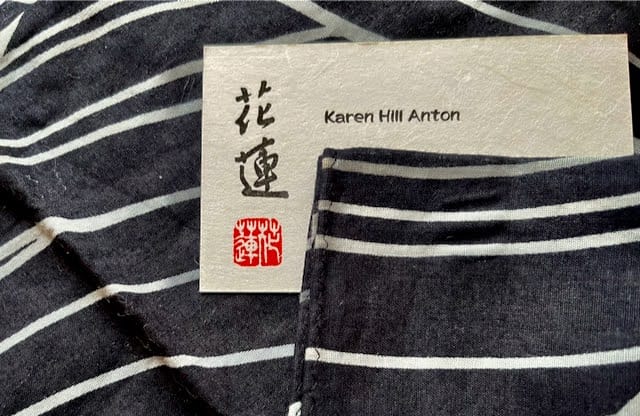
Shortly after arriving in Japan, I began to study calligraphy. In Japan, calligraphy — Shodō (The Way of Writing) — is an art form as well as a discipline. After more than 30 years of study and practice, I achieved the designation ni-dan, second-degree mastery.
In Shodō, it’s customary for your sensei (teacher) to bestow you with your calligraphy name, and that’s how you sign your finished works. You stamp your inkan (印鑑) in vermillion seal script below your name.
My teacher named me 花蓮. The first character, read as Ka, means flower; the second character, read as Ren, means lotus.
Once on a visit to Taiwan, while exploring the calligraphy gallery at the National Palace Museum in Taipei, I chanced to talk with a Taiwanese woman as we admired the same scroll. When I mentioned my calligraphy name is 花蓮 she exclaimed:
“That’s Hualien in Chinese! It’s the name of one of the most beautiful places in all of Taiwan!”
Karen. Flower of the Lotus. What a lovely name.
Last spring I gave a talk to a Japan chapter of SIETAR (Society for Intercultural Education, Training and Research). In my talk, titled “Crossing Cultures: A Personal Journey,” I also spoke about the name Karen and its current negative associations. Later, a woman who’d been in the audience wrote me saying:
“Thank you for your beautiful talk. As someone named Karen, it’s been disheartening to see our name turned into a stereotype that feels so far from who we truly are. Your talk about receiving the calligraphy name 花蓮 ‘flower of the lotus’ brought a sense of beauty and dignity back to a name many of us have struggled to love in recent years.
Knowing that it also shares its name with one of the most beautiful places in Taiwan made it even more meaningful. Thank you for reminding me that our name holds grace, history, and quiet strength beyond any passing cultural trend. Your words truly helped my name bloom again.”
Karen Hill Anton is the author of the award-winning memoir The View From Breast Pocket Mountain and the novel A Thousand Graces. Originally from New York City, since 1975 she’s lived in rural Shizuoka, Japan, where she also writes a Substack.

Member comments