Sign up for the Free Tangle Newsletter Highly curated unbiased news for busy, open-minded people.
Processing your application
Please check your inbox and click the link to confirm your subscription.
There was an error sending the email
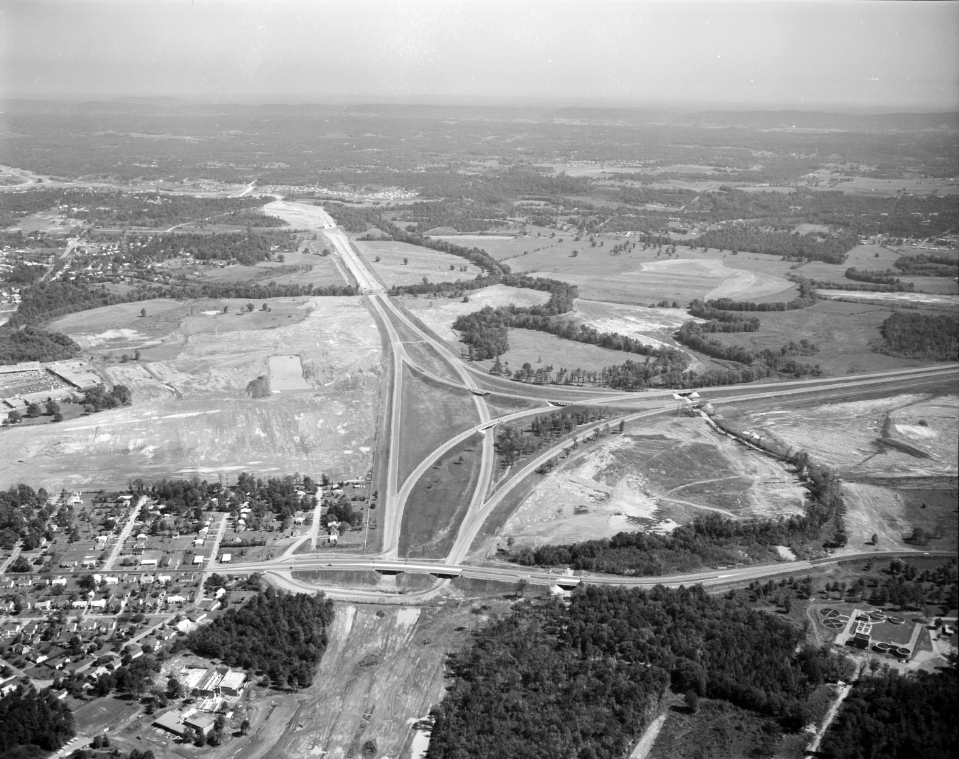
The I-75/24 Split in Chattanooga, Tennessee, shortly after initial construction was completed | Tennessee State Library and Archives, Wikipedia

By Rose Williams


This summer, to celebrate the United States of America turning 250, I decided to dedicate myself to better understanding the country I live in. For me, that means adjusting my personal syllabus. Every Fourth of July, I usually read something related to the Founding (and I still did read a few founding documents this year), but a strange series of cultural coincidences actually led me down quite a different path.

The first coincidence actually happened long before this summer. When I was in eighth grade, I happened to read John Steinbeck’s Of Mice and Men for the first time on a whim. The book captivated me in a way few others had, and it quickly became a favorite — though I didn’t read much more of Steinbeck until I found a $5 used copy of East of Eden in college. I purchased it, also on a whim, and devoured it greedily the very next summer. And that was how I developed a love of Steinbeck.

Because of that deep affinity, I bought his books whenever I could find used copies or pretty covers; then, they’d sit on my shelf, waiting to reach the top of my reading list. One such book was his 1962 travelogue, Travels with Charley: In Search of America, in which Steinbeck chronicles a cross-country road trip he took with his dog. I bought the book because it was small, it had a pretty pink cover, and I hadn’t read Steinbeck’s nonfiction before; but somehow, whenever I considered reading it, I picked something else up instead.

Then, I happened upon another writer’s nod to America’s 250th anniversary. In the spirit of Christopher Nolan’s then-forthcoming Odyssey adaptation), Plough Quarterly ran an article titled “Who Is America’s Homer?” Various members of the literati submitted their nominations for the defining voice that told America’s story; nominees ran the gamut from children’s author Laura Ingalls Wilder to poet Walt Whitman to musical artist Tracy Chapman to the Homeric choice of “no one” (yet).

It was like this article was made for me. I excitedly forwarded it to a group chat and shared my thoughts; I, personally, nominated Steinbeck, and I chose East of Eden as his defining epic. A friend agreed on Steinbeck but, instead, humbly submitted Travels with Charley as the epic. What an odd choice, I thought, knowing that it was far from his most popular. But, knowing that the book sat on my shelf unread, I resolved to read it this summer and draw my own conclusions. As an added plus, I would get to read about Steinbeck’s “search” for America in 1960, at the beginning of the most tumultuous part in the nation’s recent history — fitting, I thought, given where we are at the moment.



Travels with Charley opens with exactly the sort of literary move I love from Steinbeck: the use of grandiose, flowery language in long, sinuous sentences to describe his urge to move around, to “be someplace else,” and how those urges never abated even as he aged — cut off with the staccato, “In other words, once a bum always a bum.” And because Steinbeck is a bum, he now has to travel; but because he really isn’t a bum, he has to find a reason to travel first. So he sets the goal of reconnecting with the country, explaining that he hasn’t truly known it for 25 years, and that he must see its changes for himself before he returns home. It’s a tricky setup, off the bat: He says he’s traveling in search of America, but admits from the beginning that this search is only a pretense. The important part of the journey is simply that it’s happening.

Steinbeck travels an impressive 10,000 miles over the course of his journey. He starts from his home in New York; travels north to the deep forests of Maine; then sets off west across Michigan before stopping in Chicago; continues through Wisconsin, the Dakotas, and Montana before finally reaching the West Coast where he was raised. Once on the Pacific Coast his route takes him south, passing through the redwoods on his way to his home of Salinas; and he finally cuts east, stopping for Thanksgiving in Texas before beginning the homeward stretch through Louisiana and Alabama.

The difficulty of reading books like this is that the past is distant enough to be foreign — I never knew the world Steinbeck describes — and yet near enough that even the poorest student of history can draw the line from then to now.

When he finally makes for North Dakota — after he’d driven through much of New England and the Midwest going as slowly as possible, stopping at roadside stands and taking copious notes on the people he encountered along the way — he ends up on the “super-highway” system, the recently completed Interstate Highway System developed under President Dwight Eisenhower, much to his own distaste. Here, Steinbeck says, he can see that civilization has “advanced” while he wasn’t looking; but this advancement mostly registers as cacophony and confusion. And when he meditates on the virtues of driving, he fears that the high-speed “slashes” of super-highways will turn drivers inward, toward themselves, instead of outward toward nature and community. From my own vantage point, Steinbeck’s fears were at least partly well founded — how often, now, do you stop at roadside markets on long trips? When you drive, are you looking out at nature or watching the estimated arrival time, occupied with “making good time” or ruminating on your own dreams? 

Even so, Steinbeck recognizes, too, the way that super-highways are enabling a new kind of American life. Describing the advent of the mobile home, Steinbeck observes the mobile homeowner’s unique independence.You can imagine its significance to the author of Grapes of Wrath: a vehicle/dwelling that allows the occupant to go where the work is, to shelter and feed his family alongside himself as he travels, and even the sense of fulfilment and pride that upkeep and maintenance gives a homeowner. 

Steinbeck asks one such owner whether he’s at all concerned with lack of permanence. The man asks what permanence has to do with him when he’s got mouths to feed. And this, Steinbeck surmises, is a truer picture of the unique American spirit — restlessly seeking opportunity where it arises. The super-highway is both a natural outgrowth of that spirit and an essential ingredient to its explosion across the country.

Steinbeck’s greatest strength as a writer of fiction is his balance. He swaps seamlessly between languid prose and blunt explication in his sentences; he weaves compelling family narratives with sweeping, essay-style declarations about human nature; he demonstrates clear love, attention, and care for his craft while also maintaining a cool authorial detachment from his work. 

But the lines are blurred in much of Travels with Charley, because Travels is not a work of fiction. Instead, Steinbeck is working through his own relationship to the country and to the people in it. As such, we’re treated to the reflections of a man who knows himself to be getting older, who finds himself internally resistant to change even if he logically accepts it.


I read Travels with Charley because I wanted to see whether it might appropriately be considered an epic. In some ways, it fits the bill: it’s the story of a long journey, populated by encounters with various interesting characters — charitable gas station attendants, guarded hardware store owners, mystical traveling actors. Steinbeck himself plays a perhaps Odyssean role in the lives of those he encounters: He defuses a family conflict in the mountains of Montana, nearly starts a barfight in his hometown of Salinas, and evades a turkey-hunting trip through trickster wit in Texas.

But in spite of its epic qualities, Travels with Charley is still ultimately about Steinbeck’s journey — the journey of a bum, which starts when he gets the traveling spirit and promptly ends with a whimper when the spirit goes out. There’s no Priam kneeling at the feet of Achilles or reunion between Odysseus and Penelope; instead, Steinbeck’s final tale from his journey is of making it back to New York — and promptly getting lost.

Even so, I also approached Travels with Charley with another goal in mind — searching for America. In Steinbeck’s search, he says, he meets all sorts of individuals who are by themselves unique and unalike; yet he ultimately concludes that there is something fundamentally American uniting them all — and him with them. He does not name this trait, but it is there, he says, in all races and peoples that populate the country. And this, it turns out, is the reason that Steinbeck’s inward turn is so powerful in Travels even when objectivity is his strength in fiction: because he is an American, too, and so the story of his journey is also the story of the nation.

“This monster of a land, this mightiest of nations, this spawn of the future, turns out to be the macrocosm of microcosm me,” he writes. “From start to finish I found no strangers. If I had, I might be able to report them more objectively. But these are my people and this my country.”


Rose Williams is an amateur literary critic and longtime Tangle fan from Tennessee. She aspires to become a slightly less amateur literary critic, and she’s grateful that Tangle of all places is giving her the opportunity to grow.

Member comments

More from Tangle News related to this article

Recently Popular on Tangle News