Sign up for the free Tangle Newsletter Highly curated unbiased news for busy, open-minded people.
Processing your application
Please check your inbox and click the link to confirm your subscription.
There was an error sending the email
He’s in Transition
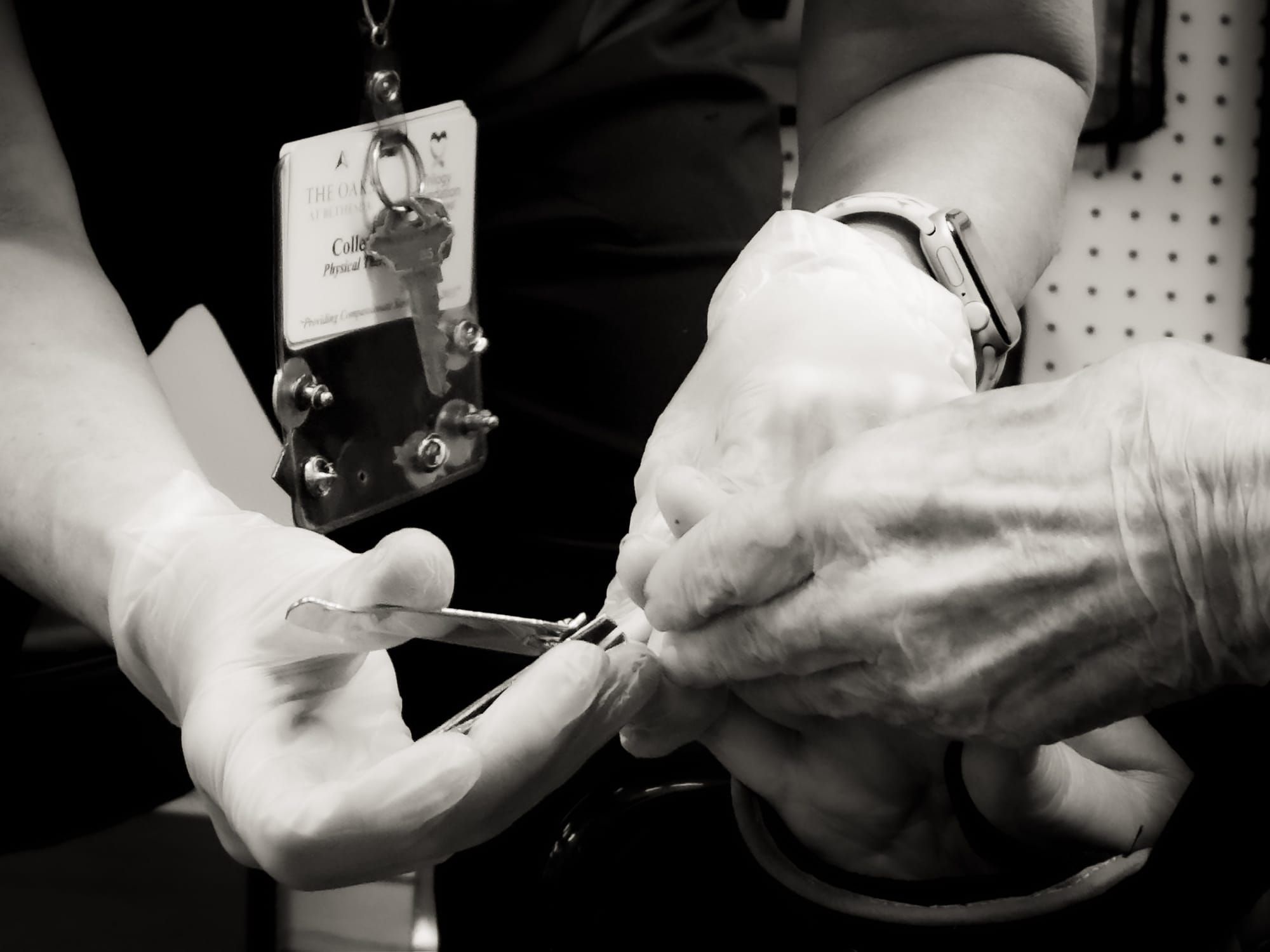
Photo from Leah Nairn

By Leah Nairn


Everyone loved my Dad.

Lying there unable to speak, peeking through his eyelids, he was still everyone’s favorite. “Gotta say goodnight to grandpa,” one aide would say before she ended her shift — even though he’d never been a grandpa. I’ve never married nor had kids, and I’ve been the only child of two parents aging in completely different ways for some time now. So yeah, it’s just me. 

His passing was like his life, slow and measured. 

He married my mother in his mid- 30s and didn’t become a father until he was 40. At age 45, he had a nervous breakdown from teaching math to middle schoolers. I remember him throwing up each morning before he went to work. After mom discovered he was suicidal with a plan, she insisted he see a doctor. That doctor concluded he could work any profession of his choosing, except education. Then suddenly, he was home all the time. He worked at the neighbor’s lawn mower repair shop for a summer, at some retail shops, and a few other places I don’t quite remember. He also spent about six years in therapy. 

We moved from Columbus to his hometown of Newark, Ohio, in 1986. He took a job with the county aging program as the activities coordinator for disabled individuals caught up in the deinstitutionalization of mental asylums. I remember him stating no one wanted the job because they were all too afraid they’d have to change a diaper. He didn’t care. 

With a county-owned van and a cast of characters, they went all over. Fishing at Buckeye Lake, to the mall, out for lunch. A few participants had our home phone number. 

“Dad, Orville’s on the phone. He wants to know where you’re going for lunch tomorrow.” 

He never had to change a diaper.

This led him to his best work: court-appointed guardian for the Licking County Probate Court. Ever the politician who was just too good of a man to get mixed up in politics, this was a perfect fit for him. He loved going to court and attending treatment meetings. 

This also put to use his incredible ability to bullshit for hours on end. He was a publican, which lent him a lot of time and opportunity to hone this skill. The Eastern Bar and Grill on the east side of Newark was his watering hole of choice and the proverbial “Hub of the Universe.” It was the backdrop for his only actual stint in politics. Many locals with clout stopped in to share a pint and a chat. One guest in particular often stayed too long and eventually stepped down from the city council after he showed up drunk for a meeting. Dad was appointed to his seat. 

He only served one term. His re-election campaign lacked luster, and I remember his opponent having billboards along the highway. Dad didn’t have the energy or the money to compete with that.



Fast forward to March 2026. At the age of 91, Dad fell and fractured his arm. That kind of injury would mean six glorious weeks off of work for most of us and that would be it. For him, it made space for dementia and depression to move in and set up camp. Medicare insisted he participate in physical therapy; the man never did a lick of purposeful exercise in his life, but it was forced on him now. 

After a few days in the hospital, he was whisked off to a nursing home for rehabilitation. That went just about as well as I expected. He was in and out of bed constantly. Years ago, bed alarms were used to “alarm” staff that a patient at risk for falling was attempting to get out of bed giving staff time to respond and prevent the fall. In recent years, alarms have been declared a restraint rendering them forbidden in nursing homes. I lost count of how many times he was found on the floor. He also started refusing food. 

I sat with him at meals and tried every form of encouragement short of making airplane noises. But he wanted no part — he threatened to throw hot coffee on me at one point. So I stopped. Instead, I visited after dinner. He snoozed in bed while I watched old episodes of Murder, She Wrote

Eventually, someone understood what was happening and suggested hospice. Tears of relief filled my eyes; this man would no longer be tortured in the name of billable hours. So we settled into the business of dying with dignity. 

As the days ticked by, the hospice nurses informed me of exactly where he was in the process. Managed dying is a lot like giving birth, but instead of centimeters dilated and the timing of contractions, it’s measured in elevated heart rate and discolored urine. There are stages. Transition leads into active and active into imminent. I was called in on more than one occasion after several professionals thought he was close. I lived an hour away, which meant crying while barreling down I-70 West towards the big city. And once I arrived, I pulled it together. Because I had another role to play: couples coordinator. 

As mentioned in the beginning, I’m the only child of two aging parents. My mother, his wife of 55 years, has Alzheimer’s and was in the memory care unit around the corner from his room. I am her only anchor to reality. She often forgot who he was, or ever being married. On more than one occasion, she insisted he was not my father. On their last regular visit (before his fall) she cornered him and hit him with her cane. From then on, she was not allowed to be alone with him. 

Every time she walked into his room, she would gasp. The amount of times she saw him for the first time is lost in the ether. These events also summoned her alter-ego, who demanded answers and heads on platters. 

“Why haven’t I been informed about this!?” She would growl through gritted teeth. “Why are they telling you and not me?” 

And for the umpteenth time I’d explain the new dynamics that have existed in our family for the past five years. That I am now the head of the family and yes, I did put them both here and yes, I will take you out for ice cream. 

I repeatedly coached her on how to be with him, reminding her to let go of any expectation of a conversation. 

“He doesn’t know I’m here,” she’d say. 

“Just let him hear your voice, mom. Tell him you love him and that it’s okay to go.” 

And then, for a few minutes, the gears would shift and mom would lovingly recite the lines I’d just provided. 


He died two months after his fall. A Friday afternoon. I tried not to linger in the room; I just didn’t want that visual of his final condition etched in my brain. 

Shit, there he was. Too late. 

Mom took a grand total of two minutes to see him one last time. We didn’t make it five steps back into the memory-care unit before she started her loop of discontentment.

“When are you going to take me out of here?” 

I stopped and I made a direct request for her to just be my mother for a minute and console her daughter who just lost her father. She obliged. But in the end, I was on my own.

This was supposed to be mom’s job: coordinating his care, sitting at his bedside, talking to the medical professionals. She was supposed to plan his memorial, select the pictures, and argue with the insurance companies. I was supposed to be the support — the one who was called in only when death was imminent. And then, once he passed, we would mourn together. 

Instead, I did all the stuff (wrote the obituary, made the phone calls) while she forgot she was ever married. How do you mourn the passing of your father with your mother when at times she has no recollection of his existence? That’s not a rhetorical question; I really want to know. 

Here’s what I did: I joked and kept my composure when the medical professionals were in the room. An occasional tear would escape while in public every now and then. But once I was home, it all came out. I went through all the old photographs trying to replace the visions of him now with the images of him then. I made a video using jazz music that he probably would not like (sorry, Dad, Dave Brubeck won’t be in the public domain until 2055). I planned multiple quilts from his extended collection of L.L. Bean flannels. Hell, I even wrote this essay.  

This entire ordeal, from his fall to his passing, was agonizing. Watching his chest rise and fall and then stop… and then start again. Seeing nothing but a rib cage. Getting no response when I told him I loved him. There were many times I had to leave. I needed a break from all the dying.

The end was surprisingly simple. There was no service. He’d made arrangements with the Ohio State University’s College of Medicine’s Body Donation Program years ago, and those logistics were already taken care of. I wrote a banger of an obituary (in my humble opinion), cleaned out his room, and went back to work.

Two months following my father’s passing, I got a call from the nurse. 

Nurse: “Hi, Umm, Leah. Can you talk to your mom? She’s asking about your dad and she’s not having a good day.”

“Sure, put her on.”

Mom got on the phone and through sniffles, I heard my name in her attempt to verify that it is me. I asked her what is wrong.

“Is Dick dead?”

“Yes, mom.”

“How long has he been dead?”

“Two months now.”

“Why am I just now finding out? Why didn’t anyone tell me?”

And of course I explained everything again. I went to visit her that same afternoon and she asked again. “Is Dick dead?” And again her face contorted in grief. Towards the end of the visit, as I was walking out she asked, 

“Did you see your father?”

“He’s taking a nap, mom.” 

“Oh.”

And that was that.

I can’t tell you which is less painful, suddenly losing someone or watching them waste away. All I know is that his release was my release. 

That is, until I have to do this all over again.   


Leah Nairn is a Natural Resources Officer (a.k.a. Park Ranger) and a freelance photographer living in Southeast Ohio. 

Member comments

More from Tangle News related to this article

Recently Popular on Tangle News