
By Kaitlyn Rubertone
Think about this for a second: if you could do something for the rest of your life and make enough money to financially sustain yourself, what would it be?
When my colleague asked this question to us this summer, the answers varied from running flower shops and bakeries to being stay-at-home parents, or any job that provides fulfillment without financial reward. After thinking about what truly brings me joy, my response was that I’d want to run a small music venue. Something is quite beautiful about an empty venue being filled with people gathering under a shared purpose. It’s magical to think about an hour or two dedicated to being in the moment, enjoying something as a whole. I dreamed about building the place where the next big artist was able to make their big break. I thought about how I could create a venue that both new and existing artists would want to play at. I got excited about all the new genres of music I would discover by giving musicians a home to do what they love. I wanted to become the community staple that both residents and tourists looked forward to frequenting.
Unpacking this question now, as I’ve had the opportunity to dedicate the last four months into understanding the policies behind local live music venues and the problems they face, this answer is somewhat facetious.
What I didn’t know when answering this question over the summer is that 64% of independent venues are struggling to keep their door open as of 2024. Yet, these same venues contributed $86.2 billion directly to the United States Gross Domestic Product. These independent stages also account for approximately 9.2% of total U.S. travel and tourism, which has an incredible ripple effect on their surrounding communities: independent music venues generated about $10 billion in off-site spending between hotels, restaurants and shops. Economic benefits are one thing, and they fail to capture that individuals who attend live music events also report stronger relationships and a greater sense of community than those who do not. These neighborhood staples provide substantial economic and social benefits, yet the people who run them struggle to make ends meet. Most indie venue owners are choosing to do what they love everyday over prioritizing financial prosperity.
From an artist’s perspective, venues have taken on a whole new meaning, as the unreliable income from streaming is not enough to financially support a career. Local venues and live shows serve as a pivotal source of income, making smaller, attainable venues imperative for up and coming artists. Many emerging musicians rely on traditional sales (such as touring, merch sales, physical album copies) as a primary source of income, which have diminished in a streaming-centered world. While streaming services offer undeniable exposure and accessibility, the reality is that an artist needs to tour to truly succeed financially. Given they can’t afford to play at large, corporate-owned venues, small community venues are pivotal to a new musician’s prosperity.
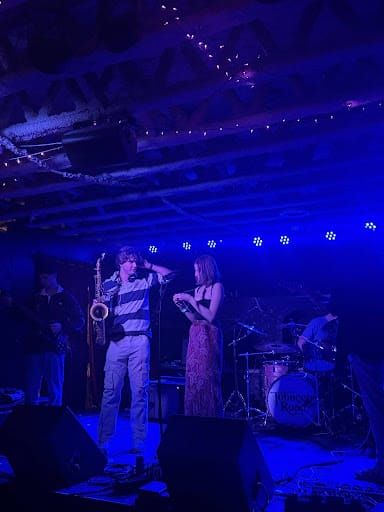
On a simpler scale, local concerts are genuinely a great way to bring communities together. I’ve met a teenage girl celebrating her 16th birthday, asking me to ease her worries about growing up and moving out for college. I met a family who reunited just to see their mom’s favorite band. I met a woman who has been following a small artist and told me how excited she is for the day they’d finally blow up. I’ve had the opportunity to meet those who own the venues themselves and hear their countless stories on their venues’ impact on the community. Independent venues offer a space to connect and converse with our neighbors in a time when we often choose to look at our phones instead of each other.
Looking back on when I answered this question, I scoffed at the idea that running a venue would be able to bring me the financial stability I desired. I knew this would have to be a “passion project” instead of a successful business model, painfully unaware that many venue managers today are struggling to make ends meet themselves. When we examine a place that both serves social connectivity and brings economic prosperity to a neighborhood, it makes us wonder why municipalities aren’t jumping at the chance to uplift these establishments. Whether that is a symptom of larger economic conditions, the shift towards technology and away from connection, or an underappreciation of the arts is up for debate. But it’s undeniable that the very people who dedicate their lives to bringing music to communities are struggling to support themselves.
If you take anything away from this essay, let it be this: go to your local venue, see an artist you know or one you have never heard of before, talk to the people around you, and learn something new. Thank venue managers and musicians for sharing the love of music with their communities. Thank those who create rooms full of strangers which bring connections that last a lifetime. Thank those who work tirelessly to keep the lights on at these prized establishments. Thank those who are dedicating their lives to curating experiences that are bigger than themselves.
Kaitlyn Rubertone is a recent graduate of the University of Virginia who studied Public Policy and Media Studies. After growing up in New York surrounded by local and inspiring talent, Kaitlyn decided to dedicate her capstone research project towards understanding the policy behind live arts.
Member comments