
I'm Isaac Saul, and this is Tangle: an independent, nonpartisan, subscriber-supported politics newsletter that summarizes the best arguments from across the political spectrum on the news of the day — then “my take.”
Are you new here? Get free emails to your inbox daily. Would you rather listen? You can find our podcast here.
Today’s read: 14 minutes.
Follow the State of the Union live with Tangle.
Tonight, President Donald Trump will deliver the first official State of the Union address of his second term. Tangle will be covering the event live on our social media channels, sharing clips and instant analysis, so be sure to follow us on:
Not a social media person? Sign up for our Subtext messaging service to receive a recap at the end of the night. You can sign up here or text TANGLE to (850) 338-9163.
Quick hits.
- The European Parliament paused the ratification process for its trade deal with the United States, citing uncertainty about the future of President Donald Trump’s tariffs. (The pause) Separately, FedEx sued the U.S. government, seeking a full refund for duties it paid on tariffs that the Supreme Court struck down on Friday. (The suit)
- The U.S. Southern Command said the military carried out a strike on an alleged drug boat in the Caribbean Sea, killing three men. (The strike)
- A former Immigration and Customs Enforcement lawyer told a congressional forum that the agency’s process for training new officers is “deficient, defective and broken,” claiming it had cut significant portions of its training program to expedite officers’ graduation. (The claims)
- Multiple outlets reported that leaders in the Defense Department — in particular, Joint Chiefs Chairman Gen. Dan Caine — have warned President Trump of significant risks of a military campaign against Iran. (The report) Trump refuted that U.S. military leaders oppose a potential war. (The response)
- British police arrested Peter Mandelson, the former UK ambassador to the U.S., on suspicion of misconduct in public office in connection with his relationship with convicted sex offender Jeffrey Epstein. Mandelson was fired from his position in September after new details about his ties to Epstein were released. (The arrest)
If you needed extra money, like, yesterday — you're not alone.
Between inflation, holiday spending, and life happening, a lot of people are scrambling for ways to fatten their bank account without taking on a second job.
The thing is, most of us are leaving money on the table. We're talking $300 from Amazon shopping smarter, $225/month watching movie previews, even getting companies to forgive chunks of credit card debt.
Some of this sounds like internet nonsense, honestly.
But millions of people are already doing it. The Penny Hoarder compiled the most practical ways to pocket extra cash this month.
Check out which ones make sense for your situation.
*This is a sponsored post.
Today’s topic.
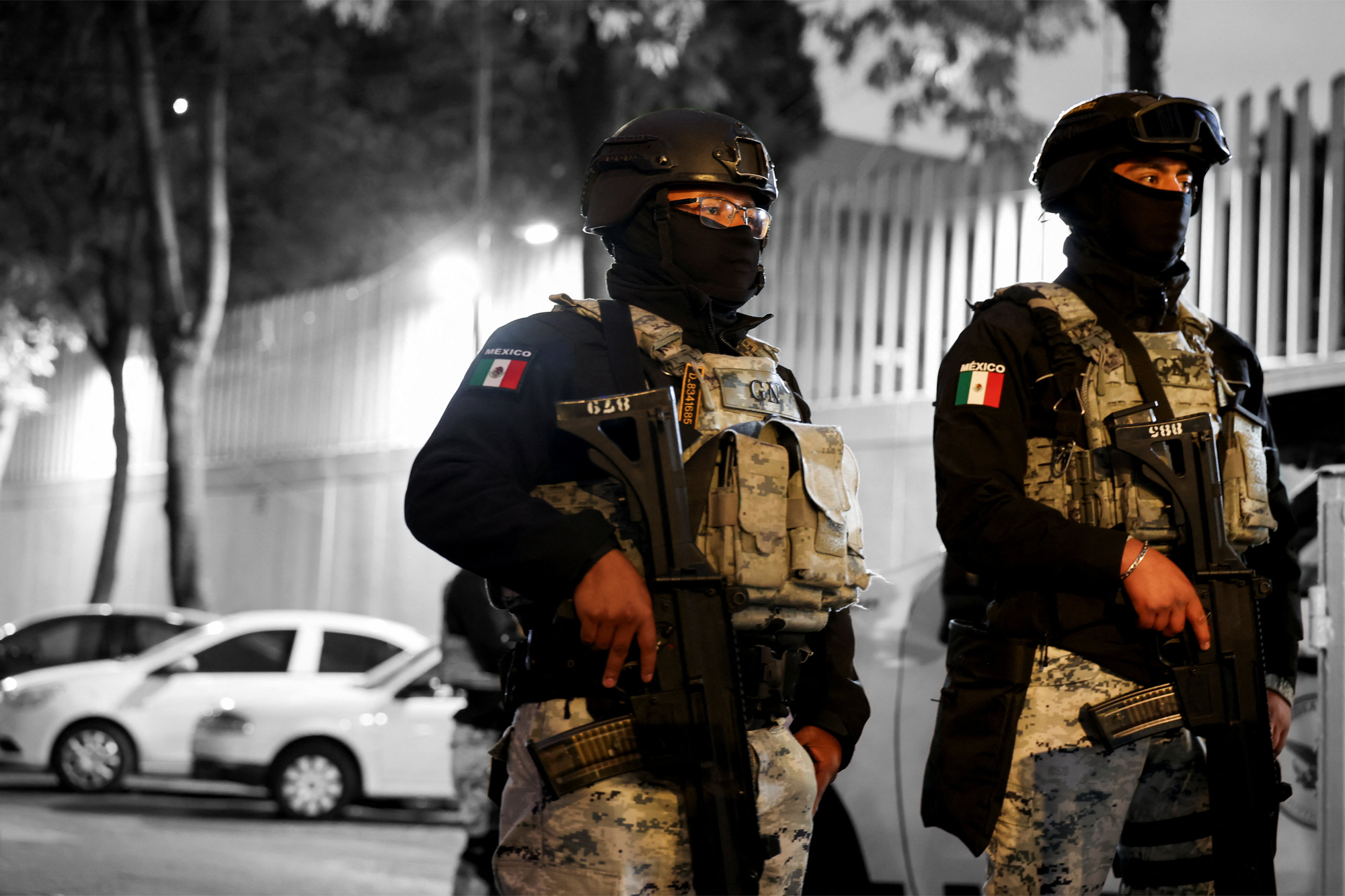
Cartel violence in Jalisco, Mexico. On Sunday, Mexican security forces killed cartel leader Nemesio Oseguera Cervantes — known as “El Mencho” — and multiple others in a military operation assisted by U.S. intelligence in Tapalpa, Jalisco, in Western Mexico. Oseguera was wounded in a violent clash with Mexican special forces and died while being flown to Mexico City. In response to the killing, shootouts, explosions, and over 250 vehicle blockades and arson attacks spread across Jalisco, as well as the nearby states of Michoacán, Guanajuato, Colima, and Tamaulipas.
Jalisco Governor Pablo Lemus Navarro declared a “Code Red” state of emergency in the state. Additionally, the U.S. Embassy in Mexico issued a shelter-in-place warning to U.S. citizens in the region, and multiple airlines canceled flights into and out of nearby airports. Mexican authorities confirmed that 25 members of the country’s National Guard were killed in six separate attacks in Jalisco; in another part of the state, a high-ranking cartel member was offering $1,000 for every soldier killed, according to Mexican Defense Secretary Ricardo Trevilla. The government said the situation had stabilized by Monday morning, by which point more than 70 people had died in the violence.
Oseguera, 59, was the leader of Jalisco New Generation Cartel (CJNG), co-founding the cartel in 2009 and building it from a local criminal group into what the Drug Enforcement Agency and Federal Bureau of Investigation consider Mexico’s largest trafficking organization and one of its most violent. CJNG has a presence across nearly all 50 U.S. states and is responsible for significant quantities of cocaine, fentanyl, and methamphetamine entering the country. The cartel is also known for its brazen violence against the Mexican government; in 2020, CJNG attempted to assassinate security officials with grenades and high-powered rifles in Mexico City. The U.S. had offered a $15 million reward for El Mencho’s capture.
In January 2025, President Donald Trump issued an executive order designating drug cartels as terrorist organizations. In August, The New York Times reported that Trump secretly signed a directive to the Pentagon to begin targeting Latin American drug cartels. Last month, the U.S. established a counter-cartel task force that works with the Mexican military and reportedly shared intelligence for the El Mencho operation.
Mexican President Claudia Sheinbaum has rejected U.S. offers for increased military assistance in combating the cartels, saying that Mexico is open to intelligence sharing but will handle its own domestic operations.
Below, we’ll cover what the left, right, and Mexican writers are saying about the military operation, El Mencho's death, and the cartel response. Then, Senior Editor Will Kaback gives his take.
What the left is saying.
- The left is mixed on the operation, with some arguing the U.S. is continuing to push for a failed policy.
- Others praise Sheinbaum for her decisive action.
In Jacobin, Benjamin Fogel wrote “another kingpin falls, nothing changes.”
“For nearly fifty years, the United States has pursued a strategy of taking out the leaders of major drug trafficking organizations as the centerpiece of its drug wars. El Mencho joins the litany of past slain iconic designated drug villains deemed as the most violent and dangerous traffickers of their day in the never-ending ‘war on drugs,’” Fogel said. “Nobody can seriously claim that any of these deaths or arrests has made Mexico a less violent country or seriously reduced the overall power of organized crime, let alone hindered the flow of drugs to the United States and the rest of the world.”
“Since Richard Nixon first declared a war on drugs in 1971, in large part to justify a crackdown on the New Left, there are now more drugs on the market than ever before, and they have never been easier to get hold of; if anything, the price has been dropping from South Africa to Europe. As a thought experiment, it’s worth asking at this point if actually winning the war on drugs is the goal, if the agencies waging it are dependent on the threat posed by narcotrafficking for continued budgets in the tens of billions,” Fogel wrote. “Regardless of what happens following Mencho’s death, the fall of another kingpin will do little to stem the power of organized crime and the interests that benefit from disorder, including those currently in the White House.”
In Bloomberg, Juan Pablo Spinetto said “Sheinbaum kills a drug lord and crosses her Rubicon.”
“Every time a major cartel loses its boss, the spasm of revenge against the government is followed by bloody internal struggles as major players and their factions move to fill the vacuum,” Spinetto wrote. “Yet even as it raises the prospect of sustained violence and cartel infighting in parts of Mexico, as seen in Sinaloa after the removal of Ismael ‘Mayo’ Zambada in 2024, Sheinbaum’s bold move deserves support and recognition. The Mexican military operation, backed by US intelligence, cements a major turning point in the country’s security strategy since Sheinbaum took office nearly 17 months ago.”
“The so-called kingpin strategy aimed at decapitating drug lords rarely prevents the rise of a new capo even as it triggers violent unrest. Like nature, multibillion-dollar criminal cartels abhor a vacuum. But the Mexican state needed to show that it has the resolve to regain control of parts of the country that criminal networks have terrorized for far too long,” Spinetto said. “The operation is also a win for Sheinbaum in other respects: It shows that bilateral security cooperation with the US can pay off and that she is serious about fighting organized crime. That will win her credit with a Trump administration that has been rough in its treatment of the US’s main trading partner.”
What the right is saying.
- The right supports the operation and calls on Mexico to continue its campaign against cartel leaders.
- Some say the U.S. and Mexico should deepen their partnership in this effort.
The Wall Street Journal editorial board asked, “will President Sheinbaum keep going?”
“[Sheinbaum’s] predecessor and mentor, Andrés Manuel López Obrador (2018-2024), followed a ‘hugs not gunshots’ appeasement policy toward the cartels that was a disaster. Organized crime now controls wide swaths of Mexico, producing and trafficking drugs, kidnapping for ransom, and running shakedown rackets,” the board wrote. “Ms. Sheinbaum took an early step toward confronting the cartels by appointing former Mexico City super-cop Omar García Harfuch as her secretary of Security and Citizen Protection. On Sunday she showed new seriousness by going after the leader of the powerful Jalisco New Generation Cartel.”
“Most Mexicans, apart from many in Ms. Sheinbaum’s Morena party, welcome [U.S.] assistance… Their country has become lawless in many places and they want relief,” the board said. “Mr. Trump can also help by telling Americans to stop feeding the cartels by using drugs, and he can roll up networks in the U.S. Mexico can expect more violence if it continues to press its cartel campaign, but that is one price of letting the drug lords gain so much power.”
In The Washington Examiner, Connor Pfeiffer explored “Trump’s opportunity in Mexico.”
“This operation is a massive victory for Mexico and the United States and demonstrates that President Donald Trump’s pressure on Mexico to increase security cooperation is working. Now is the time to double down on these gains and make lasting progress against narco-terrorist groups that terrorize both countries,” Pfeiffer wrote. “But taking down kingpins alone is not enough — Mexico has killed or captured a string of cartel leaders in the past 20 years, yet criminal groups continue to strengthen their hold over large swaths of Mexico.
“To make lasting gains against transnational organized crime, Mexico must work with the U.S. to degrade cartel leadership and networks, remove corrupt politicians who do their bidding, and improve Mexico’s legal system,” Pfeiffer said. “With the ongoing civil war between factions of the Sinaloa Cartel, there is a rare window of opportunity where Mexico’s most powerful cartels are weakened at the same time. This provides a chance for Mexican forces, supported by U.S. intelligence and other forms of assistance, to dismantle the networks that will attempt to perpetuate El Mencho’s reign of terror or seek advantage for other criminal groups.”
What the Mexican writers are saying.
- Mexican writers are relieved at El Mencho’s death, but some argue subsequent actions must target CJNG’s finances.
- Others say Mexico should work with the U.S. to continue forcefully confronting the cartels.
In Expansión Política, Alberto Guerrero Baena said “killing a kingpin does not kill his structure.”
“[El Mencho’s death] closes one chapter, but opens another that Mexico cannot read with naivety or premature euphoria. The history of Mexican organized crime teaches a brutal and recurring lesson: killing a kingpin doesn't kill his organization,” Baena wrote. “When a leader of this magnitude dies, the power vacuum doesn't remain empty for long. The internal factions of the CJNG already have their own operatives with names, territories, and loyalties… The internal succession can take two equally dangerous forms: an orderly transition under a new, consolidated leadership, or a fratricidal war that bleeds the territories under its former influence dry.”
“The Mexican government, in collaboration with the Financial Intelligence Unit (UIF), the Federal Public Prosecutor's Office, and international agencies such as FinCEN in the United States and Europol, must immediately activate a protocol for tracing the assets of the CJNG,” Baena said. “Identifying, freezing, and seizing the assets — front companies, properties, accounts, agricultural investments, and transportation franchises — that sustain the cartel's daily operations is more effective than pursuing individual leaders. Without a flow of money, the organization collapses.”
In Excelsior, Pascal Beltrán del Río wrote about “the end of hugs.”
“The events in Tapalpa demonstrate that criminals must be confronted with the same firepower and determination they have amassed. Peace is not negotiated with those who use car bombs, antipersonnel mines, and armed drones against the population, but rather imposed through the legitimate force of the State,” del Río said. “However, the leader's death is not the end of the problem. Now that El Mencho is gone, the government has an urgent obligation to continue fighting the organization with the same intensity to prevent it from regrouping under a new leader or fragmenting into even more violent cells.”
“It is positive that… there is close coordination with U.S. agencies. Drug trafficking is, by definition, a transnational crime that knows no borders and requires a joint operational strategy with our neighbor to the north, implemented without false notions of sovereignty. Shared intelligence and binational pressure are indispensable tools for dismantling the finances and routes of a monster that speaks both languages,” del Río wrote. “Mexico took a firm step on Sunday. Let us hope that this is the beginning of an era in which the law is applied firmly and in which the State finally recovers its monopoly on the use of force.”
My take.
Reminder: “My take” is a section where we give ourselves space to share a personal opinion. If you have feedback, criticism or compliments, don't unsubscribe. Write in by replying to this email, or leave a comment.
- The killing of El Mencho illustrates the power of Trump’s influence in Mexico.
- Despite the headline, this may not result in any meaningful change.
- We should continue pushing President Sheinbaum fully combat the destructive power of cartels, but through cooperation, not coercion.
Senior Editor Will Kaback: Cartels have long occupied a mythological status in U.S. pop culture, sitting alongside the Italian mafia and Japanese yakuza as real-life crime syndicates that animate the American imagination. But they always seem a safe distance away, existing to most people only through television shows, films, and music.
Days like Sunday serve as a reminder that cartel violence is more than just a plot line or catchy lyric.
Some of this violent wave has lapped upon the shores of American life — the military helicopter circling above vacationers in Puerto Vallarta, or the terrified families sheltering in place from gunfire in Guadalajara International Airport. But much of the destruction has hit innocent Mexicans — the smoke of burning vehicles billowing from highways, shattered windows of brightly colored businesses, and charred remnants of convenience stores. For me, and I expect many others in the U.S., these scenes bring the reality of Mexico’s fight against cartels into focus.
El Mencho’s killing is a significant escalation in Mexico’s anti-cartel operations, the logical next step in President Claudia Sheinbaum’s efforts to both assert governmental control and satisfy the Trump administration’s demands. After Sheinbaum’s first year in office, Mexican authorities had destroyed roughly 1,600 drug labs and arrested approximately 35,000 people for “high-impact crimes.” Comparatively, former President Andrés Manuel López Obrador, who took a “hugs, not gunfire” approach to cartels, averaged 380 destroyed labs and 8,900 high-impact arrests annually during his term. Sheinbaum has also begun cleaning house at all levels of government, targeting corrupt elected officials accused of working with cartels at the municipal level. It's a just crusade that requires a great deal of political (and personal) bravery, and it's good news she's getting support from the United States president.
These actions have sent a strong signal that the Sheinbaum administration is aggressively confronting the cartels’ influence, but the El Mencho operation takes this initiative a step further. Before her election, Sheinbaum campaigned on continuing AMLO’s strategy of fighting cartels by trying to address the “root social causes” of cartel crime. She also came into office poised to continue avoiding the “kingpin strategy” of arresting cartel leaders, which Mexican officials believed would only cause more violence.
The changes in philosophy and tactics palpably show President Trump’s influence. Combatting cartels has been a day-one priority for the second Trump administration, which has stepped up its pressure in recent weeks. It was easy to miss amid the seismic foreign policy news of the past two months, but Trump spent the back half of January issuing explicit warnings about U.S. military involvement if Mexico rebuffed his request for joint operations against cartels and their fentanyl production labs. Also easy to miss was Mexico’s apparent acquiescence. On January 15, Secretary of State Marco Rubio and Mexican Foreign Secretary Juan Ramón de la Fuente issued a joint statement highlighting the need for “tangible actions to strengthen security cooperation and meaningful outcomes to counter cartels.”
This pressure almost certainly played a role in Sheinbaum’s decision to pursue El Mencho — rather than risk a sovereignty crisis (or, worse, a hot war) if the U.S. acted unilaterally, she showed that the Mexican military was capable of taking down even the most notorious drug lord in the country.
On one hand, this result vindicates Trump’s strategy: His pressure led to action that eliminated a destructive person, all without direct U.S. involvement. This is the exact kind of flashy and efficient operation against a high-value target that the Trump administration has prioritized in other areas of foreign policy. On the other, the immediate success could backfire in the long run — and prove exactly why Mexico has been avoiding the “kingpin strategy.”
The violence that broke out in response to Oseguera’s death is likely the tip of the iceberg. When the United States arrested Sinaloa cartel leader Ismael “El Mayo” Zambada in 2024, it hailed the operation as a victory in its fight against fentanyl trafficking. But modern cartels — like terrorist groups — aren’t dependent on a single leader to function. Rather, as El Mayo’s case illustrates, removing the leader often creates a power vacuum that gives way to heightened violence. Criminal activities may be temporarily affected, but with hundreds of other leaders within the cartel and tens of thousands of contractors, the operation marches on; one year after El Mayo’s arrest, the Sinaloa cartel still ranks among the world’s most powerful drug traffickers — and violence in Sinaloa is as bad as it’s ever been.
The post-El Mencho CJNG will probably follow a similar path. While the government seems to have gotten the immediate disorder under control, long-term ramifications will reveal themselves in the weeks and months ahead.
Of course, that violent backlash doesn’t prove that Trump or Sheinbaum should just accept the inevitability of the cartels’ power or embrace López’s strategy of pacification. On the contrary, a focus on Mexican cartels is a direct response to the source of the fentanyl that fueled the drug overdose epidemic in the United States. Anyone who has criticized Trump’s actions against Venezuela as a poor response to our domestic drug issues (as we have, repeatedly) should be glad to see his eye on the ball now. But I worry that he will take the wrong lesson from the El Mencho operation — namely, that the U.S. can keep pressuring Mexico into flashy, headline wins that incur losses only Mexico feels — and may not actually curtail drug trafficking. I worry that the pressure on Sheinbaum will continue; with countless cartel leaders and operations remaining, why stop at El Mencho?
And why do I worry? Because Mexico is not Venezuela, Iran, Hamas, or Russia. They’re a partner and an ally; President Sheinbaum maintains a powerful standing in Mexico’s government, has proven effective at countering the cartels, and welcomes U.S. assistance in this fight (so long as we respect their sovereignty). Pursuing a path of coercion — rooted in credible threats of unwanted military intervention — not only risks that mutually beneficial relationship, it risks forcing Sheinbaum to substitute effective strategy for political self-preservation. If Sheinbaum wants to keep the U.S. military at bay, she knows that she must continue going after cartel leaders, regardless of whether doing so will have a meaningful impact on drug trafficking — and regardless of the downstream violence it causes.
But if an alternate approach is better than the kingpin strategy the Trump administration is pushing for, what could this other path look like? Vanda Felbab-Brown at the Brookings Institution has some of the best ideas I’ve come across: embedding U.S. law enforcement agents with Mexican units, reviving joint intelligence centers, continuing to identify and expel cartel-aligned politicians, and helping develop new Mexican federal police units. Writers like Alberto Guerrero Baena (under “What Mexican writers are saying”) also outlined how international collaboration can effectively limit CJNG’s access to financial resources. Crucially, I think Mexico would be amenable to most, if not all, of these proposals. In this fraught moment, as an El Mencho-sized power vacuum threatens to consume large swaths of the country, such a partnership presents a potent opportunity to take advantage of a destabilized cartel.
If nothing else, Mexico should remain committed to direct confrontation. The cartels are the poisonous underbelly of a country otherwise defined by its rich culture, natural beauty, and vibrant people. For too long, these criminal organizations have held it back. Trump deserves credit for pushing them toward dealing with the problem with the resources it requires instead of more half measures — but if that push doesn’t bring positive results, then he will deserve the blame, too.
Take the survey: What do you think Mexico’s stance against the cartel should be? Let us know.
Disagree? That's okay. Our opinion is just one of many. Write in and let us know why, and we'll consider publishing your feedback.
Your questions, answered.
Q: I have seen conflicting reports about what the SAVE Act would mean for voters, especially married women who have changed their last names. Some sources say a Real ID will act as proof of citizenship. Others say a passport will be required. What is the truth here? Also, will existing voter registrations be purged, requiring everyone to submit new documentation? I’m very confused and concerned about how disenfranchising this bill actually is.
— Tracy from Brighton, MI
Tangle: In April of last year, the House of Representatives passed the Safeguard American Voter Eligibility (SAVE) Act, a bill requiring proof of citizenship for voters to register for federal elections. Although it passed the House with mostly Republican support, it died in the Senate; any bill requires 60 votes in the Senate to pass the filibuster threshold, and Democrats uniformly opposed the act. This year, a new version of the bill — called the SAVE America Act — again passed the House, but now faces the same challenges in the Senate.
We covered the SAVE Act in an in-depth Friday edition, which we made available to all readers, last year. Much of what we wrote about the SAVE Act applies to the SAVE America Act, but to answer your questions directly:
If passed, the SAVE America Act would require any first-time voter — or registered voter who is changing their status — to re-register in person with documents that the bill specifies as sufficient to prove citizenship: a passport, a military identification card, or a photo ID paired with another form of government ID such as a birth certificate (similar to the documents required when filing an I-9 at a place of employment).
Among other reforms, the bill would impose new proof-of-citizenship requirements on anyone who is registering to vote for the first time. It would also require any voter who is moving, changing their name, or otherwise updating their voting status to physically go to their local government with documentation to prove their citizenship (this can be done through the mail today).
The largest impacted group would be people with changed names — and the largest subgroup is married women who have taken a new name. When re-registering, any voter whose name as it appears on their proof-of-citizenship ID does not match their name in the voter roll — or whose name on their birth certificate does not match the name on another government ID — will have to present additional documentation (such as a marriage license) in order to prove their citizenship. However, no action is required of registered voters who have already changed their names and are not making a change to their voting information. That means the roughly 69 million married women who have changed their surnames, as well as likely hundreds of thousands of transgender citizens and others with changed biographical data, will not have to do anything if they are already registered to vote.
Want to have a question answered in the newsletter? You can reply to this email (it goes straight to our inbox) or fill out this form.
Under the radar.
On Tuesday, February 17, the Department of Housing and Urban Development (HUD) proposed a new rule that would bar immigrants in the United States illegally from living in federally subsidized properties. The rule seeks to address “mixed status” households, in which some occupants are U.S. citizens or legal residents, but others are not. If enacted, the rule would require every resident of a public housing residence to provide proof of citizenship or legal status, regardless of age. “We have zero tolerance for pushing aside hardworking U.S. citizens while enabling others to exploit decades-old loopholes,” HUD Secretary Scott Turner said. Some housing advocates have come out against the rule, saying it would lead to over 100,000 people — including thousands of children — being evicted. The Hill has the story.
You're probably overpaying for half the things you buy.
Your car insurance, credit cards, Amazon purchases — companies are banking on you not noticing.
We found a list of ways to stop getting ripped off and start pocketing that money instead.
Some could save you thousands. See which ones apply to you.
Numbers.
- 5.7 million. The metro area population of Guadalajara, the capital city of Jalisco.
- 2009. The year the Jalisco New Generation Cartel (CJNG) was formed.
- 40. The approximate number of countries in which CJNG has a confirmed presence.
- 15,000–20,000. The approximate number of CJNG members.
- 9,500. The number of Mexican troops that have been deployed to quell cartel violence since February 22.
- 13. The number of Mexican states that have experienced cartel-related violence since the operation that killed CJNG leader Nemesio Oseguera Cervantes.
The extras.
- One year ago today we wrote about the Pentagon firings.
- The most clicked link in yesterday’s newsletter was Judge Aileen Cannon blocking Jack Smith’s report.
- Nothing to do with politics: A mashup credit sequence for fans of Adam Scott: Parks and Severance.
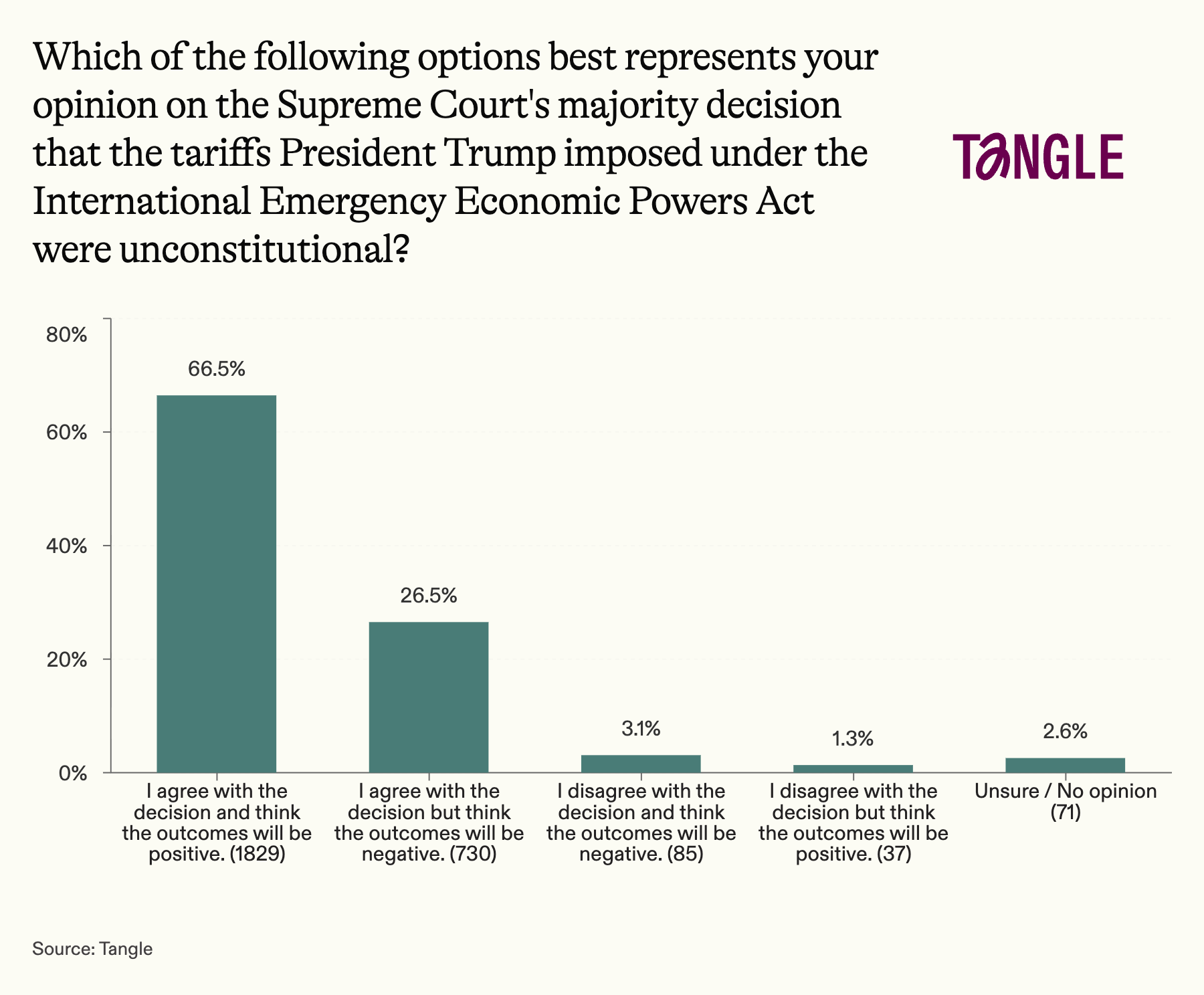
- Yesterday’s survey: 2,752 readers responded to our survey on the Supreme Court striking down Trump’s “reciprocal tariffs” with 67% agreeing with the decision and thinking the outcomes will be mostly positive. “Laws are messy and interpretation near the edges of the envelope will generally be unsatisfying,” one respondent said. “The executive branch needs to be checked after years of unilateral actions,” said another.
Have a nice day.
On Thursday morning, Fire and Rescue teams responded to a 911 call in Lawrence County, Tennessee. Emergency responders were able to successfully put out the fire, which burned the residence of a disabled 72-year-old woman. The woman suffered burns but was able to escape the blaze, thanks to the decisive actions of her granddaughter. “Our 12-year-old daughter became a hero that day. When the fire broke out, she bravely pulled her grandmother out of the house and saved her life. Because of her quick thinking and courage, we still have our mom/grandmother with us today,” the family posted in a GoFundMe update. “We are beyond grateful — and so proud of her strength.” The Lawrence County Advocate has the story.

Member comments