
I'm Isaac Saul, and this is Tangle: an independent, nonpartisan, subscriber-supported politics newsletter that summarizes the best arguments from across the political spectrum on the news of the day — then “my take.”
Are you new here? Get free emails to your inbox daily. Would you rather listen? You can find our podcast here.
Today’s read: 14 minutes.
My interview with Elliot Williams.
Last week, I sat down with Elliot Williams — the CNN anchor and author — to discuss his new book Five Bullets. The book re-tells the story of Bernie Goetz, the crime-ridden New York of the 1980s, and how his shooting mirrors so much of what we see in today’s politics. It was a great read, and Elliot was a fun interview. The sit-down came at the end of our latest episode of Suspension of the Rules, where Ari, Kmele, and I discussed how we interact with law enforcement and the Kanye West apology. You can listen here or watch it all on YouTube here.
Quick hits.
- The House Rules Committee advanced a funding bill that would end the partial government shutdown that began on Saturday. The chamber is expected to vote on the bill on Tuesday. (The latest)
- A federal judge blocked the Department of Homeland Security’s attempt to end Temporary Protected Status for approximately 350,000 Haitian nationals living in the United States, finding that Homeland Security Secretary Kristi Noem did not have the authority to terminate the status. (The ruling)
- Fulton County, Georgia, will sue the Federal Bureau of Investigation and the Justice Department over a search warrant executed last week, which resulted in hundreds of boxes of materials related to the 2020 presidential election being seized. The county believes the warrant was improperly issued and seeks to have the materials returned. (The suit)
- President Donald Trump announced a trade deal with India. The agreement will lower U.S. tariffs on Indian imports from 50% to 18%, while India will lower trade barriers for U.S. imports and stop its purchases of oil from Russia. (The deal)
- Representatives from the United States and Iran are expected to meet in Turkey on Friday to discuss Iran’s nuclear-weapons program and ongoing tensions between the countries. The foreign ministers of Saudi Arabia, Qatar, the United Arab Emirates, Egypt, Pakistan, and Oman have also been invited to join the talks. (The talks)
45% off the ultra-slim charger that actually fits in your wallet
Ever had your phone die right when you needed to make a phone call, grab an Uber, or use your GPS for directions?
Meet the Wireless ChargeCard — the absolute best VALENTINE'S DAY gift you can possibly give.
Nobody likes walking around with a dead phone, yet somehow it always happens at the worst time. The ChargeCard fixes that.
It’s an ULTRA-Slim portable charger that slips right into your pocket or wallet so it’s always with you (unlike those big, bulky chargers that are annoying to carry around).
Because it charges magnetically, there are no cables needed. Just stick it to the back of your phone and instantly start charging. It’s sleek, genius, and ridiculously THIN — the kind of gift that gets used daily.
Featured in Forbes, Fox, and Good Morning America for a reason, the AquaVault ChargeCard is arguably the most convenient charger around.
Use code TANGLE45 to get 45% OFF your order today.
Today’s topic.
Trump’s pick for Fed chair. On Friday, President Donald Trump announced his nomination of former Federal Reserve Governor Kevin Warsh to be the next chair of the Federal Reserve, choosing him to succeed current Chairman Jerome Powell when Powell’s term expires in May 2026. The nomination will now go to the Senate for confirmation, where Sen. Thom Tillis (R-NC) has vowed to block its advancement in the Senate Banking Committee until a Justice Department probe into Powell is resolved.
Back up: President Trump has had a contentious relationship with the Federal Reserve in his second term. Throughout 2025, Trump criticized Powell for not cutting interest rates quickly enough; then, in January, the Department of Justice launched a criminal investigation into Powell for alleged mismanagement of the Fed’s headquarters renovation. Trump has also targeted other Fed policymakers, attempting to fire Governor Lisa Cook in August over alleged mortgage fraud.
Last week, the Federal Reserve’s Open Market Committee (FOMC) held its most recent meeting to set the Fed’s federal funds rate, holding its benchmark interest rate at 3.50%–3.75%. The majority of the FOMC judged that inflation is still above its goal and labor markets are strong enough to warrant no change. President Trump has publicly pushed for steeper rate cuts, at times advocating for rates as low as 1% to stimulate growth. Governors Christopher Waller and Stephen Miran, both Trump appointees, publicly dissented from the FOMC’s majority decision, pushing for a cut.
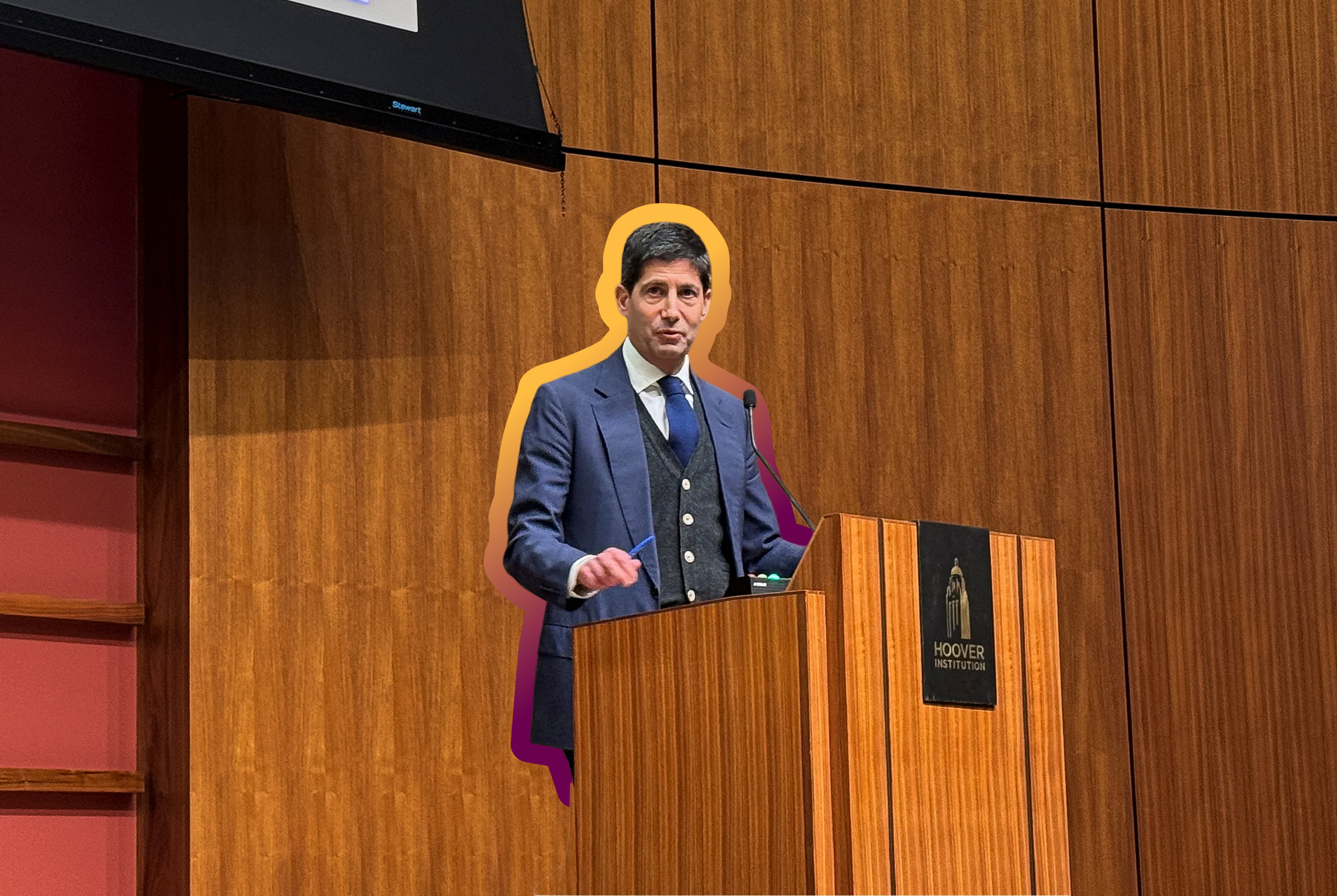
Warsh, 55, served on the Fed’s Board of Governors from 2006–2011 as its youngest-ever governor, acting as a key liaison to Wall Street during the 2008–09 financial crisis. He currently serves as a visiting fellow at Stanford’s Hoover Institution and is known for both crisis-era leadership and critiques of Fed policy under recent chairs. Before selecting Warsh, Trump considered a shortlist that included White House economic adviser Kevin Hassett, Federal Reserve Governor Christopher Waller, and BlackRock executive Rick Rieder.
Republicans in Congress have mostly supported Warsh’s nomination. Senate Banking Committee Chairman Tim Scott (R-SC) said he was “confident Kevin will work to instill confidence and credibility in the Fed’s monetary policy.” However, Warsh’s chances of confirmation are uncertain without Sen. Tillis’s support in the Banking Committee, as committee Democrats uniformly oppose the nomination until the Justice Department’s probes into Powell and Cook are dropped. “Any consideration of Kevin Warsh’s nomination can only come after this president stops trying to use the Department of Justice as his political attack dog against The Fed Board,” ranking member Andy Kim (D-NJ) said.
We’ll get into what the right and left are saying about Warsh’s nomination, then Senior Editor Will Kaback gives his take.
What the right is saying.
- The right broadly supports Warsh, believing that he will provide a much needed course correction for the Fed.
- Some question whether President Trump’s pressure will influence Warsh’s decisionmaking.
- Others think that Warsh will not bring much change to the Fed.
The Wall Street Journal editorial board called Warsh “the right choice for the Fed.”
“Mr. Warsh has in recent years offered a searching critique of Fed policy since the financial panic. He has been especially pointed in saying that the central bank has taken on a broader role in economic policy than it should,” the board said. “This ‘institutional drift,’ as he put it, has caused the Fed to lose the plot on its essential mandate, which is price stability. The Fed has also wandered into fiscal policy with its bond-buying that has underwritten excessive federal spending and asset purchases that contributed to the misallocation of capital… And that’s without its Biden-era political bows to consider climate change in financial regulation and the racial impact of monetary policy. Such political bows compromised the Fed’s independence by its own hand.”
“Mr. Warsh will steer the Fed away from all that. He will also aim to reduce the Fed’s balance sheet that has ballooned into the trillions of dollars from merely some $800 billion when Mr. Warsh first joined the Fed,” the board wrote. “None of this will be easy. He will face opposition from many on the Fed staff and from the central-banking clerisy that includes the recent Fed chairs he has criticized. The Senate should consider the latter a recommendation. He will also have to navigate the man in the White House who thinks interest rates should only go down, but Treasury Secretary Scott Bessent can help on that front.”
National Review’s editors asked, “Kevin Warsh: hawk or dove?”
“Warsh’s résumé is indeed one from central casting — Stanford, Harvard, Morgan Stanley, George W. Bush’s White House, appointed as the youngest-ever Fed governor in 2006 — but what makes it stand out is its chronology. A little more than a year after Warsh took office, increasingly severe market turbulence heralded the approach of the global financial crisis, a storm that, as someone with experience and good connections on Wall Street, he was well-equipped to help navigate, as he duly did,” the editors wrote. “During the financial crisis, Warsh was a hawk on monetary policy. He was concerned about an imminent inflationary threat in 2009.”
“The question for Warsh, who we should note has only one vote on the board, is how his long-standing hawkishness on inflation can be reconciled with the views of a president for whom, it sometimes seems, no interest rate can be too low,” the editors said. “Warsh may be put to the test on this issue in short order. The latest inflation report on producer prices came in hotter than expected. While cutting rates is not inflationary in every single instance, at this time, any further rate cuts would not only be premature but would, in the end, be likely to be counterproductive by forcing rates up, especially if there is any perception — a high risk currently — that Warsh has been bullied into it.”
In MarketWatch, Jai Kedia said Warsh “needs to keep the Fed out of politics.”
“Warsh’s best and most consistent policy view is his opposition to quantitative easing (QE)... Warsh has continued to advocate for a smaller balance sheet that would allow monetary policy to revert to its pre-2008 system that, while imperfect, is far better than now,” Kedia wrote. “Warsh has also criticized the Fed’s mission creep, and he’s right to do so. The Fed cannot fix everything, and trying to do too much only serves to detract from its core mission. Doubtless, as Fed chair, Warsh will be pressured by politicians to help with ballot-box issues. He should stand firm on principles and reject Fed involvement. Crucially, this also means standing up to the president.”
“Warsh has a better chance than Fed Chair Jerome Powell or former Chair Janet Yellen to implement such serious reform… But, all things considered, it’s doubtful that any serious changes will be implemented by changing the Fed chair alone,” Kedia said. “Take QE as an example: We were assured that it was a temporary measure when first implemented. It has been almost 20 years since, and massive asset purchases that were once an unconventional monetary-policy tool are now standard practice. It will be too tempting, and too easy, to interfere in asset markets once again at the first sign of economic distress. And Warsh’s tenure as governor already records him voting in favor of QE despite his reservations.”
What the left is saying.
- The left has a mixture of support and concern on Warsh’s nomination.
- Some criticize Warsh’s record as a Fed governor.
- Others believe that the systems in place will limit his options for reform.
In The Free Press, Jason Furman laid out “four rules for the new Fed chair.”
“Warsh clears the substantive bar for the job. He is quick, intellectually serious, and capable of engaging with arguments he disagrees with. He understands the Fed, the executive branch, and financial markets. He has the raw materials to be an excellent Fed chair,” Furman wrote. “But success won’t hinge on technical mastery alone. It will depend on whether he can meet four tests of judgment and temperament — tests that reinforce one another. Independence without technocratic discipline becomes politics. Technocracy without leadership becomes drift. Leadership without humility becomes dogma. Humility without independence becomes capitulation. The job demands all four.”
“The foundation of everything else is whether Warsh will aggressively protect the Fed’s independence. In pursuing the position, he shaded his rhetoric toward Trump’s preferences more than I would have liked. History will judge Warsh on whether or not he corrects — or overcorrects in the opposite direction — once in office,” Furman said. “Warsh is a Republican political figure. He wouldn’t be the first Fed chair with deep partisan roots… In illustrating the right attitude for the Fed to take, Warsh has used examples like eschewing commentary on climate change and inclusion. But the same principle should apply equally to tax cuts and energy regulation. The Fed cannot be selectively neutral.”
In The New York Times, Catherine Rampell described “what worries me about Trump’s new Fed pick.”
“Let’s start with the good news: Mr. Warsh is a dramatically better option than some of the alternatives Mr. Trump was considering. Kevin Hassett, formerly seen as the top contender, kissed up to Mr. Trump so overtly that investors took his subservience for granted — and greatly feared what the loss of Fed independence would mean for the economy,” Rampell said. “Mr. Warsh knows this. ‘If the Federal Reserve lost its independence, its hard-earned credibility would quickly dissipate,’ he said in a 2010 speech titled ‘An Ode to Independence.’ But there are reasons to wonder if he still heeds those words. Among them: He has abandoned some of his long-held views just in time to audition for Fed chair.”
“Mr. Warsh is seen as an inflation hawk… The day after Lehman Brothers filed for bankruptcy in 2008, Mr. Warsh, who was then a Fed governor, was still concerned about the possibility of spiking inflation. Instead, the Fed’s preferred measure of inflation immediately turned negative, thanks to cratering demand,” Rampell wrote. “Of course, plenty of people get predictions wrong. But not usually this wrong, without acknowledgment or explanation of how they’d avoid a similarly catastrophic error next time, particularly when expecting a promotion. This brings me to the political expedience that seems to sway Mr. Warsh’s choices. He has twice made an abrupt about-face on his usual demands for tighter money, and both occurred when Mr. Trump was in office.”
In the Council on Foreign Relations, Roger W. Ferguson Jr. and Maximilian Hippold argued “Kevin Warsh won’t revolutionize the Federal Reserve.”
“After years of railing against what he views as misguided monetary policy, Trump aims to resolve his issues with the central bank by installing an ally in arguably the most influential economic post in the United States,” Ferguson and Hippold wrote. “Yet if the president expects a dramatic transformation at the Fed that will lead to significant interest rate cuts, he is likely to be disappointed. Financial markets and economic realities will impose strict limits on the next chair.”
“Interest rate decisions are not made by the Fed chair alone. They are determined by the Federal Open Market Committee (FOMC), a twelve-member body,” Ferguson and Hippold said. “The structure of the FOMC, the state of the economy, and financial markets could prove to be the strongest constraint of all. Trump grew frustrated with his first appointment, and he is likely to encounter similar limits — even with a loyalist in the role. More plausible than a revolutionary Fed is a chair who communicates differently and echoes Trump’s views on the economy without implementing his most radical ideas. In the end, Trump may be satisfied simply knowing that his vision of an ‘A+++++’ economy is validated by the Federal Reserve.”
My take.
Reminder: “My take” is a section where we give ourselves space to share a personal opinion. If you have feedback, criticism or compliments, don't unsubscribe. Write in by replying to this email, or leave a comment.
- I’m relieved that Trump eschewed a more extreme nomination, and Warsh is a commendable pick in his own right.
- Warsh’s view on containing inflation could bring him into conflict with the president.
- His biggest idea — cutting the Fed’s balance sheet as a disinflationary tool — is risky but intriguing.
Senior Editor Will Kaback: One of President Trump’s truly unique qualities is his ability to elevate topics to the public consciousness that would not have garnered much attention in previous administrations. One prime example from the past year is how the president made his choice for the next Federal Reserve chair a reality television show: teasing different names, generating speculative news cycles, and raising persistent questions about his pick’s influence on the central bank. For some civics teachers out there, Trump provides incredible material — could any other politician generate such sustained public examination of something like Fed independence (or trade deficits, or immigration law, or housing policy, or foreign affairs)?
Of course, why these issues receive so much attention under Trump would make those same civics teachers sweat. The president is upending norms and institutions that many have taken for granted as things no president could (or would try to) disrupt. With the Fed, he has repeatedly attacked its leadership for refusing to cut interest rates fast enough — castigating current Chair Jerome Powell for months, attempting to fire Fed Governor Lisa Cook on dubious charges, and standing by as his Justice Department investigates Powell on similarly questionable grounds (if not outright directing it). All the while, the economy is flashing a mix of green and red signals, making decisions difficult for the Federal Open Market Committee (FOMC) as they try to chart a path forward.
Amid this confusion, enter Kevin Warsh.
President Trump’s attacks on the Fed have made this pick feel existential, and among the political and economic commentators I follow, the most common reaction to Warsh’s selection was relief — driven more by who Warsh is not rather than who he is. In particular, if Trump had nominated National Economic Council Director Kevin Hassett, who has displayed consistent fealty to him, it would have raised significant concerns about the president’s control over the central bank.
At the same time, some of Warsh’s strengths as a candidate play almost too much to Trump’s preferences. Warsh escalated Trump’s critiques of Chairman Powell at an opportune time, his father-in-law, Ronald Lauder, is a longtime friend of the president, and, not insignificantly, he looks like Trump’s idea of a Fed chairman out of “central casting.”
However, I think Warsh is a fine pick. He is amply qualified, and he has a refreshing perspective on monetary policy that I think will move the Fed toward more responsible policies. I also think he’ll be a far cry from a Trump sycophant, since Warsh’s record stands starkly opposed to Trump’s preferences in one important area: interest rates. Warsh has consistently argued that the Fed’s most important job is fighting inflation. As a Fed governor during the 2008–09 financial crisis, he maintained a focus on inflation even as the unemployment rate neared 10%. During the Biden administration, he roundly criticized the White House and Fed policymakers for ill advised decisions that led to surging inflation and called for “fiscal and monetary regime change.” If he becomes Fed chair, Warsh’s tendency towards inflation-fighting measures could easily put him in conflict with a president who wants rate cuts at all costs.
Warsh served on the FOMC during the Great Recession, and he returns to the central bank as it sizes up another tenuous economic moment. He has described this moment optimistically, arguing that Trump’s tax cuts and focus on deregulation, boosts in artificial intelligence, and American innovation will drive growth. Furthermore, Warsh argues that changes in regulation and spending can do more to fight inflation than the FOMC could by raising its rate, which would allow interest rates to stay low.
Two ideas informing this view stand out. First, Warsh thinks AI will increase productivity and wages without weakening the labor market. I don’t share this rosy view — I worry that hiring will continue to slow and some sectors’ workforces will shrink as AI adoption increases (though its discernible impact on hiring is still negligible).
Second, Warsh advocates for controlling inflation through reducing the Fed’s balance sheet: the sum of its assets (U.S. Treasury bonds and mortgage-backed securities) and liabilities (bank reserves and physical currency). Warsh actually left the Fed over his opposition to continuing quantitative easing — in simple terms, creating new money and using it to buy government bonds and other assets from banks, theoretically encouraging more lending and economic activity — after the most acute period of the financial crisis had passed. Quantitative easing has driven up the balance sheet, and in Warsh’s view, a reduction creates room for further interest rate cuts, which will spur economic activity without needing to print money. I’m not certain whether that strategy will work, but I do find his argument compelling.
How, then, might Warsh lead? Rapidly reducing the balance sheet would require rapidly selling assets, a move that could destabilize markets. And after years of getting used to easy money from the Fed, the government and Wall Street would feel the strain. It’s one thing to say this as a critic on the outside; it’s another to argue it from the chair. In Warsh’s own words, such a monumental policy shift requires “political courage and policy conviction.” Does he possess those qualities? We won’t know until we see him in action.
Even if Warsh does try to reduce the Fed’s balance sheet, he’ll have to do so gradually, meaning rates could hold steady or even be raised. And even if Warsh advocates for cuts, the Federal Open Market Committee can still vote to keep them where they are. What’s more, the independence of the chair and board members could soon be reaffirmed if the courts reject Trump’s attempt to have Lisa Cook removed. The upshot: Even if Trump gets everything he wants from Warsh, the interest rate could still stay higher than he wants, and Trump couldn’t do much about that (a reality the president seemed to acknowledge on Saturday).
That’s all getting a little ahead of ourselves; much could change before Warsh is confirmed. Trump’s attacks on the Fed have ensured a bruising confirmation process, and Sen. Tillis could stop the process in its tracks. I still expect Warsh to be confirmed eventually — with some Democratic support — but we’ll learn a lot more about how he approaches the role in the weeks and months ahead.
Concerns about Trump’s influence will also remain until we see how Warsh handles his first high-pressure decisions. I’m more optimistic than many on the left that he’s up for the challenge, but I also feel the frustration that we have to consider the new chair’s independence at all. Presidents from both parties have tried to influence Fed decision making, but Trump’s actions have no historical comparison besides President Richard Nixon’s 1972 pressure campaign on Fed Chair Arthur Burns to keep rates low, an effort that helped entrench inflation. We shouldn’t get comfortable with these kinds of attacks on the central bank, nor should we assess Warsh uncritically just because he was a less extreme choice. Still, I can’t help but feel a little relieved to be discussing issues like quantitative easing and artificial intelligence instead of how many rate cuts Chairman Hassett might push through before the midterms.
Take the survey: What do you think of Warsh’s nomination? Let us know.
Disagree? That's okay. Our opinion is just one of many. Write in and let us know why, and we'll consider publishing your feedback.
Your questions, answered.
Q: Why would you post about the Epstein Files on X when Elon Musk is in the recently released pages? Will Tangle be covering those 3 million pages?
— Shahri (submitted through Subtext)
Tangle: Among the roughly 3 million files the Justice Department released Friday to comply with the Epstein Files Transparency Act were emails, photographs, FBI reports, and apparent anonymous tips related to the Epstein investigation. The emails included exchanges between some very notable people, including Jeffrey Epstein and Elon Musk. One thread between Epstein and his executive assistant regarded Musk visiting Epstein’s island. However, a subsequent exchange casts uncertainty over whether such a visit ever occurred, and Musk publicly denies that he visited the island.
The DOJ also released further documents regarding connections between Epstein and President Donald Trump. It’s important to note that these documents included tips made to the FBI, which are notoriously unreliable. In this case, many of the tips going viral online are unsubstantiated by any further evidence. The latest release doesn’t appear to contain any significant new revelations, and the files include no direct exchanges between Epstein and the president.
Other notable names appearing in the release are Bill and Hillary Clinton (who have since agreed to testify before Congress); Steve Tisch, owner of the New York Giants; Bill Gates, founder of Microsoft; and Peter Attia, researcher and CBS News contributor (whose comments in the files have led to significant backlash). Some of the emails include salacious, vulgar and embarrassing exchanges, but — again — they contain no significant evidence of new criminal misconduct.
The files’ release was complicated by the accidental inclusion of nude photographs and victims’ names and identifying details, which were meant to have been redacted. On Wednesday, a federal judge will consider victims’ request to shut down the website that hosts the files after the improper disclosures.
Deputy Attorney General Todd Blanche said this release concludes the DOJ’s obligations; however, critics argue that the DOJ’s decision to withhold several million more files is a violation of the law.
Want to have a question answered in the newsletter? You can reply to this email (it goes straight to our inbox) or fill out this form.
Under the radar.
On Wednesday, February 4, the last U.S.–Russia nuclear treaty expires. The treaty, called New START, was signed by President Barack Obama and Russian President Dimitry Medvedev in 2010, placing limitations on several types of nuclear weapons. Deployed strategic warheads were capped at 1,550 for each side, and deployed ground- or submarine-launched missiles and bomber planes were limited to 700. Each side was also permitted to conduct on-site inspections of the other’s facilities on short notice to ensure compliance. With no new agreement in the works, New START’s expiration has raised concerns among some experts that the lapse could lead to renewed nuclear proliferation during a time of heightened global conflict. Reuters has the story.
The Valentine's gift they'll actually use (45% off)
Your phone dies when you need it most. The Wireless ChargeCard solves this — it's thin enough for your wallet, charges magnetically without cables, and works instantly.
Just stick it to your phone and go. Better than flowers that die in a week.
Use code TANGLE45 for 45% off!
Numbers.
- 2011. The year Kevin Warsh resigned from his seat on the Federal Reserve Board of Governors, after serving five years of his 14-year term.
- 13 and 11. The number of Republicans and Democrats, respectively, on the Senate Banking Committee, which votes on whether to advance a Federal Reserve Chair’s nomination.
- 3. The number of times the Federal Reserve cut its benchmark interest rate in 2025, totaling 0.75 percentage points.
- 3. The number of times the Federal Reserve is expected to cut interest rates in 2026, totaling an estimated 0.75 percentage points, according to Bankrate’s annual Interest Rate Forecast.
- 4. The length, in years, of a Federal Reserve Chair’s term.
- $253,100. The salary, as of January 2026, for Level I positions, including Federal Reserve Chair, in the Executive Schedule.
The extras.
- One year ago today we wrote about Trump’s tariffs on Canada, Mexico, and China.
- The most clicked link in yesterday’s newsletter was the job description for our open part-time editor position.
- Nothing to do with politics: Take a break and give your brain a light workout with these memory games.
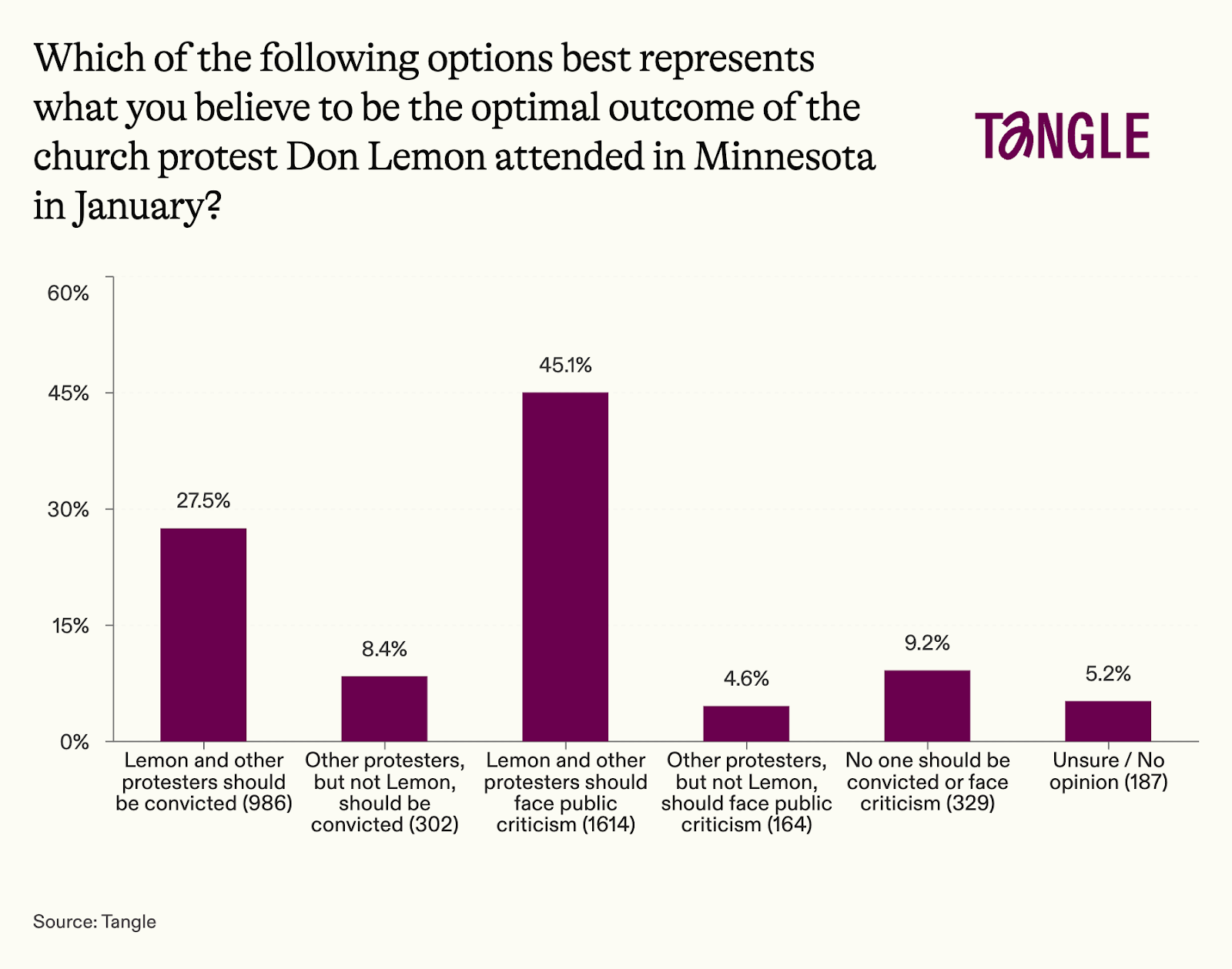
- Yesterday’s survey: 3,582 readers responded to our survey on the protesters who disrupted a Minnesota church service with 45% saying Don Lemon and protesters should face public criticism. “Lemon was not acting as a journalist, he was acting as a political activist,” one respondent said. “There is always room for criticism, but criminalizing nonviolent speech — however egregious, however ill placed — is incredibly dangerous,” said another.
Have a nice day.
Research on animal cognition has long centered on primates, dolphins, octopuses and elephants, with livestock seldom singled out. But Veronika, a pet cow living on a small farm in Austria, might be changing that. She piqued researchers’ interest with her sophisticated use of tools — a skill never observed in cattle. Over months, they observed Veronika using a broom handle to scratch the rear half of her body, manipulating the handle with her tongue and teeth. “There are around 1.5 billion heads of cattle in the world, and humans have lived with them for at least 10,000 years. It’s shocking that we’re only discovering this now,” Antonio J. Osuna-Mascaró, a researcher at Vienna’s University of Veterinary Medicine who studied Veronika’s behavior, said. Scientific American has the story (and videos).
Member comments