
I'm Isaac Saul, and this is Tangle: an independent, nonpartisan, subscriber-supported politics newsletter that summarizes the best arguments from across the political spectrum on the news of the day — then “my take.”
Are you new here? Get free emails to your inbox daily. Would you rather listen? You can find our podcast here.
Today’s read: 14 minutes.
We’re trying something crazy before Christmas.

At Tangle, we’re always going to upset people, no matter what we write — that’s the price of being a big-tent political news outlet. We could cater to one side and pump out news stories to drive subscriptions, but we’d have to sacrifice our values to do it.
One of the downsides of this model, though, is that it’s a tough business. People cancel or unsubscribe on the days we publish something they don’t like, and it can be hard to ever win them back. The net result, this year, is that we’re about 3,500 subscribers short of our annual goal for paid subscribers. We still want to try to hit that goal before Christmas.
If just one out of every 100 free subscribers reading this became a paying member, we’d easily meet our goal. In exchange, you’ll unlock a smorgasbord of members-only content and features, and you’ll help keep an independent news outlet thriving as we head into the new year. We launched our campaign this morning, and we’ve already hit 300 new subscribers. You can join the party here.
Quick hits.
- The manhunt for the suspect in the shooting at Brown University that killed two students is still underway. Law enforcement released new images and video of a person of interest, and the Federal Bureau of Investigation announced a $50,000 reward for information leading to the identification, arrest, and prosecution of the shooter. (The latest)
- The Australian Broadcasting Corporation reported that the two gunmen who killed 15 people in Sydney on Sunday had traveled to the Philippines in the month before the attack to receive “military-style training.” (The report)
- Officials from the United States and Ukraine announced that the Trump administration has promised security guarantees for Ukraine as part of a deal to end its war with Russia. Ukrainian President Volodymyr Zelensky said discussions about other provisions in a potential agreement are still underway. (The update)
- President Donald Trump issued an executive order classifying fentanyl — a synthetic opioid — as a weapon of mass destruction, describing it as “closer to a chemical weapon than a narcotic.” The order directs relevant federal agencies to focus their efforts on reducing fentanyl imports. (The order)
- President Trump filed a $10 billion defamation lawsuit against the BBC, accusing the outlet of publishing a “false, defamatory, deceptive, disparaging, inflammatory, and malicious” portrayal of the president in a documentary episode published in 2024. The BBC previously apologized to Trump for the episode, which spliced together two clips of Trump’s speech on January 6, 2021, and omitted his statement calling for peaceful protest. (The lawsuit)
Today’s topic.
The Indiana redistricting vote. On Thursday, the Republican-controlled Indiana Senate voted 31–19 to reject a redrawn congressional map designed to increase the number of GOP seats in the U.S. House of Representatives. President Donald Trump and national Republicans pushed for the new map and lobbied the state’s Republican leadership to back the effort. In the end, 21 Republican senators joined all 10 Democratic senators in opposing the bill, leaving it short of the 26 votes required to pass.
Back up: Indiana’s U.S. House delegation is currently made up of seven Republicans and two Democrats, and states usually draw new district maps at the start of each decade. The proposed map preceded the decennial census by several years, and mapmakers aimed to give Republicans representation of all nine districts by dividing the two represented by Democrats to incorporate more rural, conservative counties. Several Republican and Democratic states have already adopted mid-decade redistricting plans since this summer in an attempt to increase their party representation in the House; the vote in Indiana marks the first failed effort by either party during this push.
We covered Texas’s and California’s redistricting efforts here.
Last week, the Indiana House advanced a bill proposing the new map 57–41, with 12 Republicans joining all Democrats in voting against it. Gov. Mike Braun (R) had called on the legislature to consider the proposal in November. State Senate President Pro Tempore Rodric Bray (R) made plans to advance a vote in December, but said at the time that he did not believe it had enough support to pass.
Prior to Thursday’s Senate vote, President Trump posted a lengthy message on Truth Social criticizing Bray and threatening to support primary challenges to Republicans who voted against the bill. “Anybody that votes against Redistricting, and the SUCCESS of the Republican Party in D.C., will be, I am sure, met with a MAGA Primary in the Spring,” Trump wrote. “Rod Bray and his friends won’t be in Politics for long, and I will do everything within my power to make sure that they will not hurt the Republican Party, and our Country, again.” Separately, Heritage Action, a conservative advocacy group, posted on X, “President Trump has made it clear to Indiana leaders: if the Indiana Senate fails to pass the map, all federal funding will be stripped from the state. Roads will not be paved. Guard bases will close. Major projects will stop. These are the stakes and every NO vote will be to blame.”
Several state GOP senators who opposed the new map cited the pressure campaign as part of their reason for voting no. At least 11 Republicans reported threats, including having SWAT called to their homes, in the lead-up to the vote. “You have to know Hoosiers, we can’t be bullied,” Sen. Sue Glick (R) said. “The instant reaction is we dig in our heels and say, why?” Sen. Spencer Deery (R) also voted no and said he did not support the national redistricting push. “I, like a supermajority of you, do not want to see another Democrat Speaker of the House,” Sen. Deery said. “But that isn’t for me to decide… Living in a free constitutional republic means we empower voters to make those decisions.”
Today, we’ll share perspectives from the right, left, and Indiana writers on the vote and its aftermath. Then, Executive Editor Isaac Saul gives his take.
What the right is saying.
- Many on the right are ambivalent about the outcome but concerned about the state of the GOP.
- Some say Indiana Republicans made a mistake with national consequences.
In The American Conservative, W. James Antle III asked “is the Indiana redistricting debacle the future of MAGA?”
“It remains to be seen which is more ephemeral, Trump’s current relative rough patch or the political movement he has spawned; it is unclear that other Republicans are ready or even willing to lead. But Trump has shown Republicans that some things are possible when you are willing to exercise political power on behalf of your priorities — and also that bare-knuckled politics has its limits,” Antle wrote. “Which brings us to the collapse of the Republican redistricting bill in Indiana. The debacle features a little bit of everything ailing the GOP these days. Wishy-washy red-state Republicanism that frustrates conservatives nationally; pugilistic outside conservative agitators making hamfisted threats that always seemed likely to backfire.”
“Republicans should of course do whatever they can to counteract Democratic redistricting efforts (and preexisting blue-state gerrymandering) in places like California, which are in turn in response to Republican-drawn congressional maps in states like Texas,” Antle said. “But ultimately altering the political conditions that might bring about a Democratic wave election is the only real solution. Redistricting might expand the number of seats available to Republicans, but even if not canceled out by the Democrats or overturned by the courts, it will also produce some seats that only went for Trump by margins that won’t make them safe in a wave election.”
In The Federalist, Shawn Fleetwood said “Indiana’s redistricting surrender illustrates why primaries matter.”
“The contrast between this embarrassment and redistricting efforts by Democrat-led states could not be starker. While Democrats with razor-thin margins in blue states like Virginia are willing to seemingly violate the law to pass gerrymandered maps in their party’s favor, fake red states like Indiana can’t even be bothered to legally use their supermajorities to do the same,” Fleetwood wrote. “It’s clear there’s only one political force playing to win this game, and it’s not the Republican Party.
“But more to the point, Indiana’s bungled redistricting gambit underscores an important feature of the electoral system that many GOP voters have long ignored: the primary process,” Fleetwood said. “The entire reason feckless Republicans believe they can continue to get away with the type of betrayal exemplified in the Hoosier State is that they don’t fear electoral accountability from the GOP base. All too often, conservative voters either vote to reelect the same weak-kneed incumbents or sit out the primaries altogether, thus allowing the establishment class to maintain its hold on power.”
What the left is saying.
- Many on the left suggest the vote is Republicans’ most significant rebuke of Trump to date.
- Others note that the GOP redistricting effort is still succeeding in many other states.
In CNN, Aaron Blake called the vote “a major unforced error for Trump.”
“Whether the Indiana state legislature voted to draw two additional Republican-leaning congressional districts, as President Donald Trump wanted, was unlikely to be the decisive factor in the 2026 midterm elections. But just as Trump’s dominance over his party was looking to be somewhat in doubt in recent weeks, he picked a battle to reestablish it. He chose very wrongly,” Blake wrote. “The upshot is that Trump’s hold over his party — his most important political asset — appears weaker than at virtually any other point in his two presidencies. Not weak, period, but weaker.”
“In Trump’s first term, congressional Republicans bucked him on foreign policy issues several times… And compared to weighty foreign policy issues, passing a new map is very small-bore. The easy move for Indiana Republicans would have been to just capitulate, especially after all the pressure was brought to bear,” Blake said. “But they decided to make a point, and they did so by voting in much bigger numbers than they needed to. Several of them could have protected their careers and livelihoods by voting yes and still having the map fail, but they went out of their way to stand with one another against Trump by a large margin.”
In The Nation, David Daley wrote “Indiana’s gerrymander victory won’t save us.”
“It’s a big deal that Republicans in Indiana’s state Senate last week squashed President Trump’s demands… [But] the remaining map is still a GOP gerrymander. It ensures Republicans seven safe seats, which they won in 2024 by an average of 30 percentage points, despite netting just 58 percent of the statewide vote,” Daley said. “Throughout the rest of the country, Republicans maintain the upper hand during this unprecedented mid-decade redistricting war. Perhaps most consequentially, the GOP supermajority on the US Supreme Court will have the deciding vote when it rules on a voting rights case from Louisiana.”
“At this moment, presuming that new maps in California and Texas counteract each other, Republicans have picked up two seats in Ohio, one in Missouri and one in North Carolina. The big prize on the table remains Florida, where Governor Ron DeSantis has suggested he could flip as many as three to five Democratic seats with a new map,” Daley wrote. “There is renewed chatter in Kansas about a January special session to erase the Kansas City–area seat currently held by Democrat Sharice Davids. Some lawmakers in New Hampshire continue to push for a mid-decade redraw as well.”
What Indiana writers are saying.
- Some Indiana writers say Trump’s pressure campaign backfired.
- Others suggest the new map would have been only a short-term win for the GOP.
In The Indianapolis Star, Jacob Stewart wrote about “why Trump’s bullying backfired in Indiana — and will again.”
“Heritage Action, a conservative advocacy organization, claims Trump ‘made it clear… all federal funding will be stripped from the state’ if senators voted against redistricting. Lt. Gov. Micah Beckwith said the statement was true in a now-deleted social media post responding to my doubts that any legislator had received such a threat from the Trump administration,” Stewart said. “Stripping federal funding from a state because it decided not to redistrict early is likely unconstitutional and an excellent way to alienate conservatives who already don't trust the federal government.”
“Redistricting means enshrining Trump’s legacy and eternal control over the remains of the GOP. The congressional maps Trump wants Republicans to draw would give them slight leads, based mostly on his performance in the 2024 elections. That would make it very difficult to win a primary without the endorsement of Trump or his followers,” Stewart wrote. “In the end, Indiana Senate Republicans rejected redistricting because it was obvious it only elevates one person, President Donald J. Trump.”
In The Daily Journal, Michael Hicks suggested “redistricting is both more and less than it seems.”
“This map seems custom-made to devalue rural voters. This is undoubtedly true in two ways. First, the new map deconstructs Indianapolis, placing the largest county into four new congressional districts. This amplifies the voice of urban voters by placing the same city into multiple jurisdictions. At the same time, the vast geography of the gerrymander increases the cost of visiting smaller population centers,” Hicks wrote. “This could mark a big shift in the urban-rural dynamics of political campaigns. It seems likely no one involved in constructing these maps really cares.”
“This raises questions about Hoosier policymakers’ motivations. I am certain there are GOP members who honestly support redistricting on the merits and require no pressure from the national MAGAsphere, no calls or threats from the president’s men. This has mostly focused on the national policy outcomes they wish to preserve,” Hicks said. “But one aspect does puzzle me… How could there be such wildly different perspectives among Republicans on the same issue? One likely explanation: All representatives are up for reelection in 2026. Many state representatives clearly have been cowed into supporting redistricting. There may also be a few senators who’ve been pressured or threatened into supporting the effort.”
My take.
Reminder: “My take” is a section where we give ourselves space to share a personal opinion. If you have feedback, criticism or compliments, don't unsubscribe. Write in by replying to this email, or leave a comment.
- I applaud the Indiana Republicans who resisted the push for gerrymandering.
- Rejecting Trump has been hard for many Republicans, and these state senators chose an important issue to stand up for.
- Hopefully more people join their side to beat back the scourge of gerrymandering.
Executive Editor Isaac Saul: In some ways I wish this story weren’t even news.
Our imperfect political system tends to work well when two parties with ideological differences stand on their principles and wrestle over big, divisive policy questions. For a long time, the Republican party stood for a kind of conservatism that puts a premium on states rights or small government — but the Trump administration has bulldozed that history by siphoning more and more power toward the executive while demanding state-level politicians like those in Indiana fall in line, and that they do it with a smile on their face.
What Indiana Republicans did last week harkened back to a not-so-long-ago era where politicians actually made decisions based on their own values and the will of their constituents, rather than what might play well nationally with party leaders. They decided an important issue on principle. That this is so rare in the political world as to become a national news story is remarkable — and, also, a bit depressing.
Yet, despite how unremarkable I wish this were, these Republicans deserve their kudos because it is genuinely rare in 2025. And because the environment they did it in was not particularly friendly.
For starters, gerrymandering is a bipartisan scourge, and we’ve seen how easy it is to get dragged into the mud. We should never normalize politicians choosing their voters rather than the other way around, yet President Trump has now openly made it his mission to squeeze as many Republicans into the House as possible, with or without the customary impetus of a census. The consequences of this entire mid-decade redistricting push from both parties should fall at his feet — he is, unambiguously and unabashedly, pushing every Republican state to game the system to his favor.
Republicans started this effort in Texas at Trump’s behest. Democrats in Texas went so far as to flee the state to try to nip it in the bud. When that didn’t work, Democratic leaders across the country started gerrymandering efforts of their own, both abandoning their principles and standing up to Trump at the same time. Their options weren’t great: 1) Either sit on your hands and get steamrolled by Trump’s efforts, thus ceding more power to the guy pushing for radical mid-decade redistricting. 2) Fight back and try to even the scales, but abandon your principles along the way. 3) Let Trump hang himself politically by doing something unpopular, and then hope you can win back the House in 2026 even without the advantage of more gerrymandering.
Republicans will probably only pick up a few new seats in the end, if that, because of court rulings and what just happened in Indiana, but also because the response from Democrats has been effective and so much of the country is already gerrymandered into non-competitiveness.
The second reason Indiana’s GOP deserves its kudos is that saying “no” to Trump clearly isn’t easy for Republicans. For a decade now, Trump’s brand of brass-knuckle politics has brought the party to heel. The number of the rank and file willing to buck his wishes has dwindled, and those who do oppose him usually end up out of politics shortly after (the examples keep on coming). But what has made the Indiana GOP’s stand successful, and what might insulate them from too much damage, is that they made it together. No single name is taking the heat in the media; instead, a large group of Republican state senators rejected the proposal and rebuked Trump’s rotten goals.
In this case, the pressure was real — Vice President JD Vance visited Indiana twice to try to turn the screws. Indiana politicians were getting death threats and having their homes “swatted.” Even the sister organization of the Heritage Foundation, which once genuinely stood for principles like state’s rights, joined the Trump pressure brigade. Before their vote, Heritage Action warned Indiana’s Republicans that they would lose their state its federal funding, road maintenance, guard bases, and major projects if they didn’t pass the map.
Fortunately, Indiana’s GOP had the sense to look at all this and think: We’re not crazy about how the White House is doing business. The president didn’t help his case either by calling Tim Walz a “retard” on social media (one Indiana state senator has a daughter with Down syndrome and said he’d vote “no” after Trump’s use of the word). How refreshing is it to learn that violating the most basic, low bars of human decency can still have a negative effect on political outcomes in 2025? Go figure.
Third, and importantly, is that the Indiana GOP was not alone here. Not only did they stand together, but they also included the public in the debate — an actual walking embodiment of what our country is supposed to stand for. Rather than hide from their constituents as so many of our national representatives are now doing, Indiana’s GOP voted only after listening to 100 members of the Indiana public testify before the state legislature. It took four hours. The vast majority of the public urged them to stand strong and resist the push from the White House, and not just Democrats or never-Trump Republicans. “It’s not just politics. It’s a calculated assault on fair representation,” Ethan Hatcher, a local radio host who voted for Trump in the last two elections, told the legislature.
All of this culminated in a moment that has genuine significance and deserves earnest plaudits: A group of Republicans, under immense pressure from their own party to do the wrong thing, stuck to their principles, listened to their constituents, and did the right thing.
Of course, this doesn’t mean that the entire national gerrymandering effort is now in jeopardy. The most likely scenario is that it will cost the party two House seats, which I suppose could end up being the margin for control of Congress in 2026. However, Republicans now have to consider an increasingly realistic worst-case scenario: that they’ll lose the midterms by double digits, and lose their control of Congress.
The question now is how many other Republican states might follow Indiana’s example? What impact will this have on the psyche of politicians who have that voice in their head telling them “this doesn’t look right” — the president and party leader bullying state politicians, mocking a man who was just murdered alongside his wife, or calling for elected Democrats to be tried for treason? How many will realize it’s not only possible to stick to their values and vote their consciences, but that having a backbone is also actually politically advantageous?
My hope, sincerely, is that it’s more than just a handful. Maybe a group of Hoosiers otherwise unknown to the national public could start a national movement, and help pull us back to some of our better angels. Wouldn’t that be nice?
Take the survey: What do you think Indiana’s vote implies for other gerrymandering efforts? Let us know.
Disagree? That's okay. Our opinion is just one of many. Write in and let us know why, and we'll consider publishing your feedback.
Your questions, answered.
Q: How is the Warner Bros. buyout by Netflix or Paramount or whoever not getting shut down for monopoly stuff? Is there a percentage of content/subscribers/etc that a potential merge has to hit before it starts on these alarm bells?
— Sophie from Smelterville, ID
Tangle: Answering this question requires a bit of context first.
On December 5, Netflix emerged as the winner of a bidding war with Paramount Skydance and Comcast to acquire the streaming and studio arms of Warner Bros. Discovery (WBD) at an $82.7 billion price point. Paramount isn’t giving up the ship, though — they are pursuing a hostile takeover bid to put a higher price point in front of shareholders to purchase the entirety of the company. These kinds of bids don’t have a high success rate historically, but two things are working for Paramount. First, they are offering WBD shareholders more money. Second, the company has strong ties to the Trump administration, which can block the Netflix deal.
Still, Netflix’s position has its own strengths. First, the acquisition offer is only for the streaming and studios portion of WBD, which includes HBO, but not their cable television stations like Discovery, TNT, and CNN. Second, the deal has already been accepted, giving the streaming giant the inside track.
What would make either deal prone to being blocked? The DOJ uses a few different metrics for this, but two tend to be especially relevant. First, they consider raw market share — if a merger creates a company with an over 30% share of the market, that can trigger questions about legality. They also use a metric called the Herfindahl–Hirschman Index (HHI), which squares the market share of firms in the industry then sums them to determine concentration.
Even with those clear metrics, the answer to this question is still unclear. On one hand, a Netflix–WBD merger would exceed market-share for subscription video on demand (or streaming) services and HHI thresholds that the DOJ could use to block the deal (whereas a Paramount acquisition of Warner Bros. Discovery would not). However, neither deal would be monopolistic if you consider the entire viewing market (movies, television, and social media applications).
The Trump factor could raise different alarms. The president’s son-in-law, Jared Kushner, has a material interest in the Paramount offer, and Paramount CEO David Ellison is actively lobbying the Trump administration to block the Netflix deal, even reportedly promising to make significant changes at CNN if Paramount succeeds in its competing bid.
Want to have a question answered in the newsletter? You can reply to this email (it goes straight to our inbox) or fill out this form.
Under the radar.
On Monday, Attorney General Pam Bondi announced the arrests of four people in an alleged plot to bomb multiple targets in the Los Angeles area on New Year’s Eve. According to a criminal complaint, the four are part of a group called the Turtle Island Liberation Front, which describes itself as dedicated to “liberation through decolonization and tribal sovereignty.” Last week, the four allegedly traveled to the Mojave Desert to construct and test the bombs but were arrested by Federal Bureau of Investigation agents before they assembled the explosives. Based on a document allegedly written by one of the arrestees, the group planned to plant the bombs at five locations targeting two U.S. companies, though they said they would take measures to ensure no people would be present at the sites. NBC News has the story.
Numbers.
- 18.9%. Donald Trump’s margin of victory over Kamala Harris in Indiana in the 2024 presidential election.
- 70 and 30. The number of Republicans and Democrats, respectively, in the Indiana House of Representatives.
- 40 and 10. The number of Republicans and Democrats, respectively, in the Indiana Senate.
- 39% and 51%. The percentage of Indiana voters who supported and opposed, respectively, the state’s Republican-led redistricting effort, according to a Bellwether Research poll released in November.
- 6. The number of states that have implemented new congressional maps in 2025.
- 1. The number of states that are currently undertaking redistricting.
- 2. The number of states that have taken steps to begin the redistricting process.
The extras.
- One year ago today we wrote about the UAP sightings on the East Coast.
- The most clicked link in yesterday’s newsletter was the reported executive order to reclassify marijuana.
- Nothing to do with politics: The purchasing power of $100 in each state.
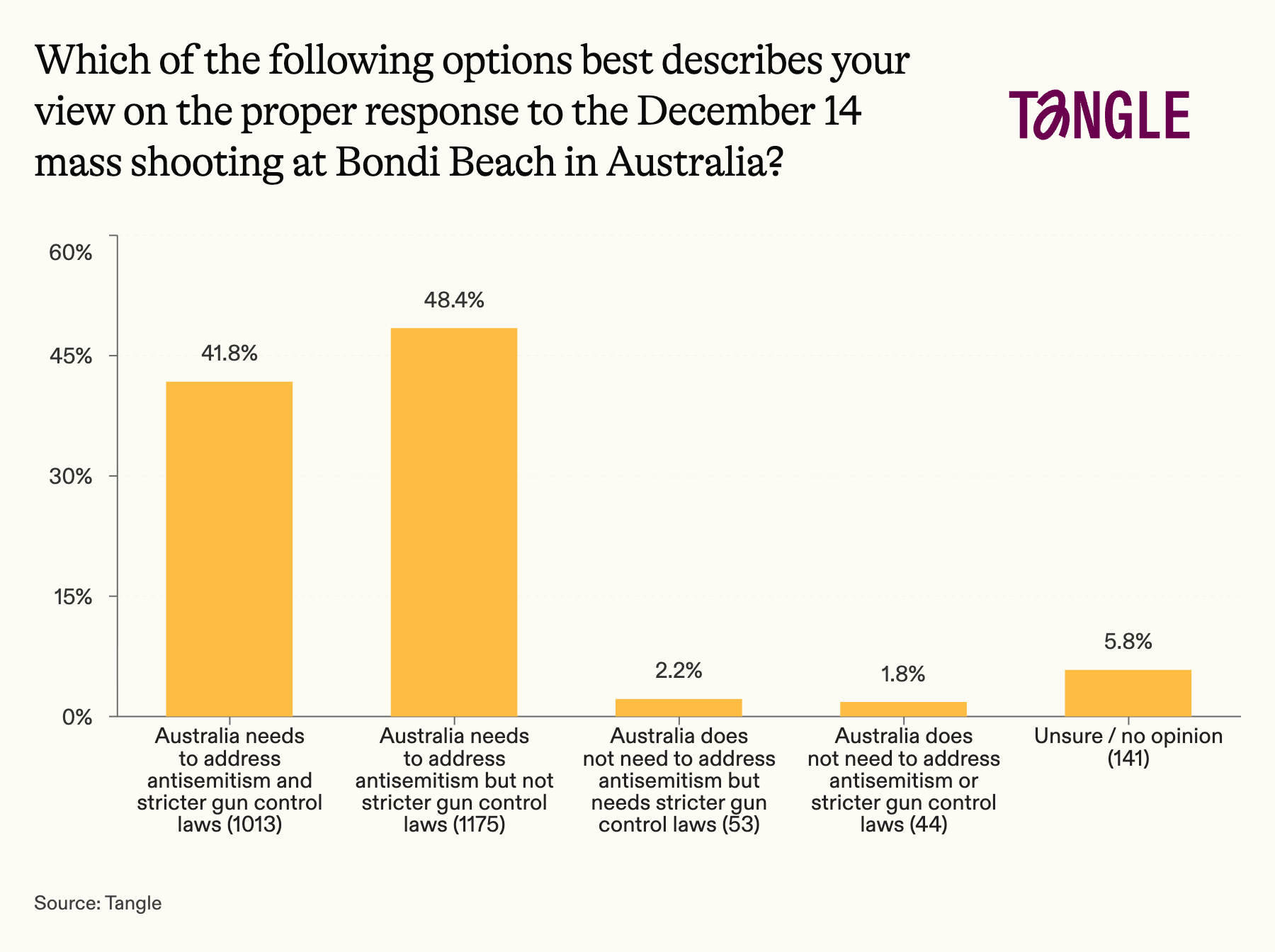
- Yesterday’s survey: 2,426 readers responded to our survey on the mass shooting in Australia with 48% saying Australia needs to address antisemitism but not impose stricter gun laws. “We need to rethink what it means to address antisemitism or we will end up amplifying the very thing we aim to address,” one respondent said. “If one of the shooters had been questioned previously about ties to the Islamic State then perhaps he should have been denied access to guns,” said another.
Have a nice day.
In late November, a group of Cub Scouts was hiking in a downpour in Golden Ears Provincial Park in British Columbia, Canada, when they came across a washed-out river and bridge with three hikers on the other side signaling for help. The hikers were ill-prepared for the weather and may have been forced to spend the night outdoors if the Cub Scouts group had not found them. After contacting authorities to assist with the rescue, the group of elementary school kids gave the teenage hikers food, thermal blankets, and hand warmers from their supplies. “We’re just so happy that we found them,” Kyle Lee, one of the rescued hikers, said. “And then we’re just really grateful that they were there.” CBC has the story.

Member comments