
I’m Isaac Saul, and this is Tangle: an independent, nonpartisan, subscriber-supported politics newsletter that summarizes the best arguments from across the political spectrum on the news of the day — then “my take.”
Are you new here? Get free emails to your inbox daily. Would you rather listen? You can find our podcast here.
Today's read: 15 minutes.
Say Goodbye to Annoying Ads.
If you’ve ever clicked on a news article only to be bombarded with popups, autoplay videos, or 19 different trackers — you’re not alone.
CleanWeb is a lightweight tool that blocks most ads and trackers before they load. Pages open faster. Distractions disappear. And third-party scripts quietly collecting your data? Gone.
It’s part of the Surfshark suite — and Tangle readers can get it bundled with their VPN for $1.99/month with an extra 3 months free.
More privacy, fewer annoyances, and (frankly) a cleaner internet.
Try it by clicking here.
Tomorrow and Memorial Day.
Tomorrow, we’re going to be publishing a members-only piece contributed to Tangle by National Review’s Noah Rothman. The essay makes a fascinating argument: that Trump’s second term is functioning as a repudiation of his first. We’ll send a free preview to all of our readers, but the full version will only be available to Tangle members. On Sunday, we’ll be releasing a podcast interview with Sarah Isgur, a legal analyst at The Dispatch, discussing the Supreme Court’s biggest cases and going deep on the birthright citizenship oral arguments.
Then, on Monday, the team will be off for Memorial Day (we observe all federal holidays). However, we have a special piece coming out that day, too: An interview with the economist and parenting expert Emily Oster. Emily and Isaac talked about falling fertility rates across the globe, what it's like to see her work go through the partisan ringer, what she makes of the Make America Healthy Again movement, and what keeps her up at night as a parent. We recorded this interview for our podcast, but will also be releasing a transcript for Tangle members and sending a preview of the transcript to our entire mailing list.
Quick hits.
- BREAKING: The Supreme Court affirmed the Oklahoma Supreme Court’s decision to block a plan to permit the state to use government money to run the United States’s first religious charter school. The court split 4–4, with Justice Amy Coney Barrett recusing herself, allowing the state supreme court’s ruling to stand. (The ruling)
- A gunman shot and killed two Israeli Embassy staffers in Washington, D.C., in what law enforcement believes was a targeted attack. (The shooting)
- The House of Representatives voted 215–214 to pass the One Big Beautiful Bill Act, with two Republicans and all Democrats voting against the bill and one Republican voting present. The bill now goes to the Senate for consideration. (The passage)
- President Donald Trump hosted South African President Cyril Ramaphosa at the White House, where they planned to discuss trade relations. However, much of the Oval Office meeting focused on President Trump’s claims — and President Ramaphosa’s refutations — that white farmers in South Africa are experiencing a genocide. (The meeting)
- Iran’s top diplomat said the country will not agree to stop enriching uranium as part of any nuclear deal. Shortly after, the country’s foreign ministry announced it would take part in the latest round of nuclear talks with the United States in Rome, Italy. (The comments) Separately, Israel is reportedly preparing to strike Iran’s nuclear facilities if the talks with the United States break down. (The report)
- The Justice Department said it will dismiss lawsuits against the Louisville, KY, and Minneapolis, MN, police departments brought during President Joe Biden’s term. The department will also move to close investigations into alleged wrongdoing at several other police departments. (The dismissals)
Today's topic.
The war in Gaza. On Sunday, the Israel Defense Forces (IDF) announced the start of a new “extensive ground operation” in Gaza, which follows a week of airstrikes on the enclave. The campaign, called Operation Gideon’s Chariots, will comprise a “broad attack that includes the displacement of most of the population of the Gaza Strip,” an IDF spokesperson said. Israel has called up tens of thousands of reservists in preparation for the offensive.
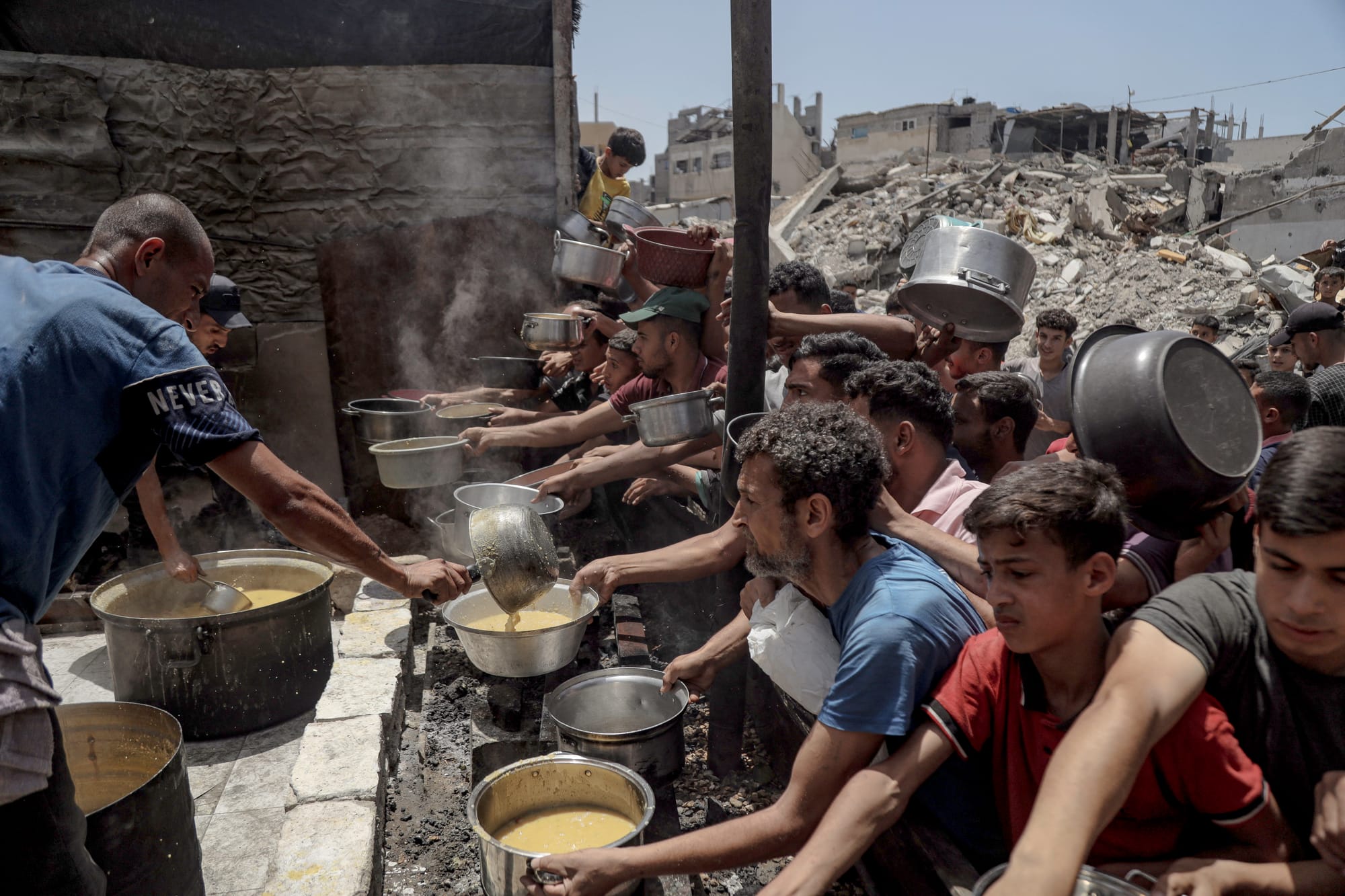
Israel claims that it struck 670 “Hamas targets” in the preliminary airstrikes, while the Hamas-run Gaza Health Ministry says more than 400 people were killed and over 1,000 injured between last Thursday and Monday. Shortly after the ground operation began, Israeli Prime Minister Benjamin Netanyahu said his government would end a monthslong blockade and allow limited humanitarian aid into Gaza at the urging of several of Israel’s allies, including the United States. Aid groups have warned that approximately 500,000 people in Gaza are on the brink of starvation and face increasing shortages of food, fuel, medicine, and clean water.
COGAT, the Israeli defense group that oversees humanitarian aid, claimed that five aid trucks entered on Monday and 93 entered on Tuesday, though that number is significantly lower than the 600 that entered the strip daily during March’s ceasefire, and the United Nations (UN) could not confirm the full total. The UN also says that the aid has yet to reach Gazans, as the Israeli military has not permitted trucks to access the area where aid is being stored. On Monday, the leaders of the United Kingdom, France and Canada warned they would take “concrete actions” against Israel, including sanctions, if it did not halt its ground offensive and allow more aid to enter Gaza.
“The level of human suffering in Gaza is intolerable. Yesterday’s announcement that Israel will allow a basic quantity of food into Gaza is wholly inadequate. We call on the Israeli Government to stop its military operations in Gaza and immediately allow humanitarian aid to enter Gaza,” the joint statement read. The leaders also called on Hamas to immediately release the remaining hostages.
Israel’s renewed offensive comes on the heels of President Donald Trump’s recent return from the Middle East, where he met with regional leaders but did not stop in Israel. While the Trump administration has affirmed its ongoing support for Israel and Prime Minister Netanyahu, the president’s Middle East visit underscored a new approach to relations with the Arab world. During the trip, Trump denied any tensions with Israel over its campaign in Gaza, though he acknowledged “a lot of people are starving.”
Today, we’ll explore the latest on the war in Gaza and President Trump’s Middle East visit, with views from the left, right, and Middle East commentators. Then, my take.
What the left is saying.
- The left criticizes Israel’s latest actions in the conflict, arguing they have abandoned any pretense of restraint.
- Some say that the Israeli government’s actions make peace impossible.
In MSNBC, Zeeshan Aleem suggested “Israel all but admits it is pursuing ethnic cleansing in Gaza in its new plan.”
“Israel’s retaliation against Hamas’ Oct. 7, 2023, war crimes has been going on for so long and with such intensity that its conduct may have begun to feel normal to many. But it must be said that this is the stuff of nightmares. This is an all-out assault on human rights and the concept of self-determination, and the U.S. cannot claim credibility on those matters either while supporting it,” Aleem said. “Israel’s starvation and bombardment regime — which many human rights organizations, human rights experts and genocide scholars have described as genocidal — has long telegraphed an agenda to render Gaza uninhabitable and force one of two outcomes: death or displacement. But this plan of calling up reservists for indefinite occupation is new.”
President Biden “offered unconditional support for Israel as it began its brutalization of Gaza and offered only modest public criticism and a one-off suspension of one shipment of munitions to Israel as it leveled the territory. It’s unclear how Biden would have reacted to these latest plans — if that ‘red line’ that never emerged under his watch would have finally made an appearance,” Aleem said. With Trump as president, “Israel may be wagering that it has a rare window of impunity for territorial control and possible annexation. Unfortunately, that calculation may be sound.”
In The Washington Post, Rick Jacobs wrote “I’m a rabbi. Starving Gaza is immoral.”
“Hamas continues to bear the greatest responsibility for the suffering of its own people, most particularly by using its citizens as human shields. American and Israeli officials have accused Hamas of confiscating desperately needed humanitarian food and supplies for its fighters while civilians starve. Hamas’s cruelty in that regard (among many others) knows no bounds, though condemnation from the international community is rare,” Jacobs said. “Nonetheless, Hamas’s actions do not excuse Israel’s policy of cutting off humanitarian aid to innocent civilians in Gaza. A just war, such as Israel’s efforts to prevent Hamas from attacking it again and curtailing its governance in Gaza, must be fought with just means.”
“Starving Gazan civilians neither will bring Israel the ‘total victory’ over Hamas it seeks nor can be justified by Jewish values or humanitarian law. Will this policy bring home the 59 remaining hostages, including the 24 who are still alive? It’s unlikely,” Jacobs wrote. “Of equal concern, far-right Israeli politicians see the aid blockade as part of a broader plan to permanently push most Gazans from northern Gaza and replace them with Jewish settlements… Depriving Gazans of food and water will not make Israel safer or hasten the return of the hostages.”
What the right is saying.
- The right is mixed on Israel’s best path forward, with some saying it should continue its military campaign until Hamas is gone.
- Others say the U.S. should push for an end to the war before the situation spirals further out of control.
The New York Post editorial board argued “Israel has no choice but to take control of Gaza and at last destroy Hamas.”
“The escalation is understandable; indeed, almost inescapable: What other choice does Israel have? Hamas won’t agree to any serious deal short of a permanent end to the war that allows it to survive and maintain its death-grip on Gaza — which it has vowed time and again to use to stage more Oct. 7, 2023-style attacks on the Jewish state,” the board wrote. “So Israel can’t permanently halt the war with Hamas in control of Gaza, yet no other nation has offered a realistic plan to end the Hamas threat, nor to govern Gaza.”
“Operation Gideon’s Chariots will roll out gradually, but won’t stop until Jerusalem controls all of Gaza — and Hamas has no place to hide. Good. Israel will also seek to deprive the terror group of humanitarian aid, which it has used to maintain its control over Gaza’s population. And it vows to destroy Hamas infrastructure and target its leaders,” the board said. “No one with any compassion wants the war in Gaza to drag on, but Israel can’t end by accepting an eternal threat of periodic Oct. 7-style massacres.”
In The American Conservative, Andrew Day wrote “cut off Israel — for its own sake.”
“Just before the president’s trip, many analysts, detecting a rift between Trump and Israel’s Prime Minister Benjamin Netanyahu, had expected (and hoped) that the U.S. president would push Israel to halt its war rather than escalate it… While Trump did make some noises about the hunger crisis in Gaza, he did not implore Netanyahu to cease fire,” Day said. “This was a serious error by the president, the only person outside Israel with the power to stop the carnage in Gaza. While Trump has signaled a desire to put some policy daylight between the two nations, he hasn’t suspended military aid to Israel, nor even threatened to do so.”
“Unless that changes, the Gaza war likely will rage on toward a grim finale, namely, ethnic cleansing. That would be a catastrophe for the Gazans themselves, obviously, and would further destabilize the Middle East. But it could also, in the long run, put the people of Israel in grave danger, leaving their nation isolated and despised on the world stage,” Day wrote. “Time is running out for the White House to change tack. While most Israelis favor striking a ceasefire agreement that brings the hostages home and enables normalization with Arab nations, Operation Gideon’s Chariots represents a different, darker path forward. If Israel carries the operation through, its reputation on the world stage will suffer irreparable damage.”
What Middle East writers are saying.
- Many writers from the Arab world see promise in Trump’s Middle East trip and hope the president can be a catalyst for a peace deal.
- Some Israeli writers see risks in Israel’s Gaza campaign but say the country must continue its mission.
In Arab News, Taufiq Rahim wrote about “Trump’s narrow window for Middle East peace.”
“Trump has been vocal about resolving global conflicts and the White House has codified this in the ‘peace through strength’ policy doctrine. Beyond his current stance, the president has warned about the dangers of nuclear war for four decades. During his first term, despite the bellicose rhetoric, he prioritized engagement with nuclear powers,” Rahim said. “The stars would appear to be aligning around a new dynamic in the Middle East — almost. The Gaza crisis casts an apocalyptic shadow over the region. Perhaps the region’s changing dynamic fed into Hamas’ geostrategic calculus in carrying out the Oct. 7 attacks. Today, however, Israel may be the biggest obstacle to the region’s march forward.”
“Trump avoided a stop in Israel on his trip, a glaring act of omission. He called out the humanitarian situation, saying, ‘the people in Gaza are starving,’” Rahim wrote. “Acknowledging this window of opportunity for change in the Middle East is not about giving Trump the benefit of the doubt. Simply put, the window will not be open for long and taking advantage is to everyone’s benefit… This moment in the Middle East requires entrenched interests and partisans across the aisle to work together in the common interest.”
The Jerusalem Post editorial board said “Israel must fight like there's no deal, and negotiate like there's no war.”
“Israel thinks that time is on its side. If the negotiations don’t work, we’ll just pummel Hamas and Gaza some more until they agree. But, after 19 months of war, time has actually turned into an enemy for Israel. Looking at the situation without delving too far inside, that might not be apparent,” the board wrote. “The longer the war goes on and civilian casualties mount, the more it will damage Israel’s international standing and toughen the challenge facing the Jewish state’s defenders around the world in arguing Israel’s legitimacy in its righteous battle against Hamas.”
“The urgency is felt every day and every hour by the hostages in Gaza and their families going through their personal hell back home. For them, time is a huge enemy. The longer the war goes on without an agreement, the greater the risk to their survival and return home,” the board said. “So, Israel must decide. Will it continue to go forward one step and then back another in its two-pronged effort to defeat Hamas and bring the hostages home, or will it negotiate like there’s no war and fight Hamas like there’s no negotiations?”
My take.
Reminder: "My take" is a section where I give myself space to share my own personal opinion. If you have feedback, criticism or compliments, don't unsubscribe. Write in by replying to this email, or leave a comment.
- My worst fears about this conflict continue to come true.
- The humanitarian situation in Gaza is dire, and Israel’s justifications for its actions are increasingly inadequate.
- The longer this goes on, the greater the threat to everyone involved.
All my thoughts about this conflict are not going to fit into today’s “My take,” as there is simply too much to say and cover in one piece. As we speak, I am writing one of the longest pieces I’ve ever written about this issue — and about my relationship with Zionism — which is set to come out for Tangle members next Friday. I don’t say that as an act of promotion, but just to concede that I won’t be able to cover everything relevant about this conflict today.
Aside from the 2024 election, we have covered this story as much as or more than any other in the last two years, and it has been exhausting and difficult for me personally, which feels insensitive to say while millions of people suffer through one of the most brutal sieges of recent times.
Still, by way of introduction, I want to briefly chronicle how my personal views have evolved (or stayed the same) since October 7, 2023:
- Horror for the Israelis, and at the idea it could have been me, but also fear about how Netanyahu would respond, and a very complicated view about the possible paths forward (which might now be the most read piece in Tangle’s history)
- An embrace of the idea that Hamas has given Israel no good options
- Horror at how Israel had been conducting the war, but…
- Resistance to the allegations that they were carrying out a genocide
- A call for a ceasefire from a Zionist perspective
- A call for Netanyahu to step down because he is a failed leader
- Fears of Iranian involvement, and a wider war breaking out
- Criticism of anti-Israel college campus protesters, and criticism of people who were overreacting to a bunch of anti-war students
- A sincere effort to explore all the arguments that I am wrong about calling for a ceasefire
- Believing that all my worst fears are coming true
- Then, in the 2024 year-end review, a concession that the latest news provided fresh evidence that Israel’s actions do meet the definition of a genocide (and a promise to write more later)
I’ve continued to have complicated and evolving thoughts about the conflict in recent months, but the combination of my son’s birth, Trump entering office, and other global conflicts breaking out has meant that we have only covered this story as a main topic twice since January 20.
Since I wrote about how all my worst fears have come true, little has improved. In the most fundamental sense, I feared that Israel would inflict a great deal of human suffering on Gazans in order to pursue two unattainable goals: bringing the hostages home alive and destroying Hamas. By those two metrics alone, Israel has achieved some partial victory: Hamas is weakened, some 17,000–20,000 combatants have likely been killed, and regional dynamics have tilted somewhat in Israel’s favor (for now). Of the 251 hostages taken into Gaza, just 23 who remain are presumed to be alive. 146 have been freed or rescued.
But these numbers only tell a partial story. First, as of January, the U.S. assessed that Hamas had recruited almost as many new fighters as it’s lost, the exact thing I warned about. While Hamas, Hezbollah and Iran are all facing greater challenges than they were two years ago, the Houthis have also been dragged into the conflict, Israel is now immersed in live combat, and Trump is beginning to signal his impatience with Netanyahu (all while pursuing deals with Arab partners who will not have Israel’s best interests in mind). At the same time, 82 of the 251 hostages have been killed (including three accidentally shot by Israeli soldiers, and at least three killed by Israeli airstrikes).
I believe, and have for some time, that Israel’s conduct over the last year and a half has diminished its moral position globally, torn apart Israelis domestically, divided the global Jewry, failed to meaningfully reduce the number of regional extremists who hate Israel (more likely the opposite), and has not improved the safety of Israelis (self-evidently: Israel appears to be in more danger today than it has been at any point in the last few decades). We're also seeing a horrific amalgamation of anti-semitism and anti-Israel hatred ramping up and manifesting itself in events like the killing of two Israeli embassy workers last night in Washington, D.C., which appears to have been targeted. While Israel is of course not responsible for these deranged acts of violence, it's also not hard to see how the war in Gaza invites more of them.
And, most relevant for anyone who cares about the Palestinians (which should be everyone), the tragedies and horrors in Gaza have only mounted: children so malnourished they are losing their sight. The execution of 15 aid workers by Israeli forces, one by one, followed by an attempted cover-up and burial in a mass grave. Two thirds of all journalists killed in the last year have been killed in Gaza. Trustworthy sources now estimate the total death toll in Gaza is between 77,000 and 109,000 people (4-5% of the pre-war population) — numbers not just based on the Gaza Health Ministry but on independent research. More bombing of hospitals. Shots fired at international delegations. The perpetual cycle of displacement; the army was in the north, then moved south, then moved back north, then moved back south. Israel, repeatedly, violating the terms of ceasefires. Gazans, brave enough to protest Hamas, stuck between their brutal rulers and Israeli airstrikes.
I saw a video this week of Theo Von, the wildly popular YouTube star, discussing Gaza. Von is, in many respects and to many people, a know-nothing comedian who has platformed loony, antisemitic bigots like Candace Owens. He prefaces his claim by noting he is “not a geologist” (either poking fun at his own ignorance or revealing it), and then says he thinks “a genocide is happening.” Von then continues into a rather moving monologue about how watching the images pour out of Gaza has impacted him.
His post got a lot of traction; he was, predictably, pilloried by Israel’s supporters for not mentioning the hostages, not mentioning October 7, and for falling for Hamas propaganda. I don't know Theo Von, and I rarely watch his show, but I think it's fair to say that his reaction here is normal, fair, and relatable. It is easy to dunk on him for commenting specifically on a topic where he isn't very knowledgeable, but Von is really like most people who just see suffering — kids buried in rubble, parents weeping over small dead bodies, neighborhoods destroyed — and want it to stop. His feelings and empathy seem entirely genuine. Those feelings are deeply human, and we shouldn't demean him or anyone else for having them. I have them. These shared feelings drive so much of my views on this war. We should never lose sight of the human cost of this violence, and whatever my reservations about Von or his conclusions, I'm glad someone with his influence is highlighting that human suffering and showing real empathy.
And now, perhaps, all this suffering is culminating in the worst possible outcome: Israel, as I warned (and as many people told me I was wrong about), is planning to re-occupy the strip — a 20-year setback that would leave us exactly where we started, only with more death and devastation in between. Meanwhile, the Trump administration is actually working on a plan to “permanently relocate 1 million Palestinians from the Gaza Strip to Libya.” To be clear: That is more than half of the entire population of Gaza. Forcibly moving a population that size from one place to another is the literal definition of ethnic cleansing. So Trump is negotiating, and many Zionists are embracing, an ethnic cleansing of Gazans.
It’s important to recognize this is not political. It is not anti-Israel (an absurd accusation to level at me, sorry). It is simply sharing the reality of what is being planned. We can decide how we want to react to this reality, and how we want to treat it, but we can’t pretend it doesn’t exist.
At a certain point, justifying Israel's actions by saying that this conflict is decades old, invoking October 7, framing their actions as in response to Hamas’s pathetic attempts at firing rockets into Israel, highlighting the need to root out terrorism, or pinning the blame on a single extremist group that holds an entire territory captive and hasn’t held an election in over 20 years are no longer adequate justifications for what we are witnessing. And frankly, we are well past that point. My disdain for Hamas is deep and ever present, but today, Israel’s apparent willingness to subject two million people to an absolutely hellish existence for 20 months is what's keeping me up at night. It has disillusioned me — about Israel, about my Zionism, about a possible path for Israelis and Palestinians to meet for peace, and about any chance for a constructive future.
There is much more to say, and I will say more next Friday, but for now I’ll just say this: I feel as if we're trapped aboard a train careening into the abyss with no way to stop it. I’m simply devastated. For Gazans, for Israelis, for Palestinians, and for the global community of Jews and Muslims who feel so personally tied to this conflict.
Take the survey: How do you think the U.S. should adjust its posture towards Israel, if at all? Let us know!
Disagree? That's okay. My opinion is just one of many. Write in and let us know why, and we'll consider publishing your feedback.
Your questions, answered.
We're skipping today's reader question to give our main story some extra space. Want to have a question answered in the newsletter? You can reply to this email (it goes straight to our inbox) or fill out this form.
Under the radar.
In a recent Fox News interview, FBI Director Kash Patel and Deputy Director Dan Bongino said they were certain that alleged sex trafficker Jeffrey Epstein had committed suicide in his Manhattan jail cell in 2019. The circumstances of Epstein’s death have generated a range of conspiracy theories, but the FBI heads insisted that there was no evidence of foul play. “As someone who has worked as a public defender, as a prosecutor who's been in that prison system, who's been in the Metropolitan Detention Center, who's been in segregated housing, you know a suicide when you see one, and that's what that was,” Patel said. Bongino, who previously elevated claims that Epstein had been killed in prison, said in the interview he had “seen the whole file” and was sure that Epstein had committed suicide. Fox News has the story.
Numbers.
- 61%. The percentage of Americans who say Israel is playing a negative role in resolving the key challenges facing the Middle East, up from 54% a year ago, according to a May–April 2025 Chicago Council on Global Affairs/Ipsos survey.
- 55%. The percentage of Americans who say the U.S. should provide military support to Israel until Hamas returns the remaining hostages, down from 60% a year ago.
- 27% and 29%. The percentage of Americans who say Israel’s current actions are justified and not justified, respectively.
- 68%. The percentage of Israelis who favor signing a hostage deal with Hamas, even if it means ending the war in Gaza, according to an April 2025 Channel 12 poll.
- 54% and 40%. The percentage of Israelis who think the war in Gaza is ongoing for political reasons and security-related reasons, respectively.
- 48%. The percentage of Gazans who say they don't have sufficient food for a day or two, up from 31% in September 2024, according to a May 2025 Palestinian Center for Survey and Research poll.
- 33% and 64%. The percentage of Gazans who support and oppose, respectively, the disarmament of Hamas in the Strip in order to stop the war.
- 11. The approximate length, in weeks, of Israel’s blockade of Gaza.
- 14,100. The approximate number of severe cases of acute malnutrition expected to occur among children aged six to 59 months in Gaza between April 2025 and March 2026, according to the Integrated Food Security Phase Classification.
Tired of popups, autoplay videos, or creepy personalized ads? CleanWeb blocks ads and trackers before they load — making pages faster, cleaner, and less invasive.
It’s part of Surfshark’s privacy suite, and Tangle readers get a steep discount of $1.99/month plus 3 months free. Nice.
Enjoy fewer distractions & more peace of mind.
Claim your discount here.
The extras.
- One year ago today we covered the death of Iran’s president.
- The most clicked link in yesterday’s newsletter was how even New Yorkers hate the New York accent.
- Nothing to do with politics: An Albany newscaster went into labor just before acing her full live segment.
- Yesterday’s survey: 2,460 readers answered our survey on the House’s budget bill with 52% approving of none of the aspects we listed. “To be fiscally responsible, one must both cut spending and raise taxes. We have yet to have a president with the spine to do both,” one respondent said.

Have a nice day.
After losing her sister in a car crash, Pennsylvania English teacher Kristina Ulmer used the small portion of the money her sister left behind to start an annual kindness challenge. Each year, Ulmer gives her students a $20 bill with the mission to spend it on an act of kindness. The project was such a success that the school started a donation program to fund it. Ulmer has said her students bring her to tears each year through the creativity and kindness they demonstrate in the project, highlighting the story of one student who used the funds to crochet hats for premature babies in neonatal care. CBC has the story.
Don't forget...
💵 If you like our newsletter, drop some love in our tip jar.
🎉 Want to reach 380,000+ people? Fill out this form to advertise with us.
📫 Forward this to a friend and tell them to subscribe (hint: it's here).

Member comments