
I'm Isaac Saul, and this is Tangle: an independent, nonpartisan, subscriber-supported politics newsletter that summarizes the best arguments from across the political spectrum on the news of the day — then “my take.”
Are you new here? Get free emails to your inbox daily. Would you rather listen? You can find our podcast here.
Today’s read: 12 minutes.
10 Weird Little Hacks Costco Shoppers Should Know
Do you shop at Costco?
Then you know the thrill of saving money.
But you might be missing other smart ways to stretch your dollars.
Check out our list of genius money hacks—almost as good as that $1.50 hot dog!
Give the gift of Tangle.
Did you know that you can gift a Tangle subscription to a friend, colleague, or family member? The process is as easy as entering their email address and a quick note. With Thanksgiving and the holidays around the corner, now is as good a time as any to share the gift of independent, balanced political news. Gift a subscription here.
Quick hits.
- The House of Representatives voted 427–1 to pass a bill requiring the Justice Department to release all files related to convicted sex offender Jeffrey Epstein. Later in the day, the Senate agreed to approve the measure by unanimous consent, and it will be sent to President Donald Trump for his signature today. (The votes)
- President Trump met with Saudi Crown Prince Mohammed bin Salman at the White House, where the two discussed their military and energy partnerships and normalizing Saudi ties with Israel. Trump also said that bin Salman was not involved in the 2018 killing of journalist Jamal Khashoggi, a claim that contradicts U.S. intelligence agencies’ findings. (The meeting)
- A three-judge panel ruled that Texas cannot use its recently redrawn congressional map in the 2026 midterm elections, finding “substantial evidence” that the new map racially gerrymanders districts. Texas Attorney General Ken Paxton (R) said he will appeal the decision to the Supreme Court. (The ruling)
- The Trump administration announced a series of measures to continue its dismantling of the Education Department, outsourcing several of its key functions to other federal agencies. (The plan)
- A federal judge ruled that Meta’s acquisitions of the social media app Instagram and messaging service WhatsApp did not violate U.S. antitrust law, finding that the government did not prove that the deals had allowed Meta to illegally consolidate control of the social networking market. (The ruling)
Today’s topic.
The hemp ban. Last Wednesday, President Donald Trump signed legislation to reopen the government that contained several additional provisions, including a ban on products made with THC derived from hemp. The ban reverses a provision in the 2018 Farm Bill that legalized the sale of hemp products with a low concentration of delta-9 tetrahydrocannabinol (delta-9 THC); that 2018 measure inadvertently allowed for legal production of THC-infused drinks, creams, gummies, oils, and vapes. The new provision is not an outright ban on all hemp and hemp products, but it narrows the definition of lawful hemp and imposes restrictions on both total THC limits and cannabinoids synthesized from hemp-derived cannabidiol (CBD).
A closer look: Hemp and cannabis (marijuana) are both varieties of Cannabis sativa L., but they differ in concentration of the psychoactive compound delta-9 THC. The new law prohibits the addition of more than 0.4 milligrams of THC per container, a shift from the prior 0.3% delta-9 THC dry-weight standard. Furthermore, the provision bans any THC that is not derived from cannabis, as well as all other cannabinoids with “similar effects.” As a result, the law will ban roughly 90% of all non-intoxicating CBD and THC products, according to an estimate from the U.S. Hemp Roundtable.
The law takes effect on November 12, 2026, and within the next 90 days, the Food and Drug Administration (FDA) must publish a list of all cannabinoids known to be naturally produced by the cannabis plant, all naturally occurring THC-class cannabinoids, and a list of all cannabinoids with similar effects to THC. Sen. Chris Van Hollen (D-MD) characterized the delay between legislation and enforcement as a period to enact an alternative regulatory framework for consumable hemp products and allow for legal challenges.
According to industry experts, the hemp-based THC industry employs roughly 300,000 people and is estimated to be worth $28 billion. The products are often used as a recreational intoxicant but are also used to treat anxiety, joint and muscle pain, headaches, insomnia, and PTSD. As these products have become more popular, children’s and adolescents’ exposure has also increased. According to one 2023 study, ingestion of THC by children increased from 207 known cases in 2017 to 3,014 in 2021.
The provision to close the loophole was proposed by Sen. Mitch McConnell (R-KY) but opposed by several lawmakers, including fellow Republican Kentuckians Sen. Rand Paul and Rep. Thomas Massie. Paul offered an amendment to remove the provision that failed to pass, claiming the new legislation was a “thoughtless, ignorant proposal” that would “eradicate the hemp industry.”
A wide coalition pushed for the provision’s inclusion. In October, 39 state attorneys general sent a letter to Congress demanding a federal crackdown on the sale of psychoactive hemp products, claiming the existing law unfairly overrode state laws that governed THC-infused products. In a floor speech defending his amendment, Sen. McConnell said that the ban would keep harmful products out of the reach of children.
Below, we’ll get into what the left, right, and industry writers are saying. Then, Executive Editor Isaac Saul gives his take.
What the left is saying.
- The left is mixed on the legislation, with some saying it is overly broad.
- Others say closing the loophole is necessary to protect minors.
In MS NOW, Jeremy Berke called the ban “a short-sighted overreaction.”
“Big mainstream retailers like Target and Total Wine & More have embraced these hemp products as younger consumers eschew alcohol for hangover-free THC drinks. And while many companies in the hemp space focus on consumer safety, others aren’t, using hemp to synthesize other forms of THC, like delta-8, and selling them to minors through gas stations or corner stores,” Berke wrote. “But with the funding bill, lawmakers failed to distinguish between the good actors, selling tested, low-dose THC seltzers in established stores, versus the bad, peddling synthetic THC products, often containing pesticides and heavy metals, through gas stations and illicit market locations.”
“There are genuine public health concerns about the unregulated sale of synthetic cannabis products, especially when sold to minors. But rather than ban synthetic cannabis products specifically, or even simply mandate ‘age-gating,’ McConnell and other senators pushed for an outright ban to crush the nascent industry entirely,” Berke said. “The core issue here is not just consumer safety or access to these hemp products. It’s jobs, livelihoods and a real opportunity to further normalize cannabis in America, regardless of what Trump decides to do on pushing reform.”
In The Washington Post, Lindsey Vuolo and Kevin Roy argued the hemp loophole is “exposing kids to drugs.”
“Congress distinguished the two by requiring products designated as hemp to contain less than 0.3 percent delta-9 THC, the main form of THC that’s naturally found in marijuana and is responsible for its intoxicating effects,” Vuolo and Roy wrote. “Then the law of unintended consequences took over. Manufacturers began to chemically convert nonpsychoactive cannabinoids derived from hemp, such as CBD, into psychoactive edible and liquid products… The products are completely unregulated in many states and may be sold without age, packaging or labeling restrictions in convenience stores and at gas stations, as well as online.”
“Opponents of [the new provision] might emphasize that Congress’s original intent was to encourage a market for industrial hemp products. But the unintended consequences of the 2018 law have become apparent in the years since,” Vuolo and Roy said. “Congress has yet another opportunity to mend the loophole it created. Lawmakers should seize it to prevent unintentional ingestion by young children and help curb the normalization of substance use among adolescents.”
What the right is saying.
- The right is also mixed on the ban, and some see the move as a common-sense measure to remedy a public health threat.
- Others say the move will hurt farmers and was advanced without a chance for debate.
In City Journal, Kevin Sabet called the ban “a bipartisan win.”
“In recent months, a bipartisan group of state leaders has regulated hemp products and called on Washington to do the same. Ohio governor Mike DeWine, a Republican, issued a ban on intoxicating hemp. California governor Gavin Newsom, a Democrat, severely restricted hemp sales. And in a remarkable bipartisan effort, 39 state attorneys general wrote to Congress urging it to close the federal hemp loophole,” Sabet wrote. “The new hemp law, however, has a catch: it doesn’t take effect for one year. Big Hemp will almost certainly flood Capitol Hill in an attempt further to stall its implementation.
“That’s why it’s important that states remain committed to hemp-THC bans over the next year. Grassroots advocacy is critical in states like Texas, where Governor Greg Abbott vetoed a bill the state legislature passed that would have banned hemp products. By adopting the federal ban in their own laws, states can slam these markets shut,” Sabet said. “Washington will almost certainly enforce the ban next year. The president supports it, as do a bipartisan majority of congressional lawmakers and red- and blue-state leaders. The public is sick of seeing high-potency THC drugs marketed to kids in gas stations.”
In The Courier Journal, Sen. Rand Paul (R-KY) said “Congress created a crisis, then conveniently used the crisis to jam through new laws without debate.”
“[The ban] wipes out the regulatory frameworks adopted by several states, takes away consumer choice and destroys the livelihoods of hemp farmers. This could not come at a worse time for our farmers,” Paul wrote. “Costs have increased while prices for crops have declined. Farm bankruptcies are rising. For many farmers, planting hemp offered them a lifeline. Hemp can be used for textiles, rope, insulation, composite wood, paper, grain and in CBD products, and growing hemp helped farmers to mitigate the losses they’ve endured during this season of hardship.”
“There is no reason to wipe out the progress made by states that have been regulating hemp since it was legalized. Of the 23 states that expressly permit the sale of hemp THC food and beverages, not one of them has set a limit lower than the 0.4 milligram limit established by the bill,” Paul said. “In true Washington swamp fashion, this hemp ban is not being debated on its own, on the merits… Anyone that asks for a debate when these ‘reforms’ emerge from behind closed doors is accused of obstruction by Congressional leaders.”
What industry experts are saying.
- Some writers say the ban will only result in more illicit sales of these products.
- Others argue that the ban could spur a national push for federal cannabis legalization.
In Convenience Store News, Melissa Vonder Haar wrote “closing the hemp ‘loophole’ won’t close the problem.”
“By banning all intoxicating hemp products… Congress is far more likely to increase the presence of those very copycat, high-dose, marketed-to-children products it hopes to eliminate,” Vonder Haar said. “Congress may well ‘close’ the loophole in the 2018 Farm Bill that allowed a $28-billion hemp THC market to bloom, but there is zero plan for enforcement. That means the responsible players — the low-dose beverages, functional gummies and mainstream retailers like Target, Total Wine and Circle K — will stop selling. Meanwhile, the bad actors already flouting copyright laws and basic decency will keep right on going.”
“We’ve seen this movie before… California became the second state to ban menthol cigarettes in late 2022. One year after the ban, research firm WSPM Group analyzed 15,000 discarded cigarette packs found in trash cans across major metro areas. Before the ban, 24.5% of cigarettes sold in California were menthol. A year later, 21% of the discarded packs were still menthol and many were from Mexico,” Vonder Haar wrote. “In short: the ban barely reduced menthol use, cost responsible retailers (and the state) millions in lost revenue, and almost certainly made public health worse.”
In Marijuana Moment, Adam Terry suggested the ban is “an opportunity to legalize cannabis across the board.”
“Each year, cannabis reform has been important work by activists who care about personal freedom and the miscarriage of justice that each arrest for cannabis represented, as well as an important initiative to expand the growing state-legal marijuana industry in America. And each year, major media outlets and most Americans have treated cannabis legalization as a mildly interesting side show,” Terry said. “But one thing changed last week: There has never before been a situation where we have seen access to cannabis given to millions of Americans and then abruptly taken away.”
“In my time in the cannabis industry, I have never seen a cannabis policy that instantly removed access to people across the entire country in the way this sweeping sledge-hammer of a ban has. Never before have so many people been affected in a negative way on this issue all at once,” Terry wrote. “We [should] use this moment, where millions of people are about to lose all access to cannabis in states that have zero dispensaries and millions more will lose the easy access they’ve come to enjoy, to once and for all decriminalize, deschedule and regulate cannabis in the U.S.”
My take.
Reminder: “My take” is a section where I give myself space to share my own personal opinion. If you have feedback, criticism or compliments, don't unsubscribe. Write in by replying to this email, or leave a comment.
- I have had concerns about the potency and addictiveness of legal cannabis for years.
- A full prohibition on these products, however, goes too far.
- Congress should consider more focused restrictions to address public-health concerns.
Executive Editor Isaac Saul: To start, I want to state plainly that my concerns about the cannabis industry have grown since 2018. While Congress’s move to close the hemp loophole creates problems, data about the legal sale of hemp and cannabis products shows that the industry has its own issues.
I wrote about this as far back as 2021, when I openly questioned my previously held confidence that legalization was the right move. In 2024, when the government was considering rescheduling cannabis as a less dangerous controlled substance, I restated those concerns: I don’t want anyone going to jail for smoking or possessing a drug that, in my experience, has been mostly harmless. But today’s cannabis is industrially potent, and it is fundamentally changing the experiences people have getting high. Even as someone who was a habitual pot smoker in my early 20s (perhaps especially as a former habitual pot smoker), the research on addiction and cannabis-induced psychosis is genuinely alarming.
Hemp-derived THC products are part of this problem. When Congress tried to distinguish hemp from cannabis by requiring less than 0.3% delta-9 THC in the products it was legalizing, manufacturers responded by chemically converting the nonpsychoactive cannabinoids derived from hemp (like CBD) into psychoactive compounds. That’s a lot of percentages and acronyms and big words just to say that a whole cottage industry popped up overnight of intoxicating drinks and gummies that could get people high, even dangerously high, and be legally sold in stores in areas where marijuana was illegal — all with no federally mandated age restrictions or regulations on how they are marketed and sold.
As you might expect, the proliferation of these products has led to kids and teenagers getting their hands on the drinks or gummies, which is especially dangerous because of the heightened risk of lifetime addiction for people who start using psychoactive substances when they are young. Already, some kids (and adults) are getting so high they are going to the hospital or calling poison control (more on that in a moment). Congress created the problem with a poorly conceived piece of legislation — and they’re now attempting to fix it with an equally slapdash legislative effort.
As Sen. Rand Paul pointed out (under “What the right is saying”), negotiations were already underway to try to solve this problem without enacting a full-scale prohibition. Yet Congress delivered exactly that; in a classic congressional move, they resolved this issue by stuffing a broad-based ban into a critical funding bill. The U.S. National Cannabinoid Report claims that “total hemp‑derived cannabinoid sales are in excess of $28 billion, supporting over 325,000 workers, and earning more than $13.2 billion in wages.” If Congress wanted to fix the loophole they created, they should have passed a standalone piece of legislation through the committee and review process that could deal with the nuances of this sprawling, multi-billion dollar industry. Instead, they are blowing up that industry overnight. Even if Congress begins to address these issues, the uncertainty here creates a huge issue for small farms that have to plan far in advance. Should they plant this spring and hope for the best? Will small farms that have been revived by being in the industry go under? And if so, how many?
Some people have justified the need for this kind of broad hemp ban by overstating the public health concerns (some of which, again, I share). For instance, Kevin Sabet, the president and CEO of Smart Approaches to Marijuana and a former White House drug-policy advisor, argued that we have to prioritize removing the risk to children, saying, “Nationwide, more than 10,000 people called poison control about delta 8 between 2021 and 2025.” This “10,000” number has been cited all over the media since.
That sounds like a lot, but that figure is a bit misleading. For starters, it includes adults, not just kids (an implication evoked by referencing “poison control”). Second, in context, that figure is not that large. The same poison-control website that provides the source for the claim says the leading substance analgesics (or painkillers) produced 278,000 exposures in 2023 alone. Cosmetic and personal care products produced 126,000 exposures in 2023. Shoot, from 2019 to 2025, there were 22,966 exposure cases related to GLP-1 drugs like Ozempic — but Congress isn’t moving to shut down the weight-loss industry.
This ordeal provides a good example of how, when it suits them, the federal government throws its weight around against certain taboo industries that lack the right lobbyists. Some hemp products are as innocuous as cosmetics; they span the gamut from textiles to oils and tinctures that address arthritis, skin problems, or anxiety in relatively safe ways — especially compared to other medications used to treat pain or anxiety. In my personal life, I know a handful of people who say CBD products have been game-changers for their various chronic illnesses or pain.
Non-intoxicant applications, like those listed above, clearly don’t create a public health concern that justifies their prohibition. Still, the industry reaction shows that intoxicating products make up a huge chunk of the hemp industry’s revenue — and the entirety of the public health concern — so I’ll focus the discussion there.
One reasonable approach Congress could take would be to simply allow state law to supersede federal law. 23 states that have permitted the sale of THC food and beverages have already set their own potency limits (none of which are as low as the new federal threshold of 0.4 milligrams of THC per container). Alternatively, Congress could set a standard somewhere around the average of existing laws. Maine limits THC to 3 milligrams per serving, while Tennessee permits as much as 15 milligrams. But the federal law shouldn’t undercut every existing piece of legislation from state lawmakers by orders of magnitude, especially not when those lawmakers seem to have approached the issue with genuine care.
Other narrower and more obvious solutions should also be on the table here. We could more strictly regulate the packaging and labeling of these products. We could introduce federal age limits, like we do for cigarettes or alcohol. We could do both. The truth is, we don’t even have a great understanding of what exactly goes into a lot of these products — and Congress could openly work with top producers to get clarity. That would require Congress to learn more about the products and develop appropriate enforcement mechanisms to keep production methods in the light and out of the black market. In other words: It would take doing the actual work of legislating.
The good news is that the effects of this legislation won’t be realized for about a year, which gives Congress time to clean up the mess they created trying to solve another mess they created. Hopefully, advocates like Rand Paul won’t give up on improving this legislation, and the potential job losses and consumer upset will move Congress to be more thoughtful here. Legal consumers, hardworking employees in the hemp industry, and our kids all deserve a much more thoughtful regulatory framework than the one we are currently getting.
Take the survey: What do you think about legalized hemp products? Let us know.
Disagree? That's okay. My opinion is just one of many. Write in and let us know why, and we'll consider publishing your feedback.
Your questions, answered.
Q: How do judges decide whether to temporarily allow an action that’s being challenged legally to either continue or cease prior to an actual decision being made?
— Philip from California
Associate Editor Lindsey Knuth: Your question centers on preliminary injunctions, or court orders that temporarily prevent or require actions related to a case being decided on the merits. Either party can file a request for an injunction at all levels in the U.S. court system, and a judge then determines whether to grant, deny, or dismiss the request.
To make that decision, judges use a test established by the Supreme Court in Winter v. Natural Resources Defense Council (2008), which considered the effects of sonar on marine life. The test consists of four factors:
- The likelihood that the petitioner will win on the merits. The higher the likelihood of success, the greater the reason to grant their injunction.
- The likelihood that the petitioner will suffer irreparable harm without an injunction. The more likely the harm, the greater the reason to grant their injunction.
- The balancing of harms to each party. The more that balance tips in the petitioner’s favor, the greater the reason to grant their injunction.
- The public interest. The higher the negative impact on the public interest absent an injunction, the greater the reason to grant their injunction.
A case’s specific facts tend to make some of these factors more relevant — and subject to more weight — than others. In Winter, the majority reversed an injunction and allowed the Navy to continue conducting sonar exercises because, among other things, it found the evidence presented by the plaintiffs failed to provide enough proof that the technology can harm marine animals. The court also determined that having a prepared military was strongly in the public’s interest.
In Trump v. Orr (which we covered last week), the Supreme Court overturned a lower-court injunction in part because it found the government had a high chance of success on the merits and would suffer irreparable harm from an inability to enact its new passport policy (a ruling I argued against in my take).
While the implementation of the four-part analysis does differ in some ways across courts and jurisdictions, judges use this standard for ruling on injunctions pretty much across the board.
Want to have a question answered in the newsletter? You can reply to this email (it goes straight to our inbox) or fill out this form.
Under the radar.
On Monday, a federal judge found that the Justice Department engaged in a “disturbing pattern of profound investigative missteps” in its efforts to secure an indictment against former FBI Director James Comey and directed prosecutors to provide Comey’s lawyers with all grand jury materials from the case. Magistrate Judge William Fitzpatrick found that misstatements of the law by prosecutors to the grand jury, the use of potentially privileged communications during the investigation, and irregularities in the transcript of the grand jury proceedings could have “undermine[d] the integrity of the grand jury proceeding.” The trial judge in the case granted the Justice Department’s request that Fitzpatrick’s ruling be put on hold to allow it to file objections, but the development raises questions about the strength of the government’s case and whether it can survive ongoing pretrial challenges. The Associated Press has the story.
The Costco Shopper's Secret Money Playbook
Do you shop at Costco? Then you know the thrill of scoring deals on bulk everything.
But beyond those $1.50 hot dogs and rotisserie chickens, there's a whole world of money hacks you might be missing. We're talking genius ways to stretch your dollars that have nothing to do with buying 48 rolls of toilet paper.
Check out our list of 10 weird little tricks that'll make your wallet as happy as it is on Costco day.
Numbers.
- $28 billion. The estimated size of the retail hemp market in the United States.
- 95%. The estimated percentage of the market that will be eliminated if the restrictions on hemp-derived consumer products go into effect next year, according to industry executives interviewed by CNBC.
- $1.4 billion. The estimated retail sales of hemp-derived beverages in 2025, according to a JPMorgan report.
- $4.1 billion. The projected size of the hemp-derived beverage market in 2028 if these products remain legal.
- 66%. The percentage of delta-9 THC products in a sample of 53 that differed from their stated dosage by more than 10%, according to a 2023 study in the Journal of Cannabis Research.
- 49%. The percentage of the sampled delta-9 THC products that converted cannabidiol (CBD) to THC to achieve their dosage levels.
The extras.
- One year ago today we wrote about Biden authorizing Ukraine to use long-range weapons.
- The most clicked link in yesterday’s newsletter was Isaac’s interview with Alex Thompson.
- Nothing to do with politics: How the average U.S. worker has changed over the years.
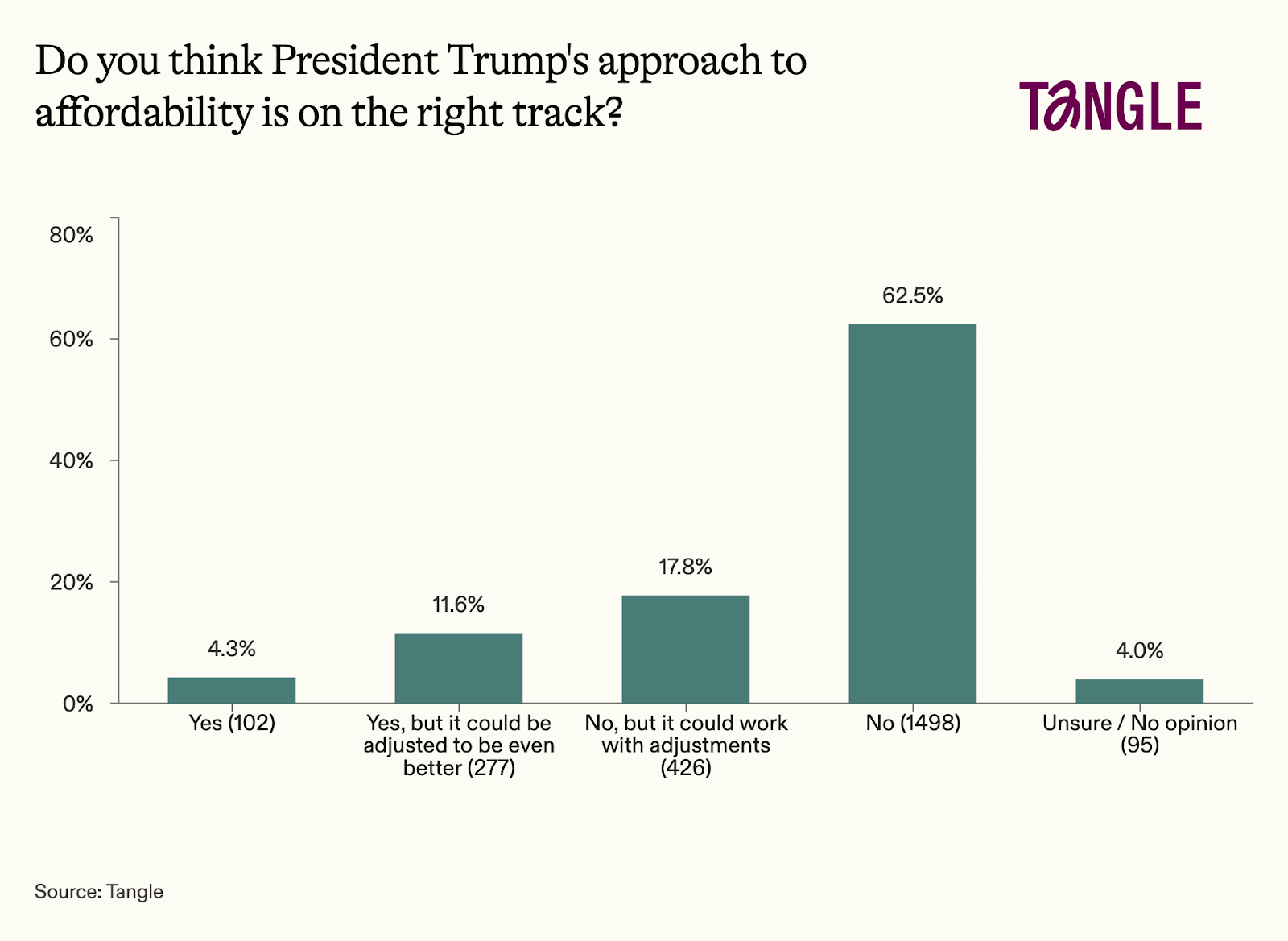
- Yesterday’s survey: 2,398 readers responded to our survey asking if President Trump’s approach to solving affordability was on the right track with 63% answering no. “I don’t think Donald Trump gives a damn about affordability,” one respondent said. “We need to look beyond the next quarter in our economic policy and planning. Trump’s plan is doing that, but will take time to bear fruit,” said another.
Have a nice day.
Whisp, a two-year-old Collie, was walking with his owner along the cliffs of the Northmavine peninsula in Shetland when he fell 100 feet down a cliff face. Unable to reach him safely, his owner called for the coast guard, who immediately began a rescue mission. Over the course of the three-hour operation, the rescuers used rope equipment to secure Whisp from above (a sea-level rescue was impossible due to the steep cliff face) and bring him back to safety. Incredibly, the dog was uninjured. Good News Network has the story.

Member comments