
I'm Isaac Saul, and this is Tangle: an independent, nonpartisan, subscriber-supported politics newsletter that summarizes the best arguments from across the political spectrum on the news of the day — then “my take.”
Are you new here? Get free emails to your inbox daily. Would you rather listen? You can find our podcast here.
Today’s read: 16 minutes.
Correction.
In yesterday’s piece about Department of Homeland Security (DHS) funding and the agency’s drawdown in Minnesota, we wrote that Tom Homan “had taken over responsibility of the operation from DHS Secretary Kristi Noem in late January.” Actually, Homan took over supervision of Operation Metro Surge on the ground from former U.S. Border Patrol Commander-at-Large Gregory Bovino, not Noem. Bovino reported to Noem while Homan reports directly to President Trump, which was the source of our error.
This is our 151st correction in Tangle’s 341-week history and our first correction since February 10. We track corrections and place them at the top of the newsletter in an effort to maximize transparency with readers.
Quick hits.
- A federal judge ruled that Immigration and Customs Enforcement cannot re-detain Kilmar Abrego Garcia, who was mistakenly deported to El Salvador in March, because a 90-day detention period has expired and the government does not have a viable plan to deport him. (The decision)
- DHS spokesperson Tricia McLaughlin announced on social media that she is leaving her position. She said the top role in her department will be filled by one of her deputies, Lauren Bis, and conservative commentator Katie Zacharia will join DHS as a spokesperson. (The departure)
- Ukraine and Russia ended a brief round of peace talks on Wednesday, with Ukrainian President Volodymyr Zelensky describing the negotiations as “not easy.” (The talks) Separately, Iran’s foreign minister said the country agreed to “guiding principles” with the United States in nuclear talks but that more work is needed to reach a formal agreement. Vice President JD Vance said Iran refused to acknowledge certain key demands from the U.S. (The negotiations)
- A man was arrested after allegedly running toward the U.S. Capitol with a loaded shotgun, U.S. Capitol Police say. His motive has not been determined. (The arrest)
- Peru’s Congress ousted interim President José Jerí after four months in office, following lawmakers’ claim that he failed to disclose meetings with Chinese businessmen. Jerí becomes Peru’s third consecutive president to be removed. (The removal)
The Goldilocks of News
What if there was a news company that wanted you to spend less time with the news?
Wait… Isn’t that like putting a pool in your backyard so you can spend less time in the water? The Pour Over doesn’t think so.
They give unbiased news for Christians (seriously… that’s not an oxymoron) that hits just what you need to be caught up on current events, plus a brief reminder that puts the news into perspective — and not a word more.
Too little news leaves you uninformed. Too much news leaves you anxious and angry. Just the right amount of news leaves you informed, with your peace intact.
See why 1.6 million Christians receive TPO’s politically neutral, anger-and-anxiety free news that “fits just right.”
Click here to get their funny welcome email… I dare you not to laugh.
Today’s topic.
The endangerment finding. On Thursday, February 12, Environmental Protection Agency (EPA) Administrator Lee Zeldin announced that the agency had rescinded the “endangerment finding,” a 16-year-old determination that allowed past administrations to regulate greenhouse gas emissions from the burning of fossil fuels. The EPA previously said that it would pursue curtailing the rule in July, claiming that the deregulation would save the auto industry an expected $54 billion. By repealing the endangerment finding, the EPA removes the scientific and legal justification for federal regulation of greenhouse gases.
Back up: In Massachusetts v. EPA (2007), the Supreme Court found that greenhouse gases fit within the Clean Air Act’s definition of “air pollutant” and required the EPA to regulate these emissions if the agency found that they endangered human health. The EPA instituted the endangerment finding after President Barack Obama took office in 2009, basing its authority to regulate airborne pollutants that become “well mixed” into the atmosphere on Section 202(a) of the Clean Air Act. At the time, the administration was having difficulty passing climate change legislation through Congress. In 2010 and 2022, the EPA denied petitions to reconsider the endangerment finding, and in 2012, the U.S. Court of Appeals for the District of Columbia sided with the EPA on a legal challenge against it.
The endangerment finding states that the “current and projected concentrations” of six gases — carbon dioxide, methane, nitrous oxide, hydrofluorocarbons, perfluorocarbons, and sulfur hexafluoride — in the atmosphere “threaten public health and welfare of current and future generations.” Although it does not itself impose regulations, the finding provided the legal basis for agency standards on greenhouse gas emissions and fuel efficiency in the auto industry and credits to automakers for instituting features that limit emissions. It also justified the 2015 Clean Power Plan to reduce power plant emissions and the strict tailpipe emissions standards put in place during President Joe Biden’s administration in 2024.
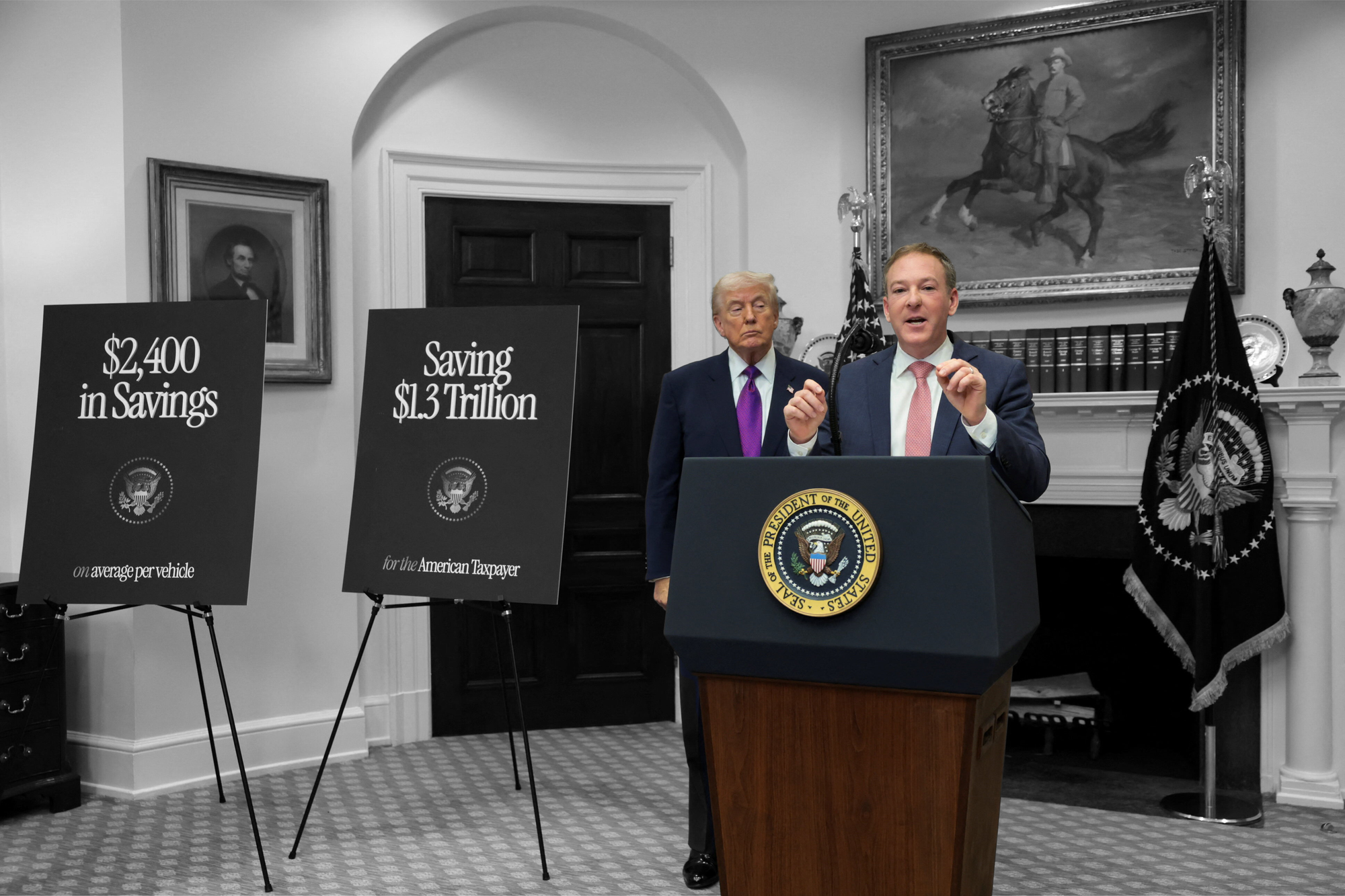
Administrator Zeldin called the repeal the “single largest deregulatory action in U.S. history,” saying it would save Americans over $1.3 trillion and benefit both manufacturers and consumers. “Referred to by some as the ‘Holy Grail’ of the ‘climate change religion,’ the Endangerment Finding is now eliminated. The Trump EPA is strictly following the letter of the law, returning common sense to policy, delivering consumer choice to Americans and advancing the American Dream,” Zeldin said. “As an added bonus, the off-cycle credit for the almost universally despised start-stop feature on vehicles has been removed.”
Critics decry the deregulation, saying the Trump administration is removing a vital environmental protection. “If this reckless decision survives legal challenges, it will lead to more deadly wildfires, more extreme heat deaths, more climate-driven floods and droughts, and greater threats to communities nationwide,” California Gov. Gavin Newsom (D) said, adding that California “will sue to challenge this illegal action.”
Below, we’ll get into what the right and left are saying about the rule. Then, Managing Editor Ari Weitzman will give his take.
What the right is saying.
- The right broadly supports the repeal, saying climate regulation should come through congress, not the EPA.
- Some claim the finding went beyond the Clean Air Act’s intent.
- Others argue the administration has strong legal footing if it faces an appeal.
The Wall Street Journal editorial board called the repeal a “climate liberation act.”
“The real import of the [endangerment] finding was to give the Obama and Biden teams legal license to mandate electric cars and force fossil-fuel power plants to shut down. Trump EPA Administrator Lee Zeldin has moved to roll back the Biden regulatory overreaches,” the board wrote. “But as long as the endangerment finding is in effect, a future Democratic President could reimpose the Biden climate diktats and go even further — say, by banning petroleum-powered lawn mowers and gas space heaters or stoves.
“Repealing the endangerment finding could stop this regulatory ping-pong. The climate lobby is sure to challenge the rescission, which could then tee up a case for the Supreme Court to revisit its misconceived Massachusetts. v. EPA precedent,” the board said. “The scope of CO2 regulation is a decision for Congress. It’s richly ironic for Democrats who denounce Mr. Trump as an authoritarian to howl that he’s relinquishing power to regulate all corners of the economy under the guise of climate that the Biden and Obama administrations unilaterally claimed.”
National Review’s editors said “Federal regulators finally get out of the climate business.”
“Regardless of how climate change will affect Americans’ health and welfare decades from now, the EPA’s finding was a gross mutilation of the Clean Air Act’s plain meaning, which allows only for the regulation of harmful air pollution. Greenhouse gases such as carbon dioxide, as a natural and eternal component of the atmosphere, by their nature cannot be considered air pollutants,” the editors wrote. “Neither are such substances threatening, if the word has any limits to its meaning, as they do no injury to those who breathe them in. The negative effects of greenhouse gases on human welfare via climate change — if they ever materialize in the face of adaptation — are purely theoretical and indirect.”
“If nothing else, the end of the endangerment finding is a triumph for realistic governance over moral fanaticism, since the EPA was never going to avert significant climate change with any regulatory scheme it could devise. The United States contributes less than 13 percent of global emissions — a shrinking share,” the editors said. “If the country somehow achieved President Biden’s goal of net-zero emissions by 2050 — which was never remotely possible — it might reduce global temperatures by one tenth of a degree by the end of this century.”
In The New York Post, Judge Glock wrote that “Trump’s about to cancel Obama’s most outrageous power grab.”
“Environmentalists will argue that the finding was required by an earlier Supreme Court ruling, and that climate change is indeed a threat to public health. Yet the earlier Supreme Court climate change ruling underestimated the vast potential it gave to the administrative state to reshape the economy,” Glock said. “Today’s Supreme Court is laser-focused on the dangers imposed by an overreaching administrative state. In 2022, the justices struck down an effort to regulate greenhouse gases emitted by power plants through the Endangerment Finding, declaring that in the case of a ‘major question’ that affected vast swaths of the economy, Congress would have to clearly authorize any administrative action.
“It’s hard to think of more of a major question than regulating greenhouse gases from all cars across the United States. Although the Supreme Court has at times upbraided Trump for his efforts to rule by executive action, in this case, the president is using executive action to reduce the power of the government,” Glock wrote. “The courts should uphold his Endangerment Finding withdrawal and restore power to Congress, which is supposed to authorize new laws. The EPA does not, and should not, have such power.”
What the left is saying.
- The left strongly criticizes the repeal, arguing it refutes the scientific consensus on climate change.
- Some say the administration’s decision will only benefit the fossil fuel industry.
- Others highlight inconsistencies in EPA’s legal rationale.
In The Hill, Byron Gudiel and Abigail Dillen said the ruling “puts polluters over people.”
“Instead of protecting us and our children from the climate crisis, the Trump administration is making climate denial official government policy. Trump’s Environmental Protection Agency is repealing its own scientific finding that greenhouse gases threaten public health and welfare, Gudiel and Dillen wrote. “For 15 years, the endangerment finding has affirmed what we can all see with our own eyes. Our government’s authority and obligation to address climate reality is a matter of irrefutable science and settled law which has been affirmed and re-affirmed by the Supreme Court.”
“By trying to upend the law, the Trump administration is seeking to consign us to extreme weather that will only drive more suffering in our country and around the world. Heat and wildfires will worsen air quality, exacerbating heart and lung diseases. Deadly storms will continue to cost lives, displace people, threaten food and water safety, and create billions of dollars in damages,” Gudiel and Dillen said. “Like the difficult questions our children ask us, we ask this administration: What is the cost of an ER visit for a child struggling to breathe? What is the cost of a home lost to a wildfire? Why are our lives worth less than polluter profits?”
In Common Dreams, Stephen Prager called the move “a gift to big oil donors.”
“The finding has been a target of the fossil fuel industry since it was reached. Under President Donald Trump, who has boasted openly of serving the fossil fuel industry in exchange for hundreds of millions of dollars of financial support during his last election, they have found their hero,” Prager wrote. “Indeed, [the repeal] is expected to immediately eviscerate fuel-efficiency standards and electric vehicle requirements for cars and trucks, which are already the largest single source of carbon dioxide emissions in the US, contributing about 1.8 billion metric tons in 2022.
“While the White House has said the reduced efficiency standards will ‘save the American people $1.3 trillion in crushing regulations,’ this is a drop in the ocean compared to the $87 trillion in economic disruption that a study by researchers at the University of Chicago and the University of Pennsylvania estimated will come over the next 25 years as a result of increased natural disasters and sea-level rise caused by American corporations’ fossil fuel outputs.”
In Bloomberg Law, Richard L. Revesz argues the EPA is “ignor[ing] Congress’ intent in unwinding greenhouse gas rules.”
“EPA claims that when Congress enacted the Clean Air Act in 1970, it sought to ‘control air pollution that threatens health and welfare through local and regional exposure,’ and wasn’t concerned with global pollutants like greenhouse gases. But EPA’s assertion ignores voluminous references to the contrary in the legislative debates, which show that Congress was in fact concerned about global pollution, including climate change,” Revesz wrote. “A major roadblock to EPA’s repeal of the endangerment is that the statutory definition of ‘welfare’ includes ‘effects on … weather … and climate.’”
“Clearly, Congress understood the difference between ‘climate,’ which involves changes in long-term meteorological patterns, and ‘weather,’ where the changes are short-term,” Revesz said. “In July 2025, when EPA proposed repealing the endangerment finding, it relied in part on the claim that the finding no longer had the requisite scientific support. That claim has since been so thoroughly discredited that the agency is no longer using it to justify the repeal. So now the agency confines itself to arguments involving statutory interpretation. These, however, fare no better.”
My take.
Reminder: “My take” is a section where we give ourselves space to share a personal opinion. If you have feedback, criticism or compliments, don't unsubscribe. Write in by replying to this email, or leave a comment.
- The endangerment finding is far from the only rule regulating car emissions.
- Repealing the endangerment finding will likely impact the auto industry less than other sectors.
- I believe, and hope, that courts will uphold the endangerment finding, rendering deregulation concerns moot.
Managing Editor Ari Weitzman: Look, I’m a bit of a greenie. I don’t begrudge people who need extra towing or passenger capacity their choice of vehicle, but I think it’s reasonable that the federal government institute policies that lead people who don’t need these features towards choices that protect common goods: clean air, public safety, and stable climate.
I have a truck that can handle a muddy rutted New England dirt road, tow a small car, and seat five; but it’s also a hybrid that gets about 30 miles per gallon. My bias coming into this story is that I want people who don’t really need large vehicles nudged towards decisions like the one I made, and away from unnecessary gas-guzzlers with poor sight lines. I was prepared to talk about the tension between regulation and choice, but after diving into this story, I think it’s actually a false lead. The practical effects of the EPA’s latest move won’t really be felt by the auto industry — but it takes a long time to explain why that isn’t the right place to focus.
When Lee Zeldin rescinded the endangerment finding, he didn’t bring all emissions regulations down with it. Zeldin did three separate things on Thursday. First, he repealed the agency’s endangerment finding. Second, he rescinded the EPA’s greenhouse gas (GHG) regulatory framework — he could have left the EPA’s emissions standards in place temporarily while the administration reconsidered the scientific backing for regulations, but he decided to bundle those actions together.
Before even getting to Zeldin’s third action, I have to pause to explain our regulatory framework for vehicles, of which the endangerment finding is only a small part.
The first meaningful federal tailpipe emissions standards were codified in the Motor Vehicle Air Pollution Control Act of 1965, which authorized the federal government to set exhaust emission standards for new cars. The 1970 Clean Air Act handed the government enforcement power, ultimately creating what’s called today a “certificate of conformity.” These certificates limit the amounts of hydrocarbons, nitrogen oxides, carbon monoxide, fine particulate matter, and fuel vapor that exit a car’s tailpipe. After reaching its endangerment finding in 2009, the EPA added in GHGs as part of those emission standards.
Every car in the United States has to hit a set of emissions standards to get this certificate, and if it doesn’t, then it can’t be sold. Period. These standards took shape over time, and they apply differently to different weights and classes of vehicles — Ford’s F-150 is going to produce more exhaust than their Focus, and the standards take that into account. At the same time as the EPA was developing its emissions standards, the Department of Transportation’s National Highway Traffic Safety Administration (NHTSA) developed an entirely separate set of efficiency standards, based on the Energy Policy and Conservation Act of 1975. This law was passed in direct response to the 1973 oil embargo; and these efficiency standards came out of Congress’s concern over foreign oil dependence, not air quality or climate.
The NHTSA developed a set of standards to enforce this law called CAFE (Corporate Average Fuel Economy). Unlike certificates of conformity, which apply to individual vehicles, CAFE standards apply to a manufacturer’s fleet, weighted by popularity. That means Stellantis can offset the inefficient Dodge Ram with the very efficient Fiat 500e. But since the Ram is so much more popular, Stellantis needs to find a way to make sure their more popular Rams and Jeep Wranglers are efficient enough to remain fleet-compliant.
Last week, The New York Times published an article claiming that, with the EPA endangerment finding gone, “the United States will essentially have no laws on the books that enforce how efficient America’s passenger cars and trucks should be.” This is almost exactly wrong. The NHTSA deals with efficiency standards, and those will remain in place. EPA tailpipe standards are independent.
Zeldin’s second action — wiping out the EPA’s GHG emissions standards — removed GHG emissions as a requirement for a certificate of conformity. The EPA’s tailpipe emissions standards remain; they just don’t take GHGs into account. The entire set of fleetwide CAFE standards remains, as well. And none of that even touches how California’s standards fit into the regulatory framework.
Finally, that brings us to Zeldin’s third action, repealing all off-cycle consumption credits. Off-cycle credits are extra points the EPA gives to automakers for applying efficiency benefits when the engine isn’t driving the car, like the start-stop feature that automatically stops an engine to save on fuel when the car isn’t in motion. Other features include grille shutters that close at highway speeds to reduce drag, high-efficiency air conditioning, and solar-reflecting coatings to reduce heat.
Zeldin’s third action removed the EPA’s crediting system for these features; but the EPA doesn’t apply these credits, the NHTSA does.
As Hyundai made clear in a statement, repealing EPA credits won’t make features like the auto start-stop extinct. “Start‑stop technology has never been federally mandated, and the EPA’s recent action removes regulatory incentives associated with it rather than prohibiting its use,” Hyundai said. But more importantly, these credits are actually still in effect, since they’re applied to an enforcement overseen by a totally different department.
Here’s how this regulatory structure works. The EPA calculates what an off-cycle feature might provide as an emissions benefit in grams per mile, then converts it into an efficiency credit. Manufacturers can then apply those credits against CAFE requirements so they can keep their entire fleet compliant with the NHTSA’s efficiency standards. That means Stellantis gets extra credit for installing start-stop features on all its Wranglers and Rams to keep its fleet compliant. That entire regulatory structure is still there. Zeldin only removed the basis for the calculations, essentially leaving these regulations intact but based on a logic that technically no longer exists, creating uncertainty for how they might change in the future.
All of that is bad news for manufacturers. They want certainty and consistency, and they want to be able to apply these credits in the future. What’s more, they definitely won’t be gaining $1.3 trillion in savings from deregulation. This claim is half of a cost-benefit analysis that the EPA ran on the effects of removing the endangerment finding. As a benefit, they claimed the industry will save $1.1 trillion in reduced costs for new vehicles — estimated at over $2,400 per vehicle — and $200 billion from avoiding purchasing electric vehicles and charging infrastructure. But in the same analysis, the EPA also found that the endangerment finding benefits consumers to the tune of $1.5 trillion in maintenance savings for more efficient cars. So, based on the EPA’s own accounting, that’s actually a net $200 billion industry-wide cost.
All told, the largest effect of rescinding the endangerment finding won’t be felt by the auto industry at all. Since the CAFE standards that will remain in place were built in tandem with GHG emissions standards, we’re going to get some emissions protections for free with the NHTSA’s efficiency standards; and, ironically, if the NHTSA decides that it won’t apply off-cycle credits without the EPA calculating them, then cars may become more fuel efficient. If they aren’t able to apply these credits, carmakers will have to focus more on fuel efficiency to become fleet-compliant in the future.
Really, the biggest impacts of the EPA removing the endangerment finding have nothing to do with the auto industry. They have to do with the aviation industry, whose GHG emissions standards are also justified by the finding. They have to do with manufacturing facilities and refineries, whose GHG thresholds were subject to permitting requirements under the finding. And most importantly, they have to do with power plants, which are regulated by Obama’s Clean Power Plan and its successor rules using the finding to target coal and gas-fired plants.
Those regulations weren’t explicitly repealed by Zeldin’s action, which was technically finalized only as it applies to vehicle emissions under Section 202(a) of the Clean Air Act. But the endangerment finding has served as the foundation for these other regulations, meaning the legal basis for enforcing those rules is now seriously weakened. As someone who is convinced by evidence showing the negative impacts of GHGs on climate and health, this is very concerning.
That brings us back to the courts, since that larger concern about enforcement would be moot if the endangerment finding is upheld. Like Isaac said when we covered this issue in July, I think that outcome is likely. First of all, the EPA didn’t ultimately advance a scientific argument for rescinding the endangerment finding. When Zeldin announced the proposal to rescind the endangerment finding in July, he used a controversial report from a handpicked group of climate skeptics at the Department of Energy (DOE) to justify the decision. In January, a U.S. district court judge ruled that the DOE acted illegally by keeping that group’s existence and meetings secret. By the time it issued its final rule, the EPA had lost its scientific backing, and it did not invoke the group’s controversial report to justify its change.
Second, the Supreme Court has already upheld the legal basis for the finding in its 2007 Massachusetts ruling, and that precedent still stands today. Interestingly, the Court’s removal of Chevron deference hurts the EPA here. With its landmark Loper Bright ruling, the Supreme Court found that any federal court doesn’t have to rely on an agency’s expert interpretations when making its ruling. That means that the court won’t give deference to the EPA’s viewpoint in interpreting legal challenges, leaving the Supreme Court’s prior determination likely to stand.
Moving forward, I won’t be watching the legal challenge to the endangerment finding to gauge how much the auto industry will change — other legal challenges, policy changes, and market forces will have a much larger impact on that sector. However, I will be watching this challenge very closely for its broader impact on the energy and manufacturing sectors.
Take the survey: What do you think of the endangerment findings removal? Let us know.
Disagree? That's okay. Our opinion is just one of many. Write in and let us know why, and we'll consider publishing your feedback.
Your questions, answered.
Q: How much of our national debt is carried by NATO members? By this, I mean how many Treasury bills does France (for instance) have, and is that value something that together, could ruin our fragile economy?
— Charles from Columbia, SC
Tangle: According to the Peter G. Peterson Foundation, most U.S. debt is held domestically by the Federal Reserve, state and local governments, or commercial banks; as of June 2025, these holdings account for roughly 69% of U.S. national debt. The remaining debt — about $9.1 trillion — is held by foreign entities, including foreign governments and, yes, some of our NATO allies. The amount of public debt held by foreign entities has ballooned over time; in 1970, foreign debt accounted for just 5% of U.S. debt.
Treasury data shows that the NATO ally that holds the highest amount of U.S. debt is the United Kingdom, with $889 billion as of November 2025. Among the countries that hold the most U.S. debt, seven are NATO members, and they hold a combined $2.97 trillion in debt. France holds $376.1 billion. Japan — an ally but not a NATO member — holds the most U.S. debt of any foreign government at $1.2 trillion.
It’s extremely unlikely that these debt holdings could cause significant ruin to the U.S. economy. For one thing, these foreign governments own U.S. debt because they see the U.S. as a safe, stable investment; threats to that investment would harm their economies as well as ours. However, that doesn’t mean that high foreign debt is completely unproblematic. If these foreign governments no longer viewed the U.S. as a stable investment, a large-scale sell-off could trigger higher interest rates and extreme financial insecurity.
Want to have a question answered in the newsletter? You can reply to this email (it goes straight to our inbox) or fill out this form.
Under the radar.
DHS is reportedly subpoenaing tech companies for the identifying data behind accounts that track or criticize ICE and Border Patrol movements. According to four unnamed government officials and tech employees, DHS has submitted hundreds of administrative subpoenas to Discord, Google, Meta and Reddit requesting names, email addresses, and telephone numbers behind anonymous accounts. The social media companies can choose whether to comply, and Google, Meta, and Reddit have reportedly complied with some — but not all — requests. Some of the companies have notified users of the requests, allowing them time to fight the subpoenas in court. The New York Times has the story.
News That Doesn't Want to Consume Your Day
The Pour Over delivers politically neutral news for Christians—just enough to stay informed, not so much you're anxious by lunch.
1.6 million readers trust their unbiased, perspective-grounded approach. Too little leaves you clueless; too much leaves you angry. This hits just right.
Numbers.
- 28%. The percentage of total U.S. greenhouse gas emissions attributed to the transportation sector in 2022, the highest percentage of any sector, according to the EPA.
- 1,802. The amount, in million metric tons CO2 equivalent, of greenhouse gas emissions by the transportation sector in 2022, according to the DOE.
- 8,887. The average number of grams of CO2/gallon emitted from burning a gallon of gasoline.
- 59.4. The industry-wide standard miles per gallon for passenger cars of model year 2026.
- 18. The industry-wide standard miles per gallon for passenger cars of model year 1978, the first year such standards were enforced.
- 42.4. The industry-wide standard miles per gallon for light-duty trucks of model year 2026.
The extras.
- One year ago today we covered peace talks between Trump and Putin.
- The most clicked link in yesterday’s newsletter was the report on chaos in Kristi Noem’s DHS.
- Nothing to do with politics: Have fun with these online optical illusions.
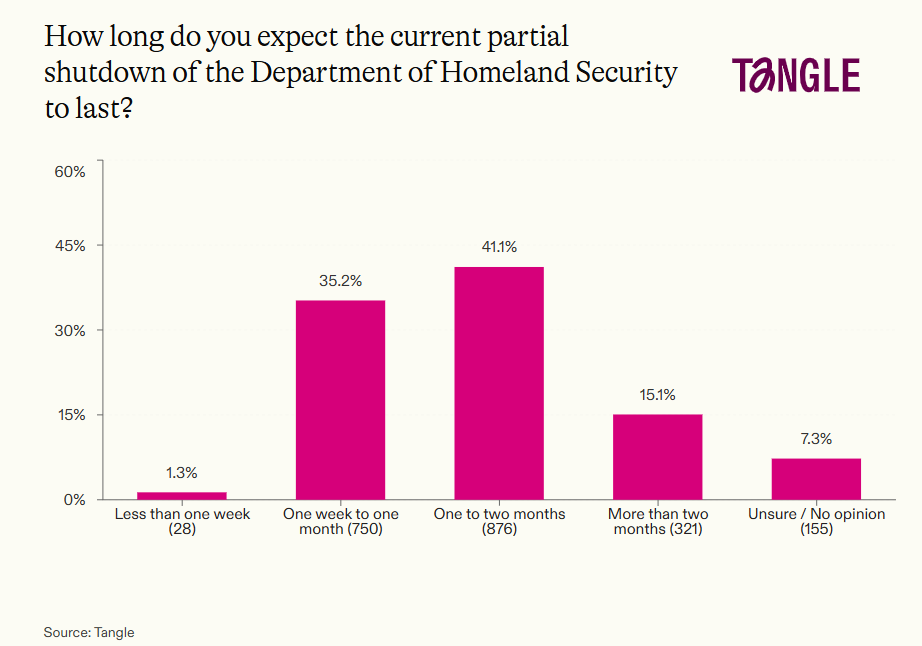
- Yesterday’s survey: 2,130 readers responded to our survey on the DHS shutdown with 41% saying they expected it to last one to two months. “Hopefully it will be long enough to force Republicans to agree to the common sense restrictions on behavior of the law enforcement agencies,” one respondent said. “I hope until Democrats realize siding with criminals (including violent protesters) does not sit well with a super majority of Americans,” said another.
Have a nice day.
In late January, 13-year-old Austin Appelbee, his mother, and his two siblings were paddleboarding and kayaking in Western Australia’s South West region when strong winds pushed them far out to sea and flipped their crafts. Unable to overcome the winds, Joanne Appelbee said she made the decision to have Austin try to swim to shore and alert authorities. Despite being 2.5 miles from shore, Austin swam for four hours in high wind and waves without a life jacket, eventually making it to land. Then, he had to run another mile down the beach to reach emergency services. The Australian Maritime Safety Authority eventually found Joanne and her other two children and rescued them from the water. Recounting his swim, Austin said, “I was just thinking in my head, like, thinking I was going to make it through. But I was also thinking about all my friends at school… I just said, ‘Not today, not today, not today. I have to keep on going.’” ABC News has the story.

Member comments