





I'm Isaac Saul, and this is Tangle: an independent, nonpartisan, subscriber-supported politics newsletter that summarizes the best arguments from across the political spectrum on the news of the day — then “my take.”
Are you new here? Get free emails to your inbox daily. Would you rather listen? You can find our podcast here.
Today’s read: 14 minutes.
Announcing our fourth guest for West Virginia!
We’re excited to announce that Free Press columnist Kat Rosenfield will join our on-stage lineup at Tangle’s next in-person event in Berkeley Springs, West Virginia, on June 14. Kat will share the stage with Tangle Executive Editor Isaac Saul, Editor-at-Large Kmele Foster, and Longview Editor Andy Mills for a conversation about artificial intelligence and national politics. We’re excited to bring the Tangle community together for the latest installment of our live event series, and we’d love to see you there.
Tickets are moving fast, and you can get yours here!
Our latest episode of Suspension of the Rules.
After some discussion of aliens last week, Isaac, Ari, and Kmele move on to the next big thing: athletes using steroids! After some discussion of cheating in sports, they dive deep into the electoral ramifications of Tuesday’s primary runoffs. Plus, Isaac addresses some criticisms, the guys speculate on Rep. Thomas Kean’s (R-NJ) absence, and Kmele tries to defend the indefensible.
Watch the most recent episode here!
Quick hits.
- U.S. Central Command said it shot down Iranian drones directed towards a commercial ship in the Strait of Hormuz, the latest military engagement between the sides amid ongoing peace discussions. (The incident)
- Former President Joe Biden sued the Justice Department, seeking to block the release of audio related to a prior investigation into his handling of classified documents. The lawsuit alleges the potential release is politically motivated. (The suit)
- Former Attorney General Pam Bondi shared that she has been diagnosed with thyroid cancer and is undergoing treatment. Bondi said she is “doing well.” (The diagnosis)
- Ugandan authorities announced the closure of the country’s border with the Democratic Republic of Congo due to the Ebola outbreak. (The closure) Separately, the Trump administration said it will establish a quarantine and treatment facility in Kenya for Americans exposed to Ebola in the region. (The facility)
- The Justice Department has reportedly launched an investigation into E. Jean Carroll, the writer who successfully sued President Donald Trump for sexual assault, related to statements she made in a 2022 deposition that she did not receive outside financial support for her two civil lawsuits against the president. (The report)
Your personal info is everywhere. Here’s how to erase it.
Your personal data is scattered across hundreds of websites right now. Home addresses, phone numbers, emails, even your family members’ details — all sitting online for anyone who knows where to look.
And it doesn’t stop with data brokers. It’s on public records sites, obscure forums, and random people search engines you’ve never heard of.
The internet never forgets. But you don’t have to leave your personal info out there.
With Incogni, you can remove your private data from hundreds of sites and keep it from showing up again. Take back control today with:
- Automated removals from data brokers
- Custom removal requests for any site
- Continuous protection as new sites pop up.
Use code TANGLE today to get an exclusive 55% discount on unlimited removals from anywhere that exposes your data.
Today’s topic.
The DNC’s 2024 election retrospective. On Thursday, May 21, the Democratic National Committee (DNC) released a report examining the party’s performance in the 2024 elections. The 192-page postmortem argued that Democrats must “organize everywhere to Win Anywhere” and particularly advocated for a “renewed focus on the voters of Middle America and the South.” However, the organization distanced itself from the document’s findings. In a Substack post accompanying the report’s release, DNC Chair Ken Martin said, “I don’t endorse what’s in this report, or what’s left out of it.”
Back up: Martin made a 2024 postmortem a central part of his campaign for DNC chair. Upon his election, he asked Democratic consultant Paul Rivera to compile the report, initially slated for a spring 2025 release. However, the retrospective was still in progress in July 2025, though the DNC had reportedly begun privately circulating some of its findings. Additionally, reports emerged that the DNC had decided to forgo analyzing key elements of the 2024 presidential election, such as President Joe Biden’s decision to run for reelection before dropping out in July 2024.
In December 2025, Martin announced that the DNC would not publicly release the report as expected, instead choosing to focus on its recent victories in off-cycle elections. This decision drew significant criticism, particularly after Martin’s appearance defending the decision on the podcast Pod Save America in April 2026. In a Substack post accompanying the release, Martin apologized for his handling of the issue, writing, “I didn’t want to create a distraction. Ironically, in doing so, I ended up creating an even bigger distraction.”
CNN was the first outlet to release the DNC autopsy in full, although it is still missing several sections, including analyses of Democratic performance in House of Representatives races, lists of sources for major claims, an executive summary, and a conclusion. Additionally, much of the report’s provided analyses are unsupported or contradict publicly available information. The DNC later issued an annotated copy of the report highlighting its errors.
The report’s delay and release have drawn significant criticism of Martin and the DNC. Democratic-aligned organizations have criticized the report’s failure to address concerns over Biden’s age and his administration’s handling of the Israel–Hamas war. Rep. Ro Khanna (D-CA) told reporters, “I mean, you don’t have to be a rocket scientist to know Gaza was one of the big issues in the 2024 election.”
In the wake of the release, some Democrats have called for Martin to step down. Rep. Seth Moulton (D-MA) told Axios “he should resign,” while Dan Pfeiffer, a former Obama adviser and Pod Save America cohost, said Martin “could not repair the trust.”
Below, we’ll share perspectives on the report from the left and right. Then, Senior Editor Will Kaback gives his take.
What the left is saying.
- The left says DNC Chair Martin mishandled the report.
- Some say Democratic leaders are changing strategy regardless of the report’s shortcomings.
- Others critique the postmortem for omitting substantive policy analysis.
In MS NOW, Zeeshan Aleem called the DNC report “the worst of all worlds.”
“If [Ken Martin] had followed through on his original promise, this report wouldn’t be shrouded in a fraction of the controversy it is now,” Aleem wrote. “It was initially supposed to come out in spring 2025, but then he delayed and delayed until he ultimately said he refused to release it at all. He had ample time to either clearly lay out expectations for the report’s quality or work to fix what was submitted. And when he torpedoed the report, he did not explain why other than to say the party ought to look forward. The result is a failure on his part: He made a pledge, and he did not fulfill it.”
“One can’t help but wonder, too, if Martin has preemptively derided the report as so bad it needed to be shelved because he sought a way to avoid tussling with activists who would’ve assailed the report’s assessment of issues like Gaza,” Aleem said. “If [the DNC] had released a report similar to this when it initially was expected to, it would likely have caused a few days of debate between moderate and progressive Democrats… But Martin’s process of delaying it, quashing it and then releasing a sloppy, incomplete report has attracted far more scrutiny than it would’ve gotten otherwise, and made the party look cowardly and incompetent in the process.”
In Vox, Andrew Prokop said “Democrats don’t need an autopsy to know what they did wrong.”
“If you’re looking for insights into why Democrats lost in 2024, you won’t find many in the DNC’s disavowed ‘autopsy,’” Prokop wrote. “There haven’t really been any dramatic attempts by Democrats to change their party brand going forward… But behind closed doors, among Democratic elites, a reckoning has indeed taken place — and a quiet consensus about at least part of the path forward has emerged.
“The most obvious midterm plan is a laser focus on affordability and on criticizing President Donald Trump, evident in campaigns across the country… Democrats have also recalibrated on various other issues where many in the party believe they’d gotten too far out of sync with mainstream voters over the past decade — most notably, border security, crime, climate change, and identity issues,” Prokop said. “This more restrained approach to changing the party’s image may well pay off in the midterms.”
In The New Republic, Alex Shephard argued “Gaza wasn’t the biggest omission” in the report.
“If you’ve read anything about the Democrats’ ‘autopsy’ of its 2024 election loss… it probably highlighted what the report doesn’t include: any mention of Gaza,” Shephard wrote. “But the overriding focus on this one omission misses a more important point. The problem with the DNC autopsy isn’t just that it doesn’t mention Gaza. It’s that it ignores policy and, for that matter, politics — how policies are messaged, and what role they play in coalition building — altogether.”
“A report that reckoned with aspects of Democratic messaging and voter targeting, while also examining political and policy issues like Gaza, inflation, and Biden’s stubborn refusal to hold onto power, could be useful,” Shephard said. “But that would have been too obvious a path for Ken Martin, it seems… The document itself may be useless, but it has yielded one important lesson nonetheless: The DNC needs new leadership.”
What the right is saying.
- The right critiques the DNC report for avoiding the party’s biggest problems.
- Some argue that retrospective reports are mostly irrelevant.
- Others say the postmortem proves Democrats don’t know what voters want.
In The Washington Times, Kelly Sadler argued “the Democratic party is in total disarray.”
“To call [the report] an embarrassment is an understatement. It was a humiliating exercise that exposed the party’s inability to self-reflect. Nowhere in the document is it critical of the party’s cover-up of former President Joe Biden’s clear cognitive decline, no mention of his disastrous debate with President Trump, and no blame on Mr. Biden for dropping out of the race early,” Sadler wrote. “There was no mention of inflation, boys competing against girls in sports, gas prices, pronouns, Gaza, or religion of any kind.”
“Realigning their party before the midterms and the 2028 presidential election also seems far off,” Sadler said. “Democrats haven’t shifted on any of their losing 2024 policy stances, which include a weakened border, support for illegal aliens, transgenders competing in women’s sports, and being soft on crime. The only economic policy they rally around is ‘Tax the rich’ as they point to raising taxes as a policy achievement… Indeed, the only good thing going for Republicans is that Democrats are a complete mess.”
In the New York Post, Rich Lowry said “Democrats should be grateful that the stakes of their autopsy are so low.”
“The report acknowledges that Democrats are out of touch and too dependent on the Republicans making poor candidate choices… It fails to grapple with the issues of inflation and immigration,” Lowry wrote. “The history of such party appraisals isn’t a good one. Donald Trump won the presidency in 2016 by taking the recommendations of the GOP autopsy after its 2012 election defeat and basically doing the opposite. Democrats may be rudderless and increasingly extreme, but that doesn’t mean they won’t have a good election night this coming November.
“Usually, a party that has just lost the White House rises or falls in the midterms based on the incumbent president’s job approval, rather than its own political creativity or inherent appeal,” Lowry said. “As for winning the White House, that typically depends on nominating someone who is charismatic and fresh, who has an unexpected approach to politics, and who develops a new coalition — think Barack Obama in 2008, or Donald Trump in 2016. None of this comes about by having a political strategist talk to a bunch of people about the immediate past election and write a long report about it.”
In Los Angeles Times, Jonah Goldberg compared Democrats to a business executive asking “‘why aren’t we selling more dog food?’”
“[In an apocryphal story, a dog food exec asked], ‘Why aren’t we selling more dog food?’ After a long silence, a small voice from the back ventures a guess: ‘Maybe the dogs don’t like it’... Simply put, the ideological activist base can’t accept that the dogs don’t actually like what they’re being served. This denial has a long history,” Goldberg wrote. “Ever since FDR’s administration, both parties have organized around an enduring myth of American politics: If everyone voted, Democrats would win. This idea more than any other explains why Republicans favor tighter controls around voting and Democrats want looser ones.”
“Another related assumption by Democrats: We’re obviously right, so we just have to do better at getting our message out,” Goldberg said. “The autopsy offers more of the same, arguing that Democrats need to copy the ‘always on’ media and activist infrastructure of the right… Now, as tradecraft, none of this is indefensible. But in context, it’s the same argument that has hobbled Democrats for decades: There’s nothing wrong with our dog food, we just need a better ad campaign.”
My take.
Reminder: “My take” is a section where we give ourselves space to share a personal opinion. If you have feedback, criticism or compliments, don't unsubscribe. Write in by replying to this email, or leave a comment.
- The report is about as bad as it’s being portrayed.
- Its greatest failure is an unwillingness to draw firm, actionable conclusions.
- Democrats want to move on from 2024, but this saga shows their organizational challenges remain prevalent.
Senior Editor Will Kaback: I’ll admit, I read all of the negative articles about the Democratic National Committee’s 2024 election report before I read a word of the report itself. If you’ve read any of those articles over the past week, you know they’re brutal — whether they’re coming from the left or right. Case in point: We reviewed 32 pieces of commentary for today’s edition (15 from the left and 17 from the right), and not a single one had a positive slant on the report or its takeaways.
My contrarian instincts pushed me to seek out redeeming qualities in the report when I finally read it. I was confident that I could unearth the overlooked, valuable, thought-provoking insights buried in the lengthy document that others had ignored, either for lack of interest or fear of deviating from the emerging consensus. But… yeah. This is about as bad as advertised. The report lacks a clear, consistent theory of the election or any grounding argument that connects the disparate pieces of evidence presented across its many sections. In fact, the sections where that theory should go were literally omitted (see below). The postmortem’s only throughline is the DNC’s apparent incompetence at every stage of compiling, presenting, and releasing it.
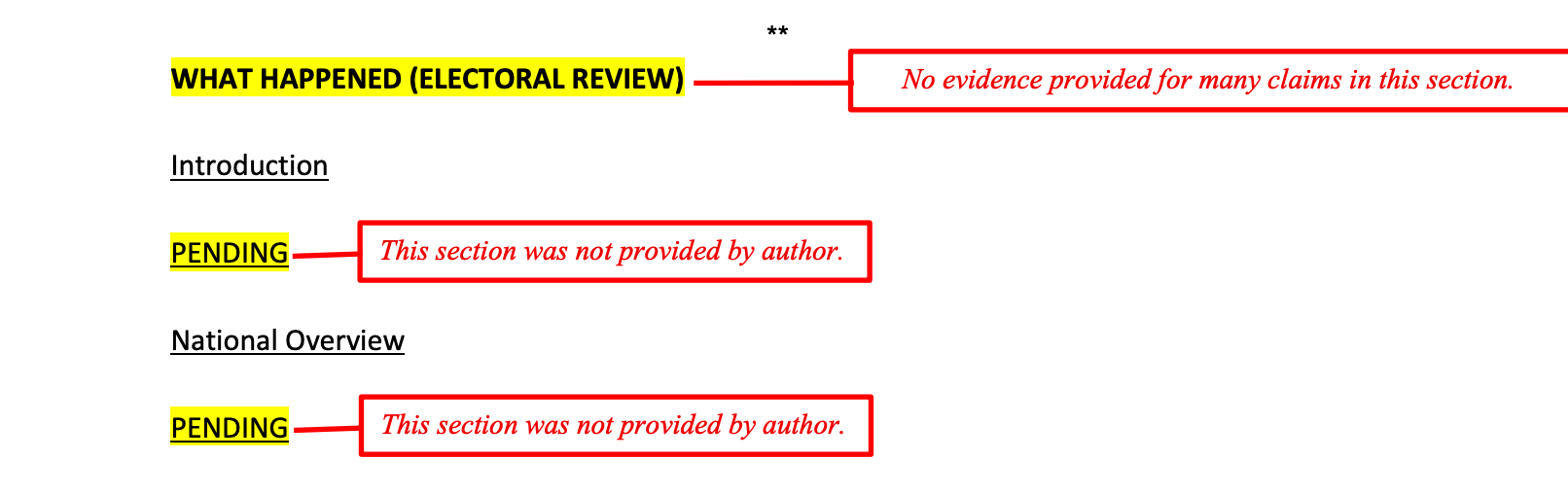
The DNC destroyed its own report’s credibility before anyone else had a chance to. Take a look for yourself — all 192 pages are tagged with a bright-red header that states, “This document reflects the views of the author, not the DNC,” effectively turning its author — a consultant handpicked by DNC Chair Martin — into a whipping boy for the DNC to excise from their political body and castigate. That disclaimer also says “the DNC was not provided with the underlying sourcing, interviews, or supporting data” for a report that the DNC commissioned. As if that weren’t enough, the DNC thoroughly annotated the autopsy to highlight factual errors, mystery sourcing, and tenuous conclusions. It’s like a tennis coach trotting out a woefully unprepared player and loudly proclaiming how weak and ineffective they are before a single point has been played. Is that more of a reflection on the player or the coach?
With that said, preemptive self-reproach was probably the best option available. The report isn’t close to finished, almost comically so. The executive summary is blank. Large portions of the “What happened” section, which you’d think would be one of the most important parts of a postmortem analysis, are blank. Most sections lack any sourcing for their core claims. And to cap it off, the conclusion is also blank.
Equally perplexing, the content that is there contains huge factual errors beyond what you’d expect in a first draft, like the claim that a Capitol Police officer was “beaten to death by the insurrectionists” on January 6, or the suggestion that 2022 Republican Senate candidate Herschel Walker would have done “little more than rubber [stamp] the president’s agenda” (the president in 2022 was, of course, Joe Biden).
Even a year after its initial due date, the report was still nowhere near ready for primetime. But given its length and the time already sunk into it, you’d expect it to contain some concrete analysis. It is dense with charts, polling and numbers (albeit unsourced), including findings on how different campaigns deployed capital and what kinds of media placements they prioritized. Frustratingly, though, it avoids drawing direct conclusions.
The report spends dozens of pages making painstaking comparisons between Democratic and Republican strategies, building to five empty corporate-speak recommendations, such as “define lanes for communications ecosystem” and “upskill organizing staff to meet the moment.” Ironically, these takeaways embody the exact kind of wooden, HR-approved rhetoric that a better report would have identified as part of the reason Democrats failed to connect with voters in 2024.
The media section contains a bit more meat, breaking down ad spending by party and medium and showing that Republicans spent less across virtually all categories and got more bang for their buck. Some tangible analysis follows: how Democrats may have overinvested in media at the end of the election cycle instead of creating a more balanced spread at all times, and how media could have been targeted differently for a phone vs. a tablet vs. a television, and so on. Salient stuff, sure. But again, the document rarely moves from modes of messaging to the message itself. Instead, it’s more corporate speak — Democrats need to meet voters “wherever they are,” they need to be “always on,” they need to “inhabit the habits of voters,” they need to “LISTEN.” That should do it.
A deathly allergy to potentially controversial stances pervades the document. One section compares Kamala Harris’s performance in North Carolina (which she lost) to then-state Attorney General Josh Stein’s performance in the state’s gubernatorial election (which he won). It tees up some thorny topics — like “The Male Voter Problem” — but the takeaways are threadbare. “Harris saw dramatic drops in support among young Latino men and young Black men compared to Biden’s 2020 performance,” it reads. “However, Stein recovered significant ground with both groups, suggesting his campaign found effective ways to reach these voters.” What were those strategies? The report doesn’t say, moving swiftly onto “Educational Polarization,” with more unexplored allusions to Stein’s comparatively better performance among white non-college voters. The closest thing to a conclusion it offers is that Harris focused too much on women, which still doesn’t explore what made Stein’s approach effective or how those differences explain an 11-point gap with male voters.
Finally, as most commentators noted, the absence of any discussion on the war in Gaza or of President Biden’s fitness for office is conspicuous. Obviously, any statement would have become a lightning rod for criticism — or more likely, as Zeeshan Aleem wrote (under “What the left is saying”), “a few days of debate between moderate and progressive Democrats.” Instead, they chose to say nothing about two of the campaign’s biggest issues, and the absence became the story. Once again, the failure (or unwillingness) to wade into choppy waters renders the entire exercise pointless.
The report isn’t completely bereft of value. Certain passages are strikingly lucid on the party’s ongoing challenges. “Since the high point of the 2008 Obama landslide… the Democratic Party has vacillated between stagnation and retrogression,” one early section reads. “These hair-splitting margins of defeat [in 2024] may lead some to argue Democrat leadership and candidates may need less changing of their message and approach and more massaging of their ideas for widespread adoption… This kind of thinking — denialist at its core — prevents the Party from seeking real accountability,” reads another. As someone who felt national Democrats badly misread the electorate in 2024, these lines feel spot on. It’s strange, then, that the ensuing pages embody that same denialist attitude, avoiding discussing solutions to broad directional problems in favor of more arcane issues about ad placements and managing campaign funds.
I honestly feel for DNC Chair Martin, but he has no one to blame but himself for his situation. This entire fiasco flowed from his promise to conduct this audit while campaigning for chair; that commitment eventually left him with no good choices, stuck between the escalating speculation about what he was “hiding” in the report and his knowledge that the document would only serve to embarrass the party. He should have ripped the bandage off earlier, yes, but given the no-win situation he was in, releasing the report — as shoddy as it is — was ultimately the right decision.
Before he relented, Martin argued that it was pointless to release the report now, with the midterms months away. I suspect many Tangle readers had a similar response when they saw today’s topic. I’ll be the first to say that this document — even if it had been completed on time — won’t greatly impact the midterms or the 2028 presidential election. The campaigns the parties run and the political conditions during the elections will matter far more.
However, I think this line of thought misses the entire point of why voters wanted this audit in the first place. Everyone knows Democrats failed in 2024. Many people have their theories about why, and they all want to see what the DNC learned: Did the party err in how it handled Biden’s age and fitness issues? What were Harris’s weaknesses as a candidate? How impactful was the war in Gaza? And how do Democrats change voters’ perception that they’re inauthentic?
The DNC’s ongoing inability to grapple with these critical issues raises another set of uncomfortable questions. Have Democrats actually learned any hard lessons from 2024, or are they simply banking on being “anti-Trump”? Are they organized and competent enough to capitalize on the current political environment, or might they squander a potential blue wave? What happens when President Trump is gone? I don’t think these questions are going away, even with this report now (mercifully) in the rearview mirror.
Take the survey: What would you want to see from a 2024 DNC postmortem? Let us know.
Disagree? That's okay. Our opinion is just one of many. Write in and let us know why, and we'll consider publishing your feedback.
Your personal info is basically floating around the internet like a cursed Craigslist couch. Addresses, phone numbers, relatives — it’s all out there. Incogni helps scrub your data from hundreds of sketchy people-search sites automatically.
Use code TANGLE for 55% off before some random website knows more about you than your mom does.
Under the radar.
On Tuesday, the Energy Department identified five companies for “advanced negotiations” on a potential plan to repurpose Cold War–era weapons-grade plutonium as fuel for nuclear power plants. The plan could address a key hurdle to building out nuclear power infrastructure: a dearth of enriched uranium for fuel. However, some nuclear nonproliferation advocates and lawmakers have questioned the plan, noting the technical and financial challenges encountered by similar efforts in the past. The New York Times has the story.
A deeper look.

Parties responding to defeat with election postmortems and reorganization isn’t new, though the methods of analysis have certainly evolved. After President Jimmy Carter’s loss to Ronald Reagan in 1980, Rep. Gillis Long (D-LA) created the Committee on Party Effectiveness (CPE) in 1981 to spearhead a reorganization of the party. The CPE’s recommendations did not prevent crushing Democratic defeats in 1984, and centrist Democrats created the Democratic Leadership Council (DLC) in 1985 in an effort to moderate the party. While Republicans won the White House again in 1988, the council’s efforts eventually paid off with former DLC Chair Bill Clinton’s 1992 victory.
The modern “election autopsy” is more recent. Following Mitt Romney’s 2012 defeat, Republican National Committee (RNC) Chair Reince Priebus announced the Growth and Opportunity Project to better understand recent GOP messaging failures. The report was released in March 2013, and it called for the GOP to become more inclusive toward minority groups and suggested that the party had “sound” policies but needed to communicate them more effectively; however, the eventual 2016 Republican candidate Donald Trump did not incorporate the report’s recommendations into his campaign.
The road not taken.
It took a long time to get to exactly where we started. At the beginning of the week, we wanted to discuss Tulsi Gabbard’s resignation, the Cornyn–Paxton primary, and the DNC retrospective — by the end of the week, that’s exactly what we discussed. But the path to making our final decision for today’s topic was far from straightforward.
We spent a good deal of time debating whether to provide an update on Iran negotiations or the new guidance from President Trump for green-card applicants to apply from their home countries. We opted against an Iran update, since peace negotiations remain in flux, and the administration’s characterizations of negotiations have proven unreliable so far. And while the green-card changes are set to have a large impact on our immigration system, until they are actually implemented and begin to affect on-the-ground processes — and drive more commentary — we want to hold off on covering the topic. As always, we may not be the first to cover a story, but we will always be thorough when we do.
The extras.
- One year ago today we wrote about Trump resuming collections on federal student loans.
- The most clicked link in our last regular newsletter was the ad in the free version for FinanceBuzz.
- Nothing to do with politics: Google search, without the AI overview.
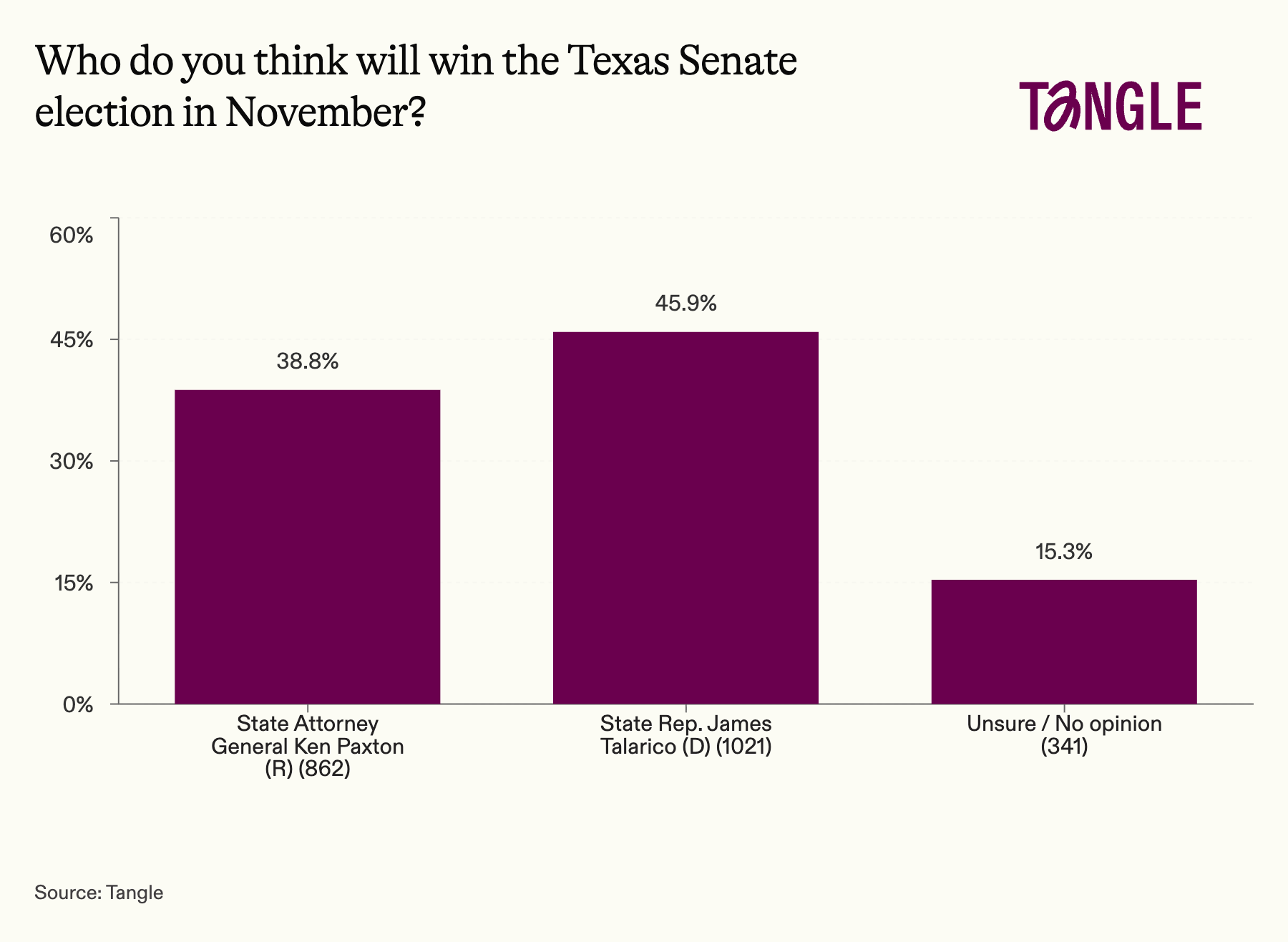
- Our last survey: 2,224 readers responded to our survey on the upcoming Senate election in Texas with 46% saying they believe state Rep. James Talarico (D) will win. “Texans will be loath to vote for a Democrat, even if Paxton is the Republican choice. But who knows?” one respondent said. “Talarico is too liberal for most Texans to stomach. Paxton will have a MAGA base; Talarico will have the ‘anyone but Trump’-ers base. Hard to tell where the middle will go,” said another.
Have a nice day.
The pandemic reshuffled daily life in many ways, not all of them negative. One example: American dads started spending a lot more time at home. Research from the American Institute for Boys and Men (AIBM) found that between 2019 and 2024, college-educated fathers cut paid work hours by six per week while adding more than four hours to cooking, cleaning, and childcare. Millennial dads now spend as much time with their kids as moms did in 1985. And the shift appears to be voluntary: The most financially secure fathers — those with the most flexibility to choose — increased their homemaking hours the most. “This is the biggest increase in the amount of hands-on fathering in half a century,” AIBM President Richard Reeves said. The Progress Network has the story.


Member comments