
I'm Isaac Saul, and this is Tangle: an independent, nonpartisan, subscriber-supported politics newsletter that summarizes the best arguments from across the political spectrum on the news of the day — then “my take.”
Are you new here? Get free emails to your inbox daily. Would you rather listen? You can find our podcast here.
Today’s read: 14 minutes.
Americans Born Between 1941–1979 Can Receive These 10 Benefits This Month
You could be missing out on $1,000s, and you might not even realize it.
Sure, you might know about some senior discounts at diners or retail stores.
But what you might not know is there are a number of lesser-known programs that can help slash bills, reduce insurance costs, and unlock powerful financial perks — right now.
We pulled together some of the most valuable money moves for 2026.
Cut expenses, boost your retirement, and recession-proof your finances.
*This is a sponsored post.
Measuring the first year of Trump 2.0.
In the days before President Trump’s second inauguration, we published a special Friday edition outlining a series of metrics and promises we would track over the course of the president’s term. One year in, we’re returning to that piece to share the latest numbers on issues like gas prices, housing prices, inflation, tariffs, deportations, foreign conflicts, and much more. We’ll explore how these numbers have changed since Trump took office, and offer a few new metrics that we’ll begin to track for the rest of his term. Keep an eye out for it in your inbox tomorrow.
Reminder: Friday editions are for premium members. To get access to this piece, you’ll need to upgrade.
Quick hits.
- After oral arguments on Wednesday, the Supreme Court appeared likely to rule that Federal Reserve Governor Lisa Cook can remain in her position while she challenges President Donald Trump’s attempt to fire her. The court is expected to rule this summer. (The arguments)
- The House Oversight and Government Reform Committee voted 34–8 and 28–15 to hold former President Bill Clinton (D) and former Secretary of State Hillary Clinton (D), respectively, in contempt of Congress for their refusal to appear for depositions in the panel’s investigation into convicted sex offender Jeffrey Epstein. The full House will now consider the contempt resolutions. (The votes)
- The Trump administration launched a new immigration enforcement operation in Maine and began making arrests this week. U.S. officials said the operation will focus on immigrants from Somalia. (The operation) Separately, a federal appeals court blocked a district judge’s injunction that restricted how Immigration and Customs Enforcement agents can engage with protesters. (The ruling)
- President Trump held a signing ceremony for members of the “Board of Peace” that will oversee the reconstruction of Gaza. The board includes leaders from Argentina, the United Arab Emirates, Hungary, and Pakistan. Canada and many European countries — including the United Kingdom, France, Germany, and Italy — did not take part in the ceremony and have not committed to being part of the board. (The ceremony)
- A major winter storm is expected to impact large parts of the South, Midwest, and Northeast from Friday through Monday, with heavy snow or ice forecasted for 33 states. (The storm)
Today’s topic.
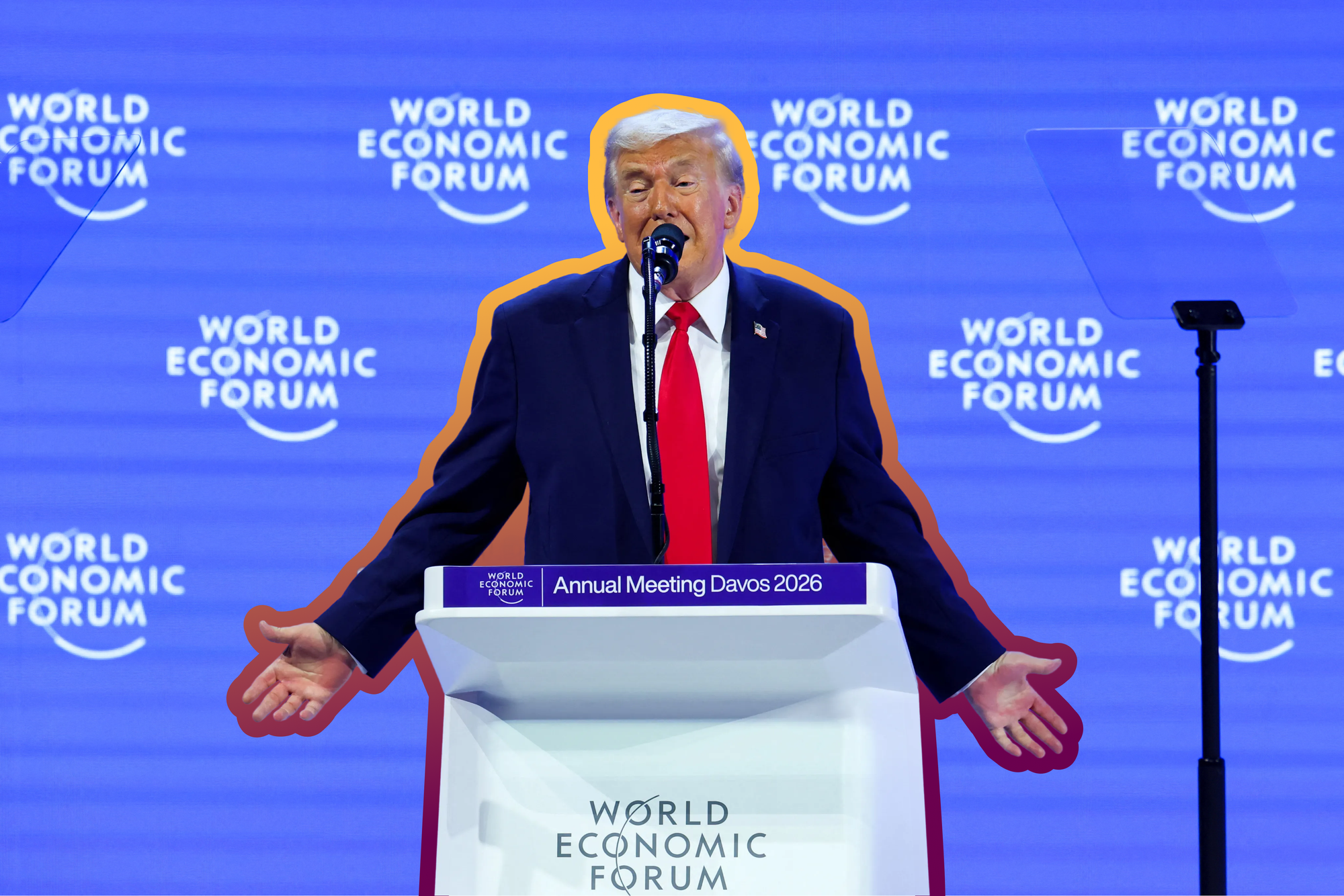
Trump at Davos. On Wednesday, President Donald Trump addressed a gathering of prominent global figures at the World Economic Forum (WEF) in Davos, Switzerland. The conference comes amid rising tensions between Europe and the United States over Trump’s efforts to acquire Greenland, and several world leaders gave critical remarks about the U.S. prior to the speech. However, later on Wednesday, Trump said that he discussed a framework of a deal related to Greenland with North Atlantic Treaty Organization (NATO) Secretary General Mark Rutte that gives the U.S. “everything we needed.”
We covered the latest on Greenland on Tuesday.
Back up: The WEF promotes cooperation between private corporations, national governments, and international organizations to address global issues. Its annual meeting in Switzerland, colloquially known as Davos, features conversations between leaders in business, government, civil society, media, and academia on a range of topics.
On Tuesday, Canadian Prime Minister Mark Carney gave a notable speech alluding to President Trump’s efforts to control Greenland and describing a global “rupture” underway. “If great powers abandon even the pretense of rules and values for the unhindered pursuit of their power and interests, the gains from transactionalism will become harder to replicate,” Carney said. “We know the old order is not coming back. We shouldn’t mourn it.”
Trump criticized Carney and Canada in his Wednesday address, remarking, “Canada gets a lot of freebies from us… They should be grateful, also, but they’re not.” The president also spent a portion of the speech criticizing European nations over their energy, trade, immigration, and economic policies, saying they were “not heading in the right direction.”
On Greenland, Trump explicitly said he would not use military force to acquire the island territory after previously refusing to rule the option out. “I don’t have to use force. I don’t want to use force. I won’t use force,” Trump said.
Later in the day, the president posted on Truth Social that he had “formed the framework of a future deal with respect to Greenland” after meeting with Secretary General Rutte. As a result of the discussions, he said he will not impose planned tariffs on eight NATO countries that recently sent a small number of troops to Greenland to take part in military exercises. Further details about the Greenland discussions have not been announced, but Rutte’s proposal reportedly does not include the transfer of overall sovereignty from Denmark to the United States.
Today, we’ll cover the latest on Trump’s time at Davos, with views from the right, left, and abroad. Then, Executive Editor Isaac Saul gives his take.
What the right is saying.
- Many on the right support Trump’s criticisms of Europe in the speech.
- Others say his address only reiterated a well established worldview.
The New York Post editorial board said “Trump simply gave Davos elites some ‘tough love.’”
“President Donald Trump in Davos just delivered some home truths to the assembled grandees of Europe, who unsurprisingly resent being reminded of what a basket case they’ve made of their continent in just a couple of decades. Trump was blunt. Europe, he told the crowd, has squandered its inheritance,” the board wrote. “The Davos crowd… bristled at Trump’s characterization of Europe (and Canada) — as freeloaders, but their vaunted and cherished social-democratic-welfare states have indeed been propped up for decades by America’s massive defense expenditures.
“The Greenland question is driving the Euros crazy, yet their response — sending a few dozen paratroopers to perform military exercises on the icy expanse — only underlines the absurdity of the European claim to the island… Fact: Absent American intervention, Russia or China would have no problem plucking at will the ripe fruit of Greenland to fulfill their Arctic ambitions,” the board said. “Trump’s criticism of Europe and the globalist outlook of ‘Davos Man’ was scathing. But ‘tough love’ often is.”
In The Washington Examiner, Daniel DePetris wrote about “Trump’s very predictable message at Davos.”
“Outside of his commitment not to use force to acquire Greenland, which many people in the room probably didn’t believe anyway, Trump’s speech simply reflected his already well-established views,” DePetris said. “First, the belief that U.S. allies are spoiled children who don’t pay the U.S. back for all the generosity it has bestowed on them since the end of World War II. Second, the U.S. is respected again on the world stage, unlike those ineffectual, stale, and morally superior dunces who occupied the office in the past. Third, the days when U.S. allies operated with a sense of entitlement are over.”
“Consider that Trump’s machinations about possibly capturing Greenland by force wouldn’t be resulting in such anxiety in Europe today if the military balance of power inside NATO were not so unequal in favor of the Americans. Perhaps there’s a lesson in that?,” DePetris wrote. “In the end, I suspect Trump will strike some kind of deal with Denmark short of full annexation. What that deal will look like is anybody’s guess, but it is likely to include the kinds of economic and security concessions that will scratch Trump’s itch and allow him to claim a public victory.”
What the left is saying.
- Many on the left say the gathering offers world leaders a chance to unite against Trump’s aggression.
- Others say Trump’s presence at Davos is part of his bid to reshape the global order.
In The Guardian, Robert Reich wrote “world leaders in Davos must stand up to Trump.”
“This year’s Davos meeting occurs at a time when Donald Trump is not just unleashing his brownshirts on Minneapolis and other American cities, but also dismantling the international order that’s largely been in place since the end of the second world war,” Reich said. “I hope the leaders now assembling at Davos speak out against Trump’s tyrannous assault on international laws and rules, and his contempt for every institution established to maintain peace. Their collective repudiation of Trump would give other CEOs and world leaders cover to express their opposition as well. It could be a tipping point.”
“Davos’s excuse for existing is supposed to be world leadership — although its attenders have not exactly distinguished themselves in the past by their fealty to democracy, social justice or the rules of international law. Some are directly benefiting from Trump’s tax cuts and regulatory rollbacks. Many occupy their positions precisely because of their reluctance to rock any big boats or cause any trouble,” Reich wrote. “Yet if there were ever a time for them to speak out, it is now. This is their opportunity. It is also their duty.”
In The New York Times, Michael B.G. Froman called Trump “the ultimate Davos man.”
“Much like the rest of the international system, Davos is entering a moment of transition that will determine whether it can adapt and retain its relevance,” Froman wrote. “Its current metamorphosis, driven largely by President Trump, is more swift and pronounced than any prior period. Gone is the yearslong emphasis on the United Nations Sustainable Development Goals, the implementation of the Paris accords and how governments should rely on local organizations to carry out their development programs.”
“The old Davos is dead, and the new Davos is still coming into view. Mr. Trump is making a bid to shape its future… Other American presidents skipped Davos, at least in part to distance themselves from the optics of rubbing elbows with the global elite instead of focusing on kitchen table issues back at home. This is Mr. Trump’s third visit to Davos,” Froman said. “In planting his flag at Davos, Mr. Trump is indicating he is not an isolationist but rather is ready to engage with the rest of the world and reshape the international system, one piece after another.”
What writers abroad are saying.
- Some writers say Trump is changing the world order, but Europe should still stick by the United States.
- Others suggest Davos’s mission is increasingly irrelevant.
In The National Post (Canada), Jesse Kline argued “Carney may be right about the ‘new world order,’ but [he] failed to articulate a coherent foreign policy.”
“What [Carney] really wanted to convince his chums in Davos of was not to invest in our country, but to join him in building coalitions so that middle powers like Canada can assert themselves in a multi-polar world and avoid being trampled upon by great powers like the United States and China,” Kline wrote. “Carney is right that co-operation among middle powers is the best chance we have of ensuring our voices get heard. Yet he isn’t advocating for a realist foreign policy, but what he terms ‘value-based realism,’ which aims to be ‘both principled and pragmatic.’”
“Carney may be right that we’re transitioning to a ‘new world order’ characterized by a great power rivalry between the U.S. and China, and that, unlike during the Cold War, Washington may not operate under the assumption that what’s best for its allies is best for America,” Kline said. “But Canada and its allies will still have to ask themselves which side they’re on. On one side we have a country that, for all its faults (and there are many), is still a capitalist country with a democratic system of government. On the other we have a coalition of totalitarian dictatorships in China, Russia, Iran and North Korea that are actively seeking to undermine the free world.”
In The Guardian (United Kingdom), Larry Elliott said Davos “represents a world that no longer exists.”
“Donald Trump represents everything that the Davos crowd hates — and it is unlikely they are any more well-disposed towards him after being forced to listen to more than an hour of the president’s rambling speech today. He is a protectionist, not a free trader. He thinks the climate crisis is a hoax and is suspicious of multilateral organisations. He prefers power plays to dialogue and he doesn’t have any time for the ‘woke’ capitalism that Davos has been keen to promote,” Elliott wrote. “Davos is an irrelevance and it seems fitting that Trump should be on hand this week to deliver the coup de grace to the liberal international rules-based order that the WEF prides itself on upholding.”
“The question is what happens next. Clearly, a well-functioning international order is preferable to the law of the jungle, but crafting one is not going to be easy,” Elliott said. “It requires faster and more inclusive growth. It requires significantly higher investment in public infrastructure. It requires the rich west to give poorer countries financial help so that they can protect themselves against the climate crisis. It requires Europe to do more to pay for its own defence. And it requires reform of the international institutions: the United Nations and the World Trade Organization as well as the IMF and the World Bank.”
My take.
Reminder: “My take” is a section where we give ourselves space to share a personal opinion. If you have feedback, criticism or compliments, don't unsubscribe. Write in by replying to this email, or leave a comment.
- Trump’s Davos speech is further proof that the threat of military action in Greenland was never more than a bluff.
- Outside of that, his speech was typical fare for Trump.
- Mark Carney, on the other hand, expressed a stark perspective on global affairs and the importance of middle-power alliances.
Executive Editor Isaac Saul: By now, I should be used to the political whiplash — but it still leaves me dizzy.
On Tuesday, I wrote about Trump’s comments on Greenland: That it is an important strategic play, that Trump’s threats to take Greenland with force are an embarrassment, and that Greenland genuinely has strategic importance. I never believed he would actually deploy troops to Greenland because 1) Trump has better instincts than to pursue such a politically unpopular idea, 2) he uses this kind of negotiation tactic all the time, and 3) enough serious people around him will make sure we never actually put boots on the ground in Greenland.
Trump’s speech on Wednesday provided strong evidence that this intuition was correct. Trump said explicitly that he wouldn’t use force to take Greenland, and the way he said it clearly showed he knew it was something he needed to say. “That’s probably the biggest statement, because people thought I would use force,” he said, “I don’t want to use force. I don’t have to use force. I won’t use force.”
Of course, people thought he would use force because he said he’d take Greenland the easy way or the hard way, he repeatedly refused to rule out using force, his advisors explicitly threatened to use force, and he complained to Norway’s Prime Minister that he didn’t feel inclined to focus explicitly on peaceful methods because he was denied the Nobel Peace Prize. This was always where we were heading — Trump declaring some ambiguous “deal” on Truth Social and all of us left waiting to hear the details.
So what changed? Two things: I think Trump most likely recognized (again) the economic consequences of his threat to tariff nations that did not support the plan. Trump, in his address, actually alluded to the stock market taking a dip because of “Iceland,” and how this whole venture has already started costing us money. (A quick aside: Trump mixed up Iceland and Greenland four times in his speech, something his press secretary denied despite it being broadcast to millions of people on video.) Trump probably also recognizes that using force would be wildly unpopular, both domestically and with the European countries that are still our global allies.
These are, typically, the things that constrain Trump: economic risks and bad polling. Frankly, these are pretty good constraints — I want a president who responds to public sentiment and economic indicators. But this issue shouldn’t require external constraints.
The rest of Trump’s Davos address was more standard and less notable. The president insisted he wanted Europe to do well, but he lambasted its leaders for mass migration and self-defeating energy policies. He told the world that the United States is the hottest country on earth, is doing better than it ever has, and has turned around remarkably after Biden’s failures. He credited this success to deregulating the energy industry, drastically reducing the federal workforce, and closing the border. The newsiest statement he made was his promise to lean into nuclear energy, but even that commitment from Trump isn’t all that new.
The speech was also full of typical exaggerations or outright lies: He claimed China makes all of the world’s wind turbines but never uses them, proof they’re ripping everyone off by selling wind energy (China is the world leader in wind power, and it accounted for 70% of new global wind power in 2024); he claimed we never get anything out of NATO, when the only time NATO’s Article 5 clause was ever exercised was after September 11; he claimed the U.S. has brought in $18 trillion of new investment — double his own administration’s tally, which itself is based on broad pledges; he claimed again that he has ended eight wars, which he has not; he claimed the prices of drugs have fallen “5, 6, 7, 800 percent,” or even “2,000 percent,” all of which are mathematically impossible (also, drug prices have gone up).
On the other hand, Canada’s Prime Minister Mark Carney gave a rather remarkable and newsworthy address to the forum (it’s much shorter than Trump’s, and worth reading in full). Carney’s speech was not subtle. He spoke to the harsh realities of today’s international order — that the powerful get to do what they want so long as the weak and intermediate powers submit; that the international rules-based order was always something the great powers could ignore when convenient. And he called on the world’s “middle powers” to act: to reject the notion that “compliance will buy safety” and to accept that the rules-based international order is dead.
“We participated in the rituals, and we largely avoided calling out the gaps between rhetoric and reality,” Carney said. “This bargain no longer works. Let me be direct. We are in the midst of a rupture, not a transition. Over the past two decades, a series of crises in finance, health, energy and geopolitics have laid bare the risks of extreme global integration. But more recently, great powers have begun using economic integration as weapons, tariffs as leverage, financial infrastructure as coercion, supply chains as vulnerabilities to be exploited.”
Carney laid out a new and significant position: That Canada recognizes itself as a middle power, and that as a middle power it cannot negotiate with hegemons on its own. As such, Canada will form different alliances for different issues, broadening its strategic partnerships to include more nations (implicitly not just the United States, Mexico, and Europe). The goal, he said, is for Canada to build coalitions to join forces with other middle powers — to give itself actual leverage rather than passive “subordination” to great powers like the United States, China, and Russia.
And it’s walking the walk. Canada has expanded the Great Powers it will play nice with, agreeing to a trade deal with China this week; it’s also negotiating agreements with other middle powers: Qatar, India, Thailand, the Philippines, the Association of Southeast Asian Nations, and the South American Mercosur bloc.
This declaration could be one of the most important responses to the great power struggle between the U.S., China, and Russia. Carney, again, was not subtle about the impetus of his remarks: He described tariffs as economic weapons and violations of international law by the great powers as the reason for this new position. Not only that, but he called on other middle powers to act — to join him, to follow Canada’s lead, to coalesce their power so they can respond together.
Trump, in his speech, took note of Carney’s words. “I watched your Prime Minister yesterday, he wasn’t so grateful. They should be grateful to the U.S., Canada. Canada lives because of the United States. Remember that Mark, the next time you make your statements.”
Indeed, Carney did not seem very grateful — nor did he seem interested in subordinating to the kind of response Trump offered.
For all the talk of Greenland and Europe and Venezuela, this, to me, seemed like the most notable and interesting development of Davos: One of our oldest and geographically closest allies has explicitly promised to collect as much power as possible to be able to stand up to us when they can. Perhaps, in two or three years, we’ll look back on this speech and scoff; but today, Canada’s prime minister got my attention, and I was left with a strong sense that he meant what he said — and intends to follow through on it.
Take the survey: What do you think of the speeches from Trump and Carney at Davos? Let us know.
Disagree? That's okay. Our opinion is just one of many. Write in and let us know why, and we'll consider publishing your feedback.
Your questions, answered.
Q: Can you please help us understand the assertion that there is a housing shortage in this country?
There are approximately 148,300,000 residential housing units in this country. Of those, about 133,000,000 are occupied. The average square footage of residential housing units in this country is around 1,800. The U.S. population stands at around 340,000,000. The average number of people per housing unit stands at 2.03 people.
In no uncertain terms, there is NO housing shortage in this country. Supply clearly exceeds demand and there is no indication of overcrowding.
Why would anybody make such an absurd assertion? What are the facts that justify such a claim?
— Jim from Atlanta, GA
Tangle: All good points, Jim, and all accurate figures (according to data from FRED). You’ll get a lot of consensus by claiming that people who have housing have ample space — U.S. homes have increased in size by 150% since 1970, and at the same time families have been getting smaller. We can definitely have a discussion about whether or not that’s a good thing, but those facts don’t prove that there is no housing shortage.
The real question is if enough housing units are available to those who need them. Put differently, since about 15 million homes are vacant, why can’t all the people who don’t have homes move into one of those?
First, most vacant homes aren’t move-in ready. According to the Census Bureau, about 30% of unoccupied homes are between residents (getting refurbished, on the market, or pending purchases), another 30% are only used occasionally or seasonally, and the remaining 40% are vacant for other reasons (legally condemned, unlivable, pending litigation, etc.). Second, most vacancies aren’t in high-opportunity areas where demand is high. A good measure of housing availability is vacancy rate. A healthy vacancy rate is around 5-10%; cities like Austin, TX; Minneapolis, MN; Washington, D.C.; Portland, OR; and Salt Lake City, UT all fall below that threshold. Third, in economic terms, a “shortage” doesn’t mean that there is an inadequate supply, full stop; it means the market has an inadequate supply to create equilibrium, leading to higher demand that causes high prices.
So, yes, if we were able to coordinate it, we could theoretically place everyone under a roof tomorrow. However, doing so wouldn’t be economically feasible — the owners of those properties would require payment, and the new occupants probably wouldn’t be able to find jobs in the areas where the most vacant homes are in order to make that payment. That creates localized market imbalances, which cause spikes in prices, which creates what economists call a shortage.
Want to have a question answered in the newsletter? You can reply to this email (it goes straight to our inbox) or fill out this form.
Under the radar.
Beginning January 17, U.S. Immigration and Customs Enforcement (ICE) has reportedly started releasing immigrant families from a Texas detention center. The shelter director said that approximately 160 detainees — half of them minors — have arrived at the shelter, and ICE plans to release up to 100–150 a day over the next two to three weeks. The agency has not explained the releases, but those freed reportedly hail from roughly 12 countries, including Iran, Russia, China, Vietnam, Venezuela, Guatemala, and Mexico. The action runs counter to the Trump administration’s previously outlined “zero releases” strategy for those arrested on alleged immigration offenses. USA Today has the story.
10 Benefits Most Americans 45–84 Don't Know They Qualify For
You're probably leaving thousands on the table.
Beyond the obvious senior discounts, lesser-known programs can slash bills, cut insurance costs, and unlock serious financial perks—starting now.
We compiled the most valuable money moves for 2026 to help you cut expenses, boost retirement savings, and recession-proof your finances.
Numbers.
- 1971. The year of the first “European Management Forum” in Davos, Switzerland.
- 450. The approximate number of participants (from 31 countries) at the first Davos meeting.
- 3,000. The approximate number of participants at the 2026 World Economic Forum (WEF) meeting.
- 65. The approximate number of heads of state and government attending this year’s WEF meeting.
- 22. The number of times President Trump mentioned “Europe” in his speech at Davos.
- 15. The number of times President Trump mentioned “Greenland” in his speech.
- 7. The number of times Canadian Prime Minister Mark Carney mentioned “middle powers” in his Davos speech.
The extras.
- One year ago today we wrote about Joe Biden’s final acts as president.
- The most clicked link in yesterday’s newsletter was Trump walking back threats to Europe over Greenland.
- Nothing to do with politics: The hidden engineering of Niagara Falls.
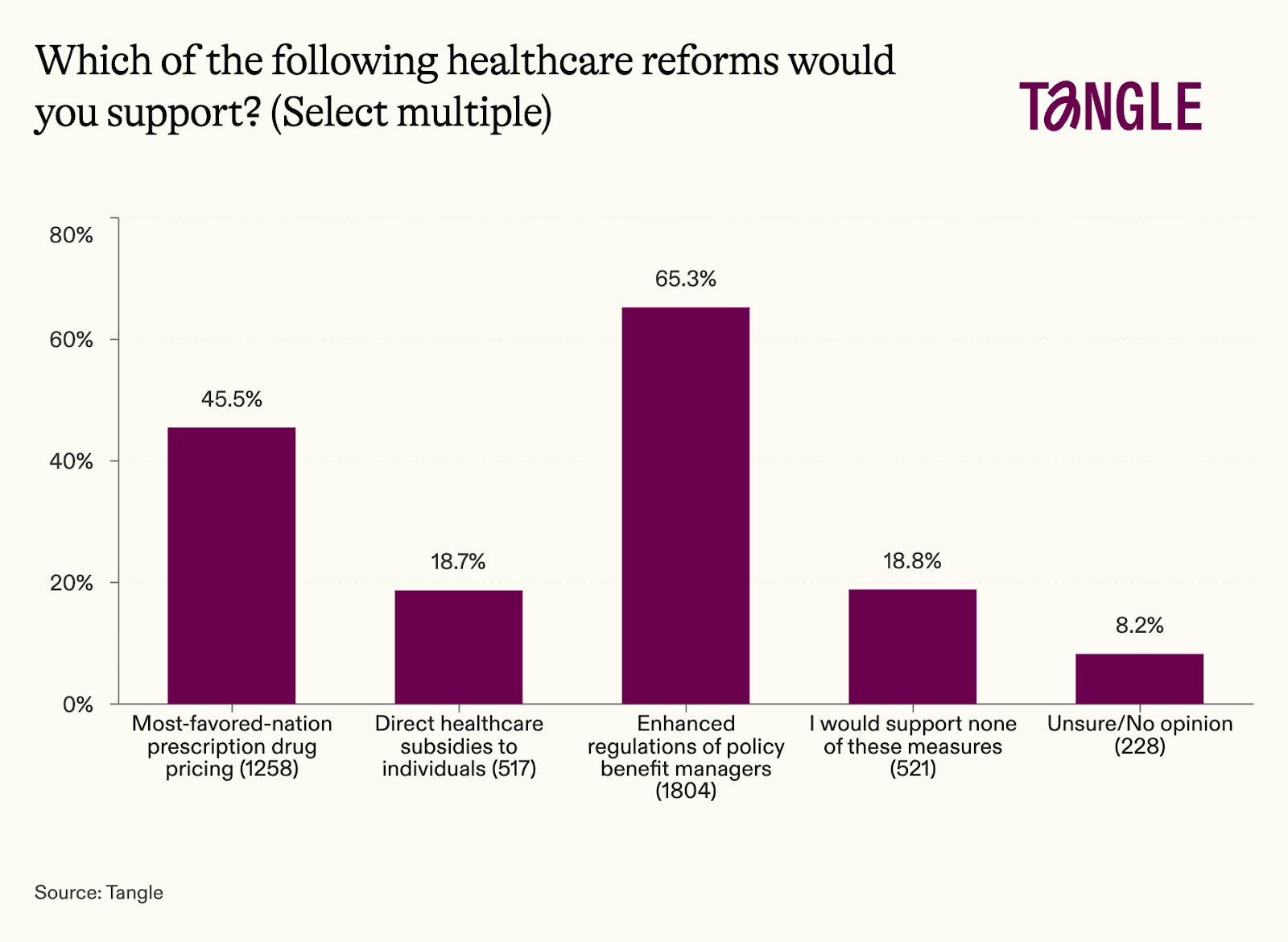
- Yesterday’s survey: 2,764 readers responded to our multi-select survey on Trump’s Great Healthcare Plan with 65% supporting enhanced regulation of pharmacy benefit managers. “Get rid of PBMs and all the coding and insurance garbage and overhead-taking with controls on the redundancy of resources that local healthcare outfits waste money on,” one respondent said. “We need universal public health care,” said another.
Have a nice day.
Despite its name, Dinosaur National Monument — located on the Colorado–Utah border — hasn’t had a dinosaur fossil excavation in over 100 years. That changed this month. On January 16, officials from the National Park Service announced that dinosaur fossils had been uncovered during parking lot construction in September 2025. As workers removed old asphalt from the site, they discovered dinosaur-bearing sandstone, a small portion of the roughly 3,000 pounds of fossils and rock that were subsequently excavated. The fossils are now being cleaned and studied at the Utah Field House of Natural History State Park Museum. CBS News has the story.

Member comments