I'm Isaac Saul, and this is Tangle: an independent, nonpartisan, subscriber-supported politics newsletter that summarizes the best arguments from across the political spectrum on the news of the day — then “my take.”
Are you new here? Get free emails to your inbox daily. Would you rather listen? You can find our podcast here.
Today’s read: 15 minutes.
Your criticism, published.
On Friday, we shared (and responded to) some reader criticism of our coverage of Charlie Kirk’s assassination. As always, we enjoy amplifying our audience’s perspectives as a way to add viewpoint diversity to our coverage, and we appreciate all the respectful and thoughtful disagreement.
Reminder: We share 90% of our content for free, but Friday editions are for our 70,000+ paying Tangle members. To support this kind of journalism as a member, you can go here.
Quick hits.
- President Donald Trump announced a new $100,000 fee for applicants to the H-1B visa program, which gives temporary legal status to foreign workers employed by U.S. companies. The White House said the fee will only apply to new applicants, though some companies advised employees with H-1B visas not to leave the country in the near future. (The announcement)
- MSNBC reported that in 2024, White House Border Czar Tom Homan allegedly accepted $50,000 from undercover federal agents after indicating that he could help them receive government contracts if President Trump won reelection. However, the Federal Bureau of Investigation and the Justice Department closed the investigation in recent weeks. Homan denies any wrongdoing. (The investigation)
- President Trump said the U.S. military struck a boat allegedly carrying drugs and bound for the United States, the third such strike publicized by the president. Trump said the three people on board the boat were killed. (The strike)
- An estimated 90,000 people attended a memorial service for conservative activist Charlie Kirk, who was assassinated on September 10. The service included speeches by President Trump, Vice President JD Vance, and other top Trump administration officials. Kirk’s wife Erika also spoke and said she forgave her husband’s killer. (The service)
- An Israeli airstrike in Lebanon killed five people, according to the Lebanese government, with Lebanon’s speaker of the parliament claiming that four U.S. citizens were among the fatalities. However, a U.S. State Department spokesperson disputed that American citizens were killed in the strike. (The strike)
Today’s topic.
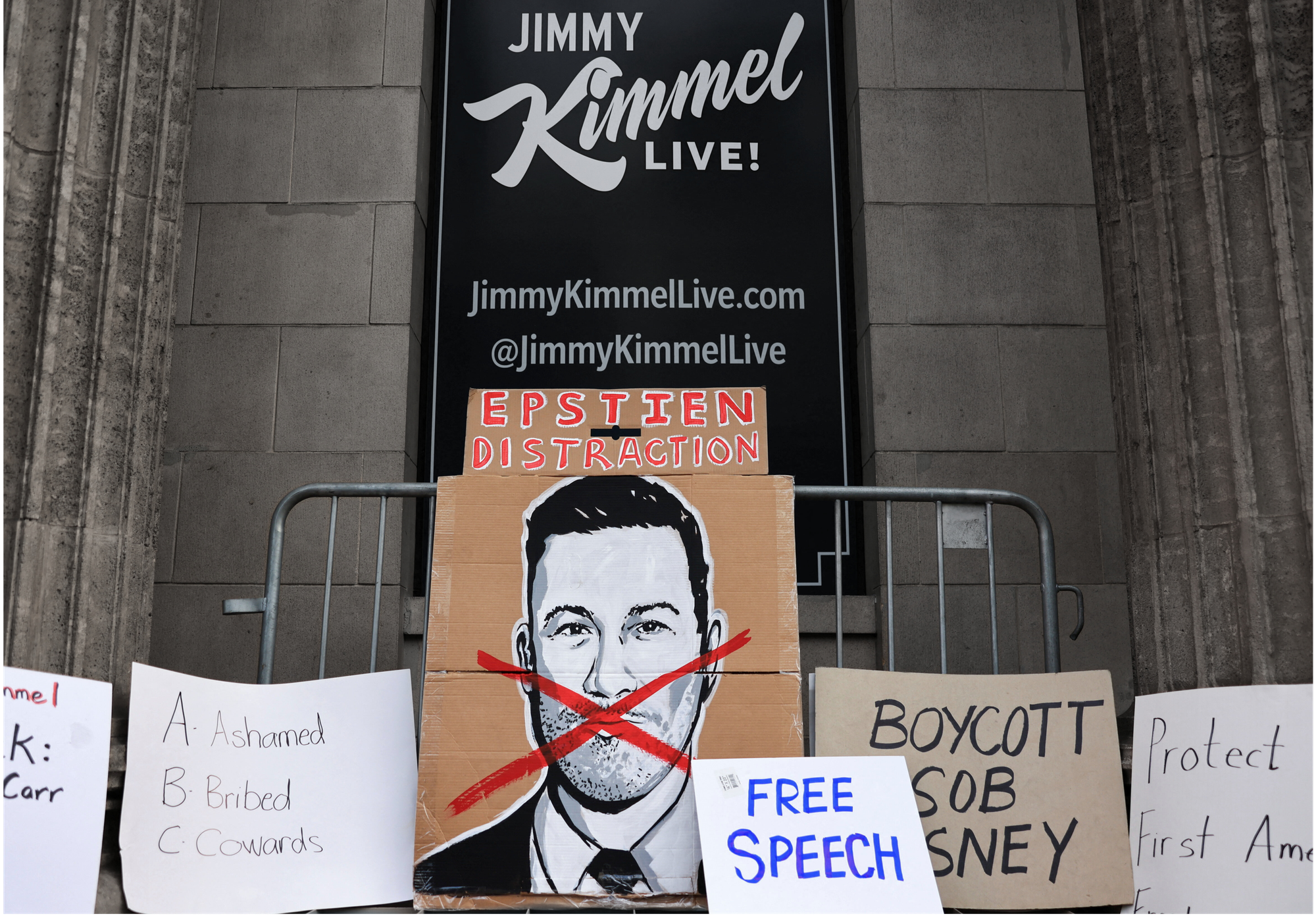
Jimmy Kimmel’s suspension. On Wednesday, ABC suspended Jimmy Kimmel’s late-night talk show indefinitely in response to comments the host made in his comedy monologue, which discussed the assassination of Charlie Kirk and the political ideology of his suspected shooter. Kimmel’s remarks prompted significant backlash from the right and drew a rebuke from Federal Communications Commission (FCC) Chairman Brendan Carr, who suggested his agency could take regulatory action against ABC.
What happened: On Monday, September 15, Kimmel discussed the arrest of the suspected shooter, saying, “We hit some new lows over the weekend with the MAGA gang desperately trying to characterize this kid who murdered Charlie Kirk as anything other than one of them, and doing everything they can to score political points from it.” The next day, clips of the remarks spread on social media, with many commentators interpreting Kimmel’s comment as a claim that the suspect held conservative or pro-Trump beliefs.
FCC Chairman Carr broached the issue on conservative influencer Benny Johnson’s podcast, saying, “We can do this the easy way or the hard way… These companies can find ways to take action on Kimmel, or there is going to be additional work for the FCC ahead.” Nexstar, a media company that owns approximately 30 ABC affiliate stations, then announced it would preempt, or replace, Kimmel’s show on its stations over its objections to his comments, after which ABC decided to suspend the show entirely.
Kimmel has not been fired, and his representatives are reportedly in talks with Disney (which owns ABC) about a plan to return the show to the air. However, political leaders from both parties and other late night hosts objected to the appearance of Carr threatening regulatory consequences for ABC if they did not take action against Kimmel, calling it an attack on free speech. Others noted that Nexstar is seeking approval for a $6.2 billion merger with broadcast media company Tegna, suggesting it was attempting to curry favor with the Trump administration.
Many others praised the decision to suspend the show, saying that Kimmel spread false information about the suspected shooter to smear President Donald Trump and his supporters. “It was appearing to directly mislead the American public about a significant fact [about] probably one of the most significant political events we’ve had in a long time,” Carr said. President Trump also cheered the decision and said networks should take similar action against other late night hosts. “Congratulations to ABC for finally having the courage to do what had to be done,” Trump wrote on Truth Social. “That leaves Jimmy and Seth, two total losers, on Fake News NBC. Their ratings are also horrible. Do it NBC!!!”
Today, we’ll share views from the right and left about the decision to suspend Kimmel’s show. Then, my take.
What the right is saying.
- The right mostly supports the suspension, arguing that Kimmel was punished by his bosses, not the government.
- Some say Kimmel is facing reasonable consequences for misleading his audience.
- Others suggest the suspension will have a corrosive effect on free speech.
In The Washington Examiner, Zachary Faria said “don’t cry for Jimmy Kimmel.”
“The decision likely had nothing to do with the Federal Communications Commission and everything to do with syndicates not wanting to lose viewers over Kimmel’s comments,” Faria wrote. “He chose to dip his toes in the water of the conspiracy theory that Kirk was killed by a right-wing supporter of President Donald Trump… Kimmel lied to his audience, and syndicates knew they would have to pay the price of a boycott of their networks, so ABC stemmed the bleeding by suspending Kimmel’s show. Kimmel wasn’t censored. He wasn’t taken off the air by Trump’s FCC.”
“Kimmel’s regular political soliloquies and lack of any comedy that appeals to anyone outside an obnoxious liberal bubble also set the stage for his suspension. Kimmel’s show is some 650,000 viewers behind Stephen Colbert’s,” Faria said. “Between the worse ratings, his overpoliticized ‘comedy,’ and lying to the public about the facts of a major political assassination, this suspension was the result of Kimmel’s ego and toxic politics, not any sort of First Amendment violation.”
In The Fort Worth Star-Telegram, Mark Davis called Kimmel’s suspension “accountability.”
“One of the hopes that emerged upon the death of Charlie Kirk was that American society could improve its manner of discourse, aiming for a return to a time when we could disagree without the hostility that springs to life so instantly today,” Davis wrote. “That path requires two things: a broad commitment to improve the tone of what we say and a reckoning for those who choose to remain mired in familiar hatred. Late-night host Jimmy Kimmel’s momentary banishment from ABC is a significant chapter in the dawn of that reckoning, and it is a welcome sign that basic standards of decency are making a comeback.”
“Genuine cancel culture — the wanton attempt to muzzle voices because some people’s feathers are ruffled — is wrong no matter which side is the target,” Davis said. “That is a far cry from a righteous public recoil on the occasion of a genuinely execrable diatribe… With ample evidence of a killer turned sharply leftward by both personal relationships and online addictions steeped in hatred of conservatives, Kimmel nonetheless chose to smear millions of Americans with the familiar loathing that has poisoned his so-called comedy for years.”
On his podcast Verdict, Sen. Ted Cruz (R-TX) criticized FCC Chairman Carr’s comments.
“Jimmy Kimmel was lying… and his lying to the American people is not in the public interest. And so [Carr] threatens explicitly, ‘We're gonna cancel ABC's license, we're gonna take [Kimmel] off the air,’” Cruz said. “[Carr] says, “We can do this the easy way or we can do this the hard way”… that's right outta Goodfellas. That's right out of the mafia… I hate what Jimmy Kimmel said, and I am thrilled that he was fired. But let me tell you, if the government gets in the business of saying, “We don’t like what you the media have said, and we're going to ban you from the airwaves, that will end up bad for conservatives.
“There will come a time when a Democrat wins again… they will use this power, and they will use it ruthlessly,” Cruz said. “I think it is unbelievably dangerous for government to put itself in the position of saying, ‘We're gonna decide what speech we like and what we don't, and we're going to threaten to take you off air if we don't like what you're saying.’ It might feel good right now to threaten Jimmy Kimmel, but when it is used to silence every conservative in America, we will regret it.”
What the left is saying.
- The left opposes the suspension, saying it resulted from government coercion.
- Some say the move exemplifies Trump’s efforts to crack down on speech he doesn’t like.
- Others suggest Kimmel’s remarks were wrong, but his punishment is more concerning.
In MSNBC, Anthony L. Fisher called Kimmel’s suspension “government censorship.”
“A government official, who openly disdains ‘mainstream media’ and has already used his bully pulpit to influence companies’ news coverage — such as when the FCC approved the Paramount-Skydance merger only after CBS News agreed to install a ‘bias monitor,’ who turned out to be a Trump-supporting, conservative think tank veteran with no journalistic experience — leaned on a corporation to silence a comedian for saying things the government official doesn’t like,” Fisher wrote. “It’s called ‘jawboning,’ and it doesn’t matter if a private company is the entity that ultimately took Kimmel off the air. That entity did so under duress from the government. This is censorship.”
“Carr gloated to media reporters by sending cheeky GIFs. President Donald Trump celebrated that Kimmel had joined the recently canceled Stephen Colbert (Kimmel’s show has not, to date, been canceled) and called on NBC to cancel Jimmy Fallon’s and Seth Meyers’ late-night shows, as well,” Fisher said. “The FCC chair justified his intervention by invoking the ‘public interest,’ but during the first Trump administration he tweeted: ‘Should the government censor speech it doesn’t like? Of course not. The FCC does not have a roving mandate to police speech in the name of the “public interest.’”
In The Nation, Jeet Heer wrote “Jimmy Kimmel’s bosses sold us all out.”
“[Kimmel’s] words were neither offensive nor factually wrong. Kimmel wasn’t saying that the killer was definitely a part of the ‘MAGA gang’ — he was objecting to the way MAGA was responding to the shooting. But the right seized on them and mischaracterized them as claiming that the assassin was a Trump supporter,” Heer said. “The fact that Trump’s war against late-night talk-show hosts is ludicrous should not disguise the fact that it is dangerous. It is part and parcel of the largest attack on free speech since the McCarthy Era of the early 1950s.”
“The political economy of the new authoritarianism is clear: In an increasingly plutocratic America, where a handful of corporations control most of the media, an authoritarian president such as Trump can easily destroy free speech. The corporate weasels (and other elite institutions) are calculating that Trump has the immediate power to hurt them, and that they won’t suffer any penalty for surrendering to Trump if/when Democrats are back in power,” Heer wrote. “Organizing against Trump’s authoritarianism is both necessary and politically sound. As scary as Trump’s attack on free speech is, the real danger is not the president but an opposition that refuses the courage this moment requires.”
In The Atlantic, Adam Serwer said “the Constitution protects Jimmy Kimmel’s mistake.”
“Kimmel made a mistake. He said something that was not correct to an audience of millions. Although he is a comedian, not a journalist, it would have been appropriate for him to apologize to his viewers and correct the record,” Serwer wrote. “Instead, he was silenced by a government and its allies that want to control what you say, what you do, and what you think… Conservative outrage over some of what was said after Kirk’s murder is understandable — people getting mad at one another over what they say is part of living in a free society. What happened to Kimmel is something different: a state-backed campaign of repression.”
“It is one thing for Trump loyalists like Carr to make threats. It is another for the targets of the threats to capitulate. In the early months of the second Trump administration, we have discovered that many American corporations, including companies that own media outlets, are ready to surrender their First Amendment rights as soon as Trump indicates the slightest displeasure with their politics,” Serwer said. “Whether they are capitulating because of fear or because they see a financial interest in aligning with the administration is ultimately irrelevant. Their rapid surrender to state coercion points to the absolute rot in these elite echelons.”
The Tangle website was built by Obox.
We've worked with dozens of agencies and companies to help grow Tangle's brand over the years. Obox was the best team we've EVER worked with so I'm happy to endorse them to our readers here.
We trusted Marc and his team to bring the innovative new Tangle designs to life as a clean, pixel-perfect website.
For 20 years, Obox has been helping clients launch their sites and grow online, always prioritizing quality and strong relationships.
If you’re looking for a team to help you build something new, maintain what you’ve got, or figure out your next steps, Obox can help.
Get a free 30-minute website strategy session when you tell them that Tangle sent you.
My take.
Reminder: “My take” is a section where I give myself space to share my own personal opinion. If you have feedback, criticism or compliments, don't unsubscribe. Write in by replying to this email, or leave a comment.
- This is the most chilling moment for free speech in my lifetime.
- Other presidents have restricted speech in the past, but never made so many attacks at once.
- That this episode is in response to genuine political violence makes the current moment that much more dangerous.
On the Suspension of the Rules podcast this week, I argued that the last few months have been the scariest moment for free speech that I’ve ever lived through. I called it unprecedented in my lifetime, using a word that’s been overused to the point of meaninglessness. But I think I’m right.
Kimmel’s transgression was suggesting that Charlie Kirk’s shooter was MAGA. All the evidence I’ve seen indicates that he is not. Kimmel should not have implied this on national television (though, as my podcast co-host Kmele Foster noted, Kimmel only said that Trump and his allies were “desperately trying” to paint the accused shooter “as anything other than one of them,” which is different than making a definitive statement about the shooter’s beliefs).
Other prominent liberals, like the historian and writer Heather Cox Richardson, have unambiguously endorsed suggestions that the suspect held far-right views. This insistence currently permeating the left-wing ether is conspiratorial, without even meaningfully bolstering their cause. The shooter having leftist political views is not an indictment of the entire left any more than Melissa Hortman’s attacker being a Trump supporter is an indictment of the entire right. Both sides use extreme rhetoric that needs to be turned down — but if you aren’t calling for or inciting violence, you don’t have to defend the actions of other people.
You can think any number of things about Kimmel’s joke: That it was a fireable offense, that his show stinks, that he was on the air too long anyway, etc. But the Federal Communications Commission (FCC) chair openly used his position to strong-arm Disney into punishing Kimmel. That’s hard to deny. And a multi-billion dollar media company being brought to heel by the federal government is a terrifying development. The FCC chair’s mafia-style threat to ABC was so clear that it drew strongly worded rebukes from people like Sen. Ted Cruz (R-TX) and Sen. Dave McCormick (R-PA), both of whom rarely cross Trump in public.
It’s also only the latest episode in a series of worrisome and overt crackdowns on free speech. Just days before, Attorney General Pam Bondi faced even more ubiquitous backlash for suggesting “we will absolutely target you” for “hate speech,” which drew such strong rebukes from the right that she ended up walking it back. President Trump is filing (often frivolous) lawsuits against media outlets for billions of dollars, explicitly saying that the suits encompass coverage he deems unfair. Legal U.S. residents are being arrested and deported for peaceful protests and expressing unpopular political views.
These examples also include a litany of less direct, equally chilling developments: U.S. officials are threatening ordinary Americans who express views they deem distasteful, often encouraging campaigns to get them fired. The Pentagon is promising to revoke clearance and access for journalists who publish stories about the military that the White House has not cleared prior to release. Trump has successfully extracted hundreds of millions of dollars from universities and law firms with lawsuits focused on their handling of speech issues or the clients they decided to represent. The president signed an executive order cutting funding for grants based on “gender ideology,” which courts rejected for violating the First Amendment. Newsrooms are kowtowing to the White House to maintain access, while the owners of our biggest social media platforms (see: Elon Musk and Mark Zuckerberg) and artificial intelligence companies (see: Sam Altman) are finding new ways each week to appease and praise Trump.
A lot of this isn’t new. President Barack Obama spied on reporters from The Associated Press and aggressively used the Espionage Act against leakers. President Biden pressured social media executives to silence “misinformation” about Covid, attempted to create a “disinformation board” run by the Department of Homeland Security, and aggressively pursued the extradition of WikiLeaks founder Julian Assange. President George W. Bush passed the Patriot Act (which vastly increased government surveillance powers), tried to criminalize flag burning, and even created “free speech zones” to cordon protesters far away from where he made public appearances. This is all without even getting into earlier actions in American history, like Abraham Lincoln’s suspension of habeas corpus or Richard Nixon’s list of enemies to target through the IRS or John Adams’s criminalization of anti-government speech through the Alien and Sedition Acts. We have a long history of presidents infringing on speech.
What makes this moment unprecedented, at least in the last few decades, is that so many of these threats to free speech are being pushed all at once from the same administration over the course of just a few months. And in the post-Charlie Kirk era, when you remember this push is all in reaction to genuine political violence, it's clear that this crackdown has the potential to get much worse.
This weekend, many of the country’s most influential conservatives gathered in Arizona to memorialize Kirk. His wife, Erika, gave a brave and moving speech that every American should spend a few minutes watching. In front of influential right-wing thinkers, the president, the vice president and the entire country, she forgave the shooter. It was a powerful moment, and had the ceremony ended there, I may have left with a sense that the temperature was turning down — that the hottest moment had passed.
Then, a few minutes later, President Trump took the stage.
In his remarks, he called out his “one disagreement” with Kirk: “I hate my opponents,” Trump said. “And I don’t want the best for them. I’m sorry. I’m sorry, Erika.”
Some in the crowd jeered, others laughed, and Trump’s defenders will write the moment off as an innocent joke. But this is where we are right now. The day before, on Truth Social, the president urged the attorney general to immediately begin the prosecution of his political opponents, including former FBI Director James Comey, Sen. Adam Schiff (D-CA), and New York Attorney General Letitia James (D). “We can’t wait any longer,” the president said. “They impeached me twice, and indicted me (5 times!), OVER NOTHING. JUSTICE MUST BE SERVED, NOW!!!”
I’ve been enthused by some of the responses from the right, and I admire those who are willing to criticize “their own side.” But the response from the president — in the context of everything else this administration's done to chill free speech — worries me. And I think we’re all becoming far too desensitized to the threat at hand. The temptation for those in power to use whatever means available to justify their ends is always great; but the lasting impact is never just those people’s ends — it’s the means themselves.
Staff dissent: Managing Editor Ari Weitzman and Associate Editor Audrey Moorehead — Isaac’s argument that Trump’s infringements are unprecedented in his lifetime understates the severity of past free speech infringements — for example, President Abraham Lincoln’s suspension of habeas corpus and President John Adams’s 1798 Alien and Sedition Acts silenced protest and anti-government speech under threat of imprisonment. Additionally, Isaac used these historical examples outside his lifetime to further argue that at no other time have all these constrictions happened at once, which feels like a rhetorical trick to make this moment more severe historically. It also ignores the McCarthyist “Red Scare” that entailed “anti-American” Congressional hearings, loyalty oaths for government officials, FBI surveillance, and public blacklists and firings for people accused of anything from homosexuality to criticism of the government. Altogether, past attacks on free speech are at least as chilling as the current moment, if not more so.
Staff dissent: Senior Editor Will Kaback — I am not overly alarmed by Kimmel’s suspension. I found FCC Chairman Carr’s suggestive comments about going after ABC to be inappropriate, but I think they fall far short of the government compelling speech. If the FCC actually tried to revoke ABC’s license over a perceived lack of consequences for Kimmel, I think they’d lose the subsequent legal challenge. Accordingly, I’m highly skeptical that Carr would have taken this course of action. I’m disappointed that ABC — like other major outlets — capitulated so easily, and I think that decision will tarnish their reputation in the long run. But I don’t think Kimmel’s suspension (which may end up being short lived) is a five-alarm fire for the First Amendment.
Take the survey: How would you describe the current threat to free speech? Let us know.
Disagree? That's okay. My opinion is just one of many. Write in and let us know why, and we'll consider publishing your feedback.
Your questions, answered.
Q: I read a post recently about what was called “soft secession” by blue states. If this is something that is actually happening, would you consider addressing it in one of your newsletters? I have had great difficulty validating some of the details of the article so I have come to wonder if it is actually happening, and if so, to what effect.
— Beth from Tehachapi, CA
Tangle: The couple posts we’ve seen about this have so far come from more niche writers on outlets like Substack, Medium, and Instagram.
“Soft secession” is a term of art here — nobody is really seceding. A better way to describe the tactic is that blue states are just going to be as uncooperative as possible to the Trump administration. Interestingly, this framework was actually developed by conservative thought leaders. Blue state leaders are rediscovering a “states’ rights” view, and are exploring how to express that power in different ways.
First, since states cannot be compelled to enforce federal law, “blue states” don’t need to help the government carry out laws that liberals don’t support — like abortion restrictions or immigration enforcement. However, that runs into a few practical roadblocks. Regarding abortion, any facility that receives federal funding must comply with federal rules, so state governments don’t have any role in enforcing federal regulations in those facilities (notably, many states already fund their own facilities and pass their own abortion laws). On immigration, states already don’t enforce immigration law. Jurisdictions can cooperate with federal law enforcement, but opting not to is pretty far from “secession.”
Second is a financial argument that, since Democratic states “send far more to the federal government than they receive in return,” states should stop sending money to the federal government. But “states” don’t send money to the federal government, individuals do through taxes — and recommending tax evasion as a form of state-level resistance doesn’t really make sense. States receive money from the government, and yes, “red states” receive more, so in a way “blue states” help subsidize them, but the only way to stop that is to actually secede. “Soft secession” can’t really work.
These tactics haven’t yielded many concrete steps yet and “secession” is a strong term. However, this movement is real and growing — Democratic governors are actively pursuing ways to resist the current administration, and we’ve just begun to see them seek out these avenues.
Want to have a question answered in the newsletter? You can reply to this email (it goes straight to our inbox) or fill out this form.
Under the radar.
On Wednesday, The Guardian reported that the Trump administration has rolled back efforts to combat human trafficking by firing officials working on the issue, reassigning others, and canceling or pausing grants. At the Department of Homeland Security, the administration has reportedly moved agents investigating human trafficking to deportation efforts, while the State Department reduced headcount by over 70% at an office that coordinates anti-trafficking efforts across the government. A State Department spokesperson said the administration takes human trafficking “very seriously,” but leaders of anti-trafficking organizations say the cuts and rollbacks are impeding their work. The Guardian has the story.
Numbers.
- 35% and 50%. The percentage of U.S. adults who approve and disapprove, respectively, of ABC’s decision to suspend Jimmy Kimmel’s show, according to a YouGov poll.
- 2003. The year ABC began broadcasting Kimmel’s late night show, Jimmy Kimmel Live!
- 8. The approximate number of months remaining on Kimmel’s contract with ABC.
- 1.8 million. The approximate number of average nightly viewers of Kimmel’s show in Q2 2025, according to LateNighter.
- 24%. The percentage of U.S. adults who say they watch all or most of a late-night talk or variety show at least once a month, according to an August 2025 Associated Press–NORC poll.
- 33%. The percentage of Democrats who say they watch all or most of a late-night talk or variety show at least once a month.
- 18%. The percentage of Republicans who say they watch all or most of a late-night talk or variety show at least once a month.
The extras.
- One year ago today we had just published a two-part edition comparing and contrasting Trump and Harris.
- The most clicked link in Thursday’s newsletter was Jimmy Kimmel’s show being pulled.
- Nothing to do with politics: An interesting find in a Washington, D.C. waterway: an alligator.
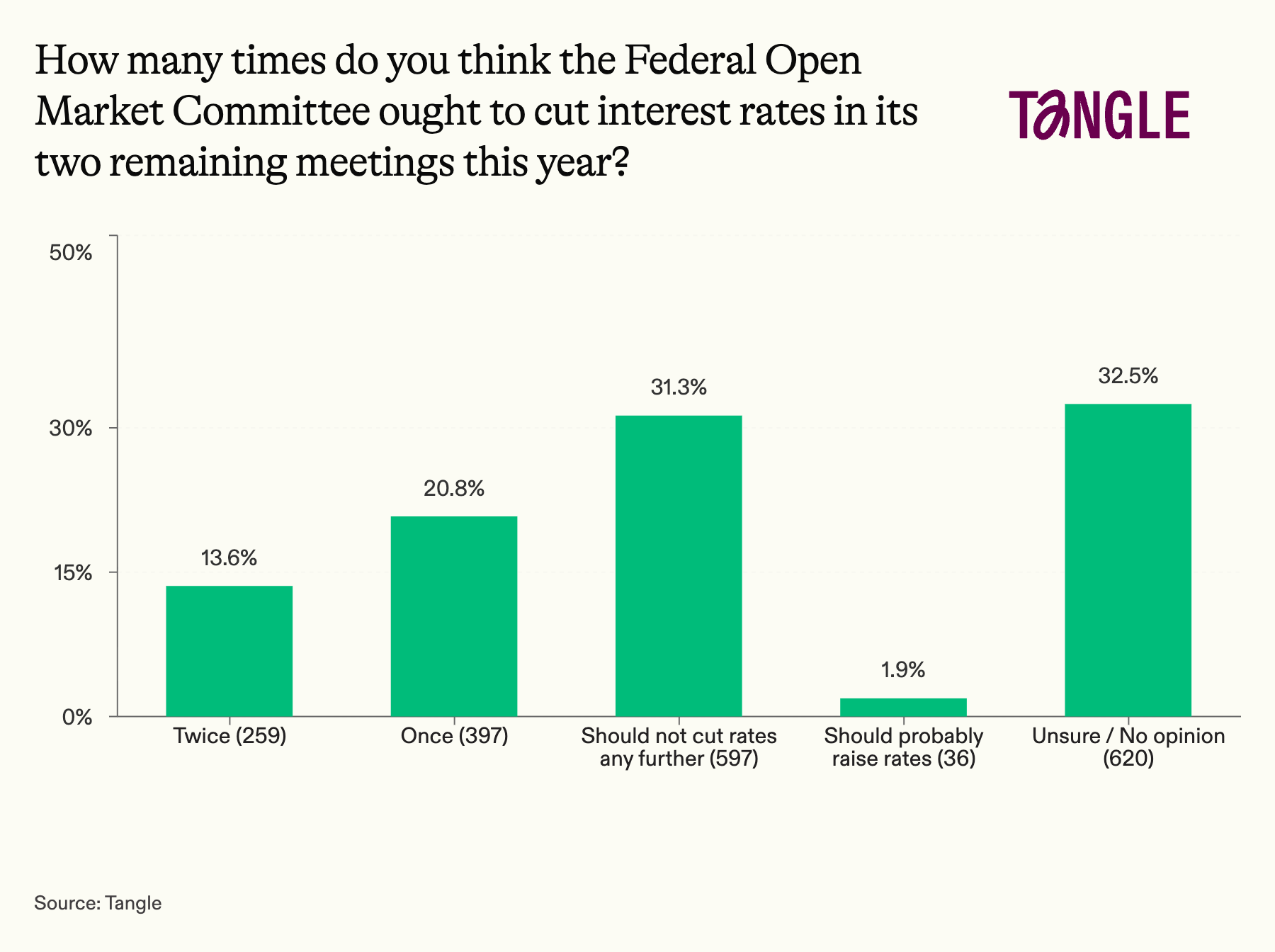
- Thursday’s survey: 1,909 readers responded to our survey on interest rates with 33% saying they weren’t sure if the Fed would cut them again this year (or had no opinion). “Depends on data that will come out over the next couple of months,” one respondent said.
Have a nice day.
Once called a “great open sewer” for its abundance of industrial waste, the Chicago River hadn’t hosted an open water swim in nearly a century. That changed on Sunday, when 500 experienced swimmers took to the river to compete in one- and two-mile races. Local nonprofit A Long Swim organized the race, and founder Doug McConnell largely credited river cleaning efforts that followed the Clean Water Act in 1972 with transforming the river’s health. McConnell said that all proceeds from the race will go toward ALS research and youth swim education. Block Club Chicago has the story (and the pictures).
Member comments