
I’m Isaac Saul, and this is Tangle: an independent, nonpartisan, subscriber-supported politics newsletter that summarizes the best arguments from across the political spectrum on the news of the day — then “my take.”
Are you new here? Get free emails to your inbox daily. Would you rather listen? You can find our podcast here.
Today’s read: 15 minutes.
Aging is inevitable — but you have a say in how you age.
C15:0 is a crucial nutrient that strengthens cell membranes and reverses aging at the cellular level. And it’s the only active ingredient in fatty15, a once-a-day supplement. Fatty15 has 36+ cellular benefits that support cognitive, liver, metabolic, and red blood cell health. The result? You can stay healthier, longer.
With over 60 patents, 100+ peer-reviewed studies, and 20+ awards, and 5,500+ 5-star reviews, it’s no wonder why 70% of customers report benefits within 16 weeks, including improved sleep, joint comfort, mood, and energy.
Fatty15 helps make your cells stronger so you can live healthier, for longer. Tangle readers get an additional 15% off their first order with code TANGLE at checkout!
Sometimes, I'm right.
Over the last few years, I’ve made a habit out of writing about when I’m wrong or when I’ve changed my mind. A lot of these (admittedly) navel-gazing pieces are born out of the idea that we need more accountability in journalism, especially among the punditry class, and I want to be as honest and transparent with readers as possible (and admit my mistakes). But on the whole, it occurred to me that I’ve spent much less time actually writing about when I’ve been right, which could cause other problems. After all, what’s the point in reading Tangle if I’m just the guy who's wrong about everything?
So, this Friday, I’m going to do something I’ve never done: I’m going to publish a follow-up edition to my “Five things I got wrong about Trump” piece, exclusively looking at a few things I’ve been right about. I think you’ll enjoy it.
Quick hits.
- President Donald Trump announced a trade deal with Japan that includes 15% tariffs on Japanese exports and a decrease of levies on Japanese auto exports from 25% to 15%. (The announcement) Separately, President Trump announced a trade deal with the Philippines that will place a 19% tariff on Filipino exports. (The deal)
- House Speaker Mike Johnson (R-LA) sent members on summer recess early in lieu of holding votes on releasing files related to Jeffrey Epstein. Johnson said the decision was intended to give the Trump administration time to determine how to proceed. (The recess) Separately, a House Oversight and Government Reform subcommittee voted to subpoena Ghislaine Maxwell, a convicted sex offender and Epstein’s longtime associate. (The vote)
- A federal appeals court said President Trump can continue restricting The Associated Press’s access to “restricted” spaces, such as the Oval Office and Air Force One, while the decision is challenged in court. (The ruling)
- General Motors reported that its net income shrank 35% in Q2, attributing the decrease to new tariffs on imported cars and auto parts. The manufacturer said it expects greater impacts from tariffs in Q3. (The numbers)
- Columbia University announced disciplinary action against over 70 students who participated in anti-Israel campus protests earlier this year. The actions come as the school negotiates with the Trump administration over approximately $400 million in withheld funds over its purported failure to address antisemitism on campus. (The actions)
Today’s topic.
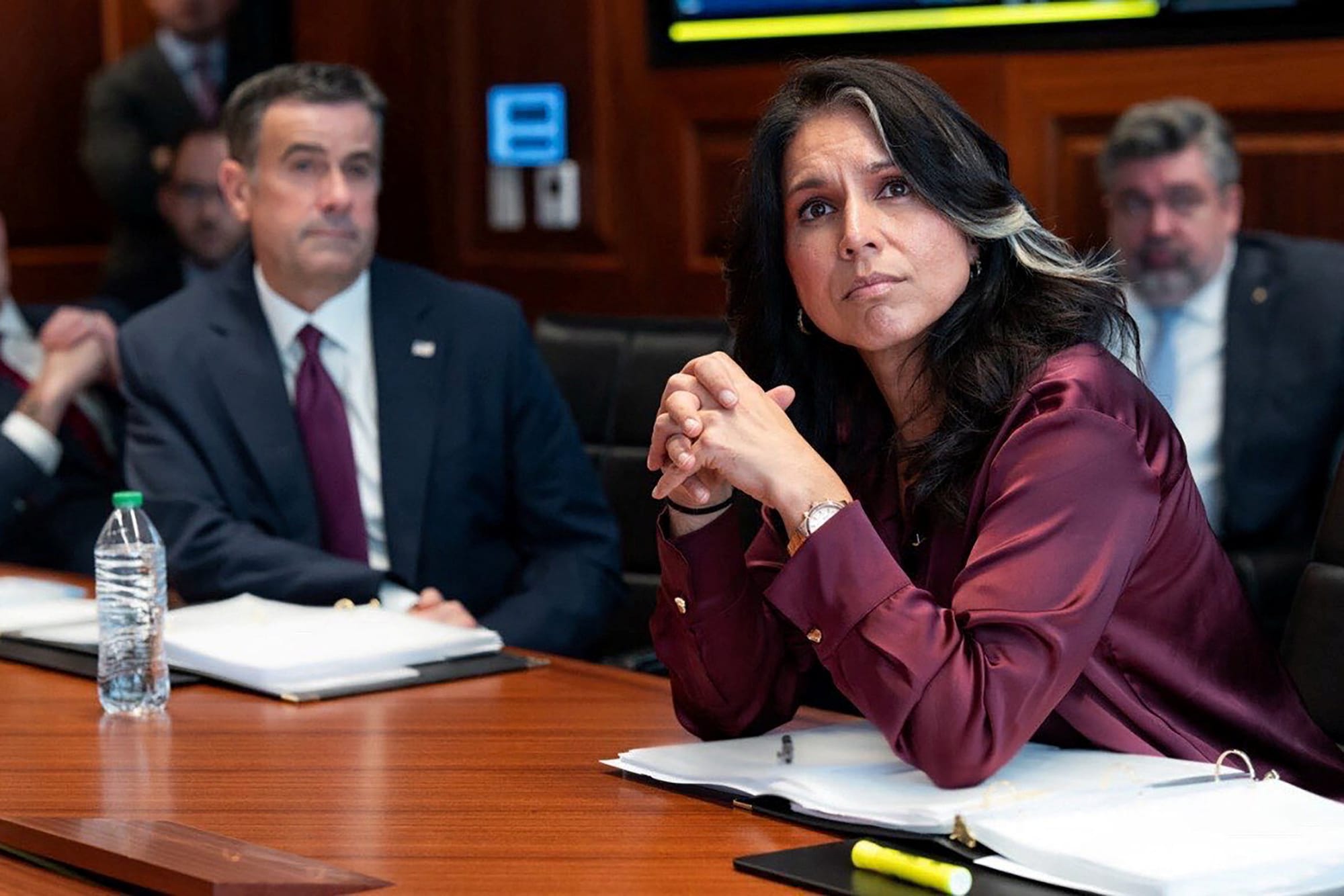
The DNI report. On Friday, Director of National Intelligence (DNI) Tulsi Gabbard announced the release of files that allegedly show President Barack Obama and his national security cabinet members concocted a false narrative of Russian interference in the 2016 election. DNI Gabbard claimed the documents showed a “treasonous conspiracy” to overturn Donald Trump’s electoral victory, posting on X that the Office of the Director of National Intelligence (ODNI) will be turning the documents over to the Department of Justice for criminal referral.
Back up: In January 2017, following President Trump’s election in 2016, what would later be known as the Steele dossier — an unverified opposition research report alleging that Trump conspired with Russia to boost his candidacy — was published by BuzzFeed News. Also in January 2017, the ODNI released an assessment finding that Russian President Vladimir Putin “ordered an influence campaign” to undermine U.S. faith in its elections, denigrate Democratic nominee Secretary of State Hillary Clinton, and support Russia’s “clear preference for President-elect Trump” through social media campaigns and hacking groups affiliated with the Democratic Party.
The Justice Department then appointed Robert Mueller as special counsel to investigate possible collusion between Trump and Russia. Mueller’s 2019 report concluded that Russia had interfered in the 2016 U.S. election — including hacking the Democratic National Committee email servers and coordinating leaks of its contents — but did not find sufficient evidence to prosecute President Trump or members of his campaign for conspiring with Russia. Subsequent Senate Intelligence Committee hearings also confirmed these findings, including that Russia did not hack voting machines or alter votes.
In her announcement, DNI Gabbard alleged that President Obama and members of the intelligence community ignored benign intelligence reports to create a narrative of Russia–Trump collusion and election interference. Gabbard wrote that, prior to November 2016, internal assessments concluded Russia had no intent or capability to hack U.S. election infrastructure. Additionally, ODNI’s report shows that talking points developed for then-DNI James Clapper stated that “foreign adversaries did not use cyberattacks on election infrastructure to alter the US Presidential election outcome.”
However, following a December 9 meeting between President Obama, Clapper and other members of the intelligence community, Clapper’s executive assistant sent a memo directing the intelligence community to create the January assessment detailing “tools Moscow used and actions it took to influence the 2016 election.” Gabbard claims that the report, and its leak to The Washington Post, are evidence of a conspiracy to “subvert the will of the people.”
Many Republicans took the DNI report as proof of an attempted coup. President Trump posted on Truth Social that Obama, Clinton, and then-Vice President Biden had participated in the “CRIME OF THE CENTURY” and should be investigated by the Justice Department.
Conversely, Democrats criticized Gabbard’s report as baseless. President Obama also issued a rare response to the claims. “These bizarre allegations are ridiculous and a weak attempt at distraction,” Obama’s office said in a statement. “Nothing in the document issued last week undercuts the widely accepted conclusion that Russia worked to influence the 2016 presidential election but did not successfully manipulate any votes.”
We’ll get into what the left and right are saying about the DNI report below, then my take.
What the left is saying.
- The left describes Gabbard’s findings as implausible and at odds with past reports endorsed by Republicans.
- Some say the report is an attempt to distract the public from the Jeffrey Epstein story.
- Others argue Gabbard’s conclusions are deliberately misleading.
In CNN, Aaron Blake wrote “Gabbard’s Russian interference claims directly contradict what other Trump officials have said.”
“When President Donald Trump sided with Vladimir Putin over his own intelligence community on the topic of Russia’s interference in the 2016 US election, then-Sen. Marco Rubio sharply rebuked Trump. The Florida Republican said in 2018 that the intelligence community’s ‘assessment of 2016 is accurate. It’s 100% accurate. The Russians interfered in our elections,’” Blake said. “But seven years later, it just keeps happening — over and over again — as Trump and his most loyal allies seek to sow doubts about that 2016 episode and punish their political enemies. That’s now taken the form of Director of National Intelligence Tulsi Gabbard threatening criminal referrals and even floating allegations of treason for key officials in the Obama administration.
“Gabbard’s commentary is especially striking when juxtaposed with those she serves with in the second Trump administration. Rubio didn’t just rebuke Trump for siding with Putin’s denials back in 2018; he also spearheaded the Senate Intelligence Committee’s big, bipartisan Russia report in 2020,” Blake wrote. “The report concluded that Russia had ‘engaged in an aggressive, multi-faceted effort to influence, or attempt to influence, the outcome of the 2016 presidential election.’ It not only said Russia had interfered, but also that it had done so to benefit Trump.”
In USA Today, Chris Brennan argued “Gabbard yells 'Russia hoax' to distract MAGA from Epstein for Trump.”
“Tulsi Gabbard was on the outs – literally and figuratively – with President Donald Trump last month after contradicting him about Iran's nuclear program, which he was about to bomb. Gabbard, Trump's Director of National Intelligence, was shut out of planning meetings about Iran and pushed to the intelligence sidelines for asserting that Iran had not been trying to build a nuclear weapon,” Brennan said. “She needed a way back inside Trump's bubble. The president's new ‘Epstein files’ scandal offered an opportunity… Gabbard dug deep into the classics of Trump's ‘hoax’ claims.”
“She's claiming Obama's team ‘manufactured’ intelligence to hobble Trump's impending presidency after he won. There's a hole in that theory… the Obama administration said shortly after the 2016 presidential election that hackers had not tampered with the election results,” Brennan wrote. “Gabbard is dredging back up Russian interference because American voters just don't buy what Trump has tried to sell them about the Epstein files that his administration is still keeping secret, after he promised during last year's campaign to make them public.”
In Techdirt, Mike Masnick said “Gabbard uses the Twitter Files playbook to mislead.”
“The pattern is always identical: release narrow technical documents that most people won’t understand, surround them with inflammatory innuendo, then hand them off to gullible rubes like Matt Taibbi who will falsely claim the biggest scandal in history just dropped,” Masnick wrote. “Here’s what actually happened: Russia absolutely tried to influence the 2016 election, primarily to sow chaos and division in the US. This generally involved supporting Trump (who brought more chaos) and attacking Hillary Clinton (whom Putin despised from her time as Secretary of State). This basic fact has been confirmed over and over again by multiple investigations (including those led by Republicans).”
“The original report was narrowly focused on one thing that was widely known: no successful hack impacted the actual election. But it’s being used to pretend it proves that the Russians didn’t try to influence the election at all — a thing we already knew they absolutely did,” Masnick said. “Gabbard then misrepresents Obama’s request to the intelligence agency, following that initial assessment, to write an analysis about Russian attempts to influence the election as a whole. That is, having seen the narrow report about a lack of success in hacking in to change votes, the request was a broader look at the many ways which Russia simply tried to influence the election, which is something entirely different than hacking voting infrastructure. These two things are not in conflict at all.”
What the right is saying.
- The right mostly views Gabbard’s announcement as a major revelation that confirms Obama and others conspired to target Trump.
- Some contend the leaders of this effort should face criminal prosecution.
- Others say Republicans have resurfaced this story to their own detriment.
In Racket News, Matt Taibbi suggested Obama is “now squarely in Russiagate crosshairs.”
“[The] documents in the chain show that not only [former Director of National Intelligence James] Clapper’s office but others, including the FBI, were relatively unconcerned about Russian interference. Figures like Virginia Senator and key Russiagate figure Mark Warner are already dismissing Gabbard’s report as an attempt to ‘cook the books’ by comparing ‘apples and oranges,’ the apples being Russian efforts to attack ‘election infrastructure,’ the oranges being ‘influence’ operations,” Taibbi wrote. “But emails dating back to September 2016 show a dismissive attitude toward both concepts, as well as a lack of conviction about Russia’s ability to impact or ‘disrupt’ the election outcome in any way.”
“In sum, just before Obama was to receive a briefing that contained no reference to significant Russian interference, the briefing was called off and a high-level meeting of White House security officials was convened, after which Obama himself tasked them with a new assessment that would lean toward a more aggressive conclusion,” Taibbi said. “It’s suspicious that a Presidential Daily Briefing was postponed to make way for [the Intelligence Community Assessment] ordered at Obama’s request, fishier yet that the evidence that Putin intended to help Trump came from a classified annex containing Steele dossier material.”
In Fox News, Gregg Jarrett wrote about “how Obama and cronies created Trump-Russia hoax, and what happens next.”
“Newly revealed documents show that in 2016 then-President Barack Obama and his national security team ‘manufactured and politicized’ phony intelligence to help frame Donald Trump as a Russian asset when they knew it was untrue,” Jarrett said. “Treason is a strong term with an exceedingly high legal standard. So, too, is seditious conspiracy. The use of violence or force is often a central element for both. Closer to the mark are other serious crimes. They include conspiracy to defraud the government and deprivation of rights under the color of law. That is, using knowingly false or fabricated evidence to support a case against Trump and to obstruct or impair a lawful government function such as an election.”
“The FBI is reportedly examining the possibility of bringing a ‘grand conspiracy’ case that would encompass many of the above-noted acts that were intended to unduly influence three presidential elections, 2016, 2020, and 2024,” Jarrett wrote. “The advantage of adopting this legal avenue is two-fold. First, it would extend any expired statute of limitations to the date of more recent overt acts such as the raid on Mar-a-Lago and events thereafter. Second, it would allow any prosecutions to be brought in a venue other than Washington, D.C., where the endemic bias of jurors make it nearly impossible to gain convictions.”
In National Review, Andrew C. McCarthy said Gabbard “makes a frivolous argument.”
“The Trump administration’s decision to revive this episode, while titillating for the MAGA political base, [is] self-sabotage. That is mainly because, after months of scrutiny, the Trump CIA has reaffirmed the ICA’s conclusions that (1) Russia sought to interfere in the 2016 election and (2) did so in order to denigrate Hillary Clinton,” McCarthy wrote. “The public position of President Trump and his most ardent supporters — the position that Gabbard reiterates — is that Russiagate was a total hoax, a complete fabrication by Democrats, without a shred of truth to it, concocted to undermine his presidency. This has always been a foolish stance.”
“The Democrats’ caterwauling that Russia stole the 2016 election from Clinton was nonsense. It has long been widely recognized for what it was: a fever dream by which Democrats sought to avoid conceding the true cause of the party’s loss — its nomination of a deeply unpopular, scandal-scarred, politically flat-footed candidate,” McCarthy said. “Yet, by claiming that there was no evidence of Russian interference, the Trump camp invites correction (including, now, from the Trump administration’s own CIA) and thereby turns into a matter of consequence something that was utterly inconsequential.”
My take.
Reminder: “My take” is a section where I give myself space to share my own personal opinion. If you have feedback, criticism or compliments, don't unsubscribe. Write in by replying to this email, or leave a comment.
- Partisans on both sides have plenty to get upset about today, but many are also overplaying their hands.
- Comparing our knowledge before and after Gabbard’s release can tell us a lot.
- I don’t know Gabbard’s motives, but however shoddy the Russia investigation was, this report reflects very poorly on her.
I’ve been writing this newsletter long enough that I know when to expect blowback from all corners; today is one of those days.
From the left, I’ll be told that this story is old news, that I’m falling for misinformation Gabbard is willfully spreading to distract from more important stories, and that Trump is an obvious Russia stooge. From the right, I’ll be told that I can’t see the generational scandal in front of me, that I’m protecting a nameless cabal of Democratic politicians and officials, and that I hate Trump so much I can’t see how obvious it is that his presidency was sabotaged by Democratic officials.
So let me start by asking you to try to abandon the emotional attachment you may have to your preferred narrative and honestly evaluate the facts and events at hand. For the left: Yes, these are events from nearly a decade ago. Yes, they are still relevant because the new report alleges a generational scandal that (if true) demands accountability and investigation. They’re also relevant because the alleged target, Donald Trump, is sitting in the White House and promising to launch an investigation to hold the accused accountable. For the right: No, I’m not personally invested in downplaying purported scandals that implicate the Obama administration. No, I am not blind to the failings of the Russia investigation that dominated Trump’s first term — in fact, in 2023, I wrote a deep dive about everything the media got wrong on the Trump–Russia story. And no, I don’t hate President Trump, and I’m not incapable of applauding his achievements or acknowledging when he’s been wronged.
As simply as I can, I’m going to tell you exactly what we knew about this story before Gabbard’s report and exactly what we know now after its release, so you can see for yourself whether you think the report is meaningful.
Before the release: We knew that the Obama administration believed Russia was trying to influence the 2016 election. We knew that they did not think Russia penetrated our voting infrastructure or changed any votes. We knew that they determined Russia was influencing the election to help Trump and hurt Clinton. We knew that intelligence officials inside the Obama administration had different assessments of the threat that sometimes diverged, and that they ended up relying on a lot of shoddy intelligence (like the Steele dossier) to surveil the Trump campaign. We knew that Obama’s intelligence agencies regularly leaked materials to the press that produced alarming and increasingly breathless coverage tying Trump to Russia’s meddling campaign. We knew that Obama and his top intelligence officials were worried their assessment would be buried by the incoming Trump administration, so they did everything they could to leave a paper trail of what they found (here’s a fascinating New York Times article from 2017 on this very thing).
After the release: We know that the Obama administration believed Russia was trying to influence the 2016 election. We know that they did not think Russia ever penetrated our voting infrastructure or changed any votes. We know that they determined Russia was influencing the election to help Trump and hurt Clinton. We know that the day before the FBI was going to deliver a private intelligence report to Obama assessing that Russia had not hacked our election infrastructure, the bureau withdrew that report. We know Obama then requested that several agencies collaborate on a public intelligence report explaining their assessment that, while Russia was not trying to hack our voting system, they were trying to influence the election via the hacking of DNC emails and the promotion of anti-Clinton messaging. We know that a rough outline of that report, detailing Russia’s efforts to influence the election, immediately leaked to the press. We know that Obama and his top intelligence officials were worried this assessment would be buried by the incoming Trump administration, so they did everything they could to leave a paper trail of what they found.
You can read those paragraphs a few times to be sure, but to me, the second paragraph adds a miniscule detail to a story we already understood quite well. Matt Taibbi, who has been one of the foremost journalists covering the media’s mishandling of “Russiagate” and the scandalous way in which the intelligence community hobbled Trump, published a series of detailed pieces following the release that overtly implied Obama could be in the crosshairs of an investigation and senior members of his team may actually end up in prison. Yet even in his own reporting, many paragraphs in, Taibbi gets down to brass tacks: “Some of this timeline was known, but the sudden ditching of a tepid PDB and ordering of a new report ‘per the President’s request,’ with emails conspicuously invoking ‘POTUS tasking’ never surfaced before.”
That really is the whole story, right there, in one sentence — though I’d argue that almost all of this timeline was already known. I don’t say that to denigrate Taibbi, whose original and critical reporting over the last nine years has unearthed a lot of information that has helped me better understand this timeline. Unlike the mainstream media, which often conflated election meddling with vote alteration or intrusion of election infrastructure, Taibbi has long been more precise in his description of what happened in the lead-up to the 2016 election. But I wonder if he might be so tied to telling a particular narrative that his own writing is now veering off into sensationalism and enthusiastically trying to prove this story is the huge scandal he has long suggested it was.
Andrew McCarthy, who literally wrote one of the seminal books on this time period (titled Ball of Collusion: The Plot to Rig an Election and Destroy a Presidency) saw Gabbard’s mountain for the molehill it is. His lengthy response to Gabbard is worth reading in full, but here’s the thrust of it: “No new light is shed on this episode by Gabbard’s email disclosures last Friday, which, unsurprisingly, were accompanied by an overwrought and misleading press release rather than an analytical report.”
Gabbard sees this one directive following a single meeting as the root cause of countless smears against Trump, a years-long Mueller investigation, two congressional impeachments, the arrests of high-level officials, and heightened U.S.–Russia tensions. In the real world, as McCarthy noted, neither of Trump’s impeachments had anything to do with Trump–Russia collusion allegations (one impeachment was for his call with Zelensky, the other was for January 6); the Mueller probe did, actually, conclusively find no actionable evidence of Trump–Russia collusion, though it also assessed Russia interfered in the election (a conclusion affirmed by Senate and House Republican investigations, as well as Trump’s current CIA director earlier this month); no Trump officials have been prosecuted or thrown in jail for anything related to the January 2017 intelligence report or the Steele dossier; and U.S.–Russia relations were plenty strained already — by Russia annexing Crimea and hacking DNC emails.
This is not to say that the intelligence community and the press treated Trump fairly in 2016 — it’s just to say Gabbard’s report tells us almost nothing new. Again, I’ve written in detail about what we now know from that period, and the Trump–Russia collusion theory was vastly overstated and veered into mania. It was fed by a circular information ecosystem between reporters and intelligence leakers, became a scandal of its own that shoddy intelligence and bad journalism compounded, and led to a soon-to-be elected president getting spied on by the U.S. government.
At the same time, the Trump administration did invite much of that scrutiny by opening its doors to Russian actors who wanted to help the campaign. Also, our intelligence community did assess Russia meddled in the election, Russia did leak DNC emails, Trump did egg a lot of it on, and some of Trump’s top campaign aides (like Paul Manafort) were indeed some of the shadiest, most corrupt people in U.S. politics (who were charged and convicted for genuine crimes).
All of those things can be true at once.
Gabbard’s report, to the degree that it tells us anything, reinforces that intelligence officials in the Obama administration disagreed about how successful Russia’s efforts were, and about how to communicate its information to the public. Ultimately, the report reads like a screed of old grievances bundled into a scandal-sounding intelligence report designed to get Trump’s attention, which it has.
Given how much Gabbard has fallen out of favor with Trump recently, maybe Aaron Blake (under “What the left is saying”) is right that this was all an effort to get back in his good graces and distract from the Epstein drama; maybe it is also the product of her being unqualified for the job and conspiracy-minded; or maybe it is a willful misrepresentation for other purposes I don’t quite understand. Whatever the actual motivation behind the release of this insubstantial report, none of them reflects well on Gabbard — or her office.
Take the survey: How would you describe Russia’s role in the 2016 presidential election? Let us know!
Disagree? That's okay. My opinion is just one of many. Write in and let us know why, and we'll consider publishing your feedback.
Your questions, answered.
We're skipping the reader question today to give our main story some extra space. Want to have a question answered in the newsletter? You can reply to this email (it goes straight to our inbox) or fill out this form.
Under the radar.
In January, President Trump announced a joint venture between OpenAI, Softbank and Oracle to build artificial intelligence (AI) infrastructure in the United States, with an expected commitment of $500 billion over the next four years. However, in the months since, the project has struggled to gain traction, failing to complete a single deal for an AI data center and scaling back its first year goals. SoftBank and OpenAI have reportedly been at odds over the terms of the collaboration, such as the location of the data centers. Leaders of both companies maintain that the partnership is on track and recently committed to building 10 gigawatts of data centers together, though further specifics were not given. The Wall Street Journal has the story.
How Did Helping Dolphins Unlock a Secret to Healthy Aging?
Caring for Navy dolphins resulted in the discovery of a crucial nutrient to slow cellular aging: C15:0. Meet fatty15 — a patented, award-winning C15:0 supplement with 70% of customers reporting benefits within 16 weeks. Get 15% off today!
Numbers.
- 114. The number of pages of documents released by Director of National Intelligence Tulsi Gabbard purporting to show U.S. intelligence community’s suppression of intelligence related to the 2016 election.
- 60%. The percentage of U.S. adults who said they believe that Russia interfered with the 2016 presidential election in a July 2018 Ipsos poll.
- 85%. The percentage of Democrats who said they believe that Russia interfered with the 2016 presidential election.
- 75%. The percentage of Republicans who said they believe that the FBI’s investigation and actions around the 2016 election were the result of political bias against President Trump.
- 43%. The percentage of Tangle readers who said the Trump–Russia investigation was an attempt to hurt Trump politically and should not have been conducted, according to a May 2023 survey.
- 42%. The percentage of Tangle readers who said the investigation was sloppily done, but there were good reasons to start it.
- 7%. The percentage of Tangle readers who said investigation was conducted reasonably and uncovered serious criminal acts.
The extras.
- One year ago today we had just covered the Republican National Convention.
- The most clicked link in yesterday’s newsletter was the ad in the free version for the Aqua Vault charge card.
- Nothing to do with politics: A Thai zoo’s adorable hippo escape drill.
- Yesterday’s survey: 1,649 readers responded to our survey on cryptocurrency with 42% saying they would not invest in the digital currency, at least not right now. “I require a ten-year performance and a 10-15% average annual rate of return to invest in anything. When crypto gets there, I'll take a look. Until then, no,” one respondent said.

Have a nice day.
Once found across Australia, the Shark Bay bandicoot faces critical endangerment due to disease, predators, and human impact. Fewer than 3,000 are left in the wild, and they’re mostly confined to islands in their eponymous region in western Australia. But in 2023, ecologists at the Australian Wildlife Conservancy began reintroducing the bandicoots elsewhere, starting by releasing 66 in the Pilliga State Conservation Area. Population growth was confirmed in 2024, and this summer ecologists spotted a family of Shark Bay bandicoots on a trail cam. “It definitely made our day seeing the photo of the three young bandicoots scurrying to keep up with their mum,” ecologist Maisie Duffin said. Good Good Good has the story.
Don’t forget...
📣 Share Tangle on Twitter here, Facebook here, or LinkedIn here.
🎉 Want to reach 400,000+ people? Schedule a meeting to advertise with us.

Member comments