
I'm Isaac Saul, and this is Tangle: an independent, nonpartisan, subscriber-supported politics newsletter that summarizes the best arguments from across the political spectrum on the news of the day — then “my take.”
Are you new here? Get free emails to your inbox daily. Would you rather listen? You can find our podcast here.
Today’s read: 16 minutes.
Not Your Grandpa’s Hearing Device
What happens when you combine German engineering with the world’s most trusted name in hearing care? You get the biggest breakthrough in hearing technology in more than a decade.
Introducing the Horizon IX hearing aid.
Horizon IX by hear.com is one of the world’s first dual processing hearing aids, designed to separate speech from background noise to deliver never-before-heard clarity. The best part? The Horizon IX hearing aids are nearly invisible, tucked inside or behind the ear, so you can enjoy crystal-clear hearing without the burden of uncomfortable (or awkward) hearing devices. They also come with:
- Bluetooth & smartphone connectivity
- Full rechargeability
- Award-winning customer service
- Insurance and flexible finance options available
Ready to join 540,000 people hearing better than ever?
See if you qualify for a 45-day no-risk trial of the award-winning Horizon IX hearing devices!
What do members of Congress actually do?
Last week, we released our most ambitious video project yet: A documentary that pulled back the curtain on what life for a member of Congress is actually like. Our production team spent three full days shadowing Rep. Jake Auchincloss (D-MA) in Washington, D.C. — here are some of the top responses to the video:
- “This is exactly the type of coverage Congress needs. It's humanizing while still being challenging.”
- “Incredible peek behind the curtain at a field shrouded in mystery. I love how candid he was willing to be with you all and I especially loved that he was willing to do this in the first place. I’ve been subbed to Tangle for nearly 5 years now and you guys have really outdone yourselves with this one.”
- “When I saw that it was over an hour, I figured I'd try to get a taste of just the first minutes. I found that it drew me in and ended up watching the entire video.”
Don’t forget to watch the video, give it a thumbs up, and subscribe to our channel:
Also, this Friday, we’re going to publish a reader mailbag answering your questions about our experience and offering a behind-the-scenes look at how the piece came together. So if you want to learn more, feel free to write in with your questions or fill out this form.
First, everything we missed.
Whenever we come back from an extended break, we like to give our readers a quick rundown of the biggest “quick hits” that took place while we were off. Here’s what you missed:
- President Donald Trump deployed the National Guard to Washington, D.C., and placed the city’s police department under federal control. (The deployment) Separately, Attorney General Pam Bondi issued an order stripping the D.C. police chief of her power; the order was rescinded one day later. (The latest)
- President Trump named Heritage Foundation Chief Economist E.J. Antoni as his nominee to lead the Bureau of Labor Statistics. Trump fired the agency’s former commissioner on August 1. (The nomination)
- Consumer prices rose 2.7% in July from a year earlier, slightly lower than economists’ expectations. (The numbers) Separately, U.S. producer prices increased 0.9% from the month prior, the largest monthly gain in three years. The increase came amid a rise in the costs of goods and services. (The numbers)
- The United States and China each extended a pause in tariffs levied on the other as trade negotiations continue. (The extension)
- Australian Prime Minister Anthony Albanese said the country would move to recognize a state of Palestine. (The announcement) Separately, Germany imposed a partial arms embargo on Israel after Israeli Prime Minister Benjamin Netanyahu’s cabinet voted to approve a new offensive to occupy Gaza City. (The embargo) Finally, five Al Jazeera journalists were killed in an Israeli air strike in Gaza. Israel said it was targeting one of the journalists due to his alleged involvement in a Hamas militant cell and in rocket attacks on Israel. (The strike)
- President Trump reportedly directed the Pentagon to begin using military force against Latin American drug cartels that the administration has deemed terrorist organizations. (The report)
- A federal judge rejected the Justice Department’s request to unseal grand jury transcripts in Ghislaine Maxwell’s New York sex-trafficking case. The judge found that unsealing the documents would not reveal meaningful new information on the case or the government's investigation. (The ruling)
- The 4th U.S. Circuit Court of Appeals ruled 2–1 that the Department of Government Efficiency can legally access Americans’ data from the Department of Education, Treasury Department, and Office of Personnel Management. (The decision) Separately, the U.S. Court of Appeals for the D.C. Circuit ruled 2–1 that aid organizations lacked legal grounds to sue the Trump administration over its refusal to spend billions of dollars in foreign aid. The court found that only the Government Accountability Office could challenge this policy. (The ruling)
- The U.S. national debt surpassed $37 trillion for the first time in history. (The debt)
- In an unsigned order, the Supreme Court rejected a request from a technology industry group to temporarily bar Mississippi from enforcing a state law that requires parental consent before young people can create social media accounts. (The decision)
- The Gifford Fire on California’s Central Coast became the state’s largest fire of 2025. The fire, which started on August 1, has burned 131,589 acres and is 91% contained as of Sunday. (The fire)
Today's quick hits.
- Many Democratic lawmakers in Texas returned to the state roughly two weeks after they left to halt a Republican effort to redraw the state’s Congressional maps. (The return) Separately, Democratic lawmakers in California released a Congressional map with new boundaries for U.S. House districts that would improve Democrats’ chances of winning an additional five seats. State lawmakers will consider the map next week. (The map)
- The union representing flight attendants for Air Canada defied a government order to resume operations on Sunday, extending the strike that began on Saturday. Air Canada flight attendants are seeking a new contract that addresses pay and scheduling disputes. The airline now says it expects to restart operations by Monday evening. (The strike)
- Protesters held demonstrations across Israel on Sunday calling for a ceasefire deal with Hamas to release the remaining hostages in Gaza. (The protests)
- Immigration and Customs Enforcement reportedly plans to double its immigrant detention capacity in 2025, opening or expanding 125 facilities and adding over 41,000 detention beds. (The report)
- Bolivia’s presidential election moved to a runoff between centrist candidate Sen. Rodrigo Paz and right-wing former President Jorge “Tuto” Quiroga. (The runoff)
Today’s topic.
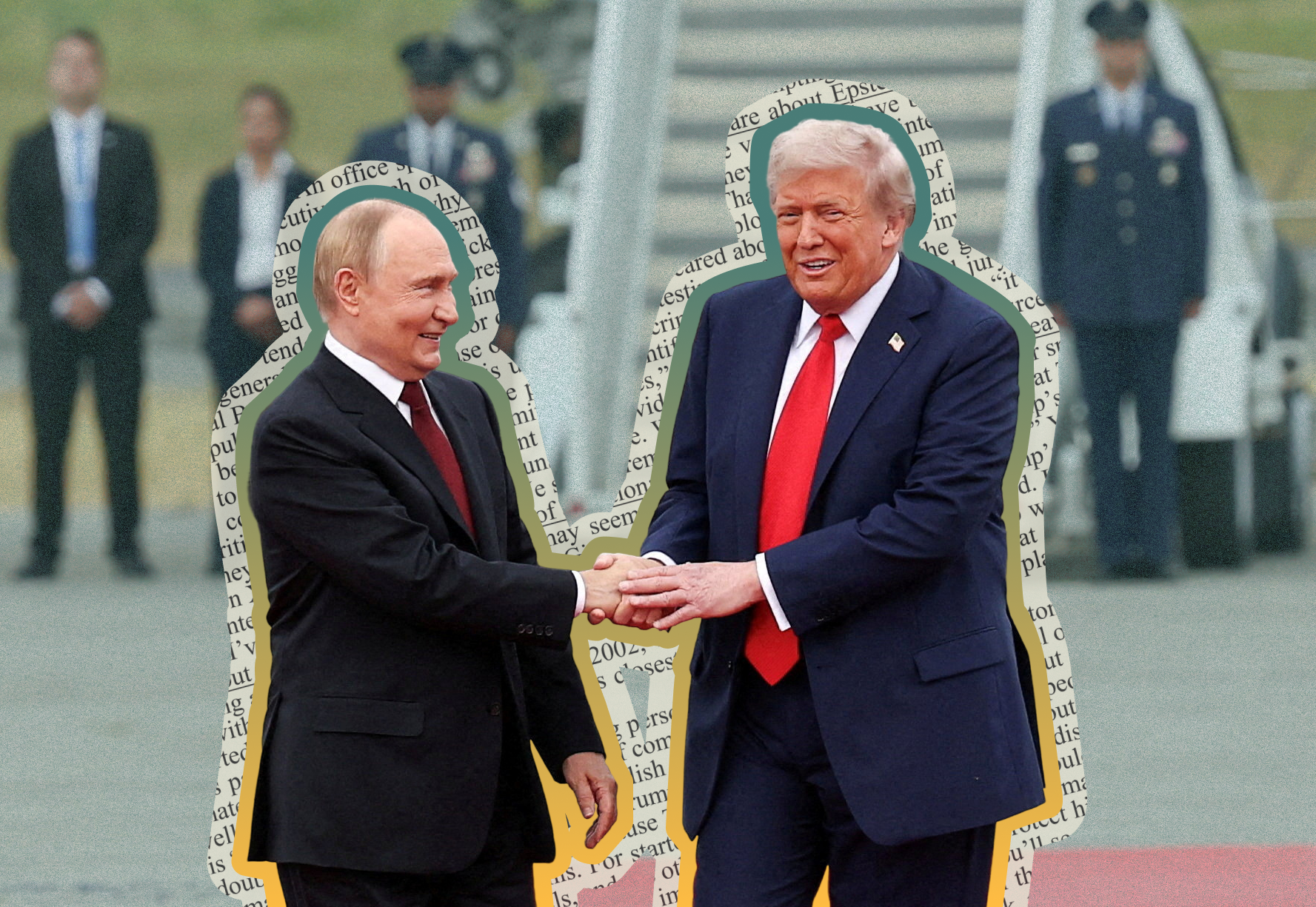
The Trump–Putin summit. On Friday, President Donald Trump and Russian President Vladimir Putin met face-to-face for the first time in Trump’s second term at Joint Base Elmendorf-Richardson in Anchorage, Alaska, to discuss the future of the war in Ukraine. While Trump described the meeting as “productive,” he shared minimal details from the discussions, and the White House has not announced any new agreements. Ukraine was not part of the discussions; Ukrainian President Volodymyr Zelensky will meet with Trump in Washington, D.C., on Monday.
Trump and Putin met in private for several hours alongside U.S. and Russian officials before holding a press conference, during which each delivered remarks but neither took questions from reporters. Speaking first, President Putin said Russia is “sincerely interested in putting an end” to the war but that doing so required addressing the “primary roots” of the conflict and “to consider all legitimate concerns of Russia and to reinstate a just balance of security in Europe and in the world on the whole.” He also called for renewed economic ties between the U.S. and Russia and praised Trump for his approach to the relationship.
In his comments, President Trump noted the “many, many points that we agreed on, most of them, I would say, a couple of big ones that we haven't quite gotten there, but we've made some headway.” He said that he would inform NATO leaders and Ukrainian President Zelensky about the details of the meeting, adding that he expected to see Putin again “very soon.” At the end of the conference, Putin suggested another meeting in Moscow, which Trump said he could see “possibly happening.”
Trump reportedly informed President Zelensky that Putin had offered to freeze fighting on most front lines if Ukraine agreed to cede the Donetsk region to Russia; Zelensky said last week he would reject any proposal that would cede Ukrainian territories in the Donbas region, which includes Donetsk. Following the summit on Friday, Trump publicly called on Zelensky to make a deal to end the war, later saying that he believed the best way to end the war was to pursue a direct peace agreement rather than an initial ceasefire, which Ukraine and Europe have sought. In an auto-translated post on X, President Zelensky wrote, “If [Russia] lack[s] the will to implement a simple order to cease strikes, it may require a great deal of effort for Russia to develop the will to achieve much more, namely a peaceful life with its neighbors for decades.”
Separately, U.S. Special Envoy Steve Witkoff said Putin agreed to “robust security guarantees” for Ukraine during the Alaska meeting, and that these guarantees would be made directly by the U.S. and European countries, rather than through NATO.
Today, we’ll share views from the left, right, and writers abroad on the Trump–Putin meeting and the latest in peace negotiations. Then, my take.
What the left is saying.
- The left argues the meeting legitimized Putin on the world stage and gained nothing.
- Some suggest Trump’s disparagement of Ukraine has undermined his negotiating power with Russia.
In MSNBC, Nayyera Haq said “it’s not clear if Trump got anything from Putin — or even what he wanted.”
“Last week, the White House blew past its own deadline of imposing sanctions on Russia for continuing its three-year invasion of Ukraine, and then, in a misguided effort to clean up that mistake, President Donald Trump gifted Russian President Vladimir Putin a one-on-one meeting in Alaska. It was impossible to make sense of what Trump expected to gain by doing so,” Haq wrote. “It was clear that Trump, in his rush to meet with Putin, not only risked whatever was left of his image as a dealmaker-in-chief, but he also may have damaged the United States’ image as a global champion for democracy.”
“Putin didn’t need anything more than a photo of him on the same military base the U.S. once used to counter the Soviets. Trump legitimized Putin as the leader of a superpower that must be dealt with directly and not a rogue state kicked out of the G8,” Haq said. “Trump completely ignored U.S. sanctions and the international arrest warrant for Putin, essentially siding with Putin against the democratic world order. He again illustrated how potentially easy it is for him to be manipulated into playing second fiddle to Putin’s imperial ambitions, gaining nothing for himself or the U.S. in return.”
In The Atlantic, Anne Applebaum wrote “Trump has no cards.”
“President Donald Trump berated President Volodymyr Zelensky in the Oval Office. He allowed the Pentagon twice to halt prearranged military shipments to Ukraine. He promised that when the current tranche of armaments runs out, there will be no more. He has cut or threatened to cut the U.S. funds that previously supported independent Russian-language media and opposition,” Applebaum said. “Many of these changes have gone almost unremarked on in the United States. But they are widely known in Russia… As a result, the Russian president has clearly made a calculation: Trump, to use the language he once hurled at Zelensky, has no cards.”
“If Trump will not put any diplomatic pressure on Putin or any new sanctions on Russian resources, then the U.S. president’s fond wish to be seen as a peacemaker can be safely ignored. No wonder all of Trump’s negotiating deadlines for Russia have passed, to no effect, and no wonder the invitation to Anchorage produced no result,” Applebaum wrote. “The U.S. has no cards because we’ve been giving them away. If we ever want to play them again, we will have to win them back: Arm Ukraine, expand sanctions, stop the lethal drone swarms, break the Russian economy, and win the war. Then there will be peace.”
What the right is saying.
- The right is mixed on the meeting’s impact, though some say it was a step toward peace.
- Others contend Trump is right to favor a peace deal over an initial ceasefire.
In The New York Post, Douglas Murray argued the “Alaska meeting was a start, but Putin is still up to his old tricks — and Trump knows it.”
“Trump came into office saying that the war would never have started if he had been the US President in 2022. And yesterday Putin was careful to stress that this was a point of agreement between the two sides,” Murray wrote. “Trump was careful not to fall for the flattery. Throughout the joint press appearance, while Putin was speaking, Trump maintained his careful, thoughtful listening face. He knows that even a smile in the wrong place can be deadly when dealing with a negotiating partner like Putin. Not just because of the man standing beside him on the stage, but for the world’s media camped out in front of them both, many of whom would love to revive the ‘Putin puppet’ memes about Trump.”
“Trump was in Alaska to get a deal done. Whether Putin was there for the same thing they were there to see. But in an expert piece of stagecraft an American B-2 stealth bomber flew overhead as Trump and Putin walked to the first photo opportunity,” Murray said. “Trump had a careful game to balance in Alaska. He managed to encourage Vladimir Putin to the negotiating table. And he did get Putin to say that he is ‘sincerely interested’ in ending the conflict... If the two leaders can have further meetings which can help bring an end to the war then that could be a good thing.”
In The Wall Street Journal, former U.S. National Security Advisor John Bolton wrote about the “silver lining” of the summit.
“The crucial news, underlining the Monday meeting’s importance, came after Mr. Trump left Alaska. He wrote on Truth Social that ‘the best way to end the horrific war between Russia and Ukraine is to go directly to a Peace Agreement,’” Bolton said. “That directly contradicts the unanimous pre-summit European view that a cease-fire must be in place before substantive discussions begin. It was unclear how European leaders reacted; their postsummit statement was silent on the subject. While it is a minority view, I believe Mr. Trump’s announcement is positive news for Kyiv, although not for the reason he gives.
“Cease-fire lines typically fall along existing military front lines. When negotiations follow a cease-fire, particularly when accompanied by the deployment of peacekeeping forces, as has also been suggested, the cease-fire line often hardens. In short order, cease-fire lines can become de facto borders,” Bolton wrote. “If a cease-fire line traces what Moscow now holds in phase two and negotiations drag on, Mr. Putin will gain time to restore his economy, rebuild and repurpose his army and navy, and prepare for phase three… Kyiv should reject this scenario unequivocally, not embrace it.”
What writers abroad are saying.
- Writers abroad are mostly critical of Trump’s handling of the summit, describing it as a win for Putin.
- Some say Putin outmaneuvered Trump, but the future of the war is still uncertain.
The Kyiv Independent editorial board called the meeting “sickening.”
“In the lead-up to the meeting in Alaska, U.S. President Donald Trump declared he wanted a ‘ceasefire today’ and that his Russian counterpart Vladimir Putin would face ‘severe consequences’ if he didn't go for it,” the board said. “Yet after a 2.5-hour closed-door meeting, Trump and Putin emerged to share… nothing. ‘Progress’ was made and some ‘understanding’ reached, but the two didn’t come to an agreement on ‘the most significant point’ — clearly, Ukraine. Trump didn’t get what he wanted. But Putin? He sure did… No longer an international pariah, he was finally getting accepted — and respected — by the leader of the free world.”
“The chummy display stood in stark contrast to Trump’s hostile reception of Ukraine’s President Volodymyr Zelensky in the Oval Office six months ago. Ukraine’s president endured a public shaming. Russia’s was pampered. Both episodes were disgraceful. Trump seemed to believe that a warm meeting could appease Putin and make a ceasefire more likely,” the board wrote. “But there’s a lesson Trump still hasn’t learned: The Russian leader doesn’t really make deals — he takes. He takes what is offered to him, and then takes some more — he keeps taking until stopped by force. That is the Russian art of the deal.”
In The Spectator, Dalibor Rohac explored “the good, the bad and the ugly of the Alaska summit.”
“The three-hour Friday summit in Alaska between Donald Trump and Vladimir Putin ended as well as it conceivably could have ended: as a big nothingburger. But that does not mean that Ukraine and its supporters can breathe a sigh of relief,” Rohac said. “Trump may be unhappy that the prospect of his Nobel Peace Prize remains elusive as Putin has not agreed to an immediate ceasefire in Ukraine. But it is far from clear that he will end up directing his anger against Russia.”
“We can be reasonably confident that Putin would have been happy to agree to an immediate ceasefire in exchange for Ukraine meeting his maximalist demands… The failure to reach a deal with Trump suggests that the US administration has not bought into Russia’s interpretation of the war and how to end it — at least not yet,” Rohac wrote. “What lies at [the] heart of the summit is that the US president neither understands nor cares about understanding Putin’s motives and the threat he poses to the world. In contrast, Putin, a former KGB lieutenant colonel, has a solid grasp of what makes Trump and his entourage tick.”
My take.
Reminder: “My take” is a section where I give myself space to share my own personal opinion. If you have feedback, criticism or compliments, don't unsubscribe. Write in by replying to this email, or leave a comment.
- Seemingly small things can change the course of history, so it’s possible these current dynamics shift in ways we can’t yet imagine.
- Trump gave a lot of ground to Putin’s point of view, although he often follows the last voice he hears.
- Ukraine ceding territory in exchange for a security guarantee seems viable, but I doubt any path is actually viable with Putin.
I’ve been reading Erik Larson’s The Splendid and the Vile over the last few months, a fantastic retelling of a single year in the life of Winston Churchill during World War II.
One idea that Larson’s book has impressed upon me is how fortunes in war can change in a hurry, often because of minor details that sideline observers might not consider paramount. For example, England’s survival depended largely on Churchill’s ability to convince Harry Hopkins, a top aide to President Franklin D. Roosevelt, that England was desperate but saveable. A small factor (like winning over Hopkins) paired with a fundamental reality (like Hitler’s decision to invade the Soviet Union) ultimately cost Germany the war.
This story is analogous to the history we’re living through now. I still agree with the assessment that the war in Ukraine only has two potential ends: Either Ukraine will lose some land but survive as a sovereign state, or it will lose land and its sovereignty. Yes, fortunes can change in a hurry — and personal relationships will still matter — but I think these options still reflect the basic tactical reality of this war as we sit here today, three and a half years after Russia invaded Eastern Ukraine.
I commend Trump’s ambition to end this war, and heading into the summit he seemed aligned with our European allies on a major push for a ceasefire. A lot of fuss was made about Trump rolling out a literal red carpet for Putin, and then having B-2 bombers give him a haircut as they entered negotiations — a mix of pomp and circumstance with military might and intimidation. But I don’t think the optics are really that important; whether Trump is having his intended effect on Putin is what really matters, and I believe the show of strength is much more persuasive than the overture of flattery.
By the end of the summit, I couldn’t say that I believed Trump’s approach worked. To me, Putin seems to have narrowed Trump’s lens from “ceasefire then discussions” to “peace agreement first,” with Ukraine ceding major territory in exchange for the end of Russia’s bombing campaigns.
Make no mistake: This framework favors Putin. Over the last three years, Russia has taken control of about one fifth of Ukraine’s land. A peace agreement could formally hand that land over to Russia. Zelensky has refused any arrangement with that baseline, and it’s not hard to understand why: One fifth of the U.S. land mass would be equivalent to losing California, Oregon, Washington, Idaho, Nevada, Arizona, and Utah to a foreign country. Or, alternatively, it’d be like Trump giving up Maine, New Hampshire, Vermont, Massachusetts, Connecticut, Rhode Island, New York, New Jersey, Delaware, Maryland, Pennsylvania, Ohio, Michigan, West Virginia, Virginia, North Carolina, South Carolina, Tennessee, Alabama, Georgia, Mississippi, Louisiana, and Florida to a country that attacked us. And this isn’t just about losing land mass; it would mean millions of Ukrainians unable to return to thousands of homes to rebuild after the war, unless they wanted to live in Putin-controlled territory.
That Trump’s position apparently morphed throughout the summit from ceasefire to peace agreement seemed to confirm some critics’ assessment that he is getting played by Putin. I don’t think the reality is quite that clear cut — as I’ve said before, I think Trump tends to be most compelled by the last argument he hears. Does Trump really believe that Zelensky can end the war today? I think he believed that on Sunday, but I don’t know what he’ll believe after hosting Zelensky and a slate of European leaders at the White House this week — and it could benefit Ukraine that Zelensky is meeting Trump second. For Zelensky, and for all wartime leaders throughout history, his management of the tiny particulars of his relationship with Trump will have grand, historical impacts.
Even though Trump is signaling favoritism for Putin’s preferred outcome (a peace agreement and Russian annexation of Ukrainian land) for the war, he’s also pushing for a future where Ukraine has robust security guarantees. U.S. Special Envoy Steve Witkoff claimed Russia agreed to such guarantees, and Zelensky is obviously hoping for them (he described the offer for a mutual defense pact with the U.S. and Europe, like NATO’s Article 5, as “historic”).
Zelensky said he wouldn’t trade any portion of Ukrainian land for an end to the war, but would he make that concession with ironclad security agreements for the future? A sizable portion of the Ukrainian public seems to be open to an arrangement vaguely described in those terms. I think Zelensky would ultimately accept such a deal, too.
Would Putin? I doubt it. He’d end up controlling swathes of Ukrainian land that his army has reduced to rubble while ceding his aspirations to rule the entire country. The truth is that no pause or end to the fighting will satiate Putin’s desire to take over Ukraine. On Sunday, just hours after Zelensky arrived in the U.S., Russia bombed two major Ukrainian cities and killed ten people. To me, U.S. and European protection just means Putin will have to recalculate how serious the U.S. and Europe would be about defending whatever is left — and we’ll have to decide what to do when he inevitably tries again. In this most cynical view, the only permanent end to any of this comes when Putin is completely removed from power.
The reality of the situation is difficult, but at least it’s a reality that Trump is now facing, after seeming totally divorced from it on the campaign trail and in the early days of his presidency. He promised to end this conflict in 24 hours, whether out of arrogance or ignorance, but after giving Putin his best shot he’s seeing just how fanciful that notion was. Trump is dealing with one leader who wants to do everything he can to avoid sacrificing any portions of his country to an enemy and another leader who believes the entire country belongs to him.
For both Putin and Zelensky, any kind of middle-ground concession is equivalent to a major defeat — yet a middle-ground concession appears to be the only way out, aside from letting the war run on until one country, or leader, actually falls.
Take the survey: What do you think is the most likely scenario for an end to the Ukraine–Russia War? Let us know!
Disagree? That's okay. My opinion is just one of many. Write in and let us know why, and we'll consider publishing your feedback.
Your questions, answered.
We're skipping the reader question today to give our main story some extra space. Want to have a question answered in the newsletter? You can reply to this email (it goes straight to our inbox) or fill out this form.
Under the radar.
Just over a week after leaving his role as director of the Center for Biologics Evaluation and Research at the Food and Drug Administration (FDA), Vinay Prasad has returned to the position. Prasad was named the center’s director in May but faced scrutiny from public health officials for his handling of a gene therapy for Duchenne muscular dystrophy that played a role in the death of two minors. Prasad, an oncologist, rose to prominence in recent years as an outspoken critic of the Covid-19 vaccine and associated mask mandates; however, he was targeted in recent weeks by right-wing activist Laura Loomer, who called him a “progressive leftist saboteur.” Neither the FDA nor the Department of Health and Human Services explained the reason for Prasad’s reinstatement beyond saying it came at the FDA’s request. Reuters has the story.
This summer, make every weekend count
Groupon brings you thousands of local steals—from family-friendly museums and outdoor adventures to cozy wine tastings and hottest concerts—discounted up to 70%.
Browse once and you’ll be planning three weekends ahead, confident that you’re squeezing every drop out of fun out of the season, not your wallet.
Numbers.
- 7. The approximate number of years between President Donald Trump’s and Russian President Vladimir Putin’s last meeting, at the 2018 Russia–United States summit in Helsinki, Finland.
- 10. The approximate number of years since President Putin had visited the United States prior to Friday’s summit in Alaska.
- 7. Before Friday, Putin’s total number of U.S. visits as Russia’s president.
- 2013. The most recent year that a U.S. president visited Russia.
- 2021. The year that a summit between President Joe Biden and President Putin was held in Geneva, Switzerland, the most recent U.S.–Russia summit prior to Friday.
- 55. The approximate narrowest distance, in miles, between mainland Russia and mainland Alaska.
- 40%. The percentage of U.S. adults who say they are confident in President Trump’s decision making regarding the Ukraine war, according to an August 2025 Pew Research poll.
- 59%. The percentage of U.S. adults who say they are not confident in President Trump’s decision making regarding the Ukraine war.
The extras.
- One year ago today we had just published a Friday edition from Isaac on his worst fears about Israel coming true.
- The most clicked link in August 7’s newsletter was Isaac’s interview with economist Noah Smith.
- Nothing to do with politics: Two words: robot boxing.
- August 7’s survey: 2,437 readers responded to our survey on international recognition of Palestinian statehood with 37% supporting the recognitions but saying they don’t provide a step towards peace. “Statehood is a step towards peace in the long run, not in the short term. I agree that right now the priority is to end the war,” one respondent said.

Have a nice day.
18-year-old Kaden Ross was at the pool that he manages in Pataskala, Ohio, when he heard a woman and child calling out from the water. At first, he thought they were playful screams — then, he realized not only were they cries for help, but they were coming from a creek 150 yards away. After jumping a fence and running the distance, Ross was able to pull the woman from the water and administer CPR to the 7-year-old boy. “As I was giving CPR, stuff started coming out of his mouth, which is usually a pretty good sign,” Ross said. “I’ve never had a save like that, and I don’t think I ever will.” ABC6 has the story.
Don’t forget...
🎧 We have a podcast you can listen to here.
🛍 Love clothes, stickers and mugs? Go to our merch store!

Member comments