

I’m Isaac Saul, and this is Tangle: an independent, nonpartisan, subscriber-supported politics newsletter that summarizes the best arguments from across the political spectrum on the news of the day — then “my take.”
Are you new here? Get free emails to your inbox daily. Would you rather listen? You can find our podcast here.
Today’s read: 14 minutes.
6 Things Rich People Do to Help Them Retire Early
You’ve done everything right. But working 40+ years just to maybe retire comfortably? That plan’s getting old.
More and more high earners are choosing a different path — and it starts with a few smart (and surprisingly simple) money moves.
This quick read reveals six habits the wealthy use to grow wealth, ditch debt, and retire way ahead of schedule.
See The 6 Habits.
*This is a sponsored post. Advertise with us here.
We need your help.
The last six months have been a difficult time for media outlets. Overwhelmed by the news, many readers and listeners are tuning out. Those who are staying up to date are increasingly relying on artificial intelligence round-ups to get their news, which has caused website traffic to fall.
Here at Tangle, we’re leaning into viewpoint diversity, human input, and independence to produce the best content we can. But we need your help to keep this work going.
Right now, you’re on our free mailing list. That means you don’t get our full suite of offerings. A Tangle membership unlocks ad-free newsletters, subscribers-only content, members-only interviews, ad-free podcasts, and more. 70,000+ people have memberships, and under 1% cancel every month — that’s how good the value is. A premium membership is also the #1 way to support our work, as subscriptions make up 90% of our revenue. You can become a newsletter member here or bundle it with a podcast membership here.
Quick hits.
- President Donald Trump said that he would not deploy U.S. troops to Ukraine as part of any security agreement but did not rule out the U.S. providing air support. (The comments)
- White House Press Secretary Karoline Leavitt confirmed that the Trump administration is in talks with Intel over taking a 10% stake in the computer technology company. Commerce Secretary Howard Lutnick recently suggested that the deal could involve swapping existing government grants for Intel shares. (The talks)
- Director of National Intelligence Tulsi Gabbard revoked security clearances for 37 current and former national security officials, including some who were involved in the assessment of Russia’s efforts to influence the 2016 election and members of former President Joe Biden’s National Security Council. (The revocations)
- Air Canada announced an agreement with the union representing flight attendants for the airline, ending their strike. (The agreement)
- The Trump administration added over 400 product categories to be covered by its 50% tariffs on steel and aluminum imports. The new levies went into effect on Monday. (The tariffs)
Today’s topic.
Trump’s nominee for the Bureau of Labor Statistics. In a social media post last Monday, August 11, President Donald Trump announced that he was nominating economist E.J. Antoni to lead the Bureau of Labor Statistics (BLS). Earlier this month, Trump fired the previous commissioner, Erika McEntarfer, after the agency released a weaker-than-expected July jobs report and revised May's and June's numbers downwards. Antoni, who worked as chief economist at the Heritage Foundation, has criticized the BLS’s reporting and said the agency must improve its processes for collecting and sharing economic data. The Senate must confirm Antoni before he can take the position, but his confirmation hearing has not yet been scheduled.
Back up: The BLS is the agency within the Labor Department responsible for measuring market activity, working conditions, price changes, and productivity in the U.S. economy. Every month, the bureau compiles an employment report from a monthly survey of about 631,000 worksites selected to represent all U.S. employers. The initial numbers released by the BLS are based on partial data for the first portion of a month, and then revised as data from more worksites and the rest of the month become available. Former Commissioner McEntarfer worked for the federal government for 20 years before starting at the BLS in January 2024.
Before his time with the Heritage Foundation, Antoni held two fellowships at the Committee to Unleash Prosperity, a conservative advocacy group led by billionaire Steve Forbes, and served as an instructor at his alma mater, the University of Northern Illinois, while working toward a PhD in economics. In recent years, Antoni has publicly criticized Social Security as a “Ponzi scheme,” referred to data from the BLS as “phony baloney,” and called for the Federal Reserve to be eliminated and for the U.S. to return to the gold standard.
“Our Economy is booming, and E.J. will ensure that the Numbers released are HONEST and ACCURATE,” President Trump posted in his announcement on Truth Social. “I know E.J. Antoni will do an incredible job in this new role. Congratulations E.J.!”
Antoni’s nomination has sparked criticism from economists who say his confirmation would threaten the neutrality and reliability of the BLS. In an interview with Fox Business after his nomination, Antoni suggested that the BLS should stop releasing its monthly jobs reports (the White House later said BLS would continue publishing the report each month). Separately, video footage shows Antoni leaving the Capitol on January 6, 2021, as others entered the building; the White House says that Antoni was a bystander who wandered over to the Capitol and was in Washington, D.C. on business.
“E.J. Antoni is completely unqualified to be BLS Commissioner,” Jason Furman, former chair of the Council of Economic Advisers under President Barack Obama, posted on X. “He is an extreme partisan and does not have any relevant expertise.”
We’ll get into what the left and right are saying on Antoni’s appointment below. Then, my take.
What the left is saying.
- The left opposes Antoni’s nomination, predicting his fealty to Trump will outweigh his commitment to accurate data.
- Some call Antoni unqualified and say he poses a threat to U.S. financial systems.
- Others say the appearance of politicization at BLS could do as much damage as manipulated numbers.
In The Nation, Chris Lehmann made “the case against E.J. Antoni.”
“Antoni’s only remote qualification for the job is a dogged commitment to the administration’s fanciful interpretation of leading economic indicators — a demonstrably false story of tariffs and tax cuts working a miraculous across-the-board recovery from an economy that was left for dead by the Biden White House,” Lehmann wrote. “Unlike other commissioners of the BLS, Antoni, the chief economist at the Heritage Foundation, the think tank behind Project 2025, has no background in labor economics, and his social media forays into macroeconomic debates show vanishingly little knowledge there as well.”
“Even before Trump’s midsummer massacre at BLS, Antoni had been calling for the equally data-challenged Department of Government Efficiency to ‘take a chainsaw to the BLS.’ In an August 4 Fox News interview, he also suggested that the BLS should simply suspend the release of jobs numbers until they’re subject to fuller vetting,” Lehmann said. “If something as important as the collection and publication of fact-based assessments of real economic conditions were to fall completely under the sway of the administration’s MAGA-boosting narratives, it will place many Americans already living precariously at the mercy of whatever appeasement strategies hacks like Antoni adopt to appease the Great Leader.”
In The New Yorker, John Cassidy argued “big business and Wall Street need to stand up for honest data.”
“In a public statement on Antoni’s nomination, the Friends of the Bureau of Labor Statistics… called on the Senate to assess whether Antoni had the necessary qualifications, management experience, statistical expertise, knowledge of the B.L.S. and its products, and commitment to its mission of providing timely and accurate statistics,” Cassidy wrote. “Looking at Antoni’s record, the answer seems obvious. He obtained his Ph.D. in economics in 2020; since then, he has worked for conservative think tanks and defended Trump’s policies… He has also openly derided the B.L.S. (‘The “L” is silent,’ he wrote on X last year.)”
“With the B.L.S. facing challenges from all sides, the responsibility of protecting its mission and preserving its integrity seems likely to fall on Republican senators, whose track record on vetting Trump’s appointments and restraining his authoritarian tendencies is woeful. But big corporations and Wall Street firms that depend on the official data in their day-to-day operations should also be applying pressure to the White House and the Senate,” Cassidy said. “In attacking the Federal Reserve, and now the B.L.S., Trump is undermining the institutional foundations on which business confidence, American financial dominance, and the reserve status of the dollar are based.”
In The Atlantic, Egan Reich suggested “the damage to economic data may already be done.”
“BLS data may not be completely tamper-proof, but they’re pretty close. The sharpest economic minds in this country, both inside and outside the bureau, pay meticulous attention to the deepest layers of the data, many strata below the headline-unemployment rate and change-in-payroll employment. Deceiving them all would be very hard to do,” Reich wrote. “Unfortunately, that might not matter. Antoni doesn’t have to manipulate any data to undermine the reliability of the government’s economic statistics. That damage might already have been done.”
“Perhaps Antoni can mandate methodological deviations that bias the numbers in Trump’s preferred direction. But I don’t think he needs to. Confidence in the bureau is already badly weakened,” Reich said. “This is about more than just our trust as consumers of the jobs report, because we are also its producers. To create its reports, the BLS needs businesses and citizens to take the time to respond to surveys about changes to their payroll and about who is going to work or looking for a job in their household. Even before Trump won the election last November, the trend in survey responsiveness was declining, posing an existential threat to the robustness of the data.”
What the right is saying.
- The right is mixed on Antoni’s nomination, though some say his efforts to reform the BLS are a worthy undertaking.
- Some worry that Antoni lacks the qualifications for the role.
- Others say he could improve the BLS but only if he eschews partisanship.
In The Daily Caller, Alfredo Ortiz argued “Trump made [the] right call in picking E.J. Antoni.”
“The BLS’s credibility has eroded in recent years due to wildly off-base economic estimates. Observe its announcement last August that it had overstated Biden administration job creation by nearly 1 million positions, resulting in Biden receiving positive jobs number headlines month after month that he didn’t deserve,” Ortiz wrote. “President Donald Trump was right to fire BLS Commissioner Erika McEntarfer, a Biden appointee, for these mistakes, even if they were the result of systemic flaws, not partisanship. Antoni, whom Trump nominated as her replacement on Monday, can restore integrity and precision to our most critical economic data agency.
“Antoni was one of the first and most articulate critics of problematic post-pandemic BLS data. His expertise and dedication to reform make him the ideal candidate to ensure Americans can once again trust what the numbers say,” Ortiz said. “Critics claim Antoni is under-credentialed for the position… The reality is that conservatives rarely climb the traditional academic ladder — not because of a lack of skill or scholarship, but because universities, especially in the social sciences, overwhelmingly deny tenure to right-leaning scholars. It’s a vicious cycle: conservatives are shut out of faculty jobs, which in turn means they don’t accumulate the ‘elite’ university credentials their detractors demand.”
In National Review, Dominic Pino wrote “Trump wants a bureau of MAGA statistics.”
“Antoni is the chief economist at the Heritage Foundation. He has been a relentless booster of Trump’s policies on social media. And he has demonstrated time and again that he does not understand economic statistics. Whether that is due to willful misinterpretation or ignorance on Antoni’s part is open for debate. But the pattern is undeniable,” Pino said. “Maybe you could excuse these posts as rage-bait for social media and point to Antoni’s more serious work to prove his competence. But there isn’t serious work to speak of. He hasn’t published in any major economics journal. His claims to fame include being a frequent guest on talk radio shows.”
“Antoni is nowhere near qualified to be BLS commissioner. If it was really true that Trump wanted to modernize and improve the BLS, he would have nominated someone with deep experience in economic data collection who has published research on statistical methodology and has ideas about how to make the nuts and bolts of the BLS work better. His nomination of Antoni proves that he wants a lackey instead.”
In The Wall Street Journal, Daniel Bunn and Kyle Pomerleau explored what could happen if Antoni “produces overly optimistic inflation numbers.”
“Every statistical tool for measuring the economy has room for improvement, but the BLS’s methodology is sound, and its team ensures reliable estimates of price changes. When it has adjusted its methodology for measuring inflation, the BLS staff has always been transparent and thorough,” Bunn and Pomerleau said. “Will that be true under Mr. Antoni? There are reasons for concern. He co-authored a 2024 paper with Peter St. Onge for the Brownstone Institute that critiques the way government measures the cost of living. Messrs. Antoni and St. Onge created an alternative measure of inflation and used it to claim that the U.S. economy has been in recession.”
“We hope that Mr. Antoni approaches the job with deep respect for the value of consistent and defensible measures of the economy. If, as he has said, he is interested in improving those measures by boosting data-collection efforts, that would be a valuable contribution,” Bunn and Pomerleau wrote. “But if he uses his role to develop alternative economic measures for political purposes, taxpayers will feel the effect. Workers may not feel the ebb and flow of monthly data reports, but they will notice higher tax bills if Mr. Trump, aided by the BLS, undersells inflation.”
My take.
Reminder: “My take” is a section where I give myself space to share my own personal opinion. If you have feedback, criticism or compliments, don't unsubscribe. Write in by replying to this email, or leave a comment.
- Trump nominated Antoni because he wants a sycophant to publish rosier economic numbers.
- Yes, the BLS could improve its process, but that’s not the reason Trump gave for firing McEntarfer.
- There are ways to improve the BLS data collection, and it’s perfectly possible this doesn’t end up a disaster — but it’s not good.
Sometimes, making sense of the news is complicated.
Sometimes it isn’t.
The Bureau of Labor Statistics does not have a problem with partisanship — it has a problem with data collection. President Trump is not solving one problem — he is creating another. He does not want more accurate job numbers — he wants job numbers that look more favorable for him.
Fortunately, very few writers and pundits outside the most loyal sycophants are pretending otherwise. Even some of Antoni’s backers, like his friend and Washington Examiner columnist Tiana Lowe Doescher, conceded that the BLS is not fudging the numbers (and couldn’t get away with it even if it tried to). Doescher believes Antoni will improve the way BLS conducts its jobs surveys, and maybe he will. But she at least doesn’t entertain the absurdity that the previous leaders of the BLS were working to undermine Trump. It’s a small thing, but still heartening to see that our partisan lines haven’t been drawn so definitively that pundits are incapable of agreeing on a common-sense view.
Economists want timely economic data. In order to get that, the BLS surveys employers to create a preliminary monthly jobs report, which economists accept will be somewhat inaccurate in exchange for its timeliness. The BLS then adjusts its report once it gets more data for a given month. And once a year, it releases its most reliable report on its most reliable data sets, which are state unemployment records. Simply put: There is always a tradeoff between accuracy and timeliness with data analysis at the BLS’s scale.
For the most part, the BLS’s system has served us well. Big revisions happen, but for a $30 trillion economy, they actually aren’t as big as you might think. For decades, a good balance between reliable and timely labor statistics has allowed presidents, members of Congress, employers, banks, and the Federal Reserve to pull certain levers to help keep our economy humming. And as we sit here today, we still have the largest economy in the world, which has recovered faster than any of our peers from Covid, putting us in a globally — and historically — strong position.
Of course, our data-collection system can be improved; and in the post-Covid world it has been getting worse, partly because survey responses have been fizzling and partly because statistical agencies are woefully underfunded. This is a frustration I myself have shared, and it is the reason a lot of Trump’s defenders offered to justify his decision to fire McEntarfer.
It is also not the reason Trump gave.
Trump fired McEntarfer because, as he said himself, he believed the jobs reports were rigged against Republicans.
There is a simple way to measure whether or not Trump’s allegation is true. When the jobs reports get revised (as they often do), how are they revised? Consistently downward revisions would mean rosy initial reports, showing bias favoring the administration, and consistently upward revisions would imply the opposite. So, are Democratic presidents getting more downward revisions than Republicans? Not at all.
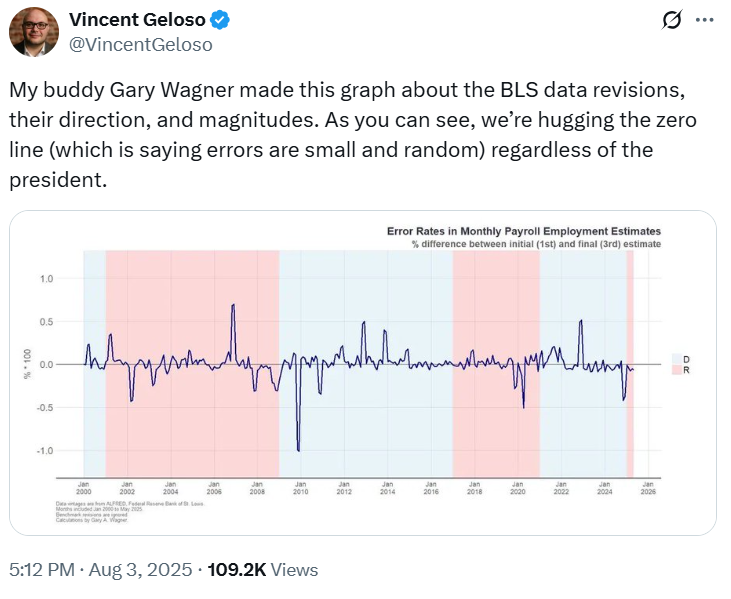
There’s a lot of noise here, but the real story is pretty simple: Trump fired the head of the BLS for releasing unfavorable jobs numbers, then hired someone to publish favorable numbers instead.
And despite some protestations from people like Doescher (who, again, is a friend of Antoni’s), I agree with critics on the right and left that he is not qualified for the job. Even if you ignore the enormous partisan asterisk — Antoni was a January 6 attendee and Project 2025 contributor, whose X feed is a firehose of the most sycophantic commentary imaginable — as Dominic Pino said in National Review (under “What the right is saying”), “he does not understand economic statistics.” Pino highlighted seven different posts from Antoni in just the last year that show a clear misunderstanding of basic economics. Here is one example:

The Import Price Index does not include tariffs. If foreign producers were eating U.S. tariffs, they would need to cut their pre-tariff prices so that the post-tariff price doesn’t rise. The graph shows that pre-tariff prices on average stayed roughly the same between April and June, which means that foreign producers on average were passing the tariffs on to Americans.
And there are several more examples like this. You can find similar arguments in the pages of The Wall Street Journal, Cato Institute, The Dispatch and UnHerd, as well as from conservative economists at The Manhattan Institute and The American Enterprise Institute. William Beach, Trump’s pick for BLS commissioner during his first term, even penned a letter questioning Antoni’s qualifications.
As much as I oppose Antoni’s nomination, it’s perfectly possible that his nomination won’t become the disaster I expect it to be. Antoni’s initial pitch to stop releasing the monthly jobs report was shot down by the White House; as Doescher wrote, he is going to have a hard time politicizing 2,000 economists even if he wants to. Additionally, there are numerous ways to measure the health of our economy and job growth that don’t involve the BLS — ADP reports, Indeed job postings, independent business surveys and even other reports from the Department of Labor like unemployment insurance claims, just to name a few. I’m also skeptical of how long Antoni will last. This position is not a lifetime or even 10-year appointment; as Trump just demonstrated, a future Democratic president could fire Antoni. And, honestly, I don’t think the business sector — which heavily influences the Senate and President — will tolerate fudged numbers or other kinds of chicanery if Antoni actually goes that route.
Still, the appointment will justifiably undermine trust and confidence in an agency responsible for crucial economic reports that the entire government and many private sector leaders rely on to make critical decisions. And we shouldn’t delude ourselves into believing the BLS is being shaken up for any kind of thoughtful reason when the man responsible for this change has explained his motivations clearly: Trump wanted to punish McEntarfer for a correction that is part of her job and is rewarding Antoni for being loyal to him. His hope, obviously, is to get more politically favorable numbers from the BLS. But thanks to this decision, the public will have to view those numbers with skepticism.
Take the survey: What do you think of Antoni’s qualifications? Let us know!
Disagree? That's okay. My opinion is just one of many. Write in and let us know why, and we'll consider publishing your feedback.
Your questions, answered.
Q: How do the Feds determine the poverty rate & why is the functional poverty rate so much higher than that?
— Dean from Carbondale, IL
Tangle: The federal government tracks the poverty rate through a pretty simple three-step process. First, they develop a baseline poverty threshold, then they alter that threshold based on the number of income-earners and children in a family, and finally they compare a given family’s net earnings to that adjusted threshold.
The government actually keeps three different poverty measures. The most common metric is the U.S. Census Bureau’s official poverty measure. To set the poverty line of the official measure, the bureau simply multiplies the cost of a simple diet in 1963 (adjusted for inflation) by three. Then, they adjust that threshold based on a family’s makeup (which you can see here) and compare it to a family’s pre-tax earnings. The percent of the population below the official poverty measure was 11.1% in 2023.
Since 2011, the Census Bureau has worked with the Bureau of Labor Statistics to calculate a more comprehensive Supplemental Poverty Measure. That measure includes costs for food, clothing and shelter (including utilities) from the Consumer Expenditure Survey — plus a “modest” amount for personal care, household supplies and non-work-related transportation (treating taxes and child care as income deductions) — then makes cost-of-living adjustments before comparing the sum to a family’s earnings. Although the supplemental measure also considers assistance benefits from the government as income, the broader considerations for costs are usually larger, meaning more people fall under this poverty line. The portion of the population below the Supplemental Poverty Measure for 2023 was 12.9%.
Lastly, the Department of Health and Human Services (HHS) keeps a Federal Poverty Level, which is a simplified version of the official level, to determine who is eligible for federal healthcare programs. HHS releases a table of the simplified thresholds for different family sizes, but does not release data on the percentage of households that exceed them.
Now, as for the “functional” poverty rate, you’re probably thinking of something used by NGOs to measure poverty. There isn’t one “functional poverty rate,” but one of the most widely referenced of these measures is the United Way’s ALICE (Asset Limited, Income Constrained, Employed). In setting this measure, the United Way considers not just food, clothing and shelter but child care, education, transportation, health care, and technology. With its much broader considerations, the United Way considers 42% of U.S. households to be below the ALICE threshold.
Want to have a question answered in the newsletter? You can reply to this email (it goes straight to our inbox) or fill out this form.
Under the radar.
On Monday, Director of National Intelligence Tulsi Gabbard announced that British authorities had dropped their demand that Apple provide a “backdoor” to access U.S. users’ data in national security and criminal investigations. In January, the UK asked Apple to disable its most advanced encryption for information stored in its cloud services, later telling U.S. officials that they would only seek this data when investigating serious crimes, such as terrorism and child sexual abuse. However, the Trump administration balked at the request, and Gabbard said dropping the protections would have encroached on Americans’ civil liberties. Bloomberg has the story.
Sharpen your view of Washington with Semafor Principals.
Every morning, the briefing delivers sharp, non-partisan reporting directly from our team of seasoned journalists stationed on the Hill. Get breaking news from the halls of Congress, the West Wing, and the backrooms where real power is brokered.
Numbers.
- 16. The number of commissioners in the history of the U.S. Bureau of Labor Statistics (BLS).
- 10. The number of acting commissioners (who serve between the departure of one commissioner and the appointment of another) in BLS history.
- 1885. The year the first BLS commissioner, Carroll D. Wright, assumed the role.
- 6. The number of BLS commissioners who have served in the 21st century.
- 10. The number of days between President Donald Trump’s firing of BLS Commissioner Erika McEntarfer and his nomination of E.J. Antoni to replace her in the role.
- 1. The number of times Antoni’s academic work has been cited, according to Google Scholar.
- 1,327. The total number of times former BLS Commissioner McEntarfer’s academic publications have been cited.
The extras.
- One year ago today we wrote about prescription drug prices.
- The most clicked link in yesterday’s newsletter was the list of new destinations rich people are surging to.
- Nothing to do with politics: A swarm of jellyfish shut down a French nuclear plant.
- Yesterday’s survey: 4,122 readers responded to our survey on President Trump deploying the National Guard to D.C. with 80% saying the district has a crime problem but opposing the deployment. “Doing anything for 30 days does not solve a problem decades in the making,” one respondent said.

Have a nice day.
In 2007, four-year-olds Ellie Koerner and Dawson Nailor were diagnosed with acute lymphoblastic leukemia. Both children were treated at the Children’s Hospital of Philadelphia, with Koerner’s cancer going into remission in 2008 and Nailor becoming cancer-free in 2010. After their recoveries, the two did not cross paths again — until Nailor approached Koerner at an orientation event for the Philadelphia College of Osteopathic Medicine. Both Nailor and Koerner cited their childhood experiences as inspiring them to pursue medicine, ultimately reuniting them after seventeen years. CBS News has the story.
Don’t forget...
🎥 Follow us on Instagram here or subscribe to our YouTube channel here.
🛍 Love clothes, stickers and mugs? Go to our merch store!

Member comments