

I'm Isaac Saul, and this is Tangle: an independent, nonpartisan, subscriber-supported politics newsletter that summarizes the best arguments from across the political spectrum on the news of the day — then “my take.”
Are you new here? Get free emails to your inbox daily. Would you rather listen? You can find our podcast here.
Today’s read: 15 minutes.
7 reasons everyone should be taking THIS kind of protein.
Your body starts losing collagen fast in your 20s — and once it’s gone, it’s hard to get back. But in one study, women who supplemented collagen for just 6 months gained 7% more bone density — the same amount most people lose over six years.
NativePath Collagen helps you fight back. Just two scoops a day of this single-ingredient formula delivers 20g of Type 1 & 3 collagen and 18g of protein. Grass-fed. Filler-free. Odorless. Tasteless. It dissolves instantly in coffee, tea, or food.
Don’t wait for symptoms to show up. Restore your collagen now — get 45% off + free shipping here.
*This is a sponsored segment.
The future of the primary reform movement.
The primary reform movement is at a crossroads. After reformers notched high-profile breakthroughs in states like Alaska, voters rejected ranked-choice voting and open primaries at the ballot box in 2024. In our latest YouTube video, we take a hard look at the state of the movement and break down its biggest wins and setbacks, then look ahead to the major battles on the horizon. It’s the second in a three-part series on primary reform that we’re producing in partnership with Unite America, and you can check it out here.
Quick hits.
- The Supreme Court heard arguments in Trump v. Slaughter on whether presidents can fire members of independent agencies, such as the Federal Trade Commission, for reasons outside of “inefficiency, neglect of duty, or malfeasance in office.” Court watchers suggested the court seems likely to rule that the president does have this power. (The arguments)
- Alina Habba resigned as U.S. attorney for New Jersey following a ruling by an appeals court that she was serving unlawfully. Habba said she will continue serving as Attorney General Pam Bondi’s senior adviser for U.S. attorneys. (The resignation)
- Paramount Skydance launched a competing bid to acquire Warner Bros. Discovery after Netflix announced a $82.7 billion deal to acquire the company on Friday. Paramount’s $108.4 billion offer is backed by the Ellison family; Jared Kushner’s Affinity Partners; and sovereign wealth funds from Saudi Arabia, Qatar, and Abu Dhabi. (The latest)
- President Donald Trump said he will sign an executive order this week blocking state-level regulations on artificial intelligence, saying that the technology should be regulated at the federal level. (The comments)
- A 7.5-magnitude earthquake off the coast of northern Japan injured 23 people and caused a tsunami along the Pacific coast. (The quake)
Today’s topic.
The new national security strategy. On Thursday, the Trump administration released its 2025 National Security Strategy (NSS), a document outlining the administration’s priorities for U.S. foreign policy. In the document, the administration provides overviews of its policies in the Western Hemisphere, Asia, Europe, the Middle East, and Africa. Key goals include refocusing on regional relationships, increasing economic power while avoiding conflict in the Pacific, protecting freedom and security in Europe, pursuing lasting peace and economic partnership in the Middle East, and maintaining U.S. dominance in the technological sector.
Back up: In 1986, the Goldwater-Nichols Department of Defense Reorganization Act mandated the NSS, a report the President sends to Congress in order to communicate the executive branch’s security priorities. These transmissions began under President Ronald Reagan in 1987, and every president since has issued at least one NSS to Congress during each of his terms.
The second Trump administration’s NSS contains some notable shifts from recent U.S. national security priorities. While the document maintains longstanding policy on Taiwan and nuclear deterrence, it differs from previous administrations in its stances toward China and Russia. The administration also outlines its problems with post-Cold War era policy, critiquing the prioritization of U.S. global dominance over domestic stability.
The document also outlines the Trump administration’s focus on the Western Hemisphere, which it calls a “‘Trump corollary’ to the Monroe Doctrine.” The administration defines this corollary as increasing partnership between the U.S. and other Western Hemisphere nations while preventing external foreign influence. Additionally, it says its policy towards Latin America will be guided by a focus on U.S. border security and the use of military power to curtail drug trafficking.
The NSS’s stated policy on Europe also breaks from traditional U.S. policy. The document criticizes European countries’ stance on Ukraine and warns that the continent faces “civilizational erasure” due to its migration policies, while also calling for European countries to increase their defense spending, improve their economic capacity, and pursue a more stable relationship with Russia.
The NSS drew sharp criticism from Democrats, who criticized the Trump administration’s positioning towards Europe. On X, Sen. Mark Kelly (D-AZ) wrote, “Donald Trump’s National Security Strategy puts his family’s and friends’ business interests with our adversaries, like Russia and China, over promises to our allies.” Meanwhile, Republican lawmakers praised the administration for its shift in focus. “The NSS is an important first step in reasserting U.S. hegemony in our hemisphere and to make Americans safe and prosperous,” Sen. Mike Lee (R-UT) said.
Below, you’ll read arguments about the NSS from the left, right, and writers abroad. Then Senior Editor Will Kaback gives his take.
What the right is saying.
- The right is mixed on the strategy, with some praising its pivot to prioritizing the Western Hemisphere.
- Others say the document fails to capture the greatest threats to the U.S.
In The Free Press, Niall Ferguson explored “the truth about Trump’s national security strategy.”
“One can tell from the opening section of the document why both the Times and the WSJ hated it, for it is a succinct repudiation of the foreign policies of both the Clintons and the Bushes — not to mention the Kennedys. It rejects the notion of an ‘indispensable nation’ with a duty to police the globe,” Ferguson wrote. “Since the early 20th century, the foreign policy establishment has held this truth to be self-evident, that all regions are not created equal, and Europe is the most important region of them all. The NSS rejects this. It firmly puts Europe in second place, after the Western Hemisphere.”
“In their rush to be offended on behalf of the Europeans, the mainstream commentariat has largely missed what a grab bag of fairly conventional ideas most of the new National Security Strategy is,” Ferguson said. “There is Nixonian realism, with its familiar insistence on the primacy of national interest, burden-sharing, and the balance of power. There is Reaganite ‘peace through strength.’ But there is also the late Joe Nye’s ‘soft power through which we exercise positive influence throughout the world’ — as Harvard-y a foreign policy idea as you could wish for.”
In The New York Post, Peter Doran wrote “Trump’s new national-security plan beats Biden’s but muddles our biggest threats.”
“The best National Security Strategies accurately describe the world as it is, align finite national resources to potentially unlimited aims and, most important, inform decision-making in a crisis. The Trump 1.0 strategy largely accomplished all three of these objectives, declaring in no uncertain terms that China and Russia were overt challengers to American power and influence. The Trump 2.0 strategy is less clear,” Doran said. “Instead of decisive language and a bold recognition of immediate dangers from China, Russia or the clerical regime in Iran, the new strategy buries Trump’s priorities under layers of befuddling rhetoric.”
“Right now, China is flexing its military muscle in the Pacific, ramming ships and wargaming threats to Taiwan. NATO generals warn that Russia could be ready to attack Europe in under five years. The clerics in Tehran are still in power and overtly antagonistic to America and its friends. Alas, the Trump 2.0 strategy gives these issues lower priority, focusing more on Western Hemisphere affairs, fair trade deals and grievances about current account deficits,” Doran wrote. “The United States cannot win a high-stakes rivalry with serious players like Beijing or Moscow if we don’t adequately confront the severity of our competition and the complexity of the threats they present.”
What the left is saying.
- The left is critical of the plan’s priorities, with many saying it will elevate right-wing governments.
- Some suggest the document’s inconsistencies derive from Trump’s variability.
In The Atlantic, Thomas Wright argued the NSS “shows less concern for the American homeland than for building an illiberal world order.”
“What the White House presented on Friday as a hardheaded, realistic assessment of the geopolitical landscape more closely resembles France’s Maginot Line — a massive fortress built before World War II to stop a German attack that never came while failing to anticipate the one that did,” Wright said. “Trump’s latest NSS is a blunt repudiation of the idea… that the United States is in a strategic competition with rival powers. It prioritizes threats from the Western Hemisphere, European civilizational decline and overregulation, and trade deficits but says nothing about the Russian threat to U.S. interests and views China almost entirely through the lens of economic security.”
“The strategy therefore does not explain what the government, Congress, and the private sector should do to fix these vulnerabilities,” Wright wrote. “The reason may lie in what the Trump administration is trying to accomplish. Contrary to its protestations about reining in America’s ambition after decades of overreach… it does have a grand plan: The NSS is a blueprint for building an illiberal international order, in which the U.S. can assert dominance unilaterally, strike deals with revisionist powers such as China and Russia, and work patiently to support right-wing populist parties in Europe in overthrowing centrist establishments.”
In Bloomberg, Andreas Kluth said “the US quietly made a new national security plan out of whims.”
“[The NSS’s authors] did their best to navigate around the many contradictions that riddle the president’s foreign policy and by extension the document… A convenient translation: Strategy is whatever Trump says tomorrow on Air Force One, or later in the Oval Office,” Kluth wrote. “All this preening shouldn’t obscure a shift in some emphases. Several things are consistent: It was always clear that the president views Moscow (not mentioned much, and in part as a potential partner) more favorably than did any of his predecessors since World War II”
“The rest is largely as predicted. The strategy heaps contempt on multilateral and international organizations (which Trump has been quitting, boycotting or deriding), while appearing to bless a return to 19th-century-style spheres of influence,” Kluth said. “And as ever, Trump’s friends, business and golf partners do well: After the document harangues the Europeans for their way of life, it graciously promises to stop ‘hectoring’ the Gulf monarchies into ‘abandoning their traditions,’ which have rarely resembled Madisonian democracy.”
What writers abroad are saying.
- Some writers abroad say the NSS should be a wake-up call for Europe.
- Others argue the administration’s criticisms of the continent’s leaders are well founded.
In The Guardian, Georg Riekeles and Varg Folkman wrote “Trump’s new doctrine confirms it. Ready or not, Europe is on its own.”
“Everybody should have seen it coming after Washington’s humiliating 28-point plan for Ukraine… But the new words still land as a shock,” Riekeles and Folkman said. “The security document is the clearest signal yet of how brutally and transactionally Washington wants to engage with the continent. It marks another phase in Trump’s attempt to reshape Europe in his ideological image while at the same time abandoning it militarily.”
“There are reasons to believe that the US will not abandon Europe completely. Protecting roughly $4tn in US investments on the continent remains a key interest. Yet the direction is unmistakable — Washington is stepping back,” Riekeles and Folkman wrote. “If Europe wants to move from a defensive crouch to a posture of strategic agency, it must sustain its surge in defence investment and make it crystal clear that attempts at coercion from Washington or Beijing will be met with forceful countermeasures. Only then can Europe avoid being squeezed between a retreating patron and a mistrustful rival.”
In Strategic Europe, Judy Dempsey said “Europe needs to hear what America is saying.”
“Europe and the rest of the world now know how poorly this U.S. administration regards them and they cannot keep pretending otherwise,” Dempsey wrote. “In adversarial language, the strategy goes on to decry ‘the activities of the European Union and other transnational bodies that undermine political liberty and sovereignty, migration policies that are transforming the continent and creating strife, censorship of free speech and suppression of political opposition, cratering birthrates, and loss of national identities and self-confidence.’
“Yes, Europe does lack self-confidence. Yes, it does lack a security and strategic outlook. Yes, it has far too long relied on the United States as a security guarantor. Yes, it has failed to listen to the grievances of the far right,” Dempsey said. “Yet, its leadership in the institutions and the member states won’t take the leap to deal with these major issues that reflect the post–Cold War era. These failings weaken Europe as a credible global player. That makes criticism of the NSS a rhetorical exercise.”
My take.
Reminder: “My take” is a section where we give ourselves space to share a personal opinion. If you have feedback, criticism or compliments, don't unsubscribe. Write in by replying to this email, or leave a comment.
- The NSS elevates a new regional focus over more urgent global threats.
- Furthermore, the administration’s actions seem to be working against its stated goals.
- While some individual provisions are strong, the document as a whole poorly prioritizes our national security threats.
Senior Editor Will Kaback: The second Trump administration’s NSS’s demands for Europe to do more in its own defense, while prescribing a renewed focus on Latin America and confronting our enemies don’t come as a surprise. But they also don’t represent the value of the NSS as a statement of priorities that highlights what we can expect from the White House in the next three years.
Trump’s NSS highlights a familiar set of goals — reducing illegal and legal immigration, leveraging U.S. influence to resolve conflicts abroad, establishing dominance in critical fields like artificial intelligence — that are, to varying degrees, sensible. But as a cohesive plan, it misdiagnoses the hierarchy of threats to the United States.
True to Trump, the document distills the America First philosophy to its essence: The U.S. will not strive to be the world’s police force outside of circumstances where it can receive a direct material benefit, nor will it maintain alliances based on historical relationships alone. It will approach global conflicts from an explicit position of self interest. That may sound blunt, because the NSS is blunt on these points; but I think it’s also an understandable response to decades of failed foreign policy that has pulled us into costly wars in the Middle East, spurred migration crises, and done little to tamp down emergent threats. In short, I can appreciate the appeal of a reworked foreign policy that refocuses our priorities on benefiting Americans first and foremost. In practice, though, the America First agenda laid out in the NSS has just as many flaws as the old strategies.
Take its ambitions in the Western Hemisphere — the “Trump Corollary to the Monroe Doctrine” describes a refocusing on regional partnerships as a means of security and economic opportunity. On paper, I think most people in the U.S. can get behind this — our relationships with our neighbors have a myriad of direct, immediate impacts. But look at how the Trump administration has gone about this goal so far: Wide-ranging tariffs dubiously justified by a “national economic emergency” and unevenly applied (a 50% tariff on Brazilian imports over the country’s prosecution of former President Jair Bolsonaro, and a $40 billion bailout for Argentina to boost President Javier Milei). A military buildup near Venezuela, along with reports that the U.S. will attempt to oust President Nicolás Maduro. Ongoing strikes on alleged drug boats in the Caribbean, prompting condemnation from several Latin American leaders (and concern from legal experts domestically). Trump’s NSS says he wants to bolster “our own nation’s appeal as the Hemisphere’s economic and security partner of choice,” but these actions seem far more likely to antagonize and alienate than foster stronger allegiances.
Execution of policy aside, the very decision to place Western Hemisphere as the top national security priority is itself suspect. Certainly, greater emphasis on the region is sensible — and the document accurately outlines the strategic benefits of “near-shoring” our supply-chain, reduced economic migration, and access to critical materials. But the war in Ukraine, an ascendant China with hegemonic ambitions, and ongoing instability in the Middle East remain far more immediate and substantial national security concerns.
Notably, the first Trump administration made this assessment. Threats from Russia and China were the focal points of Trump’s 2017 NSS, identifying the two countries as a “challenge [to] American power, influence, and interests, attempting to erode American security and prosperity.” That assessment, shared by the Biden administration, hasn’t changed in the last eight years — if anything, it is even more accurate. Since 2017, China has ratcheted up its attacks on key U.S. infrastructure and seems increasingly likely to invade Taiwan in the years ahead. A March 2025 report from the U.S. intelligence community stated clearly, “China presents the most comprehensive and robust military threat to U.S. national security.” And obviously Russia has since invaded Ukraine, and Putin continues to threaten Eastern Europe.
The Trump administration may reject the notion that Russia’s invasion of Ukraine poses any direct threat to U.S. national security, but Russia has amply demonstrated itself as a major threat even outside that war. The same 2025 U.S. intelligence community report highlighted Russia’s ongoing efforts to train its “military space elements and field new antisatellite weapons” while partnering with China to develop cutting-edge artificial intelligence tools on and off the battlefield. Elsewhere in Asia, hostile governments in North Korea and Iran remain an ever-present threat of regional (or worse) destabilization. Trump’s NSS doesn’t mention North Korea at all and only mentions the threat posed by Iran in the past tense.
Considering this broader picture, I don’t see reasserting American dominance in the Western Hemisphere as a top national security priority.
In fairness, the NSS still has plenty to say about China and Russia. The section on China is robust and accurately outlines the military threats it poses, but its argument places all its weight on the idea that “maintaining American economic and technological preeminence is the surest way to deter and prevent a large-scale military conflict.” What’s not addressed, though, is how our “economic and technological preeminence” has not meaningfully deterred China’s military aspirations. Again, China has not slowed its military buildup, its intrusions into U.S. infrastructure, or its efforts to broaden its spheres of influence since Trump returned to office.
On Russia, the document primarily focuses on establishing “strategic stability” with the country but doesn’t address any military threats in detail. The Trump administration essentially argues that dealmaking alone can resolve these issues, which is certainly hopeful but also evidently ineffective. Since Trump started his second term, dealmaking has failed thus far to produce a breakthrough in Ukraine and has done little to alter China’s course.
Separately, the NSS’s section on Europe also feels out of place for a national security strategy document. Here again the document is unsurprising — the administration has not been shy about criticizing European leaders for their approach to migration policy, defense, free speech issues, and more. Many of these critiques are also well founded, and we’ve covered many of them in Tangle. But a pressing national security concern? The document constructs an elaborate projection in which overregulation and liberal migration policies hollow out European economies and militaries, leading to the “loss of national identities and self-confidence.” The national security issue then follows from Europe’s eventual diminishment as a reliable ally for the U.S. “in 20 years or less.” That hypothetical could be a future concern worth discussing, but by centering this criticism of longstanding allies, the Trump administration overlooks much more immediate threats.
The way Trump has shifted his language on Europe in the past eight years is striking. In the 2017 NSS, “The United States remains firmly committed to our European allies and partners”; in 2025, “Our goal should be to help Europe correct its current trajectory.” In 2017, “The NATO alliance of free and sovereign states is one of our great advantages over our competitors”; in 2025, it is an “open question” whether some NATO states will remain reliable as they become “majority non-European.”
Priorities and circumstances can change in eight years, of course, but what is the strategic benefit of turning up the heat on Europe now, while seeking to negotiate an end to a brutal war on the continent, and relaxing our focus on China and Russia, which each pose immediate, non-hypothetical national security threats? Bluntly, it’s a benefit to our geopolitical rivals; just look at how Russia responded to the NSS: The document is “largely consistent with our vision,” Kremlin spokesman Dmitry Peskov said.
The NSS contains plenty of worthy goals, such as strengthening the U.S. industrial and technological base, modernizing military readiness and deterrence capabilities, and building supply chain resilience. However, these redeeming qualities are overshadowed by the failure in prioritization. The document demonstrates how President Trump’s flexible worldview — elevating an open-for-business attitude with a willingness to call out friends and foes alike — can translate poorly to a high-level vision of national security priorities.
Trump’s 2025 foreign policy is an exemplar of his conception of America First, and clearly appeals to large swaths of the country. But I think his second NSS lays bare this America First foreign policy’s own, equally significant shortcomings. In effect, it shifts the U.S. gaze inward without a clear strategy for approaching national security issues that past administrations (including Trump’s) correctly identified but failed to address. It all adds up to something that might feel like a breath of fresh air but leaves key concerns unaccounted for — and the United States less prepared for the dangers that truly define this moment.
Take the survey: What do you think of the 2025 NSS? Let us know.
Disagree? That's okay. Our opinion is just one of many. Write in and let us know why, and we'll consider publishing your feedback.
Your questions, answered.
Q: I have seen a lot of trade agreements described as a framework of a deal. Can you guys please do a follow up on the status of these deals and agreements? Are they still in frameworks? Are they actually fully fleshed out deals?
— Charles from Mechanicsburg, PA
Tangle: When the U.S. and another country reach a trade deal, they typically announce it as a “framework” rather than an official agreement. Both entities often need to take further action in order to implement the different facets of the trade deal, and the process for doing this can be slow and drawn out.
The clearest example might be the European Union deal, which we covered as a framework deal in July. A month later, the EU and the U.S. released a joint statement outlining the official provisions that the two entities had agreed upon. Since then, both sides have begun slowly implementing those provisions; for example, a recent European Council press release detailed how the U.S. has issued adjustments to its tariff rates, while the European Union recently began adopting some regulatory guidelines. But the situation, and the deal, remains fluid — the Trump administration later announced that it was threatening new safeguards on steel imports, which hadn’t factored into the negotiations over the summer.
For a more detailed look at the status of various trade deals, the law firm ReedSmith has a tariff tracker that includes information on the tariff status of each country, whether the U.S. has reached a deal with them, and if any other progress has been made on each deal.
Want to have a question answered in the newsletter? You can reply to this email (it goes straight to our inbox) or fill out this form.
Under the radar.
On Monday, the developer of ICEBlock, an app developed to track reported sightings of Immigration and Customs Enforcement (ICE) agents, sued the Trump administration, alleging that it had improperly pressured Apple to remove the app from its app store. In October, Apple pulled ICEBlock and other similar apps for violating the company’s policies on apps that “provide location information about law enforcement officers that can be used to harm such officers individually or as a group.” However, ICEBlock creator Joshua Aaron claims in the lawsuit that the administration’s efforts to remove the app violated free-speech protections and asks the courts to affirm that he cannot be sued for creating the app. The Associated Press has the story.
Numbers.
- 21. The number of times “China” is mentioned in the second Trump administration’s NSS.
- 33. The number of times “China” is mentioned in the first Trump administration’s NSS.
- 10. The number of times “Russia” is mentioned in the second Trump administration’s NSS.
- 25. The number of times “Russia” is mentioned in the first Trump administration’s NSS.
- 49. The number of times “Europe” is mentioned in the second Trump administration’s NSS.
- 28. The number of times “Europe” is mentioned in the first Trump administration’s NSS.
- 3. The number of times “Iran” is mentioned in the second Trump administration’s NSS.
- 17. The number of times “Iran” is mentioned in the first Trump administration’s NSS.
The extras.
- One year ago today we covered the UnitedHealthcare CEO shooting.
- The most clicked link in yesterday’s newsletter was our Friday edition from A.M. Hickman describing why he misses being homeless.
- Nothing to do with politics: Wikipedia’s most read articles of 2025.
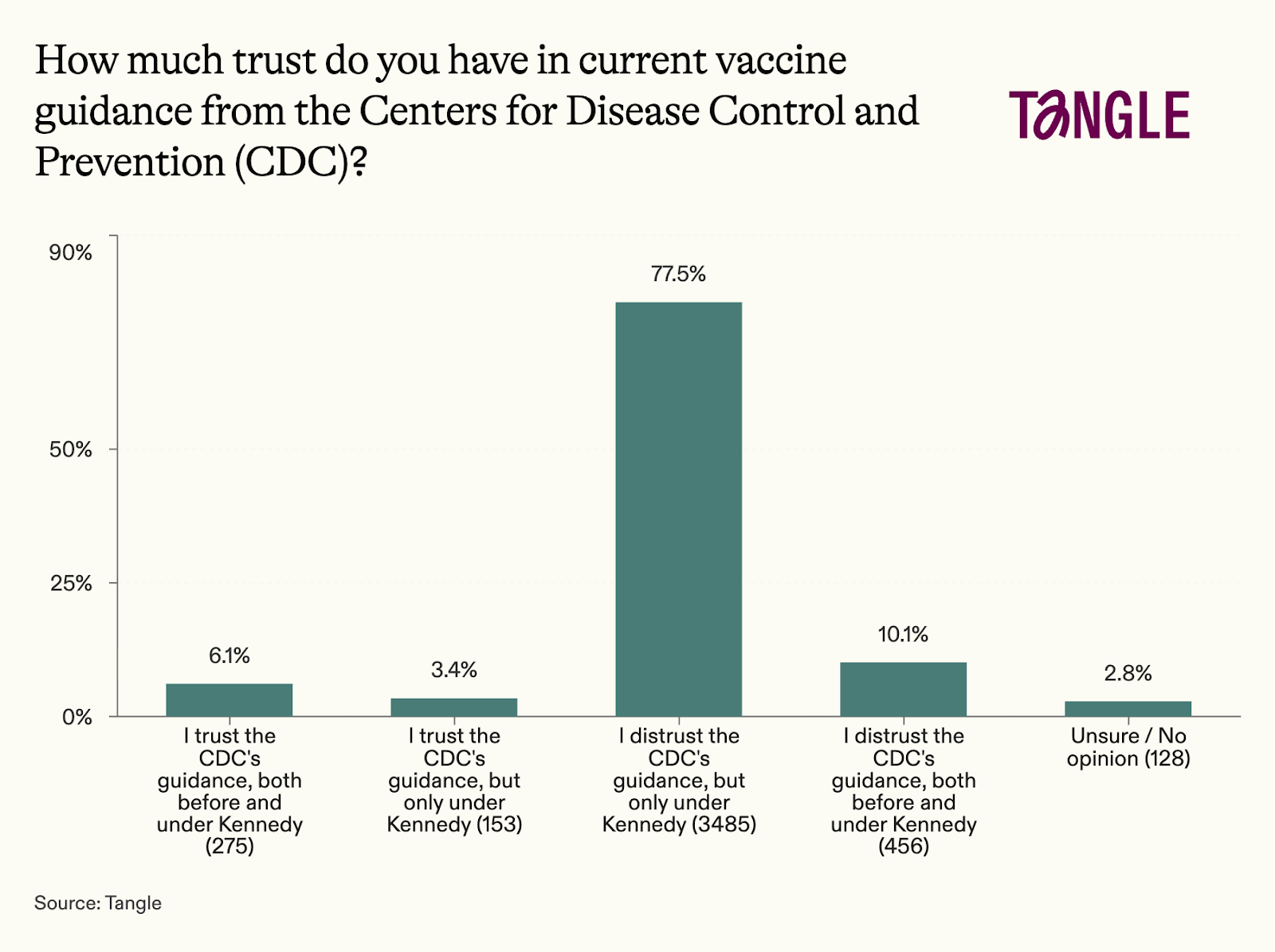
- Yesterday’s survey: 3,620 readers responded to our survey on trust in the CDC with 83% saying they distrust the CDC under Kennedy. “I still generally trust CDC vaccine guidance, but I trust it less under Kennedy and rely on my doctor as a primary source of guidance.” one respondent said. “There was never a valid reason to vaccinate every newborn for HepB nor was the vaccine tested properly before being added to the schedule,” said another.
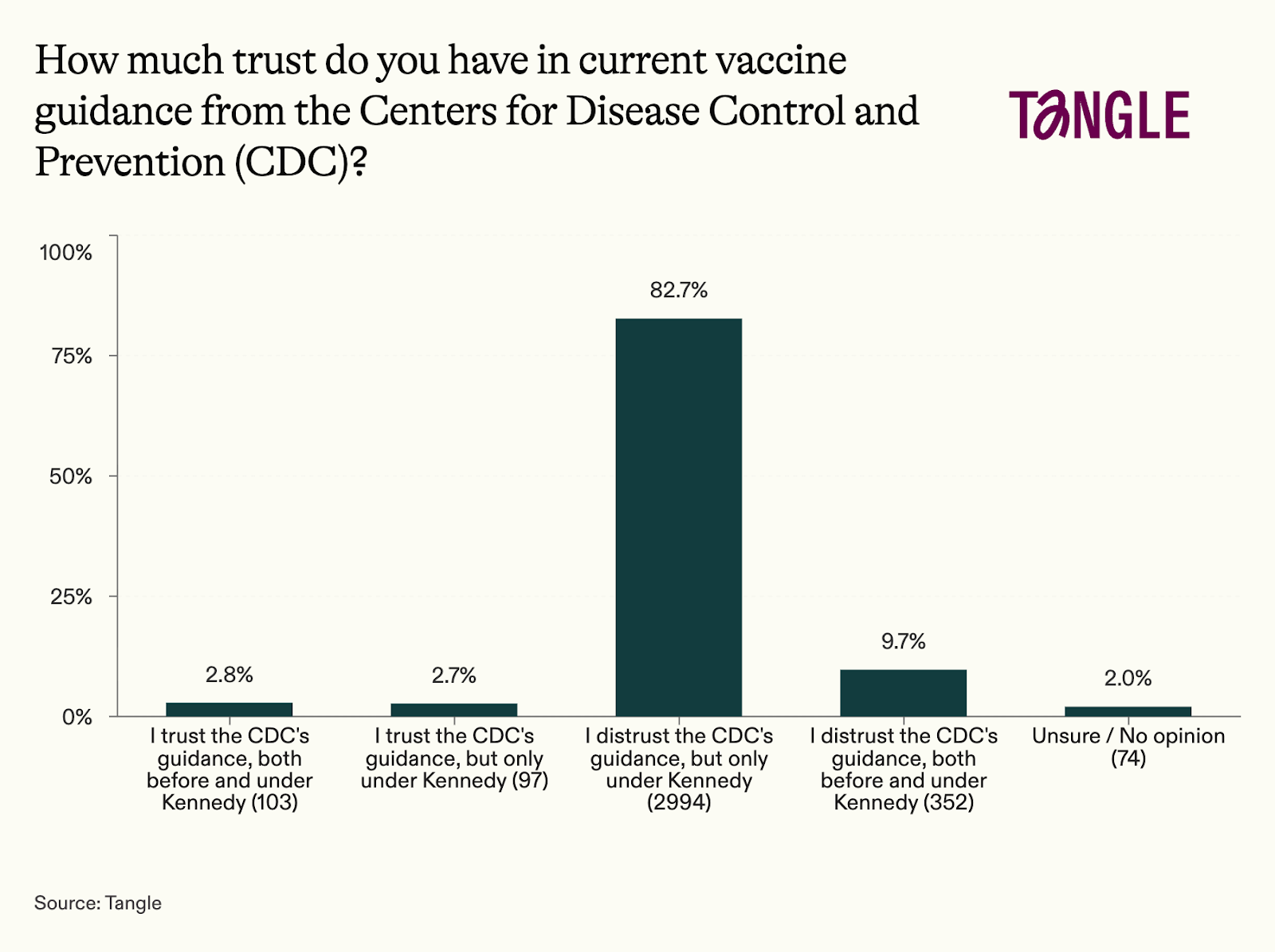
4,497 readers responded to the same question following shakeups at the Department of Health and Human Services in September. Here’s how responses have shifted since then.
Have a nice day.
Randy Fyllesvold managed a large farm near Antler, North Dakota, that grew soybeans, canola, and about 1,400 acres of corn. In September, Randy tragically lost his life in a crash, leaving his wife Kharra grieving and his fields unharvested — that is, until Randy’s neighbors stepped up. Led by Wyatt Thompson and Andy Gates, 75 volunteers running 12 combines worked together to bring in Andy’s last harvest in a matter of days. “The love and friendship that made this harvest possible are impossible to put into words. The day was full of emotion, but I found so much peace in watching it unfold,” Kharra Fyllesvold shared on Facebook. Sunny Skyz has the story.

Member comments