
I'm Isaac Saul, and this is Tangle: an independent, nonpartisan, subscriber-supported politics newsletter that summarizes the best arguments from across the political spectrum on the news of the day — then “my take.”
Are you new here? Get free emails to your inbox daily. Would you rather listen? You can find our podcast here.
Today’s read: 15 minutes.
The lesser-known Trump appointees shaping U.S. policy.
The first eight months of the Trump administration have been defined in the media by a select group of cabinet members touching the president’s most noteworthy policies. If you think about tariffs, you think of Howard Lutnick or Scott Bessent. If you think of deportations, you think of Kristi Noem. If you think about vaccines, you think of Robert F. Kennedy Jr. But the rest of President Trump’s cabinet has been just as active, working outside the headlines on major issues like energy, agriculture, labor, and more. In Friday’s two-part edition, we published a deep dive into ten “under the radar” Trump appointees, breaking down what they’ve done and the issues shaping their tenure. You can read Part One here, and Part Two here.
Reminder: Friday editions are for premium Tangle members. To read the full piece, you’ll need to subscribe.
Quick hits.
- Negotiators for Israel and Hamas traveled to Egypt to begin indirect negotiations over a plan proposed by President Donald Trump last Monday to end the war in Gaza. Hamas has said that it agrees to some points of the plan but has not accepted others, including the demand that it fully disarms. (The negotiations)
- A slew of national and local Republican leaders — including President Trump — called on Jay Jones, the Democratic nominee for Virginia attorney general, to drop out of the race after text messages from 2022 surfaced showing Jones wishing violence on then-Virginia House Speaker Todd Gilbert (R) and his family. (The texts)
- The Supreme Court paused a ruling by a federal judge that had blocked the Trump administration from removing protected status from thousands of Venezuelan nationals. Justice Ketanji Brown Jackson wrote a dissenting opinion calling the order “yet another grave misuse of our emergency docket.” (The decision)
- Defense Secretary Pete Hegseth said the U.S. military struck a boat off the coast of Venezuela that was allegedly carrying illegal drugs, killing four people. (The strike)
- The partial government shutdown continued into a sixth day. The Senate is scheduled to vote on Monday on Republican- and Democratic-led funding bills, but the measures are expected to fall short of the 60 votes needed to pass. (The latest)
The Internet Wasn't Supposed to Be This Annoying.
Pop-ups interrupting your reading. Autoplay videos you never asked for. Ads that follow you around the web for weeks after one innocent search. And don't even get started on public WiFi security.
Somewhere along the way, browsing the internet became an exercise in dodging digital clutter and praying hackers aren't watching.
Surfshark One cleans up the mess: their VPN encrypts your connection (crucial on public networks), while ad blocking eliminates the constant interruptions. Add antivirus protection and identity monitoring, and you've got a complete solution for $2.69/month—86% off plus three bonus months.
It's what the internet experience should've been all along: fast, clean, and secure.
Try Surfshark One risk-free.
*Our sponsors help keep Tangle free — thank you for supporting them when you can.
Today’s topic.
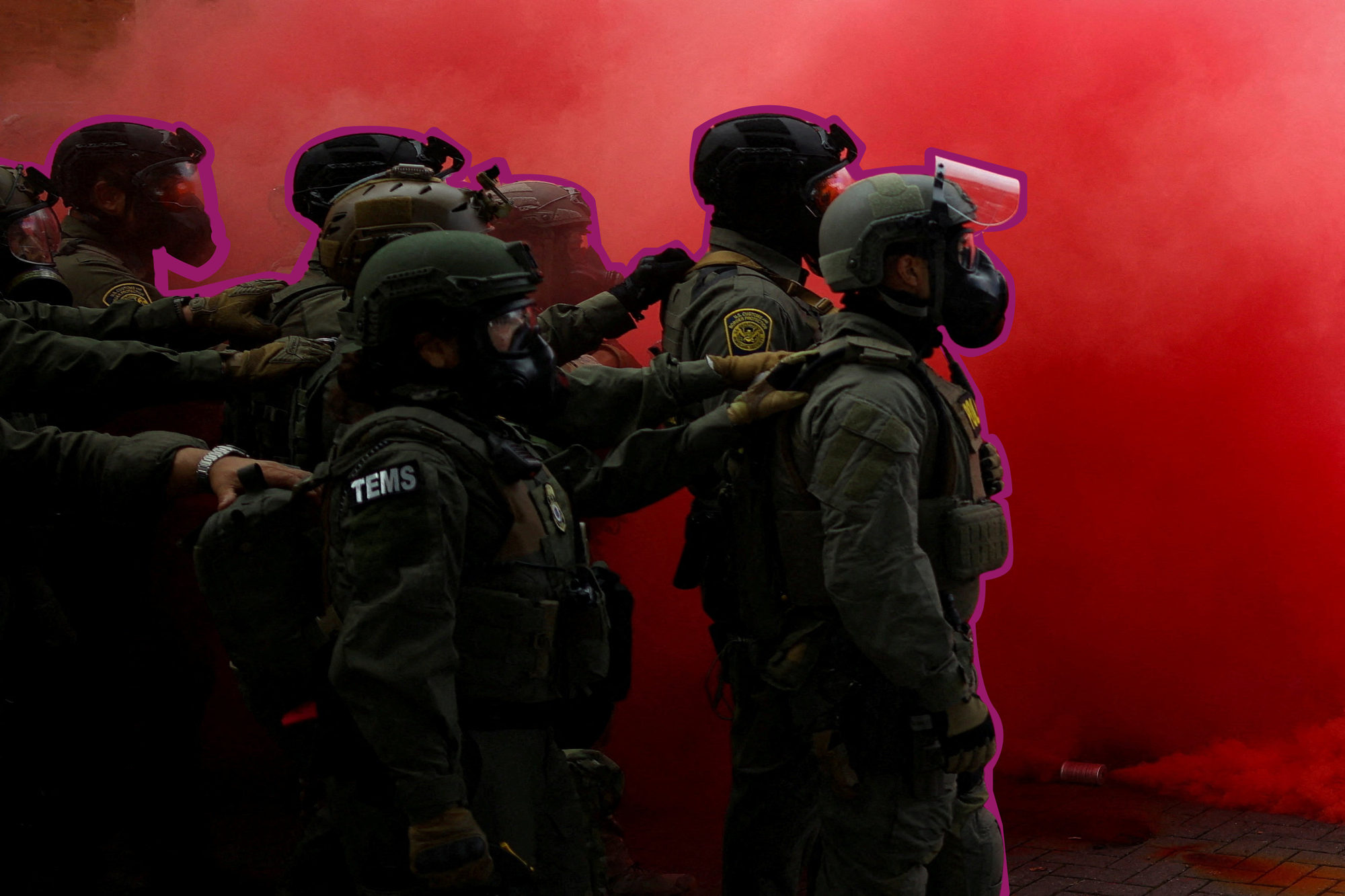
The federal crackdown in Chicago and Portland. In recent weeks, President Donald Trump deployed Illinois National Guard troops to Chicago and attempted to mobilize the National Guard to Portland, Oregon, leading to arrests and clashes with protesters in the cities. In Chicago, hundreds of federal officers carried out a large-scale raid at an apartment building on Tuesday, leading to a reported 37 arrests of alleged unauthorized immigrants. In Portland, a federal judge temporarily blocked the Trump administration from deploying the Oregon National Guard. Then on Sunday, Secretary of Defense Pete Hegseth called up 400 members of the Texas National Guard for deployments to Portland, Chicago, and other cities to support federal agents and protect property.
White House officials say the law enforcement activity in Illinois is necessary to maintain public safety in and around Chicago while also protecting immigration authorities from heightened threats. Tuesday’s raid — a joint operation involving multiple federal agencies and utilizing Black Hawk helicopters — targeted a residential building allegedly frequented by members of the Tren de Aragua gang. However, witnesses and residents said that nearly every building resident was detained, including children and U.S. citizens, in some cases without clear explanations for their arrests.
Also on Tuesday, President Trump suggested in a meeting with military leaders and Secretary Hegseth that cities like Chicago should be “training grounds for our military,” describing the unrest over immigration enforcement and federal troop deployments as “a war from within.” The comments drew strong rebukes from Chicago Mayor Brandon Johnson (D) and Illinois Gov. JB Pritzker (D). “Sending troops into cities, thinking that that’s some sort of proving ground for war, or that indeed there’s some sort of internal war going on in the United States, is, just frankly, inane,” Pritzker said.
Tensions between Immigration and Customs Enforcement (ICE) officers and protesters escalated on Saturday when federal agents were allegedly rammed and boxed in by 10 cars near an ICE facility outside Chicago. Officers fired shots at a woman in one of the cars, saying that she was armed with a semi-automatic weapon. No one was seriously hurt, but Department of Homeland Security Secretary Kristi Noem announced that additional personnel would be deployed to the area in response to the incident.
Separately, on Saturday, federal judge Karin Immergut (who was appointed by Trump in his first term) issued a temporary restraining order blocking the federal government from deploying 200 Oregon National Guard troops to Portland. Judge Immergut found that the size and nature of the immigration protests in the city did not justify mobilizing the Guard, writing that President Trump’s statements to the contrary were “simply untethered to the facts.” The order will remain in effect for 14 days, unless extended. In response, the Trump administration filed a notice of appeal to the 9th U.S. Circuit Court of Appeals.
However, after the Trump administration mobilized members of the California National Guard to Oregon, Judge Immergut convened another hearing and issued a broader ruling barring the government from sending any National Guard troops to Portland while the restraining order is in effect.
Today, we’ll share views from the right and left about the federal activity in Chicago and Portland. Then, my take.
What the right is saying.
- The right mostly backs Trump’s actions in Chicago and Portland, with many arguing that protests are out of control.
- Some say a dearth of local leadership requires federal intervention.
- Others suggest deploying troops won’t fix the underlying problems fueling the protests.
In The Daily Signal, Jarrett Stepman wrote “Trump is right to clamp down on Portland’s Jacobins.”
“Federal Immigration and Customs Enforcement facilities have been besieged for months in the Oregon city with little indication that local authorities will do anything to get control of the situation… It couldn’t be clearer that Portland’s leaders have little interest in getting the rioters under control outside of pressure from the Trump administration,” Stepman said. “The primary issue right now for Portland is not just an intractable problem with basic street crime, though that was a big one after the George Floyd riots when the city defunded the police.
“No, the problem is that Portland is returning to violence and chaos because organized agitators in their city — like Antifa and other similar groups — want to stop federal immigration enforcement. They are throwing a continual violent tantrum because they aren’t getting their way. Not only are the ICE facilities besieged on a regular basis, but many residents are fed up with having their lives disrupted while local officials do nothing,” Stepman wrote. “Since Portland is clearly not willing to do its job to protect the lives of federal employees in the city, the Trump administration has a duty to step in and put the kibosh on Portland’s Jacobins.”
In PJ Media, Michael A. Letts said “Trump is showing why order is needed in cities like Portland.”
“Trump has done a great job in Washington, D.C., when it came to turning around their misfortunes, because the leaders eventually worked with him to find that level of peace. But in Chicago and Portland, things are not that easy, and now I wonder just how long it will take for a resolution to be found,” Letts wrote. “A majority of the problem, again, comes down to leadership. For example, Illinois Governor JB Pritzker has made it clear that he’s not a fan of Trump, insisting that he is ‘threatening to go to war with an American city’ when, in fact, the war’s coming from within, due to his own problematic leadership.”
“Poor leadership is going to lead to the wrong kind of pushback and, as a result, the lack of any real progress within the state. That’s why Trump is doing what he can on his end, in an effort to bring true law and order back to these fallen states,” Letts said. “So here we are. Trump’s trying to push for law and order within these states, and the combined efforts of these violent Antifa types and Democratic leaders are now creating a dangerous situation.”
In Reason, Katherine Mangu-Ward argued “deploying federal troops is not a sustainable solution to crime in American cities.”
“An August Associated Press–NORC poll found that 81 percent of respondents view crime as a ‘major problem’ in America's large cities, while 66 percent view it as a ‘major problem’ nationwide,” Mangu-Ward wrote. “But a military occupation of American cities is neither constitutionally sound nor fiscally viable. Legally and logistically, you can't solve deep social and policing problems with Humvees parked at intersections forever. These deployments tend to devolve into a high-risk form of political theater, rewarding mayors and presidents who want to look tough while leaving communities no closer to a lasting solution and America one step closer to authoritarian rule.
“The idea of uniformed federal agents patrolling city neighborhoods as if they were appropriate for everyday law enforcement feels profoundly out of step with the spirit of America's founding values as we approach the semiquincentennial,” Mangu-Ward said. “The Constitution's architecture was designed to prevent just this kind of centralization where a standing force functions not as a last resort but as a default mode. Letting soldiers or masked federal officers replace traditional policing undermines the boundary between citizen and subject.”
What the left is saying.
- The left opposes the administration’s actions in cities, saying Trump is grossly exaggerating the situation.
- Some call on protesters to resist Trump’s attempts to antagonize them.
- Others say troop deployments will only increase the likelihood of violent disorder.
In The New York Times, Nicholas Kristof wrote “Mr. President, may we interest you in a naked bike ride?”
“The National Guard troops dispatched by President Trump to fight ‘domestic terrorists’ in this ‘war-ravaged’ city of Portland, Ore., will face an unexpected challenge: naked bicycle riders. Cycling in the buff is a Portland specialty, and one organization has announced a naked ride ‘in response to the militarization of our city.’ Such is the war zone here,” Kristof said. “National Guard troops could help Portland, if they rented office space. But the way Trump dispatches troops to fight a ‘war from within’ won’t solve the city’s problems and may inflame them.”
“Because I’ve spent much of my career covering authoritarian governments, I’m particularly alarmed by Trump’s attempt to create, in effect, his own Praetorian Guard, available to punish critics or Democratic cities. That is standard autocratic behavior, and in extreme cases — such as at Tiananmen Square in 1989 — I’ve seen such troops used to massacre protesters,” Kristof wrote. “I don’t think that will happen here, but Trump has long had an interest in marshaling military force to suppress opponents.”
The Oregonian editorial board said “keep proving Trump wrong.”
“Portlanders love a good social media throwdown and President Donald Trump’s characterizations of Portland as ‘war ravaged’ invited the onslaught… With their lighthearted humor, Portlanders are displaying the quirk and creativity so deeply ingrained in the city’s culture, while showing just how unfounded Trump’s claims are,” the board wrote. “Amid the uncertainty, Portlanders must pause and recognize how much is at stake as the country heads toward the midterm elections when voters will decide whether America is on the right path.
“This is not just about protesting inhumane immigration enforcement or defending Oregon from federal overreach. Trump’s military ploy to suppress one block of protests is yet another page from his playbook of bulldozing rights and norms while insisting such action is justified. Portland’s response must help show the rest of the country how wrong he is,” the board said. “The mayor and City Council must reinforce Portland Police’s authority to step up their presence at protests and quickly intervene if any criminal behavior occurs. They must understand that protecting public safety is not the same as supporting immigration enforcement.”
In The Chicago Tribune, David White argued “Chicago is right to resist [Trump’s] tactics.”
“President Donald Trump told generals this week that cities such as Chicago are ‘under invasion from within’ and must be crushed with force, serving as a training ground for American troops… History and science warn: When federal police use force to suppress dissent, larger and more violent protests follow,” White wrote. “Consider two philosophies of policing. Escalated force means aggressive tactics — tear gas, rubber bullets, baton charges, mass arrests, militarized gear — meant to break up crowds and crush dissent. Negotiated management, by contrast, treats protests as political expression, protected by the First Amendment.”
“Yet Chicago has periodically returned to the hard-knuckles approach, often with more harm than good. The George Floyd protests in 2020 showed the same pattern nationwide: Escalated force was followed by greater unrest, while negotiated management saw fewer confrontations,” White said. “The role of law enforcement is clear: to serve and protect, not enable federal escalation. That means rejecting militarized policing and standing between Chicagoans and outside forces who would inflame unrest.”
My take.
Reminder: “My take” is a section where I give myself space to share my own personal opinion. If you have feedback, criticism or compliments, don't unsubscribe. Write in by replying to this email, or leave a comment.
- Trying to cover this moment fairly and without hysterics is very difficult, and none of our political leaders are helping.
- These troop deployments and immigration raids are increasingly dangerous and not worth the cost.
- Federal law enforcement faces real threats, but we still don't want presidents to have this kind of power.
When President Trump deployed troops into the nation’s capital to police crime, I said it was clearly a “trial run for other cities.”
Trump made no secret of it, and now that prediction has self-evidently come true.
As with the D.C. deployment, I am vehemently opposed to the president’s use of the National Guard in Chicago and Portland. He is now checking off three of the five boxes I said I’d be watching to determine whether he was pursuing an authoritarian style of governance, a development that is deeply alarming as an American and makes our work at Tangle incredibly difficult. And just as I said a few weeks ago, I set out these five parameters before Trump’s second term ramped up; they were designed as a forward-looking gut check, not as alarmist assumptions about what Trump would do in office.
But fully describing why these deployments concern me requires acknowledging the problems that have compelled so many people to support them. So here’s the best argument I’ve heard for Trump’s actions, starting with Chicago:
There were over 10 million encounters with unauthorized migrants under Biden while Democratic leaders told us the border was secure, and many of those migrants went to Chicago. Trump is making good on his deportation pledges that won him the election by sending ICE to the city, which under decades of Democratic leadership has been home to some of the country’s most dangerous neighborhoods. It makes sense to want federal troops there to protect those ICE agents, because Chicago’s leadership won’t support the immigration enforcement effort, its police don’t have a handle on the city’s most dangerous neighborhoods, and we’ve seen what appear to be organized attacks on ICE agents.
The argument is similar in Portland: The city’s federal facilities, including ICE detention centers, have been the targets of protests and demonstrations. In some cases, those demonstrations have been violent or dangerous. Portland police’s inability to get a handle on the situation has forced Trump to deploy federal troops to protect federal law enforcement and federal buildings.
Basically: He wouldn’t be doing this if leaders in Chicago and Portland had control of their cities.
An easy and immediate counterargument is that these deployments are illegal and will be halted by the courts. In fact, that is a likely outcome — though the courts move slowly and Trump moves fast — and it’s impossible to know how many appeals and refilings the cases will require before they’re settled (Trump deployed troops to Portland for 60 days; the deployment could easily end before a binding court order permanently halts it).
Obviously, the president violating the law (or a state’s sovereignty) should be enough to compel people against this move. But it clearly isn’t; very few Republican leaders are objecting to Trump’s deployment, his voters seem invigorated by it, and pro-Trump pundits seem outright supportive of it.
I can understand this posture. An immigration crackdown is politically popular, and fears about crime are high, so a lot of people welcome a president “doing something” — legal arguments aside. While I believe that the legal limitations on Trump’s power are sufficient reason to oppose them, I’m also more compelled by a different argument: These actions cost us too much.
Some costs I accept. For example, I’d be happy to see my tax dollars go toward securing the border and paying for more immigration judges to process asylum claims and bring order to our system. Trump has approved those actions, and I support them. Increased border security with technology and troops is a worthwhile cost for more order to our immigration system. I own property near the border in West Texas, and I accept that increased security in this area means I have to go through checkpoints and submit to questioning by border patrol agents.
I also accept the cost of changing our asylum system. This one is tougher for me because it means we, as a nation, are going to be much stricter toward the downtrodden and desperate who come here seeking a better life. But our asylum system is broken, and it is being abused, and it needs to be reformed for the greater cause of improving our entire immigration system.
These costs are all worth it.
But other costs give me pause. Is it worth normalizing masked agents in America roaming the streets in unmarked cars, snatching up people who look or sound like immigrants? Is it worth abandoning due process and deporting people without hearings? Is it worth treating apartment buildings in Chicago like terrorist hubs in Afghanistan? Is it worth having soldiers rappel from helicopters into their homes? Is it worth detaining American children, dragging them out of their homes naked and afraid?
Perhaps, to some, all of this is worth it if the upside is rounding up illegal-immigrant gang members who are terrorizing communities. But what if these raids are consistently pulling in American citizens, or people here legally and nonviolent criminals? What if, despite all this, the government cuts highlight reels of said raids to share on social media, treating our Constitutional rights like a video game?
Do I want there to be order in Portland? Of course I do. Like many Americans, I watched Portland’s 2020 protests devolve into property damage, looting and arson, and I wondered where the real leaders on the left were who could control their own cities. But Portland gets to decide how to govern itself; it has elections where its citizens get to choose their own future and determine how their city is run and what environment they want to live in.
But is the cost of “fixing Portland” worth accepting a president flouting a court order from a judge he appointed, who explained in great detail why the justification for his troop deployment was unwarranted? Is it worth having a president describe U.S. cities as “training grounds” for our military, and quite obviously reveling in the thought of a military crackdown on citizens he sees as his political enemies?
Something else about this moment worries me, too. As Trump’s actions have become increasingly alarming to me over the last few months, I’ve tried my best to fulfill the promise of “My take” by being both honest (I’m alarmed) and fair (not exaggerating or sensationalizing the situation, or taking any partisan angle). The unfortunate result is that a lot of Tangle readers who support the president have unsubscribed, accused me of having “Trump derangement syndrome,” or believed me to be so biased that I can’t see the genuine threat the left poses — a threat that they say needs to be stomped out.
This is not a new phenomenon, or unique to the right. Just recently, we lost a lot of liberal readers for our coverage of Charlie Kirk. We lost a lot of Democratic voters during the Biden administration for criticizing his policies and for suggesting he was unfit for a second term. What worries me now, though, is that the underlying response to fears about the left seems to be a genuine desire for Trump to gather more power. Top aides to the president are now openly calling for a crackdown on prosecutors and judges and describing legitimate rulings from Trump-appointed judges as a “legal insurrection.”
Both sides increasingly see each other as existential threats that have to be dealt with in an immediate, unyielding fashion. This dichotomy has backed the American citizenry into a corner that feels hard to navigate out of. It’s really not difficult to imagine where all this is going and to see a very, very dark future. Right now we need leaders willing to pump the brakes and step back from the brink — but there don’t seem to be many in sight.
Take the survey: What do you think of the government deploying the National Guard to U.S. cities? Let us know.
Disagree? That's okay. My opinion is just one of many. Write in and let us know why, and we'll consider publishing your feedback.
Your questions, answered.
Q: As a staunch progressive, I firmly believe we should keep the subsidies in place for health insurance. My husband keeps arguing that it will fund insurance for illegal immigrants. What's the reality?
— Cheryl from Pella, IA
Tangle: The Affordable Care Act (ACA) subsidies Democrats are pushing for during the government shutdown won’t fund insurance for unauthorized immigrants. In fact, ACA benefits do not and have never gone to those residing in the country illegally. But the misconception is understandable.
Republicans and Democrats have been fighting over two different sets of ACA benefits this summer.
First, extended ACA benefits. These enhanced premium benefits were introduced during the pandemic, and they reduced premiums for ACA enrollees and expanded the eligibility pool to more people in the middle class. Enhanced premium benefits are set to expire at the end of 2025, but Democrats are pushing to make them permanent. At the same time, Democrats want the Medicaid cuts passed in the One Big Beautiful Bill Act (OBBA) to be repealed.
Second, benefits for lawful immigrants who are not citizens. In July, the OBBA restricted eligibility for subsidized ACA Marketplace to some lawfully present, but non-permanent-resident, immigrants — refugees, asylees, and those with temporary protected status. These restrictions are set to take effect on January 1, 2027. Additionally, a rule from the Department of Health and Human Services interpreted Deferred Action for Childhood Arrival recipients (children who came into the country illegally with their parents, also known as “dreamers”) as not lawfully present and eligible for ACA benefits. Democrats opposed these changes, too.
Put simply: Democrats have fought against the changes in bucket two, and they are currently fighting against the changes in bucket one.
Contributing to this conflation, reliable conservative outlets have been putting these two issues next to each other, creating an implication (emphasis added): “Those enhanced subsidies were supposed to be temporary and were set to expire at the end of 2025. Democrats want them extended. In addition, Democrats are screaming bloody murder about… making sure illegal immigrants don’t get covered,” National Review’s editors wrote. “Democrats now want to undo most of the healthcare spending reductions, including restoring healthcare for illegal immigrants, and on top of that, they want to extend Obamacare subsidies for insurance companies,” The Washington Examiner’s editors said.
So, Democrats do want to maintain expanded eligibility for healthcare benefits to immigrants, regardless of their permanent status; but that push still only applies to those in the country with authorization. Separately, the government shutdown only concerns extended ACA benefits, which do not apply to unauthorized immigrants.
Want to have a question answered in the newsletter? You can reply to this email (it goes straight to our inbox) or fill out this form.
Under the radar.
On Friday, a federal judge sentenced the person convicted of attempting to murder Supreme Court Justice Brett Kavanaugh to eight years in prison and a lifetime of supervised release. The Justice Department had sought at least a 30-year sentence in the case, but Judge Deborah Boardman noted several mitigating factors that led her to opt for a lighter sentence, including that the would-be assailant self-reported to law enforcement after staking out the justice’s house. Furthermore, the judge expressed concern that the offender, who now identifies as a transgender woman, would face adverse conditions in prison due to President Trump’s executive order requiring transgender inmates to be detained in prisons that correspond to their biological sex. Fox News has the story.
Tired of ads ruining every article you try to read?
Surfshark One blocks the pop-ups, autoplay videos, and trackers that follow you around the web—plus their VPN keeps you secure everywhere you go.
Right now it's just $2.69/month (86% off).
Finally browse the internet the way it was meant to be.
Numbers.
- 300. The reported number of law enforcement officers involved in the raid on a Chicago apartment building on Tuesday.
- 800. The number of arrests made since the start of the Trump administration’s heightened immigration enforcement actions in the Chicago area, according to federal officials.
- 36. The number of arrests police have made outside an Immigration and Customs Enforcement facility in Portland, Oregon, since protests at the building began in June (not including arrests made by federal law enforcement agents).
- 100. The approximate number of California National Guardsmen who mobilized to Oregon on Sunday before a federal judge blocked their deployment.
- 38% and 49%. The percentage of U.S. adults who support and oppose, respectively, deploying National Guard troops to a major city in their state for law enforcement efforts, according to a September 2025 NPR-Ipsos poll.
The extras.
- One year ago today we had just published a Friday edition examining the death penalty.
- The most clicked link in Thursday’s newsletter was once again the 20 international foods most commonly mispronounced by Americans.
- Nothing to do with politics: Each state ranked by length of coffee order.
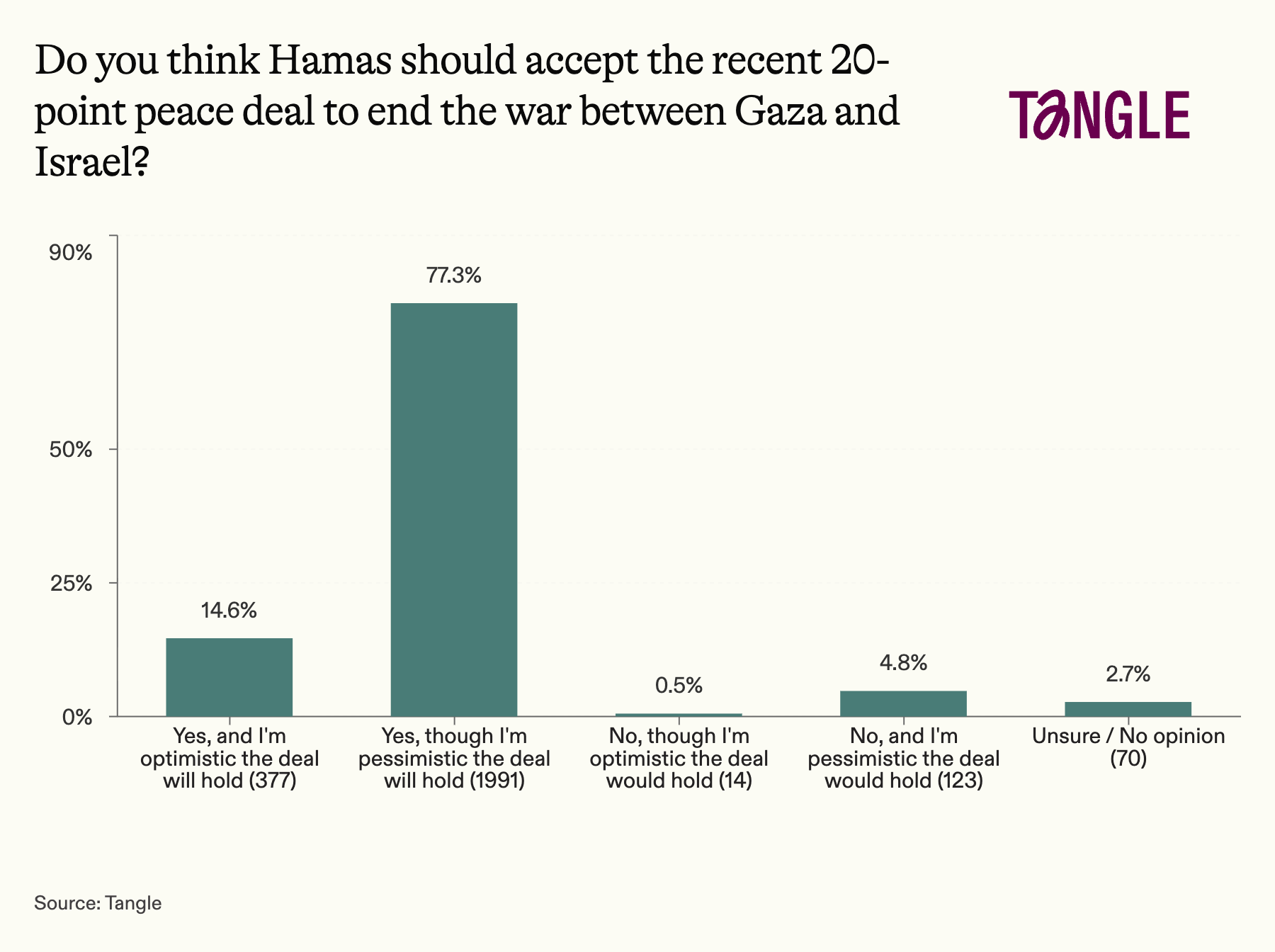
- Thursday’s survey: 2,575 readers responded to our survey on the 20-point Gaza peace plan with 77% saying Hamas should accept it but they’re pessimistic it will hold. “They should, but the whole point of Hamas is to destroy Israel, so not sure it would hold and don’t think Hamas will sign,” one respondent said. “Your gratuitous depiction of Netenyahu and Israel as the ones responsible for bad behavior in Gaza is ridiculous and deeply offensive to me,” said another.
Have a nice day.
A cascade of kindness recently uplifted a beloved staff member at a high school in Georgia. Ms. Len, the parking lot security guard at Flowery Branch High School, was facing financial struggles and car trouble. The school’s principal, Joey Farah, decided to help, offering to buy her a new tire. Then, local repair shop Christian Brothers Automotive raised the bar, gifting Ms. Len a 2014 Nissan Altima. Some of the school’s students also joined in, detailing the car and covering its registration costs. The community members then came together to hand Ms. Len the keys to her all-expenses-paid new car. Sunny Skyz has the story.

Member comments