I’m Isaac Saul, and this is Tangle: an independent, nonpartisan, subscriber-supported politics newsletter that summarizes the best arguments from across the political spectrum on the news of the day — then “my take.”
Are you new here? Get free emails to your inbox daily. Would you rather listen? You can find our podcast here.
Today's read: 13 minutes.
Today's Sponsor: Sick of cluttered websites and pop-ups? Erase them with this tool.
You clicked for news — not 37 ads and a cookie banner. Those annoying pop-ups and autoplay videos also track your clicks, what you’re searching and buying and even your mouse movements.
But there’s a tool to “erase” these trackers, block ads and malware — it’s called CleanWeb. You’ll get:
- Pages loading faster
- Fewer ads (especially those creepy, personalized ones)
- Peace of mind knowing you’re not being followed online
We’ve been surprised about how much of a difference it makes in daily browsing, so we’ve partnered with them to discount it to Tangle readers.
Our interview with the head of FIRE.
In recent weeks, we’ve written several pieces about challenges to free speech in the United States, prompting an array of feedback and commentary from the Tangle community. To further this discussion, Senior Editor Will Kaback recently spoke with Greg Lukianoff, the president and CEO of the Foundation for Individual Rights and Expression (FIRE), whose organization is involved in high-profile cases like Mahmoud Khalil’s deportation challenge and President Trump’s lawsuit against Iowa pollster Ann Selzer. Premium podcast subscribers can listen to the interview now on their preferred platform, and free members can listen to a preview here.
Quick hits.
- The Department of Education said it is freezing billions of dollars in future research grants and other aid to Harvard University until the school implements policy directives from the Trump administration. (The freeze)
- President Donald Trump announced he had authorized the Department of Commerce and the United States Trade Representative to begin the process of implementing a 100% tariff on films produced outside of the U.S. (The tariffs)
- Homeland Security Secretary Kristi Noem said the U.S. will offer $1,000 stipends and travel assistance to unauthorized migrants who voluntarily self-deport. (The offer) Separately, Rwanda’s foreign minister said the country is in talks with the Trump administration to accept migrants deported from the United States. (The comments)
- The Justice Department asked a federal judge to dismiss a lawsuit that seeks to restrict access to the abortion pill mifepristone, arguing that the case did not meet the legal standard to be heard in the court where it was filed. (The request)
- Germany’s Friedrich Merz won a parliament vote to become the country’s next chancellor, succeeding on the second ballot after failing to secure enough votes on the first. (The election)
Today's topic.
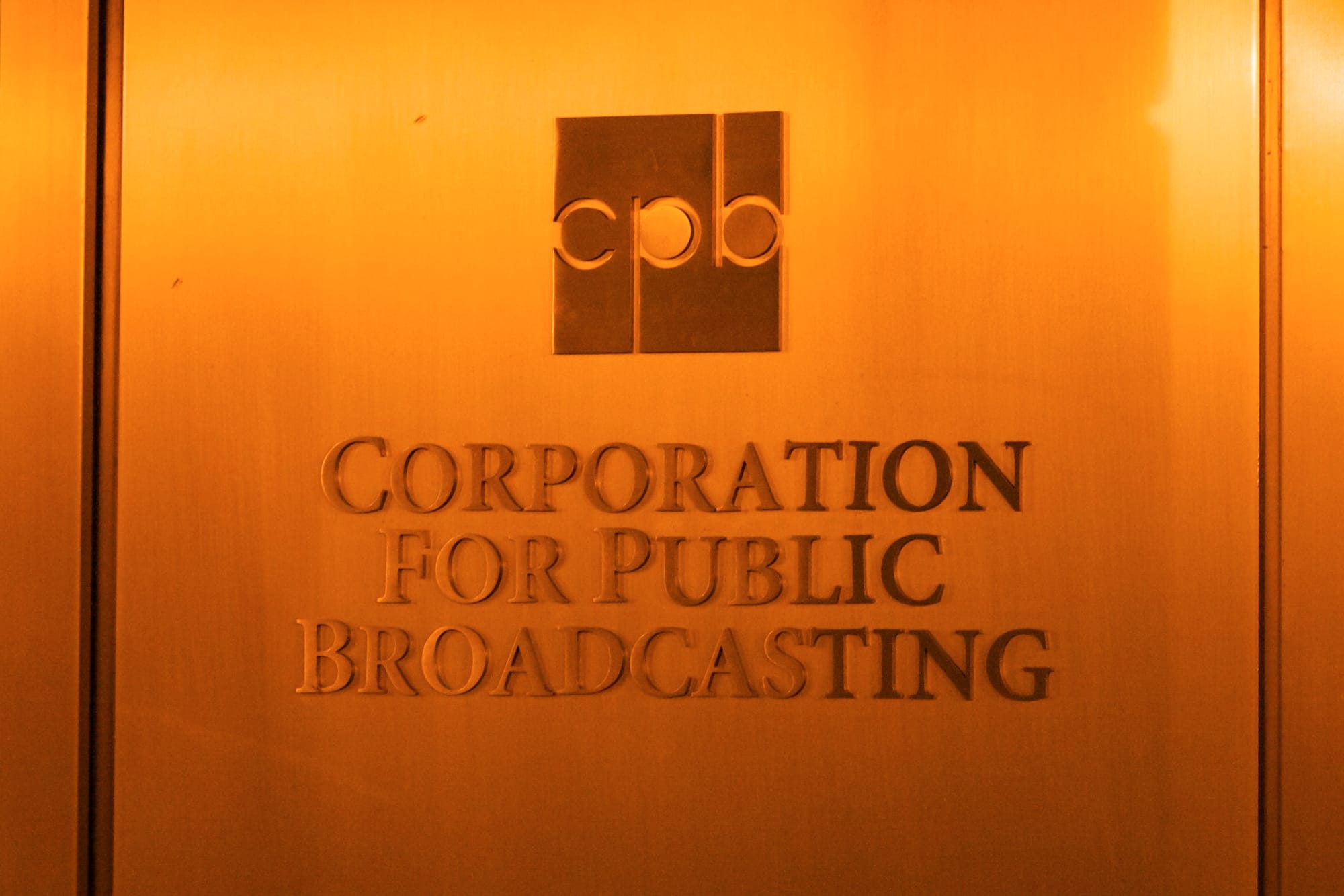
Defunding NPR and PBS. On Thursday, President Donald Trump signed an executive order directing the Corporation for Public Broadcasting (CPB) and all executive departments to end federal funding for National Public Radio (NPR) and the Public Broadcasting Service (PBS). The order claims that the outlets fail to offer “a fair, accurate, or unbiased portrayal of current events to taxpaying citizens” and instructs the CPB to “cancel existing direct funding to the maximum extent allowed by law” and “decline to provide future funding.” Executives at NPR and PBS called the order unlawful and said they would challenge it.
Back up: The CPB is a private, nonprofit corporation established by Congress in 1967 to steward the federal government’s investment in public broadcasting. In March, Congress allocated the corporation $535 million for fiscal year 2027 — PBS says that it and its stations receive 15% of their revenue from federal funding, while NPR says its stations receive 10% (NPR itself only receives 1% directly from the CPB). In April, the CPB sued President Trump after he attempted to fire three members of the corporation’s five-member board, arguing that the president lacked the authority to do so.
In addition to its claim of partisanship at NPR and PBS, the order argues that the need for publicly funded media has dissipated since the formation of the CPB. “Unlike in 1967, when the CPB was established, today the media landscape is filled with abundant, diverse, and innovative news options,” it reads. NPR and PBS contest that view, noting that rural areas and small towns (among others) still rely on public media as a critical source of local information.
Many Republicans support the order, arguing that PBS and NPR should not receive public funds due to long-standing partisan bias. Following testimony from the outlets in a House hearing in March, Rep. Marjorie Taylor Greene (R-GA) said, “For far too long, federal taxpayers have been forced to fund biased news. This needs to come to an end and it needs to come to an end now.”
Democratic lawmakers largely framed the order as an attack on a vital service. Sen. Andy Kim (D-NJ) called the order “a shameful, shortsighted betrayal of the public good,” while Rep. Dan Goldman (D-NY) said the president was taking away “Sesame Street, emergency alert systems, rural stations and educational shows for kids.”
PBS President and CEO Paula Kerger denounced the executive order, saying it “threatens our ability to serve the American public with educational programming.” NPR President and CEO Katherine Maher called the order “an affront to the First Amendment rights of NPR and locally owned and operated stations throughout America to produce and air programming that meets the needs of their communities” and said the outlet would challenge the action “using all means available.”
Today, we’ll cover Trump’s executive order with views from the left and right. Then, my take.
What the left is saying.
- The left opposes the order, suggesting that it’s unpopular even among Republicans.
- Some say the action poses a threat to American democracy.
- Others argue that many underserved groups would be affected if public media were defunded.
In The American Prospect, David Dayen wrote “Trump’s weakness shows through.”
“NPR and PBS are perpetually under threat of losing funding when Republicans are in power, but they never pull the trigger because a critical mass of lawmakers in the party don’t actually want to vote against Big Bird. This time was supposed to be different. The GOP was determined to use a mechanism to vote down currently funded initiatives that the president wants to ditch,” Dayen said. “Trump was supposed to send over the rescission bill this week. Then it got delayed, and now the timeline is the end of this month. Meanwhile, Republican lawmakers have started to grumble about cutting even this tiny fraction of spending.”
“The only durable way to defund public media is to defund CPB. And Trump was on the road to doing that with a simple majority vote in Congress. Then he apparently pulled the plug and went it alone. Reading between the lines, we can presume that there aren’t enough votes for rescinding CPB funding, or for a rescission package that is toxic because it’s attached to a president with a 39 percent approval rating,” Dayen wrote. Trump “governs by executive order because he has to, because his ideas are anathema even to a party that’s supposed to be putty in his hands.”
In Common Dreams, Tim Karr called the order “an assault on American democracy.”
“The White House made it clear that it’s taking this action based on Trump’s unfounded claims about coverage from NPR and PBS… Yet the First Amendment very clearly and succinctly prohibits the government from making any laws (and by extension, any executive orders) ‘abridging the freedom of speech, or of the press,’” Karr wrote. “In poll after poll, people of all political stripes say that federal support for NPR and PBS is taxpayer money ‘well spent’... To eliminate funding for these media institutions clearly goes against the will of the majority of Americans—and that's not the way a democracy is supposed to function.”
“As local newsrooms downsize or outright shut down, public-media stations fill a void. Penny Abernathy, at University of North Carolina's Center for Media Law and Policy, has extensively documented the spread of news deserts across the country. Local newspapers are closing at an exponential rate, and many local radio stations have hollowed out their newsrooms and replaced programming with nationally syndicated talk formats, often hosted by far-right figures,” Karr said. “The expansion of news deserts across the country is a democratic issue with profound implications for our communities.”
In USA Today, Marc Brown said “Trump's PBS funding cut is a loss for kids everywhere.”
“About 50% of children in America are not enrolled in preschool. Given that the unregulated digital landscape for kids can be toxic, dangerous and for profit, with advertisers trying to sell everything from bad snacks to toys their parents might not be able to afford, public media is the last safe place for our children,” Brown wrote. “It is noncommercial and free, accessible over broadcast even in remote areas, there to provide any child — regardless of means or circumstance — the ability to learn and grow, all while being entertained.”
“While each of America’s 356 local public television stations would be affected by funding cuts, those serving rural, island and tribal communities would face the most severe consequences,” Brown said. “A 2023 study by Protect My Public Media found that without funding from the Corporation for Public Broadcasting, 26 stations would go off air, and 23 more stations would need to reduce their coverage areas, cutting off rural audiences due to the high costs of reaching these communities. That’s as many as 46.1 million Americans losing access to public media, which plays a critical role in public safety, education and connecting communities.”
What the right is saying.
- The right supports the order, saying the outlets brought this scrutiny on themselves.
- Some suggest NPR and PBS strayed from their mission and are now paying the price.
- Others say publicly funded media is not vital to democracy.
National Review’s editors argued “defunding PBS and NPR is long overdue.”
“In principle, there is no reason why the federal government should be in the business of funding news and entertainment programming. It does not serve an essential purpose and could easily be financed privately. But if the government is going to be in the broadcasting business, it should at least not be one-sidedly political,” the editors wrote. “Instead, both NPR and PBS have abandoned any pretense of neutrality or balance, regularly pushing left-wing ideology and woke sensibilities in their news coverage and other programming.”
“NPR, PBS, and their defenders often perform a dishonest dance. They simultaneously dismiss the money contributed by the federal government as a small percentage of their overall budgets while crying that cutting off those funding sources will destroy them. It’s time, at long last, to end this charade… They have every right to operate as left-wing propaganda outlets. But they are not entitled to pursue this goal with taxpayer money,” the editors said. “Successfully ending federal funding for left-wing broadcasting networks would, after Republicans have talked about it for so long with no effect, be a nice feather in the administration’s hat.”
In The Hill, Jonathan Turley wrote “NPR’s undoing is a cautionary tale for the media.”
“Some of us have objected for years to the government subsidizing one radio outlet. It only made it worse that NPR was overwhelmingly Democratic in both its staff and its coverage. For years, NPR ignored complaints over its bias. It had a lock on federal funding to subsidize operations, even though its audience was shrinking,” Turley said. “Some of us oppose NPR’s funding as a form of state-sponsored media — a fundamental contradiction with principles of freedom of speech and the press. However, this is a moment the rest of the media should not let pass.
“NPR was ultimately undermined by its own arrogance. Editors and journalists did not have to worry about the fact that its shrinking audience was overwhelmingly white, liberal and affluent. Due to its support in Congress, it could make the vast majority of the country, which does not listen to its programming, help pay for its programming,” Turley said. “It will now have to choose between sustaining its bias or expanding its audience. It certainly has every right to be a left-leaning outlet (as do right-leaning outlets), but it has to sustain itself in the marketplace.”
In Racket News, Matt Taibbi said “no, state media and democracy don't go ‘hand in hand.’”
“The office of my first full-time reporting job with the Moscow Times was in the Pravda building. I used to spend lunch hours walking through the doors shown in the photo above, beering up in a cafeteria with writers from the sports section of Komsomolskaya Pravda, at the time the Guinness Book record-holder for world’s largest circulation,” Taibbi wrote. “With over 21 million readers, ‘Komsomolka’ sure as hell qualified as ‘strong public media,’ but hardly went ‘hand in hand’ with democracy. Like the rest of ex-Soviet media, it owed its circulation to decades of forcing insane lies on readers.”
“People who grew up reading the BBC or AFP may imagine a correlation between a state media and democracy, but a more dependable indicator of a free society is whether or not obnoxious private journalism (like the Russian Top Secret, whose editor Artyom Borovik died in a mysterious plane crash) is allowed to proliferate. As for those once-storied European networks, most have now become parodies, operating in concert with multiple official review operations like BBC Verify or the ‘Trusted Flaggers’ of the EU’s Digital Services Act. This layered messaging system essentially guarantees favorable coverage of public policy and is more dangerous than asking the listeners of stations like NPR to pay for media they like.”
My take.
Reminder: "My take" is a section where I give myself space to share my own personal opinion. If you have feedback, criticism or compliments, don't unsubscribe. Write in by replying to this email, or leave a comment.
- Fundamentally, I oppose the government sponsoring media outlets.
- NPR and PBS have great programs and journalists, but their reliance on government funding is an obvious problem.
- Still, Trump targeting these organizations through executive action is the wrong way to solve this problem.
First and perhaps most importantly: I don’t think the federal government should be in the business of funding domestic media organizations. As such, I’m not fundamentally opposed to the government cutting funding for the Corporation for Public Broadcasting.
I don’t think that stance is really that controversial. Great media organizations, like great businesses, should be able to stand on their own two feet. If I were to open Tangle up to taking a corporate sponsor, and we depended on that sponsor’s money for day-to-day operation, then Tangle would be corporate media — no matter how editorially independent I strived to be. The same is true of PBS and NPR with government funding: If they rely on funding approved by politicians to operate, then they are essentially state media. In the media space, where independence is a key pillar of journalism, that arrangement creates an enormous and predictable problem.
To be clear, whether NPR is a perfectly centrist, conservative, or liberal news outlet does not matter to me (for the record, it is obviously liberal today). That is really besides the point, which is that outlets like NPR and PBS already have perfectly workable news organizations without funding from the government, and their reliance on that money is an obvious conflict of interest. NPR does not help its case by having identifiable bias in its story selection, staff, language choice, or coverage; when Democrats are in power the optics are a threat to their credibility, and when Republicans are in power their slant is a threat to their business model.
This is not an easy position for me to take. I care a great deal about a healthy media ecosystem, which requires local newsrooms thriving. A healthy free press is a key pillar of democracy, and right now our free press is struggling. NPR, whatever you may think of their editorial slant, employs a lot of great journalists and does a ton of important local news reporting — which is needed at a time when most people focus on national news. Programs like This American Life are some of my favorite sources of journalism (even when they aren’t covering Tangle), and I’m heartened by the many CPB initiatives across the country that support journalism. People care, and they want newsrooms to work. But that doesn’t mean the best way to help them is through the government.
This position, as you might expect, comes with some nuance as it relates to the current environment. So let me flesh out some caveats here, too.
First, I don’t mean to say that all journalism initiatives should be excluded from all public funding. If the federal or state governments want to offer grant programs to encourage new journalists to enter the fray, or for specific projects in regions with limited news outlets, or to help translate content into new languages, or to make media accessible for people of a certain age (like PBS Kids) or with a disability — that all seems fine.
Second, I do think a reasonable argument can be made for the U.S. funding media organizations abroad, specifically in places where a free press is being suppressed. For all the “spreading democracy” that the United States does with bullets and jets, we could promote freedom more effectively and more humanely with keyboards and pens.
Third, while I support President Trump ending public funding of many media organizations in his recent budget proposal, I do not support him specifically targeting NPR and PBS through executive orders (or any specifically targeted executive orders). I’m even more opposed to the Trump administration’s pressure campaign on private media organizations, which has come in the form of threatening to arrest journalists, suing media organizations, and engaging in all kinds of shady arrangements that just happen to drive business towards the Trump family.
Some people might read all this and think, well, in places like Europe, publicly funded news organizations do great work. And they do, but they’re also susceptible to enormous risks. For instance, the BBC is a publicly funded media organization that now has to operate within the ecosystem of the Digital Services Act, which imposes penalties on platforms for spreading misinformation. BBC stood up BBC Verify to combat disinformation and fact-check content in that ecosystem. So, now the UK has a government-funded media organization helping decide what is and isn’t true because of a government-passed bill that helps punish outlets for spreading disinformation. I think this system will quite predictably lend itself to more favorable coverage of government policies and activities, as well as a more favorable view of what the government says is or isn’t “true” or “fact.” That should make the hairs on the back of your neck stand up; it certainly made mine.
To put a neat bow on all this: Trump’s targeting of NPR and PBS through executive action is just the latest salvo in his quest to gather and exercise power. At the same time, it’s the predictable outcome of having publicly funded media organizations, which is a good reason not to have publicly funded media organizations in the first place. So while I don’t support Trump’s executive push to target these outlets, I do support Trump’s legislative push to end that funding; and I think we’ll all be pleasantly surprised at how most of these media organizations will be able to stand up on their own without the funding and operate as a genuinely free press.
Take the survey: What do you think of the budget proposal? Let us know!
Disagree? That's okay. My opinion is just one of many. Write in and let us know why, and we'll consider publishing your feedback.
Help share Tangle.
I'm a firm believer that our politics would be a little bit better if everyone were reading balanced news that allows room for debate, disagreement, and multiple perspectives. If you can take 15 seconds to share Tangle with a few friends I'd really appreciate it — just click the button below and pick some people to email it to!
- Email Tangle to a friend by clicking here.
- Share Tangle on X/Twitter by clicking here.
- Share Tangle on Facebook by clicking here.
Your questions, answered.
Q: I am concerned about access to information in general. I read an article about the BEAD (Broadband Equity Access and Deployment) Program that was included in the Inflation Reduction Act (IRA) and a Commerce Director’s warning. From reading that article I think the project has progressed too slowly, not having broken ground yet… Are the ways we’re receiving information getting narrower? Is control of broadband the next big information war? How concerned should I be?
— Anonymous from Birmingham, AL
Tangle: There’s an old principle called Hanlon’s Razor that often applies to government: “Never attribute to malice what can be attributed to incompetence.”
To describe how the IRA’s $42 billion BEAD program to expand rural broadband and internet connectivity in “underserved” areas hasn’t made any physical progress since it was authorized in 2021, we’re going to turn to two people: Derek Thompson and Ezra Klein. Recently, Thompson and Klein co-wrote a book critiquing liberal governance from a liberal perspective, and they both used BEAD as an example of poor liberal governance while promoting their book.
“It turns out that in order for states to get access to that pot of $42 billion, they had to go through a 14-step process.” Thompson said. “And this has taken so long that of the 56 states and localities that have started the 14-step process, only three by March 2025 have gotten through the entire process. This is an example of the goals of government running up against the processes of government, such that the processes overwhelm the goals.” Klein described this process in more detail in an interview with Jon Stewart.
However, Thompson and Klein’s telling isn’t the whole story. They implied Democratic lawmakers alone were to blame for enacting a byzantine system of review, but their account left out another reason for the resulting complexity: internet service providers (ISPs). In short, ISPs were partially responsible for drawing the maps that define the areas that could receive BEAD service, they made the maps in a way that didn’t require them to act, and localities had to be aware of both the new law and the map in order to challenge it.
To his credit, Thompson admitted that he and Klein “got some of this wrong” when describing how the law failed. But whether you blame ISPs for setting up roadblocks or the government for failing to remove them (or both), it’s clear that the reason BEAD hasn’t made meaningful progress to provide rural broadband isn’t due to a malicious scheme to restrict access to information, but to the system BEAD created.
Want to have a question answered in the newsletter? You can reply to this email (it goes straight to our inbox) or fill out this form.
Under the radar.
Wednesday, May 7, is the first day that commercial travelers must present a Real ID-compliant license (or another accepted document) to board an aircraft in the U.S. In 2005, Congress passed the REAL ID Act, which sought to improve identity verification at airports in the wake of the September 11 attacks. However, implementation of the law was delayed several times, and the enforcement deadline was last extended in 2022. According to the Transportation Security Administration, travelers without a Real ID will need to provide an acceptable alternative form of identification — such as a passport or permanent resident card — and should prepare for additional identity verification and screenings at the airport. Axios has the story and information about obtaining a Real ID.
Numbers.
- 1967. The year that Congress passed the Public Broadcasting Act, establishing the Corporation for Public Broadcasting (CPB).
- 43 million. The approximate number of total weekly listeners across NPR stations, according to the network.
- 130 million. The approximate number of people who watch PBS annually, according to the network.
- 386. The number of radio grantees receiving funds from the CPB, representing 1,216 public radio stations.
- 158. The number of television grantees receiving funds from the CPB, representing 365 public TV stations.
- 70%. The approximate percentage of CPB’s federal funding allocated directly to local public media stations.
- 43%. The percentage of U.S. adults who say the federal government should continue to fund NPR and PBS, according to a March 2025 Pew Research survey.
- 24%. The percentage of U.S. adults who say the federal government should remove funding for NPR and PBS.
- 19% and 69%. The percentage of Republicans and Democrats, respectively, who say the federal government should continue to fund NPR and PBS.
The extras.
- One year ago today we covered Florida banning lab-grown meat.
- The most clicked link in yesterday’s newsletter was the economics behind rotisserie chicken.
- Nothing to do with politics: A game using AI-generated video clips that’s like GeoGuessr for historical events.
- Yesterday’s survey: 2,009 readers answered our survey on Trump’s proposed budget with 70% disapproving. “It would have been lovely if DOGE actually did what it was supposed to do, but they did not and this budget is just going to keep increasing the deficit while cutting spending to too many needed programs,” one respondent said.

Have a nice day.
Decommissioned wind-turbine blades are challenging to recycle and repurpose. However, a collaboration between Draft Surf and Acciona recently unveiled a creative solution: surfboards. The prototype boards have strips of turbine blades built into the deck for flex control and strength, use recycled fiberglass for the fins, and incorporate recycled blade particulate into the outer shell's fiberglassing process. “We know that in the next five to 10 years, countries like Australia will have a large volume of decommissioned wind turbine blades, so we’re acting now,” Acciona’s Mariola Domenech said. Nice News has the story.
Don't forget...
🎧 We have a podcast you can listen to here.
Tired of cluttered websites and creepy pop-ups?
CleanWeb blocks ads, trackers, and malware — so pages load faster, your data stays private, and your screen stays clean. We’ve partnered with them to offer Tangle readers a deal: just $1.99/month (87% off) plus 3 extra months free.

Member comments