
I'm Isaac Saul, and this is Tangle: an independent, nonpartisan, subscriber-supported politics newsletter that summarizes the best arguments from across the political spectrum on the news of the day — then “my take.”
Are you new here? Get free emails to your inbox daily. Would you rather listen? You can find our podcast here.
Today’s read: 13 minutes.
A lot of your questions, answered.
Every few months, our stack of reader and listener questions gets so big that we have to do a reader mailbag to address them. Tomorrow is one of those days. We’ve been poring over emails and submissions for a few weeks, and building out a big reader mailbag edition to address your inquiries and criticisms. We’ll be releasing that edition as a newsletter and podcast tomorrow.
Thanks for your patience.
For the past few weeks, we’ve received an elevated volume of customer service requests through our staff inbox, and we haven’t been able to respond to all of them in our typical 48-hour window. If you’ve reached out for assistance, know that we are working through the queue as fast as we can, and we appreciate the extra patience.
Quick hits.
- President Donald Trump signed a funding bill passed by Congress to end the government shutdown after 43 days. The House voted 222–209 to pass the bill on Wednesday evening, with six Democrats voting to approve it. (The end)
- House Democrats released several emails that appeared to show sex offender Jeffrey Epstein describing Donald Trump spending “hours” at Epstein’s house with a woman later revealed as Virginia Giuffre, one of Epstein’s victims (Giuffre previously testified Trump never assaulted her or partook in Epstein’s criminal activities). Later on Wednesday, House Republicans released a trove of over 20,000 emails, including one in which Epstein said Trump knew about the abuse of underage girls but never participated himself. President Trump called the suggestion that he was involved in Epstein’s crimes a “hoax.” (The latest)
- Ukraine’s energy and justice ministers resigned after the country’s anti-corruption bureau reported that they may be implicated in a $100 million kickback scheme involving the state nuclear operator. (The resignations)
- Treasury Secretary Scott Bessent suggested the Trump administration plans to reduce tariffs on coffee, bananas, and other foods not grown in the United States to address rising costs for consumers. (The comments)
- President Trump sent a letter to Israeli President Isaac Herzog asking him to pardon Israeli Prime Minister Benjamin Netanyahu on corruption charges, writing that the prime minister’s attention “cannot be unnecessarily diverted” by a trial amid efforts to maintain peace in the Middle East. (The letter)
Today’s topic.
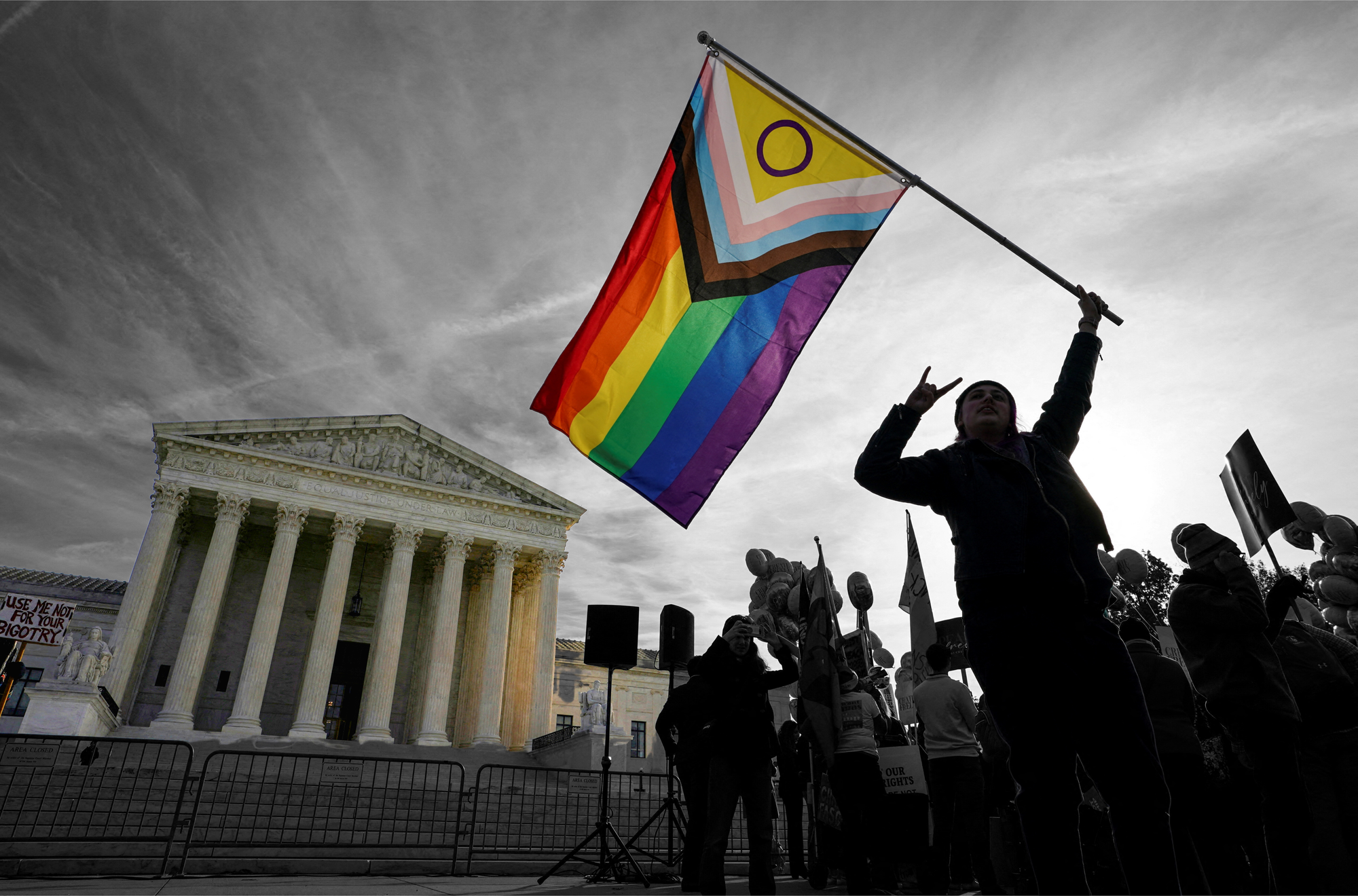
Trump v. Orr. On Thursday, November 6, the Supreme Court granted the Trump administration’s request to temporarily pause a lower court ruling to allow transgender and nonbinary Americans to self-select their sex when applying for a passport. The decision was issued through the court’s emergency docket and was unsigned, though Justice Ketanji Brown Jackson dissented and was joined by Justices Sonia Sotomayor and Elena Kagan.
Back up: On January 20, President Trump issued an executive order declaring that the United States government would only recognize two sexes (male and female) and that, “These sexes are not changeable and are grounded in fundamental and incontrovertible reality.” The order required the State Department to “require that government-issued identification documents, including passports, visas, and Global Entry cards, accurately reflect the holder’s sex.” In previous decades, the State Department allowed passport applicants to select a sex opposite from the one assigned at birth, and the Biden administration added the option “X” for those identifying as nonbinary or intersex.
A group of transgender and nonbinary individuals challenged Trump’s executive order, alleging that it violated their right to equal treatment under the Constitution, their right to international travel and informational privacy, and federal law for administrative agencies. In April, Judge Julia E. Kobick ruled that the plaintiffs were likely to succeed in their challenge and ordered the administration to issue passports that reflected their gender identity.
Last Thursday’s Supreme Court decision stays Kobick’s ruling and allows the Trump administration to proceed with its policy. “Displaying passport holders’ sex at birth no more offends equal protection principles than displaying their country of birth,” the court’s opinion said. “In both cases, the Government is merely attesting to a historical fact without subjecting anyone to differential treatment.”
In her dissent, Justice Jackson said that the court was wrong to issue an emergency stay while the case proceeds through the courts. “The Government seeks to enforce a questionably legal new policy immediately, but it offers no evidence that it will suffer any harm if it is temporarily enjoined from doing so, while the plaintiffs will be subject to imminent, concrete injury if the policy goes into effect,” she wrote.
Today, we’ll share views from the right and left on the court’s decision. Then, Associate Editor Lindsey Knuth gives her take.
What the right is saying.
- Many on the right see the outcome as an extension of the court’s prior rulings on the rights of transgender individuals.
- Some say the passport order is pragmatic, not discriminatory.
- Others argue it is improper for the court to weigh in on the intent behind these policies.
On his website, Jonathan Turley wrote about the “major opinion on transgender identity and the Trump passport policy.”
“While a brief, unsigned opinion issued on the interim docket, it represents a major ruling on the constitutional protections afforded to transgender individuals,” Turley said. “I previously discussed the Supreme Court’s upholding a Tennessee ban on transgender medical treatments for adolescents. One of the most notable aspects of this decision was the concurrence of Justice Amy Coney Barrett, rejecting the claim that transgender status qualifies as a group entitled to heightened scrutiny under the Constitution.”
“While that was a concurrence with only Justice Thomas, I wrote at the time that the concurrence ‘likely speaks to the view of three or four other members on the Court.’ It now appears that it clearly did represent the majority’s view,” Turley wrote. “The opinion substantially reinforced Barrett’s earlier position. While the government had the advantage of a case in an area where considerable deference is given to executive decision-making, the underlying equal protection holding is a major setback for advocates seeking to establish transgender status as protected in the same way as race or religion.”
In RedState, Brad Essex called the ruling “a necessary return to reality.”
“Passports have included sex markers since the mid-1970s, a convention rooted in the binary reality of human biology. Early changes required medical documentation, a nod to genuine medical transitions. But under President Biden in 2021, that threshold vanished, ushering in an era where anyone could opt for an X marker without evidence,” Essex said. “This isn’t discrimination; it's consistency. The government's interest in clear, uniform identification for international travel — where borders demand certainty, not ambiguity — outweighs the demands of a vocal minority.”
“Justice Ketanji Brown Jackson’s dissent warns of ‘immediate infliction of injury,’ citing transgender travelers’ fears of harassment at airports — tales of strip searches and accusations of fraud that, while harrowing, stem from mismatched documents, not the documents themselves,” Essex wrote. “These stories are designed to tug at the heart, but they evade the core issue: Passports are not therapy sessions. They are tools for secure passage, and blurring biological distinctions invites chaos — from heightened security risks to diplomatic tangles abroad.”
In Reason, Josh Blackman explored the “mini merits analysis” within the ruling.
The court wrote “‘respondents have failed to establish that the Government's choice to display biological sex “lack[s] any purpose other than a bare… desire to harm a politically unpopular group.”’... The omission of internal quotation marks here is significant. That quotation came from Justice Brennan's opinion in Department of Agriculture v. Moreno, a decision that Justice Kennedy cited in Romer, Lawrence, and Windsor. That one passage was the fountainhead of so many flawed precedents,” Blackman said. “I faulted Justice Barrett for citing this aspect of Trump v. Hawaii in her Skrmetti concurrence. And I will fault the per curiam Court for citing Trump v. Hawaii in the passport case.”
“This mode of constitutional adjudication should be jettisoned… Political majorities can disadvantage politically unpopular groups, unless there is a constitutional prohibition. California Democrats can gerrymander Republicans out of power, and Louisiana Republicans can gerrymander Democrats out of power — or at least they should be able to,” Blackman wrote. “Courts should not perform what McCreary County referred to as a ‘judicial psychoanalysis of a drafter’s heart of hearts.’ Judges are textualists, not mentalists.”
What the left is saying.
- The left strongly criticizes the decision, with many arguing it was not appropriate for the court’s emergency docket.
- Some say the ruling will create immediate risks for trans people.
- Others say the government’s stated rationale for the policy is nonsensical.
In One First, Steve Vladeck wrote about “the breezy inequity of Trump v. Orr.”
“The ruling provides an unusually accessible example of two of the problematic moves a majority of the justices keep making with respect to Trump-related emergency applications (and no others): The assertion without any deep analytical support that the lower-court ruling at issue is inflicting ‘irreparable harm’ on the executive branch; and the refusal to seriously consider whether that harm is more-than-outweighed by the harm it would cause to put the blocked policy back into effect,” Vladeck said. “Beyond being the 24th consecutive grant of emergency relief to the Trump administration, the cryptic ruling in Orr is a reminder of just how bankrupt the Court’s proffered justifications are in these cases.”
“In a case like this one, where the plaintiffs’ central substantive claims both come from the equal protection principles required by the Fifth Amendment’s Due Process Clause, it is thus doubly inappropriate to treat a district court injunction as necessarily inflicting irreparable harm on the executive branch,” Vladeck wrote. “One could believe that the government is harmed and still think that the harms in the other direction are sufficiently serious to justify leaving the district court’s injunction in place. But for the Supreme Court and emergency applications from the Trump administration, the rules are just… different.”
In Erin In The Morning, Erin Reed criticized the “shadow docket ruling.”
“The ruling leaves transgender people who obtained updated passports under the prior policy in limbo — and all transgender travelers facing profound uncertainty — as the administration now weighs further actions against their documents under a Court that has signaled it is willing to greenlight those efforts,” Reed said. “In the prior rulings, judges noted obvious harms: forcing transgender people to travel with documents that outs them exposes them to violence and imprisonment in countries hostile to their existence. Judges also noted the daily risks at home — outing in interactions using their passport as identification, harassment, denial of services.”
“In this new shadow docket ruling, the conservative court has determined with virtually no analysis that the policy did not stem from animus towards transgender people and was not arbitrary and capricious in violation of the APA,” Reed wrote. “With the Court signaling that transgender people may receive no meaningful equal-protection scrutiny, states may have wide latitude to pass discriminatory laws with little fear of judicial intervention.”
In Bloomberg, Stephen L. Carter said the court “failed the logic test on transgender passports.”
“We’re not talking about which pronouns to use, or which young athletes should be permitted to compete in women’s sports — issues, despite the fury they evoke, can be matters on which reasonable minds may differ. We’re talking, instead, about decisions made by mature adults,” Carter wrote. “If we take the government at its word — that the requirement to use the gender on the birth certificate ‘is merely attesting to a historical fact without subjecting anyone to differential treatment’ — then the policy is inside out. Knowing what’s on the traveler’s birth certificate yields little information that helps identify the traveler today.”
“Consider an analogy. If upon marriage, a traveler’s surname changes, the passport not only can but should reflect the change. The reason is clear: to aid in identification. It would be silly to require, when all the traveler’s other identity documents contain the new surname, that the passport retain the surname given at birth. That would make the document less accurate, not more,” Carter said. “The larger point is that the rules allowing transgender individuals to choose the sex marker most consistent with their identity helped rather than hindered the purpose for which the passport exists: to identify the bearer.”
My take.
Reminder: “My take” is a section where I give myself space to share my own personal opinion. If you have feedback, criticism or compliments, don't unsubscribe. Write in by replying to this email, or leave a comment.
- A stay on an injunction must meet high standards, and this ruling didn’t come close.
- The plaintiffs face much more immediate harm to the lower court’s ruling being paused than the government does (if it is harmed at all).
- This policy change doesn’t seem to benefit anyone, and it could actually cause more confusion and inefficiency in the travel process.
Associate Editor Lindsey Knuth: Since President Trump issued the executive order at the center of this case on Inauguration Day, I’ve been keeping an eye out for the Supreme Court to weigh in on a legal challenge. Sure enough, in a four-paragraph decision last week, the court’s majority summarily discarded a 56-page ruling from a federal court barring the implementation of this passport policy, a second federal court order, and three decades of existing practice.
I won’t feign surprise at the direction of the outcome, but I was, frankly, appalled by the majority’s curt treatment of the case. The court framed its emergency ruling as a cut-and-dry win for the government, without any regard to the harms the policy would impose on an extremely vulnerable group of citizens.
Notably, this case came to the court through its increasingly utilized shadow docket after a class action lawsuit brought by a group of transgender citizens garnered an injunction from a U.S. district judge in Massachusetts. Since it was considering granting an injunction for a policy that might be unlawful, the court had to apply a rigorous set of considerations: 1) the likelihood of success on the merits, 2) the likelihood of irreparable harm absent an injunction, 3) the balancing of harms to each party, and 4) the public interest.
The justices had to apply that same balance-of-equities test again to reverse the judge’s order; they had to determine that the government faced irreparable harm in not being able to immediately implement this policy that outweighed the harms experienced by people who claimed the new requirement infringed on their constitutional rights.
In other words, the court had a very high bar to clear — and I don’t think it came close.
What immediate harm to the government could the temporary prevention of this policy cause, if people who have already changed the sex on their passports are entitled to keep them until their expiration (as long as a decade away)? The majority’s explanation was brief, asserting that the government will experience “a form of irreparable injury” due to “foreign affairs implications.”
The court determined these implications were severe enough to supersede U.S. citizens’ Equal Protection Clause concerns, so I want to give as much credence to that explanation as possible. However, it’s difficult to do so when the majority (and the commentary supporting it) has offered no evidence that a mismatch between a person’s assigned sex at birth and identifier on their passport could pose a security threat.
On the other hand, the harm in removing the ability to change one’s listed sex is much more immediate. And I think District Court Judge Julia E. Kobick was right to block Trump’s policy as a violation of the Equal Protection Clause.
U.S. citizens are guaranteed the right to equal protection under laws, and this policy, as Judge Kobick notes, violates that guarantee by expressing an “irrational prejudice” toward transgender and nonbinary Americans. These small groups make up around 1% of the U.S. population, and they’re directly targeted under a policy that deems their identities “inchoate” and “corrosive.” Also, by requiring those groups to travel with documents that don’t list their preferred sex, Kobick found the policy directly implicates their right to freedom of travel: Some plaintiffs in the case were accused of presenting fake identification, while others say they were sexually assaulted.
Unlike age or height or national origin, if a person’s listed sex on their government documents doesn’t match their gender identity, studies have shown they are at greater risk for psychological distress. That distress is understandable when you hear the stories a policy like this produces: First-person reports and surveys have reported harassment, assault, or denial of services when a person’s identification did not match their gender expression. I’m not transgender or nonbinary, but I’ve found that a little empathy and compassion can go a long way when trying to imagine what it might be like to have a government document that’s in discord with the gender you present to the world.
Legal scholar Vikram David Amar sees the majority’s argument as centering on government speech (here, the information on a passport), against which private individuals (in this case, trangender and nonbinary people) are compelling their own messages. But just like individual speech, government expression has limits — imagine, Amar says, “if government forms and passports capture race in a binary white/non-white way, lumping all non-whites together and characterizing them as different from whites?” In Loving v. Virginia (1967), the court unanimously found that this exact collapse was a central violation of the Equal Protection Clause, even if it was equally applied.
While Orr doesn’t cover a racial classification or trigger strict scrutiny, I think Loving’s framework offers context for why the new passport requirements, even if “equally applied, factual government classifications,” can cause harm to the more vulnerable group. Before going on to find the policy violated the Equal Protection Clause twice, Judge Kobick noted that “the Supreme Court has invalidated on rational basis review government actions that burdened ‘historically disadvantaged or unpopular’ groups when the governmental justification for its action ‘seemed thin, unsupported, or impermissible.’”
Apart from harm to individuals, requiring a document used for identification to list the carrier’s sex assigned at birth seems a much worse policy than using “presented” or “identified” sex. As The New York Times’s M. Gessen rightly points out, if a person identifies as a woman and appears to be a woman to the agents, but has her “sex” (under the policy, the passport wouldn’t even say “sex at birth”) listed as “M,” wouldn’t that foment confusion and inefficiency? After all, your biological sex distinguishes you from roughly half of the population, while markers like height, weight, eye color, and date of birth are more identifiable. A counterargument could be that these markers are also subject to change, but these characteristics have a key difference: No class of citizens are vulnerable to the type of harms described above from, say, a mismatch between their natural and current hair color.
It is true that the restrictions on sex self-identification on government documents have meaningfully loosened in the past few decades — In 2010, President Obama revoked the Bush-era requirement for medical proof of reassignment surgery, and President Biden added the “X” classification for sex in 2021. I think the fluidity of these rules is actually indicative of just how unhelpful sex is as an identifier in the first place. Dividing Americans into male or female hardly narrows down the person a TSA agent might be looking at, and an admittedly radical-sounding proposition here is that we don’t need sex on passports at all — especially not in an era of biometric identifiers that offer far more specific and helpful demarcations.
Of course, I don’t expect this administration to abandon sex identifiers on passports, and I understand why some people are reticent to make selecting sex on government IDs as easy as checking a box. Yet the harms in adding friction to this process vastly outweigh the risks in making it seamless — both as a policy solution and legally.
I’m left thinking that the court’s decision is not about “foreign affairs implications” at all, but about what President Trump said in the text of his executive order: the “gender ideology” that transgender and nonbinary people express posing a “corrosive” and “socially coercive” threat to “the entire American system.” That is the framework that underlies the government’s argument, and when the court fails to expound on the litmus test they’ve set for themselves in their decisions, I’m not convinced they aren’t simply tipping the balance of harms to favor the executive branch.
For now, the class-action suit remains alive in Massachusetts, where the lower courts seem poised to side with the plaintiffs and find the policy unlawful. If they do, the government will likely appeal the case again to the Supreme Court, who could accept or decline to hear the appeal. But with the decision it has just handed down, the court’s majority has pretty clearly signaled it has made up its mind already. At this point, the prospect of them striking down Trump’s policy on the merits seems dim.
I further disagree with Lindsey that requiring a person’s sex identification on their passport to match their biological sex causes harm worthy of special treatment under the law. While I sympathize with transgender individuals whose identities are discordant with their biological sex, sex remains an immutable category whose consideration is vital to legal protections for natal women. I think a compromise position, in which biological sex and gender identity are listed on passports, is the best policy to protect both sex-based and identity-based interests — though, like Lindsey, I don’t imagine the current administration is interested in such a compromise.
Take the survey: What do you think of the Supreme Court’s decision? Let us know.
Disagree? That's okay. My opinion is just one of many. Write in and let us know why, and we'll consider publishing your feedback.
Your questions, answered.
Q: A friend said he read that under the new White House ballroom there will be a bunker for the President (and staff and family I assume) for emergencies. Do you know if this is true?
— Mike from New York
Tangle: There actually already is a bunker — called the Presidential Emergency Operations Center (PEOC). But yes, according to CBS News, the recent demolition of the East Wing for a planned White House ballroom does include a renovation of the bunker.
The PEOC was originally constructed as a safety contingency for President Franklin Delano Roosevelt during World War II, but has been upgraded over the years to operate as an emergency command operations center. Not only does the PEOC contain telecommunications necessary to run the country and command the military during an emergency, but a vast network of tunnels also connects to many other secret and not-so-secret amenities — including a bowling alley. Both Presidents George W. Bush and Donald Trump have been taken to the bunker as a security precaution (Bush in the aftermath of 9/11; Trump during protests against police violence following the death of George Floyd).
For security reasons, we don’t know the technical specifications of what existed in the PEOC before, nor do we know what the planned renovations will entail. But we can probably assume that the technology and amenities below the White House will all be updated as part of this project.
Want to have a question answered in the newsletter? You can reply to this email (it goes straight to our inbox) or fill out this form.
Under the radar.
On Wednesday, Rep. Marie Gluesenkamp Perez (D-WA) introduced a motion to condemn Rep. Jesus “Chuy” Garcia (D-IL) for his handling of his decision not to seek reelection in 2026. Garcia had filed to run for another term on October 27 but publicly announced that he had changed his mind on November 7. His chief of staff, Patty García, filed her candidacy on November 3 — shortly before the filing deadline — and will not face any challengers in the Democratic primary (the district is considered a safe Democratic seat). Perez suggested that Garcia had timed his decision to benefit his chief of staff and ensure she would secure the Democratic nomination, calling his actions “beneath the dignity of his office and incompatible with the spirit of the Constitution.” A spokesperson for Garcia said he “followed every rule and every filing requirement” and decided not to seek reelection due to his health and family obligations. The House must vote on Perez’s motion within two days. The Washington Examiner has the story.
Numbers.
- 1976. The year U.S. passports began carrying sex identification markers.
- 1992. The year the State Department began allowing passport holders to select a marker opposite their sex assigned at birth, with proper medical documentation.
- 2021. The year the State Department, under President Joe Biden, began allowing passport holders to select “X” sex markers on their passports instead of male or female.
- 22. The number of times the Supreme Court has granted an emergency request filed by the Trump administration on its interim docket (or “shadow docket”), according to NBC News.
- 2. The number of those cases in which the court has ruled against the Trump administration.
- 3. The number of those cases in which the court has yet to rule.
- 19. The number of applications for emergency relief from the Supreme Court filed by the Biden administration over four years, according to law professor Steve Vladeck.
- 8. The combined number of applications for emergency relief from the Supreme Court filed by the George W. Bush and Obama administrations.
The extras.
- One year ago today we covered Trump’s mass deportation plan.
- The most clicked link in yesterday’s newsletter was our Friday edition on the Tucker Carlson–Nick Fuentes interview.
- Nothing to do with politics: The password the Louvre used for its video security was, reportedly, “Louvre.”
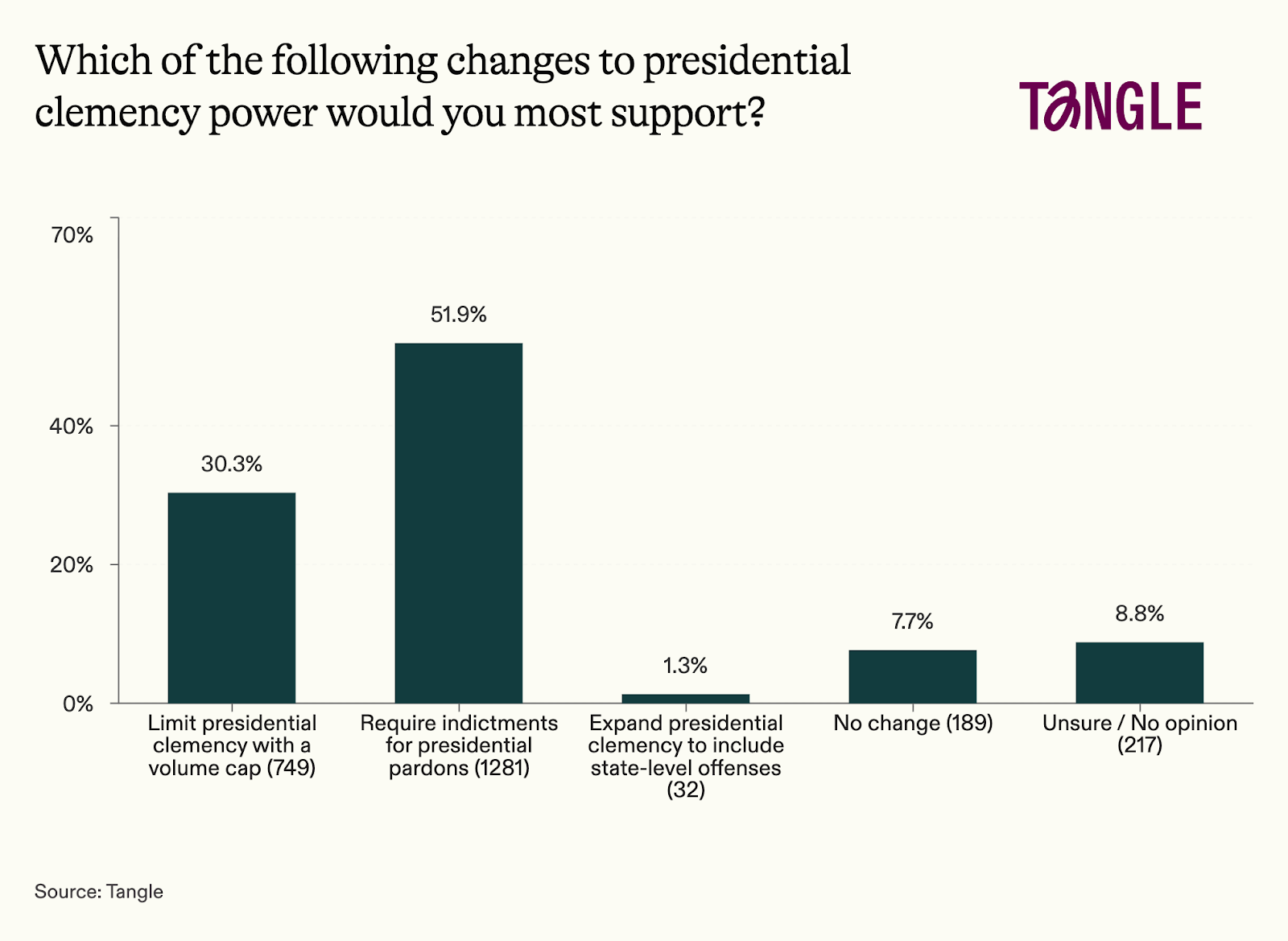
- Yesterday’s survey: 2,468 readers responded to our survey on presidential clemency power with 52% saying they support existing indictments for presidential pardons. “Deeper reform than any of these. Seems to have become completely corrupted,” one respondent said. “Get rid of them altogether!” said another.
Have a nice day.
High cholesterol and triglyceride levels are associated with increased risk of a heart attack or stroke, and these conditions affect roughly a quarter of the U.S. adult population. On Saturday, the Cleveland Clinic reported the results from Phase 1 of a first-in-human clinical trial, which showed that a gene-editing therapy lowered low-density lipoprotein (LDL) cholesterol and triglyceride levels in individuals resistant to medication treatments. 15 patients participated in the trial, and their LDL cholesterol and triglyceride levels were meaningfully reduced within two weeks of treatment and remained at low levels for at least 60 days. “This treatment is still very early in development but if future trials continue to demonstrate safety and efficacy, the therapy has the potential to change the way we treat lipid disorders,” cardiologist Luke Laffin said. The Cleveland Clinic has the story.
Member comments