

I'm Isaac Saul, and this is Tangle: an independent, nonpartisan, subscriber-supported politics newsletter that summarizes the best arguments from across the political spectrum on the news of the day — then “my take.”
Are you new here? Get free emails to your inbox daily. Would you rather listen? You can find our podcast here.
Today’s read: 13 minutes.
From today's sponsor:
The Finance Story Behind Every Political Headline
Tangle covers the politics. The Daily Upside shows you what it means for your wallet, investments, and career. Written by veteran journalists and Wall Street pros, The Daily Upside breaks down the financial moves hidden behind today’s biggest political stories. Recent insights include:
- What’s the beef? For American grocery shoppers, it’s rising meat prices.
- A December rate cut? What economists expect — markets say otherwise.
- Vanguard does about-face on crypto: reverses ban on Bitcoin.
Trusted by the Tangle team — and 1 million readers who want clarity, not noise. Subscribe for free.
A guest writer.
As Tangle continues to grow, one of our major goals is to feature more voices from across the country who are offering unique perspectives on U.S. politics and culture. In service of that quest, tomorrow, we’ll be publishing an essay on homelessness from A.M. Hickman, one of our favorite up-and-coming writers.
Quick hits.
- Federal authorities have reportedly arrested a Virginia man in connection with the investigation into the pipe bombs placed outside the headquarters of the Republican and Democratic National Committees the night before the January 6, 2021, Capitol riots. (The report)
- A Defense Department Inspector General report found that Defense Secretary Pete Hegseth could have endangered troops and violated some Pentagon rules when he shared sensitive information about imminent U.S. military action in Yemen through Signal on his personal cell phone. The report also stated Hegseth has the authority to declassify Defense Department information, suggesting he did not break the law. (The report)
- Navy Admiral Frank “Mitch” Bradley will brief lawmakers on the September 2 strike on an alleged drug boat in the Caribbean that has come under scrutiny following reports that Bradley authorized a second strike to intentionally kill survivors. (The briefing)
- The Trump administration began enhanced immigration enforcement operations in New Orleans and Minneapolis. President Donald Trump also said that he plans to send National Guard troops to Louisiana. (The operations)
- President Trump pardoned Rep. Henry Cuellar (D-TX) and his wife, who were charged together in 2024 with bribery and money laundering related to alleged payments from an Azerbaijani oil company and a Mexican bank. The Cuellars’ trial had been scheduled to begin in 2026. (The pardon)
Today’s topic.
The Tennessee special election results. On Tuesday, Matt Van Epps (R) defeated State Rep. Aftyn Behn (D) in a special election to represent Tennessee’s Seventh Congressional District (TN-07). Van Epps, a former Army officer endorsed by President Donald Trump, received roughly 54% of the vote for a nine-point victory over Behn, a former social worker and community healthcare organizer. Former Rep. Mark Green’s (R) resignation in July triggered the special election, and the race drew national attention and significant outside spending. Van Epps’s win preserves the 220–213 majority Republicans held prior to Green’s resignation.
Back up: TN-07 comprises 14 counties in West and Middle Tennessee. The district is a GOP stronghold, having been represented by a Republican for over 40 years. Former Rep. Green won his seat by over 20 points in 2024, and President Trump carried the district by 22 percentage points. However, analysts predicted a competitive race in the special election, and independent polling headed into Election Day showed Van Epps leading Behn by roughly two percentage points.
The possibility of a Democrat flip led to an influx of funding on the race, with the two parties spending a combined $6 million on campaign ads in and around the district. Both candidates ran primarily on affordability issues, with Republican ads warning Behn would raise taxes and Democratic ads suggesting Van Epps would raise healthcare costs. Van Epps won the election decisively, carrying every county except Nashville’s Davidson County. However, every voting district shifted left compared to last year’s presidential election.
Republican leaders broadly celebrated Van Epps’s victory, with President Trump calling it “another great night for the Republican Party.” Some party strategists framed the night’s results differently; veteran political strategist Matt Whitlock said the results showed “one of the biggest flashing red light warning signs we’ve seen yet for Republicans.”
Democratic leaders expressed an optimistic outlook on the single-digit margin in a district where they have struggled to be competitive for decades. “The fact that Republicans spent millions to protect this Trump +22 district and still lost so much ground should have the GOP shaking in their boots,” Democratic National Committee Chairman Ken Martin said in a statement.
Below, we’ll share what writers from the right and left are saying about the results. Then, Associate Editor Audrey Moorehead gives her take.
What the right is saying.
- Many on the right say the result was too close for comfort and should prompt reflection ahead of the midterms.
- Some emphasize the massive resources Democrats poured into the race.
- Others say Behn was a bad candidate, showing Democrats still haven’t learned from 2024.
In Fox News, David Marcus wrote “GOP win shows Tennessee hasn’t been California’d, at least not yet.”
“A win is a win, but Van Epps’ relatively narrow margin of victory will set off alarm bells for Republicans nationally, and embolden the socialist wing of the Democratic Party, which is already fast on its way to establishing its dominance,” Marcus said. “Over the past few years, the population of Nashville has grown by roughly 100 citizens a day, about 30,000 souls a year, and many are coming from blue, high-tax, high-crime states. Sadly, many seem willing to bring their failed politics with them.”
“In her concession speech, Behn said her campaign was the beginning of ‘something powerful in Tennessee and across the south.’ She could very well be right, because Nashville is not alone in turning bright blue,” Marcus wrote. “Republicans need to take these warnings seriously. Say what you will about the tenets of socialism, but at least it’s an ethos. Right now, nobody seems to know quite what Trumpism is, other than Trump himself. That has to change.”
In The Federalist, M.D. Kittle said Republicans won despite “the left’s aggressive campaign to turn it blue.”
“Behn, dubbed ‘the AOC of Tennessee,’ still proved far too left for a traditional values district that reaches the borders of Kentucky and Alabama. Behn tried to keep the focus on pocketbook issues, audaciously claiming that she would ‘stand up to both parties to make life more affordable.’ But she couldn’t escape her far-left record, much of which stands contrary to making life more affordable for the average Tennessean,” Kittle wrote. “Like the Squad’s Alexandria Ocasio-Cortez, Behn has supported taxpayer-funded Medicaid for illegal aliens and government-run healthcare.”
“Democrats, buoyed by big wins last month in blue states New Jersey, Virginia, and California, pumped a lot of money and personnel into winning Tennessee’s 7th Congressional and, more so, the momentum narrative… The left’s full-court press helped turn what should have been a blowout victory for the GOP into a race a little too close for comfort,” Kittle said. “As one influential Tennessee conservative put it, Tuesday’s special election ‘should be a massive wake-up call’ for congressional Republican leadership.”
In National Review, Noah Rothman shared “the other way of looking at Tennessee’s special election results.”
“The first conclusion most political observers have drawn from Republican candidate Matt Van Epps’s nine-point victory is that it is a terrible omen for the GOP ahead of the 2026 midterms,” Rothman wrote. “There’s another way to evaluate this race, though. For all the environmental advantages that buoyed Behn, she was also a terrible candidate. Indeed, Democratic primary voters in the district seemed to know she was a terrible candidate. In October’s Democratic primary election, Behn barely managed to eke out a victory in a four-way race.”
“Behn’s policy positions on a range of subjects lean far to the left of the median voter in her district, but her party nominated her anyway. And as such, she underperformed what looks like the emerging Democratic Party baseline in 2025 special elections,” Rothman said. “Democrats are liable to nominate similarly ill-suited candidates in competitive primaries next year or even oust entrenched incumbents in favor of progressive insurgents… It is almost a certainty that Democratic primary voters will snatch defeat from the jaws of victory in at least a handful of races.”
What the left is saying.
- The left views the result as a flashing warning sign for Republicans.
- Some suggest a “blue wave” is coming in 2026.
- Others say Republicans struggle to turn out their base when Trump isn’t on the ballot.
In The New York Times, Nate Cohn wrote “the G.O.P. continues to slip.”
“The winning party in the last five presidential elections has gone on to lose each of the next five midterms — and four of the next five presidential elections. If the last month — or really, the last year — of election results is any indication, today’s Republicans are following the same path. Almost every election night this year has gone poorly for them,” Cohn said. “They’ve lost or badly underperformed over and over — including on Tuesday in a special congressional election in Tennessee, where with nearly all of the vote counted the Republicans led by nine percentage points in a district that voted for President Trump last year by 22 points.”
“Like other recent presidents, Mr. Trump has pushed too far in pursuit of an ideological agenda. In doing so, he either alienated many of the voters who put him over the top or neglected the issues, like affordability, that brought them to his side in the first place,” Cohn wrote. “After the last year of agonizing debates over the Democrats’ future, there’s something painfully simple — even mundane — about the political opportunity that’s opening up for them. They didn’t have to do anything. But historically, electoral comebacks haven’t been built on fixing what went wrong in the last election, like moderating on the issues or avoiding an unpopular stance.”
In CNN, Aaron Blake suggested “Republicans avoided a nightmare in Tennessee.”
“[TN-07 is] a district that Trump carried by 22 points and former GOP Rep. Mark Green won by more than 21 points last year. That means that, as things stand, Behn over-performed Democrats’ 2024 presidential margin by about 13 points and their 2024 House margin by about 12 points,” Blake said. “The swing is actually smaller than other US House special elections this year. Before Tuesday’s race, Democrats had over-performed Kamala Harris’ margins by an average of 18 points and their House margins by an average of 16 points in four special congressional elections held in three states: Arizona, Florida and Virginia.”
“One fair question for Democrats, given the smaller over-performance, is whether they failed to fully take advantage of the environment by running a quite liberal candidate in Behn. She gave Republicans plenty of material with her past comments, which included saying she ‘hates’ Nashville, expressing support for defunding the police and calling herself a ‘very radical person,’” Blake wrote. “But with 2025 soon coming to a close, all told, Democrats appear to be performing better electorally than they did in 2017. And Democrats went on in 2018 to win back the US House in a ‘wave’ election.”
In The Washington Post, Paul Kane said the “surprisingly tough Tennessee election reveals House GOP has [a] base problem.”
“Republican strategists have worried for several months about Trump’s plummeting support among independent voters, which helped lead to blowout wins for Democrats in gubernatorial races in New Jersey and Virginia last month. But the underperformance in Tennessee’s 7th Congressional District backs up some research showing a lack of energy among conservative base voters,” Kane wrote. “Democrats estimate that about 70 House seats held by Republicans are more friendly than this Tennessee seat.
“In its monthly poll released last week, Gallup found a seismic drop in approval from Republican voters for the job performance of Congress, down to 23 percent. Back in July, more than 60 percent of Republican voters approved of the GOP-run House and Senate,” Kane said. “That’s the type of drop that is usually accompanied by a calamitous event that is considered an act of betrayal by one’s own political party. That poll has been shared among House Republicans, according to lawmakers, who are warning each other about how difficult the next 11 months could be for several dozen incumbents.”
My take.
Reminder: “My take” is a section where we give ourselves space to share a personal opinion. If you have feedback, criticism or compliments, don't unsubscribe. Write in by replying to this email, or leave a comment.
- Given all the context, this election should be a big warning sign for Republicans.
- The election wasn’t as close as it could have been because Behn was a vulnerable candidate, and Republicans attacked her effectively.
- 2026 could go well for Democrats — if they learn the right lessons.
Associate Editor Audrey Moorehead: The national political parties’ laser focus on my home state over the past few weeks has been a surreal experience. Of course, the reasons for the attention are obvious enough: TN-07 was a 22-point Trump district in last year’s presidential election, but early signs showed that Democrats had a real chance of challenging the historically solid Republican seat. Even so, I never imagined that an off-cycle race in a district neighboring my hometown would garner so much national attention.
That the race became so close is noteworthy in itself, and has huge implications for the midterm elections. Matt Van Epps only managed to hold the district by single digits, and that was after the party poured millions into defending the seat against a very progressive challenger in Aftyn Behn. This should have the national GOP battening down the hatches on its own. Add in that TN-07 was redrawn ahead of the 2022 midterms to split up the Democratic stronghold of Nashville, and the GOP’s narrow victory in TN-07 could portend bad outcomes in other favorable districts — not just in Tennessee but across the country.
Voter turnout can be wonky for off-cycle special elections, as participating voters tend to be either very politically involved or highly motivated base voters of the challenging party. Those two factors seemed likely to produce much higher turnout from Democratic voters than Republicans in this election. That expectation was reinforced by the primary elections, in which participation was down 75%, hitting Republican voters harder and sparking Van Epps’s aggressive campaign strategy (and the reaction from national Republicans). If that low turnout had held in the special election and produced a narrow victory for Van Epps, Republicans’ logical next step would have been working to motivate the base in order to regain their strong hold over the district ahead of 2026.
But on Election Day, voter turnout wasn’t nearly as low as expected — roughly 180,000 voters cast ballots, about the same level of turnout as the 2022 midterm election (when former Rep. Mark Green won reelection by 22 points). And Election Day turnout overwhelmingly favored Republicans compared to the early vote, where Behn had more support. While the high turnout shows that Republicans’ resources were well spent in motivating the base to defeat Behn, the victory is a double-edged sword: After Behn undeniably converted some swing voters — or even moderate Republicans — in the district, Van Epps will have his work cut out for him during the 2026 election season.
Democrats, meanwhile, can take solace in the narrower than usual loss; if they made such a high-turnout special election in a traditionally solid red Tennessee district so competitive, their chances in swing districts look fantastic. Recent polls also show plummeting approval of Congress among Republican voters, creating a worst-of-both-worlds scenario for the GOP where Democrats are motivated to turn out while the Republican base is increasingly disgruntled.
The big question for me is whether Democrats are really banking their future on candidates like Aftyn Behn.
Behn is a decidedly far-left member of her party; she has a long history as a progressive organizer known for her loud, aggressive tactics. In 2019, for example, Behn penned an essay in The Tennessean in which she wrote that Tennessee is a “racist state” with a racist legislature and proclaimed that “we will continue to be loud, disrupt, cause chaos, and speak truth to the racist powers that grip our state” until the legislature changes. She also spoke out in favor of dissolving the Metro Nashville Police Department, and a 2019 video that went viral in the lead-up to this week’s election showed her being removed, struggling and shouting, from the state House chamber after an outburst toward then-Speaker Glen Casada (R). That resume was galvanizing for the Democratic base in Nashville, but it also provided ample fodder for Republicans’ line of attack. I can’t help but think that the GOP’s attack ads were the primary reason for the high turnout of low-propensity voters who tipped this election to Van Epps.
Van Epps, on the other hand, came into the race a relative political unknown — and, notably, never seemed to be a major focus of the race. He ran on his strong military background, having served nine tours during ten years as an active-duty Army officer. But his only political experience was his year as Commissioner for the Department of General Services under Gov. Bill Lee (R), a position he stepped down from in order to run for the House seat. Trump endorsed Van Epps in the Republican primary, and most of Van Epps’s campaign emphasized economic priorities, military service, and other standard Republican positions. He was certainly a MAGA candidate, but he didn’t have an extreme background. And, interestingly enough, in the leadup to the race — and even now in the aftermath — very little attention seemed to be on Van Epps himself, which made him a little hard to sell but also difficult to attack.
Speaking of attacks, I’ve got to talk about those ads. When I read about the millions of dollars poured into races from national interests, I didn’t have a strong grasp of how those numbers translated on the ground. But when I was home for Thanksgiving watching football with my family, and the ads flooded my TV, I found the experience totally exhausting.
Still, a few themes stood out. Behn’s ads played up the issue of affordability, and she cast herself as someone willing to fight “both parties” in order to ensure low costs for Tennessee voters. Van Epps took a similar approach, but his most effective ads were his attacks against Behn. Much like the Trump campaign’s use of Kamala Harris’s past statements during the 2024 election, Republicans used real quotes and videos from Behn’s online presence: videos of her crying on the floor of the Tennessee capitol; footage of her complaining about Nashville; and, most memorably (I can literally still hear the line in my head), Behn’s unfortunate statement “I’m a very radical person,” which played in nearly every attack ad, sometimes multiple times.
None of Behn’s ads had similarly memorable attacks against Van Epps, or even particularly catchy lines about her own positions. And seeing the ads back to back, the juxtaposition between her bland, moderate ads and the aggressive, loud footage of her from the Van Epps campaign created an unsavory picture, making her seem disingenuous and dangerously radical.
Ultimately, I worry that the lesson Democrats will take from this election is not about the candidate but about the message. While I think a more moderate candidate would have been less vulnerable to attack, possibly narrowing the margin further or even outright flipping the seat, Democrats may instead decide that they should attack the Republican candidate more aggressively. Given the intractable state of polarization in national politics, I’d (almost) be willing to bet on it.
The Van Epps campaign’s success in motivating right-leaning voters on Election Day is their one silver lining from Tuesday (obviously, outside of actually holding the seat). Approaching the 2026 midterms, Democrats seem to have the upper hand when they’re able to boil the race down to issues of the economy and inflation — look at Abigail Spanberger’s success in Virginia or Zohran Mamdani’s overwhelming victory in New York. But if Democrats continue to run candidates easily branded as radicals, they offer ample opportunity for Republicans to motivate their base in red or purple districts, meaning Republican candidates could force Democrats to get off message — and the GOP might be able to limit their losses in 2026.
Take the survey: What do you think the special election signals about next year’s midterms? Let us know.
Disagree? That's okay. Our opinion is just one of many. Write in and let us know why, and we'll consider publishing your feedback.
Your questions, answered.
Q: I am curious about how many political Twitter/X accounts are foreign accounts. Additionally, why did they change the rules to show where the accounts are from and what caused them to switch it back so quickly. On another point, I heard the DoD account was from Israel. Was that the only government account that was foreign and has that been the same account for the last few administrations or does each new administration create a new social media account? Lastly; what are your thoughts on the foreign accounts?
— Peter from Seattle, WA
Tangle: We weren’t able to find any definitive numbers or databases detailing how many political accounts on X are run by foreign users, but this new feature revealed that the number is not insignificant. Some of those accounts were left-wing or reported on liberal causes, but the majority seemed to be right-wing, conservative, or MAGA accounts.
The feature hasn’t been removed, but it has changed slightly after it was rolled out. Initially, a user’s initial location was listed next to their “date joined” information — however, that location information was then removed, leading to speculation that X CEO Elon Musk scrapped location information entirely because it made conservatives on the platform look bad. That isn’t the case. If you look at a user’s account page, the location data is still there; only the initial signup location has been removed (X’s head of product said this information wasn’t reliable enough to list publicly). You can see this in the screenshot of our about page below.

And, no, the Department of Defense (or Department of War) X account is not located in Israel. This claim was originally made about the Department of Homeland Security’s account, and Snopes tracked down the source to find it was a false rumor started on the platform. Government account pages do not display a location; however, after the feature was turned on, those accounts did briefly display locations that showed they were run out of the United States.
As for our thoughts on the foreign accounts, this is something Isaac, Ari, and Kmele discussed on the most recent Suspension of the Rules episode. In short, people are free to offer opinions on any subject they like, but misrepresenting their identity when offering that opinion is misleading and misinforming. Take Venezuela as an example: We’ve offered opinions on the Maduro government a lot — as a U.S. media outlet. If we claimed to be a Venezuelan news company when we offered that opinion, that would have been unethical.
Want to have a question answered in the newsletter? You can reply to this email (it goes straight to our inbox) or fill out this form.
Under the radar.
On Wednesday, President Trump announced a Transportation Department proposal to roll back fuel-economy standards for vehicles established during the Biden administration. The Biden-era rules set the industry average for fuel efficiency at 50 miles per gallon by 2031 for light-duty vehicles; the new proposal would lower it to 34.5 miles per gallon. Additionally, the Transportation Department plans to scrap a 2024 rule to raise the minimum gas mileage for passenger cars and light trucks by 2031. President Trump said the change is intended to lower costs for automakers in designing their vehicles; environmental groups criticized the plan as a step backwards. CBS News has the story.
Join top financial executives and investors who trust this newsletter.
Tangle covers the politics — The Daily Upside shows what it means for your wallet, investments, and career. Veteran journalists and Wall Street pros decode the financial moves behind major stories, from 2026 tax shifts to rate-cut debates. Trusted by 1 million readers. Free to subscribe.
Numbers.
- +10. State Rep. Aftyn Behn’s (D) improvement over Vice President Kamala Harris’s vote share between the 2024 presidential election and the 2025 special Congressional election in Montgomery County, which accounted for 24% of the votes cast in the 7th District.
- +18. Behn’s improvement over Harris’s performance in Davidson County (partial), which accounted for 24% of the votes cast in the district.
- $3.3 million. The amount Republicans spent in the TN-07 special election, according to data from AdImpact.
- $2.3 million. Contributions from Republican-linked political action committees (PACs) as of November 24, according to Federal Election Commission filings.
- $2.4 million. The amount Democrats spent in the TN-07 special election.
- $1.8 million. Contributions from Democrat-linked PACs as of November 24.
- 40%. The decrease in Republican voters’ approval of Congress between March 2025 and November 2025, according to Gallup.
- 4%. The decrease in Democratic voters’ approval of Congress between March 2025 and November 2025.
The extras.
- One year ago today we wrote about Kash Patel’s nomination to lead the FBI.
- The most clicked link in yesterday’s newsletter was how Helsinki, Finland, is preventing pedestrian deaths.
- Nothing to do with politics: Raccoons are showing signs of domestication and comfort with human society — one raccoon in Virginia even went as far as getting drunk and passing out in a liquor store bathroom.
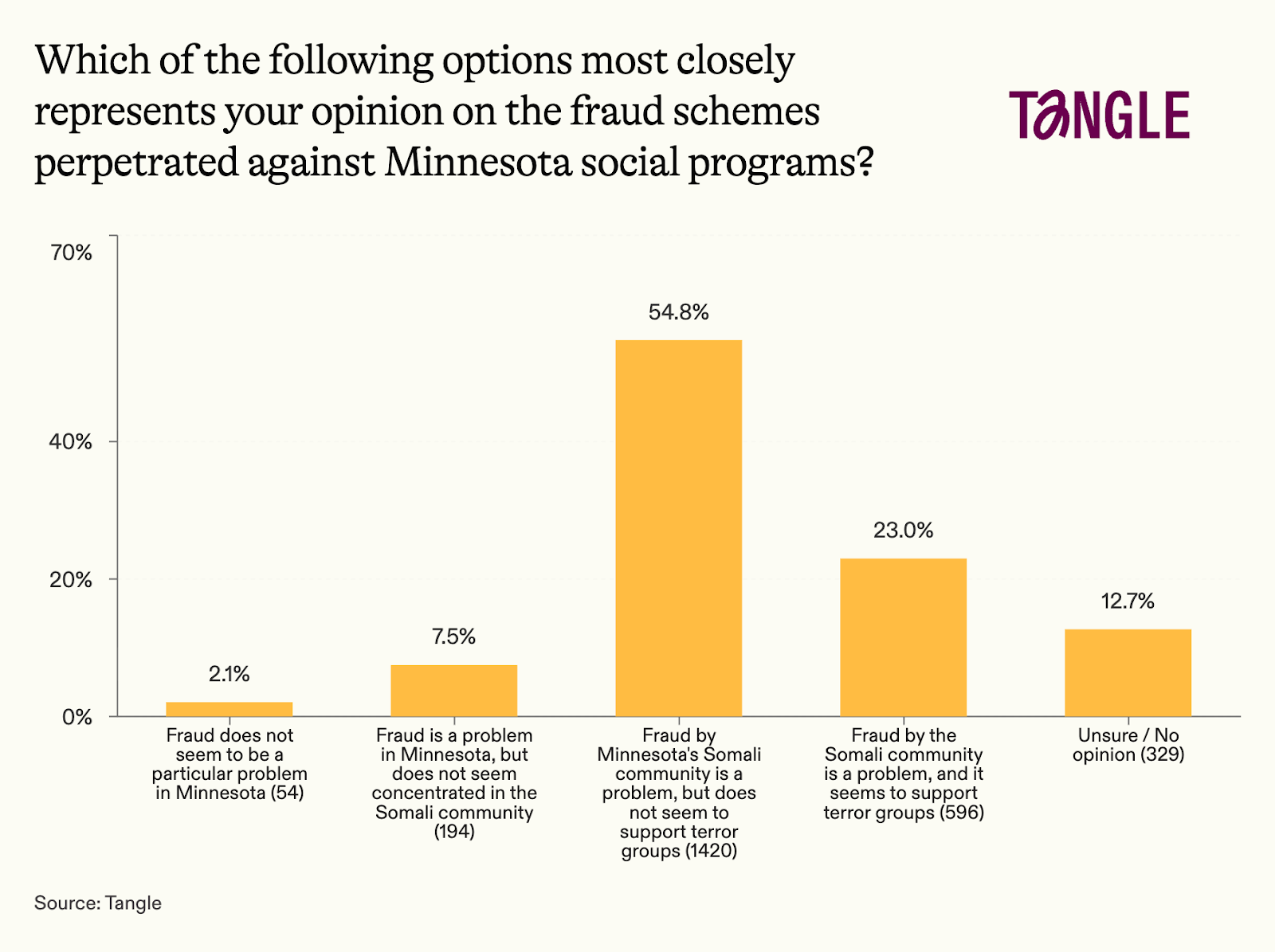
- Yesterday’s survey: 2,593 readers responded to our survey on fraud in Minnesota with 55% saying the fraud is concentrated in the Somali community but doesn’t support terror groups. “Need more details to appropriately form an opinion. There certainly appears to be large-scale fraud and I assume there are a few people benefiting from it, not just the Somali community,” one respondent said. “Where there is smoke there is fire. I will wait for the investigation to uncover the fire, but as I sit today, the Somali culture clash with American Values supports the narrative that some funds were directed to Al Shabaab,” said another.
Have a nice day.
Earlier this year, researchers in Wales found that a vaccine for shingles might be having an unexpected side effect: reducing dementia. That study of 280,000 adults found that those who had taken the vaccine had a 20% reduced risk of developing dementia over a seven-year period. A follow-up study, published Tuesday in the journal Cell, reinforced this finding, concluding that cognitively healthy people who received the vaccine were less likely to develop early symptoms of dementia. “This would be groundbreaking for dementia [if confirmed],” Maxime Taquet, an associate professor at the University of Oxford who has conducted research into shingles vaccination and dementia risk, said. The Washington Post has the story.
Member comments