
I'm Isaac Saul, and this is Tangle: an independent, nonpartisan, subscriber-supported politics newsletter that summarizes the best arguments from across the political spectrum on the news of the day — then “my take.”
Are you new here? Get free emails to your inbox daily. Would you rather listen? You can find our podcast here.
Today’s read: 13 minutes.
The cabinet secretaries you haven’t heard about.
You hear a lot about some Trump administration leaders — like Robert F. Kennedy Jr., Scott Bessent, and Kristi Noem. Others? Not so much. In the first nine months of President Trump’s term, we’ve fielded frequent questions from readers and listeners about the cabinet secretaries whose activities often go underreported but touch key issues like agriculture, energy, housing, and the environment. On Friday, we’re publishing a deep dive on 10 agency leaders — what they’ve done already, what people are saying about their tenure, and their goals for the next three years.
Reminder: Friday editions are for premium members. To read this deep dive on Trump’s “under the radar” cabinet secretaries, you’ll need to subscribe.
Quick hits.
- BREAKING: The Supreme Court ruled that President Donald Trump cannot immediately fire Federal Reserve Governor Lisa Cook. Cook will remain in her position at least until the court hears oral arguments in the case in January. (The ruling)
- The White House withdrew President Trump’s nomination of E.J. Antoni to lead the Bureau of Labor Statistics. The decision reportedly followed Sens. Susan Collins (R-ME) and Lisa Murkowski’s (R-AK) refusal to meet with Antoni about his nomination. (The withdrawal)
- President Trump announced plans for a government-run website, called TrumpRx, that will allow consumers to buy drugs directly from manufacturers. Trump also said that pharmaceutical company Pfizer would offer all of its drugs to Medicaid at reduced, “most favored nation” prices in return for a three-year exemption from tariffs on its products. (The announcement)
- Louisiana Gov. Jeff Landry (R) requested up to 1,000 National Guard members be deployed to the state, claiming federal support was needed to address crime rates and law enforcement personnel shortages. (The request)
- A federal judge found that the Trump administration violated the First Amendment by targeting noncitizens for deportation based solely on pro-Palestinian and anti-Israel speech. (The ruling)
- At least 69 people were killed in a 6.9-magnitude earthquake that struck the central Philippines on Tuesday night. Rescue efforts are ongoing. (The earthquake)
Tired of news that leaves you angry instead of informed?
Top of Mind with Julie Rose is a podcast that tackles America's toughest issues such as homelessness, education, immigration, mental health—without the outrage.
Host Julie Rose is an award-winning journalist who brings together experts and everyday people across the political spectrum for conversations that prioritize understanding over division.
Recent episodes explore whether free housing can solve homelessness, the new threat of radicalization, and whether kids should have smartphones in classrooms.
This isn't about changing your mind—it's about expanding how you see the world, so you can approach different beliefs with curiosity instead of fear.
Find Top of Mind free on your preferred podcast platform here.
*Our sponsors help keep Tangle free — thank you for supporting them when you can!
Today’s topic.
The government shutdown. On Wednesday at 12:01 AM ET, federal funding lapsed, shutting down non-essential government services. The shutdown follows weeks of protracted negotiations between Republicans and Democratic leaders — and President Donald Trump — to pass a bill to extend funding; the sides were unable to reach a deal before the midnight deadline. Democrats conditioned their support on extending healthcare subsidies and reversing cuts to Medicaid and other health programs, while Republicans have so far declined to support these changes.
Back up: Congress is required to pass a series of 12 appropriations bills by October 1 to fund the government for the next fiscal year; alternatively, they can pass a short-term funding bill, called a continuing resolution. Republicans have a 53–47 advantage in the Senate, but a funding bill requires 60 votes to pass the chamber, and so far, none of the 12 appropriations bills has been passed by both the House and Senate. When the government shuts down, some services stop, paychecks for many federal employees are suspended, and federal employees deemed “non-essential” may be furloughed. However, other programs — such as Medicare and Social Security benefits — continue to operate, as do “essential services” like air traffic control and law enforcement.
Before Wednesday, the last government shutdown ran from December 2018 through January 2019 (during President Trump’s first term) and lasted 34 days, the longest shutdown in U.S. history.
In March, Congress passed a short-term funding bill to avert a shutdown, which we covered here.
Republican and Democratic leaders met with President Trump at the White House on Monday but did not make progress toward an agreement. “Their bill has not one iota of Democratic input. That is never how we’ve done this before,” Senate Minority Leader Chuck Schumer (D-NY) said. “It’s up to the Republicans whether they want a shutdown or not.” Senate Majority Leader John Thune (R-SD) said Democrats would bear the blame for a shutdown, saying they had taken the government “as a hostage, and for that matter, by extension, the American people, to try and get a whole laundry list of things that they want, the special interest groups on the far left are pushing them to accomplish.”
Schumer and House Minority Leader Hakeem Jeffries (D-NY) are primarily pushing for a permanent extension of temporary Affordable Care Act subsidies, which are set to expire at the end of 2025. They also want to reverse spending cuts to Medicaid, the Centers for Disease Control and Prevention, and the National Institutes of Health from earlier in Trump’s term. Majority Leader Thune has said that he is open to discussing those issues as part of separate legislation but not in a funding bill.
As the shutdown approached, Office of Management and Budget Director Russell Vought sent a memo to agency heads outlining the potential for mass layoffs if a spending bill was not passed. “Agencies are directed to use this opportunity to consider Reduction in Force (RIF) notices for all employees in programs, projects, or activities” whose funding would lapse in a shutdown, Vought wrote.
Today, we’ll share perspectives from the right and left on the government shutdown. Then, Managing Editor Ari Weitzman gives his take.
What the right is saying.
- The right primarily blames Democratic leaders for the shutdown and calls their demands unreasonable.
- Some say Democrats are playing into Trump’s hands by accepting a shutdown.
- Others note how the party’s rhetoric about shutdowns has flipped since the last funding fight.
The Washington Examiner editorial board criticized “the Democrats’ ridiculous shutdown ransom.”
“[Democrats] are demanding a ransom of more than half a trillion dollars over 10 years just to keep the government running for a few more weeks. It is a ridiculous proposal. Republicans should refuse it, and Democrats will be left to take public blame for yet another example of Washington incompetence,” the board said. “Democratic lawmakers face intense pressure from their rabid base to shut down the government. Senate Minority Leader Chuck Schumer (D-NY) is especially under scrutiny because last March, he and 10 other Senate Democrats put country over party and voted with Republicans to fund the government through the end of September.”
“Democrats now want to undo most of the healthcare spending reductions, including restoring healthcare for illegal immigrants, and on top of that, they want to extend Obamacare subsidies for insurance companies that are set to expire at the end of the month,” the board wrote. “A big part of why Trump won in 2024 is that voters were tired of President Joe Biden’s illegal immigrant invasion and how much it was costing taxpayers to fund services for people who should never have been allowed in. Republicans would betray those who put them in power if they agreed to the Democratic Party’s ransom demand.”
In The Wall Street Journal, Kimberley A. Strassel wrote about “Russ Vought’s secret shutdown weapon.”
“[Democrats] insist government won’t run unless Democrats are given $450 billion in additional ObamaCare money, an end to President Trump’s hold on spending, and a reversal of the central Medicaid reform in the GOP’s reconciliation bill,” Strassel said. “Put another way: Democrats will give the Trump team exactly what it’s been wanting — a shutdown — in return for Democrats’ continuing to demand something they will never get. What a deal. Even Faust got some worldly pleasure in exchange for a soul. This is trading hellfire for brimstone.”
“The true scope of this losing proposition came clear with a memo Mr. Vought… The Vought memo orders agencies to identify all programs that depend on discretionary funding (which lapses next week) and don’t align with the president’s priorities. Employees who administer those disfavored programs or projects won’t be furloughed. They will be fired,” Strassel wrote. “The Trump team has already listed the programs that will continue regardless of shutdown: Social Security, Medicare, military operations, veteran benefits, border security, air-traffic control. The recent reconciliation bill helps ensure they function.”
In The Daily Signal, Jacob Adams argued a “government shutdown would harm the people [Democrats] claim to care about.”
“While Democrats in Congress claim to be advocates for government workers, a government shutdown would potentially furlough thousands of government employees who would not receive pay for the duration of the shutdown,” Adams said. “During the last government funding fight in March, Democrats tried to weaponize the potential harm done to federal workers against Republicans… Democrats are now downplaying the arguments they’ve previously made about the harm government shutdowns do to federal workers and government operations.
“For example, a 2023 study published in Governance, an international journal of policy, administration, and institutions, found that the 2013 government shutdown hurt federal worker morale. The study also concluded that federal workers who faced government shutdowns were ‘more likely to experience administrative dysfunction–such as unmanageable workloads, missed deadlines, poorer customer service, and abandoned projects,’” Adams wrote. “Meanwhile, the Trump administration has indicated that it would take the opportunity of a government shutdown to consider reducing the size of the federal workforce.”
What the left is saying.
- Many on the left accuse Trump and Republicans of negotiating in bad faith.
- Some say Democrats should hold out to win some concessions.
- Others warn that a shutdown could backfire politically in the long run.
In USA Today, Chris Brennan wrote “Democrats want to prevent a shutdown. Republicans want to blame them for one.”
“[The shutdown] again demonstrates a recurring, two-step pattern for President Donald Trump’s political proclamations. It goes like this. First, Trump claims that all of America's problems will be easily fixed through his leadership if we just elect him president. And then, after he becomes president and those problems don’t get fixed, Trump proclaims that someone else is at fault,” Brennan said. “This one-size-fits-all escape from reality and responsibility applies across all topics for Trump — from the shutdown, Russia’s war in Ukraine, inflation to tariffs driving up costs for Americans.”
“Here's what is tragic: The Republicans rejected Democratic input on the continuing resolution because that's what Trump ordered them to do. And Johnson canceled House sessions this week before the shutdown deadline, so there would be no chance of working out a negotiated deal other than what he wants,” Brennan wrote. “Those are the voices of politicians who have driven us to the brink of a shutdown, refused to negotiate a way out, then finally met with the Democrats, only to rebuff their attempts to negotiate.”
In MSNBC, Paul Waldman argued “losing the shutdown in the best way is Democrats' only realistic goal.”
“In the strictest sense, Democrats can’t ‘win’ the government shutdown conflict that now hangs over Washington, at least not completely. When it’s over, President Donald Trump will continue to ravage the federal government, undermining its ability to serve the public, while, at best, Democrats will only have garnered some of the policy concessions they are seeking,” Waldman said. “But there are better losses and worse losses — and the worst would be congressional Democrats folding without exacting the highest price they can.”
“Trump is extremely unpopular, and the public is disinclined to believe what he tells it… The GOP is also the party that hates government and that has shut it down in the past. That means it doesn’t get the benefit of the doubt,” Waldman wrote. “If Democrats can at least win a substantive concession or two — like the extension of ACA subsidies — and use the controversy to remind voters how much damage Trump and Republicans are doing to the country, it wouldn’t fundamentally change the course we’re on. But it would be better than nothing and better than the alternative.”
In New York Magazine, Ross Barkan said “shutting down the government would feel good. But it’s thinking small.”
“Congressional Democrats do have leverage, and they should drive it home to protect Obamacare health-insurance subsidies. Premiums will skyrocket if the GOP majority has its way,” Barkan wrote. “But a shutdown, as cathartic as it may feel for Chuck Schumer, Hakeem Jeffries, and the Democratic base, is not a long-term strategy. On a practical level, it can backfire, as Russell Vought, Trump’s OMB director, prepares for the mass firing of federal employees… As devastating as DOGE was, Vought will be willing to cut the government to the bone.”
“Democrats could enjoy a short-term boost if the government shuts down, but it’s the equivalent of a sugar high. It won’t last and doesn’t solve the underlying messaging problems for the party. It’s not, in any sense, a real strategy. Schumer, the Senate minority leader, and Jeffries, the House minority leader, have been rightly criticized for not offering a detailed vision for the future of the country, an alternative to Trump that voters can rally around,” Barkan said. “Locked out of power, they should be speaking directly to the people about what they might do if their party is in charge again. What should Americans actually look forward to?”
My take.
Reminder: “My take” is a section where I give myself space to share my own personal opinion. If you have feedback, criticism or compliments, don't unsubscribe. Write in by replying to this email, or leave a comment.
- The shutdown blame game is tiresome — this is an all-of-Congress problem.
- In Congress, Schumer misplayed his hand in earlier funding fights and Johnson is perpetuating an existing issue.
- Meanwhile, President Trump’s callous treatment of the legislative process has also contributed to the breakdown.
First and foremost, the government shutting down isn’t a Republican problem or a Democrat problem — it’s a Congress problem. It seems the only way Congress can come together to do anything is to hold itself hostage, each time saying it’s actually the left or right foot that’s stepping off the cliff.
Now, for the sixth time since 1995, we’ve tumbled over the edge.
What does that mean for us? First, essential workers like TSA agents and border patrol and select military personnel will continue to work without pay until after the shutdown is over, when they will receive back pay. The roughly 40% of the federal workforce, or 750,000 people, who are non-essential workers — curators at the Smithsonian, workplace-safety officers at OSHA, administrators at HUD, servicemembers with the National Guard, scientists at NASA, and on and on — they will have to stay home, and their households will lose those paychecks for an indeterminate amount of time. Furthermore, potentially millions of government contractors across all departments — from janitors to IT professionals — will also lose out on work.
The programs that these employees run through their federal mandates will be halted: Benefit payments will continue to go out (though Supplemental Nutrition Assistance Program (SNAP) distributions will eventually stop getting delivered), but others will be limited. National Parks will partially close, the FDA will halt new drug reviews and routine agriculture inspections, the NIH will not issue new grants, the DOJ will curtail or postpone civil litigations, the Department of Education will not issue new grants or look into civil rights complaints, etc. All in all, analysts estimate that this shutdown will cost roughly 0.1 to 0.2 percentage points of economic growth for each week that it lasts (though those losses may eventually be recouped).
American citizens are right to look at the situation and demand accountability. I get tired of feeding into the charade and arguing about which party is to blame — a recalcitrantly dysfunctional system is the root of the problem. But at the end of the day, government shutdowns aren’t just the result of systemic inertia; some individuals are always at fault. In this case, I’d point to three people specifically.
Let’s start with Senate Minority Leader Chuck Schumer (D-NY), who ultimately is the one with his hand on the button: The House passed a clean continuing resolution (CR), and he’s opting not to take it. Despite being in the minority, working off the same budget Democrats in the House and Senate approved a year ago and declaring the importance of keeping the government open when Republicans recently threatened a government shutdown in March, Schumer has decided that this is the moment to maximize his leverage — pushing for assurances for NIH funding and hundreds of millions of dollars in enhanced ACA benefits.
My issue isn’t that Schumer is “taking government funding hostage” with a letter of demands, as Senate Majority Leader John Thune (R-SD) said. It’s his job as the minority leader to push for his party’s agenda. He has leverage right now, and it’s fair to use it. But why didn’t he offer any resistance earlier?
Before Republicans passed the One Big Beautiful Bill Act, when they were torn over whether to reject Biden’s budget or pass the buck to Elon Musk and DOGE to try to find budget cuts, Schumer decided to play the role of the hero valiantly fighting to keep the government operational. Under the threat of firings and rescissions and dubious executive-branch budget cuts, Schumer offered no resistance in Congress each time Trump flexed executive authority — he had only words when the OPM shuttered the CFPB, offered remarks when the State Department gutted USAID, and of course touted his infamous “very strong letter” when Trump faced off with Harvard University. Now, when he does choose to take something to the Senate floor, he has nothing new to ask Republicans to meet him halfway on. Instead, Schumer is reaching back to a Covid-era benefit extension that is set to expire at the end of the year.
Why are an ACA benefit extension and unfrozen NIH funding the only things Schumer is fighting for? Fighting for NIH funding makes sense — that’s exactly one of those areas where Trump is overreaching on an issue the Democratic base supports. Similarly, extending ACA benefits will keep premiums lower for millions of U.S. citizens and be popular with Democratic voters. But there’s no way Senate Republicans approve this extension, even if it means shutting the government down for weeks. Schumer wants to extend a benefit increase, that was supposed to be temporary, for a program Republicans have historically opposed, that also extends to (legal) immigrants. It isn’t going to happen.
Schumer knows this; that’s why he’s not banging the drum on the fundamentals of his argument. Instead, he’s publicly begging Republicans to just come to the table. That, along with his track record of toothless protest, reduces the strength of his position and makes the minority leader seem more motivated by wanting to appear to resist than by a desire to achieve his stated goals.
Next is House Speaker Mike Johnson (R-LA). Remember, when Republicans elected Johnson speaker, he oversaw a “laddered” process that broke appropriations for the following year into batches. When Congress narrowly avoided a government shutdown in the now-routine December funding showdown, he held his caucus together to approve a mostly clean CR that denied most Democratic requests.
This time, it’s a clean CR out of the House — no strings attached, just funding the government as normal until we get to the next deadline. This constant kicking the can is exactly what the House Freedom Caucus fought when it ousted former Speaker Kevin McCarthy (R-CA). Where are those appropriations bills that Johnson committed to when he took the gavel? Does fiscal responsibility just matter less once you’re in charge of the agenda?
To be fair, Johnson didn’t invent punting on appropriations and depending on CRs to keep the government operational. But he did previously identify the issue and say he’d work to change it, and instead he’s continuing the cycle. The House of Representatives might feel good about itself for extending current levels of funding to keep the government open, but the optics are hard to look at: hundreds of thousands of people working without pay, millions of people furloughed at home, and 535 U.S. representatives fully paid and on recess until October 7.
Last but not least is President Trump. I don’t have a whole tirade about the president’s role here, my point is relatively simple and unavoidable: Why should Democrats trust the executive branch to spend the budget Congress approves? Even after Elon Musk has left his position as contract-canceller-in-chief, OMB Director Russell Vought is promising to lay off employees who work on programs the president doesn’t like. Meanwhile, the shadow of a future uniparty rescission package, which would only requires 50 votes to pass, now looms over any 60-vote budget agreement. Of course Democrats are going to ask for assurances. If the last year’s budget is always up for renegotiation, then every continuing resolution to fund the government “at current levels” is always going to raise the question of what “current levels” even means. Trump hasn’t given Democrats any reason to believe Republicans are entering negotiations in good faith.
Democrats are reasonable to take every opportunity to try to get Republicans to commit to something, even if they were late to realize that and are choosing a questionable hill to die on. Republicans are reasonable to flex their majority and toe the line, even if their party leader in the White House is apt to change his mind about what that line is in the future. It’s hemming and hawing and horse-trading — an ugly process that will probably end with another CR and unfrozen NIH funding — but that’s politics as usual. What isn’t normal is that both parties failed to come to the table until after actual damage is done; that’s totally unreasonable and negligent to the rest of the country they purportedly represent.
Until something fundamental in our politics changes, governance by brinkmanship is now the status quo. Hopefully it’s only a matter of days, not weeks, before our leaders come together on an obvious solution to the problems they’re creating for the rest of us.
Take the survey: Who do you think is most responsible for the government shutdown? Let us know.
Disagree? That's okay. My opinion is just one of many. Write in and let us know why, and we'll consider publishing your feedback.
Your questions, answered.
Q: Trump is prohibited from running for a third presidential term. However, would it be possible for Vance to run for president in the next election and have Trump as his VP running mate? If so, and if the Vance/Trump ticket won resulting in Vance becoming president and Trump becoming VP, would Trump be allowed to become president again if something incapacitated Vance?
— Bob from West Covina, CA
Tangle: The 22nd Amendment — ratified in 1951 after President Franklin Delano Roosevelt’s record four elections to the presidency — begins with, “No person shall be elected to the office of the President more than twice.”
Open and shut, right?
Not quite. Some legal experts have argued that the 22nd Amendment only prohibits a president from being elected for a third term, and that a two-term president could bypass the amendment by taking office through succession — most easily from the vice presidency.
The first president to be constitutionally prevented from seeking a third term, President Dwight D. Eisenhower even joked, “You know, the only thing I know about the presidency the next time is this: I can't run. But someone has raised the question that were I invited, could I constitutionally run for vice president, and you might find out about that one. I don't know.”
Other scholars argue that the 12th Amendment prohibits this. It states, “No person constitutionally ineligible to the office of President shall be eligible to that of Vice-President of the United States.” However, this clause arguably only applies to the Article II requirements of being 35 years or older, a natural-born citizen of the United States, and a resident for at least 14 years. Still, others raise the possibility that even if a term-limited president cannot run for vice president, that candidate could still become speaker of the House or secretary of State or some other position down the presidential line of succession and succeed to the presidency from there.
It’s impossible to tell just how the courts would rule if any president sought an unelected third term, but until someone tries, we won’t know what is behind that door.
Want to have a question answered in the newsletter? You can reply to this email (it goes straight to our inbox) or fill out this form.
Under the radar.
New research from the Center for Strategic & International Studies found that through the first half of 2025, left-wing domestic terror attacks outnumbered far-right attacks for the first time in over 30 years. The researchers analyzed a data set of 750 domestic attacks and plots from January 1, 1994, to July 4, 2025, which showed that right-wing attacks have historically been more frequent in the U.S., with 152 far-right attacks since 2016 compared to 41 far-left attacks. However, at least five left-wing plots or attacks have already been recorded in 2025, compared to one right-wing attack. Axios has the story.
Craving substance over shouting matches?
Top of Mind with Julie Rose is a podcast that tackles pressing issues such as immigration, education & homelessness through respectful conversations that challenge assumptions and inspire action.
Award-winning journalist Julie Rose brings together diverse voices to help you see multiple perspectives and approach disagreement with curiosity.
Listen free wherever you get podcasts.
Numbers.
- 34. The longest period, in days, that the U.S. government has gone with a funding gap (December 2018–January 2019).
- $18 billion. The estimated amount of federal discretionary spending for compensation and purchases of goods and services that was delayed as a result of the 2018–19 shutdown, according to the Congressional Budget Office.
- $3 billion. The estimated reduction in real gross domestic product in Q4 2018 as a result of the 2018–19 shutdown.
- $8 billion. The estimated reduction in real gross domestic product in Q1 2019 as a result of the 2018–19 shutdown.
- 25%. The approximate percentage of federal spending that is subject to annual appropriation by Congress.
- 3,100 of 12,900. The approximate proportion of Labor Department employees who would continue to work in a shutdown, according to the agency’s 2025 contingency plan.
- 406,000 of 741,500. The approximate proportion of Defense Department employees who would continue to work in a shutdown.
- 45% and 32%. The percentage of U.S. voters who say they would blame Congressional Republicans and Democrats, respectively, for a government shutdown, according to a September 2025 Morning Consult poll.
- 33% and 22%. The percentage of Republican and Democratic voters, respectively, who say their party would be at fault if the government shuts down.
The extras.
- One year ago today we wrote about Hurricane Helene and the recovery effort.
- The most clicked link in yesterday’s newsletter was the government shutdown.
- Nothing to do with politics: The 20 foods most commonly mispronounced by Americans.
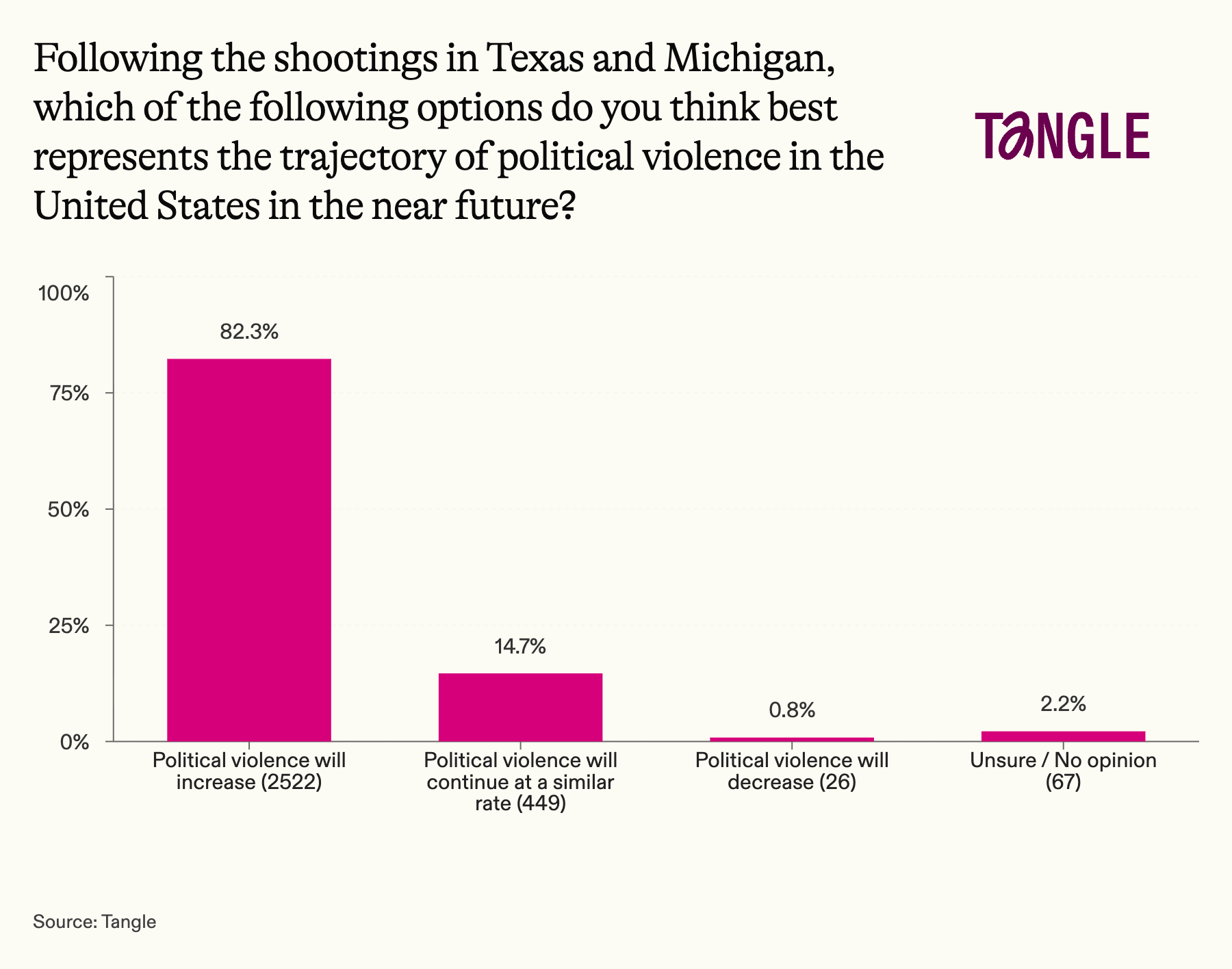
- Yesterday’s survey: 3,064 readers responded to our survey on political violence with 82% saying they expect it to increase. “Political violence will stay the same, but gun violence will increase,” one respondent said. “I would add a great deal, but what is the point? You don't read these,” said another.
Have a nice day.
Roughly 40,000 people in the United States have Huntington’s disease. Last week, gene therapy company uniQure announced that an experimental treatment shows promising signs of slowing the disease’s progression. The company administered the treatment to 17 patients and tracked their health for three years; it found the therapy slowed the progression of the disease by 75%. Victor Sung, a neurologist and principal investigator for the trial, noted that “we’ve been burned so many times in the past with failures,” but said the results of the trial are “some of the most compelling in all of neurodegenerative disease.” The Washington Post has the story.

Member comments