


I'm Isaac Saul, and this is Tangle: an independent, nonpartisan, subscriber-supported politics newsletter that summarizes the best arguments from across the political spectrum on the news of the day — then “my take.”
Are you new here? Get free emails to your inbox daily. Would you rather listen? You can find our podcast here.
Today’s read: 15 minutes.
How AI Is Changing Your Job—And What Comes Next.
Buried in all the online noise about AI are insights that could actually help you understand how it is reshaping politics, policy, and your world—but who has the hours to sort through it all?
The Deep View solves this.
500,000+ people, including members of the Tangle team, read it because it lets them stay ahead of the AI developments that actually matter. No duplicate stories, no filler content, no wasted time.
Just the essential AI developments that impact your life and work, explained clearly and concisely.
I actually met them.
Last year, the podcasts Question Everything and This American Life did a feature on the work we do here at Tangle. Central to their story was a couple, Dick and Emily, who said that Tangle helped save their marriage during the 2020 election because they were finally able to find some political common ground. The story went viral and led to hundreds of thousands of new readers of this newsletter.
Well, last weekend, at our event in Southern California, I got to meet Dick and Emily in person for the first time. We sat down for a short interview, and they gave me an update on their story. It was a genuinely moving experience, and you can watch it here.
Quick hits.
- Hurricane Melissa made landfall as a Category 5 storm in Western Jamaica before making a second landfall as a Category 3 storm in Eastern Cuba, where approximately 735,000 people were evacuated from their homes. Forecasters predict the hurricane will move into the Bahamas later today. (The storm)
- Israel launched airstrikes in Gaza, accusing Hamas of violating the U.S.-brokered ceasefire in the enclave. The Hamas-controlled Gaza Health Ministry said 104 Palestinians were killed in the strikes, and Hamas said it was not involved in attacks on Israeli forces that prompted the response. On Wednesday, Israel said it would resume compliance with the ceasefire. (The latest)
- A federal judge indefinitely blocked the Trump administration’s attempt to lay off thousands of federal employees during the ongoing government shutdown, extending a previous order that temporarily blocked the layoffs. (The ruling)
- The Senate voted 52–48 to end an emergency declaration made by President Donald Trump to levy 50% tariffs on Brazil. The House of Representatives will now vote on the resolution. (The vote)
- President Donald Trump announced that the United States has agreed to accept increased investments from South Korea in exchange for lower tariff rates. The president also said that he expects to discuss tariffs and technology investments in his upcoming meeting with Chinese President Xi Jinping on Thursday. (The announcement)
Today’s topic.
The NBA betting scandals. Last Thursday, the Federal Bureau of Investigation (FBI) announced it had made arrests in a pair of investigations into illegal gambling involving National Basketball Association (NBA) players and coaches. Miami Heat guard Terry Rozier is among those charged in the illegal sports betting case, while Portland Trail Blazers coach Chauncey Billups and several others are charged with participating in rigged poker games with ties to the mafia. According to FBI Director Kash Patel, the bureau has arrested 34 people as a result of the multi-year investigations, which covered 11 states and involved tens of millions of dollars. Billups and Rozier have been placed on leaves from their teams, and the NBA announced a review of its gambling rules.
In the poker games case (called “Operation Royal Flush”), the FBI alleges that NBA players were used as “face cards” to lend credibility to fixed games run by members of organized crime syndicates in New York, Las Vegas, and Miami. Organizers then allegedly fixed the games using rigged shuffling machines and X-ray technology to read cards. The FBI also says that members and associates from three different La Cosa Nostra crime families took part in the scheme and used threats, intimidation, and violence to coerce victims who refused or were unable to pay millions of dollars in losses.
Meanwhile, in the illegal sports betting case (or “Operation Nothing But Bet”), six people — including Rozier and former NBA coach Damon Jones — were accused of using inside information to profit from illegal bets. According to authorities, the NBA players passed on injury status and “intention to alter their upcoming game performance” to betmakers to allow for favorable wagers. “This was a sophisticated conspiracy involving athletes, coaches, and intermediaries who exploited confidential information for profit,” U.S. Attorney Joseph Nocella Jr. said.
Billups, Rozier, and their codefendants have been indicted on charges of wire fraud and money laundering conspiracy. Billups is scheduled to appear at the federal courthouse in Brooklyn in November, and Rozier’s next scheduled appearance will be in December. Separately, members of the House Committee on Energy and Commerce sent a letter to NBA Commissioner Adam Silver requesting a briefing on the scandal by the end of the month.
The pair of scandals has put the relationship between the sports industry and gambling companies under heightened scrutiny. Since the Supreme Court struck down a prohibition on online gambling in 2018, several illegal betting scandals have been uncovered. Prominent sports betting apps sponsor leagues and networks for contracts that can exceed a billion dollars, and the industry has accrued over $50 billion in lifetime revenue.
Today, we’ll get into what proponents and opponents of sports betting are saying. Then, Senior Editor Will Kaback will give his take.
Agreed.
- Proponents and opponents criticize those involved in the scandals and say the conspirators deserve harsh penalties if convicted.
What proponents are saying.
- Proponents believe legalized gambling itself isn’t to blame for the NBA scandals.
- Some say legalized betting helped expose the scandal.
- Others argue that legal betting is helping to reduce the influence of criminal networks in sports.
In the Philadelphia Inquirer, David Murphy argued “the arrests in the NBA gambling scandal are proof that the new world is better than the old.”
“One thing nobody will dispute is that Thursday was a victory for the scolds. All at once, they logged on, and logged in, and limbered up their Twitter fingers and sent them dancing across the keyboard like Herbie Hancock on the ivories,” Murphy wrote. “But the scolds are wrong. A world where people can gamble openly with reputable companies that operate within the jurisdiction of federal law enforcement and in cooperation with sports leagues is a world where any bad actors are likely to be caught. That is not the world as it used to be.”
“Nobody knows the old world as well as the NBA. Two decades ago, the league found itself mired in the biggest scandal of them all when it learned that referee Tim Donaghy had spent four years wagering on games that he officiated. His gambling was eventually uncovered by an FBI investigation that resulted in prison time, but only after he’d inflicted four years’ worth of reputational damage on the league,” Murphy said. “The cases of Rozier, Billups, and Porter are an indication that the world still isn’t perfect. But it is silly to suggest that stuff like this was less prevalent in the old world. We were just less likely to find out about it.”
In Reason, Jason Russell wrote that the scandal “shows how legalized gambling actually helps root out corruption.”
“Critics of legalized sports betting have been quick to dunk on the NBA for getting involved with sports betting. But legalized sportsbooks, and their cooperation with the NBA and law enforcement, are likely a big reason the scheme was uncovered at all,” Russell said. “In the March 2023 game, Rozier left the game early with an injury after playing for only 10 minutes. That same game had a suspicious amount of betting activity on the unders for Rozier's player prop bets, with Rozier's co-defendants allegedly betting a combined $200,000. Had that betting activity been placed with illegal bookies or offshore sportsbooks, it probably would have gone unnoticed.
“But when sports betting is legal, sportsbooks won't be afraid to flag suspicious activity like this to sports leagues and law enforcement,” Russell wrote. “The answer is not to push sports betting back into the shadows of bookies and offshore bets; it's to keep sports betting in the light so that perpetrators can be brought to justice.”
In 2014, NBA Commissioner Adam Silver made the case to “legalize and regulate sports betting.”
“There is an obvious appetite among sports fans for a safe and legal way to wager on professional sporting events. Mainstream media outlets regularly publish sports betting lines and point spreads,” Silver wrote. “Outside of the United States, sports betting and other forms of gambling are popular, widely legal and subject to regulation. In light of these domestic and global trends, the laws on sports betting should be changed. Congress should adopt a federal framework that allows states to authorize betting on professional sports, subject to strict regulatory requirements and technological safeguards.”
“These requirements would include: mandatory monitoring and reporting of unusual betting-line movements; a licensing protocol to ensure betting operators are legitimate; minimum-age verification measures; geo-blocking technology to ensure betting is available only where it is legal; mechanisms to identify and exclude people with gambling problems; and education about responsible gaming,” Silver said. “Any new approach must ensure the integrity of the game… I believe that sports betting should be brought out of the underground and into the sunlight where it can be appropriately monitored and regulated.”
What opponents are saying.
- Opponents believe the scandal is indicative of the widespread problems with sports gambling.
- Some argue that the scandal will hurt the integrity of sports overall.
- Others argue that Congress and the NBA should introduce stricter gambling regulations.
In National Review, Rich Lowry wrote about “America’s gambling problem.”
“This scandal is obviously a blow to the NBA’s reputation. The league can’t have fans thinking every time a player sits that a shady associate has placed a pricey bet on DraftKings that he’ll score fewer than ten points,” Lowry said. “There have been sports-gambling scandals before (Shoeless Joe Jackson, I’m looking at you). Yet we’ve created, out of nothing, an enormous industry that is inherently corrupting, encourages people to waste their money, and ruins lives.”
“The market is a powerful thing, and one of its greatest strengths is creating ever-more alluring products. In this case, that product — lavishly marketed and constantly innovative — is what has been traditionally considered a vice, and rightly so,” Lowry wrote. “At the very least, states should restrict so-called proposition bets on the individual performance of players, which is much more easily gamed than the outcome of a contest depending on the efforts of an entire team. Once a relatively marginal phenomenon, sports betting is now part of the American mainstream, and we haven’t seen the last of the scandals.”
In The Washington Post, Will Leitch said he was “shocked — shocked! — to find that gambling is going on in the NBA.”
“Professional sports leagues and television networks have embraced gambling for financial reasons — despite a century of gambling being so forbidden after the Black Sox scandal of 1919 that Willie Mays and Mickey Mantle were banned from baseball simply for being casino greeters,” Leitch wrote. “Now, it is impossible to watch any sporting event without being inundated with gambling advertisements, to the point that they are integrated within the broadcast (there is nothing quite like an announcers telling you where on your phone to gamble on the free throw you’re about to watch someone shoot) or even broadcast by the actual gambling establishments themselves.”
“For all the signs across clubhouses and locker rooms that players who gamble on their own sports face serious consequences, you can hardly blame a player for wondering how seriously such rules are supposed to be taken. If leagues are trying to emphasize how awful gambling is to its players, they’re doing a terrible job of it,” Leitch said. “The one thing sports can’t survive are fans who no longer trust the games to be on the level. If you do not believe that players and their teams are playing only to win — that you are watching a fair competition with everyone trying their best — then there is no reason to watch sports at all.”
In Bloomberg, Adam Minter said “the NBA deserves some blame.”
“The NBA is taking a serious reputational hit from the news, but it’s hardly an innocent bystander. By embracing and promoting sports betting, it helped foster the culture that made this scandal possible,” Minter wrote. “For most of its history, the NBA — like other American sports leagues — feared that sports betting could undermine its credibility with fans. But in the early 2010s, the rise of online gambling changed minds. By the early 2020s, the league’s focus seemed to expand beyond merely preserving the game’s integrity to finding ways to profit from Americans’ growing zeal for gambling.”
“Still, there are practical steps that the league and others could take to course-correct and help prevent future gambling crises,” Minter said. “A national system would be better equipped to regulate and enforce interstate and online gambling, while setting consistent minimum standards. But even without federal action, the league still has the power to make meaningful reforms of its own. First, the NBA should require its sportsbook partners to eliminate all ‘under’ bets on every player’s stats. Next, the league should urge its media partners to reduce the visibility of gambling-related sponsorships and advertisements during games.”
My take.
Reminder: “My take” is a section where I give myself space to share my own personal opinion. If you have feedback, criticism or compliments, don't unsubscribe. Write in by replying to this email, or leave a comment.
- Sports betting has become ubiquitous, and match fixing is just one of the problems that have followed.
- These cases actually highlight how legal betting makes illegal schemes harder to pull off.
- Sports gambling could still benefit from some reforms.
Senior Editor Will Kaback: Ten or so years ago, going to a sporting event went something like this: First, you’d figure out transportation — perhaps public transit in a big city or carpooling with friends in a smaller market. Next, you’d try to time your arrival so you could watch the pregame show while grabbing a drink or bite at a nearby restaurant, or get to your seats early to watch the players warm up. Then, showtime. If you’re lucky, it ends up a close game, and your team wins.
In 2025, the basics of that experience are the same, with one major difference. If you take the subway to the game, you’re likely to see advertisements for DraftKings plastered throughout the train; if you drive, it’s billboards for FanDuel along the highway. At the nearby restaurant, the pregame show is sponsored by BetMGM, and most segments are dedicated to building parlays around individual players’ stat lines. At the stadium, you’re encouraged to check out the new dedicated betting lounge, where you can place bets on the game you’re there to see (and plenty of others). The fans sitting around you are chattering less and looking down more, tracking their bets on their phones. Even if the game comes down to the final possession, people seem more focused on whether a certain player can score one more time and hit their points over.
If you’ve attended (or watched) a professional sports game in the past few years, this experience should feel familiar. Gambling has become ubiquitous in professional sports in the seven years since Murphy v. NCAA — and it should come as no surprise that more betting scandals have followed.
The match-fixing case engulfing the NBA this week is really just the tip of the iceberg.
On the surface, the FBI’s case looks terrible for the league, especially since Rozier’s alleged actions directly impacted the outcome of a game. It calls into question the entire competitive enterprise; now, who could blame fans if they see a player miss a wide-open layup and suspect the game might be rigged?
Dig deeper, though, and these cases actually highlight the benefits of legalized gambling.
Legalization has allowed betting to be monitored and regulated in a way that makes these schemes almost impossible to execute (at any significant scale) without detection. Like Reason’s Jason Russell,I think this scandal actually illustrates how regulated gambling is an aid to authorities trying to sniff out illegal schemes. As soon as massive bets started coming in on Rozier’s “unders” for the game in question, an “integrity monitor” firm immediately flagged the unusual activity to the NBA and betting companies, prompting an investigation that eventually led to Thursday’s charges. Sports leagues, betting companies and law enforcement all share an interest in preventing match fixing, and the resources in place to root it out are clearly effective (another NBA player, Jontay Porter, was caught in a similar scheme last year, then banned from the league for life).
Details of these high-profile arrests will probably dissuade other athletes from throwing games, though I’m confident the vast majority of professional athletes don’t need much incentive not to risk multi-million dollar careers. College sports is a separate issue, and I’m more concerned about the influence of gambling in this arena, as student-athletes make much less money (if any) and a match-fixing scheme for, say, a college volleyball match would be much more difficult to detect. But that’s a thornier discussion for another time. As for scandals like match fixing in the NBA, they demand a forceful response from professional sports leagues (I expect the NBA will ban Rozier for life) — but I don’t think they’re pervasive enough to call into question the integrity of the sport.
The question it does raise, for me, is whether organized sports should be embracing organized betting. As I described earlier, gambling has become inescapable for sports fans, many of whom have turned from fans into gambling addicts. A 2025 study published in JAMA Internal Medicine found that the introduction of retail sportsbooks led to a 33% increase in gambling addiction searches during the five months before online sportsbooks launched. Other studies have found that bankruptcies increased by 28% in states with legalized sports betting. And the percentage of Americans who see legalized sports betting as bad for society rose from 34% in 2022 to 42% in 2025, according to Pew Research. Athletes themselves are also speaking out about the effect of legalized gambling on their relationships with fans, and their testimonials are genuinely unnerving. On the whole, it seems like the embrace of betting from sports leagues and networks has made us meaner, more impulsive, and less responsible.
All of this worries me much more than a few players and coaches trading on insider information. But do I think we should roll back the clock and outlaw sports betting again? No.
Outlawing betting wouldn’t make it go away. Despite widespread sports betting legalization, Americans still wagered an estimated $84 billion on sports with illegal bookies and offshore sportsbooks in 2024. To me, gambling falls in the same category as drinking alcohol or consuming tobacco or cannabis: an undeniable vice, but something adults should have the ability to choose for themselves. This logic could be extended to other vices like prostitution or hard drug use, but I would put those in a separate category, as I think the associated harms (abuse, exploitation, and random violence) are more serious and could not be adequately addressed by legalization.
While I think banning sports betting would be ineffective, I think lawmakers should pursue two major reforms at the federal level.
First, severely restrict how betting companies advertise and market their products. I would simply regulate sports betting promotions as we do tobacco, with a required emphasis on the dangers of use and restrictions on where and how companies can advertise. While I believe gambling should be legal for adults, I don’t think we have any obligation to allow mass advertising campaigns and sponsorships that present betting as a fun, exciting, and harmless game (for what it’s worth, I would support regulating alcohol advertising in the same way).
Second, ban prop bets. These are wagers on specific outcomes within games; for example, I might bet on the number of three-pointers a player will make or whether a player will hit a home run. The major NBA betting scandals to date have involved prop betting, and it’s no coincidence: An individual player like Rozier would have a hard time throwing an entire game, but he can control his own performance.
Props are also updated and adjusted during games, creating limitless opportunities to bet on every conceivable outcome down to a granular level, like which team or player will score first. Accordingly, this kind of betting lends itself to addiction — rather than simply betting on which team will win, you can bet throughout the game. Furthermore, props are a relatively new phenomenon. Online sportsbooks have huge teams dedicated to creating and updating these bets mid-game, and shoestring bookies wouldn’t be able to replicate it. Banning or significantly restricting prop betting would be akin to regulating the levels of THC concentration in cannabis, which many states do.
As with all policies, these solutions involve trade-offs, and no amount of regulation would eliminate the potential for gambling addiction or match fixing. But I think these two reforms would provide a more sensible framework for legalized betting. Sports leagues will never implement them on their own, so we need our representatives to act to ensure a healthier future for sports leagues and their fans.
Take the survey: What do you think about sports betting? Let us know.
Disagree? That's okay. My opinion is just one of many. Write in and let us know why, and we'll consider publishing your feedback.
Your questions, answered.
Q: What’s the deal with ExxonMobil suing California? Why are climate change laws an infringement on freedom of speech?
— Dominex from Sacramento, CA
Tangle: On Saturday, ExxonMobil sued California over two laws the state passed as part of its “Climate Accountability Package” in 2023. The first, SB 253, requires companies with annual revenues exceeding $1 billion that operate within California to disclose their greenhouse gas emissions (including those incurred in the supply chain and distribution processes). The second, SB 261, requires companies with annual revenues over $500 million to disclose how they quantify and mitigate risks they incur due to climate change.
ExxonMobil contends that these laws violate the First Amendment because they amount to “compelled speech,” forcing private companies to “adopt a narrative” of climate change that conforms with the state’s. The company argues this “viewpoint discrimination” violates the Constitution’s prohibition on government-mandated ideological speech. In suing, ExxonMobil is attempting to block the laws before their enforcement begins in 2026.
The suit mirrors a similar one filed by the U.S. Chamber of Commerce, California Chamber of Commerce, and American Farm Bureau Federation over the same laws in 2024. In that case, U.S. District Judge Otis Wright II dismissed the plaintiffs’ request for an injunction, saying that they had not demonstrated either that they had suffered harm or had their rights violated. That case will go to trial in October 2026, and a trial date has not been set in Exxon’s case.
In our opinion, it doesn’t seem like ExxonMobil has a great argument — submitting to regulation is not the same as being compelled to endorse an ideology. The company has a history of fighting all manner of climate change legislation, and while they could be hoping to land in front of a sympathetic Supreme Court, their argument may not be able to withstand moderate legal scrutiny.
Want to have a question answered in the newsletter? You can reply to this email (it goes straight to our inbox) or fill out this form.
Under the radar.
On Tuesday, The Associated Press reported that a federal agent had attempted to bribe Venezuelan President Nicolás Maduro’s private pilot, Gen. Bitner Villegas, to secretly divert the president’s plane to the United States for Maduro’s arrest. According to the report, the agent, Edwin Lopez, was tipped off about information on Maduro’s pilots and met Villegas in the Dominican Republic in 2024. Lopez corresponded with Villegas for 16 months, pressuring him to help bring Maduro into custody and highlighting the Justice Department’s $50 million reward. However, Villegas eventually rejected the request, and the Venezuelan government has since celebrated Villegas for his loyalty. The Associated Press has the story.
Your Privacy and AI: What's Actually at Stake
Need to understand how AI is impacting your world?
The Deep View delivers it. Join 500,000+ readers (including the Tangle team) getting only the essential AI developments in politics, policy, and beyond—no duplicates, no filler, no wasted time. Just clear, concise insights that matter.
All 100% free.
Numbers.
- 34. The total number of people who were arrested in the two gambling investigations, according to FBI Director Kash Patel.
- 31. Of those arrested, the number who were allegedly involved in schemes to rig illegal poker games.
- 6. Of those arrested, the number who were allegedly involved in an illegal betting scheme that relied on insider information from National Basketball Association (NBA) players and coaches (three individuals were arrested in both schemes).
- 7. The number of NBA games identified in the indictment in which gamblers are alleged to have used nonpublic information to place bets.
- $7.2 million. The approximate amount of money the defendants allegedly stole in the rigged poker games.
- $99.1 billion. The approximate amount of money Americans legally wagered with sports betting companies in the first 8 months of 2025, up 12% from the same period last year, according to the American Gaming Association.
- 8% and 34%. The percentage of U.S. adults who think legalized sports betting is good and bad for society, respectively, according to a July 2022 Pew Research poll.
- 7% and 43%. The percentage of U.S. adults who think legalized sports betting is good and bad for society, respectively, according to a July 2025 Pew Research poll.
The extras.
- One year ago today we wrote about newspapers choosing not to endorse presidential candidates.
- The most clicked link in yesterday’s newsletter was Amazon laying off 14,000 corporate workers.
- Nothing to do with politics: The 10 most haunted states in America.
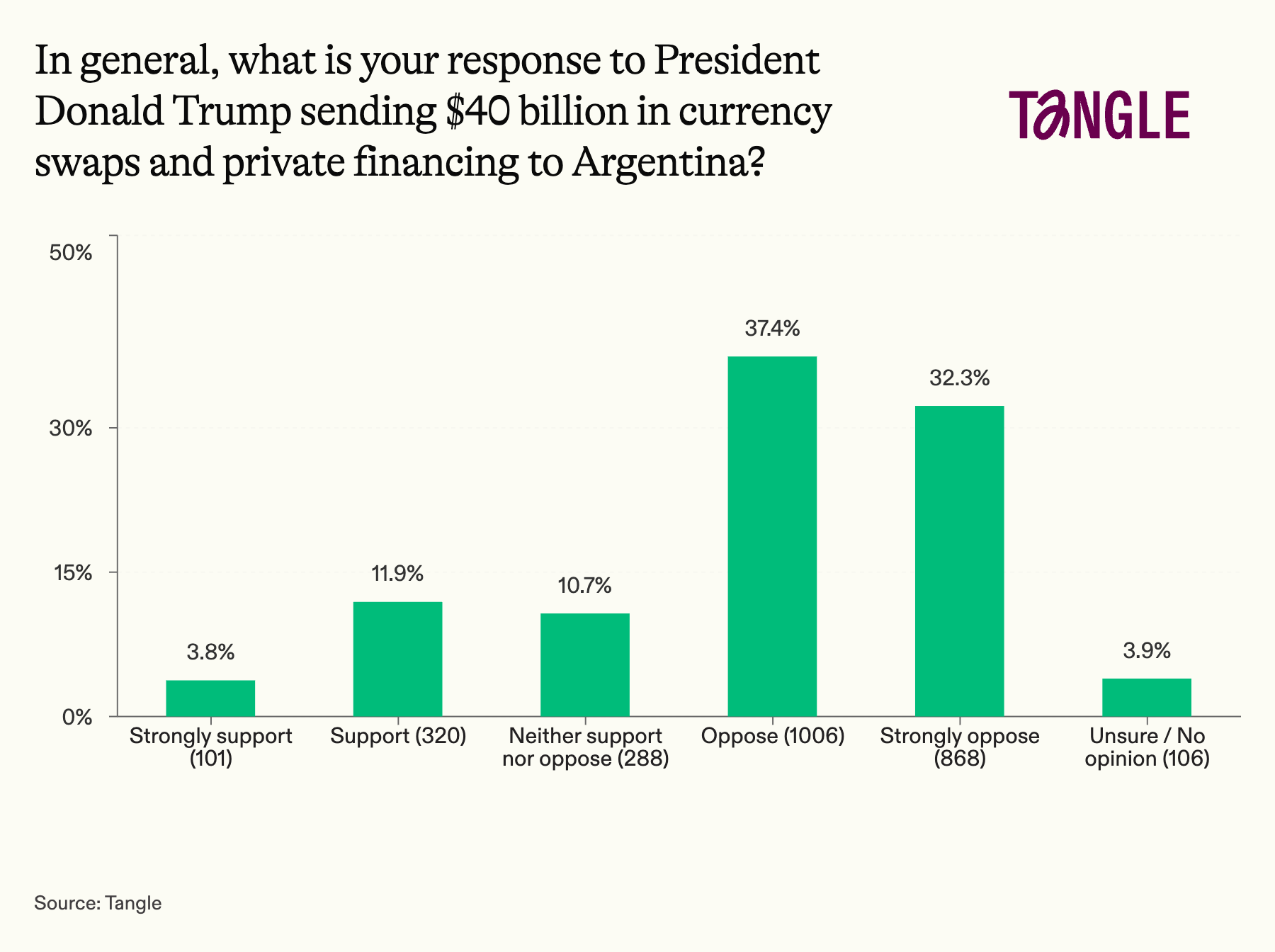
- Yesterday’s survey: 2,689 readers responded to our survey on the Argentina bailout with 69% opposed. “The money is needed HERE, in the U.S.,” one respondent said. “Let’s see what Trump gets out of Argentina in return. You never know what he’s thinking about when he makes deals like this,” said another.
Have a nice day.
Gayle Noble developed a reputation in Oceanside, California, for her random acts of what her daughter Nisse called “aggressive kindness.” Often seen in a Grateful Dead T-shirt and her signature plush hat, the 77-year-old would spend her time in retirement dropping off baked goods at different storefronts and trying to make everyone’s day a bit brighter — sometimes literally throwing cookies at employees who were reluctant to receive them. Nobel passed away this year, but her legacy lives on through those she inspired. “Not only do I feel a huge sense of peace and growth, but there are hundreds of thousands of people across the world who are feeling that, too,” Nisse said. CBS has the story.

Member comments