
I'm Isaac Saul, and this is Tangle: an independent, nonpartisan, subscriber-supported politics newsletter that summarizes the best arguments from across the political spectrum on the news of the day — then “my take.”
Are you new here? Get free emails to your inbox daily. Would you rather listen? You can find our podcast here.
Today’s read: 15 minutes.
One more time…
Today is the last day of our Black Friday–Cyber Monday deal, which is our largest discount ever. The deal is simple: You get 30% off your first year of a Tangle membership — both for newsletter subscription and bundled with the podcast — when you subscribe for the year. If you’re interested in supporting what we do, don’t miss out! Sign up for a newsletter membership here, and a bundled podcast membership here!
Quick hits.
- President Donald Trump said the airspace above and surrounding Venezuela should be considered closed, raising the prospect of potential U.S. military action. (The comments) Separately, President Trump backed Defense Secretary Pete Hegseth following reports that Hegseth ordered a second strike to kill survivors of an initial strike on an alleged drug boat in the Caribbean in September. Hegseth has dismissed the reports, but some lawmakers have suggested that such an order would constitute a war crime. (The latest)
- Four people died in a mass shooting at a child’s birthday party in Stockton, California, including three children. 11 others were injured. (The shooting)
- President Trump commuted the seven-year sentence of David Gentile, a former investment manager convicted in 2024 of securities and wire fraud charges. Gentile served less than two weeks of his sentence before the commutation. (The commutation) Separately, President Trump announced his pardon of former Honduran President Juan Orlando Hernandez, who was sentenced in 2024 to 45 years in prison on drug trafficking and weapons charges. (The pardon)
- Ukrainian President Volodymyr Zelensky’s chief of staff, Andriy Yermak, resigned following reports that he is the subject of an anti-corruption probe. Investigators from Ukraine’s anti-corruption agency raided Yermak’s house on Friday, but no further information has been released. (The resignation)
- Authorities in Hong Kong announced the arrests of 13 people amid their investigation into a fire at a housing complex that killed at least 151 people, with at least 40 people still missing. (The arrests)
Today’s topic.
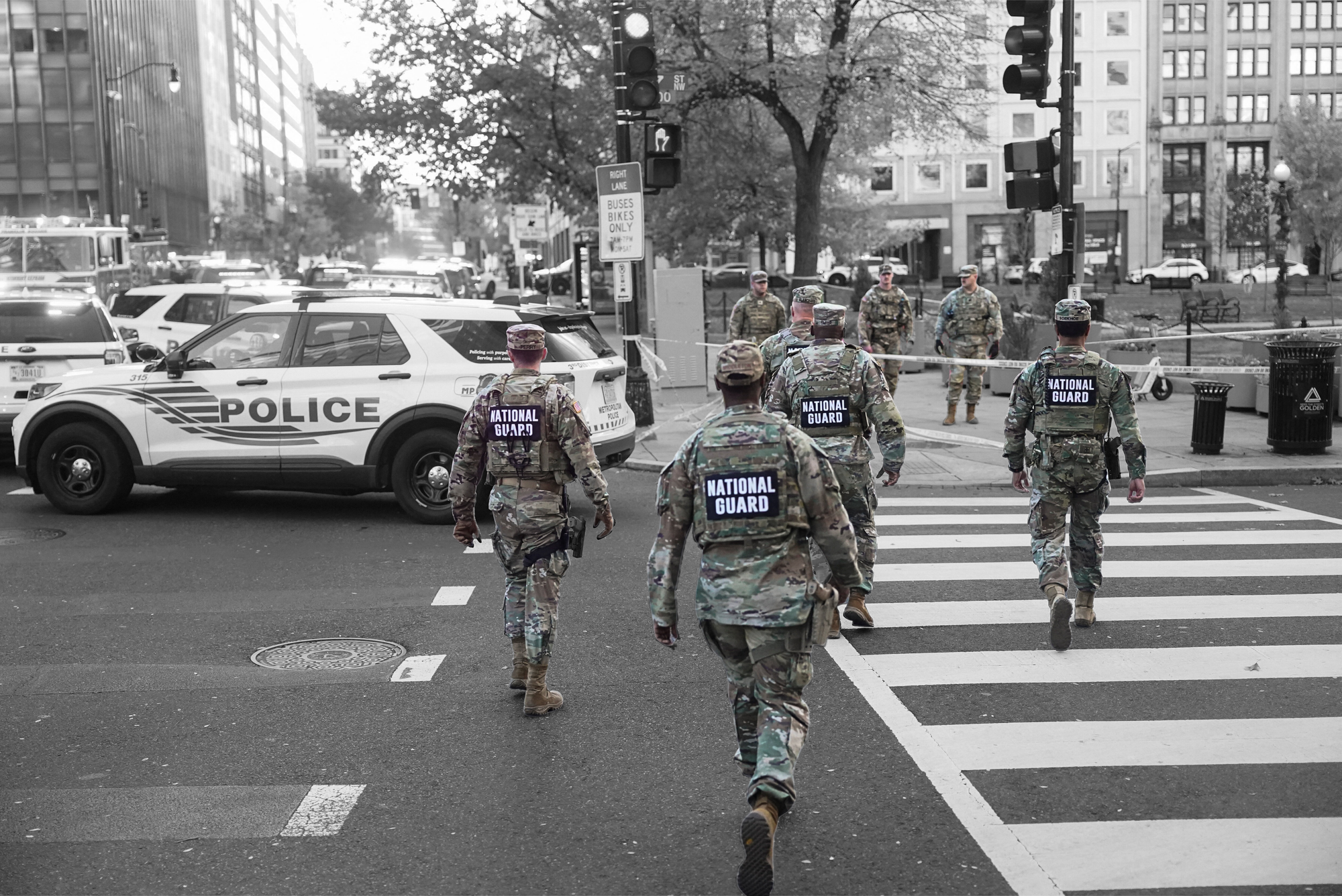
The National Guard shooting in D.C. On Wednesday, a gunman opened fire on West Virginia National Guard troops stationed near the White House in Washington, D.C., striking two service members. Army Specialist Sarah Beckstrom died from her injuries, while Air Force Staff Sergeant Andrew Wolfe remains in critical condition. The suspected shooter was also shot but is expected to survive. The suspect was identified as an Afghan national who worked with a Central Intelligence Agency-backed unit before coming to the United States in 2021 through a Biden administration program that resettled Afghan asylum seekers. He was arrested and charged with first-degree murder, in addition to potential terrorism charges.
Note: Due to the well documented contagion effect, Tangle does not name shooters or suspects in high-profile attacks.
In an address on Wednesday night, President Donald Trump called the attack “an act of evil, an act of hatred and an act of terror,” adding that it “underscores the single greatest national security threat facing our nation.” Subsequently, U.S. Citizenship and Immigration Services (USCIS) said it had stopped processing immigration applications from Afghanistan. On Friday, the Trump administration directed USCIS to pause all asylum decisions while the administration conducts a review of all Biden-era asylum approvals.
The suspect, a 29-year-old man, was a member of a special Afghan Army unit that worked with the U.S. in Afghanistan prior to the U.S. military’s withdrawal in 2021. He came to the United States legally under the Biden administration’s Operation Allies Welcome program, which evacuated and resettled tens of thousands of Afghans as the country’s government collapsed. The Trump administration granted him asylum in 2025.
As investigators work to determine a motive, new reporting suggests the suspect struggled to adjust to life in the United States and had grown increasingly isolated in recent years. According to emails sent to the U.S. Committee for Refugees and Immigrants in 2024, the suspect was not “functional as a person, father and provider since March of last year, 03/2023. He quit his job that month, and his behavior has changed greatly.” Other emails described him as prone to manic episodes, depression, and “periods of dark isolation and reckless travel.”
On Sunday, Secretary of Homeland Security Kristi Noem suggested that the suspect was “radicalized” after he came to the U.S., saying, “We do believe it was through connections in his home community and state, and we’re going to continue to talk to those who interacted with him.” Noem added that the Trump administration is planning to pursue mass deportations of immigrants from “third world” countries and will not reopen the asylum process until it clears the current backlog of cases. Separately, President Trump said that he will seek to “permanently pause migration from all Third World Countries.”
Today, we’ll share perspectives from the left and right on the shooting and the Trump administration’s efforts to crack down on immigration. Then, Executive Editor Isaac Saul gives his take.
What the left is saying.
- Many on the left say Trump needlessly put the Guard members in harm’s way.
- Some say the blame lies solely with the shooter.
- Others argue Trump is wrong to punish all Afghan immigrants for the shooting.
In The Atlantic, Juliette Kayyem said “Trump was warned that members of the military could be attacked.”
“Before an Afghan refugee… yesterday shot and seriously injured two National Guard members who had been deployed by President Donald Trump to Washington, D.C., military commanders had warned that their deployment represented an easy ‘target of opportunity’ for grievance-based violence,” Kayyem wrote. “Commanders, in a memo that was included in litigation challenging the high-visibility mission in D.C., argued that this could put them in danger. The Justice Department countered that the risk was merely ‘speculative.’ It wasn’t.”
“Even if the deployments to D.C. were legal, they lack a clear mandate and metrics of success, and have vague rules of engagement and ill-defined operating procedures. And morale is low among part-time volunteer soldiers, who have had to leave home to patrol the streets of an American city that Trump doesn’t like,” Kayyem said. “We are not at war now. But Trump’s use of the National Guard suggests that he thinks we are not at peace either. The National Guard is stranded somewhere on this battlefield of partisan politics. They are not ready for this arena, and we should never have asked them to be.”
The New York Times editorial board wrote about “the uniquely American heartbreak of yet another tragedy.”
“Our knowledge of the suspect and his motives in Wednesday’s shootings remains limited. He was described by a friend as a young man troubled by mental illness, as is so often the case in similar crimes. We also have learned that he came to the United States in 2021, after the chaotic and deadly withdrawal from Afghanistan under the Biden administration,” the board said. “America, however, is stronger for its long tradition of welcoming immigrants. And as awful as one man’s actions apparently were, a crackdown on people here legally would be a mistake. This is especially true of any backlash against the many Afghans who worked for years alongside American troops, civil society groups, aid organizations and journalists.”
“There will be Americans who note that this tragedy could have been averted if Ms. Beckstrom and Mr. Wolfe had not been needlessly deployed to Washington in August on the order of President Trump. No one, including the president, is responsible for this tragedy, except for its perpetrator,” the board wrote. “The next several days will provide more information about the attack. For now, we know it is a heartbreaking event for two families of young Americans serving their country, and we know that political violence has become alarmingly regular in the United States. All Americans should condemn that.”
In Bloomberg, Patricia Lopez argued “‘re-vetting’ hundreds of thousands of refugees is an overreaction.”
“The impulse for retribution is powerful. And after such a senseless act of violence, Trump is probably far from alone in that impulse. But it is fundamentally unfair to consider punishing an estimated 190,000 Afghans for the alleged actions of one,” Lopez said. “Wholesale deportations of those Afghans already here would also be a betrayal with grave consequences for our own national security. Breaking our promise to these Afghans — who helped the US wage its longest war — would make it much harder for US troops to gain the trust of locals who know the language, customs and intelligence so critical to success in foreign wars.”
“[Trump] insists that ‘we must now re-examine every single alien who has entered our country from Afghanistan under Biden and we must take all necessary measures to ensure the removal of any alien from any country who does not belong here or add benefit to our country,’” Lopez wrote. “That is a wild overreaction to the tragic event that has shaken the country. There is a difference between announcing an overhaul of the vetting process, where there is always room for improvement, and upending the lives of hundreds of thousands of law-abiding refugees — not to mention potentially millions of other immigrants.”
What the right is saying.
- Many on the right say Trump is right to scrutinize the immigration system after the shooting.
- Some say Afghan refugees should not face retribution for the shooting.
- Others accuse the Biden administration and Congress of negligence.
The New York Post editorial board wrote that an “Afghani lunatic proves we must totally overhaul our immigration system.”
“The details of whether and how [the suspect] got vetted are (for this purpose) beside the point: The far larger issue is the insane proliferation of programs that admit foreigners, each with different standards for everything — not just for whether the authorities adequately assess the risks,” the board said. “[The suspect] seems to have entered with his family under a ‘special immigrant visa’ program following Biden’s disastrous bugout. But that’s just one program that focuses on asylum claims; the nation has dozens of systems large and small for legal admission, a jury-rigged patchwork because the politicians keep adding new ones rather than rethink everything.”
“The foundation of the system should be supporting immigration as it benefits America and Americans. Instead, our decades-old base immigration law heavily favors… ‘family reunification,’ which is routinely gamed into ‘chain migration,’ using up the legal slots that could increase, say, the skills of the nation’s workforce,” the board wrote. “President Donald Trump is thundering about all manner of drastic changes in the wake of the DC attack; as usual, his instinct is well-founded — but presidential action alone can’t yield a permanent fix. Until the nation can manage a top-to-bottom overhaul of immigration law, we’ll keep careening from one migrant mess to another.”
The Wall Street Journal editorial board argued the shooting “shouldn’t condemn all who assisted the U.S. and now live here.”
“The reason for [the suspect’s] alleged turn from partner to terrorist, especially as a husband and father of five in the U.S., is an important question to answer. The FBI will be looking for links to a domestic terror cell or international contacts, though he might simply have been disgruntled on his own about his adopted country,” the board said. “When and how the shooter was approved for entry will become clearer, and no doubt an orderly withdrawal would have allowed more careful investigation. This is one more cost of the Biden Administration’s Afghan failure.”
“The Trump Administration said it has paused processing immigration applications from Afghanistan, and Mr. Trump said the attack justifies his mass deportation policy. But it would be a shame if this single act of betrayal became the excuse for deporting all Afghan refugees in the U.S.,” the board wrote. “Tens of thousands are building new lives here in peace and are contributing to their communities. They shouldn’t be blamed for the violent act of one man. Collective punishment of all Afghans in the U.S. won’t make America safer and it might embitter more against the United States.”
In National Review, Noah Rothman said the shooting was a “terror attack.”
“[The] attacker was an Afghan national who was one of the roughly 200,000 Afghans brought into the United States in a slapdash fashion following Joe Biden’s botched withdrawal from Central Asia in 2021. His asylum application began under Biden, but it was certified while Donald Trump was in office,” Rothman wrote. “He might have been subject to additional scrutiny had Congress passed the Afghan Adjustment Act, which was introduced in both chambers of Congress but never passed. In short, anyone who wants to blame their domestic political opponents for this act of bloodshed will encounter a target-rich environment.
“What no one in good faith could argue is that this terrorist attack – and it was a terror attack, designed to intimidate and suppress American law enforcement – was inspired by the provocative presence of uniformed military personnel on the District’s streets. But that is what some claimed,” Rothman said. “What can be said for certain is that, in the absence of Biden’s withdrawal and Congress’s lethargy, it would have been far less likely that this terror attack would have occurred. Far too many Americans own those inauspicious acts, and the blame that goes around is diluted as a result. But this is not a tragedy — it is an atrocity.”
My take.
Reminder: “My take” is a section where I give myself space to share my own personal opinion. If you have feedback, criticism or compliments, don't unsubscribe. Write in by replying to this email, or leave a comment.
- The asylum program can be improved, but Afghan nationals are not some massive threat.
- Military leaders warned that troop deployments could provoke a response, though the Guard has been effective in D.C.
- You can look at this incident to prove whatever point you’re interested in making — including that Congress should do more.
Executive Editor Isaac Saul: After six-plus years of writing this newsletter, I’ve learned that high-profile acts of violence have a special way of pushing people to grasp for simple explanations.
This is true especially of political violence. Charlie Kirk’s murder, for instance, simultaneously evoked think pieces from authors eager to point to their pet issues of left-wing violence, right-wing rhetoric, violence committed by trans people, conspiracies about Israel, gun rights, and free speech. The reflex has been similar in this case, and entirely predictable.
For many on the right, the story is about Afghan immigrants and the risks of letting radicals in through mass migration. For many on the left, it’s about a legally questionable deployment of the National Guard that was seemingly designed to provoke.
But when you look past the partisan narratives, you find a complicated story that shows just how hard it is to reduce violent attacks to any one issue.
The shooter’s case itself is a great example of how convoluted the blame-game narratives are. He was admitted to the U.S. by the Biden administration through a hurried, temporary parole program that had a documented history of helping Afghan immigrants on the terrorism watch list. Yet, he was granted asylum here by the Trump administration. He wasn’t just an “Afghan national,” but someone who worked with the CIA and whose brother was a military leader in an elite CIA squad. According to Kristi Noem, he was radicalized in the U.S. after immigrating, which would both absolve the Biden administration of negligence and bolster the argument that allowing these migrants in is risky, even when they clear the vetting process. This is not a simple immigration story where one administration is entirely at fault.
The framing from the right is convoluted, too: This shooter is an example of the dangers of bringing in too many foreign nationals. On the one hand, this suspect is the fourth publicly reported Afghan national to be arrested for an act or potential act of terrorism since just last October. One posted a TikTok video of himself making a bomb and threatening the Fort Worth, TX, area. Two others were involved in an ISIS-inspired plot for a mass-casualty attack on Election Day in 2024. Today’s suspect allegedly attacked two National Guard troops in broad daylight. As far as threats from nation-groups go, these examples paint a pretty unseemly picture of Afghan immigrants.
On the other hand, this shooter is one of just 190,000 Afghan refugees who resettled here after the fall of Kabul in 2021. One high-profile shooter in 190,000 people isn’t exactly an endemic issue. For comparison, that’s roughly the same odds of being born with 11 fingers or toes, or of being struck by lightning (if you spend a lot of time outside). Additionally, I could find zero instances of mass shootings in the U.S. committed by Afghan nationals in the last 10 years. In fact, prior to Wednesday, there were just six Afghan-born perpetrators of terrorist attacks on U.S. soil in the last 50 years — 2.5% of all foreign-born attackers — according to the terrorism dataset maintained by the Cato Institute.
However, some aspects of this story are heart-breakingly typical. The shooter was a 20-something male. He had military experience. He was prone to long periods of isolation and was struggling financially. Community members expressed concern about him prior to the act of violence. All of this is common for mass shooters in America; if anything, his Afghan nationality makes him atypical.
The framing from the left squarely blaming President Trump’s National Guard deployment is not as much convoluted as it is overly simplistic. On the one hand, military commanders did warn that putting the National Guard in the street could incite an event like this, calling the deployments a “target of opportunity” for grievance-based violence. Initially, these troops were unarmed and weren’t permitted to have weapons in their vehicles, but they were then given “Green Status” (allowing them to carry unloaded weapons and ammunition). In the wake of this shooting, the troops could be placed under “Amber Status” (ammunition loaded but not in the firing chamber) or “Red Status” (gun ready to be fired). Violence begets violence and escalation leads to more escalation, so this development would lead us a step closer towards precisely what many critics worried about: Armed troops in the streets feeling under threat, surrounded by angry and fearful civilians.
On the other hand, the National Guard troops the shooter targeted were just outside the White House — it’s not as if they were controversially patrolling D.C. neighborhoods on foot. And even there, the troop deployments in D.C. have begun to find favor in unexpected corners; the city, whose crime data may have been underrepresented for several years, has recently experienced a fall in homicides and a spike in arrests for murders. The White House claims crime is down 40% from this time last year, and Mayor Muriel Bowser (D) indefinitely extended the collaboration between local and federal law enforcement while keeping National Guard troops in the city.
Put differently: Trump’s troop deployment has gone exactly as some critics said it would and exactly as Trump said it would — yet another data point on how unwise it is to reach for a simple narrative here.
Trump is responding to this attack by promising mass deportations, promising to clear the backlog of asylum cases, and putting a “permanent pause” on migration from “third-world” countries. Again, analysis here begs for some complication. It would be an absurd overreaction to punish hundreds of thousands of Afghan immigrants, many of whom are here because of America’s actions in Afghanistan, in response to this one shooting. It is also true that pausing the asylum process until the current backlog is cleared could greatly benefit the entire system. Maintaining a huge, years-long line of cases yet to be heard is harmful to people with legitimate asylum claims who can’t get in, many of whom then decide to come here illegally instead of facing rejection and isolation in bureaucratic obscurity.
And, as is typical, no lasting solution in response to this violence is possible without some help from Congress. As The New York Post editorial board argued (under “What the right is saying”), one of the fundamental problems with our system is that it is a patchwork of dozens of programs for specialized immigrant groups, all with different and disparate qualifications to enter the country. This shooter came in under one such program, and it’s possible that something like the Afghan Adjustment Act could have tagged this case for review. That program itself is a complex effort; it offered more pathways to permanent legal status for Afghan immigrants, but only under the condition of enhanced vetting. It was introduced with bipartisan support in 2022, and again in 2023, and again in 2024 — but is yet to become law.
All of this is without even mentioning one of the most relevant details: The motive for the attack is still unknown, as is the question about whether the shooter obtained his gun legally or illegally.
So here we are: a heartbreaking tragedy, just before the holidays, with many potential simple answers that each fail to tell the whole story. All the while, a legislative solution continues to languish after three failed bipartisan efforts in the past three years. I’m eager to push for effective legislation, but I’m aware that blaming Congress for inaction is a too-simple story of its own. Perhaps the difficult truth is that in a pluralistic society, where we are granted robust freedoms and welcome people from all walks of life, tragedies like this are impossible to prevent with any single remedy. That reality is unsatisfying, but it demands that we allow for more than one narrative when looking for a solution.
Take the survey: What do you think we can learn from the recent shooting? Let us know.
Disagree? That's okay. My opinion is just one of many. Write in and let us know why, and we'll consider publishing your feedback.
Your questions, answered.
Q: Recently I’ve been hearing a lot of concern about the AI bubble. My understanding is that there’s tons of investor money going into AI, but not a lot of profit coming out. The concern is that these investments are propping up the stock market, but when the companies collapse we will get another recession. Is this a real possibility? What else do I need to know to understand this story?
— Stanley from Kaukauna, WI
Tangle: That’s mostly right, with one important edit. 42% of the value in the S&P 500 is held by the ten largest companies on the exchange. Led by tech giants Nvidia, Microsoft, Apple, Amazon, Alphabet and Meta, these 10 companies held $25.1 trillion of market capitalization as of November. However, they are immensely profitable — Nvidia, for instance, announced record earnings of $57 billion last quarter. The concern instead is whether the market is over-reliant on these businesses, and if they’ll continue to grow.
In October, Scott Galloway, who wrote a book about Amazon, Apple, Facebook and Google, said, “Since ChatGPT launched in November 2022, AI-related stocks have registered 75% of S&P 500 returns, 80% of earnings growth, and 90% of capital spending growth.” That represents a big bet on the future value of data centers to service the economy’s demand for artificial intelligence, and one that’s shared by the rest of the companies powering the S&P 500. Morgan Stanley projects that Google, Amazon, Meta, Microsoft, and CoreWeave will spend $400 billion on AI infrastructure by the end of this year.
Additionally, most of these major players are exchanging most of their funds among one another — a phenomenon some investors are calling the tech “circularity.” Econ blogger Brian Robertson described it like this: “A tech giant like Microsoft invests billions into an AI startup like OpenAI. OpenAI, in turn, uses that money to pay for cloud computing services from... Microsoft Azure. Similarly, Amazon invests billions in Anthropic, which then spends that money on Amazon Web Services (AWS). It’s a closed loop, a circular flow of capital that inflates revenues and creates a mirage of economic activity.”
All in all, that means that when you, as a retail investor, buy the market, you’re disproportionately investing in companies that are disproportionately investing in AI. And if the AI market falters, so too will your whole portfolio. That’s the basic story. And, yes, a market crash is possible, but we should stress that we don’t know what will happen next.
Want to have a question answered in the newsletter? You can reply to this email (it goes straight to our inbox) or fill out this form.
Under the radar.
For the first time in 10 years, no hurricanes made landfall in the continental United States during this year’s hurricane season. Since the season’s start on June 1, multiple storms appeared likely to impact areas on the East Coast, but all moved back out to sea before reaching the coastline. Experts said winds and air pressure created unique atmospheric conditions that caused these storms to “recurve” — initially moving west but shifting northward and back out over the ocean before reaching land. Other experts suggested that the jet stream, a band of wind in the upper atmosphere that runs west to east, contributed to a low-pressure area over the ocean that pushed hurricanes away from the U.S. mainland. CBS News has the story.
Numbers.
- 2,220. The approximate number of National Guard troops that have been deployed to Washington, D.C.
- 1,200. The number of those troops who were deployed from outside of Washington, D.C.
- 500. The number of additional National Guard troops that President Trump wants to send to Washington, D.C. following the shooting.
- 76,000. The approximate number of Afghan nationals who were resettled in the United States following the U.S. withdrawal from Afghanistan.
- 5,005. The number of Afghan nationals admitted to the U.S. under Operation Allies Welcome who were flagged for “national security” issues, according to Department of Homeland Security data.
- 956. The number of Afghan nationals admitted to the U.S. under Operation Allies Welcome who were flagged for “public safety” concerns.
- 6. The number of Afghan nationals who committed terrorist attacks in the United States between 1975 and 2024, according to a Cato Institute analysis.
- 0. The number of people who were killed in those attacks.
The extras.
- One year ago today we wrote about Trump tapping Lori Chavez-DeRemer for Labor Secretary before taking our Thanksgiving break.
- The most clicked link in Tuesday’s newsletter was the 61 things to fight about this Thanksgiving.
- Nothing to do with politics: The 17 best fast-food value menus.
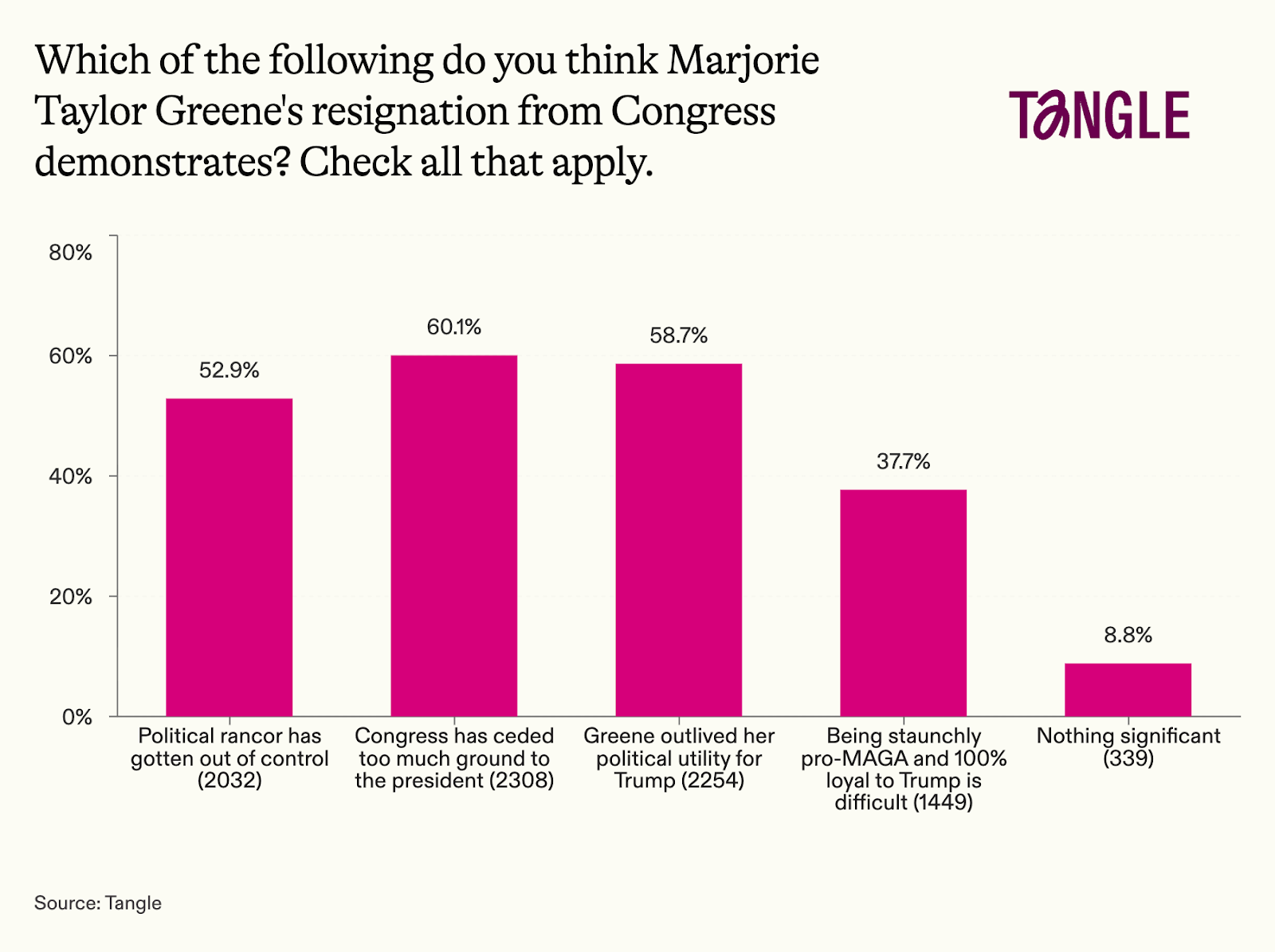
- Tuesday’s survey: 3,843 readers responded to our multi-select survey on takeaways from Rep. Marjorie Taylor-Greene’s resignation with 60% saying it shows that Congress has ceded too much ground to the president. “All of the above, plus: MTG, in the end, is human and does not want to see herself and her family dragged through the mud,” one respondent said. “I find it weird her extreme history of Antisemitism isn’t being talked about more, by anyone,” said another.
Have a nice day.
Treatment for malaria, which killed an estimated 569,000 people in Africa in 2023, primarily relies on artemisinin-based combination therapies (ACTs). However, the parasite responsible for the most severe type of the disease has started to become resistant to ACTs. A new drug called KLU156 could tilt the scales back. A recent clinical trial showed that KLU156 equaled or outperformed the ACT used for the study, and Novartis, the company that produces KLU156, plans to seek regulatory approval for the drug as soon as possible. “Having a new compound that is not artemisinin-based, and that is that effective and safe, is really music to my ears,” Abdoulaye Djimdé, Mali-based Malaria researcher and member of the study team, said. Science has the story.

Member comments