
I'm Isaac Saul, and this is Tangle: an independent, nonpartisan, subscriber-supported politics newsletter that summarizes the best arguments from across the political spectrum on the news of the day — then “my take.”
Are you new here? Get free emails to your inbox daily. Would you rather listen? You can find our podcast here.
Today’s read: 15 minutes.
Want to retire before you're 70?
Look, the traditional path—work 40 years, fill your house with stuff, then hope you have enough saved—isn't cutting it anymore.
The good news?
You don't need to be wealthy to adopt the strategies rich people use to retire early. From slashing your car insurance costs to eliminating credit card debt and making your money work harder, there are concrete moves you can make today.
The Penny Hoarder breaks down six practical steps that could help you fast-track your retirement timeline. See the 6 steps here.
Watch our most recent live event.
In October, we hosted a live event at the Irvine Barclay Theatre in Irvine, California. The evening provided us with another opportunity to meet and mingle with Tangle readers and featured a round table discussion on issues relevant to California. Executive Editor Isaac Saul hosted a discussion with Alex Thompson, Ana Kasparian, and our own Editor-at-Large Kmele Foster on immigration, gerrymandering, the 2028 presidential election, and more.
Today, we’re releasing the video of that full discussion. You can watch it on our YouTube channel here!
Quick hits.
- Republican candidate Matt Van Epps defeated Tennessee state Rep. Aftyn Behn (D) in a closely watched special election in the state’s 7th Congressional District. Van Epps will replace Rep. Mark Green (R-TN), who resigned earlier this year. (The election)
- The multinational retailer Costco filed a suit in the U.S Court of International Trade on Friday, seeking a full refund for import costs imposed on the company by President Trump’s reciprocal tariffs in advance of a Dec. 15 “liquidation” deadline. The Supreme Court is currently considering the legality of Trump’s authority to issue the duties. (The suit)
- The Department of Homeland Security announced in a memo on Tuesday that it will pause all immigration applications from 19 countries, citing the shooting of two National Guard troops by an Afghan national near the White House on Thursday. The directive subjects immigrants from those countries who entered the U.S. on or after Jan. 20, 2021, to a “comprehensive re-review.” (The memo)
- Russian officials called the five-hour meeting between U.S. Special Envoy Steve Witkoff, President Trump’s son-in-law Jared Kushner, and Russian President Vladimir Putin on Tuesday “constructive,” but said no agreement was reached to end the war in Ukraine. (The talks) Separately, Ukraine conducted drone strikes on two Russian oil tankers off the coast of Turkey over the weekend. (The strikes)
- Secretary of Defense Pete Hegseth said he did not know about the second strike that killed two survivors of an initial strike on an alleged Venezuelan drug boat until after it happened. Hegseth added that the military made the correct decision in conducting the follow-up strikes. (The comments)
Today’s topic.
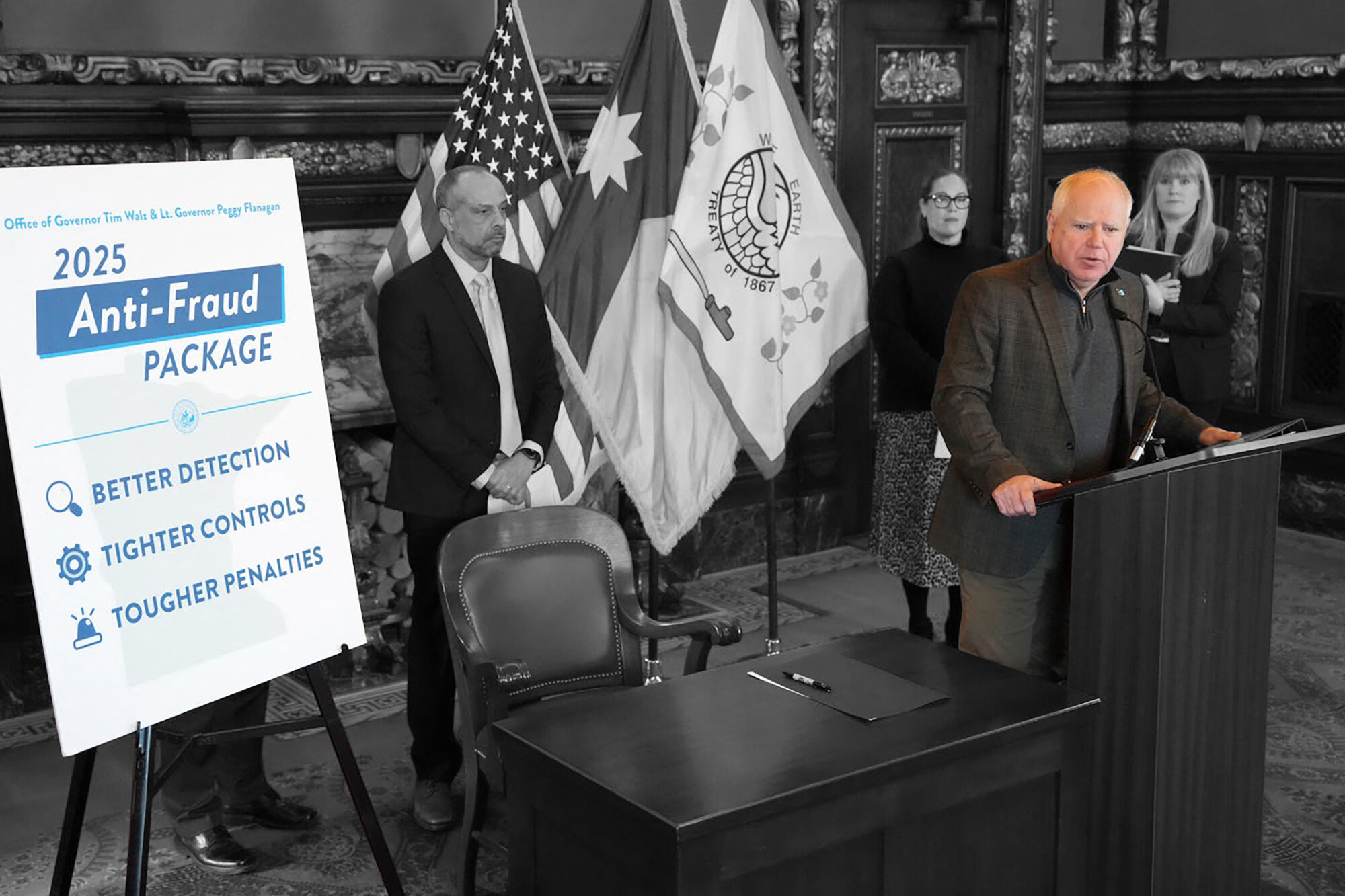
The Minnesota welfare-fraud controversy. Federal prosecutors have charged dozens of people with defrauding Minnesota social programs since 2020, and recent reporting has highlighted the links between the fraud schemes and the Somali-American community. In November, a report authored by Ryan Thorpe and Christopher Rufo and published in City Journal — a periodical funded by the conservative think tank The Manhattan Institute — highlighted the fraud’s concentration among the state’s Somali community and claimed the funds were partially directed to the Somali-based terrorist group Al-Shabaab. On Monday, Treasury Secretary Scott Bessent announced that the agency would be opening an investigation into Gov. Tim Walz’s (D) oversight of the programs beset by alleged fraud; the House Oversight Committee opened its own probe into the programs on Tuesday.
Back up: Minnesota has been dealing with a series of high-profile welfare-fraud cases, most notably the Feeding Our Future fraud scheme. Feeding Our Future was founded in 2016 to sponsor daycares and after-school programs to enroll in the Federal Child Nutrition Program, and it received $3.4 million in federal funding in its first year. However, the program massively expanded during the pandemic, taking in nearly $200 million in funding in 2021. Since then, more than 70 defendants have been charged with stealing over $250 million in federal nutrition funds. Additionally, Minnesota’s Medicaid Housing Stabilization Services program — launched in 2020 to help seniors, addicts, the disabled, and the mentally ill secure housing — was predicted to cost $2.6 million annually. Instead, payouts reached $21 million in 2021 and rose to $104 million in 2024. Federal prosecutors have been investigating the program, and two suspects have pleaded guilty of fraud as of November.
Lastly, the U.S. Attorney’s Office for the District of Minnesota is investigating the state’s Early Intensive Developmental and Behavioral Intervention (“EIDBI”) autism programs for potential fraud. In September, the U.S. Attorney announced its first charge in the EIDBI scheme, accusing a defendant of filing false support therapy services and defrauding the program of $14 million.
The City Journal report centered the fraud schemes perpetrated on Minnesota programs on the state’s roughly 80,000-person Somali community. Citing law enforcement officials, the report alleged that the defrauded funds were sent back to Somalia and ultimately accessed by the Sunni Islamist militant group Al-Shabaab. However, the report did not offer detailed proof to support its claim. “The bottom line is that we couldn’t substantiate it,” Legislative Auditor Judy Randall told the Minnesota Star Tribune.
In November, President Donald Trump announced that he intended to terminate temporary legal protections for Somali immigrants living in Minnesota (the legal protection is due to expire in March 2026). Trump then denigrated Somali immigrants living in the U.S. at the end of a cabinet meeting on Tuesday, saying “Their country stinks, and we don’t want them in our country.”
Meanwhile, many Democrats acknowledge the fraud but defend Minnesota’s Somali community and stress the lack of evidence to tie Al-Shabaab to the schemes. “Do not paint an entire group of people with that same brush… putting them at risk when there is no proof to do that,” Gov. Walz said. “But if you want to help us and you want to go after the criminals and make sure there’s no connection or find out where the money went, we welcome that.”
Today, we’ll look at what the left and right are saying about the allegations, as well as some writers from Minnesota, then Senior Editor Will Kaback gives his take.
What the left is saying.
- The left says the fraud cases highlight real issues but push back on attempts to frame Somali-Americans as collectively responsible.
- Others suggest the state can take straightforward steps to patch its benefits system.
In Bloomberg, Patricia Lopez said “we can stop fraud in Minnesota without attacking Somalis.”
“Minnesota has seen an extraordinary rash of fraud in taxpayer-funded programs recently. More than 70 people have been charged, including several Somalis. But one of the most important principles of law is that individuals are held accountable for individual behavior, not entire populations. To do otherwise risks making scapegoats of innocent people,” Lopez wrote. “Trump’s broadside against [Temporary Protected Status] may not even affect those Somalis accused of fraud. Only 400 or so individuals in the state still rely on TPS. Minnesota is home to the largest Somali community in the country, about 80,000 — a majority of whom are citizens or permanent residents.”
“The way to handle Minnesota’s real struggles with fraud is to find and bring to justice the actual perpetrators. America is never at our best when we tar an entire community with the crimes of a few individuals. During World War II, this country locked up thousands of Japanese lest some undermine the war effort,” Lopez said. “American Muslims endured years of suspicion in the wake of 9/11. If the Justice Department or USCIS finds evidence of fraud or wrongdoing in Minnesota’s Somali community, it should pursue that evidence wherever it leads. But judge individual cases on their merits.”
In Slow Boring, Halina Bennet wrote about “Minnesota’s long road to restitution.”
“Federal prosecutors say dozens of defendants, many of whom they identify as Somali Americans, created shell companies and submitted false invoices, diverting hundreds of millions of taxpayer dollars… But investigations are ongoing, and they reveal how oversight gaps allowed more than $1 billion in Minnesota taxpayer dollars to be stolen over the past five years,” Bennet said. “The Minnesota cases underscore a systems issue: Fraud thrives where oversight is minimal and enforcement is slow.”
“This summer, the state passed first-of-its-kind legislation creating a dedicated restitution fund for victims. Half of all money recovered from consumer-protection and fraud-enforcement actions must now be deposited into this account rather than the state’s general fund. The goal is to ensure that, to the extent that money is recovered, the victims are made as whole as possible,” Bennet wrote. “However, the fund doesn’t guarantee full recovery, especially for complex schemes. And of course when the victim is the government itself, the question of apportioning money between victims and the general fund doesn’t arise.”
What the right is saying.
- Many on the right view the fraud cases as a cautionary story about immigration.
- Others say the Somali-American community must work to root out fraud.
In City Journal, Christopher F. Rufo argued “the Somali fraud story busts liberal myths.”
“Minnesota has long prided itself on its generous welfare programs and reputation for good governance. But after the mass arrival of the new Somali population — many of whom brought with them different attitudes toward government and civil society — these programs became a weak point,” Rufo said. “The uncomfortable truth… is that all cultures are not equal. Therefore, not all cultures are compatible with all political systems. In this case, the Somali criminal enterprise is incompatible with a generous welfare state, particularly in the context of a racial politics that intimidates whistleblowers and other honest brokers.
“Though this story was particular to Minnesota, disruptive mass immigration is a national phenomenon. During the four years of the Biden administration, America imported millions of foreigners, many illegally. Some of these have brought, or are trying to bring, negative aspects of their home culture to the United States,” Rufo wrote. “The Trump administration claims to be on pace to ‘shatter’ records of forced deportations and so-called self-deportations, but more must be done. The administration should put financial restrictions on illegal immigrants, like requiring proof of legal status for maintaining a bank account; and implement massive remittance taxes to reduce the profitability of illegal immigration and fraud.”
In The Wall Street Journal, Jason L. Riley asked “can Minnesota’s Somalis rise above the fraud scandal?”
“Of those charged in the cases involving alleged fraud against meals, housing and autism programs, 78 of the 86 defendants are of Somali ancestry. Since the 1990s, when civil war broke out in the East African nation, Minnesota has welcomed tens of thousands of Somali refugees. Today the state’s Somali diaspora numbers about 80,000,” Riley said. “The massive fraud was an open secret. Merrick Garland, who served as U.S. attorney general under Joe Biden, called it the largest pandemic-relief hustle in the nation. Democratic state officials also suspected wrongdoing but didn’t want to upset an important voting bloc or be accused of racism.”
“It’s also true that Somalis are hardly the first migrant group to arrive in America with unwelcome cultural baggage. In the early 1900s, crime was so prevalent in New York’s Jewish and Italian neighborhoods that a specialized detective force was established,” Riley wrote. “These weren’t merely negative perceptions or ugly stereotypes, and fortunately these groups were willing to face reality… Cultures can adapt, but that will require confronting the problem rather than ignoring it or pretending that anyone who speaks out is acting in bad faith.”
What Minnesota writers are saying.
- Some Minnesotan writers argue the right is unfairly demonizing Somali-Americans.
- Others question how fraud of this scale could occur on Gov. Walz’s watch.
In The Minnesota Reformer, Kayseh Magan said “right-wing reporting on Somali money going to al-Shabaab is not new, still misses the mark.”
“I say this as an American of Somali ancestry who has investigated fraudsters and as someone who has written about it for the Reformer: I can’t prove a negative, but the story, especially in all its sensationalism, appears to be little more than an effort by the right-wing propaganda machine to whip up hatred against Somali Americans,” Magan wrote. “Over the past three years, federal prosecutors in Minnesota have charged 78 people in what they have called the largest pandemic relief fraud in the country… If federal prosecutors had any inkling that the ill-gotten gains were going to a terrorist organization, don’t you think they’d have brought charges?”
“The reality of the Somali-American experience is that we came to the U.S. in search of a better life. The vast majority of us are honest, law-abiding citizens, and have been appalled by those in our community who have preyed upon programs created to help low-income Minnesotans, including Somali Minnesotans,” Magan said. “Can more be done to root out fraud in Minnesota? Of course… I would also like to see fewer instances of Somali business owners reflexively organizing against measures designed to protect the integrity of our social programs. Regrettably, Thorpe and Rufo’s vulture journalism provides an opening to those who seek to dismiss the problem of fraud in Minnesota as right-wing demagoguery.”
In Alpha News, Patrick Knight, a Republican candidate for governor in Minnesota, asked “why so much fraud in Minnesota?”
“How did Minnesota get here? The state improperly disbursed hundreds of millions of dollars across multiple programs. The patterns are strikingly consistent. Ever increasing funds were released quickly to the same types of organizations, in similar locations, with minimal oversight, and almost all of it happened from 2020 to 2022,” Knight wrote. “It is hard to accept that a state bureaucracy with more than 55,000 employees and a biennial budget of $70 billion somehow lacked the basic controls that any private company would consider essential.”
“The most realistic explanation is culture. Specifically, it is a failure of leadership culture. In every organization, culture begins at the top,” Knight said. “The aftermath of George Floyd’s death created a wave of political emotion around social justice and equity. The Walz administration rode the wave and talked constantly about equity, commonly described as an effort to engineer equal outcomes and correct historical wrongs. In that environment, the ends were treated as more important than the means. The priority was to move money quickly to favored groups. Guardrails were treated as obstacles. Oversight was treated as an afterthought.”
My take.
Reminder: “My take” is a section where I give myself space to share my own personal opinion. If you have feedback, criticism or compliments, don't unsubscribe. Write in by replying to this email, or leave a comment.
- These fraud cases are a massive scandal for both Minnesota and the state’s Somali community.
- However, the proper response is not to exile all Somali-Americans.
- Instead, we should tighten up social welfare programs, aggressively prosecute fraudsters, and address barriers to Somali assimilation.
Senior Editor Will Kaback: The alleged crimes in these cases are shocking and infuriating. This isn’t just one fraud case; it’s several. It isn’t just a handful of bad actors; it’s dozens. It isn’t a low-grade ripoff; it’s over $1 billion stolen. Perhaps worst of all, these weren’t just any government funds; they were earmarked to help Minnesota’s most vulnerable people — children, the elderly, the homeless, and people with disabilities.
We don’t need to beat around the bush: These fraud cases have put a harsh spotlight on the Somali community in my home state of Minnesota, prompting difficult questions about whether that community has disproportionately abused the state’s social welfare system.
So, let’s talk about it.
First off, yes, the evidence indicates these crimes were concentrated among the Somali population. According to prosecutors, 78 of the 86 individuals charged so far in connection with the schemes have Somali ancestry, though most are American citizens. Not only that, but additional evidence suggests that Democratic leaders in Minnesota have been reluctant to confront that hard truth due to political and racial sensitivities. A 2024 report from Minnesota’s Office of the Legislative Auditor found that “the threat of legal consequences and negative media attention” affected how the Minnesota Department of Education approached fraud claims in the Feeding Our Future case. Some Somali-American Minnesotans have called out this dynamic more forcefully. “Fraudsters have also sought to exploit the burgeoning political power of the Somali community, and the feckless fear that establishment politicians and state agencies show when confronted with charges of racism or Islamophobia,” Kayseh Magan, a Somali-American former investigator in the Medicaid Fraud Division of the Office of the Minnesota Attorney General, wrote in 2024.
The evidence of this fraud supporting terrorist networks is much weaker. In their City Journal piece, Ryan Thorpe and Christopher Rufo claimed the stolen money was being funneled through Somali intermediaries to the Somalia-based militant group Al-Shabaab. However, this reporting has not been substantiated — and U.S. prosecutors have not brought any terror-related charges in their cases. Thorpe and Rufo don’t provide any paper trail or other evidence to show that this money ended up where they say it did, instead exporting this claim to law-enforcement officials who also did not provide objective evidence. This claim is disturbing and should be investigated further, but ultimately is still up in the air. As Minnesota’s Legislative Auditor Judy Randall said, “That doesn’t mean it didn’t happen, but it doesn’t mean it did happen. It’s just that there wasn’t enough evidence to definitively tie it.”
Even without that definitive link, the scale of fraud should put Minnesota’s Somali community under the microscope — as well as the state’s oversight methods. Much of this is not unique to Minnesota; Covid-era programs handed out billions of dollars from the federal government to support people during the pandemic shutdowns, creating a massive opportunity for fraud. The Pandemic Response Accountability Committee estimates that over $79 billion was stolen from pandemic-relief programs across the country. Something that is unique to Minnesota, however, is the level of social pressure created following George Floyd’s murder in 2020. The New York Times quoted a state prosecutor as saying that officials actively avoided bringing some cases for fear of allegations of racism. The state’s expanded social programs and culture of avoiding uncomfortable litigation created a breeding ground for potential fraud — add in an immigrant community from a country where fraud is commonplace, and this is the result.
If we’re being blunt about these uncomfortable questions, we should also be blunt about Christopher Rufo. Rufo has a history of inflaming culture-war issues to be maximally divisive, and his attempt to link Minnesota’s fraud to a Somali Islamist militant group fits that trend. His reporting seemed designed to grab the attention of President Trump and Vice President Vance, who are now leveraging this story to claim Somalis are incompatible with American values, that their culture is inferior, and that fraud is an emergent feature of that culture.
These are not dog whistles; they’re explicit positions. “Norwegians in Minnesota behave similarly to Norwegians in Norway; Somalis in Minnesota behave similarly to Somalis in Somalia,” Rufo wrote last week. “Many cultural patterns from Somalia — particularly clan networks, informal economies, and distrust of state institutions — travel with the diaspora and have shown up in Minnesota as well. In the absence of strong assimilation pressures, the fraud networks aren’t so surprising.”
Rufo raises some salient points. Somalia is a dangerous country whose ineffective governance has made it a hotbed for international fraud and piracy for years. Additionally, having grown up in Minnesota, I can attest that the Somali community often seemed isolated (or insulated) from the broader (mostly white) community. At the same time, the “Norwegians” Rufo refers to don’t present an apples-to-apples comparison. They trace their ancestry to Scandinavia, but they’ve been in the U.S. for generations (some Somalis charged in the fraud cases are second-generation Americans, but Rufo is still comparing them to people who have been in the U.S. for far longer). Cultural incompatibility is real but not permanent, and as writers like Jason L. Riley noted (under “What the right is saying”), U.S. history is rife with examples of migrant groups struggling to adapt when they first came to the country.
The solution that Rufo, Trump and others are proposing is to cut the cord, stop allowing Somali immigrants into the U.S., and seek to remove as many of those who are already here as possible. To me, that solution feels draconian and short-sighted. Research from the Minnesota Chamber of Commerce has shown that immigrants are upwardly mobile over time, with decreasing unemployment and poverty rates and increasing rates of workforce participation and educational attainment. This has been true of the Somali immigrant community, too: Between 2000 and 2018, their poverty rate dropped from 62.9% to 47.6%, their workforce participation rate rose from 46.1% to 66.4%, and their homeownership rate rose from 1.7% to 9.4%. Efforts to flatten this group into a caricature of dysfunction and criminality — in President Trump’s words, “They come from hell and they complain and do nothing but bitch” — ignore the evidence that the cultural assimilation they expect is happening. The process just takes time.
Simultaneously, the onus is also on the Somali community to recognize that these fraud cases are not one-off incidents. Kayseh Magan, the Somali-American fraud investigator, diagnosed the problem succinctly:
My experience as a fraud investigator has taught me that fraud occurs when desire meets opportunity. My community, like others, has its share of people who are poor, desperate and seek shortcuts. Many were skilled professionals whose experience and education credentials are not recognized in the U.S. As a result, they have had to resort to working menial jobs, which can be emotionally debilitating while failing to deliver financial security.
The solution, to me, is threefold: eliminate the opportunities for fraud, aggressively investigate and prosecute crimes as they happen, and tackle the root causes. The first solution requires Minnesota legislators to prioritize safeguards over generosity in the state’s robust social safety net. Some programs — like Medicaid Housing Stabilization Services — are now being scrapped entirely, and other blank-check programs should be subjected to enhanced scrutiny. Gov. Walz, clearly sensing his own political vulnerability, has now started down this path — but he started incredibly late, and the effort may require a new governor to carry out.
The second solution is also underway, as prosecutors continue to bring charges. That aggressive tack will need to continue, both to dissuade would-be fraudsters and to ensure we have a full accounting for the scale of the alleged crimes already committed.
The third solution requires confronting those in the Somali community who have sought to steal from a state (and country) that has already given them so much — and is far more challenging. Of course, that has to start within the community itself, and leaders like Magan offer a blueprint for how to properly assess the problem without demonizing the group as a whole. Other leaders, like Rep. Ilhan Omar (D), have taken the opposite approach, positioning themselves defiantly against the Trump administration while failing to acknowledge the real issues that these fraud cases have unearthed. I think that strategy ignores the justified anger that many people feel about this story and risks exacerbating the animosity toward Somali immigrants that’s now bubbling to the surface.
As with so many issues in today’s politics, stories like this are presented as a false binary: You either must side with Trump, Vance, and Rufo in viewing Somali immigrants as a communal drain on U.S. society that needs to be banished, or you must align with Ilhan Omar and decry any criticism of the Somali community as bigoted and unfair. Before we can undertake any of those solutions I outlined above, rejecting this binary is the essential first step to moving this conversation in a more productive direction.
Take the survey: What do you think of the Minnesota fraud schemes? Let us know.
Disagree? That's okay. My opinion is just one of many. Write in and let us know why, and we'll consider publishing your feedback.
Your questions, answered.
We're skipping the reader question today to give our main story some extra space. Want to have a question answered in the newsletter? You can reply to this email (it goes straight to our inbox) or fill out this form.
Under the radar.
The United States has recorded 17 mass killings so far in 2025, the lowest yearly total since 2006, according to a database maintained by The Associated Press and USA Today in partnership with Northeastern University. These events, defined as incidents in which four or more people are killed in a 24-hour period (not including the killer), are down 24% from 2024’s total, which itself was down 20% from 2023. Criminologists suggest that the decrease is less of an emerging trend and more a regression to the mean, noting that mass killings were unusually common in 2018 and 2019. However, some also say that improvements in the immediate response to mass shootings and other mass-casualty incidents could also be contributing to the decline. The Associated Press has the story.
The retirement playbook is changing.
Forty years of work, a house full of stuff, and crossing your fingers isn't the only path anymore.
Rich people are using specific strategies to retire years—even decades—earlier. The Penny Hoarder outlines six money moves you can copy today.
Numbers.
- $162 billion. The total amount of improper payments paid out by the federal government in fiscal year 2024, according to the Government Accountability Office.
- $1 billion. The total amount of money stolen across three fraud schemes in Minnesota, according to The New York Times.
- 78. The number of defendants charged in the Feeding Our Future fraud scheme as of November 24, 2025, according to the U.S. District Attorney’s office in Minnesota.
- $250 million. The total amount of money stolen in the Feeding Our Future fraud scheme, according to CBS News.
- $2.6 million. The predicted annual cost of Minnesota’s Housing Stability Services program before its inaugural year in 2021.
- $104 million. The total amount paid out by the program in 2024.
- 8. The number of defendants initially charged with defrauding the Housing Stability Services program.
- $14 million. The amount of money the Minnesota District Attorney has charged a defendant with defrauding from the EIDBI autism program.
The extras.
- One year ago today we covered the Hunter Biden pardon.
- The most clicked link in yesterday’s newsletter was the ruling that Alina Habba served as New Jersey’s top prosecutor illegally.
- Nothing to do with politics: How Helsinki, Finland, is completely preventing pedestrian deaths.
- Yesterday’s survey: 4,247 readers responded to our survey on U.S.–Venezuela relations with 43% saying it will probably escalate to a prolonged use of military force. “Illegal, immoral, uninformed,” one respondent said. “This is needed to make America safe,” said another.
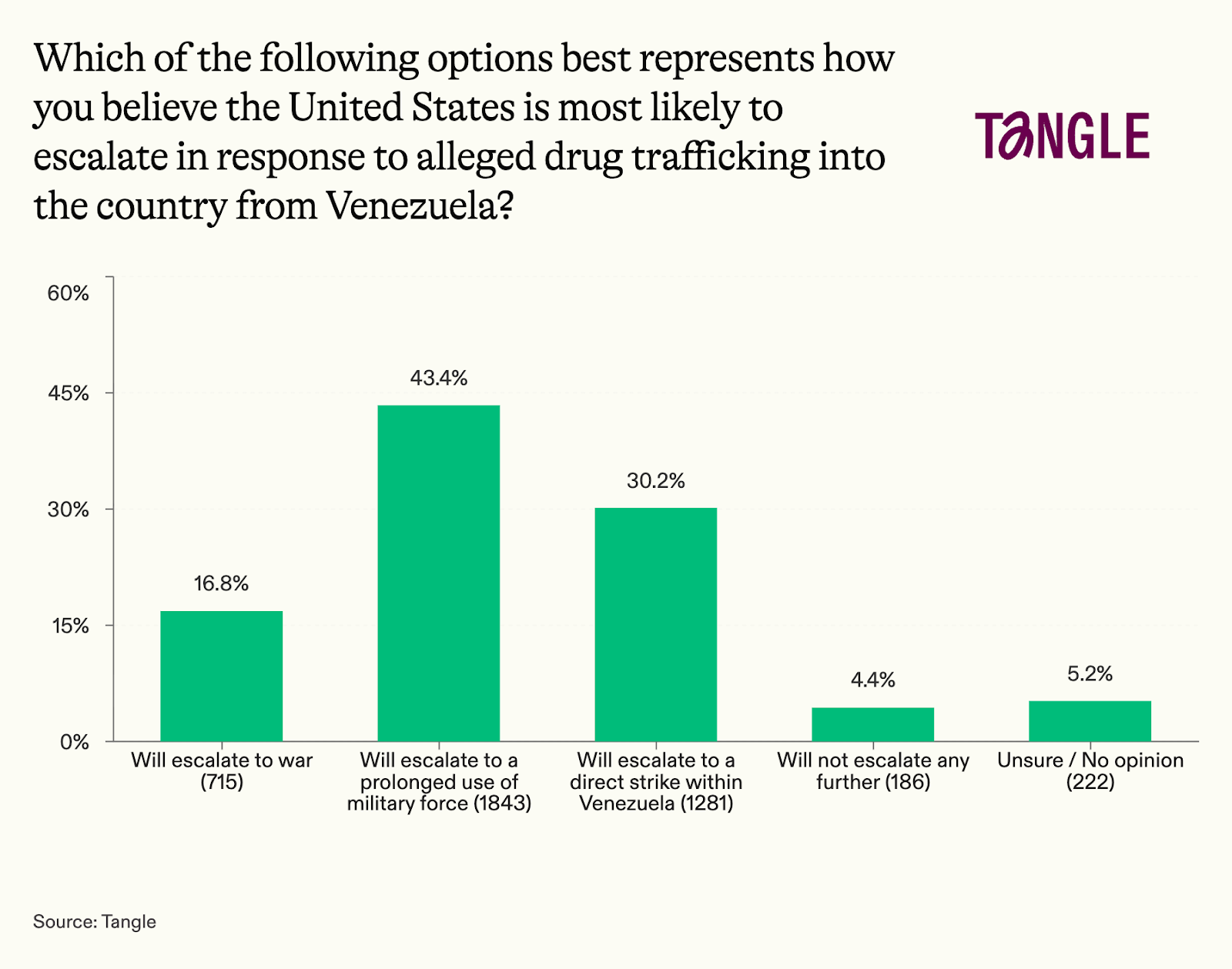
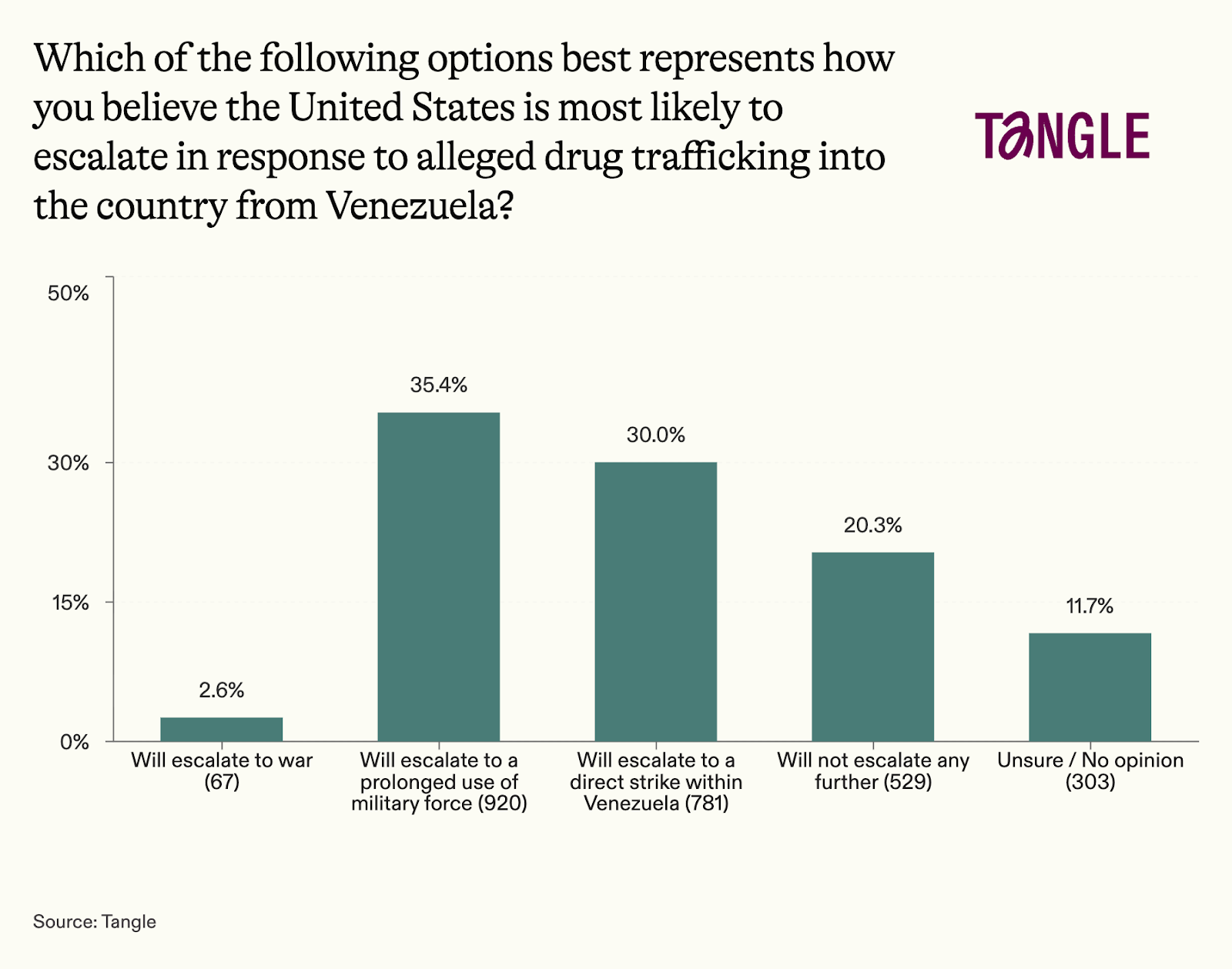
We asked our audience the same question on October 6. You can see how the results have shifted since then by comparing the above chart to the 2,600 responses represented below.
Have a nice day.
Researchers in Italy have discovered a striking social phenomenon they’ve dubbed “the Batman effect.” The researchers had a visibly pregnant woman board a busy train and counted how many passengers offered her their seats. Then, they repeated the experiment with a man dressed as Batman entering the train at the same time as the woman. They observed that 67% of passengers offered their seats when Batman was present, compared to roughly 37% when he wasn’t. At the same time, 44% of the people who offered their seats when Batman was present said they didn’t notice him on the train. “Unlike traditional mindfulness interventions that require active engagement, this study highlights how situational interruptions alone may be sufficient to produce similar effects,” Francesco Pagnini, the study’s lead author, said. Futurism has the story.

Member comments