
I'm Isaac Saul, and this is Tangle: an independent, nonpartisan, subscriber-supported politics newsletter that summarizes the best arguments from across the political spectrum on the news of the day — then “my take.”
Are you new here? Get free emails to your inbox daily. Would you rather listen? You can find our podcast here.
Today’s read: 15 minutes.
The Stories Breaking on TikTok Before They Hit CNN
By the time traditional news covers a story, it's already been shaped by someone else.
'Who Broke It' is a 3x/week newsletter that tracks the influencers and creators who actually move political narratives before mainstream outlets notice. Written by The Recount's Grace Weinstein, it breaks down how viral stories form, spread, and eventually land in the national conversation.
Think of it as your early warning system for understanding what's driving politics online—from coordinated misinformation campaigns to the psychological tactics that make content go viral.
If you've ever wondered "where did this talking point come from?"—this newsletter has your answer.
Correction.
In yesterday’s “Have a nice day” section, we incorrectly referred to the location in our featured story as Antler, South Dakota — Antler is located in North Dakota. We somehow published the error even though the person responsible for summarizing the story swears they wrote “North Dakota” and the section’s chief fact-checker insists they looked the town up on Google Maps. It’s a frustrating way to end our nearly two-month long error-free streak, but we don’t want to erase the Peace Garden State.
This is our 147th correction in Tangle’s 331-week history and our first correction since October 22. We track corrections and place them at the top of the newsletter in an effort to maximize transparency with readers.
Quick hits.
- The Trump administration said it has reached an agreement with seven states to resolve a challenge to the Biden administration’s student-loan repayment plan, the Saving on a Valuable Education program. The agreement will reportedly require the Education Department to halt new enrollments in the program, reject pending applications, and gradually remove current enrollees from the program. (The agreement)
- A federal judge granted a Justice Department motion to unseal the records of the grand jury investigation of Ghislaine Maxwell, a convicted sex offender and longtime associate of Jeffrey Epstein. (The motion)
- The Supreme Court heard arguments in National Republican Senatorial Committee v. Federal Election Commission, a case challenging the limits on what political parties can spend in coordination with candidates. (The arguments)
- Fighting between Thai and Cambodian forces continued along the border of the two countries after breaking out over the weekend. Cambodia’s military said seven civilians were killed and 20 wounded, while the Thai military said three of its soldiers had been killed. (The conflict)
- Australia’s social media ban for children under 16 went into effect, blocking access to platforms like TikTok, Meta, YouTube, and X. It is the first such ban to be implemented in the world. (The ban)
Today’s topic.
X versus the EU. On Friday, the European Commission (the executive arm of the European Union, or EU) announced that it is fining the social media company X $140 million for breaching transparency obligations under the Digital Services Act (DSA). The European Commission accused the U.S.-based social media company of deceptive use of its “blue checkmark” validation feature, lack of advertisement transparency, and failure to provide access to public data. X owner Elon Musk responded to the European Commission’s announcement of the fine by calling the post “Bullshit.”
Back up: Elon Musk, the CEO of SpaceX and Tesla, bought the social media application then called Twitter in 2022. Along with renaming the company, Musk introduced a number of changes to the online platform, including overhauling its verification system, shifting to paid subscriptions and introducing new features like long-form posts, AI-chatbot integration, and user location data. The changes reflect a pivot away from ad-driven revenue and toward subscriptions and AI integration, and the platform has drawn controversy from both users and regulators for allegedly proliferating a rise in bot activity and misinformation. Most recently, Brazil banned X from operating in the country in 2024, but its Supreme Court lifted the ban after X agreed to pay a $5.1 million fine and blocked accounts accused of spreading misinformation.
The EU passed the DSA in 2022 to regulate digital companies that operate within the EU’s jurisdiction, with specific rules for very large online platforms and search engines. Friday’s announcement marks the first major sanctions issued by the EU under the new legislation. The EU regulator said that, along with violating the law’s advertisement transparency provisions, X violated the DSA by deceiving users into believing accounts had been verified with its blue check system. “This deception exposes users to scams, including impersonation frauds, as well as other forms of manipulation by malicious actors,” the European Commission said.
X objects to the fine and says the EU is overreaching its authority by attempting to regulate a U.S.-based company. X Head of Product Nikita Bier accused the European Commission of taking advantage of an “exploit” in the platform’s advertising system in making its announcement and terminated its X account. On Saturday, Musk criticized the European Union further. “The EU should be abolished and sovereignty returned to individual countries, so that governments can better represent their people,” he posted on X.
The EU’s fine also drew the ire of top officials within the Trump administration. “The European Commission’s $140 million fine isn’t just an attack on X, it’s an attack on all American tech platforms and the American people by foreign governments,” Secretary of State Marco Rubio posted on X after the fine was announced. The European Commission defended the fine, saying it represented compliance with its law and not censorship.
We’ll cover what the left, right, and European writers are saying about the battle between the EU and X below before Executive Editor Isaac Saul gives his take.
What the left is saying.
- Many on the left say X’s fine is for straightforward infractions, not censorship.
- Others suggest the EU went too light on the platform for fear of political blowback.
In Tech Policy Press, Daphne Keller argued the fine “is not about speech or ‘censorship.’”
“Don't let anyone — not even the United States Secretary of State — tell you that the European Commission's €120 million enforcement against Elon Musk’s X under the Digital Service Act (DSA) is about censorship or about what speech users can post on the platform,” Keller wrote. “The ‘blue checks’ charge is about consumer deception. X changed the rules about how it does verification in a way that allowed impersonation and scams to flourish. It’s kind of like if a grocery store said it had vetted all the produce in its special ‘blue check’ section for worms — but then once consumers started relying on that, it actually stopped checking.”
“The ‘ads transparency’ charge stems from the DSA’s requirement that platforms must maintain a public archive showing what ads the platform ran, who paid for them, and other information. X fell drastically short of meeting this requirement, according to EU investigators… The third thing the EU penalized X for is not giving researchers better access to public data,” Keller said. “The fine announced today is important, mostly because it answers longstanding questions about how aggressively the Commission would enforce the DSA in the current transatlantic political climate. But it is also not remotely surprising, given how clearly X was violating some pretty basic legal requirements.”
In Bloomberg, Parmy Olson said “Musk’s $140 million fine shows the EU is losing its nerve.”
“X’s descent into a racist, politically radical hellscape fueled by porn in recent years is the predictable outcome of chronic opacity and deliberate obfuscation. X misled users by monetizing its blue checkmarks so anyone could become ‘verified.’ It blocked independent researchers from accessing public data and charged prohibitive fees for limited Application Programming Interface access, making it nearly impossible to study misinformation patterns, according to the Commission’s findings,” Olson wrote. “And the company declined to maintain a searchable, reliable advertising database too, obscuring who was paying what to influence public discourse.”
“The penalty could have been much bigger. The Commission had originally considered calculating a fine based on Musk’s entire private company portfolio, or what the Commission called the Musk Group… To have abandoned a higher number after a two-year investigation suggests the EU is pulling its punches,” Olson said. “X was the European Union’s first probe under its other new law addressing harmful online content… Now Europe’s handling of this initial case sets the template for its enforcement against TikTok, Meta and others — and its weak response to Musk threatens to undermine the entire regulatory framework.”
What the right is saying.
- Many on the right see the fine as the EU’s latest assault on free speech standards.
- Others suggest Musk is being targeted for his political leanings.
The Free Press’s editors wrote “Europe’s censors put a price on dissent.”
“The stated reasons for the fine are a lack of transparency, a violation of advertising rules, and misleading users with ‘deceptive’ design. The real reasons have little to do with those allegations, and everything to do with the kind of speech the EU wants to suppress: perspectives that have not been filtered through bureaucrats, academics, or media professionals; views that go against the received wisdom of policymakers; and views that have not been vetted and found to be acceptable by governments,” the editors said. “The heart of what the EU is investigating is the content that gets posted on X.”
“That was what the EU itself said when it started its Digital Services Act investigation, announcing that it would focus on ‘the spreading of terrorist and violent content and hate speech,’” the editors wrote. “The stakes here are much larger than the fine that the EU wants Musk and X to pay. For the U.S. or American corporations to give in to these kinds of demands would invite nonstop extortion from foreign mandarins. Europe’s aim is not to change the color of X’s check marks. It is to make it more expensive for U.S. companies to allow speech than to restrict it. And not only speech in Europe, but across the world.”
The Wall Street Journal editorial board criticized “Europe’s foolish war on X.com.”
“Brussels insists X must make data about advertising on the platform readily available to outsiders, and shouldn’t use its terms of service to prohibit data scraping by ‘eligible researchers.’ The EU claims this open access to X’s commercial data is vital to allow researchers and ‘civil society’ to spot scams and information warfare,” the board said. “That reference to ‘civil society’ is a tell. Brussels wants to force X (and inevitably other platforms) to share data that hostile activists can wield against the platforms in future regulatory actions or litigation. All based on a theory that European citizens are too dumb to take the things they read on X or elsewhere online with a grain of salt.”
“Mr. Musk has become a thorn in the side of many European politicians with his support for insurgent movements in many countries, sometimes to good effect and sometimes for ill. Insurgent politicians are highly effective at using X and other social media to spread their messages. This makes X an inviting target in Brussels,” the board wrote. “Europe can’t afford any of this — not the censorship of Europeans’ own political speech, not the diplomatic battle with Washington, not the war on economically vital data and technology. Earth to Brussels: Are you awake?”
What European writers are saying.
- Some European writers see the backlash to the fine as part of U.S. conservatives’ growing attacks on Europe.
- Other writers argue the EU is clearly attempting to suppress conservative voices.
In The Times, Katy Balls asked “what’s behind the Trump administration’s ideological assault on the EU?”
“In February, JD Vance used his Munich Security Conference speech to launch an ideological assault on Europe. This month Elon Musk said the EU should be ‘abolished’ after its executive branch issued a $140 million fine against Musk’s social media platform,” Balls wrote. “Some Republicans say this all comes from a good place — it’s because they care and stems from anglophilia, a feeling of shared values. As Trump put it this week when asked about the X fine Musk is facing: ‘Look, Europe has to be very careful. They’re doing a lot of things. We want to keep Europe “Europe.”’”
“But it’s also a useful political device — talking up Britain and Europe as lost lands could act as a way of warning Americans what might happen if they allow the left to govern again. How much European leaders have to worry remains in the air. Republicans in Congress could limit some of the powers of the administration on issues like troop withdrawal. Also, if the polls and recent elections are anything to go by, the Democrats could be finding a path to recovery before 2028,” Balls said. “But make no mistake: if the populist right stays in power, the criticism (and likely actions) will only harden after Trump leaves office.”
In The European Conservative, Lauren Smith wrote “the EU’s censorship regime is coming for X — again.”
“European Commission tech chief Henna Virkkunen maintains that the ‘DSA is having nothing to do with censorship,’ but it’s hard to imagine what else it could be. We need only look at Musk’s previous skirmishes with the EU to see that the DSA is clearly intended to have a chilling effect on free speech online,” Smith said. “Ahead of last year’s U.S. presidential race, then-internal market commissioner Thierry Breton cautioned Musk that streaming his planned Donald Trump interview on X might breach the DSA. That could expose the platform to massive penalties — even the risk of being shut out of the EU entirely.”
“Anyone who has been paying attention since the DSA came into force in 2022 will know that this law is far from neutral. Rather, it has routinely been weaponised against the EU’s critics — especially from the Right,” Smith wrote. “Just look at how the DSA handles elections and ‘crisis’ moments. The Commission’s election-risk guidance asks very large platforms to anticipate and mitigate threats to electoral processes and civic discourse during specific campaign periods. This effectively pushes them to pre-empt ‘information manipulation’ before it spreads, and inevitably catches lawful but politically inconvenient views.”
My take.
Reminder: “My take” is a section where we give ourselves space to share a personal opinion. If you have feedback, criticism or compliments, don't unsubscribe. Write in by replying to this email, or leave a comment.
- I’m no X apologist, but I think the EU is overreaching here.
- Europe is essentially attempting to regulate a U.S. company through a broad law ripe for uneven application.
- Musk is right to resist and call out Europe’s climate of censorship.
Executive Editor Isaac Saul: I have no love lost for X.
When I started my career in journalism, Twitter was my favorite social media application — it was an awesome way to debate smart people in public and get immediate breaking news from anywhere. But over the last few years, the platform has gone through a rollercoaster of ups and downs. When it throttled the Hunter Biden laptop story and disingenuously framed it as Russian propaganda, I strongly criticized it. When Elon Musk was supposed to join the board, I supported his push to add ideological diversity to the platform. When Musk bought the platform outright, I worried about the richest man in the world forcing the purchase of such a critical source of information. When Musk began very obviously thumbing the algorithmic scale to promote his worldview and selectively nuked accounts, I — again — vocally criticized the platform.
Today, X is a cesspool. It is overrun with bots, misinformation, porn, and bigotry. The community notes system remains helpful but is far too slow to be effective in reining in misinformation. Too many users delegate their thinking to the AI chatbot Grok, which is clearly an unreliable arm of Musk’s own beliefs; Elon himself promised to “fix” it when it started giving answers he didn’t like.
Which is all just to say: I’m not some X loyalist, even though I once believed in Musk and once loved the platform. And yet, I also think Europe’s enforcement of these rules — and its trajectory more broadly — is deeply concerning.
Whenever we cover the Trump administration, we often face the criticism that you can’t look at the president’s individual actions in a vacuum but have to look at the whole. That’s fair — fitting pieces together shows a more complete picture, which was the underpinning of my piece, “Yes, things are pretty bad right now.” The fundamental context of this enforcement, which has to be explicated up front, is that Europe is backsliding in genuinely horrifying ways on speech rights. The Digital Services Act is the latest government overreach, but it’s part of a frightening trend.
In the UK, thousands of people are being arrested each year for statements on social media. In Germany, online “hate speech” can bring the police to your door, and politicians can sue Germans for criticizing them. In France, laws narrowing online rights have proliferated. We see these attacks on speech pop up in the U.S. (from the left and right), but they are much rarer and face far more backlash. In Europe, the DSA is an important piece of this picture — an enforcement mechanism not just for the continent, but apparently the globe. And this fine is its first major enforcement.
Remember that last year, before the U.S. presidential race, then-Commissioner Thierry Breton threatened Musk, telling him that live-streaming an interview with Donald Trump on X could violate the DSA. Months ago, Musk alleged that the EU’s bureaucratic arm was offering him a “secret deal” to drop the case in exchange for the platform censoring some forms of speech (Musk didn’t specify, but the claim seems more plausible after the EU struck deals with TikTok and Facebook). All of this makes the criticisms Vice President JD Vance and Musk have leveled at Europe much more plausible; they are our allies and democratic peers, but if these kinds of draconian stances on speech spread to the United States, they could cause social upheaval.
All of this is the context leading to the EU’s fine. And X’s supposed transgression? First, its blue-check policy purportedly violates the DSA because it might confuse users about which accounts are “verified.” The symbol represented external identity verification years ago, but the platform has not been ambiguous about how to get a verification check mark now: You pay for it. I hate this change, and I think it’s partially how Musk ruined the platform. But am I confused about what that check mark means? No, I’m not — and I don’t think many users are. And do I think it should be illegal for a private company to change this feature? No, I don’t.
X’s second alleged crime is that it has not met the DSA’s standard for advertising transparency. The DSA requires companies to maintain an easily searchable, publicly available archive of who bought ads, what the ads’ content was, who the ads targeted, the legal name of the person (including companies) paying for the ad, and how many users the ad reached — among other things. Easily tracking how money flows on a platform like X has clear upside, but demanding that data be widely accessible is an incredible overreach. Advertising data is exactly the kind of proprietary information that makes X valuable; and, for advertisers, it’s the kind of thing you intentionally keep private to have an advantage on your competition.
Which, by the way, means that this action supposedly targeting a tech behemoth will have consequences for countless smaller players. For example, if my team came up with a brilliant strategy to advertise Tangle on X, I wouldn’t want our timing, location, and price points to be shared widely for our competitors to mimic or steal. Yet this is what the DSA demands of X.
The allegation is that X is not meeting the DSA’s transparency requirements because it's too hard for researchers to access data posted publicly on the platform. Specifically, the EU claims X’s terms of service forbid researchers from using a method called “scraping” to access public data (using scripts that visit webpages and get relevant information from the site’s html) and that it puts up bureaucratic hurdles and delays for researchers who want to access that data through permitted channels. At base, I feel that X is within its rights here on the terms of service; if Tangle became the most read news outlet in the world and researchers wanted to scrape our comments section to study our readers, I think I should be able to make that more difficult in our terms of service.
But putting aside the question of why these researchers should have the right to access data managed by a private company, the complaint itself seems like an incredibly subjective standard ripe for abuse. Some commentators defending the DSA argued that this law was similar to the U.S. Platform Accountability and Transparency Act (PATA), which was introduced on a bipartisan basis in 2023. The difference, obviously, is that PATA is a narrow regulation (that, also, didn’t become law), not a part of a massive regulatory framework empowering an oversight commission to fine or shut down platforms. Under the DSA, the EU can ignore difficulties posed by one company while easily tacking on a claim that another made accessing data “too hard” to some other allegations — which, in my opinion, is happening here.
Has X violated the DSA? The EU says yes, and maybe they did; we haven’t seen the evidence, and X hasn’t yet had the opportunity to defend itself (they could appeal, but it’s not clear they will). Even presuming X violated the rules, though, the issue isn’t X’s policies — it’s the law itself.
In Tech Policy Press, Daphne Keller (under “What the left is saying”) summed all this up with a cheeky, “That's it! That's everything X is in trouble for under the DSA, at least for now.” But that’s not it. The same law being enforced now also gives the EU enforcement power to compel companies like X to hand over internal data, which Keller herself acknowledges just sentences before. Plus, Europe has two other investigations open against X, including one for illegal content under the DSA, which would open the door to the EU restricting speech that is legal in the U.S. Now, X has three months to hand over an action plan explaining how it will address these “infringements,” all while facing other open investigations, or pay a potential $140 million fine.
Perhaps, for people who loathe X, are furious at Musk and despise online hate speech (I’m all three!), it feels nice to watch someone throw a punch at the platform. But trust me when I say: We should not want any government in charge of regulating speech in the modern-day public square — but especially not these governments. In Germany, insulting a politician can get you three years in prison. In France, a woman is on trial and facing a $14,000 fine for calling Emmanuel Macron “filth” in a Facebook post. Believing this enforcement against a U.S. tech company has nothing to do with speech rights requires head-in-the-sand levels of denial, no different than thinking Trump’s test run of National Guard troops in D.C. wasn’t going to be expanded across the country.
At the very least, we should all be deeply alarmed that a European enforcement agency, some of whose members won’t tolerate insulting public officials, is now reaching into the U.S. to dictate how a major social media platform here is run. If we’re lucky, X will fight and win — not because they’re the good guys, but because they have every right to run a crappy, hard-to-analyze platform full of angry, imbittered users if that’s what they want to do.
Take the survey: Do you think the EU’s enforcement is an overreach, or appropriate? Let us know.
Disagree? That's okay. Our opinion is just one of many. Write in and let us know why, and we'll consider publishing your feedback.
Your questions, answered.
We're skipping the reader question today to give our main story — and staff dissents — some extra space. Want to have a question answered in the newsletter? You can reply to this email (it goes straight to our inbox) or fill out this form.
Under the radar.
On Thursday, the Journal of the American Medical Association Network published the results of a large-scale study in France on the safety and efficacy of mRNA Covid-19 vaccines. The study followed 22.7 million vaccinated individuals and 5.9 million unvaccinated individuals for approximately four years and found that the vaccinated group had a 74% lower risk of death from severe Covid-19 and a 25% lower risk of death of any cause. Separately, the vaccinated group was 15% less likely to be diagnosed with cancer than the unvaccinated group. The study’s authors said the results offer significant new support for the safety of these vaccines, with potential applications beyond Covid-19. Reason has the story.
Where Do Viral Political Narratives Actually Start?
By the time CNN covers a story, it's already been shaped online.
Who Broke It tracks the influencers and creators who move the discourse first—breaking down how narratives form and go viral before hitting mainstream news.
Written by The Recount's Grace Weinstein. 100% Free.
Numbers.
- 539. The number of European Parliament members who voted in favor of the Digital Services Act (DSA) in July 2022.
- 54. The number of European Parliament members who voted against the DSA.
- 6%. The maximum percent of a company’s global revenue that the European Union (EU) can fine for violations of the DSA.
- 90. The number of days X has to implement changes to address issues flagged by the EU in its fine, or risk additional penalties.
- $232 million. The approximate amount that the EU fined Meta in July for alleged antitrust violations.
- $580 million. The approximate amount that the EU fined Apple in July for alleged antitrust violations.
- 63%, 59%, and 49%. The percentage of citizens in France, Germany and Spain, respectively, who say the EU’s enforcement of laws addressing Big Tech’s influence and power is too relaxed, according to a March 2025 YouGov survey.
- 7%, 8%, and 9%. The percentage of citizens in France, Germany and Spain, respectively, who say the EU’s enforcement of laws addressing Big Tech’s influence and power is too strict.
The extras.
- One year ago today we wrote about the fall of Assad in Syria.
- The most clicked link in yesterday’s newsletter was the earthquake and tsunami in Japan.
- Nothing to do with politics: A six-year-old’s letter to Santa in 1883.
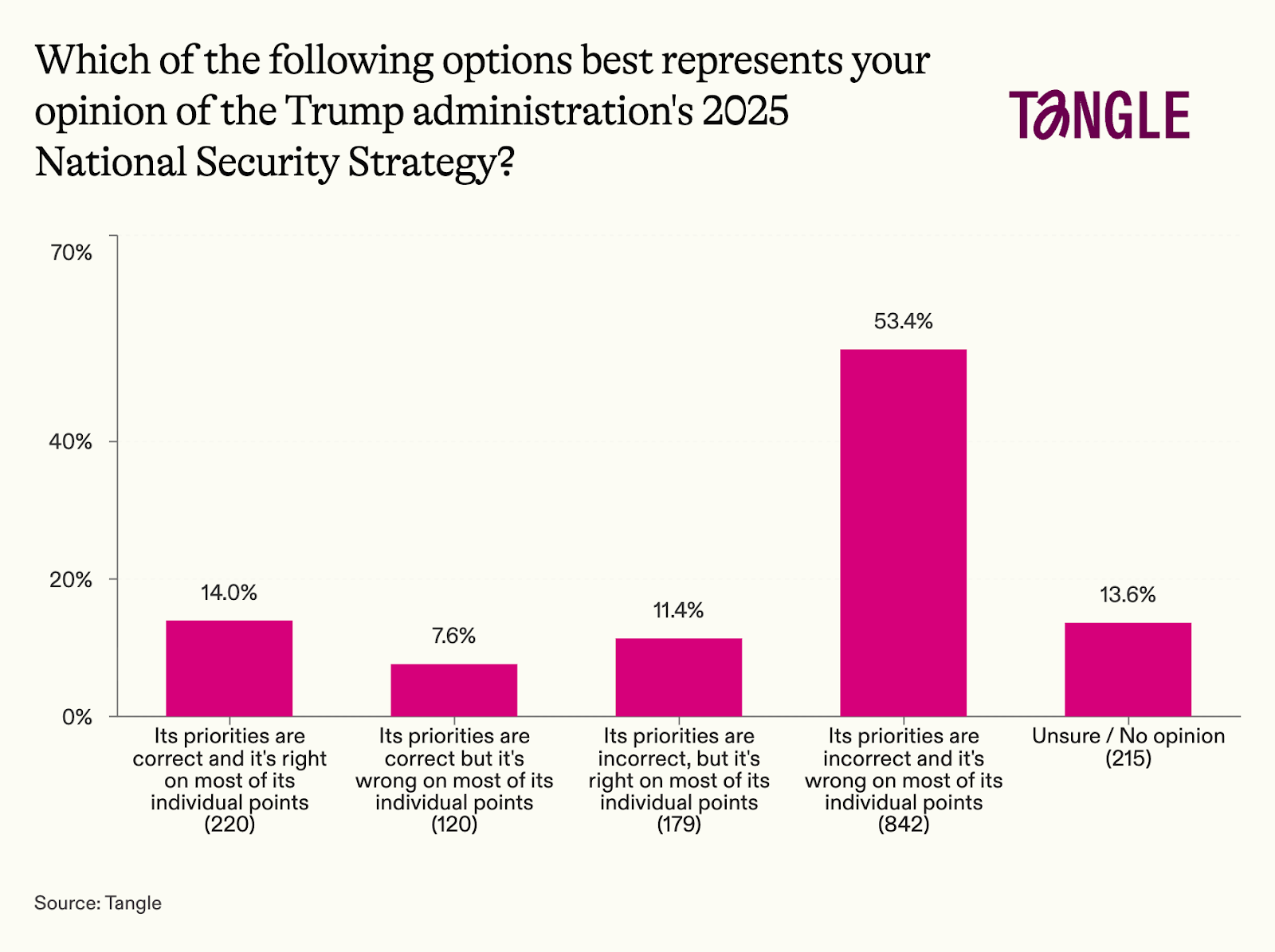
- Yesterday’s survey: 1,576 readers responded to our survey on the latest National Security Strategy with 53% disagreeing with both its priorities and individual points. “It doesn’t read as a coherent document,” one respondent said. “Have the past strategies worked? Mostly no, so a new approach is necessary,” said another.
Have a nice day.
While traveling for work in 2022, TV host and nursing mother Emily Calandrelli faced a problem: a frozen gel pack she needed to store her breastmilk had thawed, and the TSA told her to throw it out or check it. After sharing her story online, Calandrelli learned that she wasn’t the only mother who’d faced similar problems with the TSA — and that these problems sometimes threatened women’s health and the safety of their breastmilk. She began lobbying Congress for clearer protocol that would protect women’s ability to travel in airports with breastfeeding equipment. Her activism gained traction and eventually produced the bipartisan BABES Enhancement Act, which passed Congress with unanimous support and was signed into law in late November. Forbes has the story.

Member comments