
I'm Isaac Saul, and this is Tangle: an independent, nonpartisan, subscriber-supported politics newsletter that summarizes the best arguments from across the political spectrum on the news of the day — then “my take.”
Are you new here? Get free emails to your inbox daily. Would you rather listen? You can find our podcast here.
Today’s read: 16 minutes.
Unknown Number Calling? It’s Not Random.
The BBC caught scam call center workers on hidden cameras as they laughed at the people they were tricking.
One worker bragged about making $250k from victims. The disturbing truth? Scammers don’t pick phone numbers at random. They buy your data from brokers.
Once your data is out there, it’s not just calls. It’s phishing, impersonation, and identity theft.
That’s why we recommend Incogni: They delete your info from the web, monitor and follow up automatically, and continue to erase data as new risks appear.
Try Incogni here and get 55% off your subscription with code TANGLE.
*Our sponsors help keep Tangle free — thank you for supporting them when you can.
Want live coverage of tonight’s elections?
We will be back in your inbox tomorrow at noon to unpack the results of this evening’s elections, but if you want up-to-the-minute updates tonight, we have resources for you as well.
Follow us on Instagram for race analysis and clips of candidates’ victory speeches.
Follow us on X or BlueSky for the latest results and updates.
If you’d rather receive text updates, join us on Subtext by clicking here or texting TANGLE to (850) 338-9163. Once you’ve signed up, text us ELECTION25 to receive updates on the biggest races.
Quick hits.
- Former Vice President Dick Cheney, who served in the George W. Bush administration, died at age 84. Cheney’s family said his death was the result of complications of pneumonia and cardiac and vascular disease. (The death)
- The Trump administration said it will use emergency funds to cover approximately half of the monthly payments for the Supplemental Nutrition Assistance Program (SNAP), which had its funding lapse on Saturday. (The coverage)
- Two U.S. citizens were arrested in Michigan for allegedly planning a terrorist attack on Halloween. The Justice Department said the two men and three other co-conspirators aimed to carry out an ISIS-style attack, and the Federal Bureau of Investigation said its agents found multiple AR-15-style rifles in the suspects’ homes. (The arrests)
- Artificial intelligence company OpenAI announced it will buy $38 billion in cloud-computing services from Amazon over the next seven years to help build and deploy its AI products, such as ChatGPT. (The announcement)
- A group of state attorneys general sued the Trump administration over its new rule restricting eligibility for the Public Service Loan Forgiveness program. The rule changes the definition of a “qualified employer,” saying that organizations deemed to “engage in unlawful activities” such as “supporting terrorism and aiding and abetting illegal immigration” will not be eligible for the program. (The suit)
Today’s topic.
The key 2025 races. Today is election day in the United States, with voters in cities and states across the country deciding on a host of key elections and ballot measures. Some races, like the New York City mayoral election, have been in the national spotlight for months; others, like the Pennsylvania Supreme Court retention elections, have flown under the radar but could be nationally impactful for years to come.
These elections won’t determine control of Congress (we’re still a year out from that), but they do offer the first opportunity to gauge the mood of voters as we near the one-year mark of the second Trump administration. Will the momentum that swept Trump to a decisive victory and Republican control of the House and Senate continue? Or will voters express their dissatisfaction with the state of the country? Will victories from ascendant progressives like Zohran Mamdani provide Democrats with a sense of direction for the remainder of Trump’s term? Or will the party continue its struggle to regroup after last year’s losses?
Today, we’re publishing a special edition exploring these critical elections. We’ll break from our normal format to give each one proper attention — sharing a brief overview of each race, two divergent perspectives on it, and a bit of our own analysis as voters head to the polls. At the end, we’ll also share several important ballot initiatives. Then, tomorrow, we’ll follow up with a breakdown of what happened in each race and the implications of those results.
The New York City mayoral election.
Race Overview
In New York City, State Assemblyman Zohran Mamdani (D) is polling ahead of former Governor Andrew Cuomo and Republican candidate Curtis Sliwa in the race for mayor. Mamdani, a 34-year-old Democratic Socialist, garnered headlines for winning the Democratic nomination on the backs of a massive social media campaign and a relentless focus on affordability in the city. He campaigned on freezing rent and launching programs for free childcare, free city buses, and government-run grocery stores.
Cuomo, who lost to Mamdani in the Democratic primary, returned for the general election as an independent candidate. Both Cuomo and Sliwa have centered their campaigns on public safety and criticized Mamdani for making unrealistic promises while accusing him of associating with far-left political groups and Islamic extremism.
Current mayor Eric Adams suspended his campaign to endorse Cuomo, but dropped out too late to be removed from the ballot. President Trump endorsed Cuomo on Monday night, saying voters have “no choice” but to support him.
The latest Atlas poll shows Mamdani at 43.9%, Cuomo at 39.4%, and Sliwa at 15.5%.
One View on the Race
The New York Post editorial board warned against voting for Sliwa, calling it a “vote for Mamdani.”
“The math is ruthlessly clear: Zohran Mamdani is unlikely to cross the 50% line, because most voters disagree with him on all his chief issues,” the board said. “His extreme views appeal only to a band of loud and energized extremists, but ultimately they have a low ceiling of support… If Sliwa voters get behind Andrew Cuomo, they stand an 11th-hour fighting chance of preventing the city from being flattened by the oncoming progressive train.”
“Doing nothing is also not an option,” the board wrote. “Cuomo will need those reluctant to cast him their vote to turn up. Given the margins, he would need every single vote… Sliwa can’t win, so the choice is exactly what President Donald Trump described Monday night, telling voters they ‘must vote for’ Cuomo.”
A Different View
In The Guardian, Margaret Sullivan said “it’s clear why Zohran Mamdani is leading.”
“Mamdani energizes people and while some of that reaction is skeptical, a lot of the people I encounter — from students to seniors — want to give the newcomer a chance,” Sullivan said. “New York City, after all, is unaffordable for too many, so Mamdani’s relentless focus on the cost of rent and groceries has struck a nerve. Mamdani’s embrace of his Muslim faith, his advocacy for Gaza and his willingness to stand up for immigrants has solidified his appeal.”
“Governor Kathy Hochul, whose political instincts are well-honed and practical, endorsed Mamdani in mid-September despite significant policy differences,” Sullivan wrote. “She surely has calculated that it wouldn’t be a bad thing to have the Democratic mayor of New York City in her corner. And there is little doubt who that will be.”
What We’re Watching
Mamdani has been in control since winning the Democratic primary in June, but the race has tightened in recent weeks. The biggest open question is how many Republican-aligned voters in New York will cast a ballot for Sliwa versus how many will hold their noses and vote for Cuomo, who oversaw Covid-era lockdowns that made him a pariah on the right. If Mamdani wins, as we expect him to, it’ll be interesting to see whether the Democratic establishment embraces him and how much Republicans target his Democratic Socialist views at the national level.
The New Jersey gubernatorial election.
Overview
In New Jersey, Democratic U.S. Rep. Mikie Sherrill is running against Republican former New Jersey Rep. Jack Ciattarelli to succeed Gov. Phil Murphy (D), who cannot serve more than two terms consecutively. Affordability has been a central issue of the race; Ciattarelli has campaigned on cutting taxes, and Sherrill has promised to lower housing, healthcare, and utility costs.
New Jersey is a traditionally Democratic stronghold, but strong results for Republicans in 2024 make this race a referendum on national issues and an indicator of the state’s political future. The latest polls show Sherrill with a four-to-five-point edge over Ciattarelli, tightening to within the margin of error.
Recently, Sherrill has benefited from endorsements and rallies with prominent Democratic leaders, such as former President Barack Obama. Meanwhile, President Trump has virtually stumped for Ciattarelli, but has not tied himself too closely to the Republican’s candidacy. Both parties will have collectively spent over $200 million on the race by election day.
One View on the Race
In The Washington Post, Karen Tumulty wrote that Sherrill “points the way for Democrats.”
“No doubt, part of the Democratic resurgence was fueled by record spending by the candidates and outside groups. But Sherrill, the only woman running for New Jersey governor in either party, is also a politician of rare talents and with a dazzling life story,” Tumulty said. “She is a U.S. Naval Academy graduate who piloted helicopters on missions in Europe and the Middle East and a former federal prosecutor who holds a degree from the London School of Economics.”
“As a gubernatorial candidate, Sherrill has focused heavily on making life in New Jersey more affordable. But she rejects the advice from some that Democrats should be running exclusively on kitchen table issues,” Tumulty wrote. “Trump will loom heavily in the race… How well [Sherrill] does may also spell what lies in the future for her party.”
A Different View
Writing for NJ.com, Tom Martello predicted that “Jack Ciattarelli will win.”
“Jack Ciattarelli, the Republican candidate for governor, could very well be the guy who brings such unbridled joy to the GOP in New Jersey and across the nation on Tuesday. And nobody would crow more about it than Donald Trump,” Martello said. “You can’t find anyone in Jersey politics who would dispute this: Take Trump out of the equation, and Ciattarelli wins in a landslide.”
“And, at least from my perspective, Jack has an X-factor that isn’t necessarily showing up in the polling, and is being undervalued by many pundits. He has been campaigning non-stop for years,” Martello wrote. “Republicans anxious that the poll numbers haven’t budged still hope all those handshakes and appearances could move the needle just enough in Ciattarelli’s favor. In a world where we are so disconnected, will a quick chat with Jack a few months ago persuade voters who can’t make heads or tails over all those negative ads?”
What We’re Watching
This gubernatorial election is one of only two this cycle, and it will serve as a bellwether for the country’s political mood nine months into Trump’s presidency. Vice President Kamala Harris carried New Jersey by six points in 2024, which showed a huge rightward shift from President Joe Biden’s 16-point win in 2020. Sherrill continues to hold a polling lead, but if Ciattarelli can win this election — or even just improve on Trump’s 2024 performance — that will provide a strong indicator that the national electorate is shifting rightward. An especially important demographic will be Latino voters, who comprise a growing portion of the Garden State’s electorate and are showing a conservative lean nationally.
The Virginia gubernatorial and attorney general elections.
Overview
Former Rep. Abigail Spanberger (D) and Lieutenant Gov. Winsome Earle-Sears (R) are running to become Virginia’s first female governor. They seek to replace Republican Gov. Glenn Youngkin, who is barred from seeking a consecutive term under Virginia law. No single issue has defined the race, but important topics have been abortion access, policies affecting transgender youth, and federal workforce cuts. In the blue-shifting former swing state, the party that controls the presidency has only won the governorship once since 1976, a trend Spanberger hopes to continue.
Meanwhile, the attorney general race between former Delegate Jay Jones (D) and incumbent Attorney General Jason Miyares (R) has had a clear defining issue: text messages Jones sent in 2022 about a Republican colleague that were revealed in October.
Polls show Spanberger holding a commanding lead over Earle-Sears, with averages putting her up about nine points. The attorney general race appears much closer, with Miyares up 1.9% in the polling average.
Virginia will also hold elections for lieutenant governor and all 100 seats in the Virginia House of Delegates.
One View on the Race
In Bloomberg, Nia-Malika Henderson argued “those violent texts won’t tilt the top of Virginia’s ticket.”
“The race to lead the Commonwealth of Virginia just got a little bit more intense. There’s the government shutdown, which shows few signs of ending. And there’s the disturbing text messages sent by the Democratic candidate for state Attorney General,” Henderson said. “His comments have certainly upended his race, leading to tightening polls in his matchup against Republican incumbent Jason Miyares.”
“But what about Spanberger? The outlook continues to remain favorable for her for a number of reasons,” Henderson wrote. “The fundamentals of the race — and early voting — still give a considerable advantage to Spanberger… The ‘October surprise’ of Jones’ 2022 text messages shows that anything can happen to change the trajectory of a political contest. Yet, for the GOP at the top of the ticket in Virginia, it is likely too little too late to try to tie Spanberger to Jones’ terrible lapse in judgment.”
A Different View
In The Richmond Times-Dispatch, Rep. Morgan Griffith (R-VA) called Winsome Earle-Sears “the epitome of MLK’s dream.”
“Today, Earle-Sears is campaigning to be the governor in Richmond. Richmond is not just the capital of Virginia; it was once the capital of the confederacy,” Griffith said. “To have a black woman sit as governor in Richmond will be a significant symbol of the defeat of widespread racism in America.”
“There is one more way in which Earle-Sears represents the essence of Dr. King’s dream, and it is related to her character. Specifically, her calls for non-violence,” Griffith wrote. “These past few weeks, as she spoke in public, she talked about the recent murder of conservative activist Charlie Kirk. She referenced a conversation she had with her own mother years ago when her mother was afraid that she might be the victim of political violence. She told her mother, ‘No mom, this is America. They don’t do that here.’”
What We’re Watching
While Virginia’s gubernatorial election is often considered a referendum on the current president, plenty of other issues are at play this year. Democrats currently hold a slight majority in the Virginia House of Delegates and just voted to approve a constitutional amendment that would allow the General Assembly to redistrict in 2026. However, under Virginia law, the General Assembly must sign off on the amendment again in early 2026 before it can be put to a statewide vote. If Democrats hold the assembly and pass the amendment, they could potentially gain two or three seats in the U.S. House.
Additionally, the federal shutdown could greatly impact Virginia’s election. The commonwealth has the second-most federal workers of any state in the country, and counties like Fairfax, which has the most federal employees of any county in the country, are likely to reflect that constituency’s dissatisfaction with the Trump administration.
The Pennsylvania Supreme Court election.
Overview
In Pennsylvania, Democrats hold a 5–2 advantage on the state’s Supreme Court. On Tuesday, Pennsylvania voters will participate in a “retention election,” where they will cast a “yes” or “no” ballot indicating whether they want those judges to serve out another 10-year term. Just three judges are on this year’s retention ballot, all Democrats. That gives Republicans an opportunity to reshape the court in the usually uneventful down-ballot race.
A justice losing their job in these votes is historically rare, but not unheard of (it has happened once since 1968). Polling has shown voters leaning towards retaining all three justices, but enough voters are undecided to swing the result. If all three Democrats are removed, the court could be in a 2–2 deadlock until the end of 2027. In that scenario, Pennsylvania’s high court would be hard-pressed to reach a majority in its rulings for those two years and would have to defer to lower courts.
One View on the Election
The Philadelphia Inquirer editorial board said “voters should ‘vote yes’ to retain the three Supreme Court justices.”
“In recent years, the state Supreme Court has ruled on a variety of high-profile issues, including elections, redistricting, reproductive health, and education,” the board said. “Voters need only look to Washington, D.C., to see the danger of a politicized, conservative majority on the bench, as the U.S. Supreme Court continues to ignore precedent and rubber-stamps Donald Trump’s abuses of the rule of law.”
“Essentially, [Gov. Josh] Shapiro and the Supreme Court, which has a 5–2 Democratic majority, are the only bulwarks keeping Trump’s MAGA-fueled zealots from seizing total control of Pennsylvania,” the board wrote. “Voting maps would get even more gerrymandered, voting rights, including mail-in balloting, would likely get curtailed, abortion rights would get dramatically rolled back, and pro-business groups — and polluters like gas drillers — would enjoy even less regulation.”
A Different View
The Wall Street Journal editorial board said the court “doesn’t so much interpret the law as concoct it.”
“In 2020, during the plague election, their judicial rewrite of Pennsylvania’s voting laws could have ended in a national nightmare. A month and a half before Election Day, a 4–3 majority threw out the statutory deadline for mail ballots,” the board wrote. “Once judges start making up the law, there’s no quitting. In an opinion for the court last year, Justice Donohue strongly suggested Pennsylvania’s ban on Medicaid funding for abortion is unconstitutional.”
“This is the kind of stuff that raises the eyebrows of voters who might otherwise sleep through a judicial retention election. Also notable is the politics: If any of these jurists aren’t retained, Democratic Gov. Josh Shapiro can nominate someone to fill the vacancy. But his choice also requires two-thirds approval from the GOP state Senate.”
What We’re Watching
The most sweeping implication of this race is its impact on future elections. In 2018, the three Democratic justices rejected a redraw of the state’s congressional map as an unconstitutional gerrymander. In 2020, they greenlit ballot dropboxes during the pandemic. In 2022, they upheld a universal mail-in voting law. In one of the country’s most important swing states, these laws are fertile ground for future fights — and if the court’s makeup changes, new lawsuits will arise. Though a vote against retention seems unlikely, millions of dollars have poured into this election and the outcome now hinges on turnout.
The Texas Congressional District 18 special election.
Overview
Texas’s 18th Congressional District, which comprises much of Houston and the surrounding area, is holding a special election to fill the seat held by Rep. Sylvester Turner (D), who died in office in March. A replacement cannot be seated until after this November’s special election, the winner of which will serve the remainder of Turner’s term through January 2027.
16 candidates are running for the seat: seven Democrats, five Republicans, three independents, and a Green Party candidate. If no candidate wins more than 50% of the vote, the race will go to a runoff between the top two vote-getters. The final polls before the election showed Acting Harris County Attorney Christian Menefee and former Houston City Council member Amanda Edwards (both Democrats) as the leading candidates, with state Rep. Jolanda Jones (D) in third.
The boundaries of the 18th District were redrawn as part of Texas’s mid-decade redistricting in August, but the special election will use the boundaries of the old map. However, the new district map will be used in the 2026 midterms, setting up a potential clash between the winner of the special election and Rep. Al Green (D), whose 9th District was gerrymandered to be more favorable to Republicans. Green said he will not run again in his current district and has not ruled out a run in the Democratic primary for the new 18th District.
One View on the Race
The Houston Chronicle editorial board encouraged voters to support County Attorney Christian Menefee in the race.
“The 18th Congressional district is a storied district with a rich legacy of trailblazing Black Houston leaders from Barbara Jordan to Mickey Leland and Sheila Jackson Lee… That said, who in their right mind wants the job now?” the board asked. “After two incumbents in a row died suddenly while in office, Gov. Greg Abbott showed just how much he valued the district by slow-walking the special election to fill the empty seat until this November.”
“We’ll cut to the chase and share our pick: Christian Menefee,” the board wrote. “The accomplished Harris County Attorney has made a name for himself taking on Republican state leaders. Not only has he challenged Attorney General Ken Paxton and former State Comptroller Glenn Hegar in court when they wanted to discount thousands of votes or accuse the county of defunding law enforcement, he’s won.”
A Different View
In Capital B, Brandon Tensley wrote about the district going “months without representation.”
“The district has recently seen a series of Democratic leadership changes. After Jackson Lee’s death, her daughter, Erica Lee Carter, held the seat until her mother’s term expired in January 2025. Then, Sylvester Turner, the former mayor of Houston, represented the district until his death in March of this year,” Tensley said. “After almost eight months without representation, residents in the area are hungry for a leader who will continue to be an outspoken advocate for them on Capitol Hill.
“This is even more important to some now because the district has been affected by Texas Republicans’ mid-decade redistricting. The new map shifts the boundaries of the district south and east of Houston, diluting Democratic Rep. Al Green’s 9th Congressional District,” Tensley wrote. “It’s possible that Texas Republicans’ attempts to redraw the state’s congressional map and take five Democratic seats could reshape the district in the spring of 2026. These actions illustrate the precarious state of Black political power in Texas.”
What We’re Watching
This portion of the Houston metropolitan area’s eight months without representation is coming to an end — but more upheaval lies ahead. Whichever candidate wins the seat to serve the remainder of Turner’s term seems likely to face Rep. Al Green (D) in the 2026 primary. A Democrat is virtually guaranteed to win this special election (though it will probably go to a runoff), but they will have to work quickly to establish themselves and make a case to their new constituency that they are a better option than the experienced Green.
The California constitutional amendment.
Overview
On Californians’ ballots today is the “Election Rigging Response Act,” or Prop. 50, a measure championed by California Gov. Gavin Newsom (D) that would authorize the state legislature to redraw its congressional maps ahead of the 2026 midterms. The proposed amendment gives temporary mapmaking authority to the California legislature “in response to Texas’ partisan redistricting,” referencing a recent mid-decade effort in Texas to redraw its map to favor Republican candidates.
Currently, maps are drawn after the decennial federal census by the California Citizens Redistricting Commission (CRC), an independent, nonpartisan group established by voters in 2008. Analysts say Prop. 50’s map could give California House Democrats as many as five additional seats in 2026. If passed, the legislatively drawn map would stay in effect until the CRC creates its scheduled map in 2030 using new census data.
Former President Barack Obama, Reps. Nancy Pelosi (CA) and Hakeem Jeffries (NY), and Democratic National Committee Chairman Ken Martin are among the Democratic leaders expressing support for Prop. 50. Republicans have altogether criticized the measure, as Republican representatives are set to potentially lose their seats under the proposed map. Former California Gov. Arnold Schwarzenegger (R), who spearheaded the formation of the CRC, also disapproves.
One View on the Measure
The San Francisco Chronicle Editorial Board endorsed Prop. 50, arguing “Trump’s tyranny can’t continue to go unchecked.”
“A Democratic-controlled Congress — as Prop 50 attempts to secure — therefore, is one of the few checks and balances left to counter Trump’s authoritarian intentions for California and the nation. Democrats have already ceded Trump the judiciary with decades of abiding by norms and bipartisanship, while Republicans fought dirty,” the board said.
“Prop 50 is no doubt cynical in many respects. But it does contain sufficient checks and balances to temper our worst concerns. To start, it only redraws congressional lines: The work of California’s independent commission to establish fair and representative state Assembly, Senate and Board of Equalization districts will remain,” the board wrote. “Furthermore, the measure is temporary; it expires after six years to coincide with the start of the regular 10-year redistricting cycle.”
A Different View
In Cal Matters, Jeanne Raya argued “California voters should reject Prop. 50 and stay out of the redistricting wars.”
“We’ve seen for decades how partisan gerrymandering suppresses voters’ choice, undermining trust and feeding cynicism. We know that once given power, politicians will fight to retain it with the confidence that a declaration of crisis is all the cover they need. Newsom should look for a different response to redistricting warfare,” Raya wrote. “U.S. Rep. Kevin Kiley, for example, proposed legislation to ban mid-decade redistricting nationwide. I don’t know what brought Kiley, a Placer County Republican, to this moment.”
“Newsom says Democrats can take back Congress if the American people are given a fair chance, a voice and a choice. In California, the people already have that chance, and it’s the independent redistricting commission,” Raya said. “Californians can send a clear message to Newsom and legislative leaders on Nov. 4 to respect the will of the people and not sacrifice the independent redistricting commission, nor the state’s limited financial resources, for short-term political gain.”
What We’re Watching
With Prop. 50, Gov. Newsom has demonstrated that he can run a campaign that effectively energizes the Democratic base by fighting back against President Trump. All signs point to the measure passing with a clean majority; recent polling shows roughly 60% of voters in favor (thanks in no small part to the nearly $100 million spent by the pro-Prop 50 campaign).
The likely success of this blatantly partisan move portends a shift in the way Democrats will approach Trump heading into the 2026 midterms and beyond. California Democrats are notably advocating to temporarily overturn an equitable redistricting system that they pushed for, and which has become a standard for independent commissions around the country. Though taking aggressive action to counter Republicans’ mid-decade cracking-and-packing in other states might be justified in the short term, it also begs the question: How far can this go?
The Minneapolis mayoral election.
Overview
Minneapolis Mayor Jacob Frey (D) is running for reelection against 14 other candidates in a race that has garnered some comparisons to New York City’s mayoral election. Frey’s main opponent is state Sen. Omar Fateh (D), who, like Zohran Mamdani, is Muslim, in his 30s, and calls himself a democratic socialist. Fateh has challenged Frey from the left, arguing that the mayor has failed to implement meaningful police reform in the wake of George Floyd’s death and fallen short on addressing homelessness.
Minneapolis elections are officially nonpartisan (though candidates can choose a party label to appear below their name), and the city uses ranked-choice voting, allowing voters to choose their top three candidates in order of preference. While several prominent Democratic leaders have endorsed Frey, including Minnesota Gov. Tim Walz, Fateh has joined forces with two other challengers — attorney and businessman Jazz Hampton and minister DeWayne Davis — to encourage voters to vote for all three of them as a “slate for change.” Rep. Ilhan Omar (D-MN) has also endorsed Fateh.
One View on the Race
In The Star Tribune, former Minnesota state Sen. Patricia Torres Ray (D) said “Omar Fateh is the best choice for Minneapolis mayor.”
“Fateh came to the Senate determined to represent the voice of working people. He proposed to guarantee minimum wages for Uber and Lyft drivers who were getting poverty wages, to provide University of Minnesota graduate students with stronger union protections, and to make college in Minnesota not just affordable but free,” Ray wrote. “Fateh worked with determination and strategy on every one of these policies, and today they are the law for all Minnesotans.”
“He wants to raise the minimum wage to $20 by 2028, listen to the voters and pass rent stabilization while still exempting new construction, and protect renters from eviction. These are real, tangible changes that can ensure families are not forced to choose between paying rent and putting food on the table,” Ray said. “Fateh believes public safety comes from care, not crackdowns. He secured $19 million for Minneapolis for public safety, which has remained untouched by the current administration.”
A Different View
In The Star Tribune, Adam Duininck, president and CEO of the Minneapolis Downtown Council, argued “Jacob Frey’s critics would rather see him fail than Minneapolis succeed.”
“I’ve learned how important it is to approach nuanced and controversial issues with common sense and balance to achieve the best possible result,” Duininck wrote. “Frey has demonstrated a similar approach successfully employing poise, measured action and ultimately strong leadership to overcome the adversity our city has faced and positioned it for continued economic recovery.”
“Now is the time to turn the page on ideological extremism. Now is the time to assert that Minneapolis will recover as the cultural soul, the social capital and the economic engine of the region and the state. And for that, we need leaders who can be resolute in their vision for the city and fuel change in these divisive times.”
What We’re Watching
The parallels between this race and New York City’s are undeniable, but the comparison leaves a lot out. In fact, a better way to think about Minneapolis’s mayoral election is through the lens of George Floyd and the summer of 2020. The defining issue of the race is public safety — Frey has promised to implement reforms recommended by the Biden Justice Department after Floyd’s death, but Fateh says the incumbent has not done enough to address issues with the city’s police. In turn, Frey accuses Fateh of supporting policies aligned with “defunding the police,” a movement that flourished in Minneapolis in 2020 but has since become politically toxic.
The election has also garnered national attention due to outcry (mostly coming from the right) about Fateh’s campaign events, where he spoke to Somali-American crowds in Somali while waving a flag from a region of Somalia and encouraged them to support him (notably, Mayor Frey is also running campaign ads in Somali). If Fateh pulls off an upset, expect Republicans and conservative media to elevate him alongside Mamdani in their critiques of the new faces of the Democratic Party.
Key ballot measures.
Here are six ballot measures that we’re also keeping tabs on.
- Coloradans will vote on Proposition MM, which authorizes the state to raise $95 million to fully fund a program that provides free breakfast and lunch to all public K–12 students in Colorado. If passed, the state would reduce state income tax deductions for taxpayers earning $300,000 or more to raise the additional revenue. Read about it here.
- Mainers will vote on Question 1, which would make several changes to the state’s election laws. Most notably, it would add photo ID requirements for in-person and absentee voting (with some religious exemptions). Read about it here.
- Mainers will also vote on Question 2, a measure that would establish a process for obtaining an Extreme Risk Protection Order (ERPO) against individuals considered a significant danger of causing physical injury — also known as a red-flag law. Once an ERPO is obtained, that person’s access to weapons, including firearms, would be restricted. The proposal followed a mass shooting in the state in 2023. Read about the measure here.
- New York City residents will vote on Proposal 6, a ballot measure that would move local elections (such as for mayor and public advocate) to presidential election years in an attempt to increase voter turnout. Read about it here.
- Texans will vote on Proposition 15, a proposal to add language to the state constitution that parents have the right “to exercise care, custody, and control of the parent’s child, including the right to make decisions concerning the child’s upbringing” and the responsibility “to nurture and protect the parent's child.” Read about it here.
- Texans will also vote on Proposition 16, which would amend the state constitution to state that “persons who are not citizens of the United States” cannot vote in Texas. State law already bans noncitizen voting, but this amendment would affirm the requirement. Read about it here.
The 6 Dumbest Things We Keep Spending Too Much Money On.
You’re smart with your money.
But even high earners fall into these traps: quietly overspending on things that feel “normal” but add up fast.
This quick list breaks down six of the most common (and costly) habits and walks through how to fix them in under five minutes.
The extras.
- One year ago today we covered the Ann Selzer poll.
- The most clicked link in yesterday’s newsletter was Associate Editor Audrey Moorehead’s description of the conservative view of Trump’s presidency. We dropped the paywall on the piece, and you can read it here.
- Nothing to do with politics: Seven famous sibling rivalries from history.
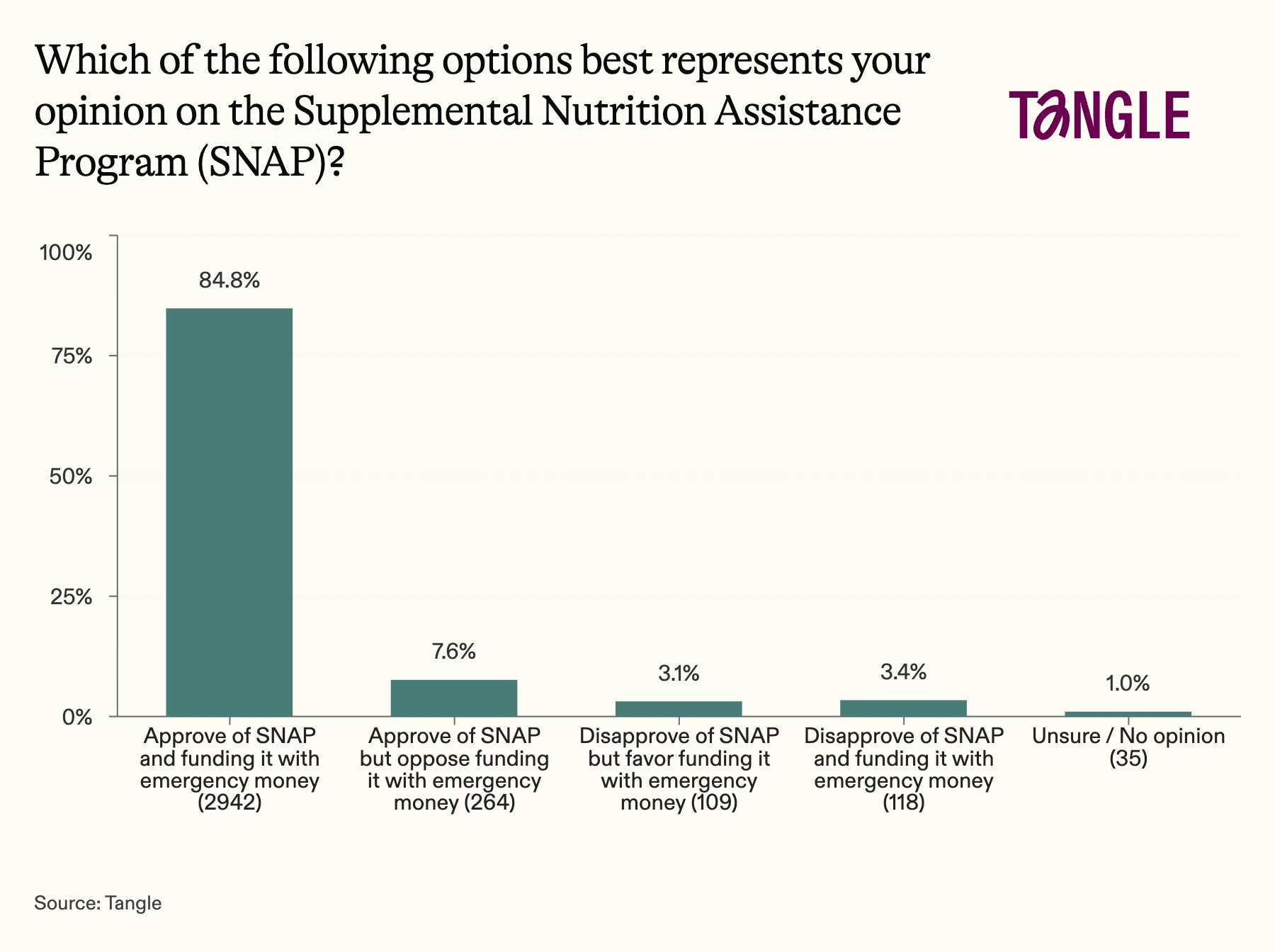
- Yesterday’s survey: 3,468 readers responded to our survey on SNAP funding with 85% approving of the program and funding it with emergency money. “It is immoral to have hungry children in a country as blessed as the USA with resources and global power,” one respondent said. “Midterms are right around the corner. It may be time to hire some folks who are willing to work together to solve some of the issues and challenges our country is currently facing,” said another.
Have a nice day.
The population of North Atlantic right whales, which are prone to collisions with boats and entanglements in fishing gear, fell by 25% from 2010–2020. However, scientists recently measured a small but meaningful uptick in the endangered species — the whales now number an estimated 384, eight more than a year ago. “The slight increase in the population estimate, coupled with no detected mortalities and fewer detected injuries than in the last several years, leaves us cautiously optimistic about the future of North Atlantic right whales,” said Heather Pettis, Chair of the North Atlantic Right Whale Consortium. The Associated Press has the story.



Member comments