
I'm Isaac Saul, and this is Tangle: an independent, nonpartisan, subscriber-supported politics newsletter that summarizes the best arguments from across the political spectrum on the news of the day — then “my take.”
Are you new here? Get free emails to your inbox daily. Would you rather listen? You can find our podcast here.
Today’s read: 14 minutes.
Here's how to stop Google and ChatGPT from sharing your private info
With a quick search, you’d be shocked to find out what anyone can find out about you on Google or ChatGPT. Your phone number, home address and what you owe on your mortgage are just the beginning.
Anyone deeply researching can access details about your family members, health records, financial accounts, employment history and even your social security number.
When you remove your sensitive data with Incogni, you reduce the risks not just from targeted marketing spam but also identify theft, financial manipulation, and insights into your most private circumstances.
And it's easy and cheap with Incogni’s Unlimited plan. It will remove all that data for you, so that you’re safe from being found by simple Google search results or AI conversations.
Use code TANGLE today to get an exclusive 55% discount on unlimited removals from anywhere that exposes your data.
*Our sponsors help keep Tangle free — thank you for supporting them when you feel they could be useful to your life.
If I ran for president.
It’s not exactly headline news that we’re living through a period of intense political polarization. But something that gets lost in all the negativity is how much Americans all agree on. That got me thinking: What would a presidential campaign built on that broad, under-discussed consensus look like? In tomorrow’s Friday edition, I build that platform — on economics, immigration, foreign policy, and more.
Quick hits.
- A federal grand jury in Florida indicted Rep. Sheila Cherfilus-McCormick (D-FL) on charges that she stole $5 million in Federal Emergency Management Agency overpayments and used a substantial portion of the money to fund her congressional campaign. (The indictment)
- President Donald Trump said that he will meet with New York City Mayor-elect Zohran Mamdani (D) at the White House on Friday. (The meeting)
- The House voted unanimously to repeal a measure that creates a legal avenue for senators to sue the government if federal investigators access their phone records without their knowledge. The provision was part of the funding bill passed last week to end the government shutdown. (The repeal)
- The Justice Department told a federal judge that not every member of the grand jury that indicted former Federal Bureau of Investigation Director James Comey saw the final version of the indictment, raising the prospect of the case being thrown out. (The development)
- The Commerce Department reported that the U.S. trade deficit fell by nearly 24% in August, primarily due to President Trump’s tariffs. Imports of goods and services dropped 5% from July to August. (The report)
Today’s topic.
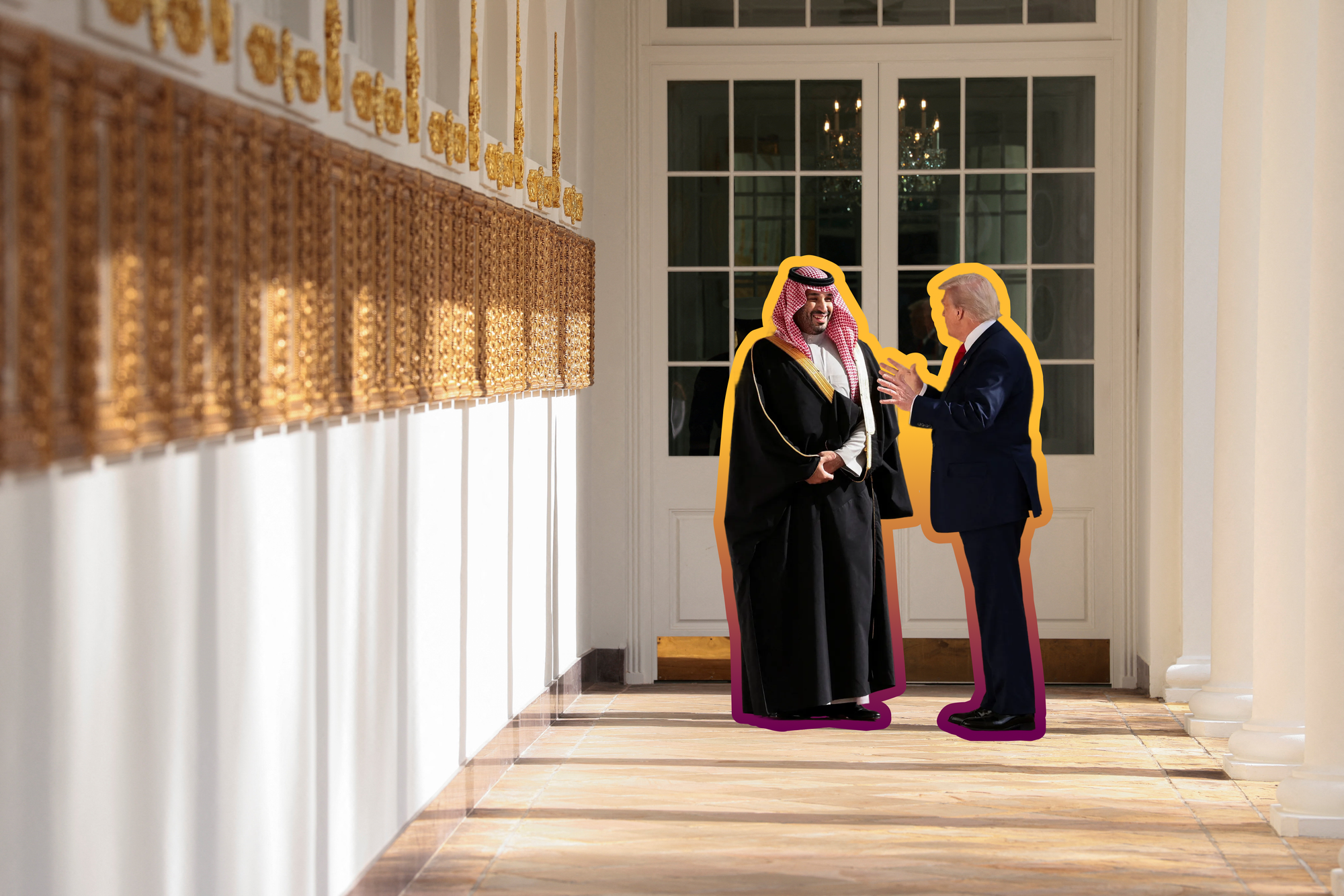
Mohammed bin Salman’s U.S. visit. Crown Prince of Saudi Arabia Mohammed bin Salman (MBS) is visiting the United States this week to discuss U.S.–Saudi security partnerships and business relations. On Tuesday, President Donald Trump welcomed MBS to the White House for a private conversation and Oval Office meeting where they took questions from the press. The next day, MBS met privately with Democratic and Republican members of Congress, and Trump spoke at the U.S.-Saudi Investment Forum. Throughout the visit, Trump and MBS expressed optimism about future U.S.–Saudi relations, including Saudi Arabia’s participation in peace negotiations in Gaza and the potential for bilateral business agreements.
Multiple diplomatic endeavors were announced during the visit. On Monday, Trump announced that he planned to approve the sale of F-35 fighter jets to Saudi Arabia. The president said on Tuesday that the two countries had struck a major defense and security deal, elevating Saudi Arabia to ‘major non-NATO ally’ status and removing existing impediments for weapons transfers between the countries.
Also on Tuesday, Trump expressed hope that Saudi Arabia might join the Abraham Accords and move toward normalizing relations with Israel. In a speech at the U.S.-Saudi Investment Forum, Trump mentioned that MBS had encouraged him to intervene in the ongoing conflict in Sudan. The president said the conflict “wasn’t on my charts” but added that “we’re going to start working on Sudan.”
The defense and security deals come as Saudi Arabia has pledged to increase its investments in U.S. industries. The White House announced that the kingdom would invest $600 billion in the U.S. when Trump traveled to Saudi Arabia in May. After MBS’s visit, the White House announced the kingdom would increase its planned investments to nearly $1 trillion.
Congressional reception for MBS’s visit was mixed. Days before his arrival, a planned larger meeting with senators was canceled over disputes about which senators would be in attendance. However, MBS met with select Democratic and Republican House members and Senators in receptions hosted by individual members.
MBS’s visit marks the first time the Saudi prince has visited the United States since the 2018 killing of U.S.-based Saudi journalist Jamal Khashoggi. U.S. intelligence determined MBS had personally authorized an operation that led to Khashoggi’s murder and dismemberment, chilling relations between the countries and drawing widespread international condemnation.
In the Oval Office press conference, a reporter questioned MBS on Khashoggi’s death; Trump appeared to defend bin Salman’s role. “Whether you like [Khashoggi] or didn’t like him, things happen, but [MBS] knew nothing about it and we can leave it at that,” Trump said. MBS called the story “painful” and said Saudi Arabia had “improved our system to be sure that nothing happened like that… happens again.”
Below, we’re including perspectives from the left, right, and Middle Eastern writers on the visit. Then, Senior Editor Will Kaback gives his take.
What the right is saying.
- The right is mixed on Trump’s approach, with some saying he should pursue a close partnership with the Saudis.
- Others suggest the relationship should be limited and transactional.
In The Washington Examiner, Tom Rogan wrote “Trump rightly fetes Mohammed bin Salman at White House.”
“Bin Salman is an authoritarian leader who was almost certainly responsible for the brutal October 2018 murder of Saudi dissident journalist Jamal Khashoggi… Just as he absurdly accepted Russian President Vladimir Putin’s claim that Russia engaged in no interference related to the 2016 U.S. elections, Trump is wrong here to reject the abundant evidence to suggest that bin Salman did indeed order Khashoggi killed,” Rogan said. “Still, leaders must ultimately pursue the policies that best serve their nation’s interests. Judged on that metric, Trump’s red-carpet treatment of bin Salman is warranted.”
“Future Middle Eastern stability depends greatly on bin Salman’s domestic reforms. While he is paranoid and impulsive in his restraint to perceived domestic challenges, the crown prince has nevertheless embarked on a bold and crucial domestic reform program,” Rogan wrote. “Trump should be judged against a prudent assessment of the varied interests at stake here. Chinese leader Mao Zedong killed tens of millions of his own people in the crazed pursuit of industrialized communism. Still, President Richard Nixon was right to fete Mao in an effort to draw China away from the Soviet Union.”
In The American Spectator, Doug Bandow argued “America shouldn’t fight for the Saudi throne.”
“The U.S. should seek to maintain a civil relationship with the Kingdom, which is an important Middle Eastern power. However, the relationship should be transactional, based on shared interests, not U.S. submissiveness. Saudi Arabia will sell oil to America and the West even if Washington stops exempting MbS from the norms of civilized society,” Bandow said. “Moreover, America’s energy revolution, along with the burgeoning international market, has reduced Riyadh’s ability to manipulate oil supplies.”
“More than any other region, the Mideast deserves a dose of America First. The president has spoken of his determination ‘to run the world.’ Better to leave most countries to handle their own affairs, especially in the Middle East,” Bandow wrote. “After their dinner, the president should send MbS and his oversized travel party on their way. It’s time for the royals to stop treating the U.S. armed forces as a modern Janissary Corps tasked with their protection. Let the crown prince convince the Saudi people that his rule and the monarchy are worth defending.”
What the left is saying.
- The left argues that Trump has whitewashed MBS’s human rights violations.
- Others say Trump’s approach to the Saudi relationship is short-sighted.
The New York Times editorial board wrote “no, Mr. President, we cannot ‘leave it at that.’”
“The realities of geopolitics have long required the United States to ally itself with foreign leaders who commit terrible deeds… Saudi Arabia is a classic example of such a country today. It both has a disturbing human rights record and is a legitimately valuable American partner in countering Iran’s aggressions and building a more stable Middle East,” the board said. “But working with imperfect partners does not mean that the United States should cover up and lie about their misdeeds, as President Trump did when receiving Crown Prince Mohammed bin Salman.”
“Mr. Trump embraced the prince’s implausible claim of innocence in the 2018 murder of Jamal Khashoggi, a Saudi citizen and journalist, and berated Mary Bruce, of ABC News, for asking about the killing… It suggested that the truth was irrelevant, and it discarded the hard work of American intelligence in trying to determine that truth,” the board wrote. “The role of the news media in our democracy is not to flatter foreign leaders or, for that matter, American ones. It is to pose important and sometimes challenging questions and publish the facts. As president, Mr. Trump repeatedly shows contempt for this principle.”
In Bloomberg, Andreas Kluth said “the US is treating the Saudis as it should treat NATO.”
“Donald Trump is about to repeat a mistake he has been making with America’s partners all over the world: He keeps confusing the proper uses of clarity and ambiguity in foreign policy, using one when the situation calls for the other,” Kluth wrote. “Hosting the Saudi Arabian Crown Prince in the White House tomorrow, for example, the US president will add clarity to a relationship that would benefit instead from remaining ambiguous. By contrast, he has introduced unnecessary ambiguity into relationships that were, and need to be, clear — with NATO, South Korea and Japan, among others.”
“If a [security] guarantee is given to buy Saudi support for the peace process in the Gaza Strip or normalization with Israel, it’s unnecessary, because those steps are in Riyadh’s interest too. If it’s meant to keep the Saudis from fraternizing with the Chinese, it will fail, because the Crown Prince wants to hedge his bets with all major powers,” Kluth said. “What it will do instead is commit an overstretched America to yet another hotspot of conflicts, possibly encouraging Riyadh to take more risk in its neighborhood and preventing the US from pursuing its own national interest.”
What Middle East writers are saying.
- Some Middle Eastern writers see MBS’s U.S. trip as a significant diplomatic victory.
- Others say the two leaders have shared interests that can be used for peace.
In Middle East Eye, Mohamad Elmasry wrote “bin Salman’s Washington comeback delivers sweeping gains for Saudi Arabia.”
“The meeting signified a shift in the Saudi-American relationship, with the two countries agreeing to unprecedented levels of cooperation that could shift the power dynamic between them,” Elmasry said. “Saudi money already lines the US from Wall Street to Hollywood, but Tuesday’s visit will inject a lot more of it… But such massive investments — even if only partially fulfilled — shift the American-Saudi power dynamic at least to some extent. While the US has long enjoyed the leverage advantage over Saudi Arabia, the latter’s increased influence over the US economy arguably shifts the balance in its favour.”
“The crown prince has now fully emerged from the Khashoggi murder affair, and Saudi Arabia has purchased influence in the American economic, political and defence spheres. He can return to Saudi Arabia showing tangible progress on his Vision 2030 aspirations, which involve strengthening Saudi military capacity and diversifying the national economy away from oil,” Elmasry wrote. “[Trump] will be able to point to hundreds of billions of dollars in foreign investments, likely significant job creation and the strengthening of ties with an important ally. But a wide range of onlookers will be dismayed at what took place in Washington.”
In Arab News, Abdulrahman Al-Rashed explored the importance of the Trump–MBS meeting.
“Saudi Arabia manages its regional relationships with the goal of preventing broader collapse, starting with the Beijing-brokered agreement with Iran and continuing through Riyadh’s revival of the two-state solution. That proposal triggered a wave of regional and international support, along with expectations of collective ties with Israel down the line,” Al-Rashed said. “A series of steps, ranging from Beijing to Tehran, Islamabad and Damascus, shows the nature of the crown prince’s approach: balanced relations, de-escalation and preparing the region for a different phase.
“Trump has articulated a parallel vision. In his address to the Knesset, he said Israel had achieved all it could through military force and that the time had come to channel its strength toward peace… The crown prince and the president are capable of working together whenever possible to push the region toward greater stability,” Al-Rashed wrote. “[The Trump] administration is aligning itself with successful economic powers, not just military ones. Saudi Arabia’s importance lies in its central role in the region and the Islamic world, its influence on global energy security and its emergence as a rising economic force within the G20.”
My take.
Reminder: “My take” is a section where I give myself space to share my own personal opinion. If you have feedback, criticism or compliments, don't unsubscribe. Write in by replying to this email, or leave a comment.
- The MBS visit showcased the good, the bad, and the ugly of Trump’s dealmaking.
- These agreements could be enormously beneficial to the U.S., but we seem to be giving up more than we’re getting back.
- The president’s callous disregard for Saudi Arabia’s human rights record casts a pall over the entire visit.
Senior Editor Will Kaback: President Trump, at his core, loves making deals. And Saudi Arabia, a country eager to strengthen its ties with the West and accustomed to making splashy investments, provides the ultimate dealmaking partner.
Trump’s meeting with Crown Prince Mohammed bin Salman (MBS) exemplifies the good, the bad, and the ugly of this deal-first approach — and of the blurred lines between the Trump family businesses and the Trump presidency.
On paper, there’s a lot to like about the trajectory of Saudi relations under Trump. For one, U.S. cooperation has encouraged the kingdom’s ongoing modernization. Since MBS first rose to power a decade ago, he has spurred meaningful change in Saudi Arabia’s culture, economy, and foreign policy. As Saudi writers have documented, what was a stagnant and repressive country in the early 2010s has evolved into a more dynamic and modern one. The crown prince has reintroduced physical education for girls, changed laws to allow women to drive and work without a male guardian’s permission, stripped the religious police of their powers, reopened movie theaters, and made the country more welcoming to visitors from all over the world. To be clear, Saudi Arabia is still a place where political rights and civil liberties are essentially non-existent, and the MBS-led reforms will last only as long as he (or the next ruler) wants them to. But these changes — and what they represent — are inarguably positive developments.
Trump wants to take advantage of Saudi Arabia’s newfound openness toward Western values, just as Biden and Obama had. In the past few months, he’s run up a staggering list of mutually beneficial deals, culminating in this week’s announcements of $1 trillion in Saudi investments in the U.S., the U.S. agreeing to sell the Saudis F-35s, and both countries reaching a civil nuclear cooperation agreement.
Directionally, I think Trump’s approach is strong. In addition to the potential economic benefits, stronger ties with Saudi Arabia give the U.S. a key partner in the Middle East as Trump works to implement his Gaza peace plan and normalize Arab–Israeli relations. Under MBS, Saudi Arabia has become a diplomatic power broker, and aligning their interests with the U.S. increases the potential for genuine breakthroughs to address regional violence and instability. The partnership can also counter the regional influence of Iran and China.
At first, all of these deals look mutually beneficial — and appear to be major diplomatic achievements for Trump. But they come with major caveats that make me think we’ve given up much more than we’ve gotten in return.
For one, these deals are far from final, and history suggests that they will end up more modest when all is said and done. Trump announced similar deals with the Saudis in his first term, most significantly a $450 billion investment commitment. But an analysis of those deals found that the investment totaled just $92 billion from 2017 to 2020 — a meaningful sum, but far less than what was promised. Similarly, a 2017 defense agreement initially estimated to be worth $110 billion only generated $23 billion in arms sales in the same time span. Saudi Arabia just doesn’t have the money to invest $1 trillion; as the Arab Center Washington DC has noted, the kingdom’s annual spending “rarely exceeds $350 billion, and its sovereign wealth fund has assets of approximately $925 billion only.” It’s also facing a projected budget deficit of over $67 billion in 2025 and is already mired in costly domestic projects.
Furthermore, MBS has barely moved his position on joining the Abraham Accords and normalizing relations with Israel, even after multiple days of lavish treatment. MBS has softened somewhat on the prospect, telling Trump that he wants to join the agreement if he sees “a clear path” for Palestinian statehood (in the past, Saudi Arabia’s requirement was the “establishment” of a Palestinian state). But the Saudi position on one of Trump’s major focuses clearly remains noncommittal.
While Saudi Arabia’s commitments are projected and probably overstated, ours are more immediate and tangible — which tilts the scales further towards the Saudis. In addition to greenlighting the sale of F-35s, Trump is bestowing the prestigious “major non-NATO ally” status upon Saudi Arabia. Add in Trump’s surprising step of lifting economic sanctions on Syria in May, a move he credited MBS with facilitating, and you can see the president making a great effort to raise MBS’s profile and legitimize his rule on the global stage.
For all the wins we’ve handed Saudi Arabia, what do we really have to show for it? No tangible progress on the Saudis joining the Abraham Accords and no way to guarantee follow-through on the investment promises. As an outside observer, you’d be forgiven for looking at these results and thinking Saudi Arabia was the world superpower and not us.
That brings us to the ugly: The Trump family’s business interests in Saudi Arabia. This week, the Trump Organization and its Saudi-based development partner Dar Al Arkan announced a project that will allow cryptocurrency investors to buy into Trump-branded real estate projects with digital currency. Jared Kushner, Trump’s son-in-law and erstwhile Middle East adviser, runs a private equity firm that has taken $2 billion from a fund led by the Saudi crown prince. And in September, real estate developer Dar Global announced that it is launching a $1 billion project to build a “Trump Plaza” in Jeddah, Saudi Arabia, the second such Trump-branded project in the city. An expanded U.S.–Saudi relationship will invariably benefit those business dealings, and invites reasonable suspicion that Trump is motivated to strike deals for personal gain.
Just as ugly: Trump’s utter disregard for Saudi human rights violations and its murder of journalist Jamal Khashoggi. I think it’s rational for the U.S. president to make the calculation that the (unjustified and immoral) killing of one journalist is not worth sacrificing our entire relationship with the Saudis, but that uneasy trade-off does not require papering over or outright denying the evidence that MBS approved the killing. The president’s behavior during the press gaggle with MBS in the Oval Office was hard to watch. The chumminess between the two felt odd and uncomfortable, culminating in a bizarre exchange where Trump reached for MBS’s hand multiple times and compared his friendliness with the leader to Biden’s. It was just one moment, but it deepened the sense of a power imbalance between Trump and MBS.
More disturbingly, Trump not only dismissed U.S. intelligence agencies’ findings that MBS approved the kidnapping and murder of Khashoggi; he also defended MBS against the charge, referring to Khashoggi as someone “extremely controversial” whom “a lot of people didn’t like.” The president then attacked the reporter who asked the question, haranguing her for “embarrass[ing] our guest.” But after the outburst, MBS just… answered the question (and a separate one about allegations that Saudi Arabia assisted the 9/11 attackers), an implicit recognition that it was not only in bounds but expected at such a meeting. His answer wasn’t satisfactory, but it was still an answer, and it was striking to see an autocrat be more responsive to tough questions from the press than a democratically elected leader.
The moment provided another example of Trump needlessly sacrificing leverage. Trump’s total willingness to ignore the bad actions of certain allies is not the mark of a sophisticated dealmaker; in fact, maintaining a tougher posture about Khashoggi and other Saudi human rights issues could actually have helped negotiate more favorable agreements. Instead, Trump seems focused solely on securing deals with eye-popping numbers and no strings attached.
Ultimately, a thriving partnership with Saudi Arabia could prove to be a long-term boon for the United States and the Middle East, and Trump will deserve praise if that comes to pass. If the deals falter, though, or fail to lead to more concrete agreements for Middle East peace, I think Trump’s missteps in these discussions will have been apparent from the start. Above all, this week’s fêting of MBS left an acrid taste in my mouth, and I worry that Trump has secured too little while giving away too much, including our moral authority.
Take the survey: How do you think U.S.–Saudi relations should advance? Let us know.
Disagree? That's okay. Our opinion is just one of many. Write in and let us know why, and we'll consider publishing your feedback.
Your questions, answered.
Q: What would it take to get a qualified assessment of President Trump’s mental fitness?
— Doug from Goshen, CT
Managing Editor Ari Weitzman: If it were up to me, I’d say he should take a mental fitness check now and actually release those results publicly. What’s the harm in it? As for when Tangle might be vociferously calling for an assessment and saying clearly that Trump may not be mentally fit for the office, I think we’re not at that point yet.
When we first started showing concern about President Joe Biden’s mental fitness in Tangle, we had two reasons: First, he started to appear in public less and less. Second, when we compared recent interviews to ones from ten years ago, the contrast was stark.
With President Trump, the issue of presence is not at all a concern. Trump is probably the most visible and active president of my lifetime. But when you compare interviews from early in his first term to his recent interview with Fox News’s Laura Ingraham, he does seem somewhat diminished. He always strayed from the initial topic, but he seems to do so more often now. He always spun or created talking points to make himself look better, but his now constant focus on self-flattery could also be a sign of mental decline. Personally, though, I still think Trump appears much closer to the man he was eight years ago than Biden did when Isaac first started voicing his concerns.
If we start seeing more noticeable differences in Trump’s speech — and especially if his public appearances take a nosedive — then we’d definitely have a problem, and the calls for Trump to take a fitness exam should increase. But for now, his mental acuity is (for me at least) worth watching but not an immediate and present concern.
Want to have a question answered in the newsletter? You can reply to this email (it goes straight to our inbox) or fill out this form.
Under the radar.
On Tuesday, the National Transportation Safety Board (NTSB) shared findings from its investigation into the cargo ship that allided with Baltimore’s Francis Scott Key Bridge in March of 2024, killing six. The NTSB found several issues related to the ship’s machinery and electrical systems, including an improperly installed wire that led to the vessel losing power. The compounding electrical issues prevented the ship from recovering control in time to correct course, leading to the crash. Investigators said the loose wire could have been identified during inspections by the ship’s operator, Synergy Marine Group, but the company’s inspectors had not adequately checked the systems. As a result of its findings, the NTSB said it is issuing 17 new safety recommendations. ABC News has the story.
What Google Knows About You (And How to Erase It)
With a quick search, you'd be shocked what anyone can find about you on Google or ChatGPT.
Your phone number, home address, mortgage details, family members, employment history—even your social security number.
Incogni's Unlimited plan removes your sensitive data from data brokers, reducing risks from identity theft, financial manipulation, and targeted spam. It's easy and affordable.
Use code TANGLE today for an exclusive 55% discount on unlimited removals from anywhere that exposes your data.
Numbers.
- 3,170. The number of days since Crown Prince Mohammed bin Salman’s most recent trip to the United States (on March 14, 2017) prior to his visit to the White House on Tuesday.
- $1.24 trillion. Saudi Arabia’s gross domestic product (in current U.S. dollars) in 2024.
- 1.8%. Saudi Arabia’s annual GDP growth in 2024.
- 22%. The percentage of the female population in Saudi Arabia aged 15 and up who participated in the workforce in 2015, according to the World Bank.
- 34%. The percentage of the female population in Saudi Arabia aged 15 and up who participated in the workforce in 2024.
- 9/100. Saudi Arabia’s score in Freedom House’s 2025 Freedom in the World report.
- 1/40 and 8/60. Saudi Arabia’s scores for political rights and civil liberties, respectively, in the report.
- 8. The number of people convicted in Saudi court in 2020 for crimes related to the murder of journalist Jamal Khashoggi.
The extras.
- One year ago today we covered Pennsylvania’s controversial Senate race.
- The most clicked link in yesterday’s newsletter was the ad in the free version detailing 11 Costco hacks.
- Nothing to do with politics: Dictionary.com’s word of the year is not a word, and it doesn’t have a definition.
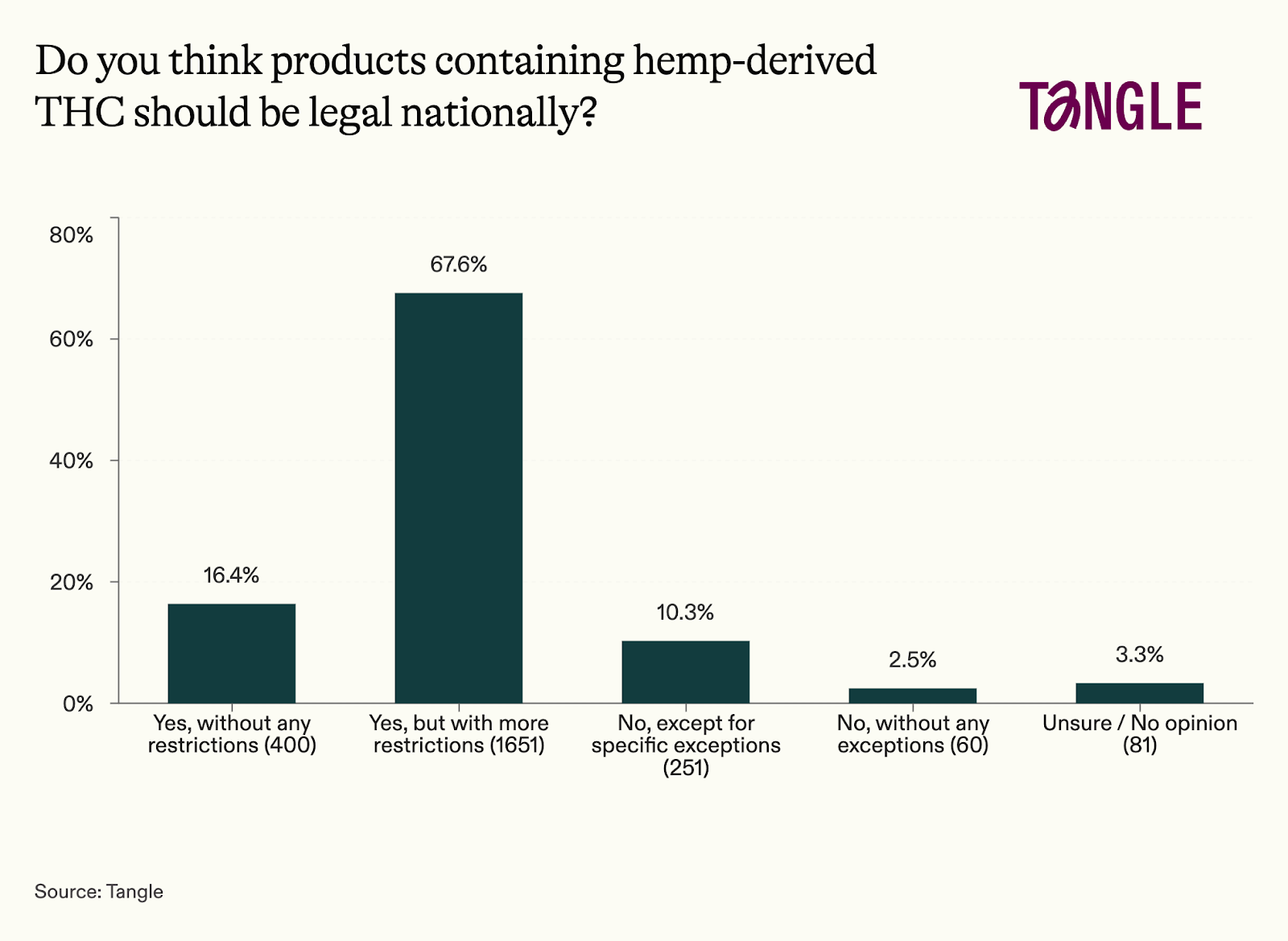
- Yesterday’s survey: 2,443 readers responded to our survey asking if hemp-derived THC products should be legal with 68% saying they should be legal with more national restrictions. “We don’t ban cigarettes or alcohol outright and, in my opinion, these are worse. Why would we ban hemp-derived THC?” one respondent said. “Cannabis has been genetically altered to such an extent that it is far more potent today than it was in the past. It needs far more control than it gets,” said another.
Have a nice day.
Illustrator and perfumer Michael O’Shaughnessy uses smells that evoke childhood recollections to motivate his art students at Liverpool John Moores University, and he’s bringing that novel approach to a surprising cohort: prisoners. With bottled and evocative scents — violin rosin, or a locker room — O’Shaugnessy wants to motivate prisoners to more viscerally imagine another life. “Some scents take them outside, away from the internal walls of their confined spaces to another world,” he explains. And that spark is taking purchase. “The more I can imagine my future – the greater the possibility,” one prisoner wrote. “What does my future smell like? Does the world have a place for me? The past was how I remembered it. How I experienced it. It taught me how to feel. I experience now through the mirror of the past. How I respond to the past affects my future.” Positive News has the story.

Member comments