
I'm Isaac Saul, and this is Tangle: an independent, nonpartisan, subscriber-supported politics newsletter that summarizes the best arguments from across the political spectrum on the news of the day — then “my take.”
Are you new here? Get free emails to your inbox daily. Would you rather listen? You can find our podcast here.
Today’s read: 13 minutes.
5 Ways to Cut Your Most Expensive Bills Without Giving Up Anything
You've mastered the coffee-at-home routine and avoided the Target trap. But those unavoidable monthly bills? They're still bleeding you dry.
Here's the thing: you're probably overpaying for essentials like car insurance, internet, and credit card debt — and these companies are counting on you not noticing.
What if we told you there's a way to slash these expenses without sacrificing a single thing you actually care about? We're talking real savings, like $1,025 per year on car insurance alone, or getting $300 just for switching your internet provider.
The best part?
Most of these fixes take less than five minutes and require zero lifestyle changes. See what they are by clicking the button below.
New VIP experience goes on sale tomorrow.
Here’s your chance to experience the Tangle community in person. Isaac Saul is coming to Southern California on October 24 to moderate a spirited discussion with three of the sharpest voices in politics today — Kmele Foster, Ana Kasparian, and Alex Thompson.
Tomorrow, we’re revealing a discount code for a special VIP experience featuring a backstage meet and greet with Isaac and the panelists. Premium members will receive an email in the morning to get early access.
Quick hits.
- BREAKING: The Supreme Court paused a district court order prohibiting immigration agents from questioning and detaining people based solely on their ethnicity, language, occupation, or presence at a particular location. The court’s three Democratic-appointed justices dissented. (The ruling)
- The U.S. and South Korean governments reached a deal to release South Korean workers who were detained in an immigration raid at a Hyundai automobile factory in Georgia on Thursday. (The deal)
- The Bureau of Labor Statistics announced that nonfarm payroll employment increased 22,000 in August and the unemployment rate was 4.3%, approximately the same as the month prior. (The report)
- Israel's Supreme Court ruled unanimously that the Israeli government was not providing Palestinian detainees with sufficient food and had a responsibility to increase the quantity and improve the quality of their diets. (The ruling) Separately, six people were killed and 12 others injured in a shooting at a bus stop in Jerusalem. The two attackers, identified as Palestinian residents of the West Bank, were killed at the scene. (The attack)
- A district judge ruled that the Department of Homeland Security's attempt to revoke temporary protected status for hundreds of thousands of Venezuelan and Haitian migrants was unlawful and cannot proceed. The Trump administration plans to appeal. (The ruling)
- Russia conducted its largest drone attack against Ukraine to date, launching approximately 800 drones at cities and towns across the country. At least five people were killed in the strikes. (The attack)
Today’s topic.
RFK Jr.’s Senate hearing. On Thursday, Health and Human Services Secretary Robert F. Kennedy Jr. testified before the Senate Finance Committee about his efforts to overhaul U.S. health agencies and change federal vaccine policy. The hearing was at times combative, as Senators asked Kennedy about the Trump administration’s firing of Centers for Disease Control and Prevention (CDC) Director Susan Monarez, subsequent resignations of other CDC leaders, and regulatory changes to Covid-19 vaccine access.
Back up: On August 27, the White House announced it had fired Monarez, saying she was “not aligned with the President’s agenda of Making America Healthy Again.” The former director was sworn in roughly one month ago but reportedly resisted Kennedy’s efforts to change vaccine policy and refused Kennedy’s request to resign. After her firing, the CDC’s chief medical officer and three other high-ranking officials at the agency resigned.
In August, the Food and Drug Administration (FDA) announced that it had authorized a new round of Covid-19 vaccines for the fall, but limited their availability to only certain high-risk groups (such as those with asthma, cancer, and heart conditions). The precise nature of the changes has caused confusion among some healthcare providers, as Kennedy said the vaccines would be available “for all patients who choose them after consulting with their doctors.” Separately, the FDA also announced that it had ended emergency use authorizations for Covid-19 vaccines.
At Thursday’s hearing, Democrats sharply criticized Kennedy for these changes. Sen. Elizabeth Warren (D-MA) told the Health secretary that he was “effectively denying people vaccines” by not recommending Covid-19 boosters outside of high-risk groups. Kennedy responded, “I'm not going to recommend a product for which there's no clinical data.” Sen. Ron Wyden (D-OR) also pressed Kennedy about his reported clash with Monarez over vaccine recommendations; Kennedy said that Monarez had lied when she claimed he asked her to defer to guidance from his newly appointed immunizations committee.
Some Republicans also questioned several of the Health secretary’s recent moves. Sen. John Barrasso (R-WY), a physician and the Senate majority whip, said he had “grown deeply concerned” by Kennedy’s actions, adding, “There are real concerns that safe, proven vaccines like measles, hepatitis B and others could be in jeopardy, and that would put Americans at risk and reverse decades of progress.” Sen. Bill Cassidy (R-LA), also a physician who cast a critical vote to confirm Kennedy in February, echoed Sen. Warren’s comments on Covid boosters, saying “effectively we're denying people the vaccine.”
After the hearing, White House Press Secretary Karoline Leavitt defended Kennedy, saying that he was “taking flak because he’s over the target” and praising him for a commitment to “addressing root causes of chronic disease, embracing transparency in government, and championing gold-standard science.”
Today, we’ll share Kennedy’s and Monarez’s op-eds about the changes at the CDC, followed by views from the left and right about Kennedy’s Senate testimony. Then, my take.
What Kennedy and Monarez are saying.
- HHS Secretary Kennedy defends his reforms to health agencies, arguing they are critical to restoring public trust in them.
- Former CDC Director Monarez says Kennedy’s efforts to undermine federal vaccine policy will harm all Americans.
In The Wall Street Journal, Robert F. Kennedy Jr. wrote about “restoring public trust in the CDC.”
“Bureaucratic inertia, politicized science and mission creep have corroded [the CDC’s] purpose and squandered public trust. That dysfunction produced irrational policy during Covid: cloth masks on toddlers, arbitrary 6-foot distancing, boosters for healthy children, prolonged school closings, economy-crushing lockdowns, and the suppression of low-cost therapeutics in favor of experimental and ineffective drugs,” Kennedy said. “For years the CDC has presided over rising chronic disease — a true modern pandemic — and, since 2014, declining life expectancy. Trust has collapsed: Only one-third of health care workers participated in the 2023-24 fall Covid booster program, and fewer than 10% of children under 12 received boosters in 2024-25.”
“We have shown what a focused CDC can achieve. When measles flared this year in Texas, we brought vaccines, therapeutics and resources to the epicenter. The outbreak ended quickly, proving the CDC can act swiftly with precision when guided by science and freed from ideology. That response was neither ‘pro-vax’ nor ‘antivax’... It was effective,” Kennedy wrote. “The path forward is clear: Restore the CDC’s focus on infectious disease, invest in innovation, and rebuild trust through integrity and transparency.”
In The Wall Street Journal, former CDC Director Susan Monarez said “I was fired after 29 days because I held the line and insisted on rigorous scientific review.”
“Reporters have focused on the Aug. 25 meeting where my boss, Health and Human Services Secretary Robert F. Kennedy Jr., pressured me to resign or face termination. But that meeting revealed that it wasn’t about one person or my job. It was one of the more public aspects of a deliberate effort to weaken America’s public-health system and vaccine protections,” Monarez wrote. “I’m gone now, but that effort continues. One of the troubling directives from that meeting more than a week ago: I was told to preapprove the recommendations of a vaccine advisory panel newly filled with people who have publicly expressed antivaccine rhetoric.”
“Those seeking to undermine vaccines use a familiar playbook: discredit research, weaken advisory committees, and use manipulated outcomes to unravel protections that generations of families have relied on to keep deadly diseases at bay. Once trusted experts are removed and advisory bodies are stacked, the results are predetermined. That isn’t reform. It is sabotage,” Monarez said. “Public health shouldn’t be partisan. Vaccines have saved millions of lives under administrations of both parties. Parents deserve a CDC they can trust to put children above politics, evidence above ideology and facts above fear.”
What the left is saying.
- The left is critical of Kennedy’s comments at the hearing, and many argue he has already done significant damage to U.S. health policy.
- Some suggest Republicans who voted to confirm Kennedy are now regretting their decision.
In The Atlantic, Nicholas Florko wrote “a different RFK Jr. just appeared before Congress.”
“[The] hearing was always going to be tumultuous. Although the panel was pitched as an opportunity to hear about President Donald Trump’s health-care agenda, it was a rare opportunity for senators to publicly question the secretary about his recent attacks on the U.S. vaccination system,” Florko said. “In the past 200 days, Kennedy has terminated mRNA-research grants, stuffed a CDC advisory panel with anti-vaccine activists, and propped up unproven treatments during a deadly measles outbreak. Last week, he pushed out CDC Director Susan Monarez, whom senators had confirmed to her position less than a month prior.”
“As Kennedy grows bolder in his attacks, Trump has been his greatest enabler. Trump achieved the rapid delivery of vaccines during the pandemic with Operation Warp Speed, yet he seems to be happily cheering Kennedy on in dismantling that legacy,” Florko wrote. “He might share Kennedy’s views, or perhaps he sees the pitfalls of dismissing a secretary who has some of the highest favorability ratings in the Cabinet.”
In Bloomberg, Nia-Malika Henderson suggested “Republican senators have a few [regrets]” about confirming Kennedy.
Kennedy “was full of misinformation and contemptuous of members of Congress, shouting them down with disdain as they questioned him on the disarray he has brought to public health agencies. The hearing also showed Republican senators to be too little, too late in criticizing the noted anti-vaxxer, who is steadily remaking the American health care system in his own tin-foil-hat image,” Henderson said. “Republicans like Louisiana Senator Bill Cassidy, a physician, made a costly mistake in backing Kennedy, either out of pure careerism or because he actually believed Kennedy when he claimed that he wouldn’t do anything to upend the federal government’s approach to vaccines.”
“Cassidy, with re-election in mind, tried to appeal to President Donald Trump’s ego as he peppered Kennedy with questions about the Covid vaccine, which is now harder to get because the Centers for Disease Control and Prevention has limited who qualifies,” Henderson wrote. “It was a clever but empty ploy, meant to get Kennedy to acknowledge the importance and effectiveness of Covid vaccines and perhaps get Trump to rein in the man he promised would ‘go wild on health.’”
What the right is saying.
- The right is mixed on Kennedy’s recent actions, with some praising him for taking on entrenched healthcare interests.
- Others criticize Kennedy for seeming to prioritize ideology over science.
In RedState, the blogger streiff wrote about the “battle lines” forming around Kennedy’s vaccine policy.
“To say the Centers for Disease Control and Prevention is in a state of turmoil right now is to grossly understate the situation. The same political activist employees who determined that a cloth mask could stop a virus and that a million people engaging in rioting was not an infection risk are fighting Health and Human Services Secretary Robert F. Kennedy, Jr.'s agenda every step of the way,” streiff said. “Secretary Kennedy's skepticism about the current childhood vaccination schedule is pretty well known… I think Kennedy has a strong point. Though each of the childhood vaccines may be safe and effective, we have no idea what the collective impact of about 20 vaccines does on a very immature immune system in the first six months.”
“You can be in favor of vaccines, and I'll match my military shot record with anyone's, and still not be convinced that vaccinating kids for diseases they are unlikely to encounter is a good idea. You can also have doubts about the rationality of bombarding a child's immune system with a wide array of vaccines being good medicine,” streiff wrote. “The very fact that so many people are screaming so loudly about Kennedy's move on childhood vaccines indicates to me that the pain being felt is in their pocketbook and not by patients.”
The New York Post editorial board said “RFK Jr.’s Senate ravings prove he won’t bring sanity back to public health.”
“Kennedy came off as a paranoid kook connecting red strings on a whiteboard. When Sen. Bernie Sanders (I-Vt.) — no fan of the pharmaceutical industry himself — pressed him on his criticism of major medical organizations that disagree with him on vaccines, Kennedy raved that they were bought and paid for by Big Pharma,” the board wrote. “The CDC and other agencies direly need to re-emphasize science-backed thinking, to rebuild their resistance to the scandalous politicization that marked their Biden-era work. But Kennedy isn’t advocating sensible reform; he wants to burn down the public health apparatus and rebuild it in his image to push his anti-science beliefs.”
“Former CDC Director Susan Monarez claims she got axed last week because she wouldn’t preapprove recommendations from RFK Jr.’s newly refilled vaccine advisory committee, which Kennedy denies. We may never know whose side of the story is true, yet Kennedy clearly is on the warpath to purge the public health apparatus of any person, policy or idea at odds with his warped worldview,” the board said. “America needs agencies like HHS and CDC moving toward a sane center, where decisions are based on data-informed evidence.”
My take.
Reminder: “My take” is a section where I give myself space to share my own personal opinion. If you have feedback, criticism or compliments, don't unsubscribe. Write in by replying to this email, or leave a comment.
- Kennedy’s overhaul of health agencies has been disruptive, and his vaccine beliefs are now (rightly) center stage.
- Even with good reasons to criticize the CDC’s Covid-19 response and chronic health, Kennedy’s getting a lot wrong.
- RFK Jr. isn’t restoring trust in our institutions, he’s degrading it further.
As I watched Kennedy’s testimony, I quickly realized this topic spans too much ground to write a take focused on any one thing. So here are 12 thoughts about the hearing, the CDC, the FDA, and the state of the MAHA (Make America Healthy Again) movement.
- I’ve never been an outright Robert F. Kennedy Jr. supporter, but when he first announced he was running for president as an independent, I defended him, writing that the “dismissal of RFK Jr. as little more than some rabid anti-vaxxer says more about the corporate media's laziness and groupthink than it does about him as a person,” adding that the label as an anti-vaxxer was “mostly unimportant,” and arguing that I was aligned with his view on the fundamental way American government was failing so many people. Of course, this was long before his name was floated as HHS Secretary or the “Make America Healthy Again” movement took hold, but the corporate media’s criticisms of him have all aged better than my defense: The anti-vaccine label was accurate, and his vaccine stances have proven really, really important.
- By now, with the benefit of hindsight, we should all be able to understand the damage public health agencies have done to their reputations. Irrespective of your feelings about Kennedy, we can’t pretend CDC guidance was consistent or defensible (as the agency itself has admitted), or that Covid-19 vaccine mandates weren’t disruptive. Currently mandated vaccines like those for polio, measles, or chickenpox underwent years and decades of testing, approval, and human trials before the public schools required them for children. No vaccine had ever gone from development to approval to being mandated for access to public spaces so quickly; nothing has ever really come close. Telling people that they have to put a relatively new and unknown drug in their body to participate in normal society is understandably going to cause pushback. Add to that the CDC’s statements that vaccines would prevent transmission (when they didn’t), and you get what we have now: a lot of distrust.
- Covid is no longer an emergency, so ending the emergency authorization of Covid-19 vaccines makes sense. But failing to replace it with a clear access plan for those who need booster shots to protect themselves — especially for the immunocompromised and elderly — is a huge mistake. As columnist Bethany Mandel put it, “Mandates and social coercion during the pandemic took options away from families. Now Kennedy has done the same thing, only in reverse. What was once an overreach of coercion has now been replaced with an overreach of restriction.”
- I personally took the initial Covid-19 vaccines and one booster, and after the original shots I got the virus several times (and my infections got less and less serious). So I stopped getting the boosters. I’m pretty young and pretty healthy, so I don’t worry about Covid much more than a cold anymore. But that’s just me. For people like my mom, who just survived her third bout of breast cancer and is still getting treatment, a booster provides important protections against serious Covid infections. The conservative radio host Erick Erickson tweeted about his wife having Stage IV lung cancer and now being unable to get the vaccines, which actually help keep her alive. Kennedy just made life harder for all these people.
- A number of Republican senators very clearly do not want Kennedy to be the head of HHS but are too scared of Trump (or Trump’s base) to do anything about it. This is not a healthy state of affairs.
- We don’t know exactly how many lives the Covid-19 vaccines saved, partly because a lot of people died with Covid but not necessarily from Covid, which means counting deaths — and thus estimating prevented deaths — is really messy. We do know that places with lower vaccination rates had much higher death rates from Covid, not just in the U.S. but globally, too. The politicization of vaccine acceptance led to red-blue divides in Covid outcomes (where Democratic voters fared better against the virus). Which is all just to say: The vaccines did, actually, save a lot of lives — and you were safer from Covid if you took them than if you didn’t (even if they didn’t actually prevent you from getting the virus).
- One core component of Kennedy’s platform is that the Covid-19 vaccines caused a lot of injuries, which in turn destroyed trust, which is part of why he has to tear these agencies apart and rebuild them. But the evidence for this is… not very strong. After four years, the Covid-19 vaccines — by any objective measure — have proven miraculously safe. That is not to say they were risk-free: We now know, for example, that mRNA vaccines can cause heart inflammation in very rare cases, and the risk was higher for young males. This is especially alarming and frustrating because young men were among the least likely to suffer serious illness. Additionally, cases of Guillain-Barré Syndrome were elevated among those who had taken the now discontinued Johnson & Johnson vaccine. But remember: Over five billion people took some kind of Covid vaccine, so it's not at all surprising that several thousand adverse effects were documented.
- When Kennedy is pushed into a corner to answer for his views, we see just how conspiratorial they are. Both the American Academy of Pediatrics and the American Heart Association are offering vaccine guidance that differs from Kennedy’s, simply because these organizations are filled with doctors whose careers inform their guidance on best health practices — instead, Kennedy thinks they’re filled with doctors who are getting paid off by Big Pharma. Chronic illness is on the rise, likely because we are acting less healthy in general, we have more robust diagnostic systems to catch these illnesses, and more of us are surviving conditions that used to have much higher mortality rates (and dealing with the long-term health consequences) — instead, Kennedy thinks the CDC is creating a health crisis.
- When testifying before Congress, Kennedy was asked to explain his firing of Susan Monarez. He told Congress that he asked Monarez if she was a trustworthy person, and she said “no,” so he fired her... Alternatively, you can read Monarez’s firsthand account of being fired, in which she says Kennedy let her go because she refused to preapprove the recommendations of a vaccine advisory panel that had not yet met or made any recommendations. Consider that for a moment: Either Monarez, a microbiologist with a strong track record as a public health official, delivered the worst and most bizarre response to her boss in the history of mankind, or Kennedy replaced a vaccine advisory panel with handpicked scientists, then told the CDC director she had to approve their recommendations before the board had even convened.
- I run a business. If I insisted potential employees agree to future plans for Tangle before knowing what they were, I’d lose a lot of really smart and qualified employees. If my top staff members were all resigning in protest of my leadership, and throwing up red flags about how I was running Tangle, you’d all rightly be concerned about what was happening here. But the Department of Health and Human Services isn’t a small independent media shop — it’s a powerful government department that controls the regulation of drugs, the delivery of vaccines, and the government’s recommendations on public health.
- Remember: All of this, according to Kennedy, is part of his effort to restore American trust in our health officials and science. But is it working? According to a CBS News poll, Kennedy’s approval rating is 45%, with 55% disapproving. Just 1 in 4 Americans trust him with health advice. 74% of Americans want vaccines to be more available. 22% want access to remain the same. Just 4% want them to be less available. Distrusting Kennedy’s recommendations isn’t equivalent to supporting broad vaccine mandates, but clearly Kennedy’s views are out of step with the country’s enough to worry about him damaging public trust in the government’s health recommendations even more.
- One closing note: I’ve said repeatedly that I share some of Kennedy’s views about our overall health. We are being ravaged by diseases of despair. We don’t eat well. Our sedentary lifestyles are bad for physical and mental health. But we don’t talk nearly enough about the successes of public health and the advancements of science, which have largely been pushed by agencies, doctors, and research Kennedy and the Trump administration are now attacking. Our food, though more processed, is less contaminated thanks to FDA regulation. Infant mortality has plummeted. Cancer deaths have dropped 34% since 1991. Death rates from childhood leukemia are down six-fold since 1950. Vaccines for measles, polio, hepatitis B, and HPV have saved millions of lives. Smallpox was eliminated. Measles cases are down 99% (despite some recent outbreaks). U.S. life expectancy rose in the 20th century by over 30 years. Cardiovascular disease mortality has fallen about 75% from the 1950s. Even the maternal mortality rates in the U.S. may have been overstated, and new studies show our numbers are much more in line with other developed nations. HIV and AIDS deaths are down 54% since 2010 alone. Overdose deaths fell in 2024 by a whopping 27%. The list goes on and on and on. In short: We’re doing a lot of things right, and doing them in large part because of these agencies, scientific research, new drugs, new vaccines, and new treatment protocols. Quite obviously, these achievements are not enough to warrant burning the entire system down.
Take the survey: Do you trust the CDC’s vaccine guidance? Let us know.
Disagree? That's okay. My opinion is just one of many. Write in and let us know why, and we'll consider publishing your feedback.
Your questions, answered.
We're skipping the reader question today to give our main story some extra space. Want to have a question answered in the newsletter? You can reply to this email (it goes straight to our inbox) or fill out this form.
Under the radar.
Mercer’s 2025 survey of employer-sponsored health plans found that the total health benefit cost per employee is expected to rise 6.5% on average in 2026, the highest annual increase in 15 years. Over 2,000 organizations responded to the survey, with 59% indicating that they will make cost-cutting changes (such as raising deductibles) to their plans in 2026 — up from 48% in 2025. If the projections come to fruition, 2026 will be the fourth consecutive year of higher costs of health benefits, driven in part by more expensive treatments and increased utilization of health services. Mercer has the results.
Stop Overpaying These Essential Bills (5-Minute Fixes)
Those unavoidable monthly expenses like car insurance, internet, credit card debt are quietly draining your wallet.
The good news?
You're probably overpaying, and these companies hope you won't notice. Simple switches can save you over $1,000 annually without changing your lifestyle. Most fixes take under five minutes.
Numbers.
- 3. The approximate length, in hours, of Health Secretary Robert F. Kennedy Jr.'s hearing before the Senate Finance Committee on Thursday.
- 29. The number of days that former Director of the Centers for Disease Control and Prevention Susan Monarez served in the role before she was fired.
- 10,000. The approximate number of Health and Human Services employees laid off by Kennedy in July.
- 9% and 39%. The percentage of Americans who say Secretary Kennedy's policies are making vaccines more and less available, respectively, according to an August–September 2025 CBS News/YouGov poll.
- 74% and 4%. The percentage of Americans who say government health agencies should make vaccines more and less available, respectively.
- 77%, 11%, and 12%. The percentage of Americans who say Covid-19 vaccines should be available to those who want them, should be available only to people who meet certain criteria and should not be available at all, respectively.
- 45% and 55%. The percentage of Americans who approve and disapprove, respectively, of Kennedy’s job performance as Health secretary.
The extras.
- One year ago today we had just written a Friday edition on why you should vote.
- The most clicked link in Thursday’s newsletter was the new January 6 investigation panel.
- Nothing to do with politics: Tesco tries out scanners for avocado ripeness.
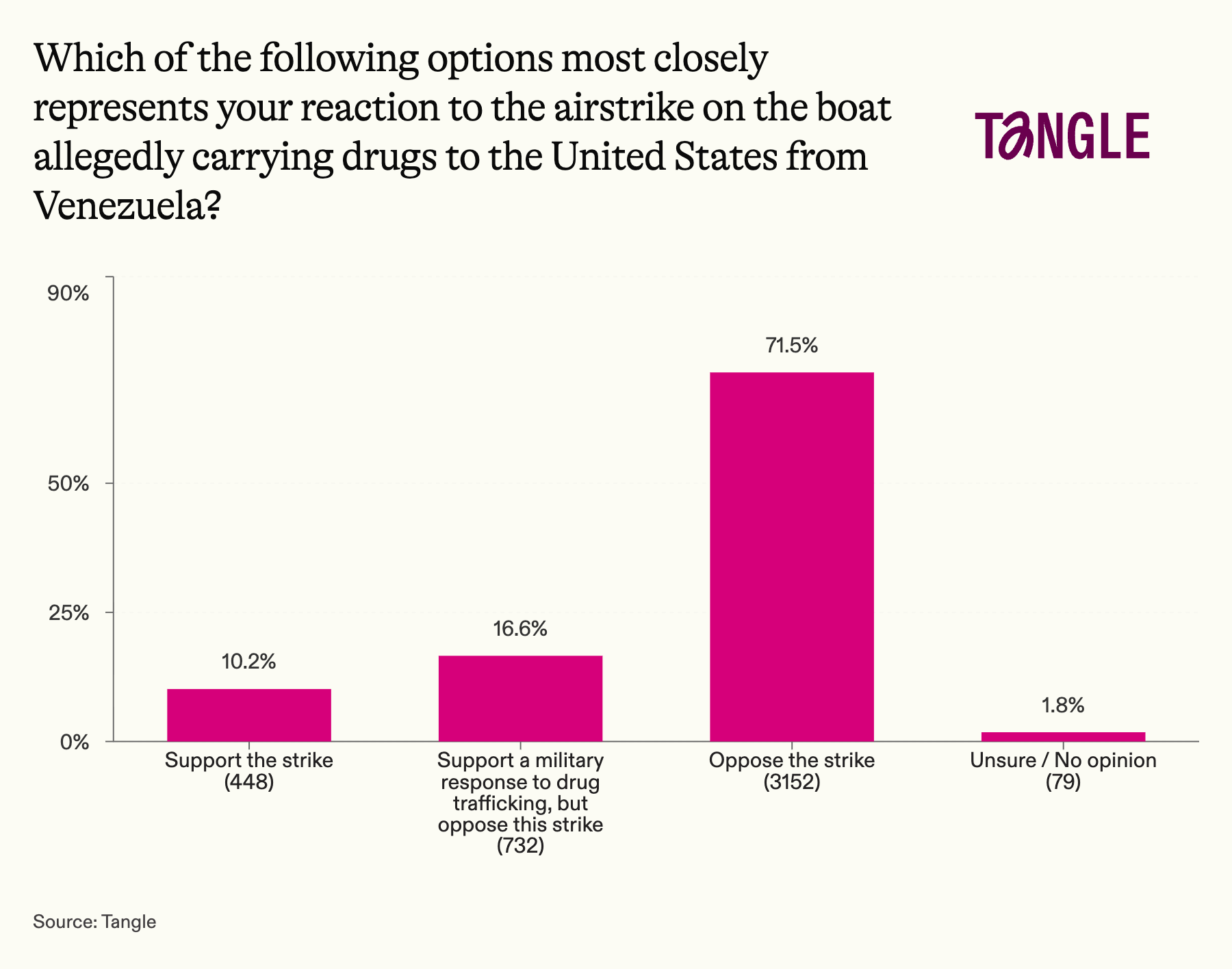
- Thursday’s survey: 4,411 readers responded to our survey on the alleged Venezuelan drug boat sinking with 72% saying they opposed the military response. “As your article says, it's clearly extrajudicial killing,” one respondent said.
Have a nice day.
Late last month, a journalist’s family in Peru had a violent attack on their home defused by an unlikely family member. When a suspect threw a stick of dynamite into Carlos Zarate’s family’s home, their Cocker Spaniel mix Manchis ran to the explosive and chewed on the fuse, deactivating it in time to save the family. “She chewed it and chewed it and saved our lives,” Zarate said. NBC News has the story.

Member comments