
By Jay Edgar
It happened to me — it’ll happen to you.
Man, those were the days.
I never thought I’d be the kinda guy to write something like that. As a gig drummer in the 2000s, I always thought that the day you first complained about “music these days” was just the day your soul started aging. Yet I heard that very statement from so many people my age, and especially my parents, saying that pop music on the radio was trash and that kids these days just didn’t know how to write great music anymore.
Have you gone down the street? I’d think. Have you even looked in the indie charts? Have you looked anywhere at all?
Underneath the Justin Biebers and the Katy Perrys was some of the most interesting pop-adjacent, experimental alt-rock we’ve ever had — truly. You didn’t even have to go that far afield, and many people didn’t. Another gig-drummer buddy of mine who filled in as the drummer of The Smashing Pumpkins, something of a semi-permanently open position, was playing arenas full of people even in the 2010s. Modest Mouse, Death Cab, The Strokes… they got so big that the alt-rock vein was basically just as strong as all-out pop. Bon Iver was winning Grammys; The Killers and The White Stripes made songs that survive today as fan chants at stadiums across the world.
That was the music of those decades, and you’d have to have been living under a rock to miss it. But now I must be living under my own rock, because I just don’t see that kind of beneath-the-mainstream vibrance anymore.
Those were the days.
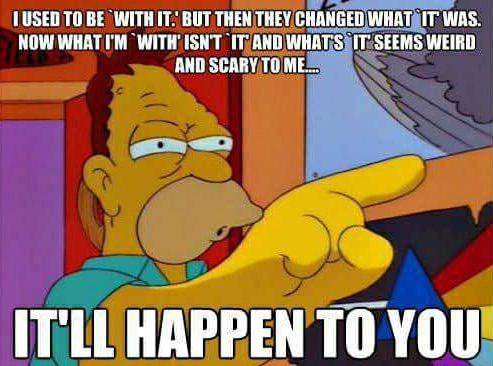
Things change, music evolves, and interesting bands churn out interesting new music that just isn’t for old guys like me anymore. I’m an old guy, now. Like Grandpa Simpson warns:
Look: I’m not gonna write the piece about indie rock, here. Many better writers than I have tried to define the genre, rank the best indie albums, and pin down the day indie rock peaked. I don’t think it’s really that interesting to do. What I haven’t seen anybody ask, though, is: When could we call the era officially dead?
Because make no mistake, the indie rock era is dead. It’s over, gone, kaput. Sure, you’ve got interesting new rockers like boygenius and Wet Leg doing their thing, but it’s a different thing now. And maybe future writers better than I can define what that is, rank the best new alt-rock albums, and try to pin down its peak.
But first, let’s solve the mysteries of the past. The indie rock era came to an end, and someone brought that end with them when they lumbered up out of the sea. With apologies to Yeats, Vexed to nightmare by a rocking age, some rough beast, its hour come round at last, slouched towards Chelsea to be born. And with it, killed the era.
Who was the indie rock antichrist? I have an answer.
Methodology
I guess you can teach an old dog a new trick or two, because the first thing I did on my quest to identify this beast was enlist the help of an AI. Using Anthropic’s Claude, I did three different things:
- Quantify the qualitative
- Analyze the release cycle
- Define the sound shift
1. Quantify the qualitative
This was the most complicated step, but I think it was the most important.
I pulled from a bunch of disparate sources to compile an ultimate meta-list of rankings from across the internet of the best, most essential indie rock albums of all time. I went to Pitchfork, Metacritic, Buzzfeed, Treble Zine, Reddit, Rate Your Music, Alt 77, and Uproxx and compiled all these rankings into a master list. Some of them looked just at peak indie, from between 2000 and 2015, and others went later or earlier — but that was exactly what I wanted, a wide range.
Next, we quantified the data. I had Claude give 3 points to any album that appeared in the top 25 of a ranked list, 2 for 25–50, and then 1 for any references after. For unranked lists we assigned the albums 1.5 points. Then, Claude sanitized the data. We removed soundtracks, then translated lists that focused on artists instead of albums by pulling that artist’s two most popular albums and assigned them each scores of 1.5.
When I look at the rankings it spit out, I gotta say, I felt my methodology had been validated.
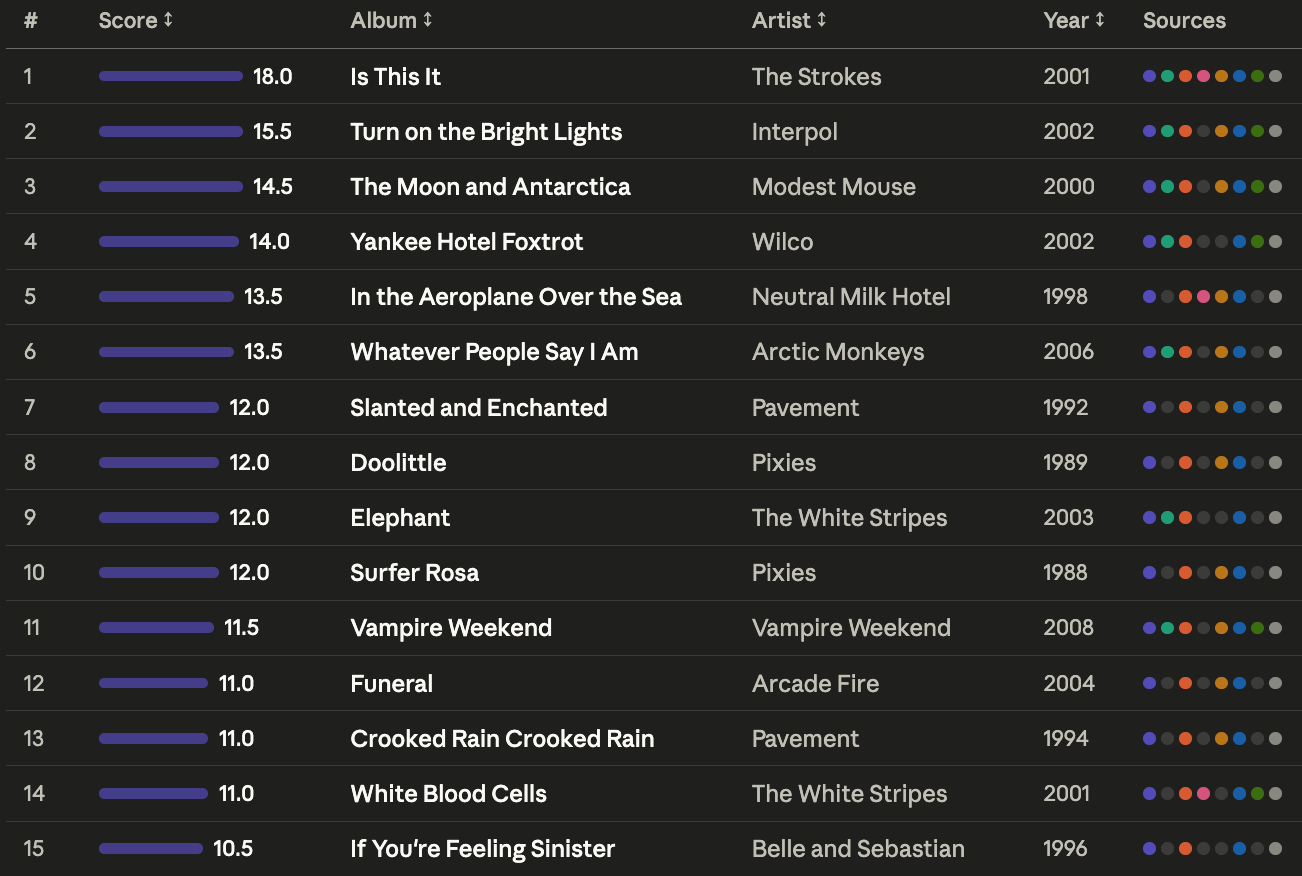
These rankings will be important later, so remember them.
The next step we took was tp plot the data chronologically. I asked Claude to define a cutoff two standard deviations from the mean, and the LLM on its own — helpfully, and spookily — applied its analysis to the data.
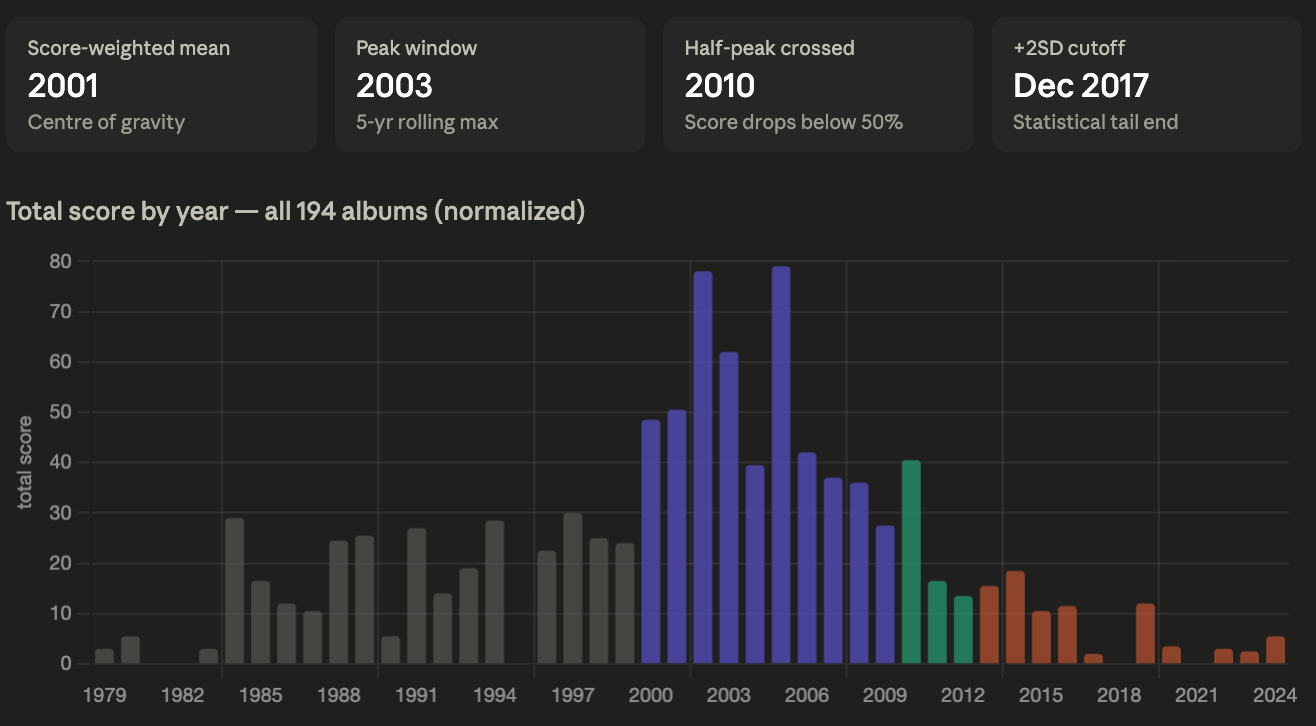
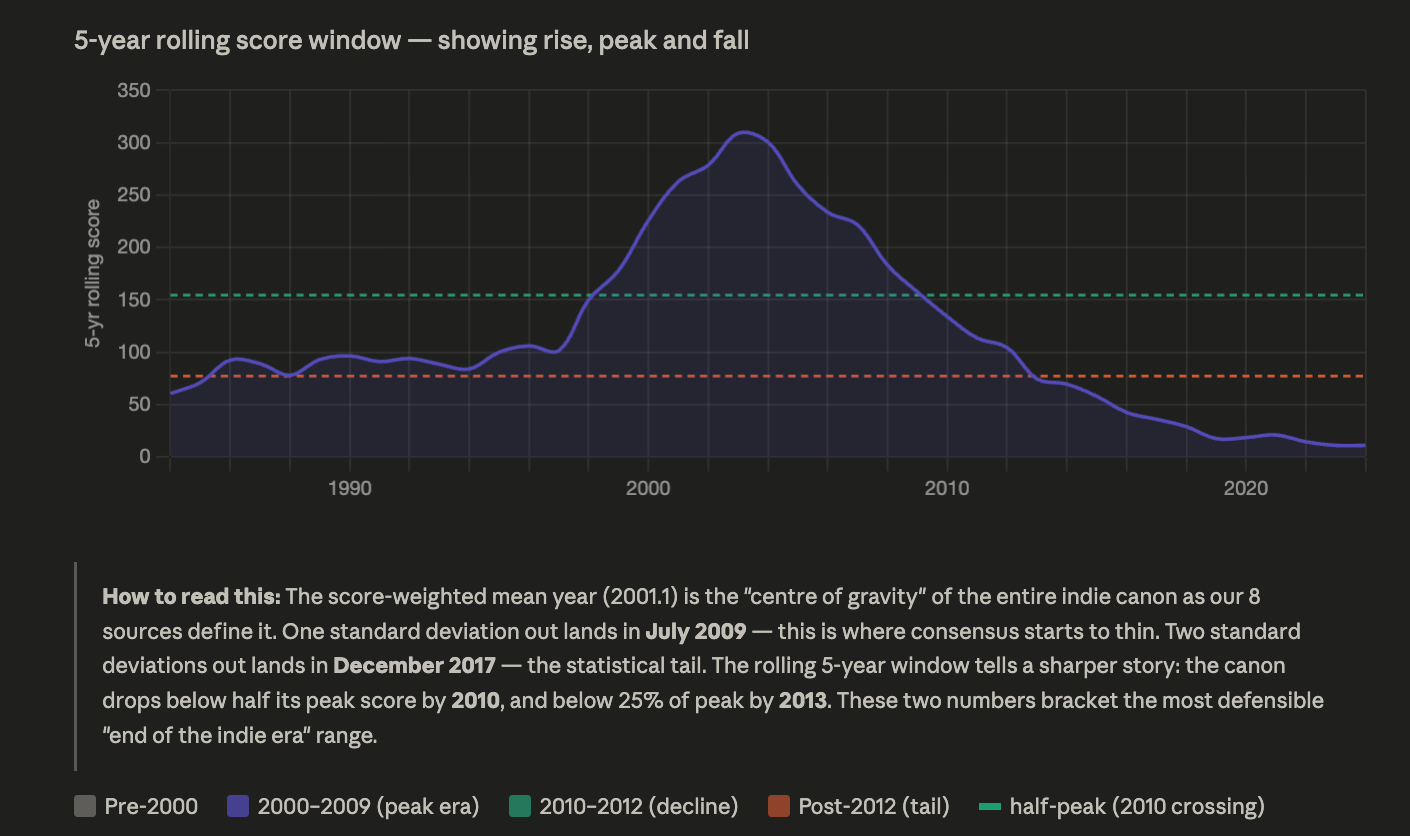
I thought the two standard deviations would define the end of the ‘decline’ and the beginning of a ‘death rattle’ stage pretty well, and I think it did. But when I look at the data, there are no albums from 2017 in the master list at all. That seems significant to me.
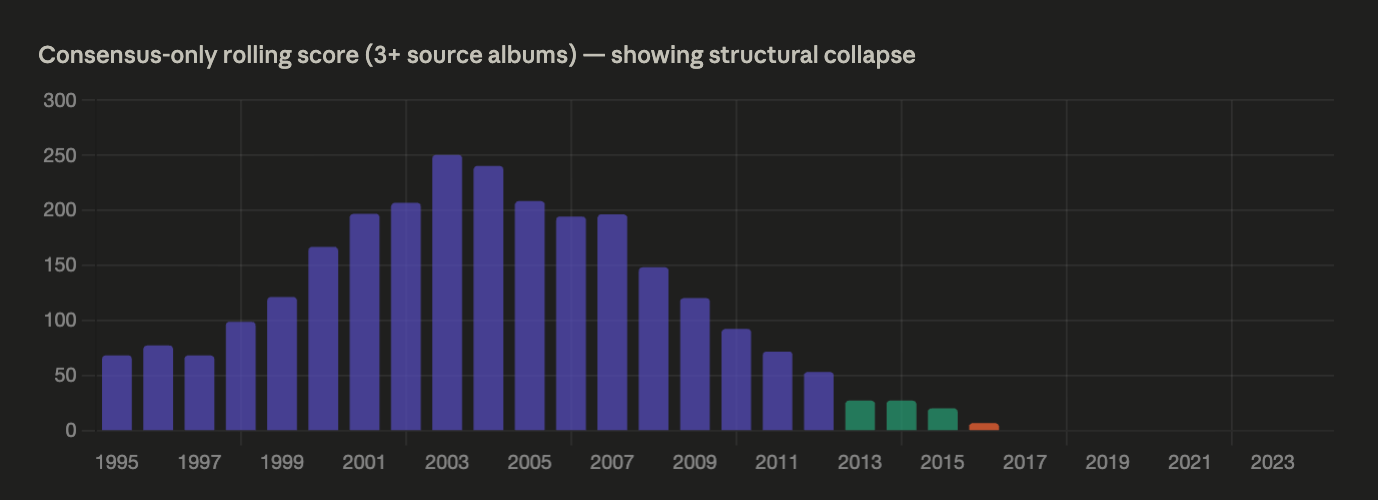
Claude applied a “consensus-only rolling score” that smoothed the data, and it became even more clear. The death was really in early 2016 — or, as Claude said, “2013 is when the genre lost the ability to generate new consensus records, even if a few stragglers (War on Drugs, Courtney Barnett) squeezed through on momentum. The death happened in 2013, the body stopped moving in 2016.”
We didn’t have a murderer yet, but we were identifying the scene of the crime. It looked like sometime between March 2015 and March 2016.
2. Analyze the release cycle
Indie music had a pretty specific way of generating buzz in the “blog era.” Tastemakers like Pitchfork acted as kingmakers, mega labels like Merge and Secretly Canadian signed new rockers to bigger contracts, and indie rockers hit the festival-to-headliner trajectory to get in front of the trendy set at Bonnaroo and Coachella.
At one point, this pipeline busted. Here’s Claude again.
Here’s the thing that jumps out when you lay the infrastructure collapse against your March 2015 canon death: they’re essentially simultaneous, and that’s not a coincidence — it’s the same event viewed from two different angles.
The blog-to-headliner pipeline — the specific machine that made indie rock work — was functionally dead by 2012–2013. What you see from 2013–2015 is a brief liminal period where a handful of artists (War on Drugs, Courtney Barnett) still made it through on the residual momentum of the old system. Barnett’s debut in March 2015 is the last one through the door before it closes permanently.
The Condé Nast acquisition in October 2015 is the institutional death certificate. It came six months after your music-data death date, which is actually a cleanly satisfying sequence: the music stopped producing consensus records first, and then the institution that validated them got captured. The cart followed the horse.
The Coachella pivot to DJs in 2016 is the popular culture confirmation — the moment the broader public could see, without needing music criticism expertise, that something had ended.
So the three-part answer to “when did the infrastructure die” is:
- The mechanism died 2012–2013 (blog era collapse + streaming displacement)
- The music died March 2015 (last consensus record)
- The institution died October 2015 (Pitchfork acquisition)
- The culture confirmed it 2016 (Coachella)
I’m seeing Claude develop its own theory about Courtney Barnett and The War on Drugs… I’m skeptical, but holding my tongue until the end of the analysis.
3. Define the sound shift
We had a window to analyze — March 2015 to March 2016 — and we had a top-15 indie album list to use. I had Claude look at the top releases in the range from March 2015 to May 2016 (just to be safe) and compare how sonically similar alt-rock releases from each month in that span were to our top 15. This really narrows us into the answer.
I wanted Claude to spit out the sonic match score for the top-rated alt-rock release for each month in that span, then try to eyeball when that match score fell off a cliff.
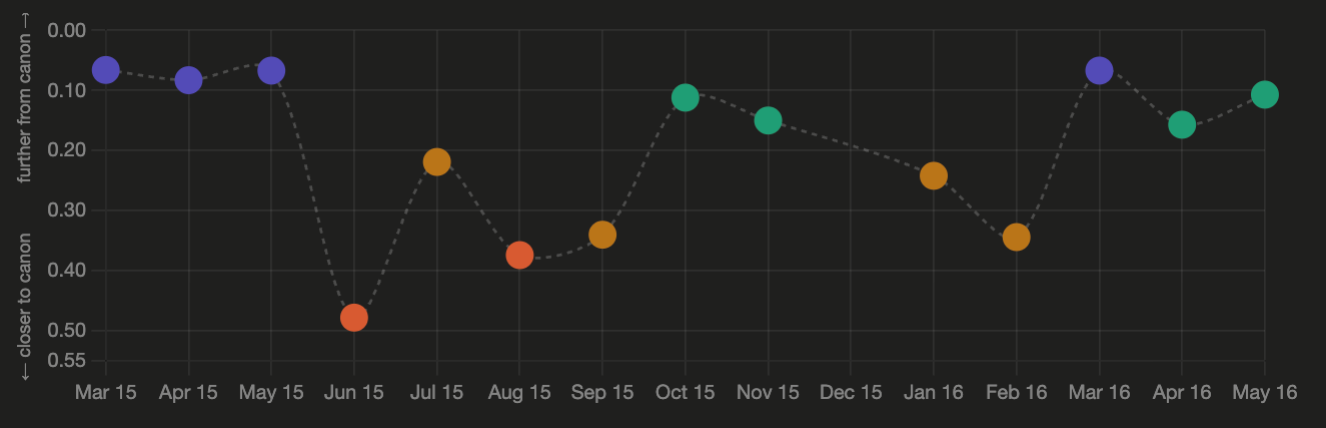
The answer was clear. There’s a death, then a dead-cat bounce.
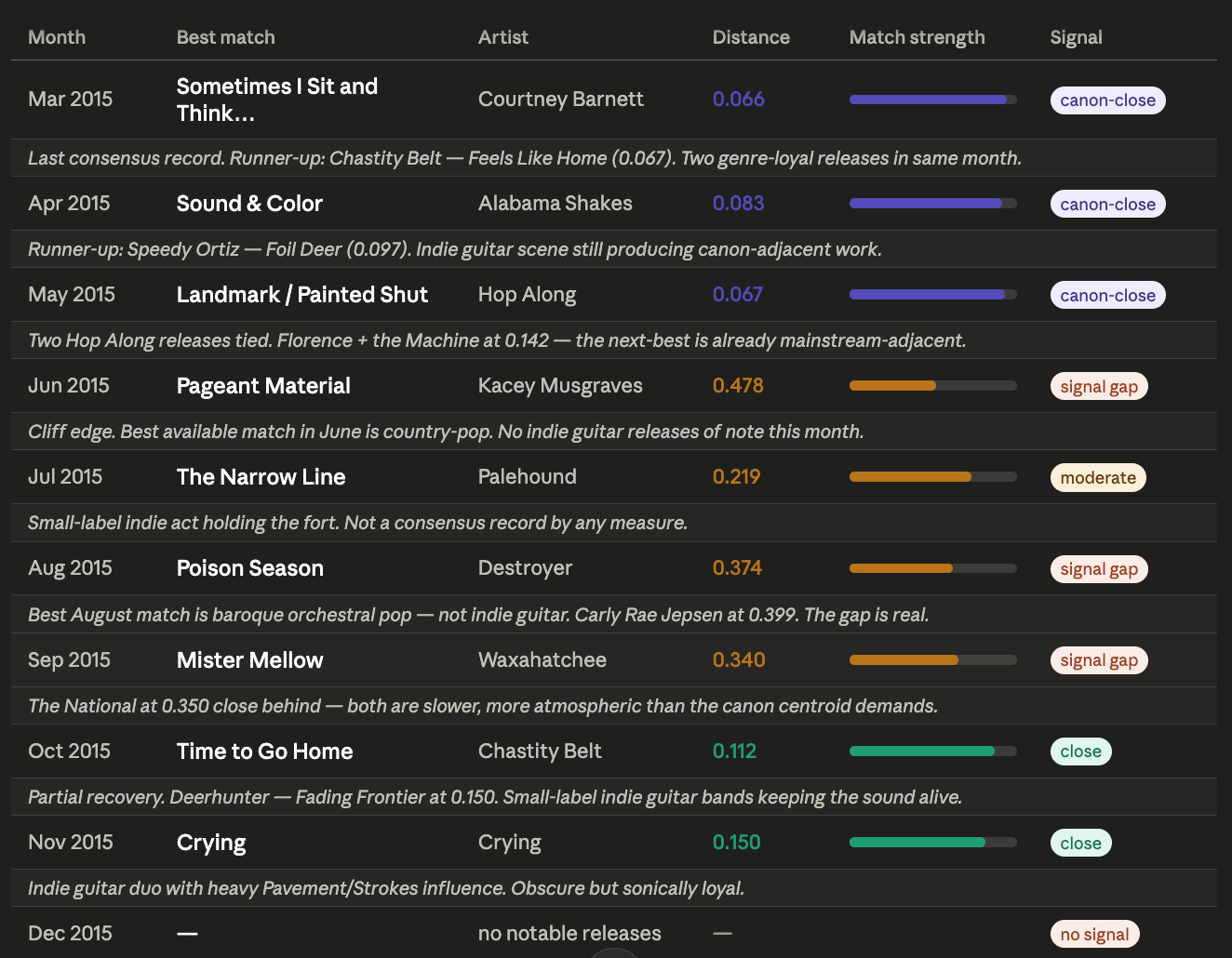
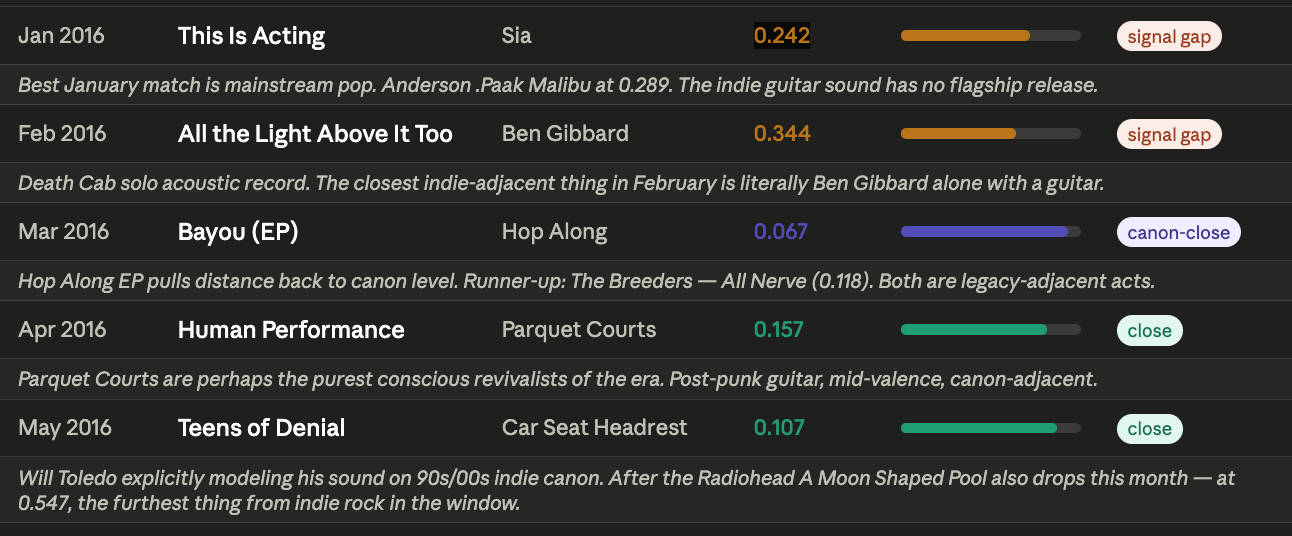
The month of June 2015 — that’s when indie rock died, after Hop Along released the very last indie album of the indie era with a far-too-fitting title: Landmark / Painted Shut.
And somebody killed it.
The killer revealed.
Some indie antichrist dropped a popular album in June 2015, bringing with them the end of the era. I was vibecoding my way to finding the vibe killer.
With that, I asked the question to my vibe-coded vibe-killer detective: What musician released an album that registered on the alt-rock charts in May or June 2015 with the lowest match score to our indie canon?
Since I’ve relied on Claude all along, I’ll give the robot the chance to sum up the answer in its own words:
X Ambassadors. VHS. June 2, 2015.
Distance of 0.309 — the farthest from the indie canon of any debut or breakthrough act releasing in the May–June 2015 window, and #1 on the year-end Billboard Alternative Airplay chart.
The feature breakdown tells you exactly how they killed it. Every single metric moves in the same direction — away from the canon and toward something new:
- Valence up +0.155 — happier, more triumphant, more anthemic
- Danceability up +0.143 — built for movement, not contemplation
- Loudness up +0.131 — louder, more compressed, radio-optimized
- Tempo up +0.100 — faster, more urgent
- Speechiness up +0.071 — hip-hop cadences bleeding into rock
- Acousticness down −0.116 — almost no organic guitar texture, pure synthetic production
That profile — louder, happier, more danceable, more electronic, more hip-hop adjacent, with basically no acoustic guitar — is a precise description of what alternative radio became after indie died. X Ambassadors weren't an anomaly; they were the template. “Renegades” is the sound of the genre that replaced indie rock announcing itself.
And the perfect closing note: they dropped VHS on June 2, 2015 — less than four weeks after Hop Along dropped Painted Shut on May 5. The last canon-faithful record and the first post-canon record separated by 28 days. That's your crime scene.
I don’t want to be a vibe-killer myself. Like I said, I know where my scene is and it isn’t here, today. Maybe you like X Ambassadors, and that’s totally fine. And maybe you hate indie rock, and, hey — it’s okay to be wrong.
But you should know what that band did. Maybe it had been on its death bed a long time ago, and maybe the machinery for its life support had been unplugged, but on one sunny day in summer 2015, three guys from Ithaca, New York, plunged the dagger into the decrepit heart of a dying genre.
What do we do with this knowledge? That’s up to you. Me personally: I’m gonna go back and listen to the top albums that came out of this analysis and relive the glory days, and I invite you to do that with me.
Jay Edgar is just a guy with a computer. If you didn’t want him to find answers to difficult questions, you shouldn’t have given him that computer.

Member comments