
I'm Isaac Saul, and this is Tangle: an independent, nonpartisan, subscriber-supported politics newsletter that summarizes the best arguments from across the political spectrum on the news of the day — then “my take.”
Are you new here? Get free emails to your inbox daily. Would you rather listen? You can find our podcast here.
Today’s read: 16 minutes.
Two new interviews.
We have two new interviews out this week for your listening pleasure. In the first, Managing Editor Ari Weitzman speaks to Tyler Austin Harper, a staff writer at The Atlantic. After Associate Editor Audrey Moorehead’s exploration into literacy on Friday, the conversation is timely — Tyler and Ari discuss funding for the humanities and what role universities should play in the future of education. You can listen here.
In the second interview, Senior Editor Will Kaback talks with the author and cultural critic Thomas Chatterton Williams about his new book, Summer of Our Discontent, which explores the social and political changes that followed from the nationwide protests in the summer of 2020. You can listen here.
Quick hits.
- Anthropic sued the Trump administration over its decision to designate the artificial intelligence company a supply-chain risk. A group of 37 AI researchers from Google and OpenAI filed a brief supporting Anthropic’s suit. (The suit)
- The Federal Bureau of Investigation (FBI) issued a grand jury subpoena for records of the Arizona State Senate’s audit of the 2020 presidential election results in Maricopa County, Arizona. The subpoena is part of the agency’s expanded investigation into potential irregularities in the election. (The subpoena)
- Live Nation Entertainment, the parent company of Ticketmaster, reached a settlement with the Justice Department to pay approximately $280 million in civil penalties and end some of its exclusivity agreements with artists. The settlement requires approval from all states that brought the antitrust suit against the company. (The settlement)
- New York City Police Commissioner Jessica Tisch said the Saturday incident in which improvised explosive devices were ignited during protests outside the city’s mayoral residence is being investigated as “ISIS-inspired terrorism.” Two suspects were each charged with five counts related to the incident, including attempted support of a designated foreign terrorist organization. (The latest)
- President Donald Trump told House Republicans that he will not sign any bills until Congress passes the SAVE America Act, which would require proof of citizenship to register to vote and identification to cast a ballot. (The comments)
If some extra money wouldn't hurt — you're not alone.
Between inflation, gas prices, and life happening, a lot of people are scrambling for ways to fatten their bank account without taking on a second job.
The thing is, most of us are leaving money on the table. We're talking $300 from Amazon shopping smarter, $225/month watching movie previews, even getting companies to forgive chunks of credit card debt.
Some of this sounds like internet nonsense, honestly.
But millions of people are already doing it. The Penny Hoarder compiled the most practical ways to pocket extra cash this month.
Check out which ones make sense for your situation.
*This is a sponsored post.
Today’s topic.
The latest developments in Iran. Tuesday marks 11 days since the United States and Israel launched joint attacks against the Iranian government and security forces, with several significant developments over the weekend.
On Sunday, Iran’s Assembly of Experts announced it had selected Mojtaba Khamenei as the country’s new supreme leader. Khamenei is the son of former Supreme Leader Ayatollah Ali Khamenei, who was killed in Israeli airstrikes at the outset of the attacks on February 28, and he maintains strong ties to Iran’s Islamic Revolutionary Guard Corps. President Donald Trump previously called his selection “unacceptable,” and Israel said Khamenei is a potential military target.
Separately, global oil prices have risen amid concerns about production and supply in the Middle East. The Strait of Hormuz, the narrow waterway connecting the Persian Gulf to the Indian Ocean, has been effectively closed since the conflict began. Oil-producing Gulf states like Iraq, Kuwait, and the United Arab Emirates have cut production due to export limitations. Brent crude futures rose to $119.50 per barrel on Monday, the highest mark since mid-2022, but fell below $100 per barrel later in the day. Energy ministers from the Group of Seven nations — Canada, France, Germany, Italy, Japan, the United Kingdom, and the United States — will meet on Tuesday to discuss a strategic release of crude oil reserves to address the ongoing supply disruption.
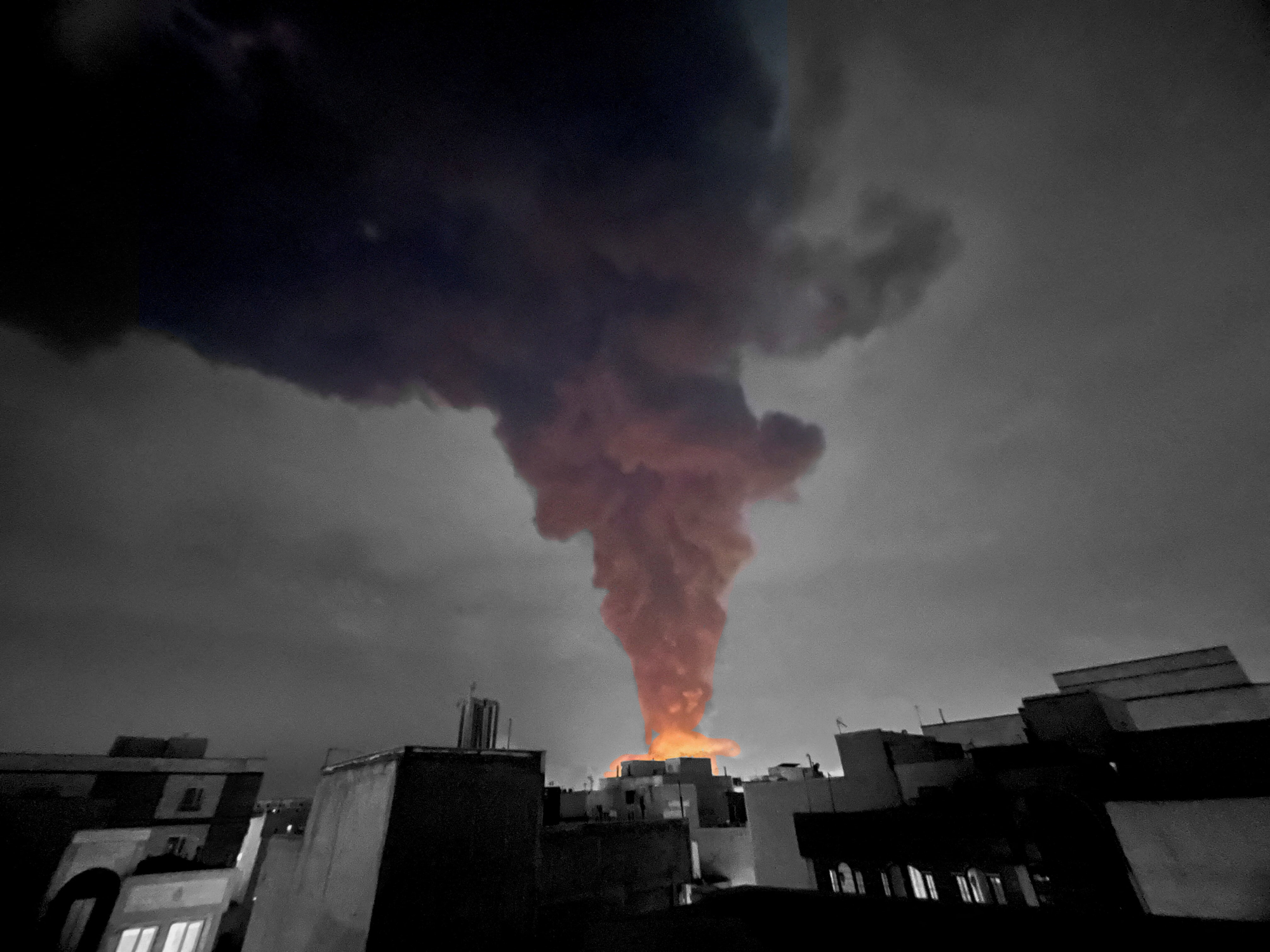
On Saturday, Israel struck multiple Iranian fuel sites near Iran’s capital, Tehran, causing large explosions. The strikes were the first known instances of Israel or the U.S. attacking Iranian energy infrastructure since the war began (though some strikes have damaged or destroyed civilian infrastructure), and Israel said it was targeting facilities used by Iran’s armed forces. However, the U.S. was reportedly unaware of the scale of the strikes beforehand, leading some officials to express frustration with the operation.
Elsewhere, on Monday, Turkey’s defense ministry said North Atlantic Treaty Organization (NATO) defenses intercepted an Iranian missile in the country’s airspace, marking the second NATO missile interception in the past week. Turkey is not expected to request formal NATO action against Iran, but it said “all necessary measures will be taken decisively and without hesitation against any threat directed at our country’s territory and airspace.”
On Sunday, U.S. military officials announced a U.S. service member had died from injuries sustained in an Iranian attack on troops in Saudi Arabia on March 1, the seventh U.S. service member death of the conflict. On Monday, the Defense Department identified the soldier as Sgt. Benjamin N. Pennington, 26.
Finally, a video published on Sunday added to evidence that the United States was responsible for a February 28 missile strike that reportedly killed 175 people at an Iranian elementary school. The video shows a Tomahawk cruise missile striking a naval base next to the school, and the U.S. military is the only one involved in the conflict that uses these missiles. President Trump previously suggested Iran was responsible for the strike, but more recently said he would accept the conclusion of the U.S. military’s investigation into the incident.
Today, we’ll share the latest on the conflict, with views from the left, right, and Middle East writers. Then, Executive Editor Isaac Saul’s take.
What the left is saying.
- The left expects the war’s impact will soon be felt at home in the U.S.
- Some say the U.S. and Israeli strategy is unlikely to produce the desired results.
In MS NOW, Joseph Zeballos-Roig said “America can’t afford Trump’s war with Iran for long.”
“The war is costing the U.S. an estimated $1 billion a day, according to two congressional sources with knowledge of the matter. Oil prices are now forecast to go higher, while gas prices have already jumped to $3.32. It’s the highest price it has reached in either of Trump’s two terms,” Zeballos-Roig wrote. “The knock-on effects of increasingly expensive oil will be felt next. Higher costs for oil and gas will spread to the costs of other goods and services, particularly those relying on trucks for transportation. Higher prices for airline tickets aren’t out of the question. Grocery bills and electricity prices will also follow suit if the war drags on.”
“[Iran’s] clerical regime does have incentives to drive up global oil prices as high as possible in a last-ditch effort to ensure its survival. The Iranian military has already targeted power plants and oil refineries in the Gulf, and the financial fallout of the war stands to get worse if nothing changes,” Zeballos-Roig said. “The building blocks of prolonged uncertainty are all falling into place. Trump remains devoted to his tariffs… If the war in Iran stretches on for months, it will magnify the expected price increases for food, furniture and much more.”
In The New York Times, Thomas L. Friedman wrote “Trump has no idea how to end the war with Iran.”
“Nothing would improve the prospects of the people of Iran, Lebanon, Iraq, Syria, Gaza, Yemen and Israel more than removing the Islamic regime in Tehran,” Friedman said. “But what if that regime is also so embedded — in mayoralties, schools, police stations, government jobs, the banking system, the military, neighborhood paramilitaries — that, despite its unpopularity with a majority of Iranians, it can’t be removed without plunging the entire Iranian landmass, about a sixth the size of the United States and home to 90 million people, into chaos?”
“Nothing underscores the embeddedness of this regime more than the fact that Iran just replaced its supreme leader, Ali Khamenei, killed early in the war, with his son Mojtaba Khamenei, said to be another hard-liner,” Friedman wrote. “Iran’s regime is a disgrace — a menace to its own people, to its neighbors and to a rules-based order as much as any other nation… But endlessly bombing it, destroying more and more military and civilian infrastructure and just hoping that Iranians seeking democracy will come together… show me where that has ever happened in history.”
What the right is saying.
- Some on the right say the U.S. is winning the war and should press on.
- Others urge Trump to wind down the conflict as soon as he can.
The Wall Street Journal editorial board argued “Iran isn’t winning this war.”
“The reality inside Iran and the region is that the U.S. and Israel continue to make progress. The regime loses more of its military each day, along with the ability to hurt its neighbors. The Israelis estimate 70% to 75% of Iran’s missile launchers have been destroyed, and the U.S. has destroyed at least 43 Iranian ships,” the board said. “At 10 days in, the war can hardly be considered prolonged, and there’s nothing gradual about U.S. or Israeli strategy. Instead there is a race: Can Iran do enough damage to global energy markets with its remaining missiles and drones before it loses them or must come to terms?”
“The U.S. in particular has ample oil and gas supplies. Mr. Trump is also right that the disruption is likely to stop when the war does and it is a ‘small price to pay’ for major security advances,” the board wrote. “It would make no sense to leave so many loose ends, from missiles and production facilities to nuclear sites at Pickaxe Mountain and the Isfahan tunnels. There’s also little reason to leave standing any IRGC or basij bases. Even if the regime survives the bombing, it’s in the U.S. security interest to give Iranians the best chance to retake their country.”
In The Washington Post, Jason Willick made “the case for declaring an early victory in Iran.”
Defense Secretary Pete Hegseth “keeps underlining the war’s ‘scoped’ military purpose: The degradation or destruction of Iran’s missile capacity, nuclear program and navy. In his telling, the United States is targeting the Islamic Republic’s means of projecting power beyond its borders, not the prevailing form of government within them,” Willick said. “Under that conception of the war, Trump ought to be able to declare victory at the time of his choosing — even in the coming days, with the highest-value known military targets taken out by thousands of strikes from air and sea. That might be the best outcome, both for Trump politically… and for the U.S. strategically.”
“The longer the war goes on, then, the more ambitious the goals may become. Replacing the Islamist tyranny that rules Iran with a freer government would obviously be the best outcome for the U.S. and the Iranian people. But short of such regime change, the U.S. might soon need to decide whether it is willing to settle for a weakened tyranny in Tehran with a decimated military at its disposal,” Willick wrote. “The prudent choice, the conservative choice, would be to take the past week’s gains and walk away.”
What writers in the Middle East are saying.
- Some writers decry the war even as they hope for the end of the Iranian regime.
- Others suggest Iran’s days as a regional power are over, no matter the war’s outcome.
In The New Arab, Nasrin Parvaz wrote “I was tortured by Khomeini’s regime. This war is still unjust.”
“For so many of us, me included, we wanted Khamenei and his henchmen to face justice in a courtroom, on trial for decades of crimes, repression and killings. I never wanted to see them killed by foreign forces but confronted by the families of those he helped destroy,” Parvaz said. “None of this can justify foreign military attacks that kill innocent people. The death of one man does not legitimise the bombing of a country, the destruction of infrastructure, or the killing of children. Justice cannot be delivered by missiles.”
“Iran should be governed by the collective will of its people — not by force, and not by a figure selected or imposed by the United States or Israel. Real justice cannot be outsourced to foreign powers,” Parvaz wrote. “Western governments often claim that military intervention brings freedom. People in the Middle East know this is not true. We have seen what war did to Iraq, to Afghanistan. We know that authoritarian regimes use war as a cover for repression, and that foreign powers are rarely interested in self-determination.”
In Arab News, Abdulrahman Al-Rashed explored “the end of Iran as a military power.”
“So far, the signs of what will come after the war do not suggest that the regime is on the verge of collapse, either through internal unrest or external pressure,” Al-Rashed said. “That may mean the world will have to accept living with a weakened but still functioning regime. This recalls the ‘Safwan tent’ scenario, when Iraq signed its surrender after its defeat in Kuwait and the destruction of much of its military. Saddam Hussein’s regime remained in power for another 12 years before it was finally removed in 2003. A similar pattern may now be unfolding.”
“In the coming weeks, estimates suggest that the remaining elements of Iran’s weapons arsenal, along with its factories and military institutions built over three decades, will be destroyed. This could grant the region a reprieve from Iranian threats for perhaps a decade, assuming a negative ‘Saddam scenario,’ in which a weakened but surviving regime attempts to rebuild its capabilities,” Al-Rashed wrote. “Another possibility, however, is that Tehran itself may change, either through a transformation of the regime or its policies, becoming a more normal state focused on development and regional cooperation.”
My take.
Reminder: “My take” is a section where we give ourselves space to share a personal opinion. If you have feedback, criticism or compliments, don't unsubscribe. Write in by replying to this email, or leave a comment.
- U.S. actions in Iran are deeply embarrassing to me.
- Strikes against civilians and schoolchildren shouldn’t be acceptable.
- I understand the argument in favor of the war, but I don’t think we’re improving Iran or making ourselves safer.
Executive Editor Isaac Saul: I consider myself a patriot.
I love my country; I wouldn’t pick anywhere else to live or raise my family. I believe in our founding documents; I respect our institutions (even Congress, even when it makes me want to rip my hair out); and in my general, day-to-day life, I find Americans to be a kind, confident, decent, and generous bunch. I’ve been blessed to see much of the world, and, well, I just like it here the most.
That’s all to preface my feelings honestly right now, which I think I can mostly describe as shame. I’m… embarrassed? Mortified? Deeply concerned? I don’t know exactly how to say it, but as I watch the early days of this war, I’m feeling my faith in all that I love about this great, grand experiment shift — just enough to turn my stomach and make me want to hide my face.
Maybe I’m having a hard time getting past how it started: The U.S. military was, in all likelihood, responsible for bombing a girls school in Iran, in what may be the single deadliest U.S. killing of civilians in decades. More and more evidence suggests it was us every day. The strike does not appear to be deliberate — right now, it seems the school was collateral damage in a strike on an adjacent Iranian naval base, perhaps accidentally targeted with artificial intelligence — but the result remains. Our president has blamed the strike on Iran, and he now says our military is conducting an investigation and will accept whatever the report shows.
In defending this position, President Trump claimed that the Tomahawk weapons recorded in the strike could have been from someone else, since other countries besides the United States have them. Fox News Pentagon correspondent Jen Griffin responded, rightly, by noting that Trump is “trying to muddy the waters” because the U.S. is the only army in this war with Tomahawk missiles. “It seems highly unlikely that it would be anyone’s Tomahawk other than a U.S. Tomahawk that hit that school. And I think the president knows that,” Griffin said. I don’t know which would be worse: That he does know that, or that he doesn’t.
This strike alone, which reportedly killed 175 people, most of them schoolgirls, is just one signal about how the war is progressing. Human Rights Activists News Agency, a U.S.-based nonprofit whose reporting in Iran has been critical for understanding the brutality of the Khamenei regime, is now reporting that more than 1,000 civilians have been killed in the war. The “liberation” of the Iranian people includes apocalyptic scenes of city streets ablaze, with toxic black oil-drenched rain falling from the sky; along with Israel, we’ve been accused of bombing desalination plants that will worsen an already serious water shortage (Iran then responded in kind, in Bahrain). Meanwhile, in the Indian Ocean, a U.S. submarine torpedoed an Iranian warship that had been participating in joint military exercises with India. The ship had been given sanctuary by India, a U.S. ally, and the U.S. left Iran’s crew members to be recovered or rescued by Sri Lanka.
Israel also bombed 30 Iranian fuel depots on Saturday, reportedly infuriating U.S. counterparts who worry the strikes on critical infrastructure that serve Iranians could backfire and rally Iranian society to support the regime (while driving up oil prices). U.S.–Israeli strikes have hit schools, hospitals, and historical landmarks. In the first 48 hours of the attacks in Tehran, some 100,000 people fled the capital. 16 countries are now involved in the conflict in some capacity, and more could soon follow. The prospect of a quick or clean exit is essentially gone.
To be honest, my tolerance for witnessing this kind of carnage, death, and destruction is simply waning, if not totally evaporated. After more than four years of war in Ukraine, Gaza, Yemen and Sudan, bearing witness to more children being killed, more civilians buried in collapsed buildings, more warspeak about “missions” and “threats” and “kinetic actions,” all while our leaders are detached from the absolute horrors of what’s happening on the ground — I just can't tolerate it much longer.
A Tangle reader recently suggested that I’m a “pacifist” and this might be the lens through which I see much of our modern conflict, often pitting me against countries like the U.S. or Israel. I don’t think that’s quite right, or at least hasn’t always been true. I’ve supported dumping unthinkable amounts of money into our military in the past. I do not believe all American intervention is bad; in fact, I’ve written explicitly about the times it has worked. I believe some wars are just and some are unjust, and in the last few years I’ve been inclined to back U.S. support and intervention in Ukraine, where 40 million people are victims of an unjust war. I understand that violence is still an apparently inevitable part of human nature, especially at a global scale. But when I survey what’s happening in Iran now, I’m not convinced we’re doing the right thing.
Maybe the war fatigue has made it impossible for me to look at burning cities of millions of people and think of it as us “winning.” Or maybe, after watching this sort of thing play out enough times, I’m just seeing clearly in a way I can’t unsee. Part of me just can’t fathom that in 2026, this is how civilizations are still solving their biggest problems.
I can even make the case for this war: Iranian proxies have wrought horror across the Middle East for decades while ineffective negotiations have failed to disarm the Iranian regime, stop its funding of terrorism, or back them off from pursuing a nuclear weapon. Thousands of Iranians flooded the streets in celebration when we took out Khamanei and his inner circle, and plenty of Iranians are welcoming this intervention despite the cost. This show of force is sending a clear message across the globe, likely instilling a new respect in our enemies for the most powerful military on earth. And maybe this was the only message that Iran would understand. “It’s called peace through strength… it’s not a slogan," Israeli Prime Minister Benjamin Netanyahu told Sean Hannity. "You have to be strong to protect freedom in an unkind world.”
But is it working? Do we have an off-ramp? Do we have a plan? Is what we have now better than what we had a month ago? Those are critical questions. New Supreme Leader Mojtaba Khamanei is more hardline than his father, younger, avoids public appearances, and just had his wife, mother, father, a sister, and a child killed in U.S.–Israeli strikes. Do we expect to be able to make peace with this guy?
Any semblance of a rules-based international order is officially dead now, if it wasn’t already. We’ve now wiped out much of Iran’s leadership and seem to be hellbent on killing whoever tries to fill the gap that we don’t like. Not long after we dropped into Venezuela to arrest and incarcerate their president, we are now threatening to do the same to his replacement, whom we also helped pick. And all eyes are on Cuba next. I worry about the implications for safety and trade, but put that aside for a moment: How do we claim to be moral international actors? How do we, as Americans, claim to be guided by a higher set of principles than what led Vladimir Putin to invade Ukraine? This isn’t spreading democracy, and it’s not defending the vulnerable — this is “might makes right.”
I want answers to these kinds of questions, but when I look to the people who are supposed to be in control, I’m not getting them. President Trump, asked on Monday whether the war was “very complete,” as he’s said, or “just the beginning,” as Defense Secretary Pete Hegseth said, responded by saying “you could say both.” Well, okay then. Congress had an opportunity to wrest control of the war back from the president, but opted not to. Sen. Lindsey Graham (R-SC) is going on Fox News with “Free Cuba” and “Make Iran Great Again” hats, assuring Americans that “we’re marching through the world” to “clear out the bad guys.”
Trust me: I want to feel good about all this — about taking out this awful regime, attempting to liberate the Iranian people, and beating back the big bad guys all across the globe. But when I honestly take stock of our actions, I have a hard time getting there. I don’t see us making life better for Iranians (or Venezuelans) right now, and I certainly don’t see how my country has improved in the last few months. I’m open to being convinced, but right now I’m not close.
Take the survey: What do you think of U.S. military actions in Iran? Let us know.
Disagree? That's okay. Our opinion is just one of many. Write in and let us know why, and we'll consider publishing your feedback.
Your questions, answered.
We're skipping the reader question today to give our main story some extra space. Want to have a question answered in the newsletter? You can reply to this email (it goes straight to our inbox) or fill out this form.
Under the radar.
On Saturday, a federal judge ruled that Kari Lake was improperly appointed to lead the U.S. Agency for Global Media (USAGM), and actions she took during her four-month tenure should be considered void. USAGM oversees Voice of America, a government-funded international broadcaster that provides news and cultural programming to a global audience. Lake was elevated to the top of the agency on July 31, 2025 in an “acting capacity” (without Senate confirmation) until she stepped down on November 19. During that time, she significantly reduced USAGM’s workforce and dismissed hundreds of contractors working for Voice of America, which has since come under scrutiny for its coverage of the conflict in Iran. Lake criticized the judge who issued the ruling and said the Trump administration will appeal. Politico has the story.
You're probably overpaying for half the things you buy.
Your car insurance, credit cards, Amazon purchases — companies are banking on you not noticing.
We found a list of ways to stop getting ripped off and start pocketing that money instead.
Some could save you thousands. See which ones apply to you.
Numbers.
- 1989. Before last week, the most recent year that Iran’s Assembly of Experts convened, to select Ayatollah Ali Khamenei as the country’s second supreme leader.
- 20%. The approximate percentage of oil consumed worldwide that is exported through the Strait of Hormuz.
- $110 and $135. The estimated cost of oil per barrel if the current conflict persists for two months and four months, respectively, according to a Rystad Energy oil markets analyst.
- 29% and 43%. The percentage of U.S. adults who approve and disapprove, respectively, of U.S. military strikes against Iran, according to a Reuters/Ipsos poll that closed on Monday.
- 29% and 42%. The percentage of U.S. adults who say the strikes will improve and worsen, respectively, U.S. national security over the long run.
- 49%. The percentage of U.S. adults who think the conflict will have a mostly negative impact on their personal financial situation.
The extras.
- One year ago today we wrote about dismantling the Department of Education.
- The most clicked link in yesterday’s newsletter was our Friday edition on rebuilding literacy.
- Nothing to do with politics: A daily geography game for all you nerds and aspiring nerds.
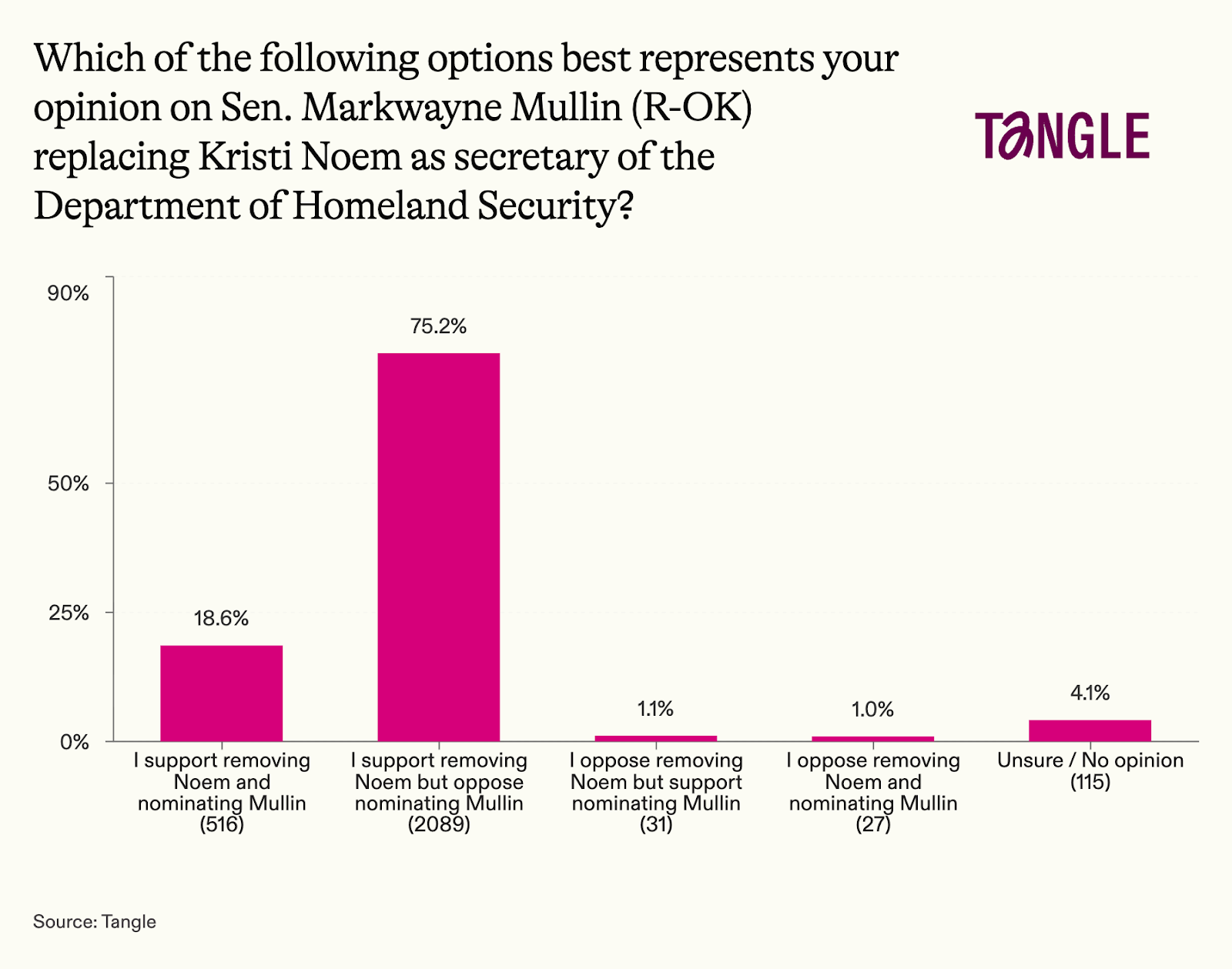
- Yesterday’s survey: 2,778 readers responded to our survey on Sen. Markwayne Mullin (R-OK) replacing Kristi Noem as DHS secretary with 75% supporting Noem’s removal but opposing Mullin’s nomination. “Noem out is a good thing, Mullin in is questionable. He appears to be better, but is he really the best choice?” one respondent said. “Wait and see on Mullin,” said another.
Have a nice day.
In August 1972, two young women leaving a movie theater in Fairview Park, Ohio, found a newborn baby girl in a paper bag in a shopping cart. They called the police and accompanied the baby to the hospital — but they never stopped thinking about her. More than 50 years later, Pearl Marshall, now a music teacher living in Virginia, discovered she was that baby. With the help of a local historical researcher, all three women reunited last summer. “I won’t forget the day that we found her,” Darlene Gilleland said. “And I won’t forget the day that we found her again!” News 5 Cleveland has the story.

Member comments