

I'm Isaac Saul, and this is Tangle: an independent, nonpartisan, subscriber-supported politics newsletter that summarizes the best arguments from across the political spectrum on the news of the day — then “my take.”
Are you new here? Get free emails to your inbox daily. Would you rather listen? You can find our podcast here.
Today’s read: 13 minutes.
Unknown Number Calling? It’s Not Random.
The BBC caught scam call center workers on hidden cameras as they laughed at the people they were tricking.
One worker bragged about making $250k from victims. The disturbing truth? Scammers don’t pick phone numbers at random. They buy your data from brokers.
Once your data is out there, it’s not just calls. It’s phishing, impersonation, and identity theft.
That’s why we recommend Incogni: They delete your info from the web, monitor and follow up automatically, and continue to erase data as new risks appear.
Try Incogni here and get 55% off your subscription with code TANGLE.
*Our sponsors help keep Tangle free — thank you for supporting them when you can.
Tangle is coming live — this week!
We’re just a few days away from Tangle News: Live! at the Irvine Barclay Theatre on Friday, October 24 — and I couldn’t be more excited. This show is shaping up to be one of our biggest events yet, and tickets are going fast. Today we have an exciting new announcement: We’re giving away VIP tickets to the show!
If you win, you’ll meet me and our panelists after the show for a private reception, where you’ll have a chance to ask your questions personally. You can enter the VIP Giveaway here!
If you don’t want to roll the dice, this is also your last call to grab tickets before we sell out. Whether you come for the debate, the humor or the insights, I promise it’ll be an evening worth remembering.
— Isaac
(We’ll choose winners in 24 hours and notify you by email, so be sure to keep an eye out.)

Quick hits.
- Organizers said that close to seven million people participated in approximately 2,700 “No Kings” rallies held across the United States on Saturday in protest of the Trump administration’s actions. (The protests)
- The Trump administration said it will repatriate two alleged drug traffickers who survived a strike on their boat in the Caribbean Sea on Thursday. The survivors were from Colombia and Ecuador, and President Donald Trump said they would face prosecution in their home countries. (The repatriations) Separately, the U.S. carried out a seventh confirmed strike on an alleged drug boat, killing three. (The strike)
- Israel said it fired on militants who crossed into an area of Gaza under its control. The incidents follow Israel carrying out a series of airstrikes and temporarily suspending humanitarian aid to the strip after it said two of its soldiers were killed in an attack by Palestinian militants. (The latest)
- President Trump reportedly told Ukrainian President Volodymyr Zelensky that the U.S. would not provide Ukraine with Tomahawk missiles for the time being, suggesting doing so would undermine peace negotiations with Russia. (The report)
- Afghanistan and Pakistan agreed to an immediate ceasefire during negotiations in Qatar, which followed a week of violent engagements along the countries’ border. (The ceasefire)
Today’s topic.
George Santos’s commutation. On Friday, President Donald Trump announced he had commuted the sentence of former Rep. George Santos (R-NY), who was serving a seven-year prison sentence for fraud and identity theft. In a post on Truth Social, Trump wrote, “George Santos was somewhat of a ‘rogue,’ but there are many rogues throughout our Country that aren’t forced to serve seven years in prison,” adding, “George has been in solitary confinement for long stretches of time and, by all accounts, has been horribly mistreated.” Trump also suggested that Santos had acted more forgivably than Sen. Richard Blumenthal (D-CT), who overstated his military record in the past. Santos’s attorney said he was released from the Federal Correctional Institution in Fairton, New Jersey, on Friday night. The commutation does not expunge Santos’s criminal record, but he will not be required to pay over $370,000 in restitution to his victims.
Back up: Shortly after Santos was elected to Congress in 2022, The New York Times published a story questioning several claims he had made about his background, which Santos later acknowledged were fabrications. In 2023, he was indicted twice, for embezzling money from his campaign, stealing the identities of campaign donors and defrauding those donors, among other counts. In December 2023, the House voted 311–114 to expel Santos from Congress, and he pleaded guilty to wire fraud and aggravated identity theft in August 2024. He was sentenced to 87 months in prison in April and began serving the sentence in July.
During his time in prison, Santos directly appealed to President Trump for clemency in newspaper columns and on social media. Several of Santos’s Republican allies in the House also advocated for his release, including Rep. Marjorie Taylor Greene (R-GA), who argued his sentence was excessive. After his release, Santos thanked President Trump, writing on X, “I saw not only the strength of a great leader, but the heart of a man who believes in mercy, in redemption, and in the promise that America gives everyone, the promise of a second chance.” He also said that he would focus on advocating for “prison reform and accountability” after his experience in solitary confinement.
Democrats and some Republicans criticized Trump’s decision. Former Rep. Robert Zimmerman (D-NY), who lost to Santos in 2022, said the commutation “demonstrates the lawlessness of the Trump administration,” and Rep. Hakeem Jeffries (D-NY) called it “insulting.” Rep. Nick LaLota (R-NY) wrote, “George Santos didn’t merely lie — he stole millions, defrauded an election, and his crimes (for which he pled guilty) warrant more than a three-month sentence.”
Other Republicans defended the decision, including House Speaker Mike Johnson (R-LA), who said, “We believe in redemption… I hope Mr. Santos makes the most of his second chance.” Rep. Greene thanked Trump for extending clemency, saying that Santos “was unfairly treated and put in solitary confinement, which is torture!!”
Today, we’ll share arguments from the right and left on Santos’s commutation. Then, my take.
What the right is saying.
- The right is mixed on the commutation, with some questioning the decision.
- Others say Santos’s sentence seemed excessive relative to his crimes.
- Still others express confusion over Trump’s rationale.
In National Review, Jeffrey Blehar wrote about Trump’s clemency decision.
“I suppose there’s no point in mentioning that this week began with Trump opportunistically targeting John Bolton for conducting business as usual among Washington elites, and ends with him commuting the sentence of a felon who accepted a plea deal on 24 federal charges, including wire fraud and money laundering,” Blehar said. “That’s just the sort of presidency we’re living under right now, and it remains to be seen whether Trump’s use of the Justice Department to so openly punish his enemies and help his friends becomes the new norm.”
“For whatever reason, Trump framed his commutation of Santos’s prison sentence in terms of a lengthy attack on Connecticut’s Dick Blumenthal, who once infamously lied about having served in Vietnam. And it is indeed true that Blumenthal is less a United States senator than he is a golem, void of intellect or spirit, clumsily sculpted to resemble a politician,” Blehar wrote. “But when it comes to COMPLETE AND TOTAL FRAUDS even Tricky Dick must yield pride of place to our old friend George.”
In PJ Media, Catherine Salgado suggested Santos’s treatment by the justice system was “suspicious.”
Santos “begged for ‘justice and humanity’ from Trump, saying he was told he would be in solitary as long as the FBI was investigating him. Notably, New Jersey law strictly limits solitary confinement, though prisons there have been accused of flouting the law before,” Salgado said. “It was somewhat suspicious indeed that out of all the dishonest, corrupt individuals in Congress, including some accused of outright felonies like Ilhan Omar, Santos was the one who was axed — coincidentally, soon after he started aggressively going after the Chinese Communist Party (CCP) and questioning its influence in our government.
“Now that Santos has received a commutation, perhaps Trump can look into and assist Chinese dissident Miles Guo, who was targeted in a biased campaign by the Biden administration,” Salgado wrote. “The president emphasized how harshly Santos was treated in prison, even while leftist judges allow major criminals to go free… Santos’s letter appears to have spurred the commutation, and he had appealed to his record backing Trump’s agenda.”
In The New York Sun, Dean Karayanis explored Trump’s “shaggy-dog story” justifying his decision.
“Santos was radioactive in political circles. Yet Mr. Trump delights in doing things that consultants warn will spend political capital for no gain. His post Friday on Truth Social was classic misdirection aimed at shifting the spotlight to Mr. Blumenthal from Santos,” Karayanis said. “In Mr. Trump’s announcement, Santos was almost an afterthought. The post was audacious in its account of Mr. Blumenthal’s misrepresentations, which were first exposed when he ran for Senate in 2010.”
“Mr. Trump wrote that Mr. Blumenthal ‘never went to Vietnam, he never saw Vietnam, he never experienced the battles there or anywhere else.’ True. The president, though, then slipped in that ‘even’ the senator’s ‘minimal service in our military was totally and completely made up,’ burying his time as a reservist,” Karayanis wrote. “As with so much in America, one’s politics will determine their reaction to Santos skating. Critics will see it as short-circuiting justice; supporters will delight that Mr. Trump stands by his friends no matter what. Mr. Blumenthal is mum on the subject — a prop in the president’s latest shaggy-dog story who’s again feeling the bite.”
What the left is saying.
- The left is sharply critical of the commutation, framing it as Trump’s latest subversion of the justice system.
- Some say Santos was let off the hook for serious crimes.
- Others suggest Santos was granted clemency primarily for his loyalty.
The Newsday editorial board called the commutation “justice betrayed.”
“President Donald Trump’s unwarranted release from prison of George Anthony Devolder Santos is another mockery of the American justice system. The commutation has generated a well-justified bipartisan mix of public condemnations. But Trump is exercising one of the more regal privileges of the presidency set in the Constitution. He will not be held accountable for this amazing disgrace,” the board wrote. “[Santos’s] friends at the top level of the Justice Department also made sure he’s off the hook on his agreement to pay nearly $400,000 in restitution to victims.”
“Nationally, this is the latest sign of a dangerous bias that Trump is injecting into the Justice Department to concoct some prosecutions and cancel others based on his personal interests. In an unprecedented way, he’s been openly demanding his appointees target specific Democrats for charges of dubious merit,” the board said. “During his two terms, Trump has fully pardoned nine former GOP members of Congress convicted of crimes, including ex-Reps. Chris Collins and Michael Grimm of New York.”
The Coffman Chronicle staff questioned Trump’s claim that Santos was mistreated.
“Santos wasn’t caught skimming from a PAC or misreporting a line item. He engineered an elaborate scheme involving wire fraud, identity theft, and campaign finance violations. He stole the identities of real donors to make unauthorized contributions. He filed false financial disclosures. He used political contributions for personal expenses,” the staff wrote. “Santos’s campaign was built on fabrication. He didn’t just pad his résumé. He invented it. He falsely claimed to be Jewish, to have descended from Holocaust survivors, to have worked at Goldman Sachs, to have lost his mother in the 9/11 attacks, and to have been a victim of the Pulse nightclub shooting.”
“After all the damage, all the lies, all the theft, the man who let him walk didn’t point to a procedural flaw, or a new piece of evidence, or even a disproportionate sentence. Instead, Donald Trump offered this: ‘He always voted Republican.’ That was the reason. Loyalty. Not truth. Not justice. Not reform. Obedience,” the staff said. “Santos didn’t walk out of prison because he deserved mercy. He walked out because he served power. He lied for the right people. Because, in a system warped by allegiance and ambition, that’s all it takes.”
In Mother Jones, Noah Lanard argued Santos was freed because he “stayed loyal.”
“Perhaps the most notable thing about President Donald Trump’s Friday decision to commute the prison sentence of former Rep. George Santos (R-N.Y.) is how unsurprising it is. In the end, one felon from Queens has come to the aid of another felon from Queens,” Lanard wrote. “The president hasn’t done so because he believes Santos was falsely accused — not even Trump could convince himself of that — but because Santos stayed loyal.”
“The commutation did not come totally out of the blue for [Santos’s lawyer Joseph] Murray, who said he had been in ‘constant communication’ with lawyers at the Justice Department’s pardon office. That office is now led by Ed Martin, a former Stop the Steal organizer, who posed for photographs in a trench coat outside the home of New York Attorney General Letitia James this August,” Lanard said. “James was indicted on flimsy charges filed in the Eastern District of Virginia, which is overseen by Lindsey Halligan, a former insurance lawyer and personal attorney for Trump… The lesson is clear: There is one set of laws for the president’s supporters, and another one for those who have run afoul of him.”
My take.
Reminder: “My take” is a section where I give myself space to share my own personal opinion. If you have feedback, criticism or compliments, don't unsubscribe. Write in by replying to this email, or leave a comment.
- George Santos is guilty of fraud (among other things), and commuting his sentence feels unfair and shady.
- His treatment in prison did seem harsh, and I hope he does work for prison reform now that he’s free.
- Trump is being incredibly transparent about his partisan abuse of the Justice Department.
Executive Editor Isaac Saul: George Santos is not a sympathetic character.
The former Republican member of Congress is a prolific fraudster. He falsified records and lied about donations he received in order to steal money from his donors and the Republican Party. He lied to the government about his crimes. He even committed unemployment fraud during the Covid-19 pandemic by lying on House financial disclosure forms to inflate his wealth. He used these ill-gotten gains to, among other things, buy designer goods, spa treatments, and Botox.
He’s been consistently dishonest not just in his financial dealings but about his personal life, and for a long time he refused to acknowledge that or take any responsibility. He called the case against him a “witch hunt,” trying to steal a page out of the president’s playbook, before eventually, thankfully, admitting to it all.
I was one of many writers who called for Santos to be expelled from Congress long before his trial. A person whose sworn duty is to represent the people and uphold the law committing these crimes is particularly offensive. It’s even more offensive when that person displays the obnoxious apathy Santos did — the brazen showmanship, the refusal to acknowledge any wrongdoing, the smugness of it all. I wanted to see him punished, and while a seven-year sentence felt harsh, three months (which is how much time he ultimately served) feels like a slap on the wrist.
And yet, a few weeks ago, an op-ed Santos wrote stopped me in my tracks. I hadn’t thought much about him since he was imprisoned last year, but the headline caught my eye: “Santos in Solitary: Slow Motion Torture.” In the piece, Santos described 12 days he had spent in solitary confinement. Here is an excerpt:
On September 7th, the warden’s office saw fit to move me into something far worse, an even smaller cell, no more than seven by nine feet, coated in filth, reeking of neglect, and utterly devoid of natural light or ventilation. In that suffocating shoebox, there is no room to walk, no hint of the sun, no trace of humanity. The silence is crushing… The air feels stale. The walls themselves seem to close in. I keep asking myself: will this barbaric confinement ever end? Is this legal under our Constitution, or have I simply been erased from the protections of due process?
Most haunting of all, will I survive it? With no access to my family, no calls, no emails, and with letters that may never leave this building, I live in total darkness, cut off from the world I once fought to serve. Let me be blunt: I find Warden Kelly’s so-called “protection” not only unpalatable, but cruel and unjustifiable. My time here has opened my eyes to a truth far too many ignore: America desperately needs prison reform.
The piece seemed significant enough to me that I posted about it on X immediately afterward. Despite all of Santos’s fraudulent past behaviors, this writing felt earnest. As someone who has written about the ineffectiveness and cruelty of locking people in cages for their crimes, I could understand how living through that experience could impact someone so deeply, and I was admittedly somewhat glad Santos was making this plea. A former member of Congress, full of bravado and devoid of shame, humbled by an experience in prison — if he is indeed earnest now, then what better spokesman for reform could you ask for?
At the same time, it’s hard to let go of the context.
When President Joe Biden pardoned his son, Hunter, I called it an overt abuse of the presidential pardon power. A couple weeks later, Biden pardoned a slew of unsavory characters, including a few who genuinely shocked me, and I bemoaned the pardon power of the presidency more broadly. Then Donald Trump came into office and pardoned a host of unsympathetic criminals himself, from violent January 6 rioters (including some who have reoffended) to notorious fraudsters like Rod Blagojevich and Devon Archer. Trump then pulled a Justice Department case about Eric Adams, in which the New York mayor seemed dead to rights, in apparent exchange for more cooperation on immigration enforcement. These acts of clemency are a different side of the same coin of political prosecutions — the president playing the justice system like a team sport to punish enemies and grant allies the kind of mercy that non-partisans rarely (if ever) receive.
Remember: Trump’s stated reasoning for rescuing Santos was not just to save him from inhumane treatment, but because he was a Republican. Perhaps most notably, the president’s pardon relieved Santos of his duty to pay back the people he defrauded, meaning he will not be required to pay over $370,000 in restitution to his victims (in a CNN interview, Santos was asked if he would still pay them back and said that he would do what the law required). Further undercutting the supposed mercy here is that Santos himself publicly requested to be put into solitary confinement for his own protection before he entered prison.
This isn’t just palace intrigue; there are real consequences here. Trump’s commutations have cost victims billions in restitution and become a cottage industry in the White House, making lawyers close to the president loads of cash in exchange for that access. It all gives me the gross, slimy feeling of dirty politics.
So, while I am genuinely moved by Santos’s writing about solitary confinement and hope he follows through on his promise to dedicate his life to prison reform, I also don’t trust his commitment to the cause for a second, or feel he received an appropriate punishment for his crimes. Put differently: What are the odds that, in six months, Santos is a dedicated troll on social media taunting his political opponents? I think they are probably better than the odds that he becomes a remorseful, humbled ex-con working to change the system he experienced and making his victims whole. I hope I’m wrong, and maybe my cynicism is getting the best of me these days, but that’s my honest read.
Trump, meanwhile, can hardly be thanked for being motivated by some kind of earnest mercy for Santos when he made his version of blind justice quite clear: If Santos had a “D” next to his name, he would still be rotting in solitary confinement.
Take the survey: What do you think of George Santos’s commutation? Let us know.
Disagree? That's okay. My opinion is just one of many. Write in and let us know why, and we'll consider publishing your feedback.
Your questions, answered.
Q: Is there a bar to getting something on the [Supreme Court’s] emergency docket? Why aren't the justices required to sign and indicate how they voted on these things? Why isn't there any kind of summary explaining their decision, so lower courts can reset/follow the precedent that SCOTUS is setting with these?
— Scott from Oregon
Tangle: The whole process for the Supreme Court’s “emergency docket” is pretty fascinating.
First, a party (usually a state or the federal government) files an emergency application from the U.S. Court of Appeals to the Supreme Court. Each justice is assigned to oversee applications originating from one of the federal court districts (for example, Justice Amy Coney Barrett is on the Midwest, Chief Justice John Roberts oversees the Atlantic Coast, and Justice Sonia Sotomayor fields the West Coast).
Appellants request the court to provide emergency relief in one of three ways: to stay a lower court’s ruling, grant an injunction (blocking or requiring an action), or issue a temporary order. The kinds of appeals they file also come in three categories: death penalty cases, refilings (cases that are first filed with one justice and then another, none of which have been successfully granted since 2000), and “substantive cases” (like the ones challenging the legality of executive actions, federal regulatory enforcement, First Amendment questions, and conflicts between state and federal authorities).
Then, if the circuit justice decides to bring the case to the court for emergency review, the court decides whether or not to grant relief based on a simple majority vote (though public details about this process are lacking). Nearly half of the court’s emergency cases concern executions, and because the timelines are so urgent, the court doesn’t typically hear oral arguments or record its opinions when issuing a judgment. And because the kinds of emergency cases the court may hear are limited, they do not publicly issue “merits-based” decisions that would serve to set precedent for other courts or future cases.
Lastly, because of the lack of detail in these decisions, the court’s “emergency docket” is also known as the “shadow docket” — or, alternatively, the “interim-relief,” “equity,” “short-order,” or “non-merits” docket. But no matter what you call it, the court’s growing use of this procedure has become the subject of increasing scrutiny. According to reporting from SCOTUS Blog, 75% of emergency cases have resulted in “conservative” outcomes despite overall decisions on emergency applications breaking roughly evenly along ideological lines. Furthermore, the court has been granting relief to “substantive cases” under the Trump administration at nearly double the rate it did under the Biden administration.
Want to have a question answered in the newsletter? You can reply to this email (it goes straight to our inbox) or fill out this form.
Under the radar.
In March, when the United States was discussing plans with El Salvador to send hundreds of Venezuelan immigrants to the country’s Terrorism Confinement Center, Secretary of State Marco Rubio reportedly agreed to return nine MS-13 gang leaders in U.S. custody — including some who were acting as informants under U.S. protection. To do so, Attorney General Pam Bondi would have had to terminate the Justice Department’s arrangements with the informants. Those individuals had threatened to reveal information about the Salvadoran government’s agreements with the gang’s leaders, which was the subject of a U.S. investigation. Some current and former Justice Department officials suggest Rubio’s decision could undermine U.S. credibility in securing the cooperation of gang members in ongoing and future criminal investigations. The Washington Post has the story.
The 6 Dumbest Things We Keep Spending Too Much Money On.
You’re smart with your money.
But even high earners fall into these traps: quietly overspending on things that feel “normal” but add up fast.
This quick list breaks down six of the most common (and costly) habits and walks through how to fix them in under five minutes.
Numbers.
- 2,646. The approximate number of days that George Santos was sentenced to serve in prison.
- 84. The number of days Santos served before his sentence was commuted.
- $373,750. The approximate amount that Santos was ordered to pay in restitution as part of his sentence.
- $205,003. The approximate amount Santos was ordered to pay in forfeiture.
- 7.6%. Santos’s margin of victory over Robert Zimmerman in the 2022 election for New York’s third congressional district.
- 311–114. The vote in the House to expel Santos in December 2023.
- 105. The number of House Republicans who voted to expel Santos.
The extras.
- One year ago today we had just written a Friday edition with our 2024 election predictions.
- The most clicked link in Thursday’s newsletter was journalists vacating their offices in the Pentagon.
- Nothing to do with politics: A list of 65 essential children’s books.
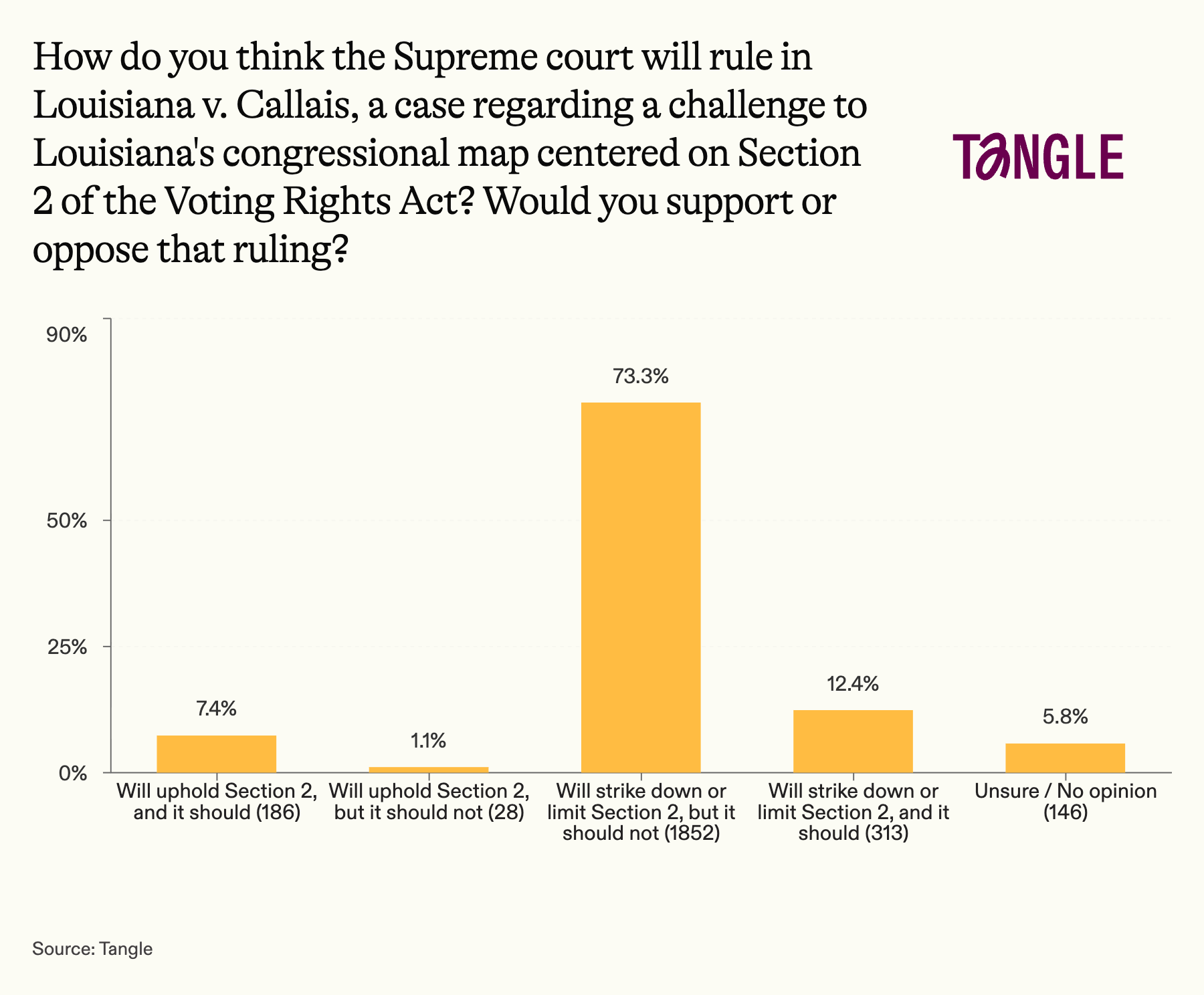
- Thursday’s survey: 2,525 readers responded to our survey on Louisiana v. Callais with 73% saying they think the courts will strike down Section 2 of the Voting Rights Act but should not. “John Roberts has spent his entire career limiting voting rights; this is just another step in that direction,” one respondent said. “I sadly think we live in a society that needs Section 2 but really hope for one that does not,” said another.
Have a nice day.
Though much is still unknown about the formation of the universe, the James Webb Space Telescope (JWST) has provided astronomers with clearer, higher resolution satellite imaging than ever before. From a recent batch of JWST photos, a group of researchers identified four unique-looking stars with characteristics similar to those of “supermassive dark stars,” primordial objects filled with self-annihilating dark matter whose existence, until now, has only been theorized. “Weighing a million times as much as the Sun, such early dark stars are important not only in teaching us about dark matter but also as precursors to the early supermassive black holes seen in JWST that are otherwise so difficult to explain,” Katherine Freese, co-developer of the original theory behind dark stars and co-author of the recent study, said. SciTechDaily has the story.

Member comments