
I'm Isaac Saul, and this is Tangle: an independent, nonpartisan, subscriber-supported politics newsletter that summarizes the best arguments from across the political spectrum on the news of the day — then “my take.”
Are you new here? Get free emails to your inbox daily. Would you rather listen? You can find our podcast here.
Today’s read: 15 minutes.
A New Year’s Sale that might actually improve your life
Some New Year’s sales are for stuff you’ll forget you bought by February.
This one’s different.
Babbel’s New Year’s Sale is live with 55% off, giving you access to all 14 languages with quick 10-minute lessons designed by real language experts (so you actually learn, instead of just tapping your screen like it’s a game).
Add in podcasts and speaking practice built around real-world conversations, and it’s surprisingly easy to stick with.
If learning a new language has been sitting on your “I should really do that” list, this is a pretty good moment to stop thinking about it and start.
Get 55% Off Babbel!
*This is a sponsored post.
Our internal communications.
In Friday’s members-only edition, we published internal communications from our Slack channel. The idea was to give our audience an inside look at what happens behind the scenes, and how we discuss the day’s issues when nobody is watching. Predictably, the post has generated a lot of valuable discussion amongst our readers. We’re proud of the decision to lean into transparency with our audience and gratified by the thoughtful response that decision provoked. If you haven’t yet, you can read Friday’s edition here.
Quick hits.
- France intends to reject an invitation to join President Donald Trump’s Board of Peace that is set to oversee the rebuilding of Gaza as part of the Israel–Hamas ceasefire agreement over concerns that the body could threaten the structure of the United Nations. (The report) In response, President Trump said he will impose a 200% tariff on French wines and champagnes. The U.S. has sent invitations to join the board to approximately 60 countries, and members must pay $1 billion to secure a seat beyond the first three years. (The latest)
- The Supreme Court is hearing arguments in a challenge to a Hawaii law that bans gun owners from bringing firearms into publicly accessible private property without permission from the property owner. (The case)
- The Pentagon reportedly ordered approximately 1,500 active-duty soldiers to prepare for a possible deployment to Minnesota if President Trump invokes the Insurrection Act. (The report) Separately, the Justice Department said it is investigating a group of protesters who disrupted services at a church where a pastor is believed to lead a local Immigration and Customs Enforcement office. (The investigation)
- The European Union (EU) and Mercosur, a South American trade bloc, signed a free trade agreement, creating one of the world’s largest free-trade zones. The deal will eliminate over 90% of tariffs between the EU and the Mercosur countries. (The agreement)
- A collision between high-speed trains in Spain killed at least 41 people, making it the country’s deadliest rail incident in over 10 years. The cause of the crash has not been determined. (The crash)
Today’s topic.
The latest on Greenland and the United States. In recent weeks, President Donald Trump has escalated his efforts to acquire Greenland, an autonomous territory of the Kingdom of Denmark that he says is vital to national interests. The president has not ruled out using military force to take control of the island, while also threatening to impose tariffs on European nations who oppose the move. Many leaders of member nations of the North Atlantic Treaty Organization (NATO) have condemned Trump’s comments and expressed concern that he is jeopardizing the stability of the alliance.
Back up: President Trump proposed acquiring Greenland in his first term and has returned to the idea at the start of his second, citing Greenland’s vast natural resources and its strategic geographic positioning for trade and national security. More recently, the president linked Greenland to a part of his second-term national security strategy newly referred to as the “Donroe Doctrine,” which prescribes a heightened focus on U.S. interests in the Western Hemisphere. Leaders in Denmark and Greenland have largely criticized Trump’s comments, saying the territory is not for sale.
We covered Trump’s comments about Greenland at the start of his second term here.
On Wednesday, a delegation from Denmark and Greenland met with Vice President JD Vance, Secretary of State Marco Rubio, and other U.S. officials at the White House. Afterwards, the Trump administration said Denmark and Greenland had agreed “to continue to have technical talks on the acquisition of Greenland.” Danish Foreign Minister Lars Løkke Rasmussen gave a different account, saying the two sides agreed to establish a working group to discuss “a common way forward.”
Separately, on Saturday, President Trump announced that he will levy a 10% tariff on Denmark, Norway, Sweden, France, Germany, the United Kingdom, the Netherlands, and Finland until a deal is reached for the U.S. to acquire Greenland. The tariff will increase to 25% on June 1, 2026.
On Sunday, Trump sent a text message to Norwegian Prime Minister Jonas Gahr Støre saying he “no longer feel[s] an obligation to think purely of Peace” after not winning the 2025 Nobel Peace Prize. “The World is not secure unless we have Complete and Total Control of Greenland,” Trump added. The message came in response to a text from Støre to Trump asking to set up a call to “de-escalate” current tensions.
The situation has raised questions about the stability of NATO. This week, the leaders of all 27 European Union (EU) nations will meet in Brussels, Belgium, to discuss the latest developments and the bloc’s response. The eight NATO nations named in Trump’s tariff announcement have also sent a small number of troops to Greenland to take part in military exercises. On Monday, Denmark announced an additional deployment to Greenland, bringing its total number of soldiers in the territory’s capital to roughly 100. Separately, the new tariff could jeopardize the recent U.S.–EU trade agreement, with French President Emmanuel Macron reportedly calling for the EU to use its anti-coercion instrument — also known as its trade “bazooka” — to restrict American companies’ access to the European single market.
Today, we’ll cover these latest developments, with views from the right and left. Then, Executive Editor Isaac Saul gives his take.
What the right is saying.
- The right is mixed on Trump’s push to acquire Greenland, with many saying he is using overly aggressive tactics to pursue a worthy goal.
- Some say the military and economic threats are ill advised.
- Others question the utility of NATO as an ongoing alliance.
In The Daily Signal, Jarrett Stepman argued “Europe needs to calm down about Greenland.”
“Is the United States about to invade Greenland?... If you’ve followed this issue from the beginning and have tried to accurately understand how the president operates, then you should conclude that this brouhaha is all about negotiating,” Stepman said. “I’d hazard to guess Trump’s reason for potentially using the military is because he virtually always says as much. It is an option, one that he would almost certainly never take. What he wants is to create maximum urgency on the part of a negotiating partner to get a deal done.”
“Greenland is important for the interests of the American people as far as security, economics, and even to a certain extent national pride. Bringing the island territory fully into the American orbit is not just a pointless media stunt. It has real implications for U.S. strategy vis-à-vis major competitors like Russia and China, countries that have a keen desire to have access to and control of the Arctic,” Stepman wrote. “Given how much pressure Trump is globally putting on U.S. rivals it makes sense that he’s essentially playing hardball to ensure that Greenland remains and becomes an even more integral part of U.S. national security.”
The Wall Street Journal editorial board wrote about “the Greenland War of 2026.”
“There are good reasons for Washington to care about Greenland, including the island’s strategic position and untapped reserves of rare-earth minerals. Mr. Trump isn’t the first President to suggest buying it outright, but the U.S. already has a high degree of access to the island, and Denmark is willing to negotiate more,” the board said. “Mr. Trump is taking reckless risk with the NATO alliance that advances U.S. interests in the Arctic. If he doesn’t believe us, he can look up Norway, Sweden and Finland in an atlas. The latter two joined the North Atlantic Treaty Organization recently, and already are discovering that with Mr. Trump no good strategic deed goes unpunished.
“The economics are nonsensical too. All of the countries on his tariff list except for the United Kingdom are members of the European Union with a common trade policy. This means any tariff he imposes on those countries will have to extend to the entire 27-member bloc. So much for the trade deals Mr. Trump negotiated to great fanfare last year with the EU and the U.K.,” the board wrote. “The message to these countries is that no deal with Mr. Trump can be trusted because he’ll blow it up if he feels it serves his larger political purposes.”
In Racket News, Matt Taibbi asked “if NATO dies, do we really have to mourn?”
“NATO is history’s most expensive self-licking ice cream cone. Proponents spent much of the last three decades taking bold, often destructive policy actions to convince taxpayers of member nations the alliance needs to keep existing. We’ve redrawn the world map multiple times and even invented new forms of war just to give it something to do,” Taibbi said. “Now we’re told the issue with Trump possibly occupying Greenland isn’t that it might be crazy or bad for Greenland, but that it might hurt the ‘trans-Atlantic security alliance.’”
“NATO’s mission was reimagined again and again over the years, notably after 9/11 when Article 5 of the NATO treaty obligating member nations to fight was invoked for the first time, then again in 2010 when we learned that NATO wasn’t just a military alliance, but a ‘political community.’ NATO’s mission grew so unwieldy that by the time Trump arrived, it was nearly impossible to say what it was,” Taibbi wrote. “If some other president tried to militarily occupy the Danes’ territory in more a de facto than de jure fashion, with less of a Goodfellas vibe, Europe might have shrugged, as it did in a thousand other incidents. But it’s Trump, which means NATO may indeed finally crack and sink. Do we have to mourn?”
What the left is saying.
- Many on the left condemn Trump’s disregard for alliances and say Europe should fight back.
- Others say Europe cannot win a power struggle with the U.S.
- Others suggest tech elites are driving Trump’s Greenland push.
In Bloomberg, Lionel Laurent argued “Europe has the weapons for Trump’s Greenland tariff war.”
“Trump’s contemptuous delight in beating up US allies was given free rein over the weekend as he raised the ante over the Arctic territory. It’s time for Europe to fight tariff fire with fire,” Laurent wrote. “The cost of such extra tariffs would be high. Bloomberg Economics estimates they could cut these countries’ US exports by up to 50%. Germany, Sweden and Denmark look especially vulnerable. But another timid acquiescence from the Europeans would be disastrous. This is textbook economic bullying, driven by a leader who recently said the only limitation on his global powers was ‘(his) own mind.’”
“The starting point is bolstering the European Parliament’s threat to hold back approval of last year’s trade agreement, which was hailed by Trump’s administration as providing ‘unprecedented levels of market access’ for American products,” Laurent said. “There should be an urgent push, too, to unbox the EU’s ‘bazooka’ for the fight ahead: The bloc’s Anti-Coercion Instrument is explicitly designed to defend member states put under tariff pressure by foreign powers… That is a much bigger stick than the usual clobbering of more niche US companies such as Harley-Davidson motorcycles with higher import taxes.”
Also in Bloomberg, Marc Champion said “Europe can’t afford a throwdown over Greenland.”
“I sympathize with European outrage over Donald Trump’s naked attempt to bully Denmark, a particularly loyal NATO ally, into handing over Greenland… But as some leaders call for using the European Union’s so-called bazooka of counter measures to launch a full-blown trade war with the US, I’d suggest they game out the consequences before pulling the trigger,” Champion wrote. “If Trump is ignoring Field Marshal Erwin Rommel’s advice never to start a fight that won’t gain you much in victory, then Europe risks ignoring even wiser counsel from the Chinese military strategist Sun Tzu: Don’t start a battle you can’t win.”
“Would Poland and the Baltic States truly be willing to endanger their US security umbrella over Greenland? Territorial sovereignty is a principle they very much embrace, but it’s a principle. The threat of losing US protection against Russia is for them existential,” Champion said. “Would they or most other European countries really risk giving Trump an excuse to withdraw intelligence sharing and US sales of Patriot air defense missiles to Kyiv, with the potential for a collapse of Ukrainian lines that would follow? Likewise, would Italy really support the launch of a trade war with Washington, when it isn’t among the eight nations Trump has threatened with tariffs?”
In Jacobin, Lois Parshley wrote about “the tech billionaires behind Trump’s Greenland push.”
“Though the island is not for sale, the president emphasized Greenland’s importance to US national security. Left unspoken: a US takeover could weaken the country’s mining laws and ban on private property, aiding Trump donors’ plans to profit from the island’s mineral deposits and build a libertarian techno-city,” Parshley said. “As the country’s glaciers recede, it’s also facing sweeping climate-driven transformations, threatening traditional industries like fishing and hunting and exposing valuable mineral resources. These shifts have prompted interest from powerful players associated with Trump. Tech moguls in the front row of his inauguration, like Mark Zuckerberg and Jeff Bezos, are also investors in a start-up aiming to mine western Greenland for materials crucial to the artificial intelligence boom.”
“The push for control of the arctic country comes as deep-pocketed investors like Andreessen have been drawn to start-ups hoping to build experimental enclaves, sold by the promise of freedom from the constraints of government,” Parshley wrote. “Proposals for these cryptostates have sprung up in Honduras, Nigeria, the Marshall Islands, and Panama, the latter of which Trump has also recently proposed taking over by military force… The sales pitch includes replacing taxes and regulations with cryptocurrency and blockchain… These utopian dreams have led to Greenland.”
My take.
Reminder: “My take” is a section where we give ourselves space to share a personal opinion. If you have feedback, criticism or compliments, don't unsubscribe. Write in by replying to this email, or leave a comment.
- Trump has been discussing Greenland for years, and he’s right about the island’s significance.
- However, as usual, his pursuit of this goal is incredibly inflammatory.
- The president seems willing to risk the entire global order out of spite, and it isn’t Trump Derangement Syndrome to say so.
Executive Editor Isaac Saul: I find this entire thing exasperating, in large part because Greenland is, actually, an important strategic piece on the global chessboard, and we have to make our next moves thoughtfully.
Almost exactly a year ago, when we covered this issue in the newsletter and on the podcast, I said that Trump was “right to be thinking about Greenland.” At the time, he was mostly talking about buying it or deepening our ties with the country. Here is what I wrote:
Let me say from the jump that this story is a great example of how frustrating Trump can be for someone with moderate politics like me. He is broaching an important subject (U.S. influence in Greenland), and his instincts are right (we should have a stronger relationship with them). He is also approaching it in a way that very few buttoned-up politicians would (making it a front-page story), and his approach is just novel enough to work (Greenland is, after all, already playing nice).
And yet, he can’t do a basic thing like bring this debate into the public sphere without ruling out the possibility of using our military (an absurd prospect) or riffing on scratching out the border between us and Canada (an obvious troll of Justin Trudeau, if you ask me), which gives his opponents easy ammunition to shoot down the entire notion. So now Trump has championed what I think is a worthwhile cause, but in a way that immediately creates division.
The pros of Trump’s approach are as strong now as they were then: Greenland is strategically important, and the Trump administration should be thinking about it as other world leaders jockey for influence in the Arctic. But the cons are also worse now than they were then: Trump is fracturing our alliances, and he has exacerbated concerns that he could use the U.S. military against an ally. He has polarized this issue to the maximum, pitting Americans against themselves and us against our allies.
This entire saga also provides another example of something that sounds like Trump Derangement Syndrome actually happening. That list is unfortunately growing. Imagine if I predicted this after Trump’s election: “Masked federal agents will rappel from helicopters into apartment buildings in major U.S. cities to arrest people as they search for unauthorized immigrants.” Many people would probably have said, “You have Trump Derangement Syndrome.” If I’d said, “I bet we’ll start blowing up alleged drug boats in the Caribbean and then arrest and extradite Nicolás Maduro,” many would have told me to seek help. And now, if I said something like, “Well, Trump seems so upset about not getting the Nobel Peace Prize that he might dynamite our military alliances and trade relationships with Europe,” you’d have to read this text message he sent the Prime Minister of Norway to believe me:
Considering your Country decided not to give me the Nobel Peace Prize for having stopped 8 Wars PLUS, I no longer feel an obligation to think purely of Peace, although it will always be predominant, but can now think about what is good and proper for the United States of America. Denmark cannot protect that land from Russia or China, and why do they have a “right of ownership” anyway? There are no written documents, it’s only a boat that landed there hundreds of years ago, but we had boats landing there, also. I have done more for NATO than any person since its founding, and now, NATO should do something for the United States. The World is not secure unless we have Complete and Total Control of Greenland. Thank you! President DJT
Putting aside a few dozen things here — Trump hasn’t ended eight wars, Norway’s government does not award the Nobel Peace Prize, the Danish kingdom has owned Greenland for 300 years (longer than the United States has existed), many “written documents” legitimately enforce Denmark’s ownership of Greenland, and on and on and on — perhaps the most worrisome thing here is that the president is even breathing a word about not receiving the Nobel Peace Prize in relation to a decision about using our military against an ally. And as we learned from his interview with The New York Times last week, spite is a consistent motivator for Trump not to exercise restraint. “I prohibited [my family] from doing business in my first term, and I got absolutely no credit for it,” Trump said. “I found out that nobody cared, and I’m allowed to.”
Again: This would all have sounded like TDS a few months ago. Now, some of the president’s biggest supporters went from claiming his text was “fake news” to declaring it noncontroversial.
Now, I don’t think Trump is going to actually invade Greenland (I still struggle to believe I’m writing that sentence). I think the president is doing something we’ve seen him do a million times before: move the Overton window to create maximum leverage.
There are some daring, over-confident people on Trump’s team — and who can blame them? Risky military operations in Iran and Venezuela have been successful. Yet I still don’t think enough people in the Trump administration would actually be willing to put U.S. boots on the ground in a territory controlled by a NATO ally.
For one, the logistics are far from straightforward (how could the United States impose a military occupation of a Danish territory without provoking an actual war?). For two, Americans hate the idea of a military escalation against Greenland, and Trump has always had good political instincts. He knows that he shouldn’t pursue an issue polling at 4% approval — especially not in an election year, and especially not when the administration is already playing defense on Trump’s signature immigration and economic policies. I think, and hope, some people close to the president recognize that would be political suicide.
Instead, I think Trump is trying to leverage chaos and fear to get some or most of what he wants. That could look like a vote on Greenland independence. But that seems less and less likely every day. As it turns out, Greenlanders don’t want to be American (and earning goodwill is clearly not a priority of the Trump administration).
It could look like Denmark coming to the table for some kind of “deal” to sell or give more land rights in Greenland to the U.S. But that is similarly tough to envision. We already have most of what we need — Greenland is under the U.S. sphere of influence since it is controlled by a NATO ally. Furthermore, The U.S. already enjoys sweeping military access in Greenland; we have one military base there now, and although Greenland’s semiautonomous government has some say in U.S. military operations on the island, a Cold War agreement between the United States and Denmark allows us to construct, install, maintain, and operate bases across the territory.
Maybe Trump uses tariffs to bully Denmark into selling Greenland to the U.S. for a song. Or maybe none of these details really matter if this all really boils down to Trump’s personal desire to “get” Greenland as part of his larger legacy. We have the power, and — if he has the focus — Trump legitimately might destabilize the global order to wield it. This personal motivation is equal parts alarming and consistent: In an interview with The New York Times earlier this month, Trump described ownership of Greenland as “psychologically needed for success.” Asked to clarify if he meant psychologically important for him or the United States, he said, “Psychologically important for me.”
It’s all confounding, worrisome, and, frankly, a tad embarrassing. While the dead-weight criticism of some allies was once a smart and true Trump attack line — the kind of thing past presidents were too timid to hammer home — our current posture crosses into the category of self-defeating and deranged. It has morphed into a fever dream of conquering 57,000 people and an island that can serve our national security as it’s governed today. Even if we avoid a worst-case scenario here, I think it’s time the president let go of this odd ambition and turned his attention back home.
Take the survey: What do you think Greenland’s relationship with the U.S. should be? Let us know.
Disagree? That's okay. Our opinion is just one of many. Write in and let us know why, and we'll consider publishing your feedback.
Your questions, answered.
Q: I’m confused when you guys report on the Consumer Price Index. Is it a good thing or a bad thing when the number increases?
— Sarah from Cranford, NJ
Tangle: Generally, it’s bad when the Consumer Price Index (CPI) increases — more specifically, when it increases past economists’ expectations. The CPI measures inflation by tracking the prices of a standardized set of consumer expenditures like groceries, housing, clothing, transportation, medical care, education, and data plans. You may also hear about “core CPI,” which also measures inflation but excludes the more volatile food and energy prices.
If the CPI goes up, that means the cost of goods and services is going up. A small amount of constant inflation is not a bad thing. Many economists expect investable assets that contribute to the CPI to increase — which is good, and why the measure is often reported relative to expectations. Relatedly, you may also commonly hear that the Federal Reserve targets 2% baseline inflation. According to the Brookings Institution, “The costs of maintaining zero inflation would be a permanent reduction in gross domestic product of 1 to 3 percent and a permanent drop in employment by the same amount.”
Some economic indicators are better when they’re going up, such as gross domestic product (GDP), stock market readouts (like the S&P 500 or Dow Jones Industrial Average), and to a lesser extent, trade balances. However, inflation, jobless claims/unemployment, and to some degree, interest rates are all better when they’re going down.
Want to have a question answered in the newsletter? You can reply to this email (it goes straight to our inbox) or fill out this form.
Under the radar.
On Friday, the Department of Education (ED) said it had temporarily delayed its plan to begin garnishing wages from student-loan borrowers’ paychecks. The department announced the move in December after a five-year hiatus, and the first notices to affected borrowers were set to be sent out last week. However, Under Secretary of Education Nicholas Kent spoke in favor of the pause, which he said allows the department to implement new student-debt repayment and rehabilitation options that “function more efficiently and fairly.” The delay also comes as the Trump administration announces several measures aimed at addressing the rising cost of living, though Education Secretary Linda McMahon did not confirm whether the collections pause was part of that effort. Bloomberg has the story.
Finally, a Resolution You Might Actually Keep
Learning a new language has probably been on your "someday" list for years.
Babbel's New Year's Sale makes someday feel doable: 10-minute lessons from real linguists, all 14 languages included, plus podcasts and speaking practice built around actual conversations.
Numbers.
- 39. The number of raw materials deemed “critical” by the United States that are found in Greenland.
- 17% and 47%. The percentage of U.S. adults who approve and disapprove, respectively, of U.S. efforts to acquire Greenland, according to a January 2026 Reuters-Ipsos poll.
- 4% and 71%. The percentage of U.S. adults who say it would be a good idea and a bad idea, respectively, to use military force to take possession of Greenland.
- 22.2%. The average effective U.S. tariff rate on Sweden if President Trump’s new 10% tariff goes into effect on February 1, the highest rate of the eight impacted countries, according to Bloomberg.
- 20.0%. The average effective U.S. tariff rate on Denmark if President Trump’s new 10% tariff goes into effect.
- 17.3%. The average effective U.S. tariff rate on the United Kingdom if President Trump’s new 10% tariff goes into effect, the lowest rate of the eight impacted countries.
The extras.
- One year ago today we had just released a Friday edition announcing the metrics we’d use to measure Trump’s success.
- The most clicked link in Thursday’s newsletter was our latest video exploring airline pricing, cancellations, and refunds.
- Nothing to do with politics: Every state’s preferred breakup food.
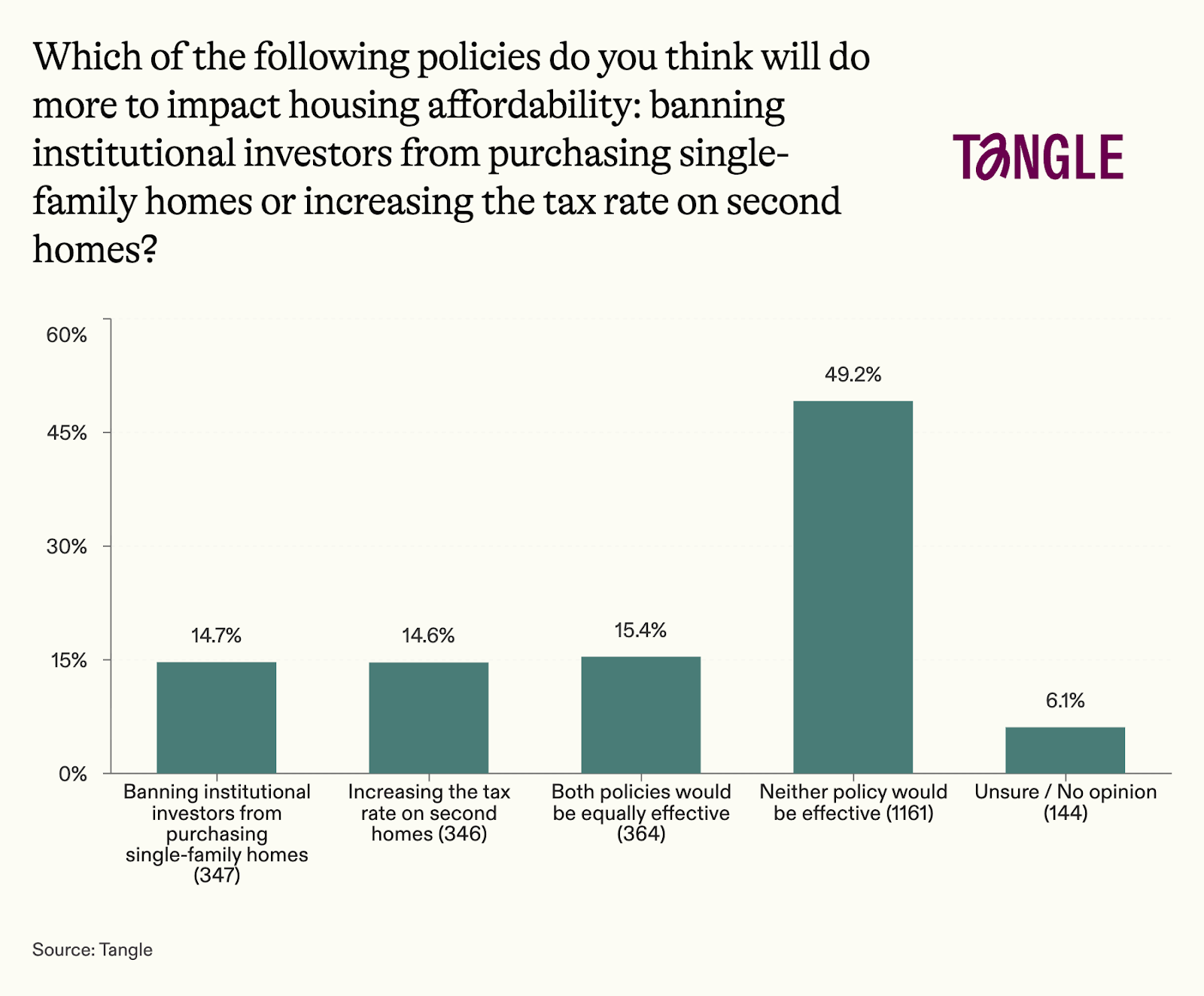
- Thursday’s survey: 2,362 readers responded to our survey on housing affordability with 49% saying neither a ban on private equity nor increased tax on second homes would help solve the problem. “We purchased a 2nd home for our parents to live in. I know of others who have done the same, so I hope they don’t increase the tax rate on 2nd homes,” one respondent said. “Both of those would only be a small help. The best solution would offer lower priced starter homes in greater numbers,” said another.
Have a nice day.
On New Year’s Day, golden retriever Phoenix was out for a walk in Westerly, Rhode Island, with his owner. However, Phoenix wandered onto dangerously thin ice and fell into a frozen pond. Fortunately, volunteers from the Misquamicut Fire Department responded within minutes, racing across the ice to retrieve the golden retriever and bring him to safety. The department said that first responders and Phoenix “were all doing well when on scene,” but warned the community that “no ice is ever safe.” Fox News has the story.

Member comments