

I'm Isaac Saul, and this is Tangle: an independent, nonpartisan, subscriber-supported politics newsletter that summarizes the best arguments from across the political spectrum on the news of the day — then “my take.”
Are you new here? Get free emails to your inbox daily. Would you rather listen? You can find our podcast here.
Today’s read: 14 minutes.
Keep Your SSN Off The Dark Web
Every day, data brokers profit from your sensitive info — phone number, DOB, SSN—selling it to the highest bidder. What happens then? Best case: companies target you with ads.
Worst case: scammers and identity thieves breach those brokers, leaving your data vulnerable or on the dark web.It's time you check out Incogni.
It scrubs your personal data from the web, confronting the world’s data brokers on your behalf. And unlike other services, Incogni helps remove your sensitive information from all broker types, including those tricky People Search Sites.
Use code TANGLE today to get an exclusive 55% discount on unlimited removals from anywhere that exposes your data.
Who is ICE?
At the heart of the issue we’re covering today are the enforcement actions taken by DHS agents in Minnesota. To get a full perspective on this issue, we highly suggest reading our Friday edition answering readers’ questions about ICE and CBP — who these agents are, what authority they have, and the scope of DHS’s immigration enforcement. You can read that piece here.
Quick hits.
- U.S. Special Envoy Steve Witkoff and President Donald Trump’s son-in-law Jared Kushner met with Iranian officials in Geneva, Switzerland, on Tuesday for a second round of talks over sanction relief and a potential nuclear agreement. (The talks) Separately on Tuesday, Iranian state media reported that parts of the Strait of Hormuz, which connects the Persian Gulf to the Indian Ocean, will be closed for a few hours due to “security precautions.” (The announcement)
- On Thursday, the Trump administration repealed the 2009 EPA endangerment finding, a standard that was used to set regulations on greenhouse gas emissions under the Clean Air Act. (The repeal)
- At least two people were killed and three injured in a shooting at a youth hockey game in Rhode Island on Monday. The suspected shooter took his own life; law enforcement officials said he appeared to target family members. (The shooting)
- Civil rights leader Rev. Jesse Jackson died on Tuesday at 84. Authorities have not revealed a cause of death, but Jackson was hospitalized in November for a severe neurodegenerative disease following his 2017 Parkinson’s diagnosis. (The passing)
- The board of Warner Bros. Discovery said it will reopen discussion with Paramount over a potential acquisition, setting a seven-day window for Paramount to make a final offer. Warner Bros. had already accepted an acquisition offer from Netflix, which has agreed to the seven-day negotiation window. (The deal)
Today’s topic.
DHS funding and Minnesota. At 12:01 on Saturday, February 14, the Department of Homeland Security (DHS) partially shut down after lawmakers in Congress failed to come to terms on a deal to fund the department through September. Senate Democrats are demanding funding be tied to reforms to Immigration and Customs Enforcement (ICE) and Customs and Border Patrol (CBP), a stance they have maintained since Alex Pretti and Renee Good were killed by federal agents in Minneapolis, Minnesota.
Separately, President Donald Trump’s border czar Tom Homan announced on Thursday that DHS would be ending “Operation Metro Surge” and leaving the state. Homan called the operation, which produced over 4,000 arrests, a success, and he said that 1,000 DHS agents have been withdrawn from the state so far.
Back up: Funding for DHS and several other agencies lapsed earlier this month over objections from Democrats to the actions of DHS’s immigration enforcement agencies, partially shutting down the government for four days. The department temporarily ceased some of its operations until February 4, when Republicans and Democrats agreed to pass a year-long funding bill that excluded DHS in order to negotiate its funding in isolation. Democrats have indicated that they will not support a continuing resolution to fund DHS, insisting any further action be tied to agency reforms. Among the requested changes are mandatory body cameras for DHS agents, a ban on roving patrols, mandated coordination with local police, more stringent warrant requirements, a ban on agents wearing masks, and a requirement that they carry identification.
DHS oversees several organizations in which the majority of employees are deemed essential and are required to continue to work without pay during the shutdown. These include the Transportation Security Administration (TSA), the Federal Emergency Management Agency (FEMA), the U.S. Coast Guard, and the Secret Service. However, the longer the shutdown lasts, the more likely service disruptions in these areas become. Immigration enforcement is also likely to continue with little disruption, as ICE and CBP received significant funding through 2029 in last year’s One Big Beautiful Bill Act (OBBBA). However, the Cybersecurity and Infrastructure Security Agency (CISA) has fewer essential workers and will face more disruptions during the shutdown. Congress is on scheduled recess until February 23, making a shutdown of at least 10 days likely.
Simultaneously, DHS agents have begun leaving Minnesota, bringing the 10-week immigration enforcement to an end. “I have proposed, and President Trump has concurred, that this operation conclude. A significant drawdown has already been underway this week and will continue through the next week,” Homan said. Homan had taken over responsibility of the operation from DHS Secretary Kristi Noem in late January amid criticism of the agency’s actions.
Below, we’ll break down what the left and right are saying about DHS partially shutting down and its withdrawal from Minnesota. Then, Executive Editor Isaac Saul gives his take.
What the left is saying.
- The left considers Operation Metro Surge a failure, with some pointing out that it didn’t accomplish its stated goal of targeting criminals.
- Some think the backlash to immigration enforcement could inspire congressional reform.
- Others note the damage the operation did to institutional trust.
In MS NOW, Zeeshan Aleem argued “Trump’s Operation Metro Surge was a failure by every metric.”
“It’s unclear, as of now, how much progress the Trump administration will have made in achieving its alleged goal of capturing the ‘worst of the worst’ in Minnesota by the time the operation ends,” Aleem said. “But in a review of Department of Homeland Security data in mid-January, a local Fox affiliate found that out of 2,000 people arrested by Immigration and Customs Enforcement agents, just 5.2% were violent convicted criminals. That tracks broadly with other assessments of national data that finds that only a small fraction of the people swept up in ICE raids have violent records, and that the ‘worst of the worst’ narrative is a fig leaf for far broader mass deportations.”
“Now to the extent that ICE operations in Minneapolis served as a potential test drive for Trump to morph the agency into a secret police force, one could argue that causing chaos, fear and pain was part of the point… did Trump succeed at his goal of wrestling a city into submission? Not really,” Aleem wrote. “Anti-ICE activists in Minneapolis were extraordinarily organized, creative, peaceful and resilient. By setting up community patrols, monitoring immigration raids and constantly protesting in the streets against the presence of ICE, residents of Minneapolis proved effective at exposing to the nation how the agency was acting as a militarized, racially profiling force that often treated the law as an afterthought.”
In USA Today, Chris Brennan suggested “Trump’s cruelty may create the immigration reform Obama wanted.”
“Barack Obama and Donald Trump are two very different presidents, but they share something in common — both used the power of their office to deport millions of undocumented immigrants from America,” Brennan said. “Obama’s immigration enforcement was quietly efficient, flying under the radar until immigration advocates discovered what was happening. Trump has used a chaotic, smash-and-grab, street-level approach to immigration enforcement in American cities in his second term. Both presidents faced backlashes, with Obama being derided by progressive allies as the ‘deporter in chief.’ Trump’s backlash, still very much underway, has been driven by vivid and violent encounters.”
“Obama, during his two terms, tried to trade aggressive enforcement of immigration laws for a sweeping package of legislative reform for those laws. Republicans took the enforcement, but balked at the reform when the package passed in the Senate in 2013 with some GOP support but then died in the House in 2014 because a majority of GOP members would not back it,” Brennan wrote. “Maybe instead of trading enforcement for reform, Trump’s enforcement will inspire reform… Republicans can take a baby-steps approach to reform now by meeting the demands of the Democrats.”
The Minnesota Star Tribune editorial board asked, “The surge is ending. The damage remains. Now what?”
“Whatever their views on immigration enforcement, Minnesotans should welcome the announcement by border czar Tom Homan on Feb. 12 that Operation Metro Surge soon will end, and that a significant drawdown of the more than 3,000 agents who had been sent to the state under federal orders is underway,” the board said. “But as the Department of Homeland Security declares its mission accomplished and begins its retreat, many are left wrestling with an infuriating if not incendiary question. What was the point of the bloody spectacle? Stripped of politics and posturing, a state and a nation deserve clear answers.”
“Homan, who said that DHS agents will now be redeployed to other cities, lauded the Minnesota mission as a law enforcement win and said that a deeply shaken and fatigued Minneapolis is now a much safer place. By what immediate or lasting measure, we ask? There has been little to no transparency to the spectacle we have just endured,” the board wrote. “Trust in government — already fragile — has been further eroded. But trust can and must be rebuilt. There’s no doubt that Operation Metro Surge induced people to take sides. Which side can declare victory will be in the eye of the beholder, but the many Minnesotans who dedicated themselves to peaceful resistance to aggressive policy can be proud.”
What the right is saying.
- Many on the right are critical of how Operation Metro Surge ended.
- Some blame Trump’s actions for shifting public opinion on immigration enforcement.
- Others believe the fault lies in Minnesota leaders’ lack of cooperation.
The National Review editors wrote that “Trump throws in the towel on the Minneapolis surge.”
“The big story here is that semiorganized resistance on the streets, with the support of the elected leadership in Minnesota and Minneapolis, made the aggressive federal enforcement too painful to continue,” the editors said. “The public considered the DHS operation arbitrary and heavy-handed, and the officers in camouflage lost the image battle to the agitators. Trump, who is attuned to optics and willing to shift gears at a moment’s notice, realized it and stood down. This is a bad precedent, but immigration enforcement doesn’t rise and fall exclusively based on what happens in Minneapolis.”
“Where to go from here? First, Homan, a no-nonsense professional, should be given de facto responsibility for immigration enforcement, which may already have happened,” the editors wrote. “While no illegal immigrant should be immune from detention and deportation, it makes sense to focus resources on targeted arrests of illegal aliens who have committed non-immigration offenses or identity theft against citizens and those who have final orders of removal. There is also a stronger case for removing recent arrivals in order to roll back the Biden-era flood. These priorities should be coupled with much more vigorous worksite enforcement… An enforcement regime along these lines would be more politically palatable and effective over time.”
In The Dispatch, Nick Catoggio said Trump was “eating the pieces.”
“On February 4 the Department of Homeland Security announced that more than 4,000 illegal immigrants had been arrested so far under ‘Operation Metro Surge’ since it began in Minnesota on November 29. That’s slightly north of 60 people per day. Not all were violent criminals, surely; probably very few were, in fact, given the national trendlines,” Catoggio wrote. “Not all who were detained have been deported either… Sixty arrests a day — for an operation that eventually involved 3,000 immigration agents. That’s one arrest daily on average per every 50 officers deployed. What did the White House get in return for that measly number? Nothing more or less, I think, than the near-total destruction of its credibility on immigration outside of the core Republican base. And even parts of the core seem a little shaky lately.”
“The president’s job approval today in the RealClearPolitics average is 42.1 percent, a new low for his second term… Yesterday an NBC News survey found his approval on ‘border security and immigration,’ traditionally his strongest issue, at 40–60,” Catoggio said. “Four thousand arrests, not all of which will end in deportation, at the cost of crushing one of the GOP’s most consequential policy advantages over the left. The U.S. attorney’s office in Minneapolis — which was overseeing the prosecution of suspects in the big Somali fraud scandal — has also been wrecked in the process. How does that grab you as a return on a political investment?”
In Townhall, Kevin McCullough said Minnesota Democrats should “own it.”
“When federal immigration enforcement finally wrapped up its operation in Minnesota this week, you might have expected humility from state and city leaders who spent months resisting it. You might have expected a sober acknowledgment that things went sideways. You might have expected, at minimum, a recognition that cooperation could have spared everyone a lot of pain,” McCullough wrote. “Instead, Governor Tim Walz and Minneapolis Mayor Jacob Frey chose entitlement. They demanded reimbursement from the federal government… After obstructing federal law enforcement, after refusing basic cooperation, after fueling tension with reckless rhetoric, and after helping turn a law enforcement effort into a prolonged public spectacle, they now want taxpayers to foot the bill.”
“Working with federal authorities does not mean abandoning compassion. It means protecting communities while upholding the law,” McCullough said. “Minnesota’s leaders chose the opposite… Minnesota got performative governance. And Americans got stuck with the consequences… There was nothing necessary about prolonged disruption. Those outcomes were the result of choices. Bad choices. Made by people more interested in pleasing activist bases than protecting their constituents.”
My take.
Reminder: “My take” is a section where we give ourselves space to share a personal opinion. If you have feedback, criticism or compliments, don't unsubscribe. Write in by replying to this email, or leave a comment.
- I don’t see this shutdown ending any time soon.
- Democrats are dug in on their demands, and DHS has given them plenty of ammunition.
- Republicans are digging in, too, and their best play is probably just to let time wear their opposition down.
Executive Editor Isaac Saul: This shutdown is only just beginning. Democrats have the wind at their backs on immigration enforcement, an issue where public opinion has long favored President Trump; and since public sentiment on Trump, ICE, and CBP is vanishingly low right now, they’d be silly not to press for as many reforms as possible. As I wrote two weeks ago, the dynamics of this standoff seem “ripe for long-term problems.”
Some Republicans are now countering Democrats with the demand to require proof of citizenship to vote; I suspect that push has no chance of gaining traction. The only question is how much Democrats will get. They are dug in, and they have the public sentiment on their side (for now). Republicans don’t have an urgent bargaining chip to play, only the passage of time and the hope of any distracting new story to get Democrats to break.
For a taste of the mood in the Democratic caucus right now, I reached out to Rep. Jake Auchincloss (D-MA), whom we profiled last year. As negotiations move forward, Auchincloss articulated a sentiment that is permeating Democratic circles right now..
“This is not a time to be precious about process,” Auchincloss told me. “This is a moment to be ruthless in power. Americans don’t want open borders and Americans do not want a paramilitary. Democrats can claim that lane.”
In other words, Democrats believe the time to capitalize is now.
Not only are the shootings of U.S. citizens Alex Pretti and Renee Good fresh in the minds of Americans, but new reports are surfacing that show incredibly poor behavior from DHS agents. Last month, ICE agents shot an unauthorized immigrant during an enforcement operation in Minnesota. Homeland Security Secretary Kristi Noem said the shooting was in self defense, after three men had attempted to murder a federal law enforcement officer. The ICE agents claimed two men attacked them with snow shovels while they were trying to apprehend a third, leading to a struggle on the ground. Fearing for their lives, one of the agents shot one of the attackers.
Well, that story was a lie. Surveillance footage and witness testimony reportedly shows the ICE agent shot the man while he stood in his doorway. No bystanders assaulted federal agents, and there was no struggle. Both ICE agents are now under investigation themselves for making “untruthful statements.” This is now a pattern: DHS agents make up a story exaggerating violent encounters with members of the public, and Noem and the White House blast their versions of events from their megaphones — then the video evidence comes out.
Most Americans don’t like illegal immigration, but no one likes being lied to. Instead of rallying opposition from their base against protesters, lies like this are turning off a lot of people who, just a few months ago, were mostly worried about issues on the border.
Naturally, even amid the shifting tide of public opinion, the Trump administration is claiming victory in Minnesota. The “draw down,” as Border Czar Tom Homan calls it, follows a “great success” in Minnesota. Homan is a serious guy, but this is an unserious claim. Some, like Zeeshan Aleem, have criticized Homan because the administration is not actually arresting “the worst of the worst,” as evidenced by a Minnesota Fox affiliate’s January analysis that just 5.2% of the 2,000 people arrested by DHS agents in Minnesota were convicted, violent criminals.
While I agree with Aleem that this operation has obviously not been a success, I also don’t find this attack line that persuasive, even when CBS and Bari Weiss deploy it. First, the analysis Aleem and Weiss were elevating looked at the 212 people DHS described as “the worst of the worst” of the 2,000 it apprehended. That’s already roughly 10%; it isn’t some “gotcha” to say this group represents a fraction of the total number arrested when DHS is already telling us that. Second, as DHS spokesperson Tricia McLaughlin has noted, we shouldn’t define the “worst” criminals only as “violent.” Drug trafficking, distribution of child pornography, burglary, fraud, DUI, embezzlement, solicitation of a minor and human smuggling are all categorized as “non-violent crimes,” an arbitrary classification that doesn’t make them more palatable. Has Trump’s deportation effort been less focused on the most horrifying crimes than he often said publicly? Absolutely. But that doesn’t mean we should minimize the crimes of about 100 of the people ICE arrested in January.
At the same time, those arrests certainly don’t prove DHS has succeeded. Neither has anything Tom Homan has said since stepping in for Kristi Noem.
Homan has also said DHS is now getting cooperation from local prisons to apprehend and remove noncitizens with deportation orders. As I’ve said before, this would be a good thing; if someone is in jail with a deportation order, ICE should be able to take custody of that person and remove them. That would be simple and cost-effective, it would prevent dangerous confrontations on the street, and someone with a deportation order who gets arrested doesn’t have much of a case to stay. But given Republicans’ losses over the last few months, even if that small concession is real (and I haven’t seen or heard any hard evidence of it yet, aside from Homan’s claim), a little cooperation from local jails is not a “great success.”
More to the point, we just watched DHS get run out of town by a wave of civil disobedience. The resistance we saw in Minnesota is usually bulldozed by law enforcement, even in our country. Yet this time, because of how poorly agents dealt with that resistance, public opposition grew and law enforcement folded. In fact, DHS’s actions were so unpopular that the entire department has shut down. That’s how much political capital has been lit on fire in the failure that was Operation Metro Surge.
Where do we go from here? At DHS, I wonder how Noem still has a job; the department’s functioning is bad enough, she’s already being supplanted by Homan, and the salacious palace intrigue isn’t helping either. Yet Trump is reluctant to “give the media a scalp” to the point of defiance — so defiant he’s apparently willing to fumble his signature issue just to stand up to criticism. It’s not how I’d play it, but fortunately for Noem, I’m not the president. Meanwhile in Congress, Democrats are dug in — and they are probably right to be. Their demands sound reasonable to most Americans, and the political moment favors them. But just as Trump is resisting criticism by not axing Noem, Republicans won’t want to give an inch while governing with a trifecta. Further recalcitrance is also not how I’d want that to play out, but unfortunately for all of us, it looks like more gridlock is on the horizon.
Take the survey: How long do you think the DHS shutdown will last? Let us know.
Disagree? That's okay. Our opinion is just one of many. Write in and let us know why, and we'll consider publishing your feedback.
Your SSN Is Probably Already for Sale
Data brokers trade your phone number, birthdate, and Social Security number daily.
Best case: targeted ads.
Worst case: breaches that land your info on the dark web.
Incogni scrubs your data from all broker types—including People Search Sites—automatically handling removals on your behalf.
Your questions, answered.
Q: Senator John Kennedy introduced two bills in November 2025 to prevent members of Congress from receiving pay during government shutdowns. Do you know the status of those bills? If either were to pass, what impact might it have on reducing (or shortening) shutdowns?
— Debbie from Texas
Tangle: Yes, Sen. John Kennedy (R-LA) has introduced two bills aimed at withholding pay to members of Congress during government shutdowns. The first bill, the No Shutdown Paychecks to Politicians Act, would withhold pay from Senators and Representatives in Congress if the government shuts down. The second bill, Withhold Member Pay During Shutdowns Act, does much of the same but with one important difference: Since the 27th Amendment requires that any congressional pay change apply after the next Congress is elected, the second bill technically pauses payments in escrow to be disbursed at the beginning of the next Congress. Our understanding is that this stipulation only applies to this Congress, and any payments normally distributed during shutdowns will be withheld — not delayed — from future Congresses.
Both define a government shutdown as “a lapse in appropriations for 1 or more Federal agencies or departments,” meaning they would apply to the current situation. Additionally, both bills remain in committee. However, Sen. Kennedy’s idea has gotten some traction. In December, the Senate Rules Committee advanced a resolution in the spirit of his second bill — the one that holds payments in escrow — that would apply only to Senators and only have to be passed by the Senate. That resolution also modified the disbursement date, from after the next Congress is elected to “only when the period of the government shutdown ends.” If passed, the resolution will come into effect after the midterm elections in November.
The resolution’s advancement brings the picture into some focus. First, it’s the likeliest measure to pass because a) it’s already cleared committee, b) it considers constitutional concerns, and c) it will not need approval by the House. Second, and most importantly, the resolution shows how the action has been watered down significantly — from “members of Congress won’t be paid at all” to “payments will be deferred until after the next election” to “Senators won’t be paid until the shutdown is over.”
Because of that watering down, Kennedy’s resolution may well pass — but it likely won’t be able to prevent any shutdowns during this session of Congress. After this term is over, however (and if our interpretation is correct), it may incentivize future Senators to work towards solutions. Although without a companion resolution passing the House, its effectiveness will be limited.
Want to have a question answered in the newsletter? You can reply to this email (it goes straight to our inbox) or fill out this form.
Under the radar.
On Sunday, Indonesia’s military announced it is preparing up to 8,000 soldiers to be deployed to Gaza for humanitarian reasons, expecting the force to be ready by the end of June. Indonesia is the first country on the Board of Peace to commit to providing stabilization troops, whose presence — within a broader International Stabilization Force — is a key element of the second phase of the Israel–Hamas ceasefire brokered by the U.S. Indonesian army spokesperson Brig. Gen. Donny Pramono said that though the troops “can be dispatched at short notice,” any deployment will require formal approval from the Indonesian government. The Associated Press has the story.
Numbers.
- 10. The number of weeks between DHS announcing Operation Metro Surge on December 4, 2025, and Border Czar Homan announcing its end last Thursday.
- 4,000. The approximate number of arrests of unauthorized migrants federal law enforcement made during Operation Metro Surge, according to DHS.
- 1,000. The approximate number of federal agents that have left Minnesota so far.
- 92%. The approximate percentage of DHS employees expected to continue working during a shutdown, according to DHS shutdown procedures from September 2025.
- 84%. The approximate percentage of FEMA employees expected to continue working during a shutdown.
- 8%. The approximate percentage of DHS employees expected to be furloughed during a shutdown.
The extras.
- One year ago today we had just published a special edition by Reason’s Jacob Sullum about presidential clemency power.
- The most clicked link in Thursday’s newsletter was the El Paso Airport–party balloon incident.
- Nothing to do with politics: The 20 songs that have defined America.
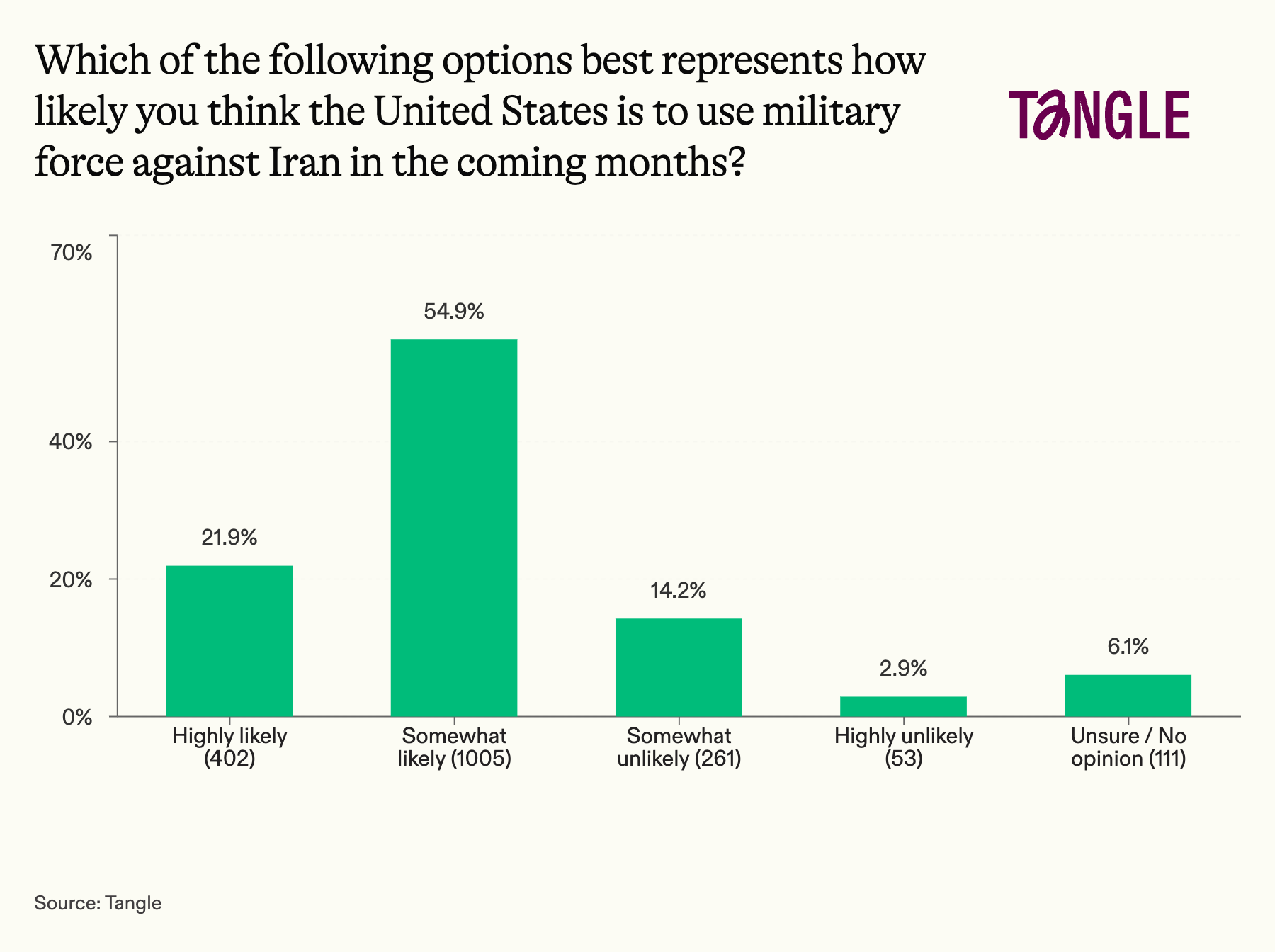
- Thursday’s survey: 1,832 readers responded to our survey on intervention in Iran with 55% saying the U.S. is somewhat likely to intervene with military force in the next few months. “It’s probably going to happen and it will be a disaster,” one respondent said. “My concern is that with Iran, as with Venezuela, Trump may settle for a cosmetic solution without real substance,” said another.
Have a nice day.
Shedly Appolon was 33 weeks pregnant when she suddenly became dizzy and lost control of her vehicle on a Florida interstate on February 6th. She crashed into a pond, where her sinking car prevented her from opening the driver’s side door — but a passerby, who saw the crash and swam roughly 30 feet out to Appolon’s vehicle, was able to open the back door of the car and help her back to shore. She was quickly transported to the hospital, and gave birth to a healthy newborn that same day, which also happened to be Appolon’s 29th birthday. She and the baby are in good health, according to Dr. David Rubay, chief of trauma and general surgery at HCA Florida Lawnwood Hospital. Good Morning America has the story.

Member comments