
I'm Isaac Saul, and this is Tangle: an independent, nonpartisan, subscriber-supported politics newsletter that summarizes the best arguments from across the political spectrum on the news of the day — then “my take.”
Are you new here? Get free emails to your inbox daily. Would you rather listen? You can find our podcast here.
Today’s read: 15 minutes.
From today's sponsor: Get 40% off Ground News
A Gallup Survey found that confidence in the media hit a new low of 28%. But according to Ground News, over 60% of the reporting came from right, with minimal coverage from the left.
That’s where Ground News comes in. Their Blindspot Feed surfaces stories that are disproportionately reported by either side of the political spectrum, giving you the full picture, not just the dominant narrative.
If you value transparency and independent thinking, you’ll appreciate how Ground News pulls from over 50,000 global sources so you can compare coverage and uncover bias, factuality, and ownership, all in one place.
Right now, Tangle readers get 40% off the unlimited access Vantage Plan at https://groundnews.com/tangle
Some fresh content!
Over the long weekend, we released four pieces of content that are very much worth your time:
- A reader essay from Dinah Bucholz arguing that Israel’s actions in Gaza have been moral.
- Our new members-only newsletter Press Pass, which gives a behind the scenes look at what’s happening here at Tangle.
- Friday’s breakdown of The Last Invention, a new podcast on the debate around artificial intelligence and how the outcome could shape the future of humanity.
- An interview with CNN air safety analyst and former FAA inspector David Soucie about how the government shutdown is impacting the safety of commercial air travel.
Quick hits.
- Hamas released the remaining 20 living Israeli hostages, and Israel released over 1,900 imprisoned Palestinians, as the first part of a peace deal to end the war in Gaza. Hamas also returned the bodies of four of the 28 deceased hostages. (The exchange) Separately, President Donald Trump addressed the Israeli Parliament to celebrate the peace agreement, then traveled to Egypt for a summit with Middle East and European leaders to discuss the later stages of the deal. (The travel)
- After announcing plans to impose a 100% tariff on Chinese imports on Friday, President Trump appeared to walk back the threat, posting on Truth Social, “Don’t worry about China, it will all be fine!” China said it would “resolutely take corresponding measures” if President Trump levied new tariffs. (The latest)
- The Trump administration began laying off federal workers amid the ongoing government shutdown. The administration told a federal judge that it has sent reduction in force (RIF) notices to approximately 4,100 federal employees across seven agencies. (The layoffs)
- 16 people were killed in an explosion at a military explosives facility in Tennessee on Friday. The cause of the explosion is not yet known. (The explosion)
- President Trump said he is considering sending Tomahawk missiles — capable of striking targets over 1,000 miles away — to Ukraine if Russia does not work faster to resolve the war. (The comments)
Today’s topic.
Chiles v. Salazar. On Tuesday, the Supreme Court heard oral arguments in a challenge to a Colorado law banning “conversion therapy,” or psychiatric treatment intended to change a person’s sexual orientation or gender identity, for minors. A majority of justices appeared more sympathetic to the plaintiff, a licensed counselor practicing conversion talk therapy who says the law discriminates against her based on her views. Other justices indicated their support for sending the case back to a lower court to review the law under a higher standard of scrutiny.
Back up: The plaintiff, Kaley Chiles, offers biblically aligned therapy, including services aimed at reducing patients’ attraction to people of their same sex or to address feelings of gender dysphoria. However, Chiles said she stopped offering this service after Colorado’s conversion therapy law passed in 2019 that barred mental health professionals from providing conversion therapy to clients under the age of 18 (with an exception for anyone “engaged in the practice of religious ministry”). Chiles says the law violates her rights under the Free Speech and Free Exercise Clauses of the First Amendment. Currently, 23 states and Washington, D.C. prohibit conversion therapy for minors, and the court’s ruling in Chiles could set standards beyond Colorado.
In 2022, a district court denied Chiles’s request for a preliminary injunction to block enforcement of the law but found she had standing to sue. The U.S. Court of Appeals for the Tenth Circuit also sided with the state, finding the law survived rational basis review, a lenient standard used in cases where no fundamental rights or suspect classifications are at issue. The Supreme Court agreed to take up the case in March.
During oral arguments, Chiles’s attorney James Campbell said, “This law prophylactically bans voluntary conversations, censoring widely held views on debated moral, religious, and scientific questions,” adding, “Aside from this law and recent ones like it, Colorado hasn’t identified any similar viewpoint-based bans on counseling.” Campbell was joined by the Trump administration’s Principal Deputy Solicitor General Hashim Mooppan, who argued the law should be subject to a stricter standard of review.
Shannon Stevenson, Colorado’s solicitor general, said that the law only applies to a single specific medical treatment, which she alleged “carries great risk of harm” and does not prohibit a healthcare professional from expressing their personal views to a patient. Stevenson argued that regulating medical treatment is fully within a state’s power.
Some of the court’s liberal justices, such as Justice Ketanji Brown Jackson, questioned why different kinds of treatment — talk therapy and medication — for the same condition should receive different protections under the Constitution. By contrast, the court’s conservative justices appeared skeptical that the law enforced an existing medical consensus on conversion therapy; Justice Samuel Alito asked why a minor should be unable to access this therapy if they desire it.
Today, we’ll break down oral arguments in the case, with views from the left and right. Then, Associate Editor Audrey Moorehead gives her take.
What the left is saying.
- The left argues conversion therapy is a discredited treatment, and Colorado’s law should be upheld.
- Some say the court’s ruling feels predetermined.
- Others criticize the court’s handling of LGBTQ cases.
In USA Today, Haley Norris wrote “junk science that harms LGBTQ youth should be banned.”
“Conversion therapy… has long been debunked by scientists, doctors and survivors alike as dangerous and deceptive,” Norris said. “The practice has no basis in therapeutic medicine and has been condemned by the medical community for years, including by the American Psychological Association and the American Academy of Child and Adolescent Psychiatry. It reinforces stigma and shame around LGBTQI+ identities, causing many who have been subjected to it to report experiencing high rates of depression, anxiety and suicidal thoughts.”
“Contrast this fight with the case the Supreme Court heard in 2024 regarding access to gender-affirming care for transgender youth, called United States v. Skrmetti. When it comes to the transgender community, the conservative calling card is often that society and doctors are ‘pushing’ gender-affirming health care onto young people and their families,” Norris wrote. “Unlike gender-affirming care, which involves months of therapy and discussion of treatment options and outcomes with patients and families, conversion therapy pressures young people to change who they are to fit the conversion practitioner’s idea of who they should be.”
In The Advocate, John Casey criticized “the sham of oral arguments on conversion therapy.”
“Chiles v. Salazar… is about whether the highest court in the land will once again choose bigotry over humanity and call it constitutional. And it will likely do it based on a lie. The Alliance Defending Freedom, which is defending conversion therapy in the case, is accused of misquoting and misrepresenting a 2016 study by scholars Lisa Diamond and Clifford Rosky,” Casey said. “This is all a dog and pony show, a sham, by the six conservative justices to somehow show that they can remain ‘unbiased,’ which is a joke with tragic consequences.
“Conversion therapy is not in any way therapy. It is psychological torture masquerading as religion, marketed as ‘healing,’ and has historically been inflicted on queer people under the guise of saving their souls. It sure as hell doesn’t save them — it destroys them,” Casey wrote. “This case really asks whether a therapist should be allowed to inflict emotional and psychological trauma on LGBTQ+ youth in the name of religion. Under this court, the answer will almost certainly be yes.”
In The Colorado Sun, Mike Littwin said Colorado’s law “looks predictably doomed.”
“It’s clear from arguments before the court Tuesday that the Colorado law is cooked, and that Colorado Springs therapist Kaley Chiles, who says ‘people flourish when they live consistently with God’s design, including their biological sex,’ will win out,” Littwin wrote. “It isn’t just Colorado law, of course, that will be trampled… Nearly 30 states now ban such therapy, which virtually every medical and mental health organization sees as both harmful and ineffective.”
“State Attorney General Phil Weiser, who went to Washington, said it’s not about free speech but about the state ensuring proper medical treatment. Justice Sam Alito wasn’t convinced by Weiser. He said a ban on voluntary talk therapy ‘looks like blatant viewpoint discrimination,’” Littwin said. “But is it really viewpoint discrimination, or is it a determination, guided by the best science, that says that conversion therapy can do serious harm to their minor-age clients? Does it sound like the court has any interest in the medical playbook that says ‘first, do no harm’?”
What the right is saying.
- The right supports striking down the law, arguing the case is fundamentally about free speech.
- Some say the law allows some kinds of gender-identity therapies but not others.
- Others suggest Colorado’s lawyers made flawed claims during oral arguments.
In USA Today, Ingrid Jacques asked “can a Christian counselor help youth with gender dysphoria?”
“The law allows counselors to use therapy to encourage minors toward a different gender identity — it just doesn’t want professionals like Chiles to advocate for comfort with one’s birth sex,” Jacques wrote. “While LGBTQ+ advocates like to act as if the science is settled on treating youth gender dysphoria, that’s far from the truth. Several European countries, including Britain, have backed away from using drugs such as puberty blockers for children after research has shown mixed results.
“Earlier this year, the Supreme Court upheld a Tennessee law restricting so-called gender-affirming care for minors. Twenty-seven states limit such drugs and procedures for children. Given the serious implications at hand, the majority thought this was an issue that states needed to figure out,” Jacques said. “The Colorado counselor’s case is about much more than gender dysphoria alone, however. It’s about our fundamental free speech rights as Americans that don’t disappear in professional settings. The government can’t compel — nor can it prevent — speech it doesn’t like.”
The Wall Street Journal editorial board wrote about “‘conversion therapy’ at the Supreme Court.”
“[Chiles] fears being punished if she discusses such things with minors experiencing gender dysphoria… That’s a constitutional violation, she argues, because the First Amendment protects ‘private conversations between counselors and their clients,’” the board said. “Colorado responds that she’s ‘overreading’ the law, claiming that none of what Ms. Chiles says she wants to do is banned… But the plain text of the law appears broader than Colorado now prefers to admit. ‘A therapist treating a minor who seeks to understand whether they identify as a girl or boy should help that patient explore that question,’ the state says. Explore how?”
“The state argues that this is a ‘routine’ regulation of healthcare, not a free speech question, akin to oversight of ‘a surgeon who incompetently closes a suture.’ The comparison is hardly apt. Ms. Chiles argues strict judicial scrutiny should apply, since Colorado is prescribing orthodoxy in the counseling room,” the board wrote. “The state predicts, with what reads like unwarranted confidence, that its law can survive any level of scrutiny. But the idea that talk therapy is conduct, not speech? That could get a chilly reception from the Justices.”
In National Review, Charles C. W. Cooke explored Colorado’s attorney’s argument.
“There are, of course, certain circumstances in which the government may regulate the speech of those who provide a commercial service — yes, including health-care providers. Under current precedent, for example, it would not be a violation of the First Amendment for the State of Colorado to pass a law that, either explicitly or implicitly, rendered it illegal for a doctor to tell a patient that he should stick a carving knife into his neck,” Cooke wrote. “Clearly, though, there is a lot of distance between that rule, which is obvious and uncontroversial, and rules relating to transgenderism, which is currently the topic of fervent political, moral, and scientific debate.”
“Repeatedly, Colorado’s lawyer suggested otherwise — even going so far as to claim that the matter had now been settled. But that isn’t true,” Cooke said. “For Colorado to have determined that counselors who live in the state are legally unable to tell people that they cannot change their gender — a position that, until about ten years ago, had been uniformly accepted through all of human history — is an astonishing overreach. Quite where the line sits between free speech and professional misconduct is hard to tell. But it’s certainly not there.”
My take.
Reminder: “My take” is a section where I give myself space to share my own personal opinion. If you have feedback, criticism or compliments, don't unsubscribe. Write in by replying to this email, or leave a comment.
- I disagree with physical types of conversion therapy, but that's not what's at issue in this case.
- I expect the court to send this case down to lower courts to review the law under strict scrutiny.
- I would support that decision, but also generally support the Supreme Court repealing overly restrictive laws like Colorado’s.
Audrey Moorehead, Associate Editor: I think Colorado’s law — and its defenders — make a pretty grave error in conflating the well established record of abuses under “conversion therapy” with conversion talk therapy. John Casey’s argument in The Advocate (under “What the left is saying”) illustrates these abuses well, detailing horrible treatments — “hypnosis, electroshock, even chemical castration” — that he argues is the world the conservative justices want to return to by overturning Colorado’s law.
Plainly: The use of conversion therapy in the name of “converting” someone from gay to straight is inhumane and has been proven ineffective and harmful. Colorado’s law and the medical establishment is right to condemn sexual orientation change efforts (SOCE), and you’d be hard pressed to find anyone other than the most extreme religious fundamentalists wanting to reinstitute electroshock therapy or chemical castration.
But this Supreme Court case has nothing to do with those physical practices. Kaley Chiles isn’t trying to shock the gay out of her patients; she wants to provide counseling to them on their feelings about their gender and sexuality in a manner that’s consistent with their own or their family’s values. The lawyers arguing on her behalf plainly distinguished between physical interventions and talk therapy early in oral arguments, and the rest of the session — including Colorado’s argument — was predicated on that distinction.
A further complicating factor is the ongoing conflation between SOCE and gender-identity conversion therapy (GICE). This conflation at the center of the case makes discussing its implications difficult, but it will almost certainly survive review by either the Supreme Court or the Tenth Circuit. Colorado’s law perpetuates the confusion, specifically defining conversion therapy as “any practice or treatment… that attempts or purports to change an individual’s sexual orientation or gender identity.” And Kaley Chiles’s brief engrains it further, explicitly specifying that she wants to provide conversion talk therapy for both sexual orientation and gender identity.
And since the case doesn’t distinguish between these two different practices, the court will have to consider both. James Campbell and Hashim Mooppan — the lawyers representing Chiles and the U.S. government, respectively — made a clear case that the Court’s prior decision protecting professional speech, National Institute of Family and Life Advocates v. Becerra, sets the precedent that Chiles’s talk therapy should be protected by the First Amendment. Mooppan’s argument in response to questioning from Justice Kagan and Justice Jackson was most convincing. He argued that one state’s law restricting a therapist’s ability to provide therapy in one way could easily become a standard allowing another law to restrict therapy in another way. For example, Tennessee was able to ban physical gender-transition treatments for minors, but not talk therapy affirming a child’s transgender identity; under this new standard, it could also have banned minors from receiving gender-affirming talk therapy.
Shannon Stevenson, arguing on behalf of Colorado, acquiesced to this position when Justice Gorsuch pressed her on the issue. Stevenson argued that states ought to change their laws when the medical establishment’s guidance changes, but as Justice Barrett pointed out, sometimes the medical establishment does not have one clear standard of care. That is the case with conversion talk therapy — and absent a clear and established proof of harm, the court should apply strict scrutiny to this legal challenge.
After reading arguments, the court seems to be leaning in this direction. While the court heard a good deal of argument about standing, most of the justices — including Kagan and Sotomayor — ultimately seemed to agree that Chiles had standing to bring this case, so I don't think that’ll be an obstacle to a ruling against Colorado here. That much seems clear. What remains unclear is whether the Supreme Court will apply strict scrutiny itself, or remand the case to the lower courts: honestly, I can envision a world where the court rules 9–0 to send the case to the Tenth Circuit to apply strict scrutiny there.
But if the court applies strict scrutiny itself in June, I think the justices are poised to strike down the law as a violation of the First Amendment.
Justices Kagan and Barrett seemed to agree on one particular point: If the court applies strict scrutiny to Colorado’s law, Colorado must prove that conversion talk therapy is directly harmful to patients. Whether Colorado can mount enough proof for its law to survive is contentious. Stevenson cited a few studies in her oral arguments that found that conversion talk therapy increased suicidality, but in his rebuttal, Campbell argued that their methodology —and Colorado’s application of it — was deeply flawed. Essentially, many of these studies fail to differentiate between averse physical therapies (like electroshock) and talk therapy on its own, and even the ones that adequately make these distinctions admit to sampling biases (such as only taking self-reporting participants, for example) and don’t claim to show causal links between talk therapy and later reports of depression and suicidality. And of course, most or all of these studies looked only at SOCE, and not the GICE practices that the law also prohibits.
The unavoidable truth is that, on the issue of gender and sexuality, the medical consensus is at best muddled and at least confusing. Even worse, ideological actors on both sides of the issue have their own reasons to cover up results that contradict their preferred policy outcomes.
In the long term, I think disentangling discussions of SOCE and GICE will be critical to regulating these practices effectively. Nearly all of the extant studies on conversion therapy deal primarily with SOCE, and most of these studies show at least some harm resulting from the practice (however dubious their methodology). I think it’s perfectly reasonable for the state to want to restrict the provision of this therapy to minors, though I think those restrictions should be narrower than Colorado’s law affords.
The same amount of evidence and study, however, cannot be afforded to GICE. And as Dilan Esper, a typically liberal First Amendment lawyer, pointed out, the Colorado law is so overly broad that it might conceivably restrict otherwise gender-affirming care regarding transition. The law prohibits attempts to alter “behaviors or gender expressions,” which might include an otherwise gender-affirming therapist who wanted to advise a patient against continuing medical transition at a particular point in time or because of specific health concerns.
“Behaviors” is the key word here; I think it creates an overly broad restriction on therapists’ ability to treat their patients. It’s entirely possible that a patient with gender dysphoria or same-sex attraction might desire not to act on these feelings, either out of religiosity or some other personal conviction. In plain text, Colorado’s law prohibits patients from seeking out talk therapy that might enable them to temper desires and behaviors that run contrary to their own convictions.
I think this particular portion of Colorado’s law clearly demonstrates viewpoint discrimination, and it doesn’t have the authority to restrict the freedom of speech between a therapist and her patient as this law does.
As it stands, Colorado’s law is overly broad and provides more confusion than it does clarity. Our patchwork of laws from state to state oscillates too far in one direction or the other, and our country’s children are caught in the middle. No state is regulating the kind of gender and sexual care adults can receive, but states are all declaring that they’re acting in the best interest of their children by preventing or restricting all kinds of care for them.
In the midst of all this confusion, Solicitor General Stevenson made a point that brought clarity to the arguments: We expect medical professionals, by nature of being medical professionals, to act in the patient’s best interests at all times. But contrary to Stevenson’s position, I think this is actually why therapists should have greater freedom to express their own viewpoints about what is best for their patients, even if they contradict a prevailing view at that time or in that state. I don’t think it would have been right for a gay teenager in 1975 to be unable to find a therapist who’d tell him he wasn’t mentally ill. But by the same standard, I think it wouldn’t be right for a gender-dysphoric Christian teenager to be unable to find a therapist who might help her resolve her dysphoria by talking about how to love the body she was born in.
To me, the only way we can protect the rights of both conservatives and liberals on issues of gender and sexuality is by allowing therapists — trusted medical professionals — to provide all kinds of guidance to their patients. And Colorado’s law explicitly restricts that freedom.
Children who wish to seek guidance on aligning their behaviors with their religion can still do so, through their priests, pastors, and church communities — just not from medical professionals. Protecting gay and trans minors requires that we bar these state mental health representatives from attempting to convert them in the name of biblical tradition. The state has an interest in doing so to prevent harm, and this law deserves to stay.
Take the survey: What do you think the Supreme Court will decide? Let us know.
Disagree? That's okay. My opinion is just one of many. Write in and let us know why, and we'll consider publishing your feedback.
40% off Ground News? Yes, you read that right.
If you read Tangle, you already care about balanced coverage. Ground News helps you go even deeper by comparing how every side frames the same story. See what’s missing, what’s emphasized, and why. Get 40% off their unlimited access Vantage Plan at https://groundnews.com/tangle
Your questions, answered.
We're skipping the reader question today to give our main story some extra space. Want to have a question answered in the newsletter? You can reply to this email (it goes straight to our inbox) or fill out this form.
Under the radar.
A new report from artificial intelligence company and ChatGPT developer OpenAI found that groups hostile to the United States are using AI tools to plan and execute hacking and influence operations. The report suggested that these actors frequently use multiple AI models to enhance existing tactics for phishing schemes and other malicious activities. OpenAI said it has banned several accounts using its product for these purposes, including accounts linked to Chinese government entities, some of which were using the platform to “generate work proposals for large-scale systems designed to monitor social media conversations.” Axios has the story.
Numbers.
- 1994. The year that the American Medical Association dropped its support for programs offering gay patients “the possibility of sex preference reversal.”
- 698,000. The approximate number of lesbian, gay, bisexual, and transgender (LGBT) adults in the United States who say they received conversion therapy at some point in their lives, according to a report from UCLA’s Williams Institute.
- 350,000. Of that group, the approximate number who say they received conversion therapy as an adolescent.
- 23. The number of states (as well as Washington, D.C.) with laws prohibiting licensed healthcare providers from offering conversion therapy to minors.
- 18. The number of states with no laws prohibiting or restricting conversion therapy for minors.
- 1,300. The approximate number of conversion therapy practitioners in the United States, according to a 2023 Trevor Project report.
- 600. The approximate number of conversion therapy practitioners with active professional licenses.
The extras.
- One year ago today we wrote about 10 ballot initiatives in the 2024 election.
- The most clicked link in Thursday’s newsletter was our latest video on data centers.
- Nothing to do with politics: Which universities produce the most billionaires?
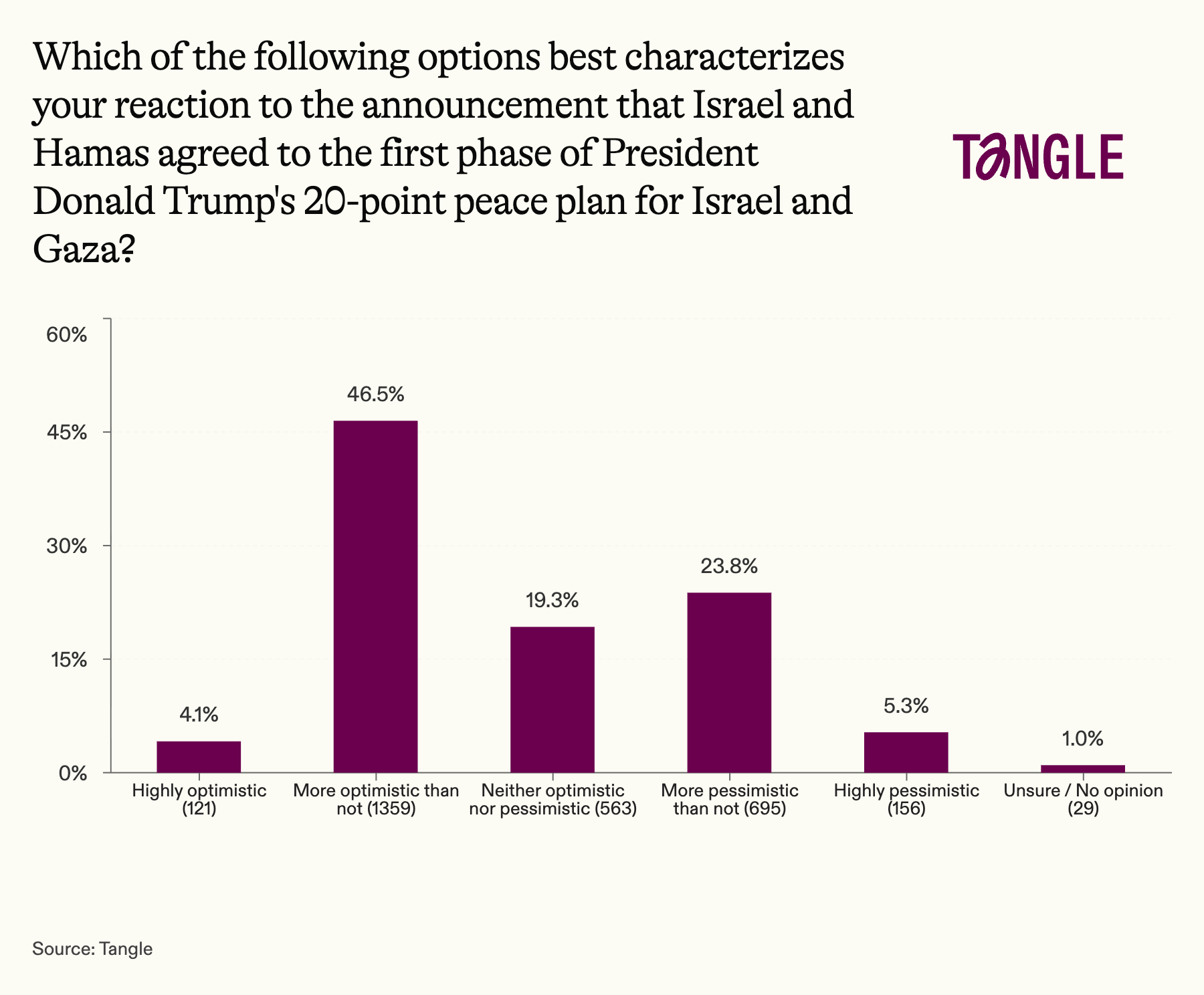
- Thursday’s survey: 2,923 readers responded to our survey on the Israel–Gaza peace deal with 51% characterizing their response as optimistic. “I think once Israel gets their hostages back the bombing will resume because Netanyahu is a criminal who relies upon war to keep from being prosecuted,” one respondent said. “I will believe it when ALL the hostages are released,” said another.
Have a nice day.
For decades, scaffolding erected around the Parthenon in Greece obstructed views of the 5th-century BCE temple — until now. The scaffolding supported maintenance and restoration of the site but concealed some details and altered the viewing experience. Last week, however, the supports were finally removed as one of the final steps in the multi-decade effort. More modern and discreet scaffolding will temporarily return in November, but the full restoration is now scheduled to be completed by the spring of 2026. Euronews has the story.
Member comments