

I'm Isaac Saul, and this is Tangle: an independent, nonpartisan, subscriber-supported politics newsletter that summarizes the best arguments from across the political spectrum on the news of the day — then “my take.”
Are you new here? Get free emails to your inbox daily. Would you rather listen? You can find our podcast here.
Today’s read: 13 minutes.
A defining moment for independent media.
In recent weeks, we’ve dedicated a great deal of coverage not just to current events, but also to how the world of politics and media is changing. If you read our editions grading our analysis from 2025, reviewing President Trump’s first year and sharing our internal editorial communications, you probably picked up on a common denominator: We’re grappling with a news ecosystem that’s evolving faster than ever while working tirelessly to keep our mission of providing balanced, thoughtful coverage that’s accessible to people of all political views.
Today, we’re asking for your help. Tangle is almost entirely supported by reader subscriptions, allowing us to remain accountable solely to our audience. While our overall readership continues to grow, financial support for our project has lagged behind. If you’ve been waiting for the right time to upgrade your subscription, now is the time. Not only will you be supporting Tangle’s work, you’ll gain access to original reporting, reader-requested coverage, and special features in our Friday and Sunday editions (along with other content offerings). Click here to upgrade!
Quick hits.
- Israel carried out airstrikes in Gaza after it said Palestinian militants attacked Israeli soldiers earlier this morning. Gaza officials said at least 21 people were killed in Wednesday’s strikes. (The strikes)
- President Trump and Colombian President Gustavo Petro met at the White House to discuss the countries’ relations after months of tensions over the Trump administration’s actions in Latin America. Both leaders called the meeting a success and said they were working on a counter-narcotics agreement. (The meeting)
- The U.S. military shot down an unmanned Iranian drone approximately 500 miles from Iran’s southern coast after the drone “aggressively approached” the USS Abraham Lincoln naval aircraft carrier. (The incident)
- Former President Bill Clinton and former Secretary of State Hillary Clinton agreed to testify before the House Oversight Committee as part of its investigation into convicted sex offender Jeffrey Epstein. The House has been pursuing contempt of Congress charges against the Clintons after they initially ignored a subpoena to testify. (The agreement)
- Eight lawyers reportedly resigned or announced their intent to resign from the Minnesota U.S. Attorney’s Office, bringing the total number of resignations in the past month to 14. The attorneys have cited recent directives from the Justice Department related to the investigations into the killing of Renee Good and Alex Pretti as their reason for leaving. (The report)
- BREAKING: Border czar Tom Homan announced the Trump administration will immediately withdraw roughly 700 federal immigration officers from Minnesota, citing new collaborative efforts with local and state officials. (The drawdown)
You're probably not getting Venmo'd a million dollars anytime soon.
But you can still manage your money like a millionaire — without buying yacht insurance or hundreds of Apple shares. The thing is, wealthy people aren't doing anything magical with their money.
They're just making smarter moves that most of us skip over. We're talking real estate investing with as little as $10, high-yield accounts earning 3.30% APY instead of the pathetic 0.40% most banks offer, and slashing car insurance by $1,025/year.
Some even get $300 just for switching their direct deposit.
These aren't get-rich-quick schemes — they are 4 of the most practical moves millionaires actually use.
Today’s topic.
The government funding deal. On Tuesday, the House voted 217–214 to pass a full-year funding package for several federal agencies, excluding the Department of Homeland Security (DHS), ending a four-day partial government shutdown. The funding bill previously passed the Senate 71–29, after Democrats pushed to remove appropriations for DHS following the shootings of two U.S. citizens by federal immigration officers in Minnesota in January. 21 Democrats voted for the measure in the House, while 21 Republicans voted against it. President Donald Trump signed the bill on Tuesday, funding most federal departments through September 30; the deadline to fund Homeland Security was set for next Friday, February 13.
A closer look: The package provides funding to the departments of Defense, Treasury, State, Health and Human Services, Labor, Housing and Urban Development, Transportation, and Education through the remainder of the fiscal year. It also provided $195 billion of discretionary spending, led by allocations to the Department of Health and Human Services for $49 billion for biomedical investments in research and $33 billion to the Department of Education for K–12 formula grants.
Last year’s One Big Beautiful Bill Act (OBBBA) allocated $191 billion to DHS, with $75 billion in funding for Immigration and Customs Enforcement (ICE) and $67 billion to Customs and Border Patrol (CBP). The OBBA also specifically funded CBP and ICE through 2029. However, annual funding for DHS still must be approved for fiscal year 2026, or some of its services will be suspended. In addition to ICE and CBP, DHS oversees Citizen and Immigration Services (USCIS), the Transportation Security Administration (TSA), the Federal Emergency Management Agency (FEMA), the U.S. Coast Guard, and the Secret Service.
Democrats have indicated that they will not support a continuing resolution to fund DHS, insisting any further action be tied to reforms. Among the requested reforms are mandatory body cameras for DHS agents, a ban on roving patrols, mandated coordination with local police, more stringent warrant requirements, a ban on agents wearing masks, and a requirement that they carry identification. Senate Minority Leader Chuck Schumer (D-NY) called these measures “common sense,” adding that Republicans who refuse to support them “are choosing to protect ICE from accountability over American lives.”
On Monday, DHS Secretary Kristi Noem announced that all of the department’s agents in Minneapolis will be issued body cameras immediately, and that the program will be expanded nationwide when funding becomes available. House Speaker Mike Johnson (R-LA) said on Tuesday that “roving patrols will be modified.” Senate Majority Leader John Thune (R-SD) expressed interest in cooperating with Democrats towards a solution. “A government shutdown is not in anybody’s interest,” Thune said.
If Congress is unable to reach an agreement to fund DHS by the February 13 deadline, some of DHS’s unfunded services may again partially shut down.
We’ll take a look at what the left and right are saying about the funding package below, then Executive Editor Isaac Saul gives his take.
What the left is saying.
- Many on the left insist Democrats hold firm on their demands for the coming DHS funding fight.
- Some say Democrats have limited options for constraining ICE.
- Others say Democrats have more leverage than they did during the last budget negotiations.
In The Hill, Lindsey Granger said Democrats “must hold their ground” on DHS funding.
“House Democrats are staring down a familiar problem, and it’s not just a procedural fight over funding the Department of Homeland Security. It’s the deeper issue of what the party actually stands for right now, and whether it has the backbone to defend it when things get uncomfortable,” Granger wrote. “Here’s the problem: Democrats have been here before. When health care reform faltered, when shutdown brinkmanship backfired, when messaging fractured instead of focused, the result wasn’t leverage. It was weakness.”
“Immigration enforcement can exist, but it cannot operate like a system with no rules, no transparency and no accountability. Masks off. Body cameras on. Proper identification,” Granger said. “So if Democrats are going to take a stand, this is the one that actually matters. Not a symbolic shutdown. Not another short-term patch. But putting clear, enforceable rules on paper and refusing to fund a system that operates in the shadows.”
In a video opinion for The New York Times, Kathleen Kingsbury asked, “What is the Democrats’ game plan on ICE?”
“You might be asking, did Democrats just roll over? The public is outraged over ICE’s egregious, inhumane tactics. Why didn’t they stop this? Here’s the thing. Shutting down the government wouldn’t have shut down ICE or Border Patrol. Their agents are considered essential workers, and the Department of Homeland Security is already well funded for years to come,” Kingsbury said. “On one hand, this buys them a little more time to negotiate without disrupting other government agencies. On the other hand, Democrats are making a big bet here that by the next deadline, they’ll still have the leverage they need to get Republicans on board with their demands for ICE and Border Patrol.”
“Spoiler alert: Those demands are not exactly radical. Democrats want an end to roving patrols, so agents can’t stop people just because they suspect they might be here illegally… They want officers to have a warrant issued by a judge before they can enter someone’s home or arrest them,” Kingsbury said. “And finally, they want to hold independent investigations when an officer is involved in a violent incident. Democrats might be able to hold on to their momentum and pass real reform. But for now, ICE will continue to operate with very few guardrails.”
In The Atlantic, Toluse Olorunnipa said “this shutdown is different.”
“Trump is largely the same person that he was four months ago, when the previous shutdown began… But his push to quickly resolve the latest shutdown highlights how much the political landscape on immigration has shifted following daily, videotaped clashes between masked federal agents and Minneapolis residents, two of whom were killed last month,” Olorunnipa wrote. “Trump made clear that he was willing to work with Democrats to avoid another government shutdown. The bill that Trump signed today funds most of the government through the end of September and continues funding for the Department of Homeland Security until February 13.”
“Democrats’ push may already be making an impact. Noem said yesterday that ICE agents working in Minneapolis will begin wearing body cameras immediately and that agents across the country will be doing the same once funding becomes available,” Olorunnipa said. “But Democrats are likely to face more resistance to their other demands. Asked about judicial warrants today, Trump was noncommittal… But, buoyed by the newfound leverage they have to draw Trump to the negotiating table, many Democrats are looking to exert maximum pressure in the coming days.”
What the right is saying.
- The right is glad to avoid a protracted shutdown, and many expect a DHS funding compromise to come together soon.
- Some criticize Democrats’ demands for ICE reforms.
- Others credit Congress for funding most of the government despite major political hurdles.
In Hot Air, Ed Morrissey wrote “[the] shutdown ends — for now.”
“[Hakeem] Jeffries and Chuck Schumer want new restrictions on arrest powers for ICE, which Republicans refuse, although both the GOP and the Trump administration have granted other concessions,” Morrissey said. “Homeland Security Secretary Kristi Noem has already ordered all ICE and Border Patrol personnel to wear body cams as soon as they can be purchased and distributed, a move that is long overdue anyway. Other than the demand for arrests only on existing warrants, the rest of the demands appear negotiable.”
“Two weeks may be a small window for these talks, but the vote today makes it clear that Democrats don't have much leverage. DHS runs a number of agencies, including TSA and FEMA, which House Dems can't really afford to derail twice in the same session of Congress,” Morrissey wrote. “Also: the more success Tom Homan has in lowering the temperature in Minnesota, the less leverage that the radicals will have in Congress… Another two weeks of reasonable coordination, and House Democrats will likely want to get back to ‘affordability.’”
In American Greatness, John R. Lott, Jr. argued “Democrats [are] using shutdown threat to rewrite immigration enforcement.”
“Democrats are demanding that major changes to Department of Homeland Security enforcement policy be written directly into the budget agreement. Those changes would largely shut down President Trump’s deportation efforts… They want to require judicial warrants for immigration arrests, force ICE agents to be easily identifiable, and grant states the authority to conduct their own investigations of federal ICE agents,” Lott said. “The vast majority of ICE’s 600,000 arrests and detentions last year, through the beginning of December, relied on administrative warrants or warrants issued by immigration judges. Requiring judicial warrants would overwhelm the federal court system.”
“Democratic demands for body cameras are especially puzzling because the very spending bill they are threatening to filibuster already includes $20 million that ‘must be used’ to purchase body cameras for ICE and Border Patrol agents,” Lott wrote. “Democrats are using the threat of yet another government shutdown to force sweeping policy changes that would sharply curtail federal immigration enforcement. Some of their demands even contradict long-standing Democratic positions on federal supremacy in immigration. But Democrats have one goal in mind: Stop Trump from deporting illegal aliens.”
In The Dispatch, Philip Wallach offered “two cheers for a semi-normal appropriations process.”
“On January 22, the House passed the final six bills, including defense spending and the thorny matter of spending for the Department of Homeland Security. Thanks to the detailed work of staffers, conducted out of the public eye, Congress was on pace to have 12 of 12 appropriations laws in place,” Wallach said. “Their accomplishment was somewhat derailed by events entirely outside of their control — the killing of Alex Pretti by Border Patrol agents operating in Minneapolis, just 17 days after the killing of Renee Good by Immigration and Customs Enforcement agents in the same city… Appropriators would have to settle for 11 out of 12.”
“The political and substantive importance of the immigration enforcement questions is huge, and Democrats have every right to play hardball. But they will have plenty of chances to do so even if the current bill is signed into law. In that case, absent further congressional action, the Department of Homeland Security would return to being shut down on February 13 (next [Friday]!),” Wallach wrote. “Meanwhile, the appropriators’ considerable accomplishment does not deserve to be casually tossed aside. Legislators should relish opportunities to support good-faith cooperation when they have them.”
My take.
Reminder: “My take” is a section where we give ourselves space to share a personal opinion. If you have feedback, criticism or compliments, don't unsubscribe. Write in by replying to this email, or leave a comment.
- This is not the way our government was designed to function.
- Democrats won’t want to compromise on their position, but halting TSA and FEMA operations will be painful.
- It’s hard to guess what will happen, but a solution within nine days seems unlikely.
Executive Editor Isaac Saul: It may be hard to believe, or it may be repeated so often that the phrase has lost its meaning, but none of this is normal. The government is not supposed to regularly shut down during spending negotiations.
Before last week, funding lapses had produced five “true” government shutdowns, in which operations were impacted for more than one business day, since 1980. This week made six, and three have now occurred under Trump (one in his first term and two already in his second; Trump had a second shutdown in his first term, too, but it only lasted two days and not more than one business day).
Congress is also not supposed to repeatedly pass spending bills on a temporary, “continuing resolution” basis. Kudos to Speaker Mike Johnson, who had made some momentary progress this year to return to regular order, but he hasn’t yet been able to fully end decades of chaos. Our government is not designed to negotiate substantial overhauls of agencies in a matter of days.
Yet here we are. Republicans and Democrats have nine days to determine how to fund the Department of Homeland Security (DHS), and what changes (if any) they want to make to the department’s immigration enforcement tactics. Democrats are going to push for DHS agents to remove their masks, wear body cameras (which Kristi Noem said they’re already starting to do), halt random sweeps and warrantless searches, and apply the same use-of-force policies as local and state law enforcement agencies. I support these policy proposals; I think most people probably do. Federal law enforcement should be subject to the same oversight, laws and limits as police, and the actions of DHS agents in the last few weeks have demonstrated precisely why.
Republicans, meanwhile, are going to fight tooth and nail against some of those provisions while also pushing to crack down on “sanctuary cities,” or municipalities that limit cooperation with federal immigration authorities. While non-cooperation in these cities has some upside (like unlawful residents reporting crimes to police or attending their immigration hearings more regularly), they also have huge downsides. At the very least, policies in these sanctuary cities should not prevent DHS from making arrests at prisons — a much more secure and less volatile environment than the public spaces and streets where arrests currently occur (typically involving people here illegally who have also been convicted of crimes). Yet I doubt Republicans get any concessions from Democrats right now, given the emotional forces of this moment.
Which is to say: Anyone expecting this to get resolved in nine days strikes me as naively optimistic. The dynamics of this stand-off seem quietly ripe for long-term problems. Democrats feel the wind at their backs to push against Trump’s key electoral issue. They also understand that any failure to provide funding to DHS means the parts of the department that aren’t ICE or CBP won’t get funding, which Democrats will have a much higher short-term tolerance for than Republicans, even if it seems counterproductive. House Minority Leader Hakeem Jeffries (D-NY) is already saying he won’t back a second stopgap funding measure for DHS if no deal is struck.
Any lasting funding gap for DHS would be most acutely felt by Americans when FEMA or TSA stop functioning properly. Obviously, a funding gap for an agency responding to natural disasters is always a risky proposition, especially with the sensitivity to natural disasters (both environmental and political) these days. TSA agents, meanwhile, could face furloughs without a resolution. During the last shutdown, many started calling in sick to work, and the Trump administration rewarded those who didn’t with a $10,000 bonus when the government reopened. How those employees navigate another indeterminable funding gap this time around will have a huge impact on U.S. travel, and thus a big impact on the political pain Congress feels for extending any standoff.
At the same time, Republican leaders like Speaker Mike Johnson are already striking a defiant tone, insisting they won’t unmask federal agents for fear of them facing personal threats and doxxing. But it sounds like the White House is going to be directly involved in negotiations, which means any resolution will be dictated by Trump — not Johnson — and thus influenced by the president’s read on public opinion, polling, and how each side’s arguments play out in the press.
Another refrain I’ve overworn through repeated use is how much can change in a few months in politics. Remember: We’re fresh off the longest government shutdown in U.S. history, which started with President Trump and Republicans promising to revel in the government grinding to a halt (and to take advantage of it at every turn), and ended with them triumphantly signing a bill to reopen the government while celebrating the fact Democrats caved on their core demand (no extension of Covid-era Obamacare subsidies). At the time, Trump’s lack of interest in resolving the shutdown was a key element of the story.
Back then, in the ancient political era historians call “November 2025,” it would have been fantastical to suggest that less than three months later, Democrats would force a shutdown over funding the Department of Homeland Security, that Trump would be deeply involved in resolving the shutdown quickly, and that he would ultimately cave to Democrats’ demands to negotiate DHS funding separately. This time, Trump’s bravado was gone and so too was the fanfare. The government reopened, and now Democrats head to DHS negotiations with a timeline that I think favors them. The fact that Congress has nine days to resolve this means negotiations will take place while public sentiment is strongly in Democrats’ corner — DHS’s worst actions are fresh in everyone’s minds, and if the deadline were weeks or months out, that dynamic would change.
One more worn-out reminder: All of this is over policy questions on an issue that has now twice propelled Trump to electoral victories. It’s pretty astonishing. Republicans have lost an unbelievable amount of political leverage in the last few months because of consistently unprofessional (and even illegal) actions by DHS agents in the field.
I genuinely do not know how the next nine days will play out. Though I’m deeply skeptical Congress can reach a compromise in such short order, I do suspect we’ll see something akin to a compromise in the end. Democrats should land provisions for body cameras and use-of-force standards, which are easy to sell to the public and where they are already making progress. Making ICE agents remove any face coverings will be more difficult, as the threat of agents being targeted is clearly a live issue. I also doubt Democrats make any progress in limiting the kinds of warrants DHS can use; administrative warrants have been common for some time, and any law restricting them will likely land in the courts. As Speaker Johnson said, a crackdown on how the administration can apply those searches would all but end the enforcement effort Trump campaigned on, and that just isn’t going to happen.
So we’ll see who blinks first. The real test, if this extends beyond the nine days legislators have, will come when TSA and FEMA operations take a hit. Hopefully we don’t get there — but I’d be shocked if Congress can resolve anything until the vice tightens around not just them but the rest of us, too.
Take the survey: When do you think Congress will reach a solution to fund DHS? Let us know.
Disagree? That's okay. Our opinion is just one of many. Write in and let us know why, and we'll consider publishing your feedback.
Your questions, answered.
Q: Provide an update on the progress of TrumpRx.gov.
— Internal note, Tangle Staff
Tangle: On December 18, 2025, we covered a national address from President Trump, writing at the time that, apart from a $1,776 “Warrior Dividend,” the address contained only two announcements of upcoming actions: “TrumpRx, a government website offering prescription drugs at lower prices, and a new pick for the next Federal Reserve chair to be announced ‘soon.’” We left a note to ourselves to see what progress had been made on these two changes six weeks later.
One of these announcements has already been fulfilled; as we covered in yesterday’s edition, Trump nominated Kevin Warsh to be the next Fed chair last week. The second initiative, using most-favored-nation pricing and a new website to make prescription drugs more affordable and accessible, is incomplete but well underway.
Since Trump’s speech, the administration has secured deals with multiple major pharmaceutical manufacturers — more than a dozen, according to the White House — to join Pfizer in participating in the TrumpRx platform. The website — TrumpRx.gov — was expected to launch in January but has been delayed. The new launch is expected some time in the next week, according to Health and Human Services (HHS) Secretary Robert F. Kennedy Jr.
The administration has also made some progress on administrative constraints. In late January, HHS released guidance to pharmaceutical companies on how to make their drugs available directly to consumers without violating federal regulations. However, three Democratic senators — Elizabeth Warren (MA), Dick Durbin (IL), and Peter Welch (VT) — formally expressed concern that the program would violate anti-kickback regulations, writing a letter to the inspector general asking for a report on the program’s compliance.
So, while we’re still waiting on many details, we should have more information in the next week or so if the official website launches as planned.
Want to have a question answered in the newsletter? You can reply to this email (it goes straight to our inbox) or fill out this form.
Under the radar.
On Monday, the Rafah Border Crossing reopened for movement between Gaza and Egypt for the first time in roughly 21 months, fulfilling a key provision of the U.S.-brokered peace deal. Israel mostly closed the crossing after taking control of the Gaza side in May 2024, and a reported 20,000 sick and wounded people are now waiting to leave Gaza to receive treatment. However, Israel said only 50 patients per day can leave initially (and 50 others will be permitted to cross into Gaza), and no goods will be allowed through. European Union supervisors and local Palestinians will facilitate the reopening, while Israel will carry out remote security checks. The BBC has the story.
Why are you still earning 0.40% on your savings?
Millionaires aren't. They're using high-yield accounts paying 3.30% APY, investing in real estate for $10, and getting paid $300 just to set up direct deposit.
These aren't insider secrets — anyone can do this stuff.
See which money moves you're leaving on the table.
Numbers.
- 16. The number of government shutdowns since 1981.
- 5. The approximate average length, in days, of government shutdowns between 1981 and 2013.
- 4. The total number of government shutdowns during the first and second Trump administrations.
- 21. The approximate average length, in days, of the shutdowns during the two Trump administrations.
- 80% and 6%. The percentage of U.S. adults who say it is important and not important, respectively, to have training and conduct standards for federal officers who enforce immigration laws, according to a January–February 2026 Ipsos poll.
- 62% and 13%. The percentage of U.S. adults who say efforts by ICE officers to deal with unauthorized immigration in the country go too far and don’t go far enough, respectively.
- 13% and 64%. The percentage of U.S. adults who say the impact of federal immigration enforcement efforts in their community has been mostly positive and mostly negative, respectively.
The extras.
- One year ago today we covered the future of USAID.
- The most clicked link in yesterday’s newsletter was the website with simple memory games.
- Nothing to do with politics: A Frenchman had an antique lodged in his rectum that required the bomb squad to remove.
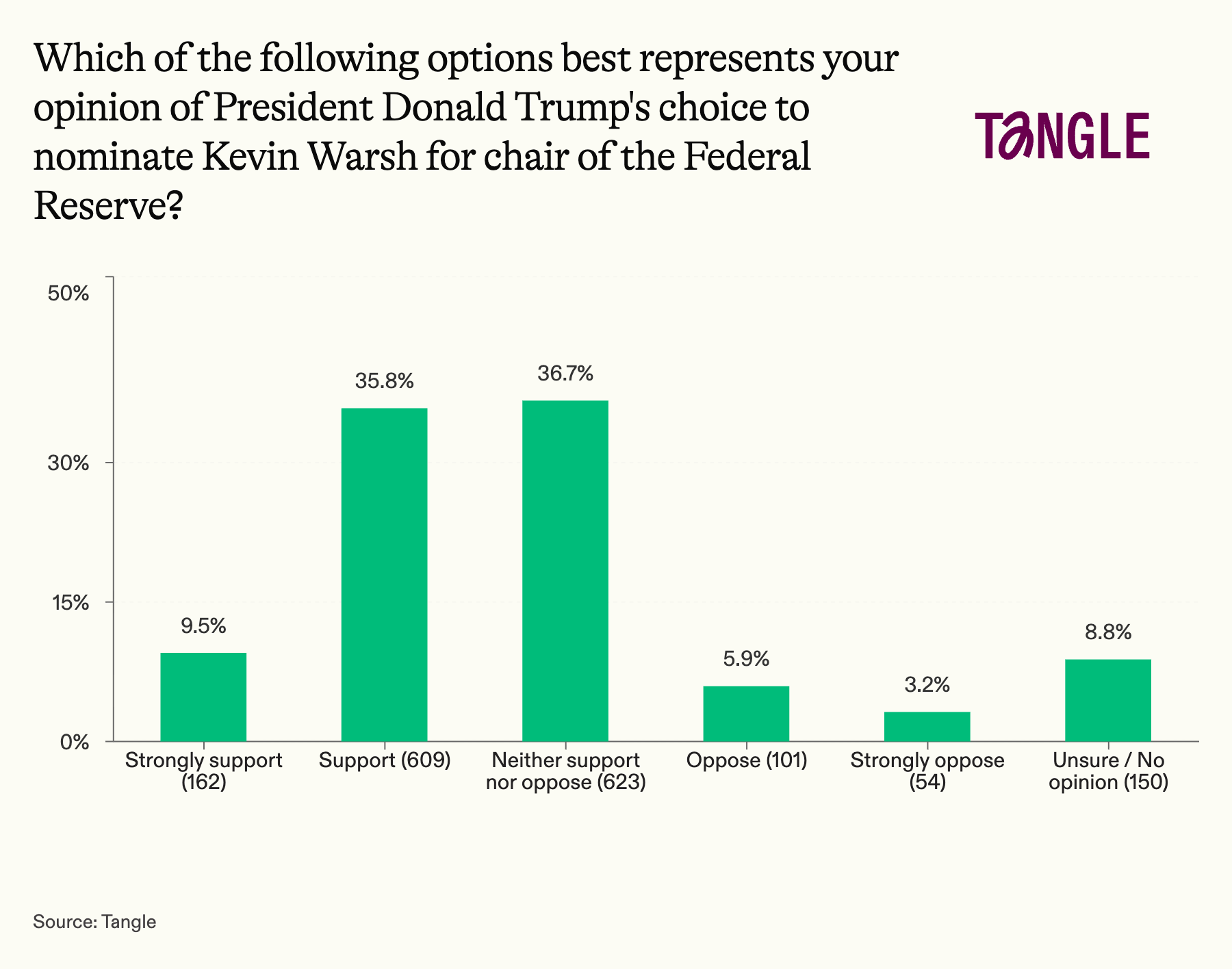
- Yesterday’s survey: 1,699 readers responded to our survey on the nomination of Kevin Warsh as Federal Reserve chair with 37% neither supporting nor opposing the nomination. “I like the idea of reducing assets held by the feds. I’m concerned, as usual, with Warsh’s too cozy ties to the banking establishment,” one respondent said. “I’m cautiously hopeful he’ll maintain the Fed’s independence,” said another.
Have a nice day.
The percentage of Americans volunteering for a religious organization or other charitable cause fell by eight points between 2017 and 2021, likely driven in part by the Covid-19 pandemic. However, according to new polling from Gallup, volunteerism has bounced back to pre-Covid levels as of 2025. 63% of Americans reported volunteering in 2025, up from 56% in 2021. Overall, people in the U.S. remained highly engaged with charities in different ways, with 76% donating money to religious organizations or other charitable causes. Gallup has the story.

Member comments