
I'm Isaac Saul, and this is Tangle: an independent, nonpartisan, subscriber-supported politics newsletter that summarizes the best arguments from across the political spectrum on the news of the day — then “my take.”
Are you new here? Get free emails to your inbox daily. Would you rather listen? You can find our podcast here.
Today’s read: 13 minutes.
Americans Born Between 1941-1979 Can Receive These 10 Benefits This Month
You could be missing out on $1,000s, and you might not even realize it.
Sure, you might know about some senior discounts at diners or retail stores.
But what you might not know is there are a number of lesser-known programs that can help slash bills, reduce insurance costs, and unlock powerful financial perks — right now.
We pulled together some of the most valuable money moves for 2025.
Cut expenses, boost your retirement, and recession-proof your finances. But act fast — we don't know how long these programs will last.
*Our sponsors help keep Tangle free — thank you for supporting them when you feel they could be useful to your life.
Reminder.
Tangle observes all federal holidays, so tomorrow (Tuesday, November 11) we won’t be publishing a regular newsletter in observance of Veterans Day. Free subscribers will receive a survey to help us shape the future of Tangle (one that our paid subscribers have already taken), so keep an eye out for that and be sure to share your feedback with us. We love hearing about how we can improve.
Paid subscribers will get our second edition of Press Pass, a new monthly edition that offers a peek behind the curtain at the inner workings of Tangle and gives you a chance to weigh in on our future.
My interview with Ana Kasparian.
Before our live show in Irvine, California, I got to sit down for a 30-minute one-on-one with Ana Kasparian, the host of The Young Turks online show and reporter at RealClearInvestigations. Ana is one of the most influential voices in independent media today, and we discussed how she got her start in journalism, her thoughts on Gavin Newsom, and accusations that she traffics in antisemitism. Check out the interview (and subscribe to our YouTube channel) here:
Quick hits.
- BREAKING: The Supreme Court declined to hear a challenge to its 2015 ruling recognizing a constitutional right to same-sex marriage. The court did not offer an explanation for the decision. (The denial)
- President Donald Trump pardoned 77 people alleged to have participated in the effort to overturn the 2020 presidential election. Former Trump attorneys Rudy Giuliani, Sidney Powell, John Eastman, and Kenneth Chesebro were among those who received preemptive pardons. (The pardons)
- President Trump proposed sending a dividend of “at least” $2,000 from tariff revenues to most Americans. The White House has not specified who would be eligible to receive the dividends, and the proposal will likely require Congressional authorization. (The proposal)
- Syrian President Ahmed al-Sharaa will meet with President Trump at the White House on Monday, the first such meeting by a Syrian leader. Ahead of the visit, the State Department removed Sharaa and Syrian Interior Minister Anas Khattab from a list of globally designated terrorists. (The meeting)
- The Federal Aviation Administration temporarily halted all flights of McDonnell Douglas MD-11 planes — the aircraft involved in the UPS cargo plane crash in Louisville, Kentucky, on Tuesday — until they are inspected. Roughly 70 MD-11 planes currently operate as cargo planes for UPS, FedEx, and Western Global. (The order)
- Super Typhoon Fung-wong has killed at least eight people and forced over one million people to evacuate in the Philippines. (The typhoon)
Today’s topic.
The latest on the government shutdown. On Sunday, the Senate voted 60–40 to advance legislation to end the federal government shutdown after Republicans reached a deal with several Democratic senators. The package includes the continuing resolution passed by the House of Representatives with amendments to include three bills (known as a “minibus”) that will collectively fund the operations of Congress, the Department of Agriculture and the Food and Drug Administration, and programs and benefits for veterans in fiscal year 2026. As part of the deal, Congress will also fund the Supplemental Nutrition Assistance Program (SNAP) through fiscal year 2026. However, the deal will not include an extension of enhanced Affordable Care Act credits, which Democrats had been demanding as part of a deal. Instead, Senate Majority Leader John Thune (R-SD) promised a vote in December on extending the credits.
In addition to the funding measures, Republicans have agreed to reverse the layoffs President Donald Trump initiated during the shutdown and prevent the use of federal funds to carry out further reductions in force through January 30. According to the text of the continuing resolution, any federal employees laid off since October 1 “shall receive all pay to which they otherwise would have been entitled.”
We previously covered the shutdown here and here.
The vote came in a rare Sunday session for the Senate, during which three moderate senators who caucus with Democrats — Sens. Jeanne Shaheen (D-NH), Angus King (I-ME), and Maggie Hassan (D-NH) — negotiated the deal with Majority Leader Thune and the White House. Democratic Sens. Catherine Cortez Masto (NV), Dick Durbin (IL), John Fetterman (PA), Tim Kaine (VA), and Jacky Rosen (NV) ultimately joined the three moderates in voting for the measure.
Sen. King said that the length of the shutdown, which reached 40 days on Sunday, convinced some of his colleagues to seek a deal. “The question was, as the shutdown progresses, is a solution on the ACA becoming any more likely? It appears not,” King said. “And I think people are saying we’re not going to get what we want, although we still have a chance, because part of the deal is a vote on the ACA subsidies.”
Senate Minority Leader Chuck Schumer (D-NY) voted against the package, criticizing Republicans for their refusal to negotiate on healthcare subsidies. “On Friday, we offered Republicans a compromise, a proposal that would extend the ACA tax credits for a year and open up the government at the same time,” Schumer said. “[They] said no on our compromise, they showed that they are against any health care reform.”
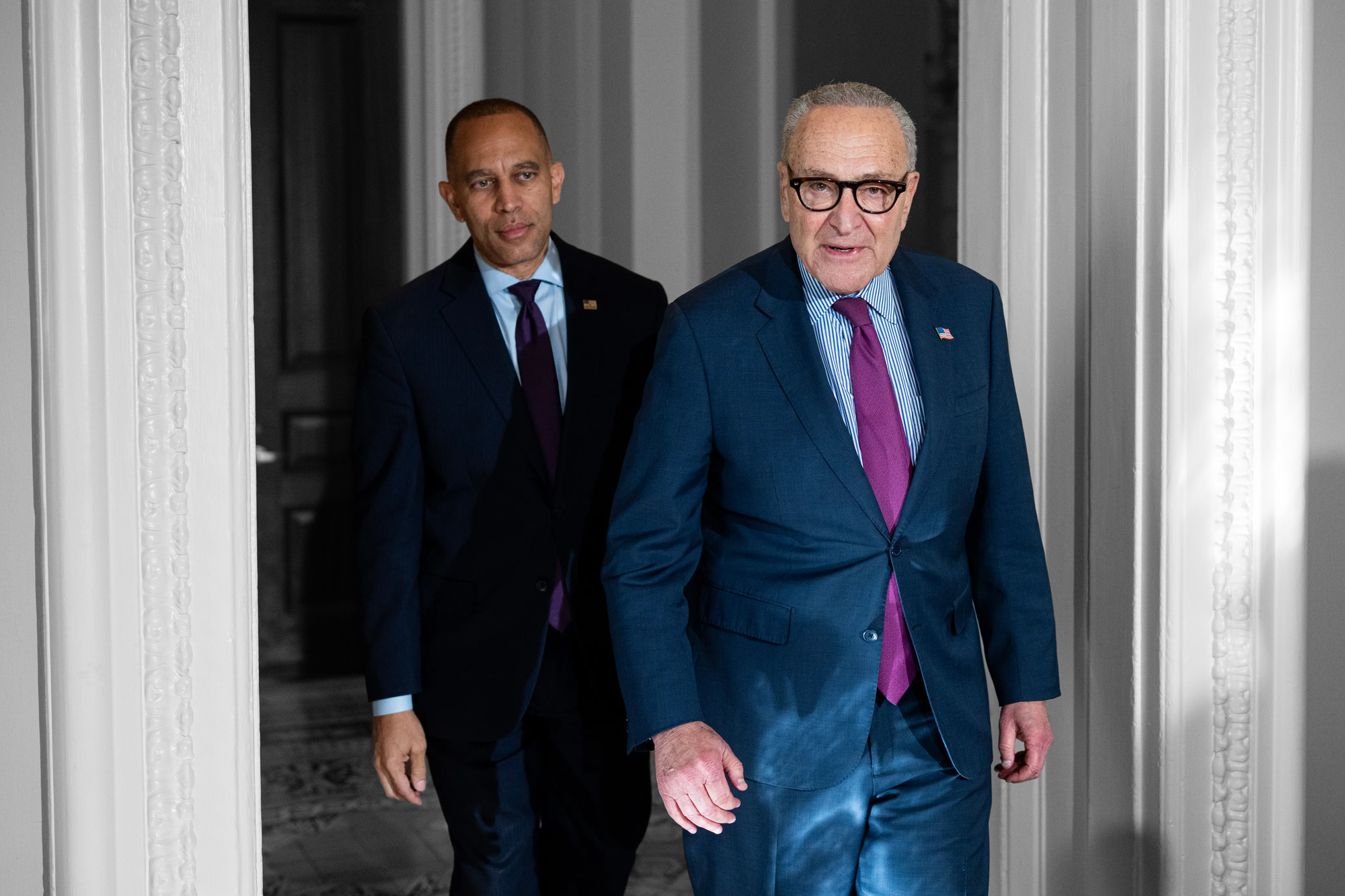
The measure must still pass the House. Republicans will not need any Democratic support to pass the bill if all GOP members unify to pass it. The House has been out of session since September 19, but members were notified that they should expect to vote on the measure this week. House Minority Leader Hakeem Jeffries (NY) said that the Democratic caucus will not support any deal that does not include healthcare-subsidy extensions.
Today, we’ll cover the latest on the shutdown, with views from the right and left. Then, Executive Editor Isaac Saul gives his take.
What the right is saying.
- The right views the outcome as a defeat for Democrats.
- Some say Republicans gave up nothing of substance.
- Others suggest the resolution is a reversion to the pre-shutdown status quo.
In PJ Media, Matt Margolis said Democrats “caved.”
“The government will reopen after a handful of Democrats finally agreed to vote with Republicans to end the shutdown — without giving Chuck Schumer and his caucus anything close to a win,” Margolis wrote. “Schumer’s caucus agreed to advance a package of spending bills that will reopen the government and extend funding through January. That’s it. No sweeping policy concessions, no big wins tucked into the fine print, no ‘historic framework’ or ‘moral victory.’ Just a basic continuing resolution, dressed up with some boilerplate back pay for furloughed workers and funding for food assistance through next fall.”
“This shutdown began because Schumer thought he could strongarm the GOP into extending Obamacare subsidies that were set to expire and repealing Medicaid reforms that closed a loophole handing out free healthcare to illegal immigrants. President Trump and Republican leaders had already said they planned to address those subsidies separately, aiming to rein them in and curb abuse,” Margolis said. “But Schumer wanted drama. He shut down the government over it, thinking Republicans would blink. They didn’t. After 40 days of a shutdown over a laundry list of demands, Democrats have nothing to show for it.”
In National Review, Jim Geraghty called the shutdown “pointless.”
“Last Tuesday night, Democrats were jubilant, convinced they had just inflicted the first of many consequential defeats upon their detested foes, President Trump and the Republican Party. And now here we are, six days later, and Democrats are once again disappointed, infuriated, and at each other’s throats,” Geraghty wrote. “Republicans needed at least four more Democrats to change their mind…. all they needed was a pledge from Senate Majority Leader John Thune of South Dakota to hold a vote on legislation to extend the Obamacare exchange premium subsidies by the second week of December.”
“I am sure some Democrats, eager to put lipstick on a pig, will argue that the longest federal government shutdown in history added to the perception of disarray in Washington and made Americans more frustrated with Republicans, just in time for Election Day 2025,” Geraghty said. But “Republicans just got the government reopened in exchange for a promise of a vote — not even promise of passage! — and rehiring government workers who were on the job on September 30. That’s a very small price to pay, and Republicans didn’t have to get rid of the filibuster.”
In Hot Air, Ed Morrissey wrote that Democrats got “nothing more than what they would have had with the clean continuing resolution.”
“The Senate will replace that CR with new language that would extend government operations until the end of January while negotiations continue on the FY2026 budget. Forty days ago, Schumer demanded passage of an extension of expiring ObamaCare subsidies, plus repeals of Medicaid changes in the One Big Beautiful Bill that eliminated coverage for illegal aliens,” Morrissey said. “So what did Democrats end up getting for this biblical walk in the idiotic budget wilderness? A promise for a vote on the ACA subsidies, with no guarantee of GOP support.”
“Democrats didn’t get anything they wanted. They didn’t even get a pass on the filibuster for the debate on ACA subsidies, let alone a commitment for an extension… the only real concession in this deal from the GOP is a pledge to rescind the layoffs that Russ Vought began, and those only took place because Schumer shut the government down,” Morrissey wrote. “Rescinding the RIFs may be a concession of some sort, but the RIFs wouldn’t have happened in the first place had Schumer not shut down the government.”
What the left is saying.
- The left is disappointed by the outcome, suggesting that Democrats gave up their leverage.
- Some say the party folded without achieving any of its goals.
- Others say Democrats were not able to stomach the ongoing damage from the shutdown.
In The Atlantic, Jonathan Chait argued “Senate Democrats just made a huge mistake.”
“The conventional wisdom about government shutdowns is that they always fail… the public eventually turns against the party responsible, applying more and more heat until its most vulnerable members feel compelled to give in,” Chait wrote. “That did not happen this time. Polls found that the public narrowly but consistently placed the blame on Donald Trump and his allies, not congressional Democrats.”
“What’s more, Democrats’ goal during the shutdown was to draw more public attention to health care, one of their strongest issues, and one where Republicans are engineering a social catastrophe. Democrats are demanding an extension of tax credits for people purchasing health insurance on the individual market. That is an issue where they command massive public support,” Chait said. “Holding out would have caused serious pain in the short run… If you truly believe that Trump poses an existential threat to the republic, however, this is the kind of ruthless maneuver you would undertake.”
In CNN, Stephen Collinson wrote about “Democratic unity fractur[ing].”
“It might be crass to parse the human misery caused by the shutdown for a partisan win after a political duel that deprived millions of Americans of food benefits, left federal workers with $0 paychecks, and created chaos and safety fears in commercial aviation,” Collinson said. “But the crisis — precipitated by the expiration of enhanced subsidies for Affordable Care Act plans, whose prices are skyrocketing — was fought for multilayered political reasons. It will influence judgments on Trump’s second presidency and the Republican majorities in Congress and help define the trajectory of the Democratic Party’s comeback bid ahead of next year’s midterm elections.”
“The headline here is that sufficient numbers of Democrats are folding without achieving the goal that led them to withhold votes from a government funding bill and halt federal operations at the beginning of October,” Collinson wrote. “On the face of it, this looks like a massive failure. Democrats won no undertaking that Obamacare subsidies will be extended — despite insisting that such a move was their bottom line. The best they will get is a Senate vote. There is no guarantee that a bill extending subsidies will pass, considering the Senate’s GOP majority. And the prospects of the Republican House endorsing it seem even more remote.”
In The New York Times, Ezra Klein said “Democrats were on a roll. Why stop now?”
“Centering the A.C.A. subsidies created two strange dynamics inside the coalition. First, there was always a crucial group of Senate Democrats that had never believed the tax credits were worth shutting down the government over,” Klein wrote. “Second, for most Senate Democrats, the emotional energy of the shutdown was around fighting Trump’s assault on the American system of government, but the actual negotiations about the shutdown were around the much-narrower issue of A.C.A. subsidies. (Is authoritarianism acceptable so long as health insurance premiums are low?)”
“More than anything else, this is what led some Senate Democrats to cut a deal: Trump’s willingness to hurt people exceeds their willingness to see people get hurt. And some of them feared that their Republican colleagues would, under mounting pressure, do as Trump had demanded and abolish the filibuster,” Klein said. “This, in the end, is the calculation the defecting Senate Democrats are making: They don’t think a longer shutdown will cause Trump to cave. They just think it will cause more damage.”
My take.
Reminder: “My take” is a section where I give myself space to share my own personal opinion. If you have feedback, criticism or compliments, don't unsubscribe. Write in by replying to this email, or leave a comment.
- As I expected, the election results spurred immediate action to end the shutdown.
- I doubt Democrats are defecting organically — Schumer is just folding in a way that gives the appearance of resistance.
- It all raises the question: What was this all for?
Executive Editor Isaac Saul: After last week’s election results, I wrote about the immediate reactions I expected:
1) A flurry of activity to reopen the government, given that Democrats withstood the political blowback and Republicans now hear alarm bells everywhere (this prediction is already starting to prove correct). 2) Many Republicans will reconsider the gerrymandering wars.
We’ll see about the gerrymandering, but the flurry of activity to reopen the government happened at about the pace I expected. Internally, at Tangle, my bet was that the government would be open by Wednesday. The current pace of negotiations puts that prediction on track.
Why did I think this? After sweeping at the ballot box, Democrats got some momentum and power back, sensing that voters were blaming Republicans more than them and that the anti-Trump “resistance” was alive. In my mind, their wins have given them the freedom to end the shutdown feeling like they got the right kind of attention for “standing up to Trump” and that their base was behind them. Republicans, meanwhile, would recognize they just got crushed in elections across the country while the shutdown continues to poll badly for them — and that their control of Congress and the White House makes it hard for them to deny any responsibility.
I suspected, actually, that Democrats would force some concessions on the expiring ACA subsidies — the central issue they claimed this shutdown was about. But, instead, they seemed to have gotten… not very much.
So, then, what was the shutdown about?
Throughout the entire saga, I’ve said that (strangely) it has had no clear, defining issue. Democrats kept saying it was about the Obamacare subsidies, and many of their mouthpieces in the media insisted that was the case. Republicans kept claiming it was about “funding healthcare for illegal immigrants,” a talking point they mostly used to try to force a stalemate on the issue.
Well, now the government is opening up again — without any adjustment to the Obamacare subsidy cliff, and with nothing done about any healthcare programs going to unauthorized immigrants (because that was never a real thing to begin with). As State Rep. Malcolm Kenyatta (D-PA) said, Democrats effectively got a “pinky promise” for a vote to extend the Obamacare subsidies sometime in December, on a yet-to-be-determined bill, at a yet-to-be-determined date (and without any assurance that the House would take it up if it passes the Senate).
So, yes, they folded.
And my read is that any insistence pretending otherwise is just political cover. Minority Leader Chuck Schumer voted against the bill, and even released a video on X pretending to oppose this outcome. Yet that is just the theater of politics — this wouldn’t happen without his approval, and it wouldn’t be happening without his approval. Behind closed doors, I suspect most Senate Democrats are on board with reopening the government, which is why they came out of a caucus meeting with this plan. Of the eight Democrats who voted for it, two are retiring next year and six aren’t up for re-election until at least 2028. That tells you everything you need to know. The point, obviously, was to insulate the party from any political blowback by pinning this on the “centrists,” and then letting the rest of the caucus say whatever they wanted about the deal to play this right in the press and with their own constituents.
Welcome to Washington.
Now I’m wondering how bad that blowback will be. A problem with inventing an issue to make this shutdown about (Obamacare enhanced subsidies that were passed, during Covid, on a temporary basis) is that when your base follows your lead, and makes the shutdown about healthcare, you have to have an explanation when you fold without getting what you want. Democrats don’t have an explanation.
The Affordable Care Act has high approval ratings, and the party is riding the tailwind of a hugely successful night… and backing down. Personally, I can see the jam Democrats were in: Trump was willing to fight the release of SNAP funding in the courts, air travel appeared on the brink of collapse, and hundreds of thousands of federal workers were furloughed. Also, again, the central fight this was supposedly about is a subsidy that Democrats themselves passed into law with the understanding that it was temporary. But it’s just not going to make sense to base Democratic voters who followed the party into battle on the Affordable Care Act issue.
And you can see that reflected in the House. There, Democrats are making a lot of noise about how they will vote against this bill, criticizing the Senate up and down. Rep. Ro Khanna (D-CA) is already calling for Schumer to step down; I expect to hear more of that from other members soon. Democratic strategist Simon Rosenberg is now insisting to his followers that they light up the phones in D.C. today and let the Senate know they don’t want Democrats to end the shutdown. A revolt against Schumer is brewing.
But House Democrats also have no power: Republicans can stick together to pass the new proposal in the House (and almost certainly will, perhaps with a couple theatrical, coordinated holdouts of their own), and Democrats can’t stop it. Then, even if the Senate does vote on extending the Obamacare subsidies, the House has made no such promise. Will either side feel the pressure? The House has been gerrymandered into noncompetitiveness, and Democrats are outgunned by a simple majority. On our Suspension of the Rules podcast, I debated this very issue with my co-hosts, who insisted Democrats would be better off not engaging Trump in a fight on gerrymandering so they could use the issue in the next two elections, adding that Democrats shouldn’t fear a Republican-dominated House that already exists and doesn’t do a whole lot of legislating. Well, this a good example to me of both 1) how different negotiations would be if Democrats took back the House and 2) the insidious impact of gerrymandering, where previously vulnerable Republicans now don’t have to worry about the optics of a tough vote on the Affordable Care Act.
Speaking of Republicans, I want to call out some important aspects of the deal that haven’t gotten much attention — namely, the way the deal gives very little deference to Trump’s spending preferences. First, Trump wanted to cut the Food for Peace program that sends surplus American crops to communities experiencing famine around the world; the Senate rejected that proposal. Second, Trump wanted to cut the Government Accountability Office’s funding (which has said that Trump’s unilateral budget cuts were illegal twice this year), but the Senate retained its funding. Third, in maybe the only tangible sign Republicans are feeling some pressure, the bills reversed thousands of federal workers’ firings and forbade any new firings through January 31.
Does Trump mind? Is he even aware? I’m not entirely sure. He spent the weekend posting on Truth Social about — and I don’t use this term lightly — a conspiracy theory that DOGE stopped Barack Obama from getting $2.5 million a year in “royalties” from Obamacare. He hasn’t shown much interest in the shutdown since it started, instead spending much of his time the last few weeks abroad or focused on foreign affairs from the White House. He hasn’t seemed to care much about how Congress is functioning in either of his terms as president. The “concept of a plan” Trump once promised on healthcare has yet to emerge, and with over 20 million Americans months away from having their premiums skyrocket under the Affordable Care Act, Republicans still have no plan to “repeal and replace” Obamacare. This is the leverage Democrats had, which they’ve now ceded. But the president doesn’t seem worried about it — and if this is how Democrats are willing to end the shutdown, he probably doesn’t need to be.
So, I’ll ask again: What was this shutdown for? The longest government shutdown in U.S. history is now over, but has anything changed? I’m still looking for a good answer.
Take the survey: Which party do you think “won” the government shutdown? Let us know.
Disagree? That's okay. My opinion is just one of many. Write in and let us know why, and we'll consider publishing your feedback.
Your questions, answered.
We're skipping the reader question today to give our main story some extra space. Want to have a question answered in the newsletter? You can reply to this email (it goes straight to our inbox) or fill out this form.
Under the radar.
Visa and Mastercard are reportedly nearing a settlement with merchants to end a long-standing dispute over interchange fees, the costs merchants pay for credit card transactions. The deal is not finalized, but it would involve Visa and Mastercard lowering interchange fees by an average of roughly 0.1 percentage points over several years, in addition to relaxing rules over which cards merchants must accept. For consumers, the result could be that merchants accept fewer credit cards (for instance, they could accept one type of Visa card but not others). Any agreement will require court approval before taking effect. The Wall Street Journal has the story.
10 Financial Programs Slashing Bills for Americans 55+
Missing out on thousands?
Beyond basic senior discounts, lesser-known programs can slash bills, reduce insurance costs, and unlock powerful perks. We've compiled the most valuable money moves for 2025 to cut expenses and boost retirement.
Check eligibility now—these programs won't last forever.
Numbers.
- 14. The number of times the Senate has failed to pass the House-passed continuing resolution.
- 52. The number of days that the House of Representatives has been out of session.
- 26%. The percent increase, on average, in premiums offered by health insurers on the Affordable Care Act marketplace in 2026, according to KFF.
- 17%. The percent increase, on average, of the average benchmark premium (on which the tax credit calculation is based) in states that run their own marketplaces.
- 30%. The percent increase, on average, of the average benchmark premium in states that use the federal Healthcare.gov marketplace.
- 10%. The percent reduction in flight volume ordered by the Federal Aviation Administration on Thursday in response to air-traffic-controller shortages linked to the government shutdown.
- 40. The number of airports impacted by the flight reductions.
- 1,000 and 1,500. The approximate number of flights canceled on Friday and Saturday, respectively.
The extras.
- One year ago today we had just published a Friday edition answering post-election questions.
- The most clicked link in Thursday’s newsletter was the Nordic countries that don’t have a word for ‘please.’
- Nothing to do with politics: A tool for accurately converting sizes between different clothing brands.
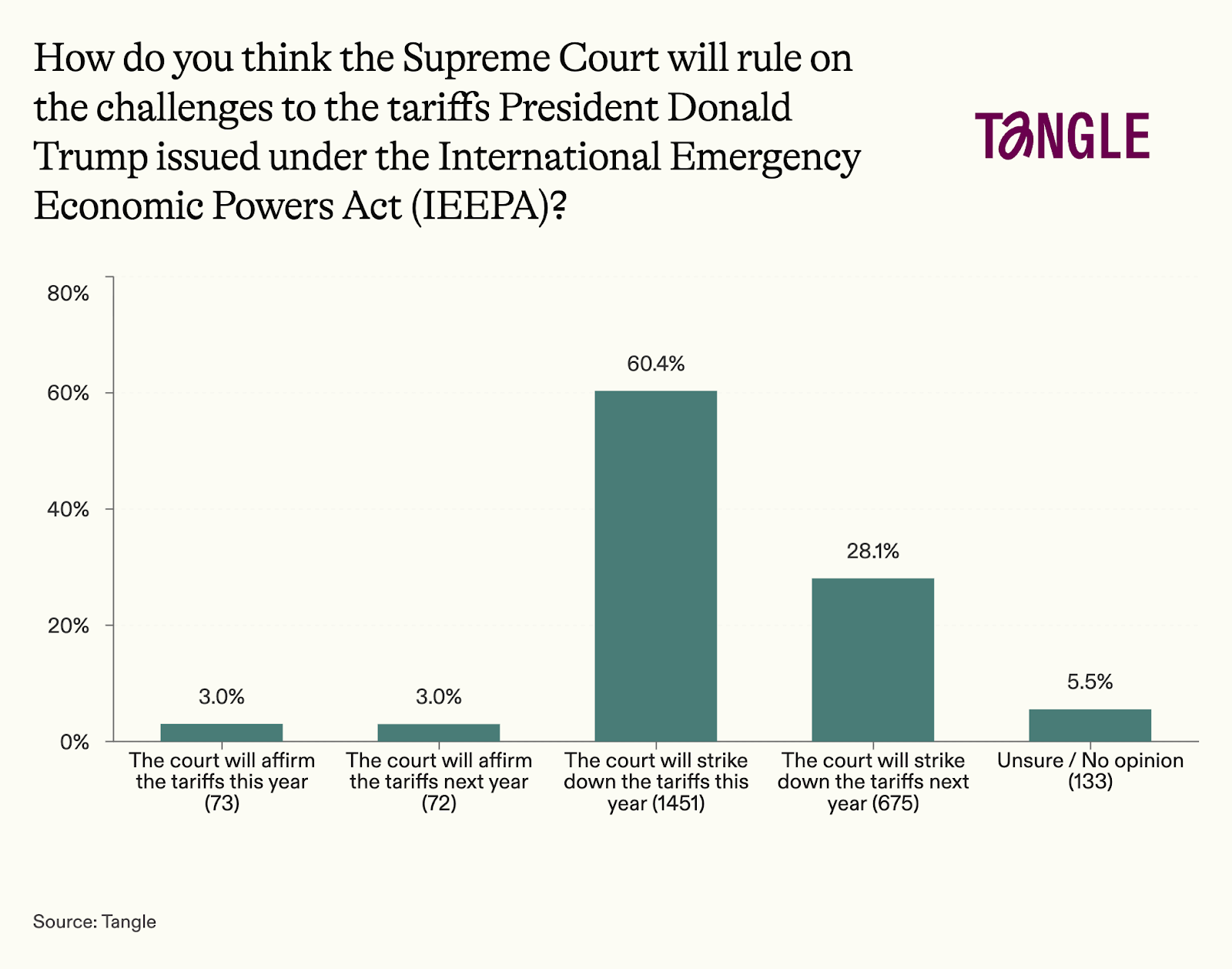
- Thursday’s survey: 2,404 readers responded to our survey on the Supreme Court challenge to Donald Trump’s use of tariffs under emergency powers with 60% saying the court will strike the tariffs down within the year. “There was never any emergency but I don’t know how long the court will take to say so,” one respondent said. “There is a national emergency. Are tariffs the answer or were they legal? Who knows,” said another.
Have a nice day.
In 1693, Prince Rupert of the Rhine became the first to propose the idea that a cube can pass through another, identical cube with room to spare. Over the last decade, mathematicians have pondered another question: Are there any convex polyhedrons, a group that includes 3D-solids like cubes and tetrahedrons, that don’t have this quality? In August, friends Jakob Steininger and Sergey Yurkevich created one. Complete with 90 vertices and 152 faces, the “Noperthedron” — which combines “Nope” with “Rupert” — disproved the conjecture that all convex polyhedrons hold the Rupert property. Steininger called the Noperthedron’s success, which turns on a delicate feature of its vertices, a “miracle.” Quanta Magazine has the story.

Member comments