
I’m Isaac Saul, and this is Tangle: an independent, nonpartisan, subscriber-supported politics newsletter that summarizes the best arguments from across the political spectrum on the news of the day — then “my take.”
Are you new here? Get free emails to your inbox daily. Would you rather listen? You can find our podcast here.
Today’s read: 15 minutes.
The return of decency.
“According to polling from Pew, 79% of Americans would characterize our political discourse negatively — and 90% say they feel exhausted by politics,” Tangle Executive Editor Isaac Saul wrote on Friday. “A survey from Gallup supports this view; 69% of Republicans and 60% of Democrats say inflammatory rhetoric has gone too far, up 16% and 9%, respectively, since 2011. And I think — I hope — what happens next is that Americans develop a thirst for the novelty of decency.” Check out Isaac’s piece, where he makes the case that decency is about to make a comeback. You can read it here.
Quick hits.
- The U.S. military rescued the second of two crew members of a fighter jet shot down over Iran on Friday (the first was rescued hours after the incident). The airman reportedly hid in the mountains near the crash site for two days while Iranian forces searched for him. The operation involved hundreds of U.S. aircraft and personnel, with Israel providing intelligence support. (The rescue) Separately, Iran’s Islamic Revolutionary Guard Corps announced that the group’s chief of intelligence, Majid Khademi, was killed in an Israeli airstrike. (The strike)
- The Bureau of Labor Statistics reported that payrolls rose by 178,000 in March after declining by 133,000 in February. The unemployment rate decreased slightly to 4.3%. (The numbers)
- The White House asked Congress to approve $1.5 trillion for defense for fiscal year 2027, a roughly 40% increase over the current year’s budget. The request was part of the Trump administration’s new budget, which also calls for $73 billion in spending cuts across domestic agencies. (The budget)
- The Board of Peace, led by President Donald Trump, has reportedly issued a demand to Hamas to finalize an agreement to demilitarize the Gaza Strip by the end of this week. Board members are expected to meet with Hamas officials on Tuesday in Egypt for negotiations. (The demand)
- In an unsigned order, the Supreme Court vacated an appeals court ruling upholding pro-Trump activist Steve Bannon’s conviction for contempt of Congress for defying a subpoena from the House committee investigating the January 6 Capitol riots. The Court sent the case back to the lower courts, and the Justice Department has moved to dismiss the charges. (The order)
12 Dumbest Things Americans Waste Money On
You’re clearly smart about your finances, whether it’s scouring the clearance racks for a deal, limiting your restaurant visits, or opting for the most affordable streaming services available.
While your discipline is impressive and puts you ahead of the curve, many people still find themselves treading water despite their best efforts.
To help you plug those leaks, we’ve pinpointed the 12 Dumbest Things Americans Waste Money On that could be sabotaging your financial goals.
Once you discover these common pitfalls and learn how to sidestep them, you’ll likely find a surprising amount of extra cash in your pocket every single month.
Today’s topic.
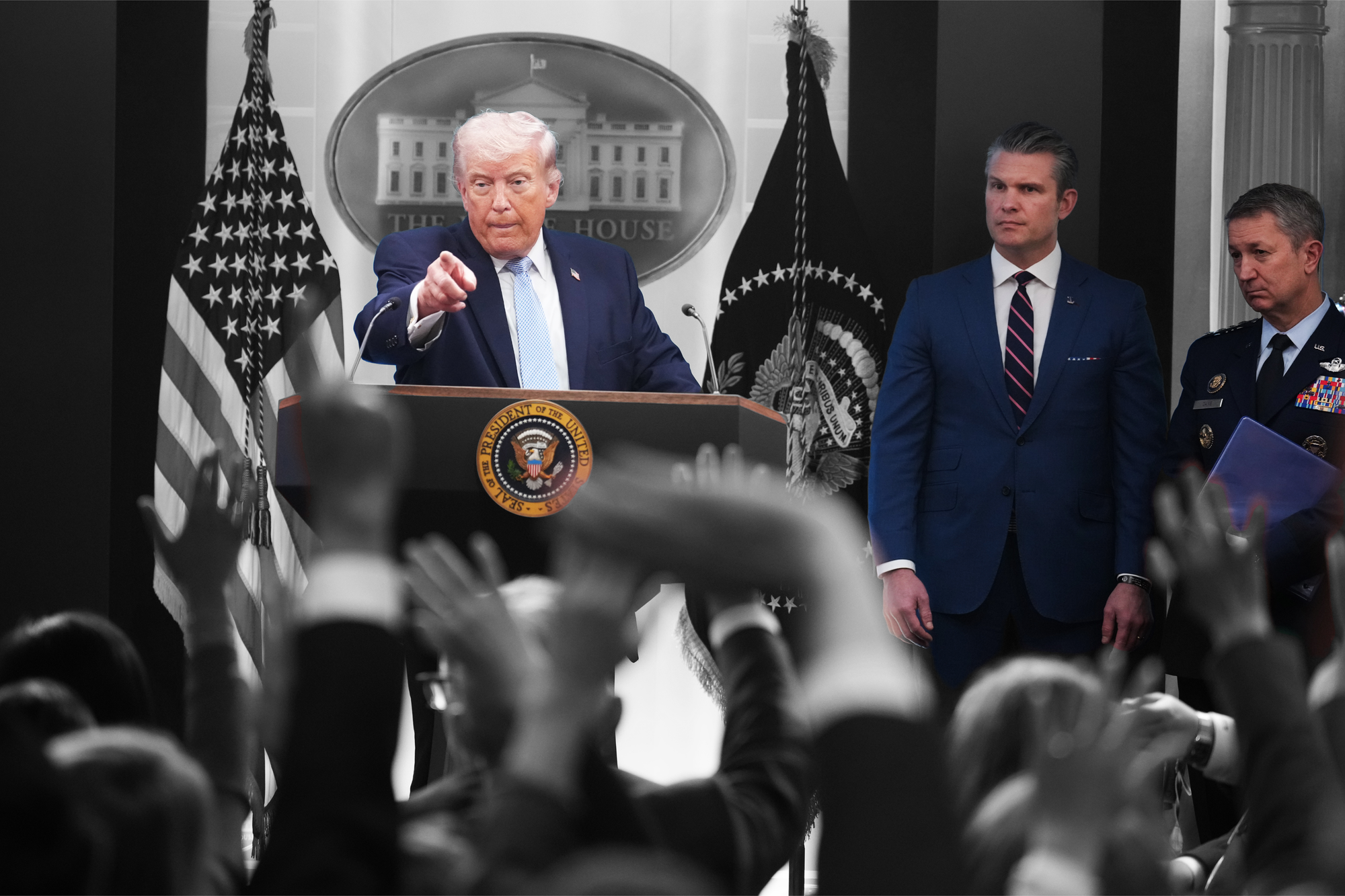
Trump’s Strait of Hormuz deadline. In a post on Truth Social Sunday morning, President Donald Trump appeared to set a deadline of 8:00 PM ET on Tuesday, April 7, for Iran to reopen the Strait of Hormuz to commercial traffic. In a preceding post, the president suggested that he will authorize strikes on civilian energy and transportation infrastructure if the demand is not met, writing, “Tuesday will be Power Plant Day, and Bridge Day, all wrapped up in one, in Iran. There will be nothing like it!!! Open the Fuckin’ Strait, you crazy bastards, or you’ll be living in Hell - JUST WATCH! Praise be to Allah.” In a Wall Street Journal interview later on Sunday, Trump said Iran would “lose every power plant and every other plant they have in the whole country” if they block the strait beyond Tuesday.
Back up: Amid its war with the U.S. and Israel, Iran has disrupted shipping through the Strait of Hormuz, the narrow waterway connecting the Persian Gulf to the Indian Ocean, destabilizing global energy markets. In late March, President Trump issued a 10-day deadline to Iran to reopen the strait, which expired on Monday. The Trump administration is also reportedly considering ground operations to attempt to take control of the waterway.
Iran has so far rejected Trump’s demands. On Monday, an Iranian military spokesman said the country would respond “more crushingly and extensively” if the U.S. attacks civilian infrastructure. Also on Monday, a foreign ministry spokesperson said the country was in talks with Oman on “a procedure for the safe passage of vessels through the Strait of Hormuz.”
The U.S. and Iran reviewed a ceasefire proposal over the weekend that would pause the conflict for 45 days. However, Iran rejected the plan on Monday, offering a counterproposal for a permanent end to the conflict, removal of sanctions, and compensation for damages from U.S. attacks. In a news conference that evening, President Trump reiterated his demand for Iran to reach a deal on the strait by Tuesday at 8:00 PM ET.
The president’s threat to strike Iranian civilian infrastructure drew criticism from U.S. lawmakers. Sen. Chris Murphy (D-CT) said “blowing up bridges and power plants” would be “mass war crimes” and called on Republican leaders to stop the president from carrying out such strikes. In his Wall Street Journal interview, Trump said that the Iranian people are “living in hell” and want the U.S. to strike civilian infrastructure to undermine the government. In a separate interview with ABC News, he said if the U.S. doesn’t reach a deal with Iran, “we’re blowing up the whole country.”
Today, we’ll cover President Trump’s ultimatum on the Strait of Hormuz, with views from the right and left, followed by Executive Editor Isaac Saul’s take.
What the right is saying.
- The right is mixed in its response to Trump’s threats, with some saying he should continue his aggressive posture.
- Others say striking civilian infrastructure would be a strategic and moral error.
- Still others suggest the U.S. can’t afford to end the war with the Strait of Hormuz closed.
In The New York Post, Paul du Quenoy argued “Trump must indeed blast Iran’s regime back to the Stone Ages.”
“Looking for a negotiated off-ramp is undoubtedly tempting for Trump. As the midterm elections loom in November, the latest polls show that two-thirds of Americans ‘strongly’ or ‘somewhat’ disapprove of his war with Iran… When Trump suggests hostilities will end soon, as he did early last week, US stocks rally and oil prices drop. When he sounds more belligerent, as he did later in the week, markets jitter while oil rises,” du Quenoy wrote. “[Trump] must bear constantly in mind that these phenomena are temporary and that the real danger — for him, our country, and the world — is to let the mullahs and their murderous regime go on.”
“With total air superiority, adequate naval deployments, and, possibly, the occupation of strategic land positions, Hormuz can be opened just as President Reagan did in the 1980s, including with the international help some allies are now offering,” du Quenoy said. “In the seven months to go before the midterms, his ‘excursion’ in Iran could soon become a matter for the history books instead of a majority-losing issue at the ballot box. But for that to happen, the mullahs must be destroyed.”
In The Free Press, Eli Lake wrote “Mr. President, don’t bomb Iran’s civilian infrastructure.”
“If Donald Trump makes good on his latest threats, a just war could lose its moral standing… Some might argue that this is just the art of the deal. Trump is bluffing to keep Iran’s Islamic Revolutionary Guard Corps guessing as to what he might do next. And I certainly hope that he is. But threatening a war crime is no way to gain leverage over the hard men who now call the shots in Tehran,” Lake said. “A strategic victory in the war would be a color revolution that ended the threat posed by Iran’s revolutionary regime for good. So one must ask how destroying power plants that provide electricity for both the regime and the people advances that goal.”
“The answer is: It doesn’t. It punishes the very people whom Trump at first said he was hoping to liberate. This is why Iranian opposition figures outside the country are counseling the president to reconsider,” Lake wrote. “Trump’s threats are a gift to the enemy. While it’s certainly true that losing power stations will make it harder on the regime to project power, the price that America and Israel will incur in global public opinion will advance the regime’s strategy of painting itself as the victim of Western aggression.”
In The Washington Times, Bradley Martin and Liram Koblentz-Stenzler said “Trump should not end the war with Strait of Hormuz unresolved.”
“Iranian officials are not offering a compromise. They are setting conditions: removing American forces from the region, lifting sanctions, preserving their missile program and expanding control over the Strait of Hormuz. Those demands would shift the balance of power in Iran’s favor,” Martin and Koblentz-Stenzler wrote. “We have seen this logic before. After Iraq invaded Kuwait in 1990, Osama bin Laden offered to defend Saudi Arabia — on the condition that the kingdom reject American troops. The point wasn’t only security. It was also to push out the U.S. and replace it with a different kind of order.”
“If U.S. policy is seen as responsive primarily to economic pressure, then Iran may conclude that escalation can force political concessions. That conclusion won’t stay confined to this conflict. If Iran comes out of this war with its leverage intact, then governments in Saudi Arabia and the UAE will have to reconsider how much they can rely on Washington alone,” Martin and Koblentz-Stenzler said. “That also creates room for other world players. Russia, already aligned with Iran, would have more space to expand its role. Turkey, which stayed out of the fighting, could emerge from it in a stronger position.”
What the left is saying.
- The left opposes Trump’s threat to bomb civilian targets, saying it would be both immoral and ineffective.
- Some argue such acts would clearly constitute war crimes.
- Others say the situation in the Strait of Hormuz has only emboldened Iran.
In Bloomberg, Marc Champion suggested “escalation would make Trump’s epic Iran mistake worse.”
“When a US president resorts to public expletives and the threat of war crimes to get his way in war, it takes a heroic effort to discern a strategy amid the disgrace. But to the extent Donald Trump is executing a plan, it is a version of the ‘escalate to de-escalate’ doctrine attributed to Russian nuclear planners,” Champion wrote. “This tactic very rarely works, either in the real world or war-gaming exercises… because de-escalating under duress requires both trust, or at least a belief in the credibility of the threats being made, and a willingness to endure public capitulation.”
“Nothing we know about the regime in charge of the Islamic Republic of Iran suggests it would prove an exception to this rule. On the contrary, Trump’s threats to bomb Iran back into the stone age by an ever-shifting deadline are merely confirming Tehran’s long-standing belief that US cannot be trusted in general,” Champion said. “Every new day brings the risk of new unwanted consequences. And in this case, the victims include not just the protagonists themselves but the entire world economy. Without a clear and viable path to military success, it would be unforgivable to invite those risks by the scale of escalation Trump has proposed for Tuesday evening.”
In Just Security, Margaret Donovan and Rachel VanLandingham wrote about “when war crimes rhetoric becomes battlefield reality.”
“‘Tuesday will be Power Plant Day, and Bridge Day, all wrapped up in one, in Iran. There will be nothing like it!!!’ posted President Donald Trump on Easter Sunday… Such rhetorical statements — if followed through — would amount to the most serious war crimes — and thus the president’s statements place servicemembers in a profoundly challenging situation,” Donovan and VanLandingham said. “Iranian power plants and other critical civilian infrastructure are protected from attacks by the law of war the United States helped craft after World War II. Such an object can lose its protection only if it is used for military purposes by the enemy and its destruction ‘offers a definite military advantage.’”
“[These strikes would] pose a significant risk of moral and psychic injury for servicemembers. National soul-searching regarding how Americans fight followed the long U.S. wars in Afghanistan and Iraq, in which both civilian casualties and detainee abuse undermined strategic objectives and weighed heavily on soldiers’ consciences long after the fighting stopped,” Donovan and VanLandingham wrote. “The public record of intent to commit war crimes puts soldiers at risk of later liability. In any future war crimes or U.C.M.J. investigation — for which there may be no statute of limitations — their actions will be judged based on the reasonably available information at the time of the strikes.”
In The New York Times, Robert A. Pape said “the war is turning Iran into a major world power.”
“Many analysts believe that Iran’s grip on the Strait of Hormuz is only temporary. A widespread expectation is that U.S. and allied naval forces will soon stabilize the situation and that oil flows will resume along familiar lines,” Pape wrote. “That expectation is flawed. It assumes that to continue to control the strait, Iran must physically close it off. But as we have already seen, you can control the strait without closing it. Today, the strait remains open to tankers. Traffic has dropped by over 90 percent since the war began, though, not because Iran has been sinking every vessel that entered the strait but because, given the credible threat of an attack, insurers withdrew or repriced war-risk coverage.”
“The problem for the United States is one of asymmetry. Protecting each and every oil shipment that passes through the Strait of Hormuz against potential attacks — mines, drones, missile strikes — is a full-time operation. It requires continuous military presence. Iran needs only to hit an oil tanker once in a while to cast doubt on the reliability of the world’s oil shipments,” Pape said. “If uncertainty persists, the Gulf arrangement will inevitably change, giving way to a different regional order — one in which the Gulf states increasingly accommodate the actor that can most directly influence the reliability of their exports. That actor is now Iran.”
My take.
Reminder: “My take” is a section where we give ourselves space to share a personal opinion. If you have feedback, criticism or compliments, don't unsubscribe. Write in by replying to this email, or leave a comment.
- Trump seems to have backed himself into a corner, and I worry for what comes next in Iran.
- His rhetoric has gotten noticeably more unhinged this past week.
- Polling doesn’t seem to matter, the president is surrounded by sycophants, and the recent developments are extremely concerning.
Executive Editor Isaac Saul: In retrospect, I think how we got here is pretty easy to explain.
Trump came into the operation in Iran under the belief that it would be swift, dominant, and easy. In his mind’s eye, he saw another Venezuela — which he made clear in a statement before the initial wave of strikes and repeated afterward.
But it wasn’t Venezuela.
Rather than roll over or run into hiding, the new Iranian leaders have fought violently and mercilessly. They’ve attacked their Arab neighbors with force that we didn’t expect; they’ve strangled a global shipping route with an equally unexpected vigor; they’ve lobbed missile after missile at U.S. bases and Israel; and despite early claims that this capacity would be quickly “obliterated,” those missiles are still being launched six weeks later.
The president gave the regime until March 23, and then Monday, and now until Tuesday night to do as they are told or their entire country will be obliterated. Who knows what will happen tonight? Less than two weeks after the initial strikes, Trump declared we “won the war.” By mid-March he was asking NATO for help to open the Strait of Hormuz. By late March he was threatening war crimes against Iran if it didn’t open the strait. By the end of March he was touting progress toward a deal. This morning, he warned a “whole civilization will die tonight,” assuming Iran refuses to acquiesce. Trump has repeatedly drawn red lines and then balked, only to announce some phantom breakthrough in negotiations. He has also drawn red lines and stuck to them, with the full force of the U.S. military raining down on its targets.
Now, though, the president has backed himself into a corner, and how he will react is unclear. This part is important: In the past, Trump has navigated politics like a blunt-force tool. He is a hammer and everything else, every opponent and obstacle and rule, is a nail. But most of his actions up until this point can be, or have been, undone by opposition or courts or even himself reversing course or sending out a Truth Social post: A tariff is on, then it’s off, and that’s it. An executive order is signed, and then struck down by a court, and it’s over.
War is not like that. Trump wants it to be like that; he wants to be able to abandon the Strait of Hormuz and leave it to the Europeans to figure out. He wants to install a new supreme leader and have everything resolved. He wants to dictate terms on social media and get everything he wants. But he can’t.
Remember, the administration (eventually) communicated that our goals in Iran were to destroy their armed forces, missile capabilities, factories, and (later still) nuclear capabilities. I support these objectives. Indeed, I agree with the Trump administration that Iran should never be allowed a nuclear bomb and is deserving of its international label as a prolific sponsor of terrorism. Iran’s leadership, theocratic radicals hellbent on global dominion, are dangerous and unreliable. My agreement with Trump’s goals makes my disapproval of his methods even stronger. If we end the war now, without fulfilling our objectives and with Iranian leverage over the global economy fully intact, it will be framed as a victory for Iran and will bring long-term economic pain to us. This quagmire is of the Trump administration’s own making.
And when the president’s furious posts on social media don’t yield the results he wants, they become more frequent and more furious. I’m genuinely afraid of what might come next, as the president seems not just irate but alarmed. He seems scared. As I said last week, in Trump’s second term, the times I’ve gotten him wrong were because I did not expect him to do some bad thing he ended up doing; I don’t want to fall into that trap again. Yet now I find myself thinking, “there’s no way he will actually bomb a power plant where hundreds of Iranians are forming a human shield, will he?” Will he?
Here, the president must recognize the oil price shocks, the disruption to the global economy, and the consequences of an unfavorable outcome — not just for a temporary dip in the markets, but for the next three years of his term.
And these are just the big, overarching narratives that are easy to spot. What about the ships stranded in the Persian Gulf with no water or food or help? What about the long-range missiles we have been launching that are now in frighteningly low supply? What about the panicking energy experts and the now-broken petrodollar? What about Iran continuing to execute political dissidents while we focus on the war? What about the impact on the largest war in Europe since World War II?
These kinds of questions deserve straight answers, but good luck getting them from this White House. Punchbowl News — the D.C.-focused, insider politics newsletter — is often criticized for being too inside D.C., to the point that their reporting is overly soft to maintain their connections. Here is how they described the president on Monday: “Tracking and understanding Trump right now is very difficult, especially on the Iran war. It’s like trying to nail Jell-O to a wall. He’s all over the place on every issue — domestic policy, international affairs and Iran specifically — presenting Republicans with a political mess.”
The tone is notable, but I’d say this undersells it in typical fashion.
I’d say the president appears unwell. I feel the same way I did after the 2024 presidential debate, when my long-held fears that President Biden was not fit to serve were confirmed. Trump looks to me like he’s truly unraveling. He does not seem fit for the job.
Even by Trump’s norm-breaking, oh my God did he just say that standards, his social media posts over the weekend were jaw-dropping. I thought maybe the president had been hacked, not because he dropped an f-bomb but because he posted without his now-signature “Thank you for your attention to this matter” sign off, opting instead for “praise be to Allah.” But he wasn’t hacked. He really was using Easter morning to call Iranians “crazy bastards,” warn of impending attacks on civilian infrastructure, and mock Islam to top it all off.
People like me are being misdiagnosed with Trump Derangement Syndrome because the president is acting deranged and we’re willing to say so — a very weird circular firing squad of derangement accusations. And some of Trump’s most ardent supporters are noticing, too. Tucker Carlson suggested the thrill, for Trump, was in the killing, the ultimate kind of power. Across social media, I’m seeing a proliferation of Trump-friendly commentators announcing their disappointment, fear, or outright shame in what Trump 2.0 has wrought. MAGA still stands with Trump, of course, and they may for some time. But Trump voter regret is starting to register in polling, too, and among political independents he is now underwater — polling worse than he ever has.
Trump is committing political suicide. The real question is: Does he care? This part, too, is important: I don’t think he does. Historically, Trump has been reactive to the polls, a quality of his I’ve treasured. But there is no next election for him, and his team doesn’t seem to care about the ramifications for the Republican Party. He already passed the One Big Beautiful Bill Act, a massive tax cut and regulatory rollback. The border is quiet. He’s locked in for roughly three more years. He and his family are getting exorbitantly rich. He’s the center of the universe, again, as he flexes absolute military power across the globe.
So no, I do not think he will be disturbed by any potential midterm losses, and I’m unsure he’s even aware of how bad the polling is or whether it would matter if he knew; it’s the markets, his personal relationships, and his own perception of his legacy that matter to him. From what I can tell, the cost of surrounding himself with sycophants is really coming due now, so much so that his own chief of staff worries Trump’s advisers are giving him a rose-tinted view on the Iran war. This means he won’t genuinely fear for his legacy or understand the polling; he will only hear how great his leadership is and how much MAGA is loving it.
So now we are here: A president who, a few weeks ago, was promising to liberate the Iranian people is now threatening war crimes against them. The “stop wasting money on the Middle East wars” White House is now seeking to raise its historic $1 trillion 2026 Pentagon budget to $1.5 trillion for 2027, all while talking about rebuilding Iran. Meanwhile, Trump is saying the federal government can’t pay for Medicare, Medicaid and day care because “we’re fighting wars,” while gas is up to a national average of $4.11 per gallon — with no end in sight.
Pointing all this out does not mean you are anti-American or rooting for Iran or hate the president; it’s an honest assessment of the state of the country, the folly of war, and the dangers that lie ahead.
Take the survey: Do you think Trump should enforce his deadline by bombing Iranian infrastructure? Let us know.
Disagree? That's okay. Our opinion is just one of many. Write in and let us know why, and we'll consider publishing your feedback.
Your questions, answered.
Q: What are the details of the results of The Daily Wire and The Federalist’s lawsuit against the federal government this week? It seems like the outcome was positive for free speech?
— Anonymous from Texas
Tangle: As a quick recap, in December 2023, Texas Attorney General Ken Paxton (R) sued the U.S. Department of State under President Joe Biden for conspiring to censor, deplatform, and demonetize American media outlets disfavored by the federal government. Texas was joined on the suit by The Daily Wire and The Federalist, who claimed that the government entity Global Engagement Center (GEC) funded tools that suppressed free speech by targeting conservative media outlets.
The State Department, which oversees the GEC, settled with the plaintiffs this past week. As part of the settlement, the government officially prohibited the State Department from supporting any censorship of Americans, decreed that it will monitor the State Department’s conduct for 10 years, and appointed The Daily Wire and The Federalist as compliance monitors for that time.
On one hand, the settlement delivered a win for free speech by issuing a firm legal rebuke of the conduct of the GEC, which played a role in the infamous government pressuring of social media companies that led to the Twitter files. On the other hand, the State Department didn’t need a lawsuit to close the GEC — the program had already been defunded amid public scrutiny under Biden, and Secretary of State Marco Rubio announced it would be dismantled in April 2025.
Lastly, the stipulation that two specific media outlets can monitor the activity of the State Department is unusual. That allowance may create enforceability across different administrations, but it may also be an overcorrection that creates biases among the department in favor of conservative outlets.
Want to have a question answered in the newsletter? You can reply to this email (it goes straight to our inbox) or fill out this form.
You're Careful With Money — So Why Does It Still Disappear?
You hunt for deals, skip restaurants, pick the cheapest streaming options.
Yet somehow the math doesn't add up. We identified 12 common money drains that catch even disciplined spenders — and once you spot them, you'll likely find extra cash every month.
Numbers.
- 38. The approximate number of days that the Strait of Hormuz has been effectively closed to most commercial shipping.
- 15. The number of ships that passed through the strait over a 24-hour period over the weekend, according to Iran’s Fars News Agency.
- 138. The historic average number of daily transits through the strait prior to the Iran war.
- $4.14. The national average price of a gallon of regular gasoline in the United States as of April 7, according to AAA.
- $3.41. The national average price of a gallon of regular gasoline in the United States one month ago.
The extras.
- One year ago today we wrote about the global response to Trump’s tariffs.
- The most clicked link in our most recent newsletter was again the University of Minnesota’s scientific survey of the Tangle audience. That survey is officially closed — thank you to all who have taken it!
- Nothing to do with politics: A recent study could confirm a strange, 75-year-old astronomical sighting.
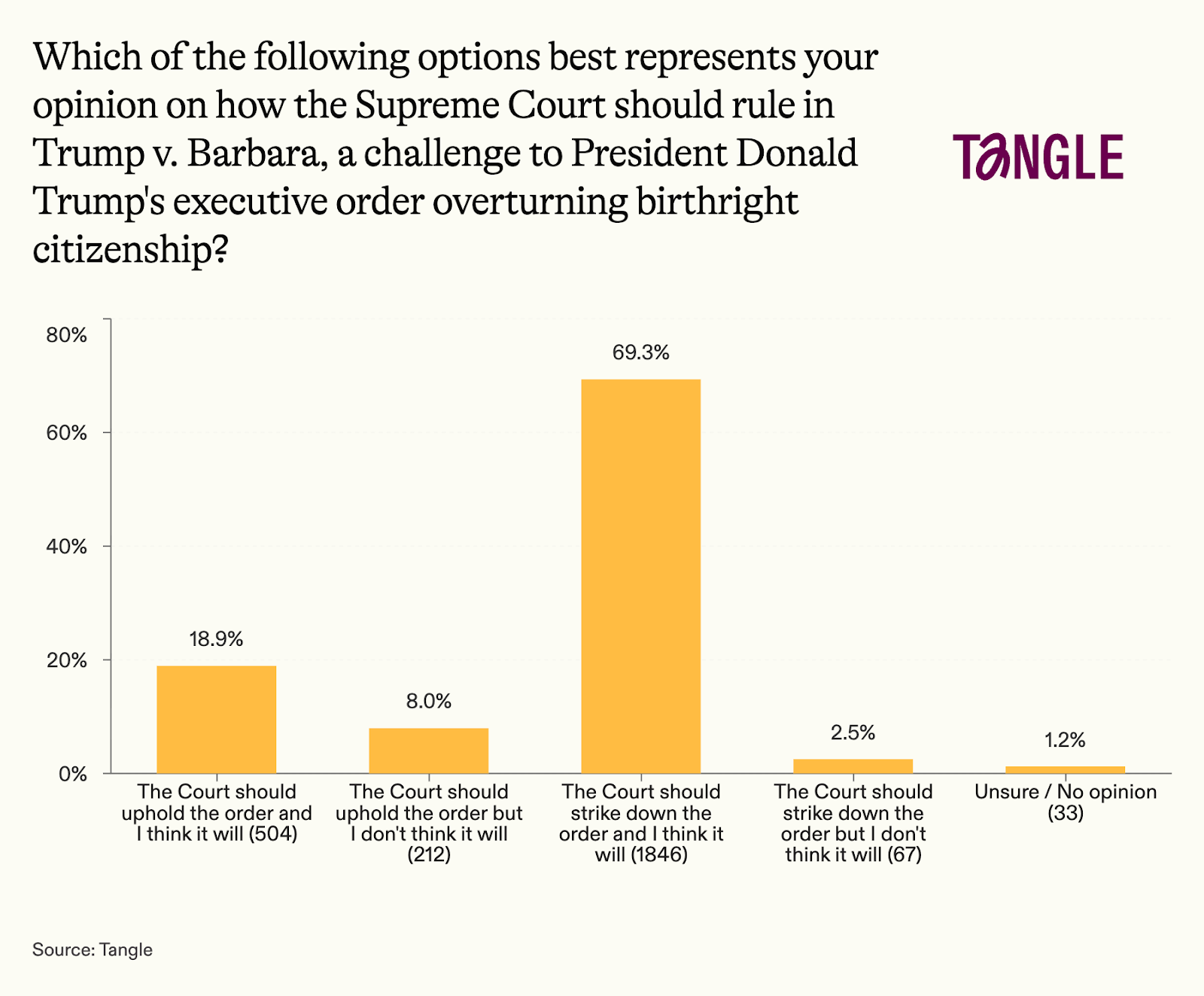
- Our last survey: 2,662 readers responded to our survey on the Supreme Court case considering Trump’s executive order ending birthright citizenship with 69% saying the Court should and probably will strike down the order. “If the Constitution does not prohibit birthright citizenship for illegal aliens, then it needs to be amended to clearly prohibit it,” one respondent said. “I can see the court striking down the Executive Order but accepting a carve-out for parents in the country on a short-term tourist visa,” said another.
Have a nice day.
In 2020, Carroll Taylor Wiseman died of cancer at age 46, leaving behind her husband, Reid Wiseman, and their two children. Right now, Reid is in space, along with three other astronauts on the Artemis II mission that passed around the moon on Monday. During their voyage, the crew named some of the moon’s craters they could see from the ship, including one particularly bright spot. In an emotional broadcast back to Earth, astronaut Jeremy Hansen announced the crew had named it “Carroll.” The BBC has the story and the video.

Member comments