
I’m Isaac Saul, and this is Tangle: an independent, nonpartisan, subscriber-supported politics newsletter that summarizes the best arguments from across the political spectrum on the news of the day — then “my take.”
Are you new here? Get free emails to your inbox daily. Would you rather listen? You can find our podcast here.
Today’s read: 15 minutes.
The Reality of Modern Digital Life
Your morning routine probably looks familiar: check email over coffee, scroll news during commute, shop online at lunch, stream shows after work. What you might not realize is how much personal data you're broadcasting with each click.
Every website visit, purchase, and search creates a digital footprint that companies eagerly collect and sell.
This isn't paranoia, it's Tuesday.
Surfshark One offers a practical solution: VPN protection, antivirus, ad blocking, and identity monitoring bundled for $2.69 monthly. That's 86% off their standard rate, plus three bonus months.
Consider it digital insurance for your family's online life—because privacy shouldn't be a luxury in 2025.
*This is a sponsored post.
Our latest video.
Last week, we published our most ambitious video project yet: A documentary look into the life of a member of Congress, Representative Jake Auchincloss (D-MA). This Friday, we’re going to publish a reader mailbag answering your questions about our experience spending three days with a member of Congress and offering a behind-the-scenes look at how the piece came together. So if you want to learn more, please write in or fill out this form so we can answer your questions in the newsletter!
Quick hits.
- President Donald Trump and Ukrainian President Volodymyr Zelensky met at the White House to discuss a potential deal to end the war in Ukraine. President Trump also pushed for a trilateral meeting with Zelensky and Russian President Vladimir Putin. (The meeting)
- Hamas agreed to a Qatari- and Egyptian-proposed ceasefire agreement that reportedly includes a 60-day pause in fighting, Hamas’s release of 10 live hostages and 18 deceased hostages, and Israel’s release of Palestinian prisoners. Israel has not indicated whether they will accept the deal. (The deal)
- President Trump said he would sign an executive order ending the use of mail-in ballots and voting machines ahead of the 2026 midterm elections. If issued, the order is likely to draw legal challenges from states. (The proposal)
- House Oversight Committee Chairman James Comer (R-KY) said the Justice Department will begin sharing documents from its investigation of convicted sex offender Jeffrey Epstein in compliance with a subpoena issued by the committee. (The documents)
- Newsmax agreed to pay $67 million to settle a defamation lawsuit brought by Dominion Voting Systems over the cable news channel’s claims that Dominion helped rig the 2020 U.S. presidential election. (The settlement)
Today’s topic.
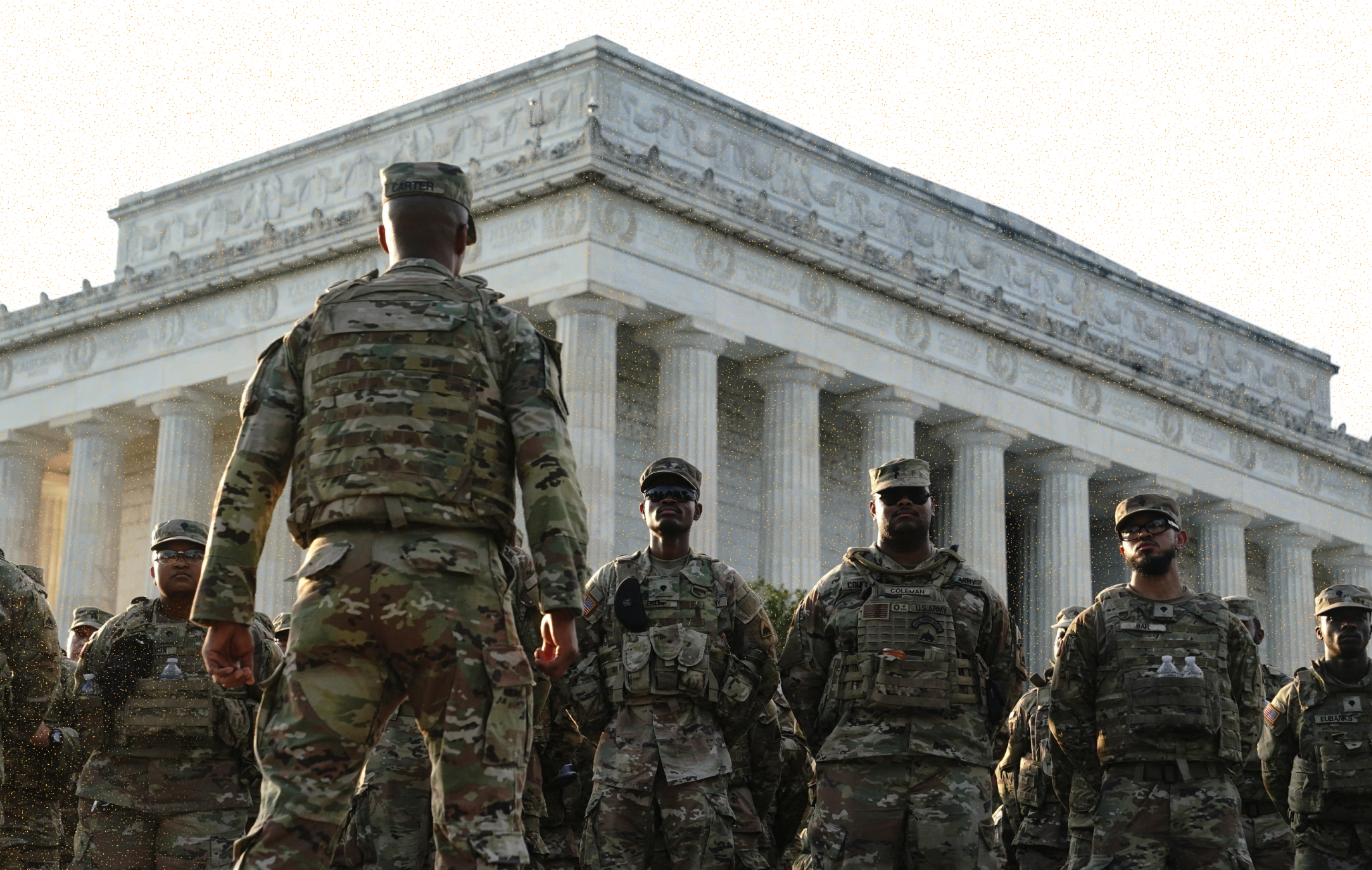
Trump’s D.C. security takeover. On August 11, President Donald Trump issued a memorandum mobilizing the District of Columbia National Guard to Washington, D.C. and an executive order placing the city’s police department under federal control. Approximately 800 D.C. National Guard troops were deployed to the city after the announcements. The president said he intended to restore public safety in the capital because the local government had “lost control” of crime. Trump also suggested that he would consider similar actions in other U.S. cities.
Back up: In 2024, Washington, D.C.’s murder rate was roughly 25 per 100,000 residents; while the rate of violent crime has fallen in recent years, the capital is routinely among the U.S.'s most violent cities. According to data collected by the Metropolitan Police Department (MPD), violent crime in the capital in 2024 was down 35% from the year prior, reaching its lowest level in 30 years. However, the veracity of this data has come under scrutiny, as the department suspended Commander Michael Pulliam in July while it investigates allegations that he manipulated crime statistics in his district. Data from the Federal Bureau of Investigation, which tabulates crime data differently than the MPD, showed a 9% drop in violent crime in D.C. in 2024.
President Trump invoked Section 740 of D.C.'s Home Rule Act to put the city’s police department under federal control. Under this section of the law, the president may order the D.C. mayor to provide “such services of the Metropolitan Police force as the President may deem necessary and appropriate” when the president determines that an emergency requires such action. This control can last for up to 30 days with congressional notice. In his memorandum, Trump cited recent public safety incidents, including the murder of two Israeli embassy staffers in May and the attack on a Department of Government Efficiency staffer earlier this month, as grounds for the emergency declaration.
District of Columbia Mayor Muriel Bowser criticized Trump’s declarations and deployments, writing on X, “American soldiers and airmen policing American citizens on American soil is #UnAmerican.” Though she acknowledged that Trump has the authority to federalize the police, Mayor Bowser also questioned the legality of Trump’s use of the National Guard. Separately, the police force takeover has prompted large protests across the capital.
Since the National Guard’s deployment, the White House says that roughly 240 people have been arrested and over 70 homeless encampments have been destroyed. The Guard itself is not making arrests but instead providing support for local law enforcement and conducting patrols. This week, National Guard troops from Mississippi, Ohio, South Carolina, and West Virginia were deployed to the capital at the request of the federal government and may begin carrying weapons during patrols.
On Friday, the Trump administration and Washington, D.C. reached an agreement over control of the local police force after the city sued to stop the federal takeover. The agreement permits the federal government to retain control of the MPD but blocks Drug Enforcement Administration Administrator Terry Cole from acting as emergency head of the police force, as the administration initially attempted to do. Under the terms, Cole must work through Mayor Bowser’s office before directing the MPD, but Bowser is required to adhere to his requests. MPD Chief Pamela Smith will also remain chief of the department.
Today, we’ll break down the latest in the federal takeover of Washington, D.C.’s policing, with views from the right and left. Then, my take.
What the right is saying.
- The right mostly supports the federal takeover, suggesting disorder in the capital has been rampant for years.
- Some say that Trump is well within his power to exercise this authority.
- Others note the toll that crime in D.C. has taken on the community.
In The Spectator, Ben Domenech argued “Trump is right to take over DC.”
“Ever since the violent summer of George Floyd, Washington has struggled to achieve the same return to normalcy that has been the case in other major cities. A major driver is the lack of sufficient police staffing, with the Metro Police Department running almost a thousand officers short of needed levels. Carjackings and vehicle theft are three times the national average, and the homicide rate is six times that of New York City,” Domenech wrote. “The poor response times and lack of an ability to disburse gang activity is taken for granted by residents, with restaurant closures and other venues seeing less foot traffic because of the crime concerns.”
“The overall result of Trump’s move in media terms will be to make national figures finally pay attention to how bad things are in DC, if only to deny they justify his actions — but they’ll also be set to use any criminal activity that does happen going forward to argue that the administration methods are ineffective,” Domenech said. “But this is a sideshow: the real question is how DC’s citizens feel about what comes next, and whether it makes DC feel safe again. As a local who hasn’t been willing to risk taking my children into the city late in the day, I can hope that changes soon.”
In National Review, Charles C. W. Cooke said “D.C.’s Home Rule is a luxury, not a right.”
“Per the plain terms of the U.S. Constitution, Congress has plenary power over ‘the Seat of Government of the United States,’ which is not a city, or a state, or even a reservation, but a special district like no other in the land,” Cooke wrote. “If the national legislature wishes to, it can delegate some of its power to a council or a mayor or an emissary in a pointy hat. But it is not obliged to do so… In D.C., home rule is a luxury, a privilege, an indulgence.”
“I would prefer that Washington, D.C., be transmuted into a genuine federal district, with the vast majority of the city’s area handed back to Maryland, Virginia, or any other state that is willing to take it. Until such time as that is achieved, however, it is entirely reasonable for the United States Congress — and, to the extent that he has been empowered by law, the United States president — to exercise control over land that is the undisputed preserve of the United States,” Cooke wrote. “If, as seems plainly to be the case, the region’s experiment in political devolution has been a failure, it is not only right but necessary that the rightful ministry be restored.”
In The Atlantic, Charles Fain Lehman wrote “Trump is right that D.C. has a serious crime problem.”
“Is crime in D.C., as Trump put it last week, ‘totally out of control’? Critics were quick to dismiss his claims as fearmongering,” Lehman said. “The reality is more complicated than either the president or the mayor depict. Bowser is right that violence has declined. But the nation’s capital really does have a long-standing and profound violence problem that will not improve without deliberate intervention… Although violent-crime rates overall are near 30-year lows, Washington’s murder rate was generally rising even before the pandemic. The murder rate at the end of 2024 was… lower than 2023, but still about 70 percent higher than that of a decade prior.”
“This violence takes a dreadful toll on the communities it affects. In 2023, the most recent year for which complete data are available, 3.4 out of every 1,000 Black boys and men ages 15 to 24 in Washington died by homicide. That’s nearly 3.5 times higher than the national rate,” Lehman wrote. “A federal takeover of D.C.’s crime apparatus could, in theory, address this problem, though it’s far from guaranteed. There’s a real risk that the feds could posture for 30 days — the window in which Trump will likely maintain control of the MPD — and then declare victory as violence continues its downward trajectory. That would, of course, do little to fix the real problems.”
What the left is saying.
- The left is strongly opposed to Trump’s actions, saying he is more interested in control than addressing crime.
- Some suggest Trump is making it more difficult for D.C. to improve public safety.
- Others say D.C. has a real crime problem but question Trump’s approach.
In The Atlantic, Jonathan Chait argued “Trump doesn’t really care about crime.”
“Trump claims that he is acting to quell a spike in violent crime. And although he might very well feel sincere concern about crime, this does not explain his actions any more than concern about fentanyl smuggling (which he no doubt also genuinely opposes) motivates his trade restrictions against Canada,” Chait said. “The most obvious reason for skepticism about Trump’s desire to fight crime is that he is the most pro-criminal president in American history. He has treated laws as suggestions throughout his career, beginning with his defiance of Justice Department orders that he and his father stop discriminating against Black prospective tenants.”
“Serious policy experts, some of them conservative, have proposed solutions to bring down crime levels in Washington. The most straightforward remedy is to fill vacancies in the city’s courts to speed up the processing of criminal cases. At Trump’s press conference, the Fox News host turned (God help us) U.S. Attorney Jeanine Pirro denounced the District of Columbia’s laws restricting sentencing for juvenile offenders,” Chait wrote. “Trump’s plan bears little resemblance to any of these remedies. His big idea is to flood the streets with troops.”
In The Hill, Svante Myrick said “Trump unleashes troops on cities already making progress on crime.”
“I was a mayor for 10 years. All mayors deal with crime, and we have learned a lot about what works to make cities safer for everyone. That’s why so many cities, including Washington, D.C., are safer today than they were 10, 20, or 30 years ago,” Myrick wrote. “I believe Trump taking control of D.C.’s police department and calling out the National Guard, based on false claims about crime, is both an attempt to distract voters from bad news about the extraordinary harm he is unleashing on the American people and an effort to further test the limits of his own power.”
“Trump made it clear in Los Angeles that he will deploy National Guard troops over the objections of state and local officials. He has explicitly threatened to expand his tactics in D.C. to other cities where he has far less constitutional legitimacy to intervene,” Myrick said. “The president would like to distract us from bad economic news on jobs and the price of groceries. And, certainly, the president would rather that we not pay much attention to the astonishing levels of shady dealing that have made Trump and his family billions of dollars richer. Trump abusing his power to shift the narrative is an aspect of his authoritarian rule. It’s not going to make the residents of D.C. or any other city safer.”
The Washington Post editorial board wrote about “how Trump’s D.C. crime experiment ends.”
“President Donald Trump likes a foil, and few serve his political needs quite like D.C.’s government. By federalizing the local police force this week, he allowed himself to pose as a man of action — and then dare his opponents to claim that crime in the capital is not a problem. Yet his law-and-order message so far has translated into little more than security theater, and it cannot go on forever,” the board said. “The president says he wants to maintain indefinite control, but the Home Rule Act gives him only 30 days. After that, he is required to get an extension from Congress.”
“Trump is not known for his interest in policy minutiae, whether the question is over taxes or street crime. Whatever his motivation for picking this fight now, Republicans on Capitol Hill would do the city a service by developing a credible plan for how federal intervention might help D.C. accomplish what police could not on their own,” the board wrote. “Politically, Trump’s opening gambit has paid off. And he should be on defensible legal ground at least for three more weeks, even though this question has never been litigated. But if he cannot show results — and instead pivots to another stunt — this will become a political albatross.”
My take.
Reminder: “My take” is a section where I give myself space to share my own personal opinion. If you have feedback, criticism or compliments, don't unsubscribe. Write in by replying to this email, or leave a comment.
- Trump deploying the military to a major U.S. city was one of the “warning signs” of creeping authoritarianism I mentioned in March.
- I’m also worried that, in downplaying D.C.’s very real crime problem, Democrats are going to lose the messaging battle to Trump.
- We’ll be in a very bad place if the president can decide to use the military as a police force as he sees fit.
This one worries me.
Back in March, I answered a reader question from someone wondering whether they were witnessing real threats to American democracy under Trump or seeing ghosts. They asked: “What would a political candidate that could undermine American democracy or its protection of citizens to bring America its own Tiananmen Square, or Holocaust, or some other, fresh horror, look like? Would there be warning signs?”
I answered by saying that I’d look for five things: 1) The DOJ or FBI attempting to prosecute or imprison prominent Democratic leaders, especially those potentially running for office in 2028. 2) Using the military, especially with excessive force, against peaceful protesters. 3) The eroding or ending of free and fair elections. 4) Democrats completely submitting to Trump and failing to provide meaningful political opposition. 5) Genuinely restricting free speech.
While the effectiveness of their resistance has been a mixed bag, Democrats seem far from folding, and in fact appear to be fighting Trump more enthusiastically now than a few months ago. However, everything else I listed has been moving steadily forward: The DOJ and FBI are threatening to prosecute Barack Obama, Joe Biden, and others. Trump is promising to encroach on how states conduct elections while also escalating the gerrymandering arms race to its furthest extremes yet. I noted back in March that speech restrictions were already happening. And, a couple months after using the National Guard against protesters in Los Angeles, the president is now deploying the military to police the streets of Washington, D.C.
I set these five warning signs just weeks into the Trump administration after trying to think of the least overreactive, most direct ways to measure authoritarian actions from any president. It’s not Trump Derangement Syndrome to observe that Trump has been checking some of these boxes over the past five months — it’s just reality.
If Trump were standing up to say “this is a unique problem calling for a unique solution, and we’ve allowed crime in D.C. to worsen for far too long,” that would be one thing. After all, D.C. crime is actually quite bad (more on that in a second) and the federal government is uniquely positioned to police the city legally. Instead, Trump is making it crystal clear that D.C. is a trial run for other cities. The president possibly deploying the military to any city he personally deems deserving of the government’s strong hand should worry everyone.
I find it particularly alarming that Democrats are failing to supply a resonant message against Trump’s actions, which makes me think he may actually win public support for this power grab. Hakeem Jeffries, for example, responded to Trump’s move by saying, “The crime scene in D.C. most damaging to everyday Americans is at 1600 Pennsylvania Ave.,” before parroting the line that “violent crime in Washington is at a 30-year low” and telling Trump to “get lost.”
It’s a nice zinger. And it’s true that the overall reported violent crime rate is at a 30-year low.
However, it’s also true that D.C. remains one of the national leaders in violent crime. Journalists all over the city have stories of their own personal experiences; indeed, just a few weeks ago, a member of the Tangle staff was jumped and beaten up there. It’s anecdotal, but I don’t hear these stories as much from other cities — meanwhile, the hard and objective data in D.C. is not that reliable. Crime data is based on violations like assaults and armed robberies that are notoriously underreported, especially in cities where people don’t think the police are going to do anything. Worse yet, Washington, D.C.’s police department is literally in the middle of an internal investigation into whether the city has been systematically altering their crime numbers; a D.C. police commander just got suspended amid the investigation.
Despite the caveats, the reported statistics we do have are still alarming. Much more reliably reported homicides are not close to 30-year lows; the murder rate has ticked down in the last few years, but only after rising steadily since 2012 — and it’s still very high, at around 25 homicides per 100,000 residents. D.C.’s murder rate is now 70% higher than it was a decade ago, and nearly seven times New York City’s.
Locals, 65% of whom say crime is a very or extremely serious problem in the city, are also probably picking up on increases in public disorder. Visible homelessness and sanitation-enforcement requests to the city’s 311 line have spiked in the last two years, according to a Manhattan Institute report from Charles Fain Lehman (who penned an opinion piece featured under today’s “What the right is saying”). Even before the surge, D.C. had one of the largest homeless populations in the United States.
Which is all just to say: Crime is a serious problem in Washington, D.C., that “30-year-low” talking point is misleading and possibly based on outright falsified data, and the crime in the district has been bad for decades. And, yes, Democratic leaders in the city have failed to make meaningful strides to address it (or actively neglected the issue, like by letting the city’s crime lab lose accreditation for three full years).
I regularly take a look at reader emails and the Tangle comments, so I’ve noticed that anytime I align myself with one of of Trump’s diagnoses of an issue (like his view that crime is bad enough for intervention in Washington, D.C.) while criticizing his solution (like deploying U.S. soldiers into a major U.S. city), I seem to frustrate a lot of left-leaning readers. And I admit that, in turn, these responses frustrate me. In most cases, I much prefer a politician who tries to address a real problem with a bad idea over a politician who looks me in the eyes and tells me the problem doesn’t exist. Even more aggravating are politicians who acknowledge a problem but demand I accept the status quo or claim that it isn’t that bad, as many Democrats did with Biden’s border crisis.
In this case, Trump’s solution — deploying the American military to a major U.S. city — is so extreme to me that it matters a lot less whether he is right about crime in D.C. than it does how he is responding. My concern, today, is almost an inversion of my normal response: Because he is right about the underlying problem, and because many Democrats and left-leaning journalists are denying it exists or failing to offer their own solutions, it’s going to be easy for Trump to win the messaging war over a very dangerous plan.
If Trump, Republicans and Democrats like Jeffries actually wanted to help, there is plenty they could do. Congress has unique authority over D.C. (which is why Trump can deploy National Guard troops there legally). Again, as reporter and D.C. resident Josh Barro pointed out, Congress could address all the judicial vacancies in D.C. that lead to fewer prosecutions and fewer criminals being held accountable. Democrats could demand Republicans appropriate enough money to the city’s budget to hire more actual police, not soldiers, to hit the streets. Republicans could also properly fund the National Parks Service, which is responsible for many of the small parks across D.C. that are degrading without proper resources — that degradation ties directly into public drug use, vagrancy, and other issues D.C. residents see every day.
We don’t need unmarked cars full of anonymous government agents refusing to identify themselves and snatching people up off the streets. We don’t need soldiers patrolling some of D.C.’s safest neighborhoods by foot. And we don’t need a president who thinks the military is a police force he can deploy domestically wherever and whenever he wants. We do need to retain our sensitivity to something that, a few years ago, may have been unimaginable.
Trump’s deployment of the National Guard and seizing control of the local police department need to be rejected, not because D.C. is a safe and secure place with historically low crime rates, but because the president is obviously testing the boundaries of what the public will accept — not just in D.C., but in cities across the country. The government using the military as a police force isn’t a warning sign of authoritarianism; it is the thing itself. It’s a red flag when it happens in other countries, it’s illegal in the U.S., and unless you want to open the door to soldiers marching down the streets of your own city one day, you should reject the military deployment to D.C. We must not only reject it, but demand a better solution — not just from Trump, but from local D.C. officials and Democrats, too.
Take the survey: What do you think of Trump’s National Guard deployment? Let us know!
Disagree? That's okay. My opinion is just one of many. Write in and let us know why, and we'll consider publishing your feedback.
Your questions, answered.
We are skipping the reader question to provide more space to our coverage of today’s main story. The reader questions will return shortly; we have a lot of ground to cover since our return from break.
Want to have a question answered in the newsletter? You can reply to this email (it goes straight to our inbox) or fill out this form.
Under the radar.
Over the weekend, law enforcement arrested a woman from Indiana and charged her with making online death threats against President Donald Trump. U.S. Attorney Jeanine Pirro’s office said that Nathalie Rose Jones posted on social media on August 6, “I literally told FBI in five states today that I am willing to sacrificially kill this POTUS by disemboweling him and cutting out his trachea.” Then, on Friday, Jones told the Secret Service that she had access to a “bladed object” and that “if she had the opportunity, she would take the President’s life and would kill him at ‘the compound.’” Jones was charged with one count of threatening death or bodily harm upon the president and one count of transmitting threats of violence using interstate commerce; she faces up to five years in prison on each charge if convicted. The Washington Post has the story.
Why do 1.5M+ professionals start their day with The Hustle?
Because it's the only business newsletter that makes you smarter without boring you to death. Get growth-focused insights, tech trends, and innovation stories delivered in 5 engaging minutes—no fluff, no negativity, just actionable intel.
Numbers.
- 10. Prior to 2020, the number of times that the D.C. National Guard, its predecessor (the D.C. Militia) or federal armed forces were placed on federal active duty in the capital, according to a Congressional Research Service report.
- 1814. The year the D.C. Militia was activated to fight in the War of 1812, the first such mobilization in the militia’s history.
- 1857. The year that Marines were deployed to Washington, D.C. to restore peace in response to gang violence affecting the city’s municipal election.
- 150. The approximate number of National Guard troops from Ohio mobilized to join the D.C. National Guard in the capital this week.
- 200. The approximate number of National Guard troops from Mississippi mobilized to the capital.
- 200. The approximate number of National Guard troops from South Carolina mobilized to the capital.
- 300–400. The approximate number of National Guard troops from West Virginia mobilized to the capital.
- 22. The number of multi-agency teams involved in President Trump’s federal takeover of the capital, according to Fox News.
- 1,800. The approximate number of personnel deployed across D.C.’s seven police districts.
The extras.
- One year ago today we covered Kamala Harris’s proposal to ban price gouging.
- The most clicked link in yesterday’s newsletter was our YouTube video showing a day in the life of a U.S. member of Congress.
- Nothing to do with politics: With places like Mykonos and St. Barts attracting influencers, here are the new destinations rich people are surging to.
- Yesterday’s survey: 2,560 readers responded to our survey on possible ends to the Ukraine–Russia War with 50% saying Ukraine is likely to cede land with security guarantees. “I think if there is a ‘peace’ that it will only be a matter of time before Russia breaks that peace. With, or without some ‘provocation’ (real, false flag, or imagined),” one respondent said.

Have a nice day.
For years, doctors viewed cardiac amyloidosis — a disease that impairs the heart’s ability to pump blood — as rare and difficult to treat. Over the past year, however, a series of newly approved medications has made long-term health increasingly attainable for those living with the disease; recently published drug trials show new treatments can reduce cardiac deaths by up to 35% compared to placebo. Following treatment, one patient — 75-year-old James Hicks — is back to his exercise regimen of lifting weights and e-biking 100 miles a week. “I don’t feel 75 years old anymore; I feel much younger,” Hicks said. The New York Times has the story.
Don’t forget...
🎥 Follow us on Instagram here or subscribe to our YouTube channel here.
🛍 Love clothes, stickers and mugs? Go to our merch store!

Member comments