

I'm Isaac Saul, and this is Tangle: an independent, nonpartisan, subscriber-supported politics newsletter that summarizes the best arguments from across the political spectrum on the news of the day — then “my take.”
Are you new here? Get free emails to your inbox daily. Would you rather listen? You can find our podcast here.
Today’s read: 13 minutes.
Asking ChatGPT to be me.
In the last week, the artificial intelligence mania has hit a new peak. Tomorrow, I’m going to write about why I’m still skeptical about the displacement AI might bring — and share some experiments I’ve been conducting to see how well ChatGPT can mimic my own writing. It’s going to be a fun members-only edition.
Quick hits.
- The United States military has continued to build up forces near Iran. Trump and national security officials reportedly met in the White House Situation Room on Wednesday to discuss the recent developments. Reports indicate a strike could come as soon as this weekend, though Trump has yet to make a final decision. (The build-up)
- Police in the U.K. arrested Andrew Mountbatten-Windsor, formerly known as Prince Andrew, in relation to his mentions in the Jeffrey Epstein files. Mountbatten-Windsor is being investigated for allegedly sharing confidential information with Epstein while serving as a British trade envoy. (The arrest)
- President Trump will name National Institutes of Health Director Jay Bhattacharya to serve as acting director of the Centers for Disease Control and Prevention until he nominates a permanent replacement. (The appointment)
- Washington, D.C. Mayor Muriel Bowser declared a local public emergency after more than 240 million gallons of wastewater spilled into the Potomac River due to a pipe collapse. Officials say the spill poses a risk to public health and the environment but will not affect drinking water. (The spill)
- Eight skiers were found dead and one more is still missing after an avalanche occurred in the backcountry near Lake Tahoe, California. Six other skiers were found and rescued. (The avalanche)
Browse Like It's Y2K
Remember when "pop-ups" meant toys, not annoying ads?
Back when the only thing tracking you was your neighbor's nosy cat?
Today's internet is loud, cluttered, and secretly collecting your data. CleanWeb from Surfshark is the digital bouncer you never knew you needed.
It blocks ads, trackers, and malware. Just one install, and boom — pages load faster, creepy banners disappear, and your browsing feels like the internet used to: clean, simple, and yours.
Tangle readers can get it now for just $1.99/month (87% off), plus enjoy 3 extra months free.
*This is a sponsored post.
Today’s topic.
The January jobs report. Last Wednesday, the Bureau of Labor Statistics (BLS) reported that nonfarm payroll employment increased by 130,000 in January, its strongest monthly growth in over a year, while the unemployment rate fell from 4.4% to 4.3%. The healthcare sector accounted for most of the growth with 82,000 new jobs, but declining employment in state and federal governments, finance, and the information sector offset some of those gains. The release was delayed five days due to the partial government shutdown, which ended on February 3.
Back up: The BLS is the agency within the Labor Department responsible for measuring market activity, working conditions, price changes, and productivity in the U.S. economy. Every month, the bureau compiles an employment report from a monthly survey of about 631,000 worksites selected to represent all U.S. employers. The initial numbers released by the BLS are based on partial data for the first portion of a month, and then revised as data from more worksites and the rest of the month become available. The BLS consistently revised jobs reports downward after their publication throughout 2025, resulting in a net negative revision of 1,029,000 nonfarm jobs over the course of the year. After a lower-than-expected jobs report in July and another significant revision in August, President Donald Trump fired then-BLS Commissioner Erika McEntarfer. Weeks later, Trump nominated Heritage Foundation economist E.J. Antoni to replace McEntarfer, then withdrew his nomination in September. William Wiatrowski is currently serving as acting BLS commissioner.
In its annual “benchmark” revision that accompanies each January jobs report, the BLS revised the March 2025 seasonally adjusted employment level down by 898,000, similar to economists’ expectations. Overall, the BLS reported that 181,000 jobs were added in 2025 compared to its estimated 584,000, the lowest growth since 2020.
The 130,000 jobs added in January were more than double economists’ expectations of 55,000, according to a Dow Jones survey. Many economists said the latest employment numbers signal a stabilizing job market and decrease the likelihood of the Federal Reserve cutting interest rates at its March meeting.
“It does look like the labor market is beginning to heal from the trauma we saw it go through last year,” Diane Swonk, chief economist for KPMG, said. Heather Long, chief economist at Navy Federal Credit Union, called the improved numbers “a January job surge,” adding that “this is still a largely frozen job market, but it is stabilizing. That’s an encouraging sign to start the year, especially after the hiring recession in 2025.”
Trump administration officials celebrated the latest jobs numbers and repeated calls for the Federal Reserve to lower interest rates. “GREAT JOBS NUMBERS, FAR GREATER THAN EXPECTED!” President Donald Trump posted on Truth Social following the release, adding that “The United States of America should be paying MUCH LESS on its Borrowings (BONDS!).”
Today, we’ll explore reactions from the left and right to the latest employment numbers, followed by Managing Editor Ari Weitzman’s take.
What the left is saying.
- The left says the jobs report isn’t as strong as it seems.
- Some point out that gains mostly came from a specific sector, while other parts of the economy didn’t show much growth.
- Others believe this creates conflicting pressures for Federal Reserve monetary policy.
In MS NOW, Philip Bump said “old people” are “the story of the Trump economy.”
“Data released last week shows that the country has added about 359,000 jobs since January 2025, the month Donald Trump returned to the White House. That’s close to the average number of jobs added per month during Joe Biden’s presidency,” Bump wrote. “Trump has celebrated the fact that this change in employment has come at the expense of government workers. Looking only at private-sector jobs, more than 600,000 jobs were added.”
“You would be forgiven for assuming — based on Trump’s rhetoric — that those increases came in things such as manufacturing… All of the growth, instead, was in the service sector. The biggest growth — anomalous growth, really — was in ‘private education and health services,’” Bump said. “So what’s going on? Well, one central factor here is that Americans keep getting older. The baby boom extended from 1946 to 1964. In 2011, the oldest boomers began hitting age 65. The density of elderly people in the population began to skyrocket, pushing demand for health care aides and (lagging a bit) nursing home and retirement care.”
In CounterPunch, Dean Baker offered “further thoughts on the January jobs report.”
“Many folks have lost their bearings in looking at the January jobs number. It was much better than expected (my monthly prediction to my wife, just before the report, was 40k), so in that sense it was good, but we created an average of 103,000 jobs a month in 2024 and 188,000 in 2023,” Baker wrote. “The January figure was hardly something to brag about, which of course the Trump administration did.”
“The category ‘healthcare and social assistance’ accounted for 123,500 of the job growth, 95 percent of the total. If we add in the 27,800 jobs in restaurants, we’re up to 151,300 jobs. That means on net, everything else lost jobs,” Baker said. “There is nothing in principle wrong with jobs in health care and social assistance, but this is a very narrow base for the economy. It certainly is not the manufacturing renaissance Donald Trump has promised.”
In Bloomberg, Jonathan Levin said “Kevin Warsh’s Fed job already looks impossible.”
“The latest Bureau of Labor Statistics report showed that the unemployment rate slipped to 4.3% in January, from a prior 4.4%, as US payrolls expanded at twice the rate that economists had been expecting. While that’s great news for workers, it will make life a lot more challenging for Kevin Warsh, President Donald Trump’s pick to become the next chair of the Federal Reserve,” Levin wrote. “Trump wants his nominee to slash interest rates, but Warsh’s Fed colleagues are likely to balk if the labor market continues to hold up this well.”
“Prior to Wednesday, concerns about the labor market had offered the clearest path to easier monetary policy, and an ebbing in those risks could foreclose on the possibility of additional cuts in 2026,” Levin said. “Labor market resilience is never a bad thing for the American people. But Trump has been banging the drum for rate cuts since the start of his presidency. No sooner had he announced Warsh’s nomination than he was cracking jokes about suing him if he doesn’t cut rates. On Wednesday, he celebrated the positive jobs numbers in a post on Truth Social, and yet confusingly seemed to imply that they provided justification for lower rates (which is either ignorant or willfully deceptive).”
What the right is saying.
- The right said Trump should get more credit for overseeing a strong economy.
- Some celebrated the job market as expanding.
- Others said the Fed should be cautious not to overheat the market.
In USA Today, Tim Swarens asked “why doesn’t Trump get more credit” for the economy.
“In April 2025, as U.S. stock markets were melting down in reaction to Donald Trump’s so-called Liberation Day edicts, the president’s top adviser on tariffs, Peter Navarro, proclaimed that not only would markets rebound but that the Dow Jones Industrial Average also would soar past 50,000 points. Listening to Navarro at the time, I resisted the urge to roll my eyes like a 12-year-old,” Swarens said. “It turns out I was (happily) wrong and Navarro was right, much to the relief of the 62% of American adults who own stocks… Other data released in recent days also reflect the overall strength of the U.S. economy. Analysts painted the job market as stable after the Bureau of Labor Statistics reported Feb. 11 that employers added 130,000 jobs in January and the unemployment rate dropped to 4.3%.”
“So, why don’t more Americans feel bullish about the economy? And why doesn’t Trump get more credit for the almost-impossible-to-stick soft landing that the U.S. economy is gliding toward as recession fears wane and inflation is tamed? Trump himself is a big part of the problem,” Swarens wrote. “But, as with nearly every other facet of American life these days, the partisan divide also is at work on opinions about the economy… Hold on to all the bad vibes you want about Trump. He may well deserve them. But let’s not mislead people into thinking the economy is awful when it’s actually quite strong.”
In RealClearMarkets, U.S. senior counselor for trade and manufacturing Peter Navarro told “the real story in January’s jobs data.”
“We are not watching a debt-financed government hiring binge. We are watching a private-sector expansion paired with a right-sizing of Washington. Federal employment has fallen to its lowest level since 2014—and to one of the lowest shares of total nonfarm employment on record,” Navarro said. “That is not austerity. That is productivity—Washington shrinking while Main Street produces, and resources shifting from administrative overhead into competitive markets where innovation, capital investment, and efficiency drive real output growth.”
“With this release, the Bureau of Labor Statistics published its annual benchmark revision. Payroll employment between March 2024 and March 2025 was revised down by 898,000 jobs, the largest downward revision since 2009,” Navarro wrote. “The labor market many analysts celebrated was materially weaker than advertised… This point is not partisan. It is empirical. When benchmark revisions wipe out nearly a million jobs in a single annual adjustment, the baseline changes. Measured honestly, the economy is expanding from a weaker starting point—but expanding nonetheless.”
In Financial Times, Michael R. Strain argued “everything you thought about the labor market is wrong.”
“Markets, economists and Federal Reserve officials seem to believe that the US labour market spent most of last year weakening, that inflation is trending back to the Fed’s inflation target and that the central bank will continue cutting interest rates in 2026. On each of these three points, the conventional view is probably wrong,” Strain said. “The holes in the consensus narrative were clear before last week’s jobs report, which surprised many analysts on the upside.”
“To be sure, the conventional view of the job market has some empirical support. The rate at which employers are hiring workers is lower than it has been since 2013. Still, the risk of inflation accelerating this year is greater than the risk of a spike in the unemployment rate,” Strain wrote. “It would be a mistake for the Fed to cut rates again in 2026. Though the Fed thinks it has its foot on the economy’s brake pedal, it is actually hitting the gas.”
My take.
Reminder: “My take” is a section where we give ourselves space to share a personal opinion. If you have feedback, criticism or compliments, don't unsubscribe. Write in by replying to this email, or leave a comment.
- The latest jobs data gives us clearer insight into why past reports have been missing the mark.
- Erika McEntarfer and Jerome Powell haven’t been perfect, but their records don’t support dismissal.
- Negative polarization is infecting our discourse, which is a shame because the economy is actually doing pretty well.
Managing Editor Ari Weitzman: Now that the 2025 revisions are out, we have a pretty clear picture of the drivers behind the past few years of inaccurate jobs reports.
First, declining survey responses. Fewer businesses are filling out BLS surveys in time for monthly jobs reports, which means the BLS’s initial estimates rely less on empirical payroll reports and more on their models. When more complete data eventually comes in through the Quarterly Census of Employment and Wages — which is based on unemployment insurance records and is far more comprehensive — it often tells a much different story.
Second, the statistical method — called the birth-death model — the BLS uses to estimate new business creation and businesses closing. For three years up until former Commissioner of Labor Statistics Erika McEntarfer’s firing, the model had been routinely overestimating job creation, accounting for the bulk of the BLS’s reporting errors. And because of the underreporting problem, the BLS relied on its faulty predictive model more, making those errors even larger. The BLS knew about these problems and had begun fixing the model during McEntarfer’s tenure, and her successor — acting Commissioner William Wiatrowski — has continued that work.
Coming into the second Trump administration, we expected a bit of melodrama out of the federal government. Donald Trump likes to lead by splashy fiat and bombastic pronouncements, and he came out of the gate swinging — budget cuts, tariffs, and Justice Department investigations were on the political menu for most of the year.
Of all the departments in the federal government, perhaps the positions least likely to provide the settings for musical-chair melodramas have delivered them: the Federal Reserve and the Bureau of Labor Statistics. Fed Chair Jerome Powell, whose term as chair ends in May (though he’ll remain on the board of governors), has been under constant fire, while former Commissioner Erika McEntarfer has already gotten the dreaded past-tense honorific prefixed to her title.
As we’ve said the last few times we’ve covered the BLS, the jobs reports had missed the mark for a while before McEntarfer’s firing last year. We’ve also said that they didn’t seem to justify the decision to fire her, especially when a side effect of that decision is degrading confidence in the institution that provides much of the data economists and business leaders rely on.
To be blunt, the BLS absolutely had an issue with its reporting, and it took an inexcusably long time to fix it. Those routine mistakes led to increased public scrutiny and decreased trust in the institution’s monthly numbers. I’ve read a good deal of apologia for its anemic pace of adjustment — business creation being slow is a sign of a coming recession, revisions are part of a normal process, and revisions have actually been improving when you zoom out far enough. Well, in the last few years, the BLS had been repeatedly and predictably failing, so its model needed to be updated — even people in the private sector knew it, and they expected the jobs data to be wrong. That consistent incorrectness can lead to persistently false beliefs, like that rumored recession we’ve been waiting for since Biden was in office.
As president, Trump would have been right to point those issues out; he could have focused scrutiny on the BLS model, set hard deadlines for improvements, or done anything that showed he’d taken the time to understand the issue to communicate it properly to the public. Instead, this was Trump’s response: “I was just informed that our Country’s ‘Jobs Numbers’ are being produced by a Biden Appointee, Dr. Erika McEntarfer, the Commissioner of Labor Statistics, who faked the Jobs Numbers before the Election to try and boost Kamala’s [Harris’] chances of Victory… She will be replaced with someone much more competent and qualified.”
Trump not so subtly implied the BLS commissioner position was political, even after Biden had his appointee stay on for years (as Trump had done with Obama’s). He smeared McEntarfer’s ample qualifications, then tried to replace her with a sycophantic stooge. He accused McEntarfer of concocting fake numbers to help Democrats, even though the last report before the election made Biden and Harris look bad. And he pinned the whole issue on McEntarfer, even though she inherited the problem and oversaw the beginning of its solution. Trump’s response did more to inject partisanship into and foment distrust of the BLS than it did to fix the problem, and — if we’re honest — it made him appear to have a very unsophisticated understanding of the economic reporting system he oversees.
That’s especially frustrating, because it produces a subtle negative polarization effect whereby people who don’t like the president’s assault on his economic advisers are influenced toward interpreting the economy as worse than it is. Some pundits almost seem eager to discount the good news and root for economic failure. But actually, the economy is doing pretty well! The jobs data was solid, even if we do expect another, much smaller revision to this month’s numbers. Unemployment is low, GDP growth is up, and the U.S. economy has avoided most — though not all — of the worst effects economists feared would result from Trump’s tariffs, making me wonder if that shoe will ever drop. Wages are ticking up and, as Pam Bondi was so keen to tell us last week (during an Epstein hearing), the stock market has been incredibly robust.
It’s not all rosy, though; job growth is pretty flat, consumer confidence lives on the floor, and inflation is still over the Fed’s target of 2%. And even though jobs increased in January, a lot of that growth was concentrated in healthcare and social services; other key sectors, like manufacturing and hospitality, are essentially flat. In response, the Fed will probably hold rates steady next month, a proper decision that would reflect the mostly good judgment we’ve come to expect from its chairman — judgment for which the president wishes to fire him.
I mentioned how negative polarization affects pundits above; it affects nobody more than the president of the United States. Can we just say how much that sucks? The economy is mostly good (and I hope it gets healthier) and the BLS needed reform, but it just drags our entire discourse down when the president goes after the people who bring him news he doesn’t like while anyone in his administration getting criticized by his “enemies” gets a pass.
I’m optimistic about the jobs data, I’m optimistic that BLS reports will improve, and I’m even optimistic that the bottom won’t drop out of the economy anytime soon. But to be totally honest, what stands out to me most clearly when I examine this issue is that I’m incredibly pessimistic about the style of President Trump’s leadership — the pall he’s cast on something as simple as economic reporting is going to infect these conversations for the remainder of his term.
Take the survey: What do you think of the current state of the economy? Let us know.
Disagree? That's okay. Our opinion is just one of many. Write in and let us know why, and we'll consider publishing your feedback.
Your questions, answered.
Q: Yesterday’s quick hits mentioned “A man was arrested after allegedly running toward the U.S. Capitol with a loaded shotgun.” Given that the shotgun falls under the 2nd Amendment and running is not illegal, may I assume there is more to the story, or more context, and ask what it is?
— Richard from Warsaw, IN
Tangle: We don’t know a lot of information about this arrest yet, but from what Capitol Police have told us, the suspect — 18-year-old Carter Camacho of Smyrna, GA — was arrested for unlawful activities, carrying a rifle without a license, having an unregistered firearm, and having unregistered ammunition. This is speculation, but it seems that Camacho’s running towards the Capitol with a weapon provided police with reasonable suspicion to detain him, at which point they found he had been carrying a shotgun and ammunition without a license. They also found a gas mask and helmet inside the vehicle.
You’re right, running and carrying a weapon are both legal activities. However, carrying a weapon on the National Mall is not legal. Even licensed gun owners are prohibited from bringing guns into public areas in the capital district. But let’s say that wasn’t the case — even if Camacho had been running with a shotgun down a public street, you can probably easily see how combining those two legal activities would create the appearance of threatening behavior. I’m legally allowed to hold a knife, wear a mask, and scream as loudly as I can — if I do that at an Arby’s, though, I’m giving authorities reasonable suspicion to detain me.
There’s a difference between overtly breaking the law and providing reasonable suspicion to be detained and questioned, which is known as a “Terry stop.” That term comes from the 1968 Supreme Court case Terry v. Ohio, in which the Court held that police can briefly detain someone based on “reasonable suspicion” — a lower bar than probable cause for arrest. Reasonable suspicion can be built from a totality of circumstances, meaning individually innocent behaviors can be aggregated to justify a stop. Then, after performing a Terry stop, if police find evidence that a suspect is breaking law — in Camacho’s case, carrying a firearm without a license — they can arrest that person under suspicion of a crime.
Want to have a question answered in the newsletter? You can reply to this email (it goes straight to our inbox) or fill out this form.
Under the radar.
A February 5 analysis from health news site STAT found that more than 40 hospitals or health systems have stopped providing gender-transition hormones and puberty blockers for minors since Trump took office, including nine confirmed pauses since the start of 2026. In December, the Centers for Medicare and Medicaid Service (CMS) proposed two rules to withhold federal funding from clinics that continue to provide what CMS termed “sex-rejecting procedures” for minors; the period for public comment on those rules closed on Tuesday, moving them into the final rulemaking stage. Though proposed rules’ effect on hospitals’ decisions to pause their transgender healthcare offerings is unclear, at least one cited a Health and Human Services investigation into its services as a potential risk to federal funding. STAT has the story.
The Internet Used to Be Quieter
Remember browsing without pop-ups stalking you across every site? CleanWeb from Surfshark brings that back — blocking ads, trackers, and malware with one install.
Pages load faster, creepy banners vanish, and your data stays yours.
Tangle readers get it for $1.99/month (87% off) plus 3 extra months free.
Numbers.
- +181,000. The change in nonfarm employment in 2025.
- +1.5 million. The change in nonfarm employment in 2024.
- –9.4 million. The change in nonfarm employment in 2020.
- 33,000. The increase in construction jobs in January.
- 34,000. The decrease in federal government jobs in January.
- 94%. The odds that the Federal Reserve votes to keep the current interest rate target at its March meeting as of Thursday morning, according to the CME Group’s FedWatch tool.
The extras.
- One year ago today we covered Elon Musk and DOGE.
- The most clicked link in yesterday’s newsletter was the online optical illusions.
- Nothing to do with politics: A loose dog almost placed at an Olympic event.
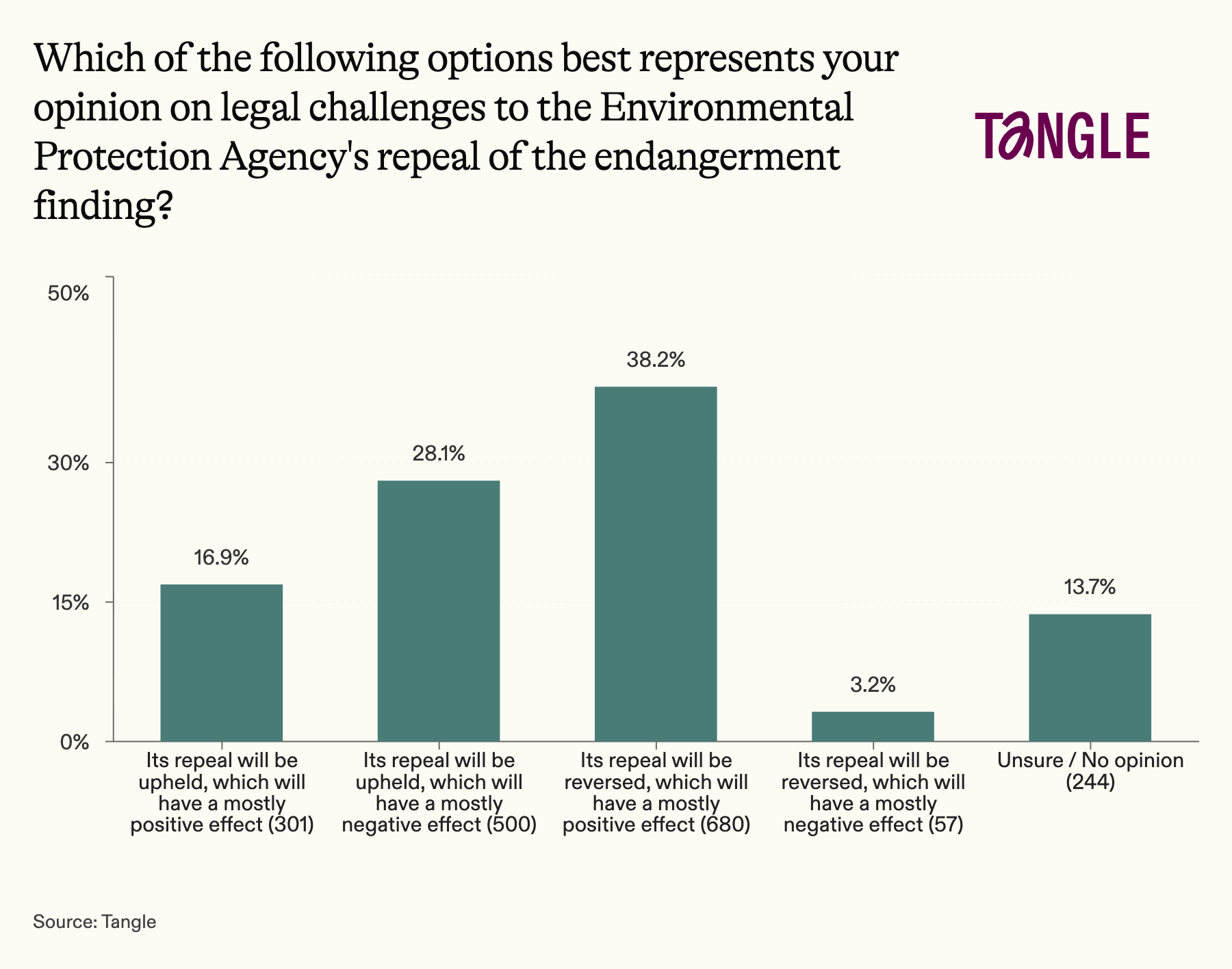
- Yesterday’s survey: 1,782 readers responded to our survey on the endangerment finding with 38% saying the repeal will probably be reversed, which will have a mostly positive effect. “I truly hope it will; I don’t necessarily think the current Supreme Court will make that decision, however,” one respondent said. “Bummer on the start-stop thingie; I was all ready to get a new car if they remove that horribly annoying device,” said another.
Have a nice day.
On February 2, for the first time in 25 years, the Smithsonian’s National Zoo and Conservation Biology Institute (NZCBI) welcomed a newborn Asian elephant calf. “After waiting nearly 25 years for an Asian elephant calf, this birth fills us with profound joy,” NZCBI Director Brandie Smith said. “What we learn from our elephants in D.C. directly strengthens our work to protect wild Asian elephants across Southeast Asia.” To commemorate her birth, the zoo is inviting anyone who provides a donation the opportunity to vote on the baby elephant’s name. The National Zoo has the story (and pictures).

Member comments