

I'm Isaac Saul, and this is Tangle: an independent, nonpartisan, subscriber-supported politics newsletter that summarizes the best arguments from across the political spectrum on the news of the day — then “my take.”
Are you new here? Get free emails to your inbox daily. Would you rather listen? You can find our podcast here.
Today’s read: 12 minutes.
We’re launching “Press Pass.”
Next week, we are launching a once-a-month, behind-the-scenes newsletter called “Press Pass” for paying subscribers only. In an effort to be more transparent and engaged with our audience, this newsletter is going to update subscribers on the inner workings of Tangle, what new ideas for the newsletter we are exploring, and what challenges we are facing as a team. We’ll also profile a staff member and open the door for your feedback on how we can improve. If you’re already a subscriber, you’ll get the first edition next week (and can always opt out if you aren’t interested).
We’ll be off from our normal newsletter on Monday in observance of Columbus Day, but we’ll be sending the inaugural Press Pass edition in its place.
What’s that windowless building?
You’ve all seen them: Giant, boring-looking, windowless buildings that sometimes span blocks and acres. These huge facilities are data centers — which are key to the function of our digital world. What’s inside these buildings? What do they do? And why are they popping up all over the U.S.? In our latest YouTube video, we investigate:
Quick hits.
- Federal authorities arrested a man suspected of starting the Palisades fire in Los Angeles in January, which became the most destructive wildfire in Los Angeles history. The suspect is charged with destruction of property by means of fire and faces a minimum of five years in federal prison. (The arrest)
- A federal appeals court lifted a federal judge’s order barring President Donald Trump from calling up Oregon National Guard troops into federal service, but it kept in place a second order prohibiting the president from deploying them in the state. The court will hear arguments on Thursday about whether to pause the judge’s order entirely. (The ruling)
- 500 National Guard members arrived in Chicago for an initial 60-day deployment to support federal immigration officers. Illinois and Chicago have jointly sued to stop the move, and Illinois Gov. JB Pritzker (D) called the deployment an “invasion.” Separately, President Trump said Pritzker and Chicago Mayor Brandon Johnson (D) “should be in jail” for allegedly failing to protect immigration officers. (The latest)
- Former Federal Bureau of Investigation Director James Comey pleaded not guilty to charges he lied to Congress, and his attorney indicated that he would seek to dismiss the case, calling it a “vindictive” and “selective” prosecution. (The case)
- The Internal Revenue Service furloughed approximately 34,000 workers — about half of its workforce — due to the ongoing government shutdown. (The furloughs)
Unknown Number Calling? It’s Not Random.
The BBC caught scam call center workers on hidden cameras as they laughed at the people they were tricking.
One worker bragged about making $250k from victims. The disturbing truth? Scammers don’t pick phone numbers at random. They buy your data from brokers.
Once your data is out there, it’s not just calls. It’s phishing, impersonation, and identity theft.
That’s why we recommend Incogni: They delete your info from the web, monitor and follow up automatically, and continue to erase data as new risks appear.
Try Incogni here and get 55% off your subscription with code TANGLE.
*Our sponsors help keep Tangle free — thank you for supporting them when you can.
Today’s topic.
The Gaza peace deal. On Wednesday, Israel and Hamas agreed to the first stage of President Donald Trump’s plan to end the war in Gaza. Precise details of the agreement are still being worked out, though the initial provisions took shape over night. Under the terms, within 24 hours, Israel will retreat to agreed-upon deployment lines — remaining in control of about half of Gaza; within 72 hours of Israel’s retreat, Hamas will release the remaining hostages. Israel will also return a multitude of imprisoned Palestinians, but it reportedly does not intend to release several prominent detainees, including Palestinian leader Marwan Barghouti.
Back up: On Monday, September 29, President Trump shared a 20-point proposal that outlines a series of actions to end the war between Israel and Hamas — including Hamas’s release of 48 hostages in exchange for nearly 2,000 Palestinian prisoners held by Israel — as well as a demilitarization plan, rebuilding framework, and governance structure for Gaza after the war. Prime Minister Netanyahu endorsed the plan, and Hamas reportedly expressed openness to its key tenets.
We covered the Trump administration’s proposal here.
White House Special Envoy Steve Witkoff and adviser Jared Kushner have led negotiations on behalf of the Trump administration, and they traveled to Egypt to participate in the peace talks. Qatari officials also played a key role as mediators between the sides.
In a post on Truth Social, President Trump said that all of the hostages taken by Hamas on October 7, 2023 would be released “soon” and that Israel would withdraw its troops from Gaza. “This is a GREAT Day for the Arab and Muslim World, Israel, all surrounding Nations, and the United States of America, and we thank the mediators from Qatar, Egypt, and Turkey, who worked with us to make this Historic and Unprecedented Event happen,” Trump wrote. The president also suggested that he would travel to the Middle East this weekend.
Israeli Prime Minister Benjamin Netanyahu will convene his government on Thursday, and they are widely expected to approve the deal. Netanyahu welcomed the deal, calling it “a great day for Israel.” Separately, Hamas announced it had accepted the deal but called on “President Trump, the guarantor states of the agreement, and all Arab, Islamic and international parties to oblige the government of the occupation to fulfill all the agreement’s commitments, and not to allow it to evade or delay implementation of the accords.”
Several unresolved questions remain, including the precise timeline for Israel’s withdrawal from Gaza. Furthermore, Hamas reportedly needs at least 10 days to locate bodies of dead hostages. Egyptian officials also indicated that larger issues, such as the disarmament of Hamas, have not been worked out, framing the agreement as an initial step to allow negotiations to continue.
Today, we’ll cover the latest on the potential peace deal, with views from the left, right, and Middle East writers. Then, my take.
What the left is saying.
- Many on the left note the war is not actually over but see this agreement as a key step.
- Others say Trump deserves credit if the deal holds.
In The Atlantic, Yair Rosenberg wrote “the Gaza war isn’t over yet. But it could be soon.”
“The parties have only agreed to some form of exchange in which Hamas will release its remaining hostages in return for Palestinian prisoners, including many serving life sentences in Israeli jails for terrorism. Even if this release goes forward in the days ahead, that will only end the Gaza hostage crisis, not the Gaza war,” Rosenberg said. “This first phase of Trump’s peace plan does not resolve any of the underlying issues that continue to drive the conflict. Among other outstanding concerns: Hamas will still be standing, still be armed, and will not have been supplanted by an alternative Palestinian regime. Far-right members of Netanyahu’s government will still seek to vanquish the terror group and potentially resettle parts of Gaza.”
“Ending the Gaza war was always going to require the president’s personal investment. Until recently, he seemed disinclined to give it. Trump did not intervene as the first cease-fire he helped broker in January fell apart. But in recent weeks, he seems to have latched on to the issue with renewed vigor,” Rosenberg wrote. “If he succeeds, that success will raise another question: How far is he willing to go to achieve his promised peace in the Middle East? The Gaza war is only an acute symptom of the region’s underlying malaise.”
In The New York Times, David E. Sanger said “Trump is on the brink of a major diplomatic accomplishment.”
“For Mr. Trump, success in this venture is the ultimate test of his self-described goal as a deal maker and a peacemaker — and a pathway to the Nobel Peace Prize he has so openly coveted,” Sanger wrote. “Much could go wrong in coming days, and in the Middle East it often does. The ‘peace’ deal Mr. Trump heralded on Truth Social on Wednesday evening may look more like another temporary pause in a war that started with Israel’s founding in 1948, and has never ended.
“But if Mr. Trump can hold this deal together, if Hamas gives up its last 20 living hostages this weekend and with them its negotiating leverage, that would be an extraordinary step toward the kind of peace plan Mr. Trump, and his predecessor, Joseph R. Biden Jr., have pressed to accomplish,” Sanger said. “Getting to the next stage, where Hamas would have to give up its arms and, even harder, its claim to run Gaza, may prove even more difficult than bringing the living and dead hostages home. Hamas may well balk at the next steps, and so may Mr. Netanyahu.”
What the right is saying.
- The right supports the deal, but many caution that Hamas could still derail it.
- Others praise Trump for his unrelenting push for a peace agreement.
In Hot Air, Ed Morrissey asked “will Hamas comply — and disarm?”
“The deal itself contains telling surprises. Those also constitute good reasons for skepticism. Now that the initial blush of joy over an apparent agreement to free the hostages, the question remains: Will Hamas comply?” Morrissey asked. “The terms of Donald Trump’s ultimatum contain poison pills that Hamas had refused to accept over the last two years… This agreement does not require the full withdrawal of the IDF from Gaza first, or even at all in this phase. The requirement for Hamas to disarm remains, although that too is pushed off for later phases of a broader peace agreement.”
“Or, perhaps, this is nothing more than another spin on the dance floor to the Hamas Hokey Pokey. Hamas appears to already be making demands for a shift in phasing, especially when it comes to positioning the IDF,” Morrissey said. “This is the first real step toward progress for the hostages in well over a year, but their freedom is not yet secured. Hamas has many ways to toss spanners in the works, and a track record of doing just that. If the polka music of the Hamas Hokey Pokey even plays for a bar or two, Trump had better be prepared to demonstrate a commitment to his red lines.”
In The Free Press, Matthew Continetti called the deal “a triumph of coercive diplomacy.”
“The Gaza deal is a triumph of coercive diplomacy. By pairing support for Israel with negotiations, President Trump leveraged IDF hard power to gain Hamas concessions. Just as he did in Iran, Trump used the credible threat of military force to achieve his goal,” Continetti wrote. “Americans are often tempted to separate force from peace talks, thinking that one must precede the other. Trump doesn’t make this mistake. For him, talk without action is meaningless. Talk with action gets results. And demonstrations of power are integral to the bargaining that culminates in a transaction.
“The deal is also a victory for Prime Minister Netanyahu. To date, his alliance with Trump has produced four historic achievements: the Abraham Accords, the demolition of Iran’s nuclear program, the deconstruction of Iran’s Axis of Resistance, and the pending release of the October 7 captives,” Continetti said. “Over the past six months, the world has seen what’s possible when America and Israel stand together to confront the enemies of civilization. Let’s not stop now.”
What Middle East writers are saying.
- Many writers from the Arab world say the agreement does little to change Palestinians’ underlying struggle.
- Some Israeli writers say Israel should still target Hamas’s leaders even if the war in Gaza ends.
In Middle East Monitor, Adnan Hmidan wrote “we must keep marching for Palestine.”
“Every time the world hears of a ‘new development’ — a roadmap, a framework, or now the first phase of Trump’s agreement — many are encouraged to believe that this could be the long-awaited turning point,” Hmidan said. “But for Palestinians, such announcements evoke not hope, but memory — the memory of countless previous ‘phases’ and ‘initiatives’ that promised calm yet delivered only more destruction. This is why we continue to march. Because every so-called breakthrough has left the fundamental injustice untouched — the same siege, the same dispossession, the same impunity.”
“There is still no permanent end to the siege, no accountability for those who have committed war crimes, no guarantee that the displaced will ever return home. There is no recognition of the right to live freely and with dignity. An agreement that leaves people starving, homeless, or stateless is not a step towards peace — it is a continuation of the same crime by different means,” Hmidan wrote. “To remain in the streets, therefore, is not a rejection of negotiation; it is a demand that negotiations finally mean something real. Our presence is a reminder that moral pressure must not fade simply because politicians have found new language to disguise an old injustice.”
In The Jerusalem Post, Moshe Phillips said “Hamas must not win the peace with Israel.”
“Hamas’s leaders, responsible for the slaughter of some 1,200 people and the kidnapping of civilians, are reportedly seeking safe haven in exile, most likely within the borders of its longtime host Qatar,” Phillips wrote. “The unspoken premise is that Hamas will remain part of the Palestinian Arab future; that its leaders have some sort of right to flee Gaza and live to fight another day, even though they are mass murderers.”
“Letting Hamas’s leaders escape into exile would be more than a tactical error. It would be a crime. Allowing them to spin their survival as victory and rally the next generation around their so-called ‘resistance.’ It would also send a disastrous message to terrorist groups worldwide: Mass murder leads to international negotiations, global attention, and eventually, attainment of goals,” Phillips said. “Israel has the right — nay, the obligation — to finish what it started and dismantle Hamas completely, just as the United States hunted down Osama bin Laden and decimated the ISIS leadership.”
My take.
Reminder: “My take” is a section where I give myself space to share my own personal opinion. If you have feedback, criticism or compliments, don't unsubscribe. Write in by replying to this email, or leave a comment.
- It feels surreal, but there could actually be peace in Israel and Gaza.
- Compared to just a few weeks ago, the recent development is stunning.
- There is still plenty to do, but these developments provide good reason for some optimism.
I’ll be honest: I feel at a loss for words.
I’m hoping and praying for the Palestinians, for Israel, for the region, and for everyone mediating the deal. It’s genuinely surreal to read about a deal like this, which looks like it might legitimately stick, moving forward right after the two-year anniversary of the war. I still remember waking up to messages about October 7, and watching in horror as the events that came after upended so many lives (in Gaza, in Israel, and across the world) in ways I don’t think any of us could have fully grasped two years ago.
To be here, now, almost feels unbelievable. I am swimming in skepticism; we had a multi-phase deal earlier this year that never came to fruition, and Israel was still striking locations in Gaza over the weekend. I’m just waiting for the news that some agreed-upon condition has been violated, that some bad actor dynamites this agreement, that some part of the progress was misreported. But, I’m tentatively hopeful that we may finally have a light at the end of the tunnel.
As I said last week, the 20-point proposal was smart, novel, and included priorities for both sides. Any workable deal always needed to include Israel withdrawing from Gaza and the return of all the hostages Hamas is holding. That the deal also managed to include a removal of Hamas from power, an opportunity for members of Hamas to disarm and seek amnesty, a commitment from Israel not to annex Gaza, and a return of aid distribution to the United Nations is all great news. If the deal holds, it will quickly become the shining diplomatic achievement of the Trump administration.
Again: I have no illusions about where this might go. Major questions still remain: The precise timeline for Israel’s withdrawal is still murky, and the logistics of Hamas’s disarmament have not been worked out. But consider where we were just a few weeks ago: Israel bombed Qatar and tried to kill lead negotiators. Qatar, a U.S. ally, was furious with Israel; the U.S. was left mostly in the dark about the strike. That could have evolved into the all-out regional war everyone has been fearing.
Flash forward to today: A deal is on the table that immediately halts the fighting, and the remaining hostages could be released as soon as Monday. The first phase of the peace plan also requires Israel to withdraw its troops from Gaza and for a rush of aid to enter the strip. That Hamas has actually agreed to give up all the remaining hostages, who — for the entirety of the war — have been its biggest leverage points, is the strongest signal yet the fighting might really be coming to an end.
After two years of sharing my analysis about the conflict, and given everything we have witnessed, I’m finding it hard to be analytical here. But I feel like this is a moment where it’s important to take stock of the situation. The region has fundamentally changed since this war started: Hamas has been all but destroyed, and now may be signing onto a deal that forfeits their power in Gaza. Numerous senior commanders from Hezbollah were killed, and while it remains armed and active, it is much weaker. The nuclear threat from Iran has, at least in the short term, been stifled (and its top scientists and some top generals were killed), while many of its proxies have become less active in the region.
For Israel, these will all be logged as victories. But the cost has been immense: In Gaza, tens of thousands have been killed and much of the strip has been destroyed. It will take years to fully rebuild, and decades to mend the wounds of the war (if not longer). Gazans who lived through the last two years will not forget what happened to them, and Israelis feel as if their security has been shattered. Jews across the world, including me, have a newly strained relationship with their ancestral homeland and its government. Israel’s standing on the global stage is diminished, with more external fury and internal frustration toward its government than I’ve ever seen before. Its relationship with allies is more tenuous. Its leader, Benjamin Netanyahu, is still fiercely opposed by many in Israel, and if the deal goes through, he is primed to face a revolt from the right-wing faction that has held his coalition together.
What will come next from Israel, Palestine, and the region? The optimistic take about this devastating conflict has always been that it wrought so much destruction that it offered a reset — a real chance for new power to rise in Gaza and for some kind of lasting peace deal that ends with Palestinian sovereignty and Israeli security. We are, in my estimation, still pretty far off from that. But with so few opportunities for optimism, this at least feels like a moment to celebrate a step in the right direction and an opportunity to imagine a future where the fighting, violence, and devastation can finally come to an end.
Take the survey: What is your reaction to the peace deal? Let us know.
Disagree? That's okay. My opinion is just one of many. Write in and let us know why, and we'll consider publishing your feedback.
Your questions, answered.
Q: How far reaching is the NSPM-7? It has such broad language, it seems like it can claim a lot of things as domestic terrorism. I'm not seeing a lot of coverage about it. Do NSPMs change how laws can be applied and forgo rights granted by the Constitution?
— Madison from Kansas City, MO
Tangle: First, let’s define our terms. National Security Presidential Memoranda — or NSPMs — are what the Trump administration calls its presidential directives on national security matters. Other presidential administrations have issued similar directives but called them by different names, like Barack Obama’s Public Policy Directives or George W. Bush’s National Security Presidential Directives.
These presidential directives usually function as guidance for executive officials on national security matters. Trump’s NSPM-1 created the organizational structure for his administration’s national security teams, while NSPM-2 outlined the administration’s planned foreign policy toward Iran. They aren’t binding directives like executive orders, and they can’t revoke laws or appropriate funding like acts of Congress. They only affect the internal policy of the Trump administration — Section 5 of NSPM-7 acknowledges this explicitly.
On its own, NSPM-7 isn’t as extreme as it might seem. The only policy it prescribes is a heightened focus on finding and disrupting possible domestic terrorism; it doesn’t create any new designations or prescribe new punishments. Its broadest language comes in Section 1, where — after describing the recent spate of political violence targeting right-wing figures — the memorandum outlines “common threads animating this violent conduct.” While these threads conspicuously only include ideas that oppose the Trump administration’s ideological goals, the memorandum doesn’t actually direct the federal government to declare these ideas “domestic terrorism.”
The alarming aspect of NSPM-7 is that it could shift priorities within organizations like the IRS or DOJ to aggressively monitor and target organizations that the Trump administration deems worthy of surveillance. It is, in effect, a formalization of the president’s rhetoric, and it could open up avenues for a group like the Joint Terrorism Task Force to investigate left-wing groups under the guise of counterterrorism.
Still, there are legal constraints to all of the above, and any actions downstream of the memo will certainly meet legal challenges. What exactly those downstream actions could be is still, as of yet, unknown.
Want to have a question answered in the newsletter? You can reply to this email (it goes straight to our inbox) or fill out this form.
Under the radar.
In fiscal year 2025, illegal crossings at the U.S.–Mexico border fell to their lowest level since 1970, according to preliminary Department of Homeland Security data. U.S. Border Patrol agents recorded nearly 238,000 migrant apprehensions in the fiscal year ending on September 30, and more than 60% of those apprehensions were recorded in the last full three months of the Biden administration. The drop off from recent years is significant; in 2022, Border Patrol made 2.2 million apprehensions. The early data follows the Trump administration’s heightened efforts to restrict unauthorized entries, including its use of emergency powers to halt the U.S. asylum system. CBS News has the story.
Scammers aren't guessing your phone number—they bought it.
BBC caught call center workers bragging about stealing $250k from victims using purchased data.
Once brokers sell your info, it's not just calls—it's phishing and identity theft. Incogni automatically deletes your data from the web and monitors for new threats.
Get 55% off with code TANGLE.
Numbers.
- 733. The number of days since Hamas’s October 7 attack on Israel.
- 24. The length of time, in hours, of an initial ceasefire marking the start of the Gaza peace deal, according to the terms of the agreement.
- 72. The length of time, in hours, that Hamas will have to return all remaining hostages after the 24-hour ceasefire.
- 1. The number of days until the winner of the Nobel Peace Prize is announced.
- 338. The number of candidates for 2025’s Nobel Peace Prize.
- 244 and 94. The number of those candidates who are individuals and organizations, respectively.
The extras.
- One year ago today we wrote about Elon Musk’s backing of Donald Trump.
- The most clicked link in yesterday’s newsletter was Attorney General Pam Bondi’s congressional hearing.
- Nothing to do with politics: A barbecue feud that’s embroiling a Texas town.
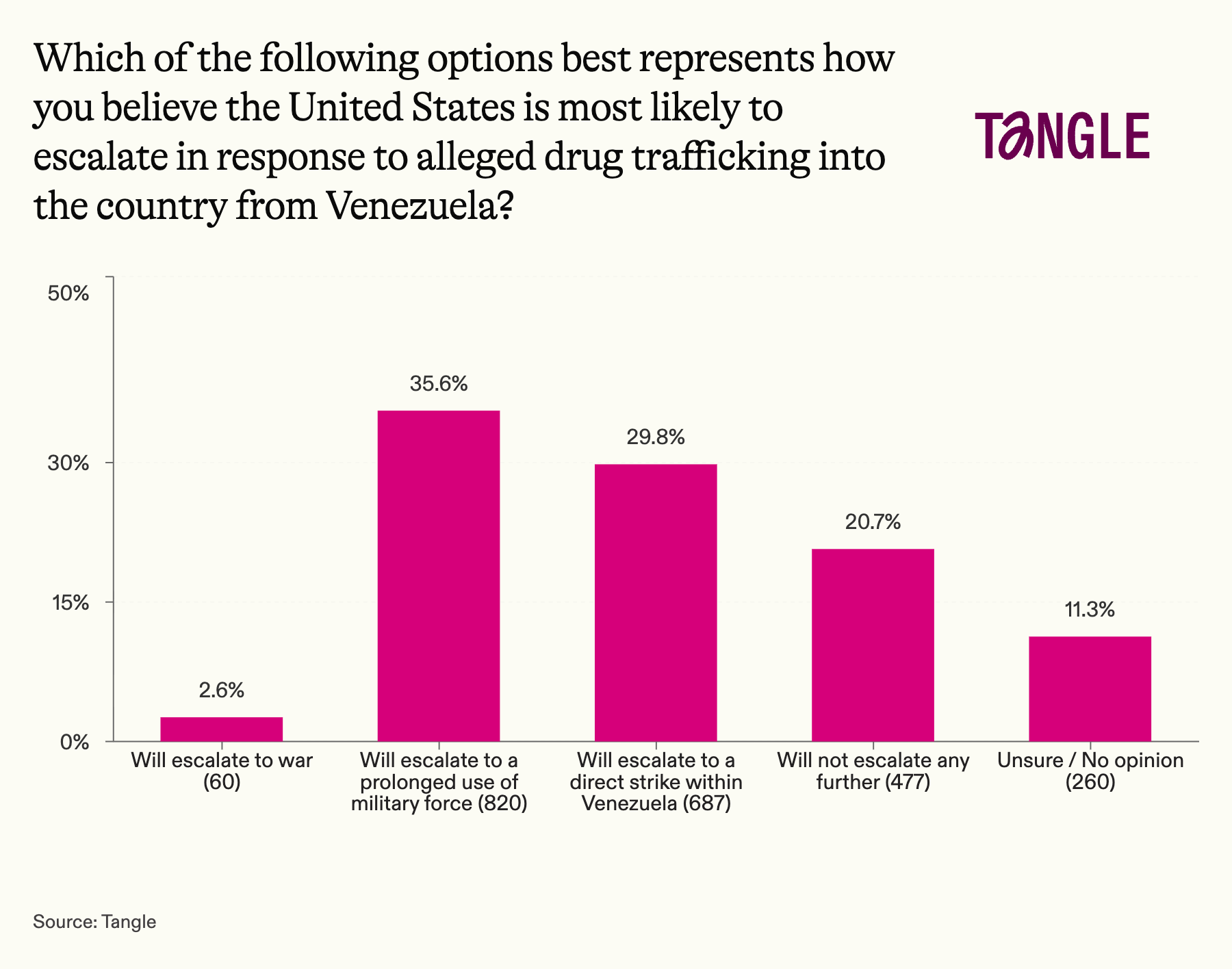
- Yesterday’s survey: 2,304 readers responded to our survey on the U.S.–Venezuela tensions with 36% saying they expect the situation to escalate to a prolonged use of military force. “I have no clue what might happen next, nobody does. That’s a big part of the problem,” one respondent said. “These drug traffickers are murdering US citizens, many of them young people. They have declared war on the US by doing so and should be blown out of the water!” said another.
Have a nice day.
Some aspects of the human immune system remain a mystery even after centuries of research. But new findings shed light on a few of the key outstanding questions. On Monday, three scientists — Mary E. Brunkow, Fred Ramsdell and Shimon Sakaguchi — were awarded the Nobel Prize in Physiology or Medicine for their work on T cells, the white blood cells that fight infection in the body. Over multiple decades, the scientists explored how the immune system knows to avoid attacking the body’s own healthy cells, identifying the FOXP3 gene, which is implicated in a rare human autoimmune syndrome. The discoveries are already contributing to treating autoimmune diseases and cancer, with additional applications for life-saving procedures like organ transplants. The New York Times has the story.

Member comments