

I'm Isaac Saul, and this is Tangle: an independent, nonpartisan, subscriber-supported politics newsletter that summarizes the best arguments from across the political spectrum on the news of the day — then “my take.”
Are you new here? Get free emails to your inbox daily. Would you rather listen? You can find our podcast here.
Today’s read: 14 minutes.
The Truth About Collagen: Purity Matters
Collagen is one of the most talked-about wellness supplements—for good reason. It supports joint comfort, radiant skin, healthy hair, and overall vitality.
But not all collagen is created equal.
Some formulas on the market include hidden fillers, hormones, heavy metals, and even trace antibiotics.
That’s why we love NativePath Collagen: it’s made with just one ingredient—100% grass-fed, pasture-raised bovine collagen. No additives. No GMOs. No sketchy extras.
Each scoop delivers Types I and III collagen (the most beneficial for skin, joints, and bones), and because it’s hydrolyzed, it’s easy for your body to absorb and put to work—fast.
This is collagen done right. And your body deserves it.
For your reading, listening, and viewing pleasure.
In recent weeks, we’ve put out a range of original content across our platforms.
- On our Suspension of the Rules podcast, Isaac, Ari, and Kmele broke down the Young Republicans group chat controversy and talked about the shifting Overton window in politics.
- In the newsletter, we published a Friday edition featuring two dueling perspectives on the future of the war in Ukraine.
- On YouTube, we posted a deep dive on the rise of data centers.
- On our social channels, we shared on-the-street interviews with college students about the issues that matter most to them.
- And finally, we are putting on a live show in California on Friday, and you can get your tickets here!
Quick hits.
- A federal appeals court ruled 2–1 that the Trump administration can mobilize and deploy members of the Oregon National Guard to Portland while a legal challenge to the move proceeds. The court’s majority found that the administration was likely to prevail on the merits of its appeal. (The ruling)
- Construction crews began demolishing a portion of the White House’s East Wing as part of a construction project spearheaded by President Trump to build a White House ballroom. (The demolition)
- Amazon Web Services said that a sweeping internet outage originating from its cloud-computing data centers was mostly resolved. The outage impacted sites and apps serving millions of users and businesses. (The outage)
- The United States and Australia agreed to a critical-minerals and rare-earths deal to partner on projects worth up to $8.5 billion in total. (The deal)
- Japan’s Lower and Upper House voted to elect Sanae Takaichi as prime minister, making her the first female prime minister in the country’s history. (The vote)
Today’s topic.
The latest on the government shutdown. On Tuesday, the federal government shutdown entered its 21st day, with Republican and Democratic lawmakers at an impasse over a deal to reopen the government. The shutdown is now the longest full government shutdown in U.S. history; only the 35-day partial funding lapse in 2018–2019 lasted longer. On Monday, the Senate failed to pass a GOP-backed funding bill for the 11th time.
Back up: On October 1, federal funding lapsed, halting some government services and suspending pay to many federal employees. The Senate failed to reach the 60-vote threshold required to pass a stopgap funding bill to keep the government open, with Democrats pushing for a permanent extension of temporary Affordable Care Act subsidies set to expire at the end of the year. Republicans have maintained that health subsidy negotiations should be held only after the government reopens.
We covered the beginning of the shutdown here.
Services designated as essential — such as air traffic control and federal law enforcement — remain operational during the shutdown. However, many other government functions have been paused or disrupted, and federal agencies have begun furloughing workers or asking employees to work without immediate pay. On Monday, the National Nuclear Security Administration, which is responsible for overseeing and modernizing the U.S. nuclear stockpile, announced it would furlough most of its staff. Separately, the Administrative Office of the U.S. Courts said the shutdown would begin to affect its operations this week, and the Supreme Court will be closed to the public due to resource limitations.
In addition to the furloughs, the Trump administration has sought to lay off thousands of federal workers during the shutdown as part of its ongoing efforts to reduce the size of the government. On Wednesday, White House Budget Director Russell Vought suggested that over 10,000 jobs could be cut, saying, “We want to be very aggressive where we can be in shuttering the bureaucracy, not just the funding.” However, also on Wednesday, a federal judge temporarily barred the administration from carrying out planned layoffs, then extended the order to a broader group of unionized federal workers on Friday. The judge suggested that the Trump administration was “fir[ing] line-level civilian employees during a government shutdown as a way to punish the opposing political party.”
Separately, Vought has paused billions in funding for projects in mostly Democratic-led cities, calling them “lower-priority projects” that may be canceled outright. The Office of Management and Budget director has also frozen or canceled infrastructure- and climate-related projects in major cities, drawing criticism from Democratic lawmakers.
Today, we’ll cover the latest on the shutdown, with views from the left and right. Then, my take.
What the left is saying.
- Many on the left contend that Democrats should broaden the shutdown fight to address Trump’s abuses of executive power.
- Some note that the shutdown has accelerated Trump’s efforts to cut the federal workforce.
- Others say the politics of the shutdown are considerably different from past instances.
In The American Prospect, David Dayen argued “to win the shutdown, Democrats need a big switch.”
“In public, this is just a fight about a looming health care cliff, using the leverage of needing Democratic votes (at least under current Senate rules) to pass government funding to demand that Republicans avert a crisis of millions of people losing their insurance coverage or seeing the price of it double,” Dayen wrote. “In private, this is a fight about extreme executive power and autocracy, with Democrats demanding that any government funding they pass must actually be spent, not withheld or rescinded. A No Kings Budget, in other words.”
“If there’s a way to switch this out, to make the need for No Kings (which is quite popular) the primary focal point of the shutdown fight, Democrats have a better chance of getting out of this with something,” Dayen said. “But you don’t want to drop the health care conversation entirely — there really is a risk of millions of people losing insurance when enhanced Affordable Care Act subsidies expire in December, and people in Republican districts will be disproportionately hurt, raising stakes that White House officials are keenly aware of, even if they won’t admit it in public.”
In The Los Angeles Times, Jackie Calmes wrote “this is Trump’s shutdown. But he’s been dismantling the government all year.”
“Trump has been dismantling many of the government’s domestic programs for nine months, with an abandon that disregards federal laws and the Constitution’s separation of powers, as numerous lower-court judges have found (only to be temporarily checked by the Trump-friendly Supreme Court),” Calmes said. “Even America’s foreign rivals and enemies couldn’t have conceived of a more shockingly self-defeating course than the one its commander in chief has his nation on — targeting education from pre-K through postgraduate studies, scientific and medical research, public health and general healthcare, clean energy, community development and so much more.”
“Yet even Trump & Co. have had to tacitly admit, repeatedly, they’ve gone too far. They’ve called back some targeted federal employees or sought new hires for the Internal Revenue Service, the National Weather Service and the Centers for Disease Control and Prevention, among others,” Calmes wrote. “Democrats are right to demand that Republicans support continued healthcare subsidies before Democrats vote to reopen the government. But the ongoing shutdown is at least as valuable for drawing Americans’ attention to the de facto Trump shutdown that predates it, and that unfortunately will outlast it.”
In Bloomberg, Matthew Yglesias explored “what makes this shutdown so different.”
“This shutdown has a different dynamic. The public is displeased with both sides’ behavior, but on balance tends to put slightly more blame on Republicans than Democrats. That means President Donald Trump has strong incentives to minimize the visible pain of the shutdown,” Yglesias said. “More consequentially, Trump isn’t letting a lack of authorized funds stop him from paying the troops or even maintaining the WIC program for pregnant women and young children. The legality of these moves is questionable. The White House is essentially daring Democrats to sue, in which case they would be responsible for the lack of military pay. But Democrats aren’t taking the bait.”
“Leaving aside the dubious legality of all this, politically this is not the usual form of pressure found in the shutdown playbook. The senators Trump is hitting by cutting funding to blue states are not the vulnerable frontliners who might be coerced into caving. They’re safe-seat Democrats whose constituents would rebel if they backed down. Trump, as is often the case, is more interested in punishing his foes than in winning an argument,” Yglesias wrote. “For now, there simply isn’t meaningful pressure on either the White House or Senate Democrats to cave. The result is a standoff that, unless Republicans choose to resolve it on their own, could persist for a long, long time.”
What the right is saying.
- The right says Democrats’ shutdown strategy is a losing proposition.
- Some argue Republicans should hold firm on not extending ACA subsidies.
- Others say the shutdown is revealing parts of the government that should be permanently cut.
In Newsweek, Josh Hammer said “Democrats still haven’t learned any lessons.”
“Senate Minority Leader Chuck Schumer (D-N.Y.) defended his caucus's latest vote, opining, ‘It's always been unacceptable to Democrats to do the defense bill without other bills that have so many things that are important to the American people in terms of health care, in terms of housing, in terms of safety.’ But to most Americans, such tendentious bloviating falls on deaf ears,” Hammer wrote. “Most commonsense Americans understand that there is no reason paying America's warriors should be held hostage to arcane debates over housing policy.”
“Democrats seem to be unable to avoid tripping all over themselves… Illegal immigration and gender radicalism are perhaps the two least popular issues right now for Democrats. Yet they are arguably the two issues most at the forefront of the current Beltway standoff — or at least the debate over the scope of taxpayer funding is,” Hammer said. “A rational political party interested in self-preservation and electoral success would certainly take a different approach. Such a party would ditch the post-2008 obsession with identity politics and wokeism and revert to the Clinton-era message of economic growth and cultural centrism.”
In USA Today, Dace Potas argued “Republicans have the perfect chance to stop wasting your money on the ACA.”
“Republican leadership remains unwilling to negotiate until the government is reopened. However, there has been some openness within the Republican ranks to extend the Obamacare subsidies for another year,” Potas wrote. “That's something Republicans should refuse. Not only can America not afford to continue subsidizing a failing health care plan, but it is the right political decision as well. It should be an easy choice.
“Health insurance premiums have skyrocketed since the passage of the Affordable Care Act in 2010. This rise in premiums can be chiefly attributed to the flurry of regulations imposed on health insurance companies under the ACA. Guaranteed issue and community rating regulations are expensive regulations that have driven up the cost of health care,” Potas said. “Democrats are right that people will lose health care, but the cost of keeping the enhanced subsidies far outweighs that downside. However, the existing subsidies under the base contents of the ACA, which will remain in place regardless of the outcome of this political fight, are still rather generous.”
In The Wall Street Journal, Daniel Huff wrote “government shutdown? No, an efficiency audit.”
“Since 1981, four major shutdowns have generated data about what government actually needs to function. Furlough rates have ranged from about 15% to 40%. The current 2025 shutdown sits at the low end, suggesting agencies have broadened their understanding of operational minimums,” Huff said. “Shutdowns let Congress run an experiment it would ordinarily never attempt: Close the whole thing down and see what breaks. This is what Elon Musk did at Twitter. He fired 80% of the staff, watched what broke, and restored only what proved necessary.”
“This approach—furlough broadly, identify failures, restore specific functions—is vastly more efficient than conventional budget cutting… For example, the fiscal 2014 shutdown generated data on which services generated outcry when suspended (national parks), which created safety risks (fewer inspections by the Food and Drug Administration), and which caused surprisingly little disruption,” Huff wrote. “Each funding impasse has collectively produced the world’s largest organizational efficiency study. Not a simulation or theoretical analysis, but a real-world test of which positions government can function without.”
My take.
Reminder: “My take” is a section where I give myself space to share my own personal opinion. If you have feedback, criticism or compliments, don't unsubscribe. Write in by replying to this email, or leave a comment.
- This shutdown lacks a clear centerpiece issue — instead, it’s a standoff over power.
- Neither Republicans nor Democrats are pressing to end the shutdown, and neither has a solution for runaway spending.
- I’m afraid this won’t end until it starts to drastically impact the public.
Executive Editor Isaac Saul: Nothing about this shutdown feels normal.
Perhaps most importantly, there is no real centerpiece issue here. In 2018, the shutdown was about Trump’s demand to fund a border wall. In 2013, it was over the Affordable Care Act (ACA). In 1995, it was about cuts to Medicare and education demanded by Newt Gingrich.
What is this shutdown about? Democrats want to make it about healthcare, but the shutdown really isn’t about healthcare. It’s about power — it’s the Ezra Klein argument that Democrats need to stand up and fight back against Trump because funding a government operating the way his government is operating is no longer tenable. Republicans wanted to make the debate about Democrats trying to “fund healthcare for illegal immigrants,” but that story is misleading to the point of fabrication.
Now, Republicans have all but abandoned that argument and pivoted to the idea that they are the party of healthcare and are trying to reopen the government while Democrats refuse to. Truthfully, though, Republicans are fine if the government remains shut down — because President Trump doesn't care if the government remains shut down.
Which brings me to the second odd thing about this standoff: Nobody seems interested in actually reopening the government. There are no urgent meetings between the president and the House Speaker. Congress is not convening to find a solution. Democratic politicians feel their base is behind them, including the affected government workers. And why not? The threat of layoffs is not so harrowing given that Trump clearly doesn’t need the pretext of a shutdown to fire people, instead inviting DOGE and OMB to slash government staff. At least now Democrats can tell those government workers and their constituents they are fighting back.
Many Republicans, meanwhile, view the shutdown as a live audit, an opportunity to purge government employees and programs that they see as extraneous. If you’re quiet enough, you can hear Russ Vought rubbing his hands together. Of course, Republicans would be pivoting if it were politically advantageous; but they think they’ll win the messaging war the longer the shutdown goes on, and with Trump’s bullhorn they may be right.
The third unusual thing about this shutdown is that something specific has actually brought us to this point, and almost nobody is talking about it. It isn’t Trump being a fascist. It isn’t Democrats trying to subsidize healthcare for immigrants here illegally. It’s much more mundane: It’s that shutdowns are always about funding the government, and our current government funding is totally unsustainable. The Washington Post editorial board is one of the few places I’ve seen pointing out this dynamic explicitly.
Remember: The Affordable Care Act, however well intended and popular, is still not affordable for the government. During the pandemic, President Joe Biden and congressional Democrats passed a massive expansion of emergency subsidies to support healthcare programs like the ACA. Those “emergency” subsidies for healthcare, student loan forgiveness, and food stamps were supposed to be temporary, but — as is typical — if voters acclimate to a government benefit, that program becomes much harder to cut. This has been the traditional conservative argument: These won’t be temporary. In this case, that argument was right. Congress massively expanded its spending during the pandemic without an accompanying funding mechanism, and it has not undone those expansions.
Meanwhile, Trump came into office with a dire fiscal situation that needed to be resolved by some combination of raising taxes or cutting federal costs. Instead, he tried to pass off the job of fiscal responsibility to DOGE — but that initiative was a farce that extended maximum pain onto government employees and axed overseas programs for little more than table scraps. The $20 billion Argentina bailout Trump just approved costs roughly double the combined savings from all of DOGE’s cuts (roughly $1.4 billion) and Congress’s $8 billion USAID funding cut.
As we keep saying, in order to seriously cut the budget the government has to reduce spending in Social Security, healthcare, and defense. The president hasn’t touched the first two, and he continues to approve historically large military spending bills — all while the Pentagon remains incapable of even passing an audit. Then, on the other side of the coin, Trump has extended tax cuts from his first term that were also meant to be temporary.
So, here we are: $37.9 trillion in debt; no plan to pay for the most popular, important or expensive government programs; and nothing to do but to try to distract voters into hating the other side on fabricated or irrelevant grounds.
Frustratingly — infuriatingly — none of that has anything to do with ending this shutdown. For that, we’ll have to see when Americans start to really feel pain and who they’ll blame it on. Ultimately, Democrats are the ones holding up a funding CR for their demands; their biggest pain point in the past may have been when food assistance programs and health service for seniors started to run dry. Today, though, more of their base is wealthy and highly educated. It’s a crude political calculation, but this shift may make Democrats more tolerant of these issues than they had been in the past. Conversely, a lot of Republicans are sounding the alarm about this coming cliff — and in a relatively new development, it might be more politically perilous for Republicans if these entitlement checks stop flowing.
Instead, the biggest pain point of this shutdown for Democrats may be when the lack of normal operations starts to impact day-to-day life. Thanksgiving week will be a key test — how chaotic and broken can U.S. airports get with limited TSA and air traffic control staff? And how tolerant will Democrats be of such a public mess when they can reopen the government with a vote at any time?
For Trump and Republicans, the biggest pain points are already arriving, but the president is trying to find ways to mitigate them. When military pay was supposed to freeze last week, Trump took unconstitutional (read: illegal) action to keep checks flowing to active duty soldiers. Republican senators described the move as varying degrees of “inappropriate,” but none seemed eager to take back the power of the purse; meanwhile, Democrats are unwilling to take legal action to hold the president accountable for paying military personnel. And in the end, I doubt many Americans noticed or cared (except for active-duty soldiers and their families, whom I presume are quite relieved).
The president seems keen to use a similar process to restart loans for struggling farmers (who are being hit hard by his tariffs) or keep other politically popular programs alive. Basically, the government is shut down, but the party in power is finding emergency funding to make it all a bit less painful for their favored constituents.
It’s anyone’s guess what happens now. We’re barrelling toward the longest shutdown in U.S. history. Republicans have a governing trifecta but also can’t move the ball without Democratic votes, and seem keen to sit tight. They’re displaying a sort of governing-by-breaking-it attitude, best exemplified by Trump but now expressed by the party wholesale. Meanwhile, Democrats have the strength of their healthcare argument (“costs go up if nothing is done”), but conveniently have no plan to pay for the billions in funding that, four years ago, was sold to the public as emergency and temporary.
Truthfully, my best guess is we see little to no movement until the problems become untenable for the public. It’ll take nightmarish travel delays, disappearing food stamps, impossibly long waits to resolve healthcare snafus, and reports of degraded military readiness before anyone comes back to the table. And then, unfortunately, we’ll have to wait for Congress to actually agree on something.
Take the survey: Which party do you think is more responsible for the government shutdown? Let us know.
Disagree? That's okay. My opinion is just one of many. Write in and let us know why, and we'll consider publishing your feedback.
Your questions, answered.
Q: Stephen Miller said President Trump had ‘plenary authority.’ What does that mean?
— Rory from Princeton Junction, New Jersey
Tangle: First, the definition: According to the Legal Information Institute at Cornell Law School, “plenary authority” means power that is “complete, comprehensive, and not subject to significant limitation.”
As for the comment, Stephen Miller, the White House deputy chief of staff who has been responsible for much of President Donald Trump’s immigration enforcement policy, recently cited “plenary authority” to justify the deployment of the National Guard to Los Angeles, Chicago, and Portland. While giving an interview to CNN on Monday, Miller said “Under Title 10 of the U.S. Code, the president has ‘plenary authority,’” before pausing during the interview.
The network said that a technical glitch resulted in audio from a different channel being sent to Miller’s earpiece, causing him to pause.
When the interview resumed, Miller clarified his point. “Under federal law, Title 10 of the U.S. Code, the president has the authority, anytime he believes federal resources are insufficient, to federalize the National Guard to carry out a mission necessary for public safety,” Miller said. Title 10 is a portion of federal law covering the military.
Miller is correct that the constitution and federal law do give the president authority to deploy troops in the U.S. to respond to an invasion or insurrection, or if law enforcement is unable to execute the law without assistance. The president also does have narrow “plenary” power over the number of troops to send on a deployment.
However, Miller’s argument that the situation in cities justifies the use of this authority is not nearly as straightforward. For context, Miller has been publicly constructing an argument that broad illegal immigration and lawlessness in U.S. cities justify federal troop deployment. He has laid the groundwork for this argument by referring to illegal immigration as an “invasion” and, more recently, describing a confrontation between protesters and ICE agents outside Chicago as “domestic terrorism and seditious insurrection.”
Federal judges have blocked troop deployments to Los Angeles and Chicago under the president’s (and Miller’s) rationale, but an appeals court just allowed the Guard’s deployment to Portland. So, while the president does have meaningful authority over military deployments, Miller’s one-time (and potentially accidental) characterization of that authority as “plenary” is much more dubious.
Want to have a question answered in the newsletter? You can reply to this email (it goes straight to our inbox) or fill out this form.
Under the radar.
On Saturday, a U.S. military demonstration that involved shooting live-fire artillery rounds over Interstate 5 in California dropped metal shrapnel onto a California Highway Patrol (CHP) protective services detail for Vice President JD Vance. The CHP said that the shrapnel was from an explosive ordnance that detonated prematurely and some of it struck a CHP patrol vehicle and motorcycle. No one was injured and the Marines stopped firing additional live ordnances over the highway after they were notified of the incident, but California Gov. Gavin Newsom (D) criticized the Trump administration for carrying out the exercise without coordinating with the state, calling the decision “reckless.” The Los Angeles Times has the story.
The 10,000 Steps Rule Is a Lie From the 1960s
The simplest way to lose fat isn't cutting calories—it's boosting cardiovascular output through low-intensity walking.
But forget the 10,000 steps rule. That wasn't based on science; it was a 1960s marketing gimmick. Research shows even lower step counts deliver real health benefits.
Take Simple's quick, personalized quiz to discover your optimal step count and what your body needs to lose weight. They've helped 18 million users lose millions of pounds.
Numbers.
- 0 of 12. The number of appropriations bills needed to fund the U.S. government that Congress has passed.
- $18 billion. The approximate amount of federal spending temporarily withheld during the 2018–19 partial government shutdown.
- 89%. The percentage of employees at the Environmental Protection Agency who have been furloughed during the current shutdown, the highest share of any federal agency, according to CNN.
- 334,900. The approximate number of Defense Department employees who have been furloughed, the most of any federal agency.
- 54% and 35%. The percentage of U.S. adults who see the government shutdown as a major and minor problem, respectively, according to an October 2025 AP-NORC poll.
- 37% and 45%. The percentage of Republicans who see the government shutdown as a major and minor problem, respectively.
- 69% and 28%. The percentage of Democrats who see the government shutdown as a major and minor problem, respectively.
- 33% and 39%. The percentage of U.S. adults who primarily blame Democrats in Congress and Donald Trump and Republicans in Congress, respectively, for the shutdown, according to an October YouGov/Economist poll.
- 20%. The percentage of U.S. adults who blame both sides equally for the shutdown.
The extras.
- One year ago today we wrote about Israel killing Yahya Sinwar.
- The most clicked link in yesterday’s newsletter was the list of 65 essential children’s books.
- Nothing to do with politics: Another top-65 list, this time a ranking of pumpkin-spice-flavored foods.
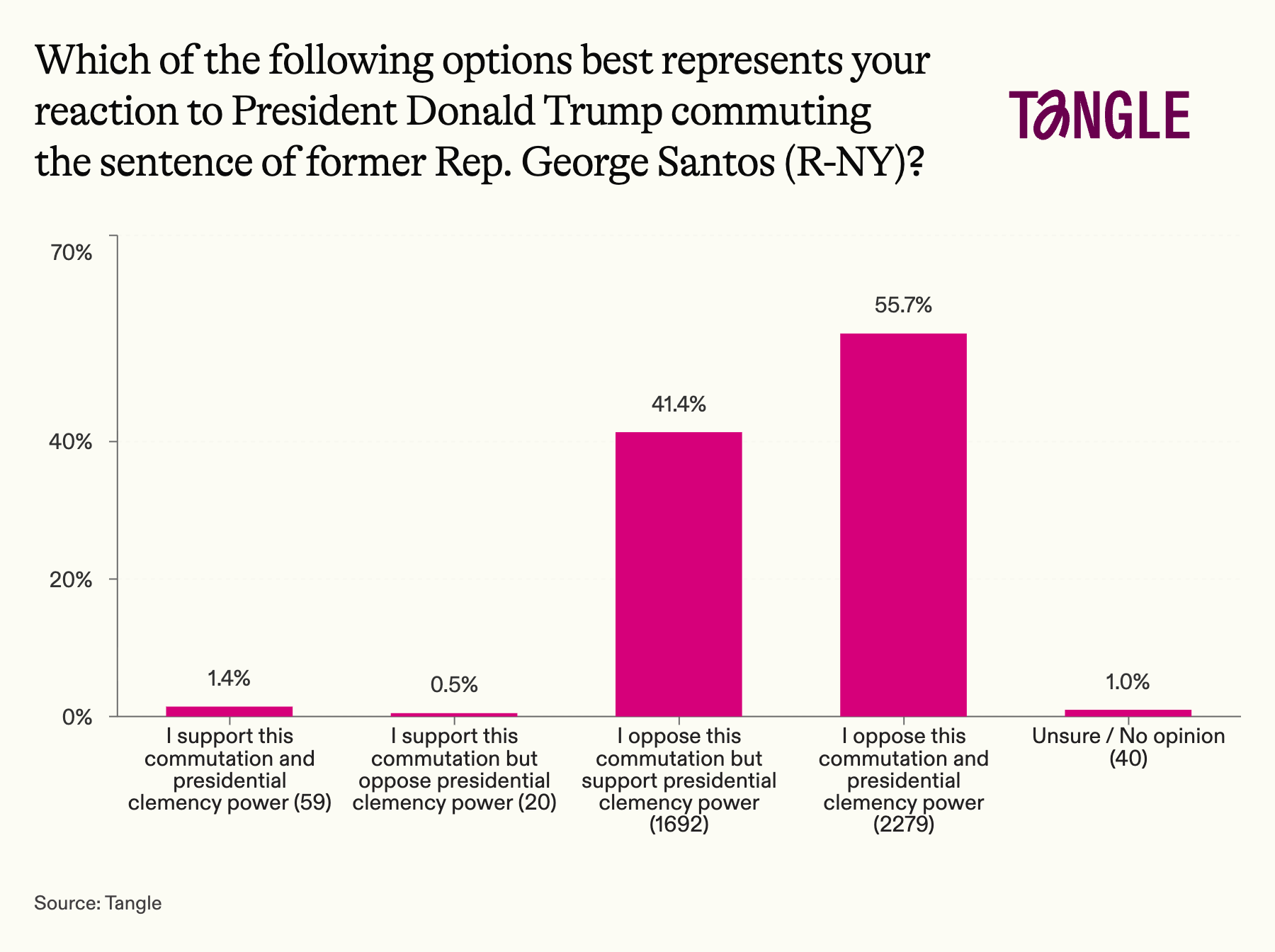
- Yesterday’s survey: 4,090 readers responded to our survey on George Santos’s commutation with 56% opposing the commutation and presidential clemency more broadly. “There needs to be some controls over the pardon power. It has been abused by both sides for decades. That does not make it right,” one respondent said. “At least Trump is transparent about the abuse of clemency power unlike Biden who lied about it, snuck them in at the 11th hour, and delegated the decisions to staffers,” said another.
Have a nice day.
Ryan Ramos had an unusual request for the theme of his fifth birthday party: America’s 39th president, Jimmy Carter. Ryan first became interested in President Carter when his preschool class celebrated Presidents’ Day in 2024, and Ryan’s mother has done her best to indulge his interest. Her stories about planning his party, complete with a Carter cake and cardboard cutout, went viral on TikTok, where they even reached the former president’s family — who sent Ryan a personalized goodie package, including family recipes and memorabilia from the late president’s 100th birthday. WSB-TV Atlanta has the story.

Member comments