

I'm Isaac Saul, and this is Tangle: an independent, nonpartisan, subscriber-supported politics newsletter that summarizes the best arguments from across the political spectrum on the news of the day — then “my take.”
Are you new here? Get free emails to your inbox daily. Would you rather listen? You can find our podcast here.
Today’s read: 13 minutes.
Stop Chasing Headlines That Don't Matter
Cut through the noise with The Daily Upside — sharp financial reporting from veteran journalists and Wall Street insiders who actually understand what moves markets.
While other outlets bury the real story under clickbait, The Daily Upside deliver the economic trends, market moves, and business stories that directly impact your portfolio and career.
Get the context behind the numbers, the strategy behind the moves, and the analysis that helps you stay ahead.
Recent coverage includes the Fed's interest rate wake-up call, AI disrupting restaurants, & energy giants Exxon & Chevron becoming frenemies as they face profit pressure.
Get The Daily Upside for Free.
*This is a sponsored post
Can our primary system be fixed?
Congress is increasingly polarized, and the situation only seems to be getting worse. Is there anything we can do to reverse course? Reforming our primaries — the process by which we select candidates to run for public office — offers a ray of hope. But how exactly do our primaries work, and are the alternatives better than what we have now? In our latest YouTube video, we break down the U.S. primary system, explaining how it increases political polarization and what some states are doing to change their systems. You can check it out here.
Quick hits.
- Israel carried out an airstrike targeting Hamas leaders in Doha, Qatar. The fate of the targets is not yet known. (The strike)
- The Wall Street Journal published an image of a drawing and letter bearing President Donald Trump’s signature included in a birthday book given to Jeffrey Epstein in 2003. The image comes from a copy of the book given to Congress by lawyers for Epstein’s estate. The White House maintained that President Trump did not draw the image or sign the letter. (The story)
- The Murdoch family reached an agreement to consolidate control of the family’s media empire — which includes Fox News, The New York Post, and The Wall Street Journal — with Rupert Murdoch’s son, Lachlan, while paying out over $1 billion to each of Rupert’s other children in return for their voting shares in the business. (The deal)
- The Department of Homeland Security announced it is launching an immigration enforcement operation in Chicago — called Operation Midway Blitz — targeting unauthorized immigrants with criminal records living in the city and surrounding areas. (The announcement)
- Defense Secretary Pete Hegseth and Joint Chiefs Chairman Gen. Dan Caine visited Puerto Rico amid reports that the Pentagon is considering involving the U.S. territory in regional military operations targeting drug cartels. (The visit)
Today’s topic.
The August jobs report. On Friday, the Bureau of Labor Statistics (BLS) reported that nonfarm payroll employment increased by 22,000 in August, while the unemployment rate rose from 4.2% to 4.3%. The healthcare sector accounted for roughly 31,000 new jobs, but declining employment in the federal government, manufacturing, and professional services offset some of those gains; the BLS also revised June’s employment numbers down by 27,000 and July’s numbers up by 6,000. Separately, on Tuesday, the BLS reported that the U.S. added 911,000 fewer jobs between March 2024 and March 2025 than previously estimated, adding to concerns about the health of the job market.
The jobs report is the first issued since President Donald Trump fired former BLS Commissioner Erika McEntarfer and nominated Heritage Foundation economist E.J. Antoni to replace her. William Wiatrowski is currently serving as acting BLS commissioner while Antoni awaits a confirmation hearing.
The 22,000 jobs added were notably lower than economists’ expectations for August, according to a Dow Jones survey. Many economists said the latest employment numbers signal a stagnant job market and increase the likelihood of the Federal Reserve cutting interest rates at its September meeting.
“The warning bell that rang in the labor market a month ago just got louder. A weaker-than-expected jobs report all but seals a 25-basis-point rate cut later this month,” Olu Sonola, head of U.S. economic research at Fitch Ratings, said. “Four straight months of manufacturing job losses stand out.”
Trump administration officials gave a mixed response to the latest jobs numbers. National Economic Council Director Kevin Hassett acknowledged that the jobs numbers were “a little bit disappointing” but said he expects them to be revised upward in future months, noting the BLS’s ongoing struggles with decreasing response rates to employment surveys.
Other government officials criticized Federal Reserve Chairman Jerome Powell for his economic management and resistance to lowering interest rates. Labor Secretary Lori Chavez-DeRemer said, “Jerome Powell should be embarrassed by this report because he has not done his job,” and Treasury Secretary Scott Bessent wrote, “The U.S. faces short- and medium-term economic challenges, along with the long-term consequences of a central bank that has placed its own independence in jeopardy.” President Trump added to his longstanding criticism of Powell, writing on Truth Social, “Jerome ‘Too Late’ Powell should have lowered rates long ago. As usual, he’s ‘Too Late!’”
Today, we’ll explore reactions from the right and left to the latest employment numbers, followed by my take.
Agreed.
- Writers on the right and left share concerns that the cooling labor market is an increasingly urgent problem.
What the right is saying.
- The right’s view of the report is mixed, but many worry that the negative effects of Trump’s tariffs are coming to bear.
- Some note that wage growth continues to be positive despite the struggling job market.
- Others say Trump must make improving the economy his priority going forward.
The Wall Street Journal editorial board wrote about “the Trump summer jobs stall.”
“Nearly all of the new jobs last month were in social assistance and healthcare (46,800), which rely on government spending. Industries with high tariff exposure shed workers, including manufacturing (-12,000) and wholesale trade (-11,700),” the board said. “Mr. Trump blamed the Federal Reserve, as he always does, and he told Americans to look for the ‘real’ jobs numbers a year from now when companies supposedly finish building new plants. The jobs report probably does lock in a 25-basis point cut in interest rates this month.”
“What Mr. Trump needs is a broad revival in business confidence of the kind that accompanied his November victory and appeared before his tax on imports and willy-nilly interventions in private business decisions. Repeat after us: Tariffs are taxes, and taxes hurt economic growth,” the board wrote. “Mr. Trump this week asked the Supreme Court to hear the legal challenge to his tariffs on a fast track. The best news for the economy would be if the Court takes up his challenge and finds them unconstitutional.”
In Hot Air, Ed Morrissey explored “curious” aspects of the jobs report.
“The Bureau of Labor Statistics reported that the economy only added 22,000 jobs in August. With revisions, that means that the US only created 88,000 jobs the entire summer, and that will undoubtedly put pressure on Donald Trump to either adjust his approach or find job-creating investments stat,” Morrissey said. “At the same time, however, wages continued moving upward. This seems very curious indeed. Why are wages still increasing above the current rate of inflation after three months (and arguably five months) of flat job-creation growth?
“This isn't necessarily just a shift of departing immigrants and replacement by legal workers either. BLS calls the unemployment rate essentially flat, and that's mainly correct, but that U-3 measure is ticking up slightly at 4.3%,” Morrissey wrote. “One would expect either wages or working hours to drop, but working hours are steady (overtime dropped a bit) and these wage numbers look pretty good. It's a little mystifying. Replacement of illegal workers by legal workers might explain it, but if that were the case, we'd see drops in the civilian workforce numbers; instead, we added nearly a half-million workers in the Household data.”
In The Federalist, Christopher Jacobs said “if Republicans don’t get the economy right, all their other wins will be in vain.”
“Donald Trump won reelection over Harris in large part because voters remembered the positive economy — and specifically the robust income growth — during his first term, as opposed to the ‘Bidenflation’ of the past four years. If Republicans show the same complacency as Democrats did on the economy last year, they could become the next ones to take the electoral hit,” Jacobs wrote. “While political leaders often have to react to unexpected events, like the recent Minneapolis school shooting, they can also choose when and where to engage. Unfortunately, the economy does not always appear to rank high on Republicans’ priority list.”
“The ongoing price increases help explain why consumer confidence took a hit during August, and why [according to The Wall Street Journal] ‘more U.S. consumers now say they’re dialing down spending than when inflation spiked in 2022’ — a bad omen heading into the midterms next year,” Jacobs said. “The entire administration must spend every day convincing the American people that they are doing everything in their power to help families get ahead, for they ignore ‘the economy, stupid,’ at their peril.”
What the left is saying.
- Many on the left say the signs of a weak economy validate the Fed’s cautious approach.
- Some blame Trump’s economic policies for the state of the labor market.
- Others suggest the economy is becoming a political liability for Trump.
In Bloomberg, Jonathan Levin wrote “the Fed saw these jobs numbers coming.”
“Policymakers are doing an impressively decent job at forecasting an inherently unpredictable economy that’s undergoing major changes from trade and immigration policies and the emergence of artificial intelligence,” Levin said. “It may be premature to expect rapid-fire rate cuts. Recall that the same policymakers who projected 4.5% unemployment and 3.1% core inflation also predicted two rate cuts this year and one in 2026. Yet following Friday’s payrolls report, investors and financial pundits started contemplating the possibility of a 0.5 percentage point rate cut this month.”
“The most alarming statistic in Friday’s data dump was the meager 22,000 increase in nonfarm payrolls in August and the downward revisions to the previous months’ data. All told, payroll growth has averaged 29,000 a month in the past three reporting periods, a pace that feels perilously close to stall speed,” Levin wrote. “At the same time, estimates of ‘breakeven’ job growth — the amount of job creation needed to keep unemployment steady — have dropped precipitously due to declines in net immigration resulting from border policies and deportations.”
In MSNBC, Heather Boushey suggested “Trump should blame himself” for the labor market’s struggles.
“After last month’s similarly anemic report, President Donald Trump claimed that the jobs numbers were ‘rigged’ and fired Bureau of Labor Statistics Commissioner Erika McEntarfer. But the facts don’t lie — and the data is reliable even with the firing of the BLS commissioner, at least for the moment,” Boushey said. “Rather than blame the BLS, Trump should blame himself. His policies are creating challenges on both the supply and demand sides of the economy, affecting Americans in their roles as workers as well as consumers. To zoom in a bit more — the population of immigrant workers has declined by 1.2 million since January.”
“The administration’s economic agenda is driving up uncertainty and making everyday decisions for American businesses and consumers more difficult. Businesses can’t plan ahead, the manufacturing sector has shrunk for six straight months, and American workers are paying the price,” Boushey said. “Whether we’ll continue to have reliable data from the BLS is an open question as well. Trump’s nominee to replace McEntarfer — E.J. Antoni — has urged officials to take a chain saw to the BLS and suggested we suspend the jobs report altogether. If that weren’t concerning enough, on Friday, National Economic Council Director Kevin Hassett assured the nation that ‘next month’ the data will be revised upward.”
In The New York Times, Jess Bidgood asked “will Trump have to run from the economy?”
‘Last year, Donald Trump couldn’t stop talking about the economy. As a presidential candidate, he assailed Democrats for inflation and rode the persistent malaise over the high cost of living right back to the White House, promising swift relief even though economists warned that his plans could actually drive prices higher,” Bidgood wrote. “Today’s lackluster jobs numbers are a reminder of how quickly the issue could present him, and his party, with political peril as elections approach.”
“The president has a problem. A recent Gallup poll found that his approval rating on the economy fell to 37 percent in August, from 42 percent in February. That’s a steep drop from his average approval rating on the economy during his first term, which was 52 percent,” Bidgood said. “Indeed, Trump is already working hard to make sure the midterms are about anything other than the economy. He has openly said that he believes his crackdown on crime in Washington — which he has said he intends to expand to cities like Chicago and perhaps New Orleans — will play well for him next fall.”
My take.
Reminder: “My take” is a section where I give myself space to share my own personal opinion. If you have feedback, criticism or compliments, don't unsubscribe. Write in by replying to this email, or leave a comment.
- The simplest story is that tariffs are starting to have adverse effects.
- Trump didn’t inherit a phenomenal economy, but it seems clear his policies are starting to hurt some of the sectors he is aiming to help.
- We can’t anticipate what happens next — which is part of the problem.
Economics can be confusing, but the basic story here seems pretty simple:
Trump is levying tariffs against a number of our biggest trading partners. Tariffs increase costs, and the nature of these tariffs creates uncertainty. Increases in cost and uncertainty lead to job losses — and they also restrict the kind of job growth that could otherwise outpace more cyclical job losses.
On the one hand, a 4.3% unemployment rate is very good by historical standards. You could argue that Trump inherited an economy where growth was slowing already, and perhaps we haven’t seen the full upside of his policies yet. The Fed is expected to lower interest rates later this month (which Trump has been pushing for), and that should increase some investment and economic activity. Perhaps, optimistically, lower rates will drive up employment and investment, the reshoring of jobs will ramp up, and the president will continue to strike trade deals and raise tariff revenue.
On the other hand, monthly job gains have averaged about 27,000 per month in the last four months, compared to 167,000 per month for all of last year (and the BLS just released a preliminary report suggesting actual job growth over the 12-month period ending in March may have been significantly less than previously thought). Put simply: Many more jobs were being added each month under Biden’s economy than under Trump’s — and, again, a lot of economists were worried about those numbers, arguing that the Fed should be cutting rates to spur the economy. At the same time, inflation is not yet below the Fed’s 2% target. Core goods prices are now 2% above the pre-2025 trend, according to the Yale Budget Lab. Cutting interest rates risks driving prices up further, which could land us in the much-dreaded stagflation scenario.
This is not a great position for the Trump administration to be in just eight months into the job.
A number of Trump’s supporters have defended the recent job losses and explained the shrinking labor market by arguing that this is a temporary disruption downstream of the president cracking down on illegal immigration. That crackdown is happening; I’m not sure that’s entirely good, but I am sure that it is causing an economic impact. However, part of that impact is that the native-born unemployment rate is now creeping up, and jobs for native-born workers fell in August. So our economy is not just providing fewer jobs for illegal workers, but fewer jobs for everyone.
Perhaps most worryingly, Trump’s economic policies were specifically designed to boost American manufacturing. Unfortunately, the opposite seems to be happening. The U.S. manufacturing industry has now shrunk for six straight months, constituting a sector-wide recession. And for all Biden’s economic struggles, this sector boomed during the first couple years of his presidency. Economist Joey Politano compiled this chart illustrating how bad the drop off in blue-collar jobs has been since 2023:
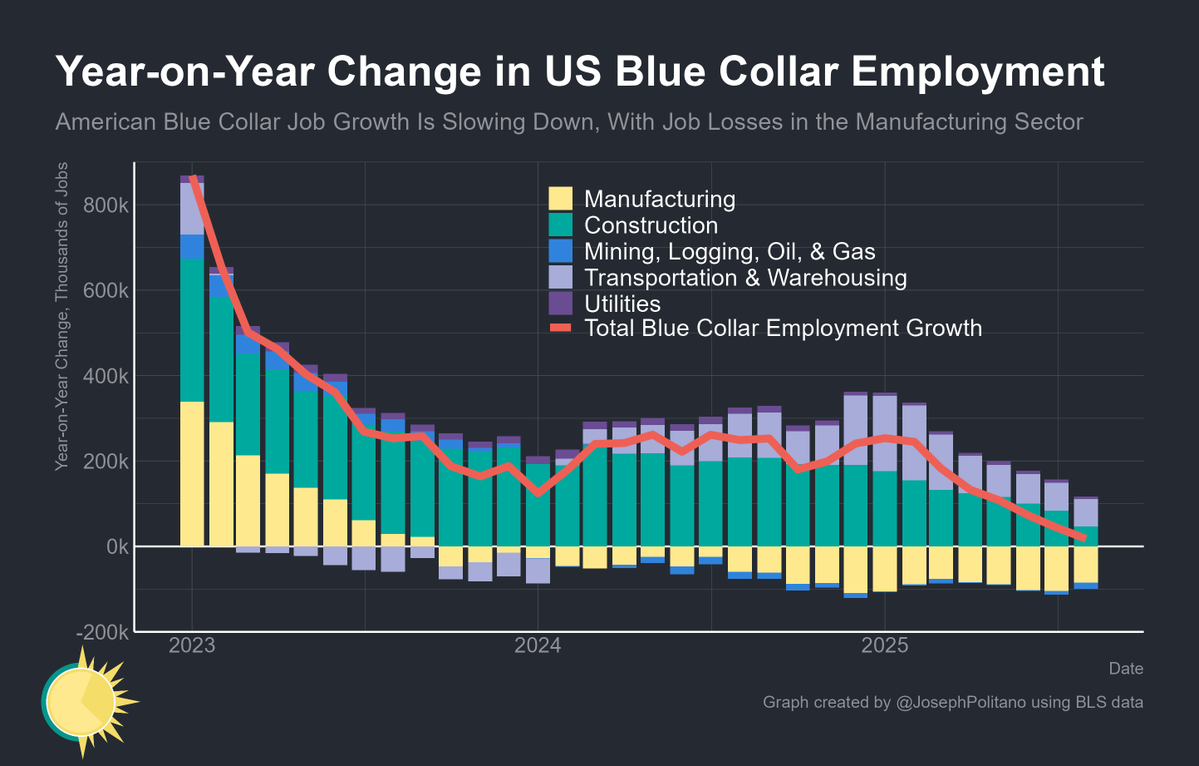
As the writer Derek Thompson pointed out, surveyed manufacturing businesses bring up the same concern again and again: tariffs.
Another confounding aspect of the economy as it stands is that healthcare and social assistance, two sectors that are heavily reliant on government funding and policy, are currently showing the most growth despite Trump’s focus on cutting government jobs and spending. Meanwhile, the manufacturing industry is bleeding employment despite the president’s focus on bringing those jobs back.
Remember: Last month, Trump fired the BLS commissioner because — let’s be real — he thought she was rigging the jobs numbers against Republicans. This month’s numbers were markedly worse. That’s good news about the BLS, because 1) It means we are probably still getting real numbers and 2) It reaffirms the obvious, which is that last month’s jobs numbers were obviously not rigged. But it’s also bad news about the economy, because the numbers are not good.
In July, when I wrote about the five things I got wrong about Trump, I noted that the tariff policy had been going better than I expected so far. Trump was bringing in a lot of extra government revenue and tariffs had not noticeably driven up prices, which I thought would have happened faster. There were a lot of reasonable explanations for this, which is why I flagged three major caveats:
“1) It is early, still, and tariffs may not have impacted consumer pricing just yet. 2) Trump has delayed, reversed course, or altered many of the reciprocal tariffs he announced on ‘Liberation Day.’ And 3) Tariffs are, actually, seriously impacting certain industries.”
Consumer prices are starting to inflate a bit now, but more importantly it looks like the tariffs — and the general unpredictability of the Trump administration’s policies — are impacting business growth across the country. Which makes sense. As The Wall Street Journal editorial board noted, the extra taxes are hitting companies that fuel the manufacturing sector: Tariffs are costing the equipment manufacturing company Caterpillar $1.8 billion this year, Deere $600 million, and Ford $2 billion. General Motors expects to lose $5 billion in profit this year due to tariffs. These are not small numbers, and the costs to manufacturers were always going to show up in the jobs data — especially when these businesses can’t get a clear picture on what the future will look like.
What happens next is anyone's guess, which is part of the problem. The Supreme Court could rule Trump’s tariffs are illegal, and Trump could certainly back out of some of his announced tariffs; he’s done so before, earning the TACO (Trump Always Chickens Out) moniker. Alternatively, the court could also rule that the president’s “reciprocal” tariffs are legal, and he could also end up doubling down; Trump has repeatedly and stubbornly tried to drive tariffs up when he feels a trading partner isn’t sufficiently cooperative.
As for the political implications, Americans are keen to the moment: Trump’s approval on the economy is down five points from February (and 15 points from his first-term average), economic sentiment just took a major hit, and inflation is still a top issue for voters. If Trump can’t right the ship on the fundamental issue of the economy, he’ll have a hard time preserving a House majority next fall — and pursuing his agenda in the second half of his term.
Take the survey: What do you think of the latest jobs report? Let us know.
Disagree? That's okay. My opinion is just one of many. Write in and let us know why, and we'll consider publishing your feedback.
Your questions, answered.
Q: I've been hearing about Trump gunning for a Nobel Peace Prize and have seen headlines that the U.S. under Trump has brokered peace in several conflicts. How true is this and how much credit does the Trump Administration really deserve?
— JS from Crown Point, IN
Tangle: Over the past month or so, President Trump has said he deserves a Nobel Peace Prize, reportedly told Norway he wants a Nobel Peace Prize (the recipient is selected by the Norwegian Nobel Committee), been nominated by several countries for the prize, and downplayed talks about receiving the accolade (Nobel Laureates will be chosen in early October).
Regardless of his motivation, President Trump has said that, in his second term, “I've settled six wars, and a lot of people say seven because there's one that nobody knows about.” We’ll break down the claim for each conflict here, and give each one a quick accuracy rating.
Israel–Iran: Mostly true. Although Iran and Israel were never formally at war, the U.S. did broker a ceasefire — but only after it also participated in (and helped Israel plan) the strikes.
India–Pakistan: Mostly false. India and Pakistan were also not formally at war when they agreed to a ceasefire. And while Pakistan credits Trump with easing tensions, India denies that the U.S. was involved in the mediation.
Armenia–Azerbaijan: Partially true. The two countries have agreed to a transit agreement that the U.S. was involved in mediating in 2025, but have not agreed on terms to end their current conflict.
Rwanda–Democratic Republic of Congo: Mostly true. The U.S. was involved in mediating a peace deal in June. However, armed rebel groups do not believe the peace deal applies to them, and much of the fighting remains active.
Cambodia–Thailand: Partially true. After recent border skirmishes (that did not amount to a war), the two countries agreed to a ceasefire influenced by U.S. trade pressure. Notably, Cambodia has nominated President Trump for the Nobel Peace Prize because of his influence here.
Egypt–Ethiopia: Mostly false. Trump has said he was involved with helping the two sides reach an agreement over an Ethiopian Dam on the Nile River, but no binding resolution has been reached, and the U.S.’s involvement is not official. Furthermore, this disagreement never escalated to war.
Serbia–Kosovo: False. The two sides haven’t formalized an agreement during Trump’s second term, but the White House included this conflict among the seven that Trump referred to in his list. The countries agreed to an economic agreement in 2020 that may have prevented conflict, but did not end an existing war. Talks have stalled since, and Serbia still denies Kosovo’s independence.
Want to have a question answered in the newsletter? You can reply to this email (it goes straight to our inbox) or fill out this form.
Under the radar.
New data from the Bureau of Labor Statistics shows that, between January and August, the number of Americans missing work for National Guard deployments or other military or civic duty reached a 19-year high. During that time span, military deployments resulted in approximately 90,000 instances of employees missing work for a week or more, partly due to President Donald Trump’s deployment of the Guard to Los Angeles and Washington, D.C. However, these absences make up just a fraction of overall workplace disruptions like labor disputes and bad weather, both of which were higher than military-related leaves in August. The Washington Post has the story.
Finance News That Impacts Your Bank Account
The Daily Upside cuts straight to what matters — no filler, no fluff, just smart analysis from former Wall Street pros and veteran financial journalists.
While others chase clicks, we chase clarity on the market moves and economic shifts affecting your money.
Numbers.
- 598,000. The number of jobs added in the U.S. job market in 2025.
- 26,750. The average monthly job gain since May, the month after President Trump announced his “Liberation Day” tariffs.
- 25.7%. The percentage of unemployed people who have been unemployed for 27 weeks in August, the highest monthly share since February 2022.
- 62.3%. The labor force participation rate in August, a 0.4% year-over-year decline.
- +31,000. The increase in health care jobs in August.
- –15,000. The decrease in federal government employment in August.
- 88%. The odds that the Federal Reserve votes to cut interest rates by 25 basis points at its September meeting as of Monday afternoon, according to the CME Group’s FedWatch tool.
- 12%. The odds that the Federal Reserve votes to cut interest rates by 50 basis points.
The extras.
- One year ago today we covered Trump’s and Harris’s economic pitch to voters.
- The most clicked link in yesterday’s newsletter was the U.S. agreeing to release over 300 South Korean workers after a Hyundai factory raid.
- Nothing to do with politics: The James Webb telescope’s latest breathtaking pictures.
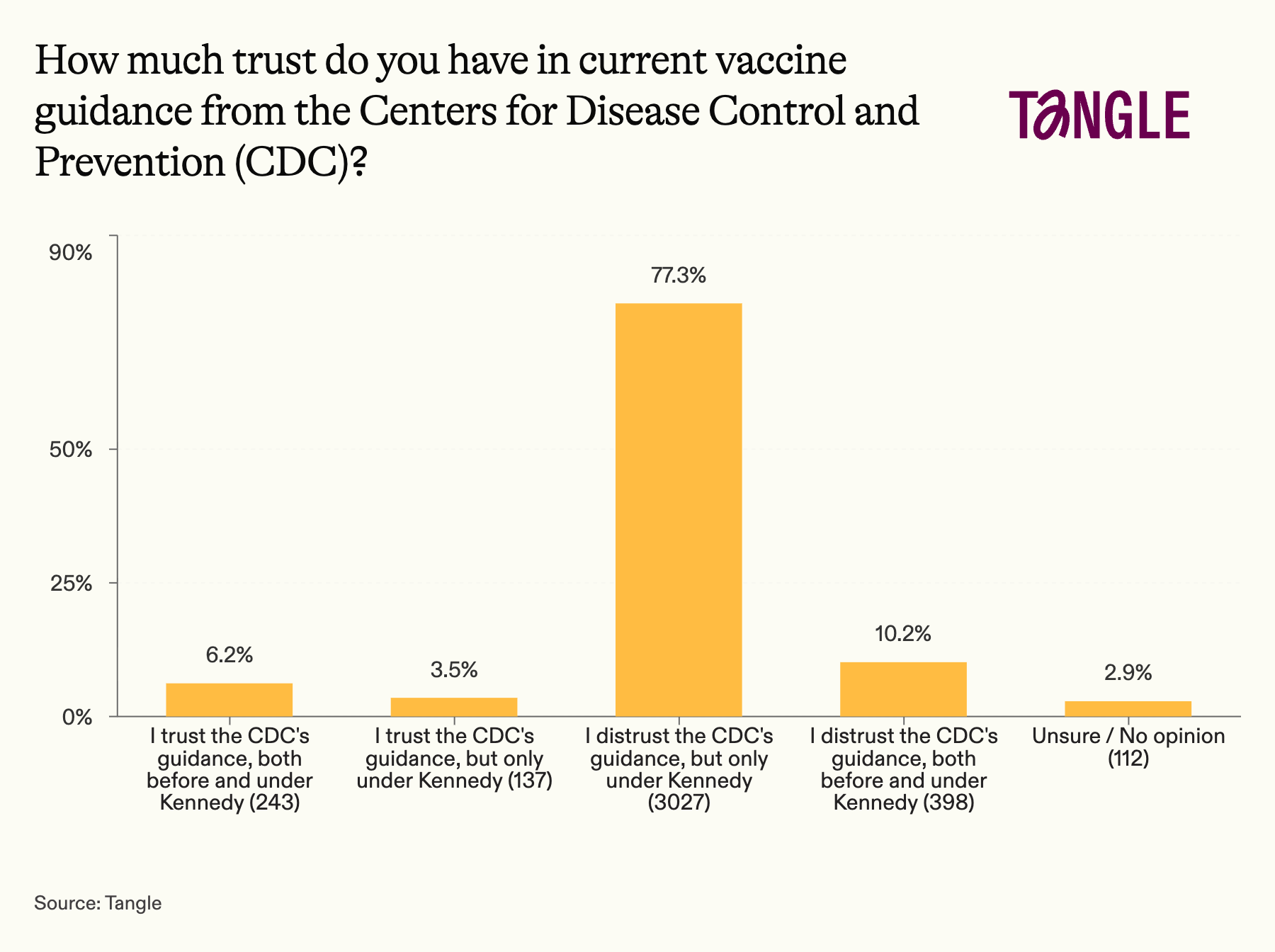
- Yesterday’s survey: 3,917 readers responded to our survey on the CDC with 77% saying they distrust the agency’s guidance under Kennedy. “I didn't completely trust CDC before Kennedy (they got a lot wrong on COVID) but have considerably more distrust under him,” one respondent said.
Have a nice day.
Poachers, disease, and habitat loss have put jaguars at risk of extinction in Mexico, but a new population study from the National Alliance for Jaguar Conservation (ANCJ) reveals a promising upward trend. ANCJ Zoologist Gerardo Ceballos and a team of nearly 50 researchers and local community leaders documented 5,326 jaguars across the country in 2024, up 30% from 2010. “The fact that the country has managed to maintain and increase its population over the last 14 years is extraordinary,” Ceballos said. The Guardian has the story.

Member comments