
I’m Isaac Saul, and this is Tangle: an independent, nonpartisan, subscriber-supported politics newsletter that summarizes the best arguments from across the political spectrum on the news of the day — then “my take.”
Are you new here? Get free emails to your inbox daily. Would you rather listen? You can find our podcast here.
Today’s read: 15 minutes.
A scientific survey of Tangle readers.
Every day, we share an informal survey on our daily topic to get a sense of reader sentiment and show Tangle subscribers what their fellow readers may be thinking. This survey is not at all scientific. However, a team of researchers wants to take a more rigorous look at you, our readership.
Today, we are sharing an opportunity to participate in an independent study led by researchers at the University of Minnesota examining how Tangle readers engage with other people about politics. It would be incredibly helpful for us if you participated. The survey is anonymous, takes five minutes, and gives you the option to enter a lottery for a $200 Amazon gift card.
Quick hits.
- President Donald Trump will deliver a speech with “an important update on Iran” tonight at 9 PM ET. (The speech)
- President Trump signed an executive order directing the Department of Homeland Security to make a list of U.S. citizens in each state who are eligible to vote and barring the Postal Service from sending mail-in ballots to anyone not on the list. The order also instructs the attorney general to prioritize the prosecution of election officials who distribute ballots to “ineligible” voters; it is expected to be challenged in court. (The order)
- The Supreme Court is hearing arguments on Wednesday in a challenge to President Trump’s executive order seeking to end birthright citizenship. Trump is in attendance. (The arguments)
- U.S. and Iraqi authorities said that American journalist Shelly Kittleson was kidnapped in Iraq. A suspect with ties to an Iranian-aligned militia group was arrested in connection with the kidnapping, but Kittleson’s whereabouts remain unknown. (The kidnapping)
- A federal judge temporarily blocked President Trump’s plans for the $400 million construction of a White House ballroom, finding the project requires Congressional authorization. (The ruling) Separately, a federal judge blocked Trump’s executive order ending federal funding for National Public Radio and the Public Broadcasting Service, finding that the order ran afoul of the First Amendment. (The ruling)
If you needed extra money, like, yesterday — you’re not alone.
Between inflation, gas prices, and life happening, a lot of people are scrambling for ways to fatten their bank account without taking on a second job.
The thing is, most of us are leaving money on the table. We’re talking $300 from Amazon shopping smarter, $225/month watching movie previews, even getting companies to forgive chunks of credit card debt.
Some of this sounds like internet nonsense, honestly.
But millions of people are already doing it. The Penny Hoarder compiled the most practical ways to pocket extra cash this month.
Today’s topic.
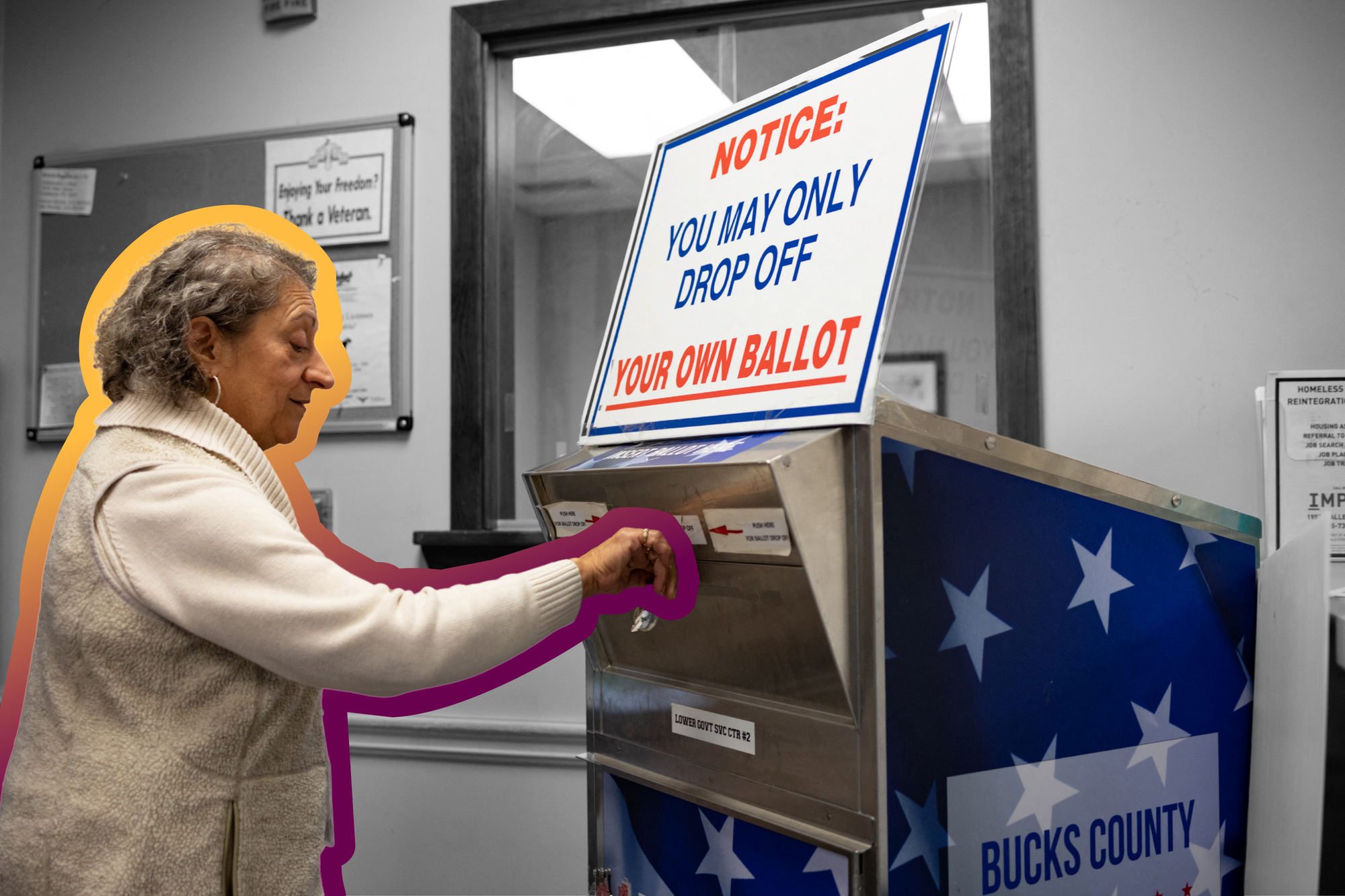
Mail-in ballots. Last Monday, March 23, the Supreme Court heard oral arguments in Watson v. Republican National Committee, a challenge to a Mississippi law that allows mail-in ballots postmarked by Election Day to be counted after Election Day. Several conservative justices appeared sympathetic to the challengers, who argued that the state law violates federal statutes defining the date of elections. If the Court rules in favor of the challengers, more than a dozen states with similar laws could be affected.
Back up: During the Covid-19 pandemic, Mississippi changed its election laws to allow mail-in ballots for the 2020 election to be counted up to five days after Election Day if postmarked by that date. A group led by the Republican National Committee (RNC) challenged the post-election ballot deadline in federal court in 2024. In July of that year, a district judge upheld the law, finding that the five-day period did not violate the intention of existing Election Day statutes. A three-judge panel for the 5th U.S. Circuit Court of Appeals reversed that ruling on appeal, finding that those statutes require all ballots to be received by Election Day. Mississippi appealed that decision to the Supreme Court, which agreed to consider the case in November.
Paul D. Clement, representing the RNC and other plaintiffs, argued that federal statutes require receipt of ballots by Election Day itself. “All agree that elections for federal office have to end on the day of the election specified by Congress, and all agree that you can’t have an election unless you receive ballots, and there must be some deadline for ballot receipt,” Clement argued. “Nonetheless, Mississippi insists that ballots can trickle in days or even weeks after Election Day.”
Mississippi Solicitor General Scott G. Stewart argued that voters are only required to make a final choice by Election Day. “States have broad power over elections. Throughout our history, they’ve used that power to change how they hold elections,” Stewart said. “The dispute is whether Congress blocked just one change, allowing ballots cast by Election Day to be received after that day.”
Justices Clarence Thomas, Samuel Alito, Amy Coney Barrett and Brett Kavanaugh, along with Chief Justice John Roberts, all appeared at various times sympathetic to the arguments presented by the challengers. Justices Kavanaugh and Alito appeared particularly concerned about the “appearance of fraud” that would follow delayed elections, while Justices Barrett and Thomas pressed Stewart on what constituted a final decision. Justices Sonia Sotomayor, Ketanji Brown Jackson, and Elena Kagan all appeared to side with the defense, citing a lack of textual evidence that would abrogate responsibility from the states.
As is typical, the Supreme Court has not indicated when it expects to issue a final decision in the case. If the Court rules on the case this summer, as is expected, states may have only weeks to implement new laws before voting begins in the midterm elections in November.
We’ll get into what the right and left are saying about the case below. Then, Executive Editor Isaac Saul gives his take.
What the right is saying.
- Most on the right think the Court should rule that mail-in ballots must arrive by Election Day.
- Some say the case could have an outsized influence on the midterms.
- Others push back on arguments that stricter standards will hurt voters.
In The New York Post, Betsy McCaughey wrote “what is Election Day? [The] Supreme Court’s answer could swing the midterms.”
“The US Constitution reserves to state legislatures the authority to prescribe ‘the times, places, and manner of holding federal elections.’ True — but the Constitution empowers Congress to set the date,” McCaughey said. “In recent years the meaning of Election Day has been eroded — its finality and certainty upended by state laws allowing absentee ballots to be counted days later. At stake is a national treasure of civic virtue, long understood as the day on which the whole electorate’s votes get counted, and everyone knows the results.”
“Democrats argue that striking down the Mississippi grace period would throw the coming midterms into chaos. But four states — Ohio, Kansas, North Dakota and Utah — eliminated their grace periods last year, when the Mississippi lawsuit was filed… These states expect the grace period to be struck down, and they are on the mark,” McCaughey wrote. “A clear majority of states require ballots to arrive by Election Day to be counted, and no one is protesting that’s a massive disenfranchisement problem. Getting to the mailbox with plenty of time to spare is a small price to pay for the privilege of living in a representative democracy.”
In Reason, Damon Root explored “what’s at stake in Watson v. Republican National Committee.”
“Both sides agree that Congress may, if it wanted to, directly prohibit a state from counting mail-in ballots that arrived after a federal election. The disagreement is about whether Congress already has prohibited the states from doing so,” Root said. “Because federal election law does not explicitly say anything like that, however, the legal wrangling is largely over questions of congressional intent and statutory interpretation, as well as the related question of just how much deference the states ought to receive in this kind of dispute.”
“Mississippi is one of more than a dozen states that currently have such mail-in balloting laws on the books. So the outcome of this dispute could impact election day practices well beyond the borders of the Magnolia State,” Root wrote. “With both a midterm election coming up this fall and a sitting president who recently argued that ‘Republicans ought to nationalize the voting,’ that leaves us with the makings of a Supreme Court decision that is as important as it is controversial.”
On The Wall Street Journal’s Potomac Watch podcast, Kim Strassel discussed speculation that the Court will cause “chaos in elections.”
“All these headlines in the press right now [suggest] that if the Supreme Court goes this way and it kills these grace periods, that there’s going to be chaos around the country and chaos in elections. And I do think that it is incumbent on the Supreme Court. If they are going to get rid of these grace period laws… then they either need to get this opinion out extremely quickly, like right away, so that people have time to plan for it, or they possibly need to stay it,” Strassel said. “It’s not impossible though. I think that’s very different from the arguments that were made, which I found very unpersuasive in this case, that this is unworkable and unfair.”
“There was a lot of talk about overseas and military voters… but [Justice] Kavanaugh also talked [about] how the importance here is simply knowing what the deadline is and then making sure that people have enough time to actually hit that deadline,” Strassel said. “Many states actually already allow their overseas military members to vote online, making sure that their ballots are actually cast and heard… There’s no reason that other states can’t do the same if they’re that concerned about military voters and overseas voters being able to get their ballots.”
What the left is saying.
- The left worries the Court will side with the RNC on dubious grounds.
- Some say the case only fuels Trump’s misleading claims about fraud.
- Others criticize the Court’s justices for focusing on hypotheticals over substance.
In The Nation, Elie Mystal wrote “the Supreme Court looks likely to cave on mail-in ballots.”
“If you take the Republican arguments about Election Day to its logical conclusion, their theory of the case also kills the ability of states to have an early voting period. If the 1845 Election Day Act sets the date certain by which votes must be received, there’s every reason to say that it also sets the date certain for when votes must be cast,” Mystal said. “Obviously, in 1845, there was no ‘early’ voting. Since then, states have been given the power to decide for themselves when Election Day starts. If the Republicans’ theory holds, ballots cast before Election Day are just as invalid as ballots received after Election Day.”
“The Republicans shouldn’t win this case. They shouldn’t have won it in front of the Fifth Circuit. We shouldn’t be here at all. The only reason their argument hasn’t already been thrown out of court is that Donald Trump lost an election and can’t handle that loss like an adult,” Mystal wrote. “But ‘Donald Trump is whining on social media and might launch another coup’ is often enough of a reason for the Supreme Court to upend settled law. They might do it again… My gut tells me it’s a 6–3 win for the hysterical man throwing a six-year temper tantrum.”
In New York Magazine, Ed Kilgore said “[the] Supreme Court risks fueling Trump’s attack on mail ballots.”
“The principal argument for federal-court intervention regarding this state-determined election administration issue is the claim that it violates a federal statute (itself authorized by the Constitution) creating a uniform Election Day for federal elections. Counting ballots received after this uniform day, it is suggested, eviscerates Election Day itself,” Kilgore wrote. “It’s rather a dumb argument if you think about it for a few minutes. Voters casting mail ballots prior to Election Day fill out a ballot, seal and sign it, and turn it over to the U.S. Postal Service. It is just as definitive an act as voting in person before or on Election Day and actually involves more of an effort.”
“Voting-rights advocates shouldn’t overreact to a narrow but adverse decision if it comes. Post–Election Day mail-ballot-receipt allowances are mostly a vestige of the COVID-19 era, in which the Postal Service periodically struggled with handling a suddenly elevated number of mail ballots. Given proper notice, voters can likely comply with new ballot-receipt deadlines, much as they did before the pandemic,” Kilgore said. “But while it’s not inherently a blow to democracy, a restrictive decision in Watson v. RNC could give new impetus to Trump’s more general attack on voting by mail.”
In Slate, Mark Joseph Stern suggested “the Alito wing of the Supreme Court sure sound[ed] sold on Trump’s voter fraud lies.”
“The Supreme Court may be poised to commit the single biggest act of disenfranchisement in modern history in a direct assault on the constitutional authority of states to set election laws… That news, in itself, is a five-alarm fire for democracy. But what makes it even more disturbing is the fact that so many justices proved eager to embrace a legal theory that is incoherent, dishonest, and rooted in paranoid hostility toward mail voting,” Stern wrote. “Because there is so little evidence of [vote-by-mail] fraud, these justices warned of the threat of ‘appearance of fraud’ as being just as dangerous.”
“Justice Samuel Alito asked Mississippi Solicitor General Scott Stuart… if he thought it was ‘legitimate for us to take into account’ Congress’ passage of Election Day statutes ‘for the purpose of combating fraud or the appearance of fraud,’” Stern said. “Stuart explained that even the Trump administration had failed to identify ‘a single example of fraud from post–Election Day ballot receipt in this century.’ But Alito’s argument was not grounded in reality — or, for that matter, law. It is not the Supreme Court’s job to decide whether Mississippi’s law increases ‘fraud or the appearance of fraud’ (though it doesn’t). Its job is to decide whether Congress intended to foreclose grace periods for mail ballots when it set federal Election Day more than 150 years ago. It obviously did not.”
My take.
Reminder: “My take” is a section where we give ourselves space to share a personal opinion. If you have feedback, criticism or compliments, don't unsubscribe. Write in by replying to this email, or leave a comment.
- Today, I reversed both of my prior beliefs about this case.
- The law seems to be on Mississippi’s side, while the effects of overturning it wouldn’t be some sweeping disenfranchisement.
- The pundits might be wrong, and the Court could easily keep the law in place.
Executive Editor Isaac Saul: One question I love to ask readers is: When was the last time you changed your mind?
Try to imagine a moment in the last few months when your position on a political issue changed. And if you can’t think of one, meditate on why. Nobody has ever been right about everything, and there is pretty much a zero percent chance you’re the first person who is. Changing your mind is a sign of intellectual humility.
I like to be open about when my mind changes, because I think we should talk about our intellectual evolutions without shame. For me, today is one of those days.
When headlines about oral arguments came out, the consensus seemed to be that the Supreme Court would strike down Mississippi’s law and upend mail-in voting in several states. I messaged my team on Slack saying that I thought the Court would be right to do so, and I was ready to write about it. Yes, I would prefer if votes postmarked before or by Election Day count, because I want more voices to be heard. But I also believed that this was incongruent with the law — that Election Day was intended to be election day, and our current condition of chronically delayed election results is both untenable for public trust and also not the intended norm for our democratic process.
In other words, I believed these grace periods were an important element of voter access, but I believed ending them would be the correct legal decision.
After reading through oral arguments, though, my position changed. Not only did I come away thinking Mississippi had the law on its side, I also became less convinced about the practical importance of this system for voter access.
Let’s start with the law. Article I, Section 4 of the Constitution says, “The Times, Places and Manner of holding Elections for Senators and Representatives, shall be prescribed in each State by the Legislature thereof; but the Congress may at any time by Law make or alter such Regulations.” So: States make election rules, unless Congress makes rules to alter those regulations? Clear as mud, I suppose.
Both sides of this case agree that Congress could, if it wanted to, directly prohibit a state from counting mail-in ballots that arrived after a federal election. But that isn’t the question in this case — instead, the question is simply whether Congress has already done that. The federal statute at the center of the case is an 1845 law that established the Tuesday after the first Monday in November as “Election Day.” If ballots are counted later, the challengers argue, then the state is violating federal law. Paul Clement, arguing for the challengers, said that casting ballots was implicitly intertwined with Election Day, arguing that “no one would have thought of one without the other.” If that were true, I think he’d have a pretty good argument. In fact, that was my view.
But after reading the arguments, I don’t think it is true.
The justices spent a good deal of time on Civil War exceptions, arguing whether they were more analogous to absentee voting or mail-in voting. Justice Sonia Sotomayor basically obliterated the challengers’ argument when she referenced the history of states allowing soldiers in the field to vote before Election Day and the states that created a grace period for soldiers after Election Day, including by mail. This simple fact establishes that we’ve been receiving and counting votes after Election Day for more than a century, and that each state has handled its own elections independently under the existing federal laws.
Even if the justices were to argue precedent and history to some kind of draw, in that case they should defer to the states, which have a clearly defined primary role in administering elections.
All of this, to me, clearly supports a) that Congress has not pre-empted the states and b) that Mississippi is acting within historical precedent. Furthermore, mail-in voting continued to expand in the 20th century unencumbered because federal legislators understood these facts. Justice Ketanji Brown Jackson, whom I’ve criticized in these pages recently, also asked sharp questions about the core argument here, which is really not about election practices but who decides when ballots must be received and whether Congress prohibited states from making these decisions. Her focus seemed the most important. Until Congress changes the existing federal laws, these states can continue counting votes that arrive late so long as they were cast on time.
To me, this pretty much resolves the legal question. On the practical outcomes, my opinion similarly reversed. Slate’s Mark Joseph Stern, a former Tangle Live guest and a court watcher whose opinion I respect, noted that more than 750,000 late-arriving ballots were counted as part of a state’s grace period in 2024. He called the potential for those votes to be thrown out the “single biggest act of disenfranchisement in modern history” and a “five-alarm fire for democracy.”
After reading more into this issue, I disagree. For starters, the law in Mississippi and many other states didn’t even exist six years ago. Going back to a pre-pandemic norm is not a five-alarm fire for democracy. Also, a five-day grace period is already a pretty arbitrary line to draw, which is kind of the challengers’ point. Would it be a major disenfranchisement if we were going from a ten-day grace period to five? Washington state’s grace period allows it to count ballots for 21 days after the election; if it had to cut that to meet Mississippi’s five-day limit, would that be a five-alarm fire? I doubt we’d frame it in those terms, yet it’d be an order of magnitude larger of a change.
Obviously, if Mississippi’s law goes, then so does Washington’s and all the others. And in that scenario, I think voters won’t be disenfranchised — instead, they will just change their behavior to ensure ballots get to their election offices by Election Day. I struggle to envision a scenario where, assuming the new rules are clearly communicated, a significant portion of voters would be unfairly restricted from casting a vote under this new standard. After all, voters in every state are always working on an established deadline as it is, and voters in the vast majority of states already have to have ballots in by Election Day. Even in states with generous deadlines, it’s not a foolproof system. Voters are human, which means they’ll push up against the deadline and sometimes miss it no matter what it is. In California, where votes are counted for a generous seven days after the election, 122,000 mail-in ballots were rejected in 2024 for arriving too late, having mismatched signatures, or lacking any signature at all.
In my final opinion shift, contrary to the general framing, I also don’t think it’s at all clear how the court will rule. Despite some tough questioning, Justice Roberts and Justice Barrett’s positions were not obvious to me, and I wouldn’t be shocked to see a 5–4 ruling in Mississippi’s favor. That isn’t just my view: Damon Root of Reason said (under “What the right is saying”) it was “too close to call,” while Advisory Opinion hosts David French and Sarah Isgur also said they did not think the final ruling was clear. Amid the blaring headlines, those are courtwatchers I trust the most.
Perhaps most interestingly, I’m not entirely sure which party benefits more from each potential outcome. Conventional wisdom seems to be that Republicans are pursuing these changes to help win November’s midterms, but the evidence is not as strong for this as it used to be. Most of the states with these grace periods are “blue,” but Democratic voters in today’s political alignment are more likely to follow the news closely and be aware of these rule changes. In 2024, higher voter turnout would have hurt Democrats and helped Republicans; and in red Ohio, Republicans opted to preemptively end their grace period ahead of this challenge, giving them more time to alert their voters about a change. That’s to say nothing of active duty military who may be overseas for the November election and often get exemptions for late-arriving ballots. Restricting grace periods could hurt Democrats, but it could hurt Republicans, too.
An alternate theory is that both sides are fighting for honestly held principles, regardless of whether those positions help them electorally. Conservatives challenging this law in Mississippi believe in a stricter view of Election Day while liberals defending it want to maximize openness in the process.
Ultimately, 72 hours ago, I believed a law requiring these ballots to be counted violated federal law, and that the Court was going to strike the law down. I also believed that doing so would infringe on voting access. Now, my view is that states are well within their established rights to make changes to their mail-in voting laws, and that the court should (and might) let Mississippi’s law stand. Yet if they opt to strike it down, it won’t be a sweeping disenfranchisement of voters. It’d just mean bringing 14 states in line with all the rest, and voters in those states adjusting their behavior accordingly.
Take the survey: How do you think the Supreme Court should rule in this case? Let us know.
Disagree? That's okay. Our opinion is just one of many. Write in and let us know why, and we'll consider publishing your feedback.
Under the radar.
On Sunday, pharmaceutical company Eli Lilly reached a $2.75 billion deal with biotechnology company Insilico Medicine to bring drugs discovered and developed by artificial intelligence (AI) to market. Insilico has developed 28 drugs using generative AI, with approximately half in clinical stages of testing. It uses the technology to expedite preliminary research and synthesize molecules more quickly than traditional methods. A representative for Eli Lilly said the partnership seeks to “accelerate the identification of promising therapeutic candidates across multiple disease areas.” CNBC has the story.
You’re probably overpaying for half the things you buy.
Your car insurance, credit cards, Amazon purchases — companies are banking on you not noticing.
We found a list of ways to stop getting ripped off and start pocketing that money instead.
Some could save you thousands. See which ones apply to you.
Numbers.
- 23.1%. The percentage of voters who voted by mail in the 2018 midterms, according to the Census Bureau.
- 43.0%. The percentage of voters who voted by mail in the 2020 election.
- 29.0%. The percentage of voters who voted by mail in the 2024 election.
- 25%–26%. The approximate percentage of voters in the age 18–24, 25–44, and 45–64 demographics who voted by mail in the 2024 election.
- 36.8%. The percentage of voters aged 65+ who voted by mail in 2024.
The extras.
- One year ago today we wrote about Trump’s executive order about law firms.
- The most clicked link in our most recent newsletter was the Supreme Court’s ruling on conversion talk therapy.
- Nothing to do with politics: A look back at a famous Google beta announced 13 years ago today.
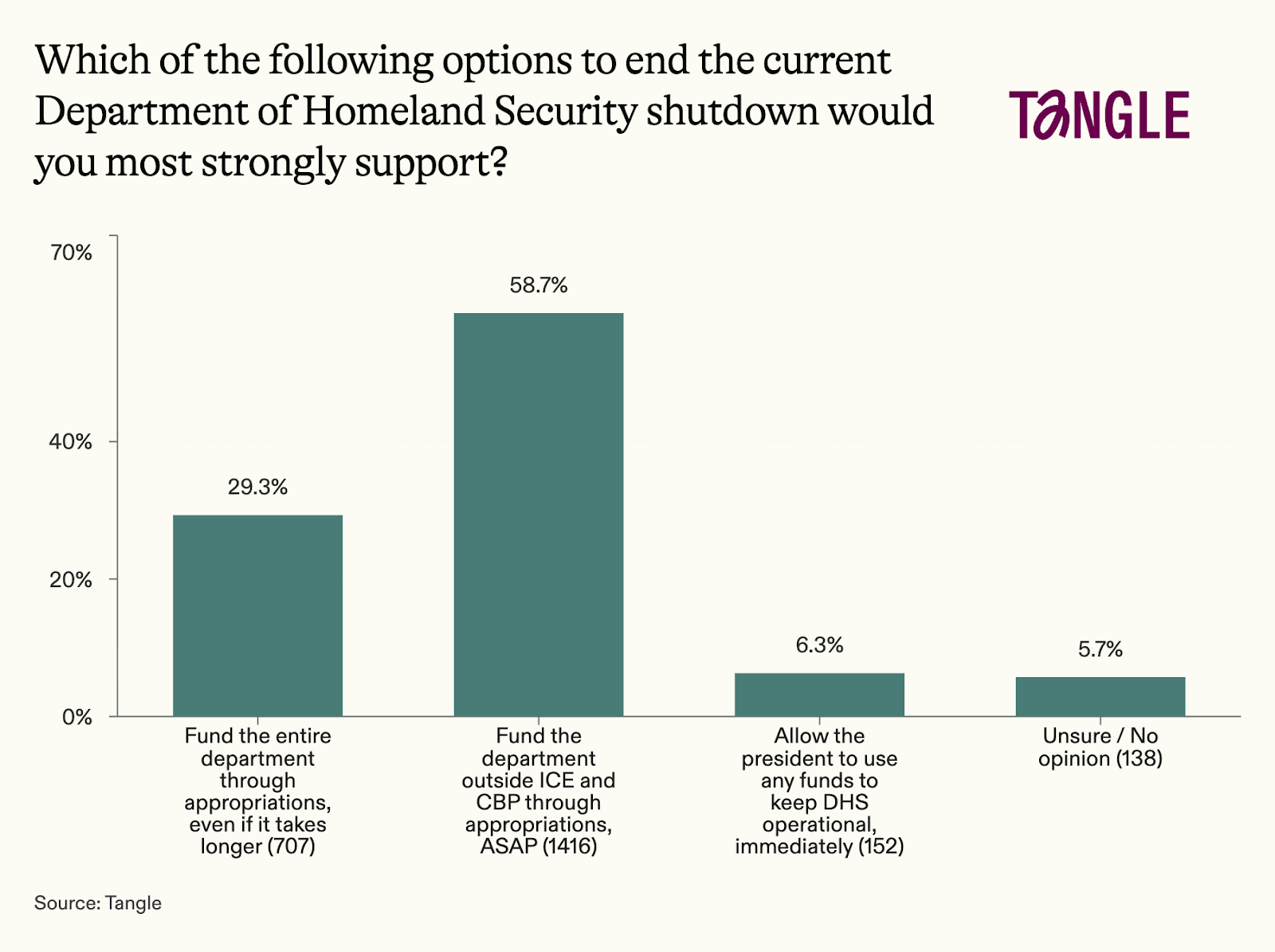
- Our last survey: 2,413 readers responded to our survey on the options to end the current Homeland Security shutdown with 59% supporting funding the department, without ICE or CBP, as soon as possible. “Congress needs to do its job! It is shameful that they left Washington instead of staying to do their job,” one respondent said. “Frankly, government shut-down is a misnomer. For most Americans, life goes on as usual. The freeways operate, the airports, hospitals, everything keeps going,” said another.
Have a nice day.
When a bear attacked the Martinez family’s farm animals in Cordova, New Mexico, their 12-year-old dog Honey — half-blind and far outmatched — fought back. The next morning, the family found her severely injured; but Honey had done her job, saving dozens of animals (including 60 chickens). To help provide affordable care for Honey, Española Humane stepped in to bandage her wounds and give her the medication she needed. “She’s our little savior. She’s been nicknamed the bear slayer, and we’ve just come to find out that the bear slayer is afraid of the vacuum cleaner,” Denise Martinez said. KOB has the story.

Member comments