
I'm Isaac Saul, and this is Tangle: an independent, nonpartisan, subscriber-supported politics newsletter that summarizes the best arguments from across the political spectrum on the news of the day — then “my take.”
Are you new here? Get free emails to your inbox daily. Would you rather listen? You can find our podcast here.
Today’s read: 14 minutes.
Change is coming to Tangle.
We’re working to build the most trusted political news outlet in the world. As part of that effort, we fixate on the small things — language choices, structural tweaks, refined coverage approaches, and the like. As a staff, we’re constantly scrutinizing our editorial choices and thinking of ways they can be improved. And occasionally, every couple of years, we decide on a set of significant changes that we share with the Tangle community.
In tomorrow’s Friday edition, we’ll give updates on our editorial guidelines, changes to the newsletter’s structure, and new policies for our comment section. For each update, we’ll talk through what led to the decision, why we’re making it now, and what we hope the effect will be. The full edition will be sent to free and paid members, so keep an eye out for it in your inbox tomorrow.
Quick hits.
- Russia has reportedly expanded its intelligence sharing and military cooperation with Iran to assist its attacks on U.S. forces in the Middle East. (The report)
- The Israeli military struck an Iranian natural gas processing facility, the first such strike in the current conflict. U.S. officials confirmed that the Trump administration approved the strike. (The strike) Separately, President Donald Trump waived the Jones Act, a law requiring goods shipped between U.S. ports to be transported on ships that are U.S.-built, -owned, -flagged and -crewed, for 60 days. The White House said the move is intended to “mitigate the short-term disruptions to the oil market” during the Iran war. (The suspension)
- The Federal Open Market Committee voted 11–1 to keep interest rates unchanged at its current 3.5%–3.75% range. The committee noted uncertainty in the U.S. economic outlook due to the conflict in the Middle East. (The vote)
- National Intelligence Director Tulsi Gabbard testified before the Senate Intelligence Committee to update lawmakers on threats facing the United States. On Iran, Gabbard said the regime “appears to be intact but largely degraded” by U.S. and Israeli strikes. (The testimony)
- The Senate Committee on Homeland Security and Governmental Affairs voted 8–7 to advance Senator Markwayne Mullin’s (R-OK) nomination as Department of Homeland Security secretary to the full Senate. Senate Majority Leader John Thune (R-SD) says a final confirmation vote could come as soon as next week. (The vote)
Americans Born Between 1941–1979 Can Receive These 10 Benefits This Month
You could be missing out on $1,000s, and you might not even realize it.
Sure, you might know about some senior discounts at diners or retail stores. But what you might not know is there are a number of lesser-known programs that can help slash bills, reduce insurance costs, and unlock powerful financial perks — right now.
We pulled together some of the most valuable money moves for 2025. Cut expenses, boost your retirement, and recession-proof your finances.
But act fast — we don't know how long these programs will last!
Unlock Your Savings: See the Full 2025 Checklist.
Today’s topic.
The SAVE America Act. On Tuesday, the Senate voted 51–48 to begin debate on the Safeguard American Voter Eligibility Act, also known as the SAVE America Act. The bill would require citizens to present documentation confirming their citizenship when registering to vote and require photo identification to vote in federal elections. Tuesday’s vote formally initiates discussion of the bill on the Senate floor, a precursor to a potential final vote.
Back up: In September 2024, the House rejected an attempt to pass an earlier version of the SAVE Act that was paired with a government spending bill. In April 2025, the House passed another version of the bill, but the Senate did not take it up. The latest version of the bill has become a priority for President Donald Trump, with the president saying earlier this month that he will not sign any legislation until the act is passed. The House voted 218–213 to pass the bill in February, but it still must overcome the 60-vote filibuster threshold to pass the Senate, where Republicans have a 53–47 majority.
Under current law, people registering to vote must present their driver’s license or the last four digits of their Social Security number to verify their eligibility. If neither form is available, states can verify citizenship through a federal database. For those registering to vote by mail-in ballot, states verify identity by comparing the signature on the ballot to the one on file.
The SAVE America Act would limit mail or online voter registration and require documentary proof of citizenship (such as a birth certificate or passport) to register. The bill would also mandate government-issued photo ID at polling places. To vote by mail, voters would need to attach a copy of their identification when requesting a ballot and sending it back. Alternatively, people voting by mail could submit the last four digits of their Social Security number, along with an affidavit stating that they could not obtain a copy of a valid photo ID. Furthermore, the law would require states to submit their voter rolls to the Department of Homeland Security for cross-referencing with citizenship data.
Republicans say the bill is necessary to maintain the integrity of U.S. elections, particularly by preventing noncitizens from voting. In recent weeks, some GOP lawmakers have called on Senate Majority Leader John Thune (R-SD) to force a “talking filibuster” — requiring Democrats to physically hold the floor to block the bill from coming to a vote — to work around the 60-vote threshold that stands in the way of a final vote. Thune, however, has so far resisted, saying that Republicans do not have sufficient votes for the move.
In proceeding to debate on the bill, Republicans say they want to bring national attention to the effort and force Democrats to go on record about why they don’t support it. Sen. Eric Schmitt (R-MO) is expected to begin debate with a series of amendments backed by President Trump, including ending unsolicited mail-in ballots (with exceptions for military service, disabilities, illnesses, and travel), banning biological males from competing in women’s sports, and prohibiting transgender surgeries for minors.
On Tuesday, Senate Minority Leader Chuck Schumer (D-NY) said that Democrats are united in opposition to the bill and will fight its passage for as long as the debate process lasts. Democrats claim the SAVE America Act addresses a nonexistent issue — voter fraud and noncitizen voting — and its restrictions would only dissuade or burden potential voters. Some have also suggested the effort is designed to promote mistrust in election security ahead of the midterm elections, allowing Republicans to claim the results are fraudulent if they suffer significant losses.
Today, we’ll cover the latest developments in the push to pass the SAVE America Act, with views from the left and right. Then, Executive Editor Isaac Saul gives his take.
What the left is saying.
- The left opposes the bill, with many arguing it would disenfranchise a significant number of Americans.
- Some say the legislative push is derived solely from Trump’s grievances.
- Others suggest Republicans have little shot of passing the bill.
For The Brennan Center, Michael Waldman wrote about the “SAVE Act reach[ing] the Senate.”
“Why this bill, now? President Trump, in the middle of a drive to undermine future elections, calls it his number one priority. The public has a different idea. A recent New York Times/Siena poll asked voters what they see as the most important problem facing the country. The war? The economy? The percentage of voters who wanted Congress to focus on ‘election integrity’ was… zero,” Waldman said. “This legislation goes far beyond, say, requiring identification at the polls. The requirement to show a passport or birth certificate to register to vote would block many, many more American citizens from voting than any voter ID rule that has come anywhere close to passage.”
“The newest version of the SAVE Act has been stuffed with bad ideas. It would require states to hand sensitive voter roll information over to the Department of Homeland Security to scrutinize. We already know that the federal government has requested — and, in some states, received — the ability to demand the removal of specific voters from the rolls,” Waldman wrote. “Again, we must ask: Why this, why now? Sen. Mike Lee (R-UT) said the quiet part out loud. He posted a chart showing that the prediction site Polymarket now shows that ‘Democrats are the favorites to win control of the Senate in 2026.’”
In The New York Times, Jamelle Bouie asked “this is what the president is fixated on right now?”
“As the president sees it, and as the name would have you believe, the SAVE Act is meant to secure American elections against corruption and malfeasance,” Bouie wrote. “But to this president, as we should know by now, a ‘rigged’ election is one that he lost or did not win to his satisfaction. To Trump, the 2016 presidential election, in which he won the Electoral College but lost the popular vote, was ‘rigged.’ So was 2020, where he lost outright and then led his supporters in a failed but destructive effort to ‘stop the steal.’”
“Trump does not believe that he can legitimately lose an election… The SAVE Act is an attempt to make that distinction a political reality by removing as many mere Americans from the voting pool as possible and elevating the ‘true’ people of the United States — who just so happen to support Trump and the Republican Party — as the only legitimate players in American political life,” Bouie said. “The point of the SAVE Act… is to use a ginned-up panic over noncitizen voting to disenfranchise the tens of millions of Americans who oppose the president and who have, as a result, been placed outside the political community.”
In CNN, Aaron Blake suggested “Republicans face a growing conundrum on the ‘SAVE America Act.’”
“Congressional Republicans have spent years playing into President Donald Trump’s wild claims about undocumented immigrants and illegal voting… The party appears stuck between a rock and a hard place when it comes to the legislation the GOP has dubbed the ‘SAVE America Act’ to address this purported problem,” Blake wrote. “The rock is the increasingly apocalyptic demands of a base and a president who appear insistent about this legislation, and the hard place is the fact that Senate Republicans don’t appear to have any straightforward way to pass it like the House did.”
“Perhaps the most oft-mentioned idea is implementing the ‘talking filibuster’… But this works better in theory than in practice. In reality, it could simply mean that the Senate’s efforts get gummed up for weeks or months, with no guarantee of success. The process would also mean Democrats could offer amendments that could torpedo that whole bill,” Blake said. “The final option would be to nix the filibuster entirely — the so-called ‘nuclear option.’ But similar to when Democrats floated this idea earlier this decade, the Senate GOP doesn’t seem to have the votes. And some more institutionally minded and centrist Republicans would surely fear what that would portend.”
What the right is saying.
- The right supports the bill, and many note that its core provisions are overwhelmingly popular with voters.
- Some worry that the Trump-backed version of the bill could backfire on the GOP.
- Others encourage Republicans to accept a compromise.
In The Daily Caller, Travis Taylor said “if democracy means listening to voters, [the] Senate should pass SAVE America Act.”
“As a professional pollster, I can tell you that few political issues, if any, enjoy the kind of strong, bipartisan support that the SAVE America Act enjoys,” Taylor wrote. “When it comes to election integrity, there are two groups of people. One group wants to ensure only eligible Americans are casting ballots. The other group is willing to tolerate election fraud. There is no third group. The American people are overwhelmingly in the first.”
“Despite what the elites say, Americans’ concerns about election integrity aren’t discriminatory or paranoid — they are perfectly reasonable. Democracy requires trust in elections — so that no matter who wins or loses everyone accepts the outcome. This leads to more civic harmony, a stronger society, and a government more in line with what people actually want,” Taylor said. “Senate Democrats should take a look at the polls and realize that supporting the SAVE America Act is a huge opportunity to deliver for most of their voters. And, if they won’t do that, then Republican Leader John Thune should force the issue and show the American people which party reflects their values.”
The Wall Street Journal editorial board wrote about “why the SAVE America Act… won’t.”
“Mr. Trump now wants to expand the SAVE America Act. One of his ideas is to countermand dozens of state laws on mail voting, by restricting such ballots to people who are sick, disabled, serving in the military, or traveling,” the board said. “As an election policy, this has real upside. Yet many GOP states let anyone vote absentee. Do Republicans really want to endorse having the federal government overrule the election laws in Florida, Georgia, Wisconsin, Ohio, Pennsylvania, Oklahoma, Kansas, and more?”
“Audits in a variety of places — Georgia, Michigan, Texas, Utah, Idaho — have found noncitizen voting and registration to be rare. Other states might be worse, but consider incentives: Illegal immigrants who want to stay are trying to avoid being noticed by the authorities,” the board wrote. “But the SAVE America Act wouldn’t turn blue states red, and it can’t save Republicans from voter anger at unpopular policies. In the MAGA era, the bill could even marginally hurt the GOP. Kamala Harris in 2024 won college graduates and voters earning over $100,000 a year. Mr. Trump carried those with no degrees and lower salaries. Which coalition is most likely not to have passports and birth certificates handy?”
In Fox News, David Marcus argued “[the] Senate GOP should take Fetterman’s deal on voter ID.”
“Over the next several days, perhaps even stretching into next week, the United States Senate, that grave and august deliberative body, will performatively waste time with impassioned speeches over the SAVE America Act, which they all know will never pass,” Marcus said. “There may, however, be an off ramp to this Mobius loop of legislative futility: A proposal from Sen. John Fetterman, D-Pa., would have the upper body vote on a clean, simple, voter ID bill, without provisions regarding mail-in ballots or citizenship.”
“Even without the provisions regarding citizenship and mail-in voting, a law requiring a valid ID to vote in federal elections would be a major victory for Republicans… Politically speaking, such a clean voter ID bill would put Democrats in a much tougher bind than they are in today, because they lose every one of their somewhat plausible-sounding objections to the SAVE America Act,” Marcus wrote. “The American people neither need nor desire a week of pointless speeches about a bill that can’t pass. Instead, let the Senate do some actual work, and at the very least pass a simple, popular and effective voter ID bill.”
My take.
Reminder: “My take” is a section where we give ourselves space to share a personal opinion. If you have feedback, criticism or compliments, don't unsubscribe. Write in by replying to this email, or leave a comment.
- Election security has become perhaps my biggest area of expertise over my time with Tangle.
- Voter fraud happens and election fraud is very rare — however, laws to address them probably don’t cause voter suppression.
- I wouldn’t support this bill, but I would support a bill requiring ID to vote that also makes it free and easy to get IDs.
Executive Editor Isaac Saul: I’ll cut to the chase and put my cards on the table immediately:
- We do not need to change the proof of citizenship requirements for people to vote.
- We could benefit from voter ID laws, with one important stipulation.
Now that you know where I’m going to land at the end of this take, I’ll show my work here:
As longtime Tangle readers know, I inadvertently became one of the more prominent reporters on the “election fraud” beat over the last six years. I had a thread on Twitter that went viral during the 2020 election, where I explained, debunked, or (in rare cases) validated voter- and election-fraud allegations in real time. I went on a radio show where the host was giving out cash awards to people who could share an election fraud theory that I couldn’t explain. Since then, I’ve investigated and written extensively about all manner of allegations that the 2020 election was stolen, from Dinesh D’Souza’s film 2,000 Mules to the way the story was proffered by characters like Sidney Powell. And, I’m proud to say, I changed a lot of people’s minds.
In short: This is an area where I’ve become a bit of an “expert,” and one I’m deeply interested in because — honestly — if the 2020 election was stolen, or our elections were vulnerable to widespread fraud, it’d be the biggest story of my lifetime. I’d want to be the journalist who broke that story. But after years of reporting on this issue extensively, a few obvious truths stand between that theory and reality.
First, voter fraud (that is, individuals casting illegal ballots) happens in most elections. A lot of people who trust our elections get caught by denying that, but it does happen — it’s just a very tiny fraction of all votes cast. Voter fraud is often caught and prosecuted, and I don’t know of a single election where instances of fraud changed the outcome. It often happens accidentally, through people voting at the wrong precinct or casting a ballot when they are no longer eligible. When it happens intentionally, it’s most often a family drama (like someone trying to cast a ballot for their dead parent who hasn’t yet been cleared from the voting rolls).
Election fraud, which is the systematic manipulation of an election by groups, is extremely rare. Still, election fraud has changed the outcome of small, local elections in rare cases where a few hundred votes can decide the outcome — most recently, a 2020 New Jersey City Council election in Paterson, New Jersey. Another prominent example in the 21st century featured former Rep. Michael “Ozzie” Myers, who was caught bribing election workers to stuff ballot boxes in Philadelphia’s 2014 through 2018 elections. He pleaded guilty in 2022 and was sentenced to two and a half years in prison. That’s a good example of what election fraud usually looks like.
Unauthorized immigrants casting ballots may be the least common version of both voter fraud and election fraud. We know this because many states — including Georgia and Texas — have spent millions of dollars auditing elections and investigating this very phenomenon. In Texas, the state found 2,700 illegal immigrants on its voter rolls. On one hand, that is a lot of people. On the other hand, that is just the people who could have voted, not the people who tried to. And 18 million people are on the Texas voter rolls, so that’s 0.015% of all voters. Texas’s audit, in total, found one million people on voter rolls it deemed ineligible, so unauthorized immigrants make up a very tiny fraction of just this ineligible-but-registered population (and again, these weren’t people who voted, but simply might have been able to get away with voting because of bad voter records).
Still, given all this, I don’t think this issue is quite as simple as “We’re trying to fix a problem that doesn’t exist.” There is a problem, which is that people lack trust in our elections. And in states like Texas, where voter rolls are not being kept up properly, we do end up with a lot of people who are still eligible to vote when they shouldn’t be. Have Trump and Republicans exacerbated this lack of trust? Of course. Do I think it’s absurd the president is talking about refusing to sign any legislation until this non-pressing problem is addressed? Definitely. Do I wish they were focused on solutions like better data sharing across state lines and keeping voter rolls more up to date? Absolutely. Am I happy about any of this? No. But is there a solution here that might be beneficial? Actually, I think so.
In 2023, I wrote about how I changed my mind on voter ID laws. The upshot of that piece is that voter ID laws are commonplace across our Western peers, and it shouldn’t be that controversial to ask people to show their identification to vote. Also: Voters presenting IDs could reduce time and costs elsewhere, as it would almost certainly reduce the number of people accidentally voting in the wrong precincts, or voting as a dead relative, or casting a ballot that (later) needs to be cured because of a bad signature or some other minor, technical issue. It could even relieve some of the stress on states that have to cross-reference all manner of data points (from signatures to address changes) if we had a more direct system of voter verification.
Just as very little evidence shows election fraud is a real problem, very little evidence shows that voter ID laws disenfranchise voters. We have studied this in the states that have implemented these laws. Obviously, regulations will impact more people if they’re implemented at the federal level, but I think the solution is simple: In conjunction with a voter ID law, include funding to provide government-issued IDs for free to anyone who doesn’t have one (often the elderly and low-income). If Republicans are serious about this issue, they could spend a little bit of money to make sure no American citizens are cut out of the process for lack of means.
Short of that, I wouldn’t support a voter ID law. But I think that would be a real path to get it done. Indeed, Sen. John Fetterman (D-PA) is proposing a standalone voter ID bill that, with some small amendments, could be just the kind of thing that (God willing) restores faith in our elections and does it without restricting the right to vote for any American.
Another upside of this route is that it would avoid all the other negative impacts of the SAVE America Act’s complicated, and in some cases draconian, provisions. For example, requiring people who are registering to vote, or changing their precinct, to present not just photo ID but proof of citizenship would create all manner of complications, especially for married women who have changed their names (some 69 million Americans) and town clerks who would be responsible for processing millions and millions of documents for a very, very small issue. Given the cost, time, and absolute mayhem these changes would cause at the local level, the upside is very close to nonexistent. To learn more about this, I recommend reading our deep dive on the original SAVE Act from April 2025.
Maybe such a compromise doesn’t stand a chance in this iteration of Congress, but real reform that helps improve confidence in our elections, brings us in line with peer countries in the Western world, and does it all without disenfranchising anybody is the kind of thing most Americans would rally behind.
Take the survey: What do you think of the SAVE America Act? Let us know.
Disagree? That's okay. Our opinion is just one of many. Write in and let us know why, and we'll consider publishing your feedback.
Your questions, answered.
Q: Is there a reason oil production volume is measured in barrels but spilled oil is measured in gallons?
— Morgan from Lenexa, KS
Tangle: Measuring crude oil production in barrels is a vestige of the history of the oil trade between American and English merchants. In 1866, American oil producers met in Titusville, Pennsylvania, to agree on a standard unit of measurement when shipping oil. They decided to use the tierce, a specific type of 42-gallon barrel that had developed in England over centuries of craftsmanship. Watertight tierces were a common shipping container for a variety of goods in the 19th-century United States, and when filled with oil they weighed about 300 pounds, the most weight one worker could reasonably handle during shipping.
Because of its standard use in shipping, the 42-gallon barrel became the industry standard measurement for oil production over the following two decades. It has remained the industry standard for measurement since then, even though modern oil drums hold 55 gallons and most oil is transported in tankers or via pipelines.
Measuring oil spills has its own complicated history. The National Oceanic and Atmospheric Administration tracks oil spills in both barrels and gallons. During and after the 2010 Deepwater Horizon oil spill, the U.S. government also issued estimates in both barrels and gallons, and media coverage used both metrics to discuss the spill. Some writers criticized this coverage, arguing that using barrels or switching between barrels and gallons was confusing for U.S. readers and misled them on the amount of oil that was spilled. Environmental organizations tend to primarily use gallons to describe spilled oil, arguing it is easier for the public to comprehend the measure; however, barrels spilled is the metric used to impose fines or track the economic impact of oil spills.
Want to have a question answered in the newsletter? You can reply to this email (it goes straight to our inbox) or fill out this form.
Under the radar.
On Tuesday, Arizona Attorney General Kris Mayes (D) filed criminal charges against prediction market platform Kalshi, alleging that the company operates an illegal gambling business. Kalshi and its rival platform Polymarket offer users the ability to place bets on real-world outcomes in politics, business, sports, and more. Arizona claims that Kalshi’s business runs afoul of state laws on unlicensed gambling by allowing bets on professional and college sporting events, as well as elections. Kalshi, which called the charges “meritless,” has argued that its platform is a financial marketplace and should not be subject to gambling regulations. Other states have sued these platforms on civil grounds, but Arizona’s criminal lawsuit raises the stakes in the ongoing fight. The New York Times has the story.
10 Benefits Americans 45–84 Rarely Claim
Beyond the usual senior discounts, lesser-known programs can slash bills, cut insurance costs, and unlock real financial perks — many with eligibility windows that won't last.
We compiled the most valuable money moves for 2025 to help you cut expenses and strengthen your retirement.
Numbers.
- 71%. The percentage of U.S. voters who say they support the SAVE America Act, according to a February 2026 Harvard CAPS/Harris poll.
- 91%, 50%, and 69%. The percentage of Republicans, Democrats and independents, respectively, who say they support the bill.
- 54%. The percentage of U.S. voters who say stopping voter fraud should take priority over voting access concerns for eligible citizens.
- 58%. The percentage of U.S. voters who believe there is at least some voter fraud in U.S. elections.
- 83% and 16%. The percentage of U.S. adults who favor and oppose, respectively, requiring all voters to show government-issued photo identification to vote, according to an August 2025 Pew Research poll.
The extras.
- One year ago today we wrote about the deportations under the Alien Enemies Act.
- The most clicked link in yesterday’s newsletter was our newest YouTube video about American evacuations from the Middle East.
- Nothing to do with politics: See what’s on the radio waves across the world with Radio Garden.
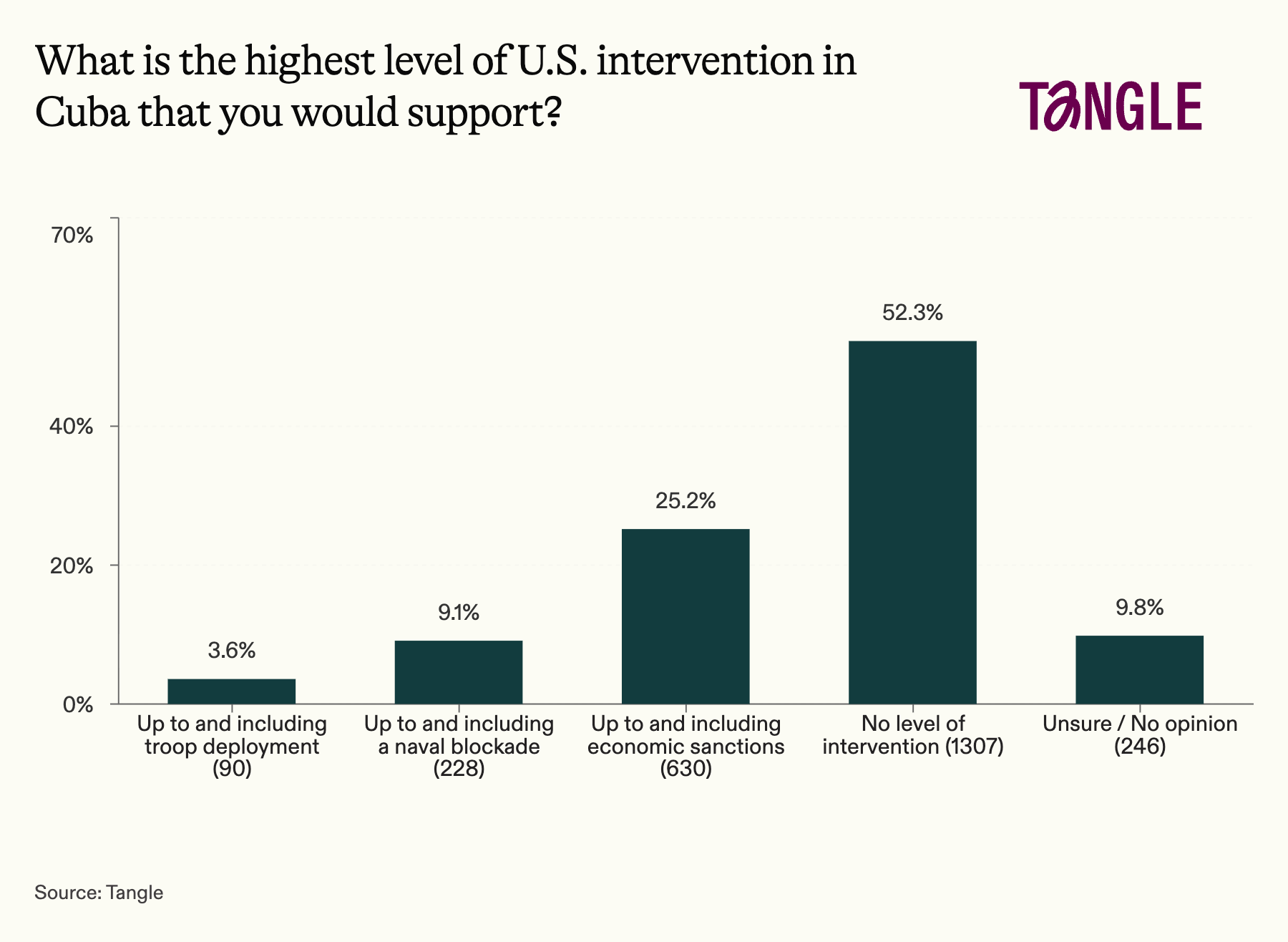
- Yesterday’s survey: 2,501 readers responded to our survey on U.S. intervention in Cuba with 52% supporting no intervention. “We are taking on too many challenges at once. Fix the Iran mess and re-support Ukraine. Don’t light new fires,” one respondent said. “Use of military force should always be the last resort,” said another.
Have a nice day.
Kakapo are large, lime green, flightless birds native to New Zealand that have become endangered — at the beginning of 2026, only 236 kakapo remained around the world. However, kakapo mating this year surged due to the season’s abundance of rimu berries, a necessary component of the birds’ mating ritual. The strong breeding cycle was particularly celebrated by the Ngai Tahu, a Maori iwi tribe that cares for the birds on New Zealand’s South Island. “It’s a taonga species, a treasure to us,” Tane Davis, representative for the tribe’s kakapo conservation efforts, said. Scientific American has the story.

Member comments