
I'm Isaac Saul, and this is Tangle: an independent, nonpartisan, subscriber-supported politics newsletter that summarizes the best arguments from across the political spectrum on the news of the day — then “my take.”
Are you new here? Get free emails to your inbox daily. Would you rather listen? You can find our podcast here.
Today’s read: 14 minutes.
Almost at our goal!
You may have heard that Tangle News has a nonprofit project that accepts charitable donations to fund our video content development for the next generation of news consumers. One of our donors, Steve, is matching every donation up to $5,000, and wants to encourage other Tangle supporters to join him. We are now 66% toward our fundraising goal. Thank you to the 60 donors who have given $3,285 so far!
Can you help us raise the last $1,715?
You can make a one-time or monthly donation of $5, $50, $500 — or any amount — to ensure Tangle reaches today’s young people! If you start a monthly gift, all new gifts will be matched for the first year. Your charitable gift is tax deductible thanks to our fiscal sponsor, Journalism Funding Partners.
Quick hits.
- In a speech to the United Nations General Assembly, President Donald Trump criticized the organization and its European member states for their handling of immigration issues and international conflicts, saying the UN was failing to live up to its potential and creating new problems for America. (The speech) Separately, Trump met with Ukrainian President Volodymyr Zelensky at the event, after which he said he believes Ukraine can win back all territory lost to Russia with support from the European Union. (The comments)
- A Florida federal jury convicted a man of attempting to assassinate President Trump in September 2024, finding him guilty on five criminal counts. The man reportedly tried to stab himself in the neck with a pen as the verdict was read. He faces a potential life sentence in prison. (The conviction)
- Adelita Grijalva (D), a county supervisor, won the special election in Arizona's 7th Congressional District to fill the seat previously held by her father, Rep. Raul Grijalva (D), who died in office in March. Grijalva’s victory narrows Republicans’ House majority to 219–214. (The election)
- Jimmy Kimmel returned to his late night comedy show, telling his audience that he had not intended to suggest that the suspect in Charlie Kirk’s assassination was a Trump supporter. Kimmel also criticized the president for purportedly trying to silence him and thanked several conservatives for defending him. (The return)
- President Trump signed an executive order designating the anti-fascist movement antifa as a domestic terrorist organization, giving federal agencies a mandate to investigate the group and its members. (The order)
The world feels heavy right now. Headlines can leave you anxious, angry, or just plain exhausted.
That's why The Pour Over exists. It’s not “Christian news” or a theological breakdown of world events. It’s a simple summary of the biggest stories of the week, paired with reminders that Christ is still in control. It helps you stay informed while staying focused on what truly matters, Jesus.
Join over 1.5 million Christians who've found news that’s politically neutral (no, seriously) and Christ-first.
It’s free. It’s hopeful. And yes, you can unsubscribe anytime.
Today’s topic.
The Trump administration’s autism claims. On Monday, President Donald Trump, Department of Health and Human Services (HHS) Secretary Robert F. Kennedy Jr., and other Trump administration officials announced a pair of actions the Food and Drug Administration (FDA) will take to address the increase in autism spectrum disorder (ASD) in children. First, the FDA will update the warning labels for acetaminophen — the active ingredient in pain relievers like Tylenol — to note a potential association between the ingredient and neurological conditions — such as ASD and attention-deficit/hyperactivity disorder (ADHD) — in children (though it also emphasized that no causal link has been established). Second, the agency has initiated the approval of leucovorin calcium tablets for patients with cerebral folate deficiency (CFD).
Back up: As the FDA noted in its announcement, acetaminophen is the only over-the-counter drug approved for use to treat fevers during pregnancy, which can pose a risk to fetuses. While some studies have found an association between acetaminophen during pregnancy and a subsequent ASD diagnosis, a causal link has not been proven. Separately, leucovorin is a modified version of vitamin B9 that helps the body make red blood cells and supports cell growth; it is especially vital in early pregnancy. Small studies have suggested that a significant percentage of people with autism have antibodies that interfere with how folate is transported within the body.
In a press release, HHS noted “the conflicting literature and lack of clear causal evidence” on the causes of ASD but said these actions were intended to “encourage clinicians to exercise their best judgment in use of acetaminophen for fevers and pain in pregnancy by prescribing the lowest effective dose for the shortest duration when treatment is required.” President Trump was more direct in his remarks, saying, “Don’t take Tylenol. Don’t take it. Fight like hell not to take it,” and encouraging pregnant women to “tough it out” except in extreme circumstances. Although the FDA announcements did not mention vaccines, Trump also warned against giving children too many vaccines at once, saying, “Don’t let them pump your baby up with the largest pile of stuff you’ve ever seen in your life.”
Many medical researchers and physicians criticized the announcement and Trump’s comments. “It is clear that the Tylenol-autism link is not a new question — it has been looked at many times and in many different studies,” autism researcher Dr. Diana Schendel said. “Without showing any evidence to back them up, the announcements become reckless and potentially harmful.”
A co-author of a report on Tylenol and autism cited by the Trump administration also said she still considers acetaminophen an option for pregnant women with medical guidance and supervision. Separately, other doctors suggested they would not recommend leucovorin to treat ASD until the results of large, randomized trials were available.
Today, we’ll share arguments from the right and left on the FDA’s announcements and President Trump’s comments. Then, Managing Editor Ari Weitzman gives his take.
What the right is saying.
- The right is mixed on the announcement, but many say the Trump administration is pursuing answers to many parents’ questions.
- Some cast doubt on the veracity of studies linking acetaminophen to autism.
- Others say the FDA is giving parents options, not taking them away.
In RedState, Eli Shepherd criticized experts’ “panic at questions they don’t want asked.”
“I’m not here to prove or disprove whether prenatal Tylenol use could contribute to autism. That’s not the point. The point is the reflexive, knee-jerk hostility toward even asking the question. When did ‘science’ become less about discovery and more about protecting reputations?” Shepherd wrote. “Medical history is one long cautionary tale of ‘settled science’ gone wrong. Doctors once told women that smoking during pregnancy was safe. They prescribed thalidomide to expectant mothers, only to discover later that it caused birth defects.”
“The arrogance is the problem. Too many in medicine and public health are more worried about being right than being honest. They confuse protecting their brand with protecting people. And when you put brand management over patient safety, you stop being scientists and start being bureaucrats,” Shepherd said. “If future studies confirm there is no link between Tylenol and autism, great. Parents deserve to know that, too. But why the sheer panic at the possibility? Why the immediate press campaigns? Why the defensive posturing designed to shut the conversation down before it starts?”
In UnHerd, Cremieux Recueil argued “RFK’s autism report twists correlation into causation.”
“The HHS’ rationale for the new Tylenol warning is based on a systematic review led by Harvard Dean of Public Health Andrea Baccarelli. Dr. Baccarelli’s review contends that there is a ‘strong, consistent association between prenatal acetaminophen exposure and ADHD/ASD/other NDDs’. The review emphasised that this result was exceptionally robust, that it stood strong in studies controlling for bundles of different confounders, with negative control exposure periods, and with propensity score matching,” Recueil wrote. “The only problem is that none of these methods are reliable and the authors actually ignored some good evidence that contradicts their conclusion.
“The main failing point of the review is that its authors knew about good evidence in the form of sibling control studies — studies where scientists compare a sibling who is exposed to Tylenol in utero to a sibling who wasn’t exposed to it — and they ignored those results. But those studies were the strongest; it just happens to be the case that those studies didn’t find anything alarming,” Recueil said. “To me, that seems like the correct explanation for why the authors were so gung-ho to attack them on spurious grounds.”
In POLITICO, Dr. Jay Bhattacharya, Dr. Marty Makary, and Dr. Mehmet Oz described “the Trump administration’s new steps to tackle autism.”
“While the pathophysiology of autism is still being understood, one potential area of interest is the folate transport system in the central nervous system… A relatively inexpensive, generic prescription drug called leucovorin can help some children to heal by bypassing the transport blockage. Peer-reviewed publications and randomized clinical trials have documented that up to 60 percent of folate-deficient children with ASD can have improved verbal communication if given leucovorin,” the authors wrote. “Americans are tired of waiting, so we are cutting regulatory red tape to enable families to pursue treatment now, as directed by their physician.”
“Observational evidence has suggested that when moms take acetaminophen during pregnancy, especially close to delivery, it is correlated with subsequent diagnosis of conditions like autism and ADHD in their children,” the authors said. “At the same time, we also recognize the literature continues to evolve and evidence from family control studies have failed to find a correlation… What should parents do? In light of this evidence and lack of clear alternatives, we believe acetaminophen should be used judiciously in pregnancy, and under medical supervision of an obstetrician, as a practical, prudent medical approach that balances risks and benefits.”
What the left is saying.
- The left is critical of the announcement and calls Trump’s and Kennedy’s remarks meritless and dangerous.
- Some say the policy changes will create more suffering for pregnant women.
- Others question the administration’s framing of autism as a crisis.
The Washington Post editorial board said “this shoddy autism science helps no one.”
“The much-ballyhooed news conference made clear that the administration intends to march headlong into its anti-vaccine delusions. Health and Human Services Secretary Robert F. Kennedy Jr. announced that his department will investigate vaccines as potential causes of autism, promising ‘no areas of taboo,’ even though reams of studies have already relentlessly debunked the association,” the board wrote. “The administration’s claims about acetaminophen are weak, too. Though studies have found an association between prenatal use of the drug and autism, that link disappears when scientists account for other factors.”
“At best, Trump’s rant on Monday merely undermines the government’s credibility. Many Americans understand autism’s complexity, and will find the administration’s pronouncement to be further evidence of its untrustworthiness. At worst, it could do serious damage: The president’s comments about vaccines are likely to turn more people against immunizations, making society more vulnerable to disease outbreaks,” the board said. “The acetaminophen finding might also scare women away from treating their own pain, based on flimsy data, while discouraging more plausible areas of study.”
In The Guardian, Moira Donegan suggested Trump’s claims will “heighten the suffering of pregnant women in the US.”
“Pregnant women do not lack for judgmental, frightening and dubiously factual instructions about their health. Everywhere, they are told that they risk the health of their fetus by partaking in a series of banal everyday activities — be it jogging or having coffee or eating a certain cheese — that they are told will lead, by obscure mechanisms that are never quite explained, to impossible and devastating health outcomes for their children-to-be,” Donegan wrote. “Now, this cynical exploitation of pregnant women’s fears, deployed to them at a time when they are most vulnerable, is coming from no less a place of authority than the White House itself.”
“Trump advised pregnant women to simply endure their suffering. ‘A mother will have to tough it out,’ he told them. Readers will forgive me if I posit that perhaps pregnant women in the US are already suffering enough,” Donegan said. “But pregnant women are not a punchline. Their hopes for their families, their fears for their bodies, their health, their comfort and their dignity — all of these are things Trump is willing to sacrifice at the altar of his own ego”
In The New York Times, Maia Szalavitz wrote about “what the government autism announcement got so wrong.”
“Experts disagree on the causes of that increase [in autism rates], but for President Trump and Health Secretary Robert F. Kennedy Jr., it’s a clear sign that autism has become a ‘crisis’ that must be eradicated,” Szalavitz said. “The Trump administration seems to see autistic people as a burden on society that should be eliminated, not as citizens who are valuable. Mr. Kennedy has said that ‘autism destroys families’ and called it ‘cataclysmic’ during the press conference. But there is much more to autism than this bleak view suggests. Like many brain differences, autism isn’t just an affliction.”
“As many autistic people do, I tend to seek escape in systems, which are more predictable to us than people. I sometimes think we can fall in love with them the way you would with another person. Science, of course, is the system to understand all systems — and so to see it under attack, in the name of fixing us, of all things — is brutal,” Szalavitz wrote. “Moreover, autistic folks tend to love stability and routine, and to struggle mightily with chaos. To see the nation’s scientific agencies following Mr. Kennedy’s lead and promoting pseudoscience is shattering.”
My take.
Reminder: “My take” is a section where I give myself space to share my own personal opinion. If you have feedback, criticism or compliments, don't unsubscribe. Write in by replying to this email, or leave a comment.
- Trump and Kennedy ignored the evidence that undermines the fundamental premise of their claims.
- There are genuine open questions about why autism rates are increasing, and they are not all explained by diagnostic criteria.
- Once again, we’re seeing Kennedy raise awareness about a real issue while offering a very ill-informed solution.
Monday’s joint press conference with Trump and Kennedy was the last stage of a game of telephone that started with a few papers suggesting a causal link between acetaminophen and neurological disorders and ended with President Trump’s “don’t take Tylenol” directive to pregnant women.
In 2017, a few studies drew media attention to the claim that taking acetaminophen (or Tylenol) during pregnancy increases the risk for autism or ADHD in babies. In its press release, the FDA cited two other studies from 2019 and 2020 as further proof of the link. However, larger and more robust studies contradict their core findings. In particular, a study released this month that examined over 200,000 children and set up controls for siblings found no causal link between acetaminophen use and autism. And in 2024, a study published in the Journal of the American Medical Association (JAMA) showed a moderate increased relative risk of Autism Spectrum Disorder (ASD) and ADHD from taking acetaminophen.
However, those increased relative risks are very small, from 1.33% to 1.53% for autism; and the authors attributed the increased risk not as effects of taking the drug, but as correlating with headaches and fevers — which are also symptoms pregnant women may experience when their fetuses have neurological disorders — that women were taking Tylenol to treat. The study concluded bluntly that “acetaminophen use during pregnancy was not associated with children’s risk of autism, ADHD, or intellectual disability.”
Why would the FDA ignore those findings and cherry-pick their chosen studies? Why not highlight other, more elevated relative-risk factors for autism and ADHD like smoking during pregnancy, or advanced paternal age, or air pollution? Why make such a sweeping proclamation at all?
I’m speculating, but maybe Secretary Kennedy (who has shown a tendency to blame “Big Pharma” for all of society’s ills) felt somewhat predisposed to find a causal link with Tylenol, since “Tylenol causes autism” has become a recent companion to the “vaccines cause autism” mantra, and many of his friends happen to be suing Tylenol in court. Perhaps, after he promised in April to find a cause of autism by September, Kennedy felt pressured to latch on to a recent Harvard study showing a tenuous link between autism and Tylenol before his self-imposed deadline — even though that study’s author said further research was needed.
No matter his motivation, Kennedy announced this link alongside President Trump, who decided to blast the message that autism “may be entirely preventable” and use his megaphone to advise pregnant women not to take Tylenol. Members of the White House are reportedly concerned and frustrated that Trump’s comments went too far — and he certainly seemed to leave prudence behind when making his remarks. Acetaminophen is the only pain-relief option the FDA has approved to treat a range of ailments during pregnancy, and if women can’t take Tylenol for a fever or intense pain, their alternatives — like ibuprofen or nothing at all — could result in very serious and immediate harm. So when the president of the United States says “don’t take Tylenol,” he better have a serious, compelling, and definitive body of scientific research behind him.
He does not.
Not everyone has the time or expertise to parse through scientific studies, so we need reliable direction from people in positions of authority. On one hand is the president, who is not a scientist and could not pronounce the name of the drug he told pregnant women not to take. On the other hand are non-governmental health groups, which are staffed and run by scientists: Every one of those organizations that I’ve seen make a statement in the last 48 hours has said that Tylenol is safe to take during pregnancy. I’m certainly not suggesting you blindly “trust the experts,” but I know which argument seems more convincing to me. Science is complicated, nuanced, and ever evolving — blasting a dictum based on marginal findings will only deliver division and confusion.
In the case of autism, that division isn’t new. If you Google “autism rates increasing,” your first hit is probably an article that says profound autism has not increased over the past 10 years. If you’re someone who cares for others with profound autism, and you’re noticing a lack of special education teachers and struggling to find support, you probably leave that article with some cognitive dissonance. Then you go back and see the second search result: an April 2025 press release from HHS that says “Autism Epidemic Runs Rampant.” When the mainstream media isn’t showing the full picture, parents are driven to extreme narratives on either end of a spectrum that leaves little room for nuance.
As has become common with Kennedy, he has identified a real issue here — the increase in autism rates is real and it is a problem. I know that many people disagree, and I’m aware of the several rebuttals to this stance. But I don’t think they’re convincing, and I can explain why.
Many people will say that the increased incidence of autism, including profound autism, is 100% attributable to increases in diagnostic standards. Very few people will dispute the CDC’s finding that one out of every 31 children in the United States aged 3–17 is currently diagnosed with Autism Spectrum Disorder. Nor is there much disagreement that this incidence rate has been on the rise — up from 1:36 in 2020, 1:68 in 2010, and 1:150 in 2000. But what many will say is that these figures don’t represent an epidemic; they represent a change in how we detect ASD.
This stance is fairly mainstream. Epidemiologist Suzanne O’Sullivan recently appeared on Derek Thompson’s Plain English podcast to explain how we’re living in an age of diagnosis that affects not just autism but ADHD, PTSD, and a host of other psychiatric disorders. In that episode, O’Sullivan claimed explicitly that “all of the diagnostic inflation of autism happens at the mild end of the spectrum” and that there is no evidence that cases of severe autism have increased.
But there is evidence of this. Social Security Insurance support for people with ASD, which is reserved for the most profoundly impacted (those with severe verbal deficits who require routine assistance), increased by over 300% from 2005 to 2015. Enrollments in special education programs have exploded in California, Massachusetts and Minnesota, where researchers said diagnostic methods do not “largely explain the increasing trends.” Researchers who have explicitly studied whether autism has increased over time have concluded that it has, and they have said that the increase cannot be attributed to diagnostics alone. Lastly, a 2023 Public Health Reports study found that incidence of both non-profound and profound autism increased from 2000 to 2016 — from 3.9 to 14.3 non-profound cases and from 2.7 to 4.6 profound cases in every 1,000 people. The evidence is not just real; it’s significant.
I think these numbers provide good reason for Kennedy to direct a $50 million initiative to fund studies investigating this increase in the prevalence of autism, with a few caveats: None of this research should be directed towards exploring a causal link between autism and childhood vaccination. Kennedy has claimed that there could be (or even is) a link between autism and vaccinating children, which is arguably the one thing we can most confidently say does not cause autism.
Nor should discussing the existence of an “autism epidemic” in and of itself imply that those with ASD are lesser people, or that we should try to prevent people with that diagnosis from being born. Unlike the majority of ASD diagnoses, the autism cases that Kennedy has focused on are most commonly referred to as “Level 3 Autism” or “profound autism” — a term defined by the medical journal The Lancet in 2021 to describe people “who are unable to advocate for themselves and are likely to need 24-hour support throughout their lives.” And while severe diagnoses represent greater challenges that deserve discussion — both for these individuals and the people who care for them — that discussion does not imply those individuals are lesser people, either.
Simply put, there is a chasm between the mainstream “there is actually no problem” stance and the actual data, and Secretary Kennedy is now filling that void with absolute junk. Obviously, Kennedy deserves ample criticism for supplying the junk. But our inability to agree on the basic facts is creating the chasm — and if that chasm widens, more junk will follow.
Take the survey: What do you think about the HHS announcement, autism, and Tylenol? Let us know.
Disagree? That's okay. My opinion is just one of many. Write in and let us know why, and we'll consider publishing your feedback.
Your questions, answered.
Today’s answer includes discussions of suicide. If you are having thoughts of suicide, call or text 988 to reach the 988 Suicide and Crisis Lifeline or go to SpeakingOfSuicide.com/resources for a list of additional resources.
Q: Are you all going to look into the two hangings in the south?
— Margaret from Winchester, VA
Tangle: First, some context: Last Monday, two men were found dead hours apart in Mississippi; 21-year-old college student Demartravion “Trey” Reed was discovered hanging from a tree on the campus of Delta State University (DSU) in Cleveland, and Cory Zukatis, 36, was found in the same condition near a casino in Vicksburg. The similarity in time, location, and method of the deaths immediately sparked questions about whether they could be connected in some way.
We still don’t have much information on Zukatis besides that he was described as homeless by the county coroner and that an autopsy has yet to be completed. The day after he died, images spread in news reports and on social media incorrectly identifying Zukatis, a white man, as Gavin Fortenberry, a black 17-year-old killed by gun violence in August.
Reed was a black student at DSU, a campus roughly 50 miles from the site of Emmett Till’s 1955 lynching. A preliminary investigation conducted by the Bolivar County Coroner's office ruled Reed’s death a suicide, and a formal autopsy conducted days later confirmed the findings. However, the NAACP raised doubts over the coroner’s suicide determination, and Reed’s parents have also expressed suspicion about the cause of their son’s death amid social media posts alleging other injuries on Reed’s body (which the police have denied). Reed’s family has obtained a civil rights attorney to investigate further. Meanwhile, Colin Kaepernick’s organization Know Your Rights Camp has stepped forward to pay for a second autopsy for Reed.
With the evidence we have so far, it seems unlikely that the two deaths are connected, but we’ll continue to keep an eye on developments as the investigations continue.
Want to have a question answered in the newsletter? You can reply to this email (it goes straight to our inbox) or fill out this form.
Under the radar.
On Tuesday, the Secret Service announced that it had discovered, seized, and dismantled a network of electronic devices located throughout the New York tristate area capable of conducting telecommunications attacks ahead of the United Nations General Assembly meeting in New York. Officials said the network included roughly 100,000 SIM cards and 300 servers, and it could anonymously send 30 million text messages per minute. The Secret Service said the network had already been used to threaten senior U.S. government officials. “This network had the potential to disable cellphone towers and essentially shut down the cellular network,” Matt McCool, the top agent at the Secret Service’s New York field office, said. The New York Times has the story.
The world is loud and overwhelming. Your news source shouldn’t add to the weight. Stay informed. Stay grounded. Stay hopeful.
Join 1,562,128 Christians. Always free. Unsubscribe anytime.
Numbers.
- 1878. The year acetaminophen was first synthesized.
- 1893. The year acetaminophen was first used to treat pain and fevers.
- 1955. The year Tylenol was introduced by McNeil Laboratories as an aspirin-free pain reliever and fever reducer.
- 3.2%. The approximate percentage of 8-year-old children who were identified with autism spectrum disorder (ASD) in 2022, according to the Centers for Disease Control and Prevention (CDC).
- 1.5%. The approximate percentage of 8-year-old children who were identified with ASD in 2012.
- 0.7%. The approximate percentage of 8-year-old children who were identified with ASD in 2002.
- 4 in 100. The approximate proportion of boys in the U.S. with autism in 2020, according to the CDC.
- 1 in 100. The approximate proportion of girls in the U.S. with autism in 2020.
The extras.
- One year ago today we wrote about the SAVE Act and government funding.
- The most clicked link in yesterday’s newsletter was the sordid history of popcorn ceilings.
- Nothing to do with politics: How rabbits with papilloma virus could be the root of the jackalope myth.
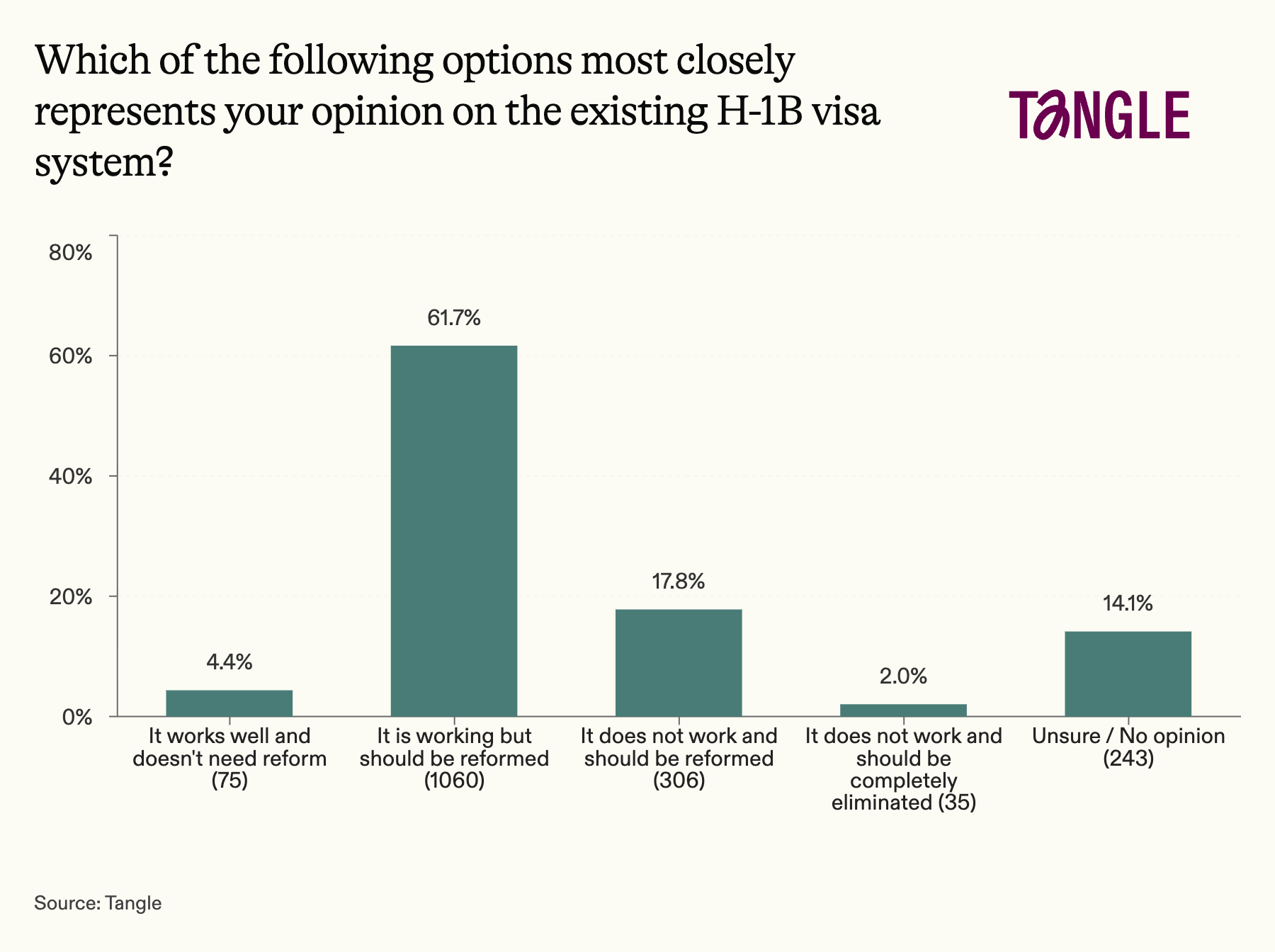
- Yesterday’s survey: 1,719 readers responded to our survey on the H-1B visa program with 62% saying the program is working but should be reformed. “Working in federal government IT, I’ve seen a lot of H-1B folks come in when there are TONS of perfectly qualified US Citizen candidates. The H-1B program should be used much more sparingly, so I’m not actually opposed to this change,” one respondent said.
Have a nice day.
In June, Autumn Buck got a call from her brother-in-law: A bird’s nest had fallen from a tall tree in his yard, killing one small crow and leaving another injured and immobile. Buck and her husband attempted to nurse the injured crow back to health, and they received assistance from an unlikely source — their dog Meeko. Meeko stayed close to the crow, chasing cats and other potential predators from the yard. The crow, now named Russell, recovered, and it has become close companions with Meeko. The two run (and fly) around together, play fetch, and take naps side by side. The Washington Post has the story and video of the new friends.
Member comments